Introduction
The swede midge, Contarinia nasturtii Kieffer (Diptera: Cecidomyiidae), is an invasive pest of multiple Brassica Linnaeus (Brassicaceae) crops in North America, including canola and cruciferous vegetables (broccoli, cabbage, etc.) (Hallett Reference Hallett and Reddy2017). Since its introduction from Europe in the late 1990 s (Hallett and Heal Reference Hallett and Heal2001), the swede midge has spread rapidly across the northeastern United States of America and Canada and (in the latter) now ranges from Saskatchewan to Nova Scotia (Hallett Reference Hallett and Reddy2017). Swede midge population control has proved challenging, partly owing to the considerable variation in the timing of diapause entry and emergence (Hallett et al. Reference Hallett, Goodfellow, Weiss and Olfert2009; Des Marteaux et al. Reference Des Marteaux, Schmidt, Habash and Hallett2015; Hallett Reference Hallett and Reddy2017). This variation in overwintering phenology likely contributed to the successful invasion of the swede midge, not only by allowing for multivoltinism but also by providing a means of population bet hedging (Hopper Reference Hopper1999; Ghalambor et al. Reference Ghalambor, McKay, Carroll and Reznick2007; Mahdjoub and Menu Reference Mahdjoub and Menu2008). Effective control and prevention of further spread necessitates a firm understanding about the patterns and mechanistic controls of swede midge diapause phenology.
Phenotypic variation (VP) in a trait such as diapause entry may result from a combination of genetic (VG) and environmental (VE) variation (classically defined as VP = VG + VE) (Lynch and Walsh Reference Lynch and Walsh1998). For insects with obligate diapause (which occurs in a predetermined developmental stage regardless of environmental conditions), VP is explained entirely by VG (Denlinger Reference Denlinger, Resh and Cardé2009). Diapause may also be facultative – initiated in response to specific environmental cues above a particular “diapause induction threshold,” which varies at both the individual and population levels (Taylor Reference Taylor1989; Denlinger Reference Denlinger2002). VP for facultative diapause is therefore dependent on VE but may also be heavily influenced by VG. Indeed, genetics play various roles in the phenology of facultative diapause in insects and other arthropods (Saunders Reference Saunders1965, Reference Saunders1987; Morris and Fulton Reference Morris and Fulton1970; Waldbauer and Sternburg Reference Waldbauer and Sternburg1973; Roff and Bradford Reference Roff and Bradford2000; Blanckenhorn and Heyland Reference Blanckenhorn and Heyland2005; Kawakami et al. Reference Kawakami, Numata, Ito and Goto2009). For example, genetic diversity accounts for 70% of the variation in photoperiodic diapause thresholds for female Oncopeltus fasciatus (Dallas) (Hemiptera: Lygaeidae) (Dingle et al. Reference Dingle, Brown and Hegmann1977). Pupal diapause initiation in Sarcophaga bullata (Parker) (Diptera: Sarcophagidae) is primarily governed by simple Mendelian inheritance (Han and Denlinger Reference Han and Denlinger2009) but can also be maternally influenced (Henrich and Denlinger Reference Henrich and Denlinger1983). The heritability of diapause entry plasticity in Allonembobius socius (Scudder) (Orthoptera: Trigonidiidae) is dependent on natal seasonal lengths (Winterhalter and Mousseau Reference Winterhalter and Mousseau2007). Bombyx mori (Linnaeus) (Lepidoptera: Bombycidae) exhibits three genetic strains that differ in embryonic diapause behaviour: a univoltine strain that enters diapause in every generation, a bivoltine strain that enters diapause under specific environmental conditions, and a third strain that never enters diapause (Yamashita Reference Yamashita1996).
For the swede midge, facultative diapause in the third instar is initiated in response to photoperiod (with some temperature modulation), and population diapause incidence increases sigmoidally as day lengths and temperatures diminish over the growing season (Rogerson Reference Rogerson1963; Des Marteaux et al. Reference Des Marteaux, Schmidt, Habash and Hallett2015). For example, in West Wheldon, United Kingdom (the native range), swede midge diapause incidence increases from 2% in early July to nearly 100% by early November (Readshaw Reference Readshaw1961, Reference Readshaw1966). Similarly in Elora (Ontario, Canada), diapause incidence increases from 4% in late June to 100% by October (Des Marteaux et al. Reference Des Marteaux, Schmidt, Habash and Hallett2015). An abrupt population shift from direct development to diapause entry (i.e., a population diapause incidence of 50%) occurs under diapause-critical conditions (typically the critical day length). The critical day lengths for the swede midge in West Wheldon and Elora are approximately 13.3 and 13.7 hours, respectively. In a laboratory population, a stable 10-hour day length at 14 °C approximated diapause-critical conditions (45% diapause incidence) (Des Marteaux et al. Reference Des Marteaux, Habash, Schmidt and Hallett2012). At a given temperature and photoperiod (i.e., negligible VE), it stands to reason that VG explains much of the variation in diapause entry. Characterising diapause entry among swede midges with known genetic similarity in a stable laboratory environment (ideally under diapause-critical conditions, or maximum diapause VP) could thereby lend insights into the genetic component of the diapause induction threshold (Winterhalter and Mousseau Reference Winterhalter and Mousseau2007).
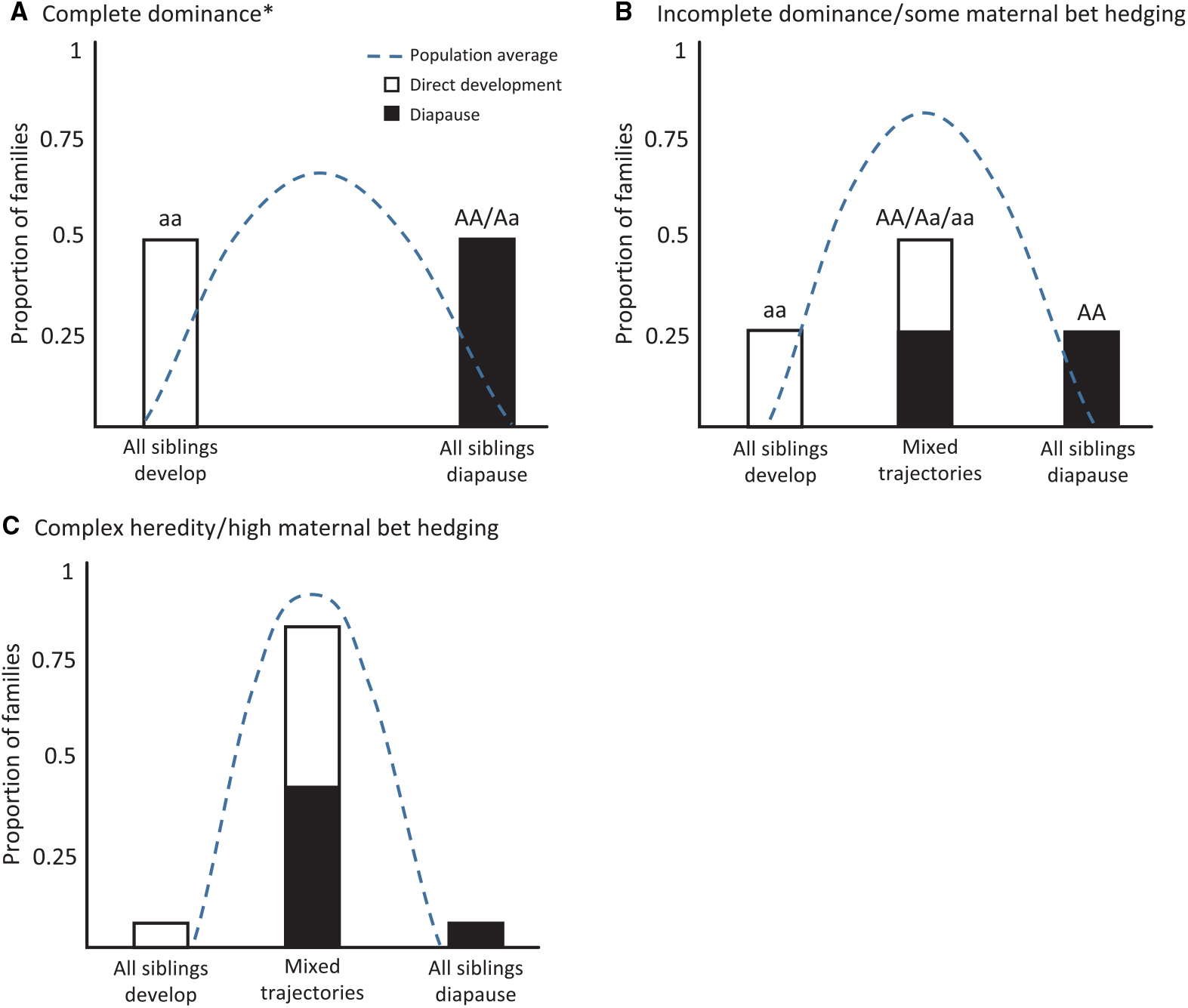
Here we quantify diapause incidence within and among full-sibling swede midge families reared under one of two environments: warm, long days promoting direct development (low expected VP for diapause; control), and cool, short days meant to emulate diapause-critical conditions (maximum expected VP for diapause). In Figure 1, we outline three scenarios for heritable control of the diapause induction threshold, based on diapause entry patterns under cool, short days; if developmental fate is consistent among siblings (Fig. 1A), then the diapause induction threshold likely follows simple Mendelian inheritance with complete dominance for a particular allele (Williams and Sokolowski Reference Williams and Sokolowski1993; Kawakami et al. Reference Kawakami, Numata, Ito and Goto2009). Mixed developmental trajectories within swede midge families could indicate either incomplete dominance for alleles governing the diapause induction threshold and/or some maternal influence through bet hedging (Fig. 1B) or complex (polygenic/polyallelic) heredity for the diapause induction threshold and/or a high level of maternal bet hedging (Fig. 1C) (see Fig. 1 caption for details).
Three heritability scenarios for a swede midge diapause induction threshold trait, with predicted developmental trajectories under diapause-critical rearing conditions. Total population diapause incidence under such critical conditions is approximately 50%. If the trait is controlled by a single gene with two alleles (e.g., A – diapause favoured; a – direct development favoured), we may expect one of the following two patterns. A, In a scenario of complete dominance for a given allele, siblings should exhibit the same developmental trajectories (aa families would complete development directly and AA families would enter diapause, with Aa families following the trajectory of the dominant allele); B, in a scenario of incomplete dominance, heterozygotes Aa would have an intermediate diapause induction threshold (i.e., greater variability). One quarter of all families should exhibit direct development (aa), one quarter of all families should enter diapause (AA), and the remaining half of all families should exhibit mixed trajectories (with overall diapause incidence of 50%). Alternatively, scenario B could indicate some degree of maternal influence through bet hedging (i.e., a maternal effect promoting diapause in some offspring and not others). If the vast majority of families exhibit mixed developmental trajectories (C), then the diapause induction threshold is more likely to have a complex heredity (e.g., a polygenic/polyallelic trait) and/or maternal bet hedging is common. *If we assume equal frequencies of the two alleles across the population, then 75% of all midges in scenario A would follow a particular developmental trajectory under diapause-critical conditions – contrary to observations. Therefore, scenario A should only yield the observed population-wide diapause incidence of 50% if the recessive allele is more common than the dominant allele. The diapause-avoiding ‘aa’ genotype would be selected against in years of adverse late-summer/early-autumn conditions, which could promote a greater frequency of the diapause-favouring A allele. Conversely, the genotype aa (and Aa in the case of a dominance) can produce additional generations in favourable years, which could maintain the a allele in higher abundance over time.

Methods
A swede midge colony was reared continuously in laboratory on cauliflower (Brassica oleracea Linnaeus) under a 16.5:7.5-hour light:dark photoperiod at 28 ± 2.5 °C and 65 ± 15% relative humidity, since 2009 (as described by Des Marteaux et al. Reference Des Marteaux, Habash, Schmidt and Hallett2012). The colony had originated from the Swiss Federal Research Station for Horticulture (Wädenswil, Switzerland) (Chen and Shelton Reference Chen and Shelton2007) and had been reared continuously at the New York State Agricultural Experiment Station (Geneva, New York, United States of America) since 2004. For experiments, we used adult females that had emerged from rearing cages without host plants (to increase the likelihood that females were mated and gravid). Because female swede midges have a low likelihood of multiple matings (Bergh et al. Reference Bergh, Harris and Rose1992; Smith et al. Reference Smith, Wise and Lamb2004), all offspring of a given female were assumed to be full siblings. Females were transferred to observation cages (30 × 30 × 30 cm) (BioQuip, Sancho Dominguez, California, United States of America) containing a single cauliflower plant (one cage per female), and allowed to lay eggs for 48 hours, after which females were removed. Each cauliflower plant therefore contained only one full-sibling family, typically of a single sex (Barnes Reference Barnes1950).
Based on our previous work with the colony, rearing swede midges at 14.3 ± 1.7 °C with a 10:14-hour light:dark photoperiod approximated diapause-critical conditions (yielding 45 ± 13% diapause incidence) (Des Marteaux et al. Reference Des Marteaux, Habash, Schmidt and Hallett2012). We attempted to match these conditions in the present study; each swede midge family (i.e., each plant containing full-sibling eggs) was randomly assigned to warm, long-day conditions (16.5:7.5-hour light:dark photoperiod; 24.9 ± 1.0 °C; n = 14 families) or cool, short-day conditions (10:14-hour light:dark photoperiod; 13.3 ± 1.4 °C; n = 16 families; Supplementary Table S1). Development was monitored daily, and upon reaching the late third instar (wandering), all larvae for a given family were then carefully transferred with a paint brush to a piece of fresh cauliflower apical meristem in a 5-cm-wide, 30-dram clear styrene vial (Bel-Art Scienceware, Wayne, New Jersey, United States of America). The vials contained ground peat moss (Sphagnum Linnaeus; Sphagnaceae) (sifted to 0.425 mm particle width) mixed with 8 mL tap water for a final mixed peat moss depth of 3 cm (see Des Marteaux et al. Reference Des Marteaux, Habash, Schmidt and Hallett2012). Larvae were observed to burrow into the peat moss shortly after transfer to the apical meristem, and vials were lidded until all larvae had burrowed. The vials were placed individually in mesh BugDorm cages (24.5 × 24.5 × 24.5 cm) (MegaView Science, Taichung, Taiwan) and returned to the same rearing conditions in which the larvae had developed. Any emerging adults were collected from cages daily and sexed.
Five consecutive days (warm, long-day treatment) or 10 consecutive days (cool, short-day treatment) after the emergence of the last adult, peat moss contents were examined for remaining midges. Peat moss was first rinsed for five minutes with tap water through stacked 0.425 mm (number 40) and 0.18 mm (number 80) steel mesh Fisherbrand sieves (Fisher Scientific, Ottawa, Ontario, Canada). Large cocoons, larvae, pupae, and dead adults were retained by the 0.425-mm mesh sieve, while small larvae were occasionally found on the 0.18-mm sieve. Sieve contents were suspended in water within a watch glass and sorted under a dissecting microscope (details in Supplementary Table S1). Diapausing larvae (those in spherical cocoons) and larvae destined for pupation (those in elongate cocoons) (Readshaw Reference Readshaw1961) were enumerated. Any remaining live (un-cocooned) or dead larvae, pupae, and adults were also recorded.
The proportion of siblings entering diapause in each family was determined for each family (excluding dead and un-cocooned larvae, as the developmental fate of these individuals was unknown). Families in which the developmental fate was known for fewer than 10 individuals were omitted from analyses. Welch’s t-tests were used to compare various developmental parameters of swede midges reared under the two conditions. Because time of year may affect diapause frequency even in laboratory-reared insects (Timer et al. Reference Timer, Tobin and Saunders2010), we assessed the effect of egg laying date on diapause frequency under cool, short-day conditions via regression. All analyses were performed in R (version 3.3.1; www.r-project.org) with α = 0.05. Values in the text are reported as mean ± standard error.
Results
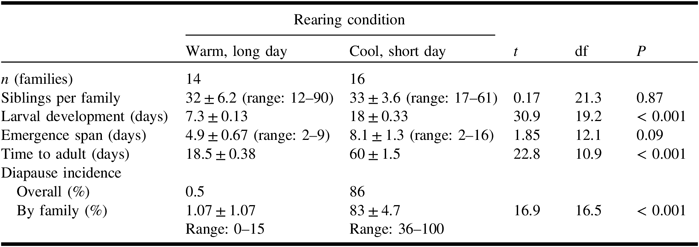
We recovered 91 ± 2.0% of the total third instars placed in vials of ground peat; the remainder were presumed to have died and decomposed such that they were unidentifiable (Table 1). Families were 97 ± 1.9% unisexual (see Barnes Reference Barnes1950), with a mean size of approximately 32 siblings. Larval development time and lifespan of individuals reared under cool, short-day conditions were approximately 2.5-fold and 3.3-fold longer than under warm, long-day conditions, respectively. Some un-cocooned larvae were observed to be active in vials as many as 240 days after hatching, but it is unclear why neither diapause nor pupation occurred for these individuals (discussed in Des Marteaux et al. Reference Des Marteaux, Habash, Schmidt and Hallett2012). Almost no diapause was observed under warm, long-day conditions; 99.5% of all swede midge larvae pupated, and only two of 17 siblings from a single family entered diapause (Supplementary Table S1).
Record of family size, development time, and diapause frequency for swede midge families (siblings) reared under warm, long-day conditions (16.5:7.5-hour light:dark photoperiod; 24.9 ± 1.0 °C; mid-summer conditions) or cool, short-day conditions (10:14-hour light:dark photoperiod; 13.3 ± 1.4 °C; mean to simulate diapause-critical conditions).

Larval development was taken as the time to reach the larval wandering stage. Time to adult was taken as the total number of days between hatching and emergence. The two rearing conditions were compared for aforementioned parameters via Welch’s t-tests. By-family diapause incidence is the estimation not weighted by family size (number of siblings). Values are reported as mean ± standard error.
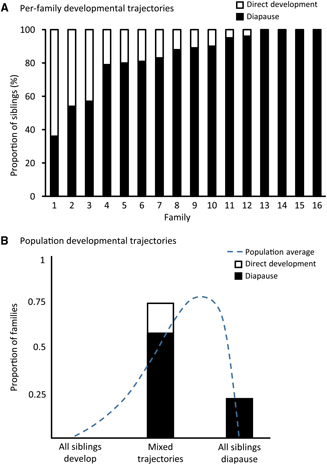
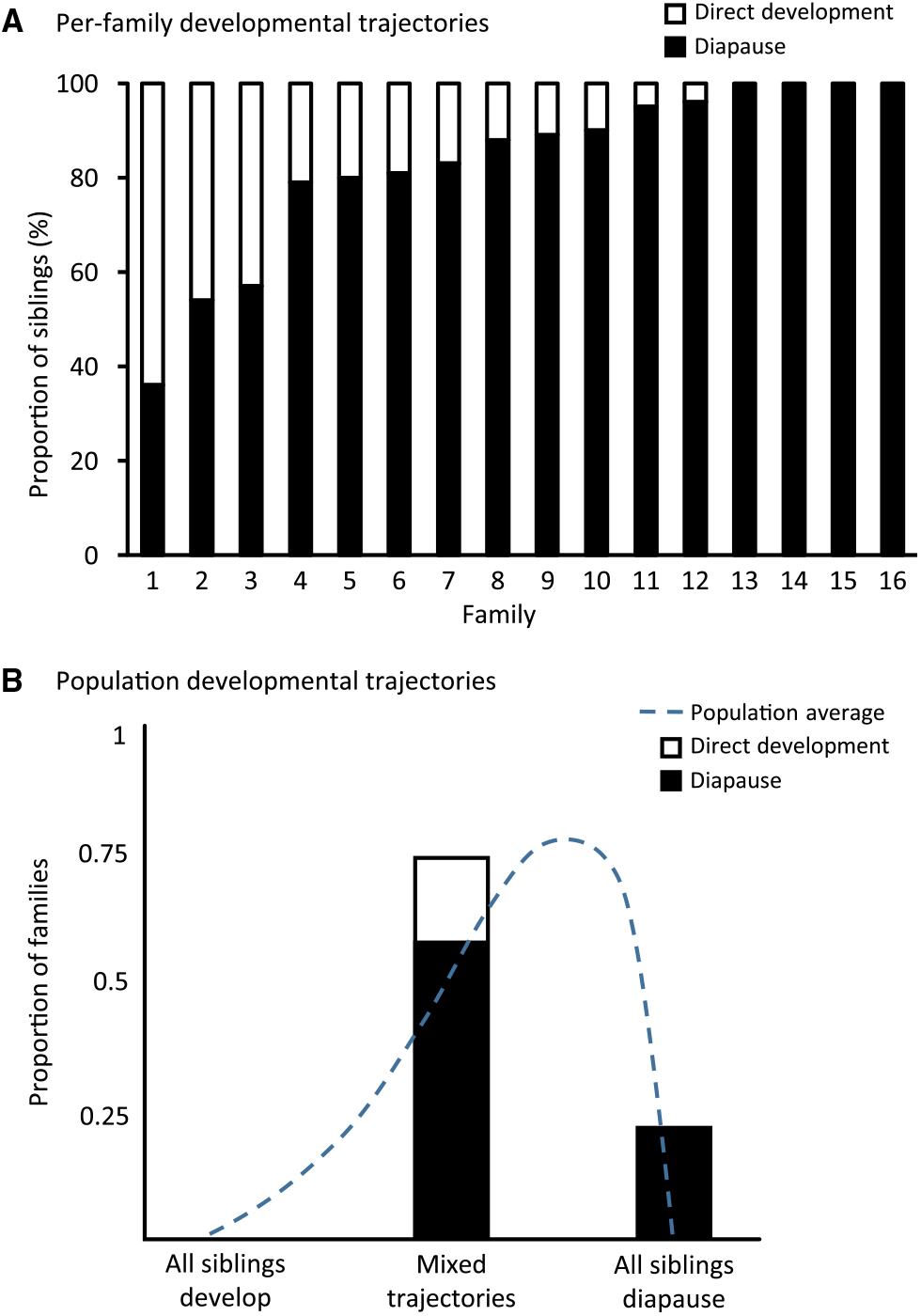
Rearing under cool, short days resulted in 86% of the total larval population entering diapause. This diapause incidence was nearly twofold greater than expected based on our previous study (Des Marteaux et al. Reference Des Marteaux, Habash, Schmidt and Hallett2012). The frequency of diapause was neither affected by the date of egg laying (adjusted F 1,14 = 1.26, P = 0.28; Supplementary Table S1) nor family size (F 1,14 = 0.22, P = 0.65). The developmental fate of siblings reared under cool, short-day conditions was not conserved within families; diapause entry for 100% of siblings occurred in only four (25%) of the 16 families (Fig. 2A). The remaining families exhibited mixed developmental fates ranging from 36% to 96% diapause (there were no families in which all siblings pupated directly).
Developmental trajectories by family (A) and population (B) for swede midges reared under cool, short-day conditions (13.3 ± 1.4 °C, 10:14-hour light:dark photoperiod). Total population diapause incidence was 86% (higher than predicted based on a preliminary study), and thus the rearing conditions here represented above-diapause-critical conditions (skewed towards diapause entry). Most swede midge families did not exclusively favour either direct development or diapause, and we observed no families in which all siblings developed directly to pupae. Mixed developmental trajectories within families indicate that any alleles governing the diapause induction threshold are unlikely to follow a scenario of complete dominance (see Fig. 1).
Discussion
Few studies addressed the heredity of diapause induction thresholds for economic pests with facultative diapause such as swede midge, yet such information may be crucial for effective pest management. We began to address this knowledge gap by characterising diapause incidence within and among full-sibling swede midge families reared under stable conditions (a means of eliminating thermal and photoperiodic influences as well as environmentally driven parental effects). In a mid-summer-like environment (warm, long-day rearing conditions), almost no larvae entered diapause (in agreement with previous observations in the field; Des Marteaux et al. Reference Des Marteaux, Schmidt, Habash and Hallett2015; Readshaw Reference Readshaw1966). In an autumn-like environment (rearing under cool, short days), 86% of the population entered diapause and most families exhibited mixed developmental trajectories. This developmental variability among siblings allows us to rule out a scenario of simple Mendelian inheritance with complete dominance for an allele governing the diapause induction threshold (Fig. 1A). Because overall diapause incidence was considerably higher than anticipated (86% rather than 50%), it is difficult to make precise predictions about diapause patterns across the population in the alternative heredity scenarios for the diapause induction threshold (Fig. 1B–C). Nevertheless, these patterns would be skewed in favour of diapause entry, which we observed (Fig. 2B). As 25% of families exhibited a single developmental trajectory (100% diapause), we cannot rule out a scenario of incomplete dominance for an allele governing the diapause induction threshold. The predominance of mixed developmental trajectories within families (with a variable range from 36% to 96%) also supports the potential for a more complex mode of inheritance (e.g., the trait may be governed by multiple genes and/or alleles) or a high incidence of maternal bet hedging.
Diapause incidence under cool, short days was 30% higher than expected based on our previous laboratory study (Des Marteaux et al. Reference Des Marteaux, Habash, Schmidt and Hallett2012). This discrepancy may have been at least partly attributed to a 1 °C cooler rearing temperature in the present study. Yearly timing of experiments can also affect diapause frequencies for insects in the laboratory (Timer et al. Reference Timer, Tobin and Saunders2010); and unlike our previous study, which was conducted during the winter (Des Marteaux et al. Reference Des Marteaux, Habash, Schmidt and Hallett2012), the present study was conducted between late summer and early autumn. Still, diapause incidence for eggs laid in the present study between 5 September and 2 October (91% diapause) was within the range of that observed in the field between similar dates in Ontario (76% on 7 September to 100% by 1 October; Des Marteaux et al. Reference Des Marteaux, Schmidt, Habash and Hallett2015). In the laboratory at 14 °C, the diapause-critical day length of 10 hours is already much shorter than 13.7 hours observed in the field (Des Marteaux et al. Reference Des Marteaux, Schmidt, Habash and Hallett2015), and diapause initiation is also likely to differ between stable day lengths in the laboratory and changing day lengths in the field (Taylor Reference Taylor1989). Rearing swede midges under a broader array of conditions would be required to generate accurate reaction norms for diapause entry in the laboratory population (Winterhalter and Mousseau Reference Winterhalter and Mousseau2007).
The unexpected popularity of diapause entry under cool, short-day conditions (Fig. 2B) limited our ability to conclude whether simple (single-gene) incomplete dominance (Fig. 1B) or complex heredity (Fig. 1C) is a more likely scenario for genetic control of the diapause induction threshold. As diapause initiation depends on multiple environment-sensing physiological systems (e.g., the photoperiodic clock, thermal sensing, and nutrition), single-gene or single-allele control over diapause entry is likely to be the exception rather than the rule (Xu et al. Reference Xu, Sato, Ikeda and Yamashita1995; Mori et al. Reference Mori, Romero-Severson and Severson2007; Emerson et al. Reference Emerson, Bradshaw and Holzapfel2009). Still, both incomplete dominance and complex heredity for the diapause induction threshold could enable the variation in developmental outcome observed under a given environment (Mathias et al. Reference Mathias, Jacky, Bradshaw and Holzapfel2007; Boyle et al. Reference Boyle, Li and Pritchard2017). In the former scenario, heterozygotes could be developmentally unstable and/or their diapause entry may be more readily influenced by slight differences in rearing conditions (Simons and Johnston Reference Simons and Johnston1997; Hopper Reference Hopper1999). The use of inbred lines would be one alternative approach to determine the extent to which genotypic variation explains variation in diapause entry under a constant environment. Selection experiments under diapause-critical conditions could similarly help to identify any heritable component of the diapause induction threshold (Glass Reference Glass1969; Hoy Reference Hoy1978; Boivin et al. Reference Boivin, Bouvier, Beslay and Sauphanor2004; Goto et al. Reference Goto, Han and Denlinger2006), and although time-consuming, chilling to facilitate diapause completion could speed up this process for diapause-selected swede midge lines (Readshaw Reference Readshaw1961). Diapause-selected and non-diapause-selected lines would also provide a system with which to identify genes and pathways unique to each developmental trajectory under diapause-critical conditions (e.g., via comparative transcriptomics; Poupardin et al. Reference Poupardin, Schöttner, Korbelová, Provazník, Doležel and Pavlinic2015).
Maternal bet hedging may be an alternative (albeit not mutually exclusive) mechanism explaining the predominance of mixed developmental trajectories within swede midge families under a stable environment (Hopper Reference Hopper1999). Variation in diapause entry via bet hedging could manifest from maternally determined variation in offspring size (Marshall et al. Reference Marshall, Bonduriansky and Bussière2008; Rajon et al. Reference Rajon, Desouhant, Chevalier, Débias and Menu2014), maternal age at egg laying (Danks Reference Danks1987; Mousseau Reference Mousseau1991; Bradford and Roff Reference Bradford and Roff1993; Hockham et al. Reference Hockham, Graves and Ritchie2001), or perhaps even through epigenetic effects (Ratcliff and Denison Reference Ratcliff and Denison2010). Size variation in newly cocooned swede midge larvae could be correlated with developmental fate (the cocoons of diapausing larvae are distinguishable from pupal cocoons by shape; Readshaw Reference Readshaw1961), and maternal age at egg laying could be more narrowly controlled in the laboratory. Although epigenetic influences on diapause induction have not been investigated in the swede midge, the growing literature on insect epigenetics may soon offer insights about mechanisms that could promote developmental diversification in offspring (Reynolds et al. Reference Reynolds, Clark, Diakoff and Denlinger2013, Reference Reynolds, Bautista-Jimenez and Denlinger2016, Reference Reynolds, Peyton and Denlinger2017; Hand et al. Reference Hand, Denlinger, Podrabsky and Roy2016; Sgro et al. Reference Sgro, Terblanche and Hoffmann2016). For example, an epigenetic factor in the overwintering parental generation that promotes direct development in offspring could diminish across subsequent generations over the growing season (Reznik and Samartsev Reference Reznik and Samartsev2015; Webster et al. Reference Webster, Jordan, Hibshman, Chitrakar and Baugh2018).
Some non-genetic factors could potentially influence variation in diapause initiation under a stable environment and thus warrant consideration. For example, because swede midges lay multiple clutches on the preferred Brassica hosts (Boddum et al. Reference Boddum, Molnár, Hill, Birgersson, Hansson and Abreha2018), a shortage of optimal oviposition sites could result in nutritional or growth rate differences among siblings developing on different regions of the host plant. These differences could, in turn, influence the propensity to enter diapause or continue development (Nijhout and Williams Reference Nijhout and Williams1974; Hunter and McNeil Reference Hunter and McNeil1997; Hahn and Denlinger Reference Hahn and Denlinger2007). The assessment of larval mass in the late wandering stage could provide some indication about whether size or growth rate has any influence on developmental trajectory. Although larval crowding can influence diapause entry in some insects (Hagstrum and Silhacek Reference Hagstrum and Silhacek1980; Togashi Reference Togashi2017), family size did not explain variation in developmental outcomes for siblings in the present study.
Acknowledgements
Funding for this research was provided to R.H.H. by the Ontario Ministry of Agriculture and Rural Affairs – University of Guelph Research Partnership through the Sustainable Production (Plants) Programme. The authors would like to thank Marc Habash and Jonathan Schmidt for comments on an earlier draft of this manuscript.
Supplementary material
To view supplementary material for this article, please visit https://doi.org/10.4039/tce.2019.33.