Implications
This study questions the use of a constant amino acid (AA) profile of retained protein to assess AA requirements in pig nutrition. Tissues respond differently in terms of weight gain, protein content and AA content in protein to a moderate and prolonged AA deficiency. Although the AA composition of muscle protein is affected by the sulfur AA deficiency, the impact on meat quality is limited.
Introduction
In growing pigs, the sulfur containing amino acids (AA) Met and Cys, are considered the second or third limiting AA for most cereal–soybean-based diets (National Research Council (NRC), 1998). Methionine is not only an indispensable AA required for body protein deposition, but it is also an important methyl donor and precursor for polyamine, carnitine and creatine (Kim, Reference Kim2005). As a semi-indispensable AA, Cys can be synthesized from Met through the transsulfuration pathway, whereas Met must be supplied by the diet (Chung and Baker, Reference Chung and Baker1992). Cysteine is a constituent of glutathione, a major cellular antioxidant, and also serves as a precursor for taurine and co-enzyme A (Stipanuk, Reference Stipanuk2004).
In the factorial approach used to establish AA requirements, the AA composition of body protein is assumed to be constant. However, there are indications that question the validity of this assumption because different factors have been shown to affect the AA composition of body protein, including protein and energy intake (Bikker et al., Reference Bikker, Verstegen and Bosch1994), growth rate (Kyriazakis et al., Reference Kyriazakis, Emmans and McDaniel1993) and the AA content of the diet (Chung and Baker, Reference Chung and Baker1992; Gahl et al., Reference Gahl, Finke, Crenshaw and Benevenga1996). The effect of dietary AA deficiencies other than Lys were mainly studied by measuring performance (Chung and Baker, Reference Chung and Baker1992) and the AA and protein content of the whole body and carcass (Gahl et al., Reference Gahl, Finke, Crenshaw and Benevenga1996; Martinez-Ramirez et al., Reference Martinez-Ramirez, Jeaurond and de Lange2008). Tissue protein is composed of different types of proteins (e.g. myosin, actin and collagen in the muscle) and these proteins differ in AA composition (Pearson and Young, Reference Pearson and Young1989). It has been proposed that changes in the relative tissue mass in combination with differences in AA composition among tissues contribute to changes the AA composition of whole-body protein (Wei and Fuller, Reference Wei and Fuller2006). Results of a study in our laboratory indicated that specific tissues respond differently to a deficient total sulfur AA (TSAA) supply (Conde-Aguilera et al., Reference Conde-Aguilera, Barea, Le Floc'h, Lefaucheur and van Milgen2010). If the AA composition of tissue protein such as the muscle is affected by the AA supply, it is possible that meat quality traits are affected as well. The objective of this study was to investigate the response of pigs to a prolonged and moderately deficient TSAA supply on the AA composition of body tissues and on carcass quality.
Material and methods
Animals, experimental design and housing
Experimental procedures and animal care were carried out according to current French legislation. An authorization to experiment on living animals was provided by the French Ministry of Agriculture, and the experiment was approved by the local Ethics Committee on Animal Experimentation.
Eighteen Piétrain×(Large White×Landrace) piglets were used, originating from the INRA herd in St-Gilles (France). All pigs were free of the halothane sensitive and RN− alleles to avoid possible interference with postmortem metabolism and subsequent meat quality. Animals were weaned at ∼4 weeks of age and housed in groups of four in pens (1.3×1.2 m) until the start of the experiment. At 6 weeks of age, 12 piglets (12.2±0.9 kg initial BW), six females and six castrated males, were selected on the basis of BW and origin (littermates or half-siblings), and housed individually in cages (0.8×0.6 m, with plastic slats) under controlled environmental conditions. The pigs were divided into two homogenous groups of six piglets each (three females and three castrated males). Each group received a diet either deficient or sufficient in TSAA (TSAA– and TSAA+, respectively). At 10 weeks of age, pigs were transferred to a grower unit and housed in individual pens (0.9×2.7 m) until the end of the experiment at 23 weeks of age. Room temperature was maintained at 28°C during the week after weaning and was decreased by 1°C each week afterwards until 24°C to be maintained until the end of the experiment. Animals were weighed weekly without overnight fast before the morning meal. Pigs were slaughtered at the end of the experiment.
Diets and feeding
Pigs were offered commercial weaner and starter diets ad libitum from weaning until the start of the experiment (i.e. from 4 to 6 weeks of age). The starter diet was then progressively replaced over 3 days by the experimental diets.
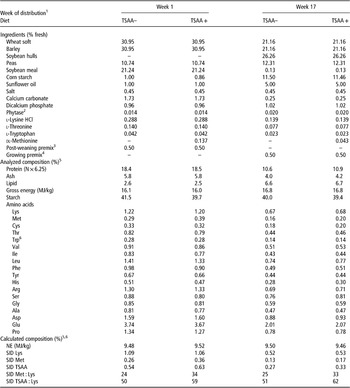
Pigs were offered a diet with a deficient or a sufficient supply of TSAA. To account for changes in nutrient requirements during the experiment, two diets were formulated for each treatment. These diets were formulated to fulfill the nutrient requirements other than TSAA at the beginning and at the end of the experiment and served as a basis for the diets to be distributed during the experiment (Table 1). In total, four diets were formulated differing in TSAA contents (i.e. the experimental treatments) and in energy, CP and AA contents to account for changes in nutrient requirements during the experiment. All diets were prepared as mash in a 1-week period and stored under controlled conditions at 4°C and relative air humidity <60%. Pigs received a different diet each experimental week by proportional blending of the diets formulated for weeks 1 and 17. Except for TSAA, the AA pattern met or exceeded the current French recommendations (Henry, Reference Henry1993; Sève and Le Floc’h, Reference Sève and Le Floc’h1998). The standardized ileal digestible (SID) Lys content in diets decreased from 1.08% during week 1 to 0.53% during week 17. Differences in TSAA content were created by substituting dl-Met for cornstarch. Diet TSAA– provided 24% SID Met : Lys and 51% SID TSAA : Lys, which are, respectively, 19% and 16% below the recommended requirements (Henry, Reference Henry1993; NRC, 1998). Diet TSAA+ provided 33% SID Met : Lys and 60% SID TSAA : Lys.
Composition of diets deficient (TSAA–) or sufficient (TSAA+) in total sulfur amino acids

NE=net energy; SID=standardized ileal digestible; TSAA=total sulfur amino acids.
1 The diets differed in TSAA contents on the one hand and in energy, CP and amino acids contents on the other hand. Within a treatment, diets were blended proportionally each week using the diets formulated for weeks 1 and 17 to account for changes in nutrient requirements during the experimental period.
2 Natuphos 5000 G (BASF, Limurgerhof, Germany) provided (per kg of complete diet) 703 and 1000 phytase units (FTU) of phytase for diets offered in weeks 1 and 17, respectively.
3 Supplied per kg diet as-fed: vitamin A, 10 000 IU; vitamin D3, 2000 IU; vitamin E, 20 mg; vitamin K3, 2 mg; thiamin, 2 mg; riboflavin, 5 mg; niacin, 20 mg; pantothenic acid, 11 mg; pyridoxine, 5 mg; biotin, 0.2 mg; folic acid, 1 mg; vitamin B12, 0.03 mg; choline chloride, 600 mg; ascorbic acid, 40 mg; Fe, 104 mg; Cu, 20 mg; Zn, 99 mg; Mn, 40 mg; I, 0.6 mg; Se, 0.3 mg; and Co, 1 mg.
4 Supplied per kg diet as-fed: vitamin A, 5000 IU; vitamin D3, 1000 IU; vitamin E, 20 mg; vitamin K3, 2 mg; thiamin, 2 mg; riboflavin, 4 mg; niacin, 15 mg; pantothenic acid, 11 mg; pyridoxine, 1 mg; biotin, 0.2 mg; folic acid, 1 mg; vitamin B12, 0.03 mg; choline chloride, 500 mg; Fe, 80 mg; Cu, 10 mg; Zn, 100 mg; Mn, 40 mg; I, 0.2 mg; Se, 0.2 mg; and Co, 0.1 mg.
5 Ajusted to 87.3% dry matter.
6 Values for NE and Trp were calculated from Sauvant et al. (Reference Sauvant, Perez and Tran2004). The SID values were obtained from the calculated ileal digestibility values of the ingredients (Sauvant et al., Reference Sauvant, Perez and Tran2004) combined with the measured amino acid contents.
Diets were pelleted weekly using a 3 mm die for diets used from week 1 to 4, and a 4.5 mm die for diets used from week 5 to 17. Each diet was offered in three daily meals at 0900, 1300 and 1600 h, and twice during weekends. The feeding level was restricted at ∼90% of the ad libitum intake capacity to avoid differences in feed intake between treatments because the TSAA content in the diet may affect voluntary feed intake. This intake was based on the ad libitum intake of similar pigs housed in our facilities. The allowance was adjusted weekly according to appetite avoiding feed refusals and taking into account the anticipated increase in BW. Refusals, if any, were dried and weighed to calculate actual feed intake. Water was freely available. Samples of the feeds were taken twice per week and pooled by week and feed for further analysis.
Slaughter procedure and measurements
At 23 weeks of age (after 22 h of fasting), pigs were transported to the experimental slaughterhouse of INRA (Saint-Gilles, France), electrically stunned (350 V – 4 A; stunner C. Bernadet, 64 Orthez, France) and killed by exsanguination. Pigs were scalded and dehaired mechanically by abrasion and singed in a gas flame. After slaughter, the gastrointestinal tract was removed and the small intestine, from the ligament of Treitz to the ileocoecal junction, was divided into three segments of equal length corresponding to the proximal and distal jejunum and the ileum. Each segment was emptied, rinsed with water, pat-dried and weighed. The liver was removed and weighed. Skin samples were collected from five locations from the right half-carcass: belly (2 cm distal to the diaphragm at midline), ham (7 cm dorsal from midline), lower and upper loin (5 cm dorsolateral from midline at the second–third lumbar vertebra level, and at the third–fourth, respectively), and shoulder (20 cm dorsolateral from midline). From each location, four skin samples were taken using a core cutter (4 cm diameter). The attached subcutaneous fat was removed manually after which the skin samples were weighed and pooled per pig. The samples from the small intestine, liver and skin were cut in smaller pieces to facilitate freeze-drying and frozen. The longissimus dorsi (LM) and rhomboideus muscles (RM) from the right half-carcass were removed entirely, weighed, frozen at −20°C, ground in a cutter-slicer (Hobart FR15 cutter/slicer, Marne la Vallée, France) and freeze-dried later. Samples of the freeze-dried muscles, small intestine, liver and skin were homogenized in a cutter mill (Grindomix GM200, Restsch, Newtown, PA, USA) and representative samples of 200 g were taken and kept at –20°C for further analysis. Subsamples of 50 g were taken and ground with a ball mill (Vangoumil 300, Darmstadt, Germany) for AA analyses.
Carcass quality characteristics
The hot carcass weight was recorded at slaughter. Backfat thickness was determined as the mean of measurements taken between the third and fourth lumbar vertebra (8 cm from the midline) and third and fourth from the last rib (6 cm from the midline), and muscle depth (between third and fourth from the last rib, 6 cm from the midline) were measured using a Fat-O-Meter (SFK, Herlev, Denmark). After 24 h at 4°C, the weights of the cold carcass without the viscera, head, feet and tail and of wholesale cuts of the left side were recorded. Lean meat content was calculated from the wholesale cuts using an equation proposed by Daumas (Reference Daumas2008):
 $$\eqalign{{\rm Lean}\,{\rm meat}\,{\rm content}={\rm 25}.0{\rm 8}-\left[ {{\rm 1}.{\rm 23}{\times}\left( {%\,{\rm backfat}} \right)} \right] \cr \quad \, {\plus}\left[ {{\rm 0}{\rm .87}{\times}\left( {%\,{\rm loin}} \right)} \right]{\plus}\left[ {{\rm 0}{\rm .73}{\times}\left( {%\,{\rm ham}} \right)} \right].$$
Wholesale cuts were taken from the left side of the carcass.
Technological meat quality traits
After 30 min postmortem, samples of LM at the level of the third lumbar vertebra were excised from the left carcass, immediately frozen in liquid nitrogen, and stored at –80°C for subsequent determination of the initial pH and glycolytic potential. The initial pH was determined after homogenization of 2 g of muscle in 18 ml of 5 mM iodoacetate/150 mM KCl buffer (Ingold Xerolyte electrode, Knick pH-meter, Berlin, Germany). The glycolytic potential was determined according to Talmant et al. (Reference Talmant, Fernandez, Sellier and Monin1989):
 $$\eqalign{{\rm Glycolytic}\,{\rm potential}={\rm 2}{\times}\left( {{\rm glycogen}{\plus}{\rm free}\,{\rm glucose} }}\right \cr \quad\,\left {\plus}{\rm glucose{\hbox -}6{\hbox -}phospate}} \right){\plus}{\rm lactate},$$
where lactate, free glucose, glucose-6-phosphate and glucose from glycogen hydrolysis are expressed as micromoles per gram of wet tissue. The metabolite concentrations were determined using enzymatic methods for glucose and glucose-6-phosphate (glucose HK, ABX Diagnostics kit, 34187 Montpellier, France) and lactate (Biomerieux kits, Marcy l’Etoile, France). The glycogen content was determined from glucose (see above) after hydrolysis by amyloglucosidase as described by Lebret et al. (Reference Lebret, Meunier-Salaun, Foury, Mormede, Dransfield and Dourmad2006). These analyses were performed using an automatic spectrophotometer (Cobas Mira Roche, Basel, Switzerland). The glycolytic potential was expressed as micromoles of equivalent lactate per gram of wet tissue.
The day after slaughter, a traverse section of LM at the level of the last rib was taken from the left carcass for determination of the ultimate pH (i.e. 24 h postmortem) using the method described above. Meat color was evaluated through CIELab coordinates for lightness, redness, yellowness, chroma and hue angle in triplicate in the central part of LM at 24 h postmortem using a Minolta chromameter CR-300 (Osaka, Japan) with a D65 illuminant and a 1-cm diameter aperture (Wyszcecki and Stiles, Reference Wyszcecki and Stiles1982). Approximately 100 g of LM (cranial to the last rib cut) was collected for determination of drip loss as described by Honikel (Reference Honikel1998).
Chemical analyses
All analyses were performed in duplicate. Chemical analyses were carried out in diets and samples of individual pigs for the LM and RM, intestines, liver and skin. Samples were analyzed for dry matter (ISO 6496-1983) using methods of the International Organization for Standardization (ISO methods, http://www.iso.org). The N content was analyzed according to the Dumas procedure (NF V18-120, 1997 (with a Rapid N cube, Elementar France, Villeurbanne, France)) of the AFNOR group (NF methods, http://www.afnor.org/en). Feed samples were also analyzed for starch content (ISO 6493-2000) using a digital polarimeter (ADP220, Bellingham, England). The AA analyses of feed and body tissues (ISO 13903-2005) were performed with a HPLC (Alliance System, Waters, Guyancourt, France) after hydrolysis with 6 N HCl at 110°C for 23 h under reflux according to the Waters Pico Tag method (Cohen et al., Reference Cohen, Meys and Tarvin1989). The Cys and Met contents were determined as cysteic acid and Met sulphone, respectively, after performic acid oxidation before hydrolysis (Moore, Reference Moore1963).
Statistical evaluation
ANOVA was performed using the GLM procedure of SAS (SAS Institute Inc., Cary, NC, USA) by one-way ANOVA using the individual animal as the experimental unit. Normality of data was assessed using the Shapiro–Wilk test and the hypothesis for a normal distribution of the data was not rejected. Differences among means were tested for every tissue and significance was accepted at P⩽0.05.
Results
In general, pigs appeared to be in good health and no signs of abnormal behavior were observed during the experiment. Occasional cases of diarrhea occurred at the beginning of the experiment during 3 days and pigs were then treated with colistin sulfate (CEVA Santé Animale, Libourne, France), sulfamethoxazole/trimethoprim (Vétiquinol S.A., Lure, France), or both. Some animals had occasional feed refusals, especially during the first 2 weeks, which were recovered quantitatively and weighed. During the experiment, daily feed refusals ranged from 1% to 11% of the feed allowance, with an average value of 4% for the entire period. There was no apparent relation between feed refusals and dietary treatments.
Animal performance and tissue growth
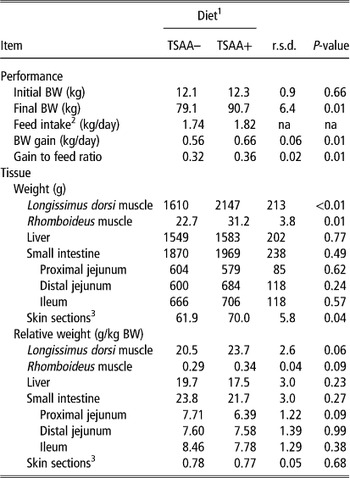
Performance data are given in Table 2. The TSAA content in the diet affected performance with lower final BW, average daily gain (ADG) and gain-to-feed ratio for pigs receiving diet TSAA– (P<0.01).
Effects of a diet deficient (TSAA–) or sufficient (TSAA+) in total sulfur amino acids on performance in pigs from 6 to 23 weeks of age

na=not applicable; TSAA=total sulfur amino acids.
1 Pigs received diets TSAA– or TSAA+ for 17 weeks and were slaughtered thereafter (six pigs per treatment).
2 Ajusted to 87.3% dry matter.
3 Skin sections were collected from five locations (i.e. the belly, ham, lower and upper loin and shoulder). Subcutaneous fat was removed and samples were pooled by pig.
The TSAA supply affected the weight and relative weight (i.e. weight of the tissue divided by BW) of tissues (Table 2). Pigs receiving diet TSAA– had lower weights of LM and RM (P<0.001) and skin sections (P<0.05) compared with pigs receiving diet TSAA+.
Protein and AA content of tissues
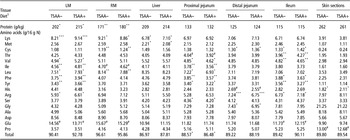
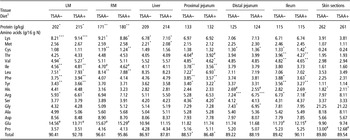
Among all tissues, only the protein content of LM (P<0.05) and RM (P<0.01) decreased in pigs receiving diet TSAA– (Table 3). The protein content of the other tissues was not affected by the dietary TSAA content.
Effects of a diet deficient (TSAA–) or sufficient (TSAA+) in total sulfur amino acids on tissue composition in pigs at 23 weeks of age
LM=longissimus dorsi muscle; RM=rhomboideus muscle; TSAA=total sulfur amino acids.
1 Pigs received diets TSAA– or TSAA+ for 17 weeks and were slaughtered thereafter (six pigs per treatment). The tests correspond to testing treatments TSAA– v. TSAA+. Significant level for the effect of the diet is indicated within a row and tissue component by ***P⩽0.001, **P⩽0.01, *P⩽0.05, and # P⩽0.10. Residual s.d. of the composition of tissues are given in Supplementary Table S1.
Except for the liver, the Met content in tissue protein was not affected by the TSAA supply. In the liver, the Met content was higher (P<0.05) in pigs receiving diet TSAA–, whereas the Lys content was lower (P<0.05). The Cys content in protein of RM, distal jejunum and ileum was decreased (P<0.01) when pigs received diet TSSA–. For the other AA, changes were minimal for the skin sections and liver, moderate for the distal jejunum and RM, whereas LM, proximal jejunum and ileum were the most affected tissues (Table 3). In pigs receiving diet TSAA–, the Lys, Val, Leu, Arg, Ile, Phe and Tyr contents in protein of LM were lower (P<0.05) than in pigs receiving diet TSAA+. In the proximal jejunum, reducing the TSAA supply resulted in an increase in the Val, Leu, Tyr, Ser, Ile and Phe contents (P<0.05). In pigs receiving diet TSAA–, the Thr and Arg contents in protein of the ileum were lower, whereas the Val, Tyr and Phe contents increased (P<0.05). In RM, the Lys and Leu contents of protein increased (P<0.05) when pigs received diet TSAA–. For the distal jejunum and skin sections, the content of, respectively, Arg and Gly (and Cys), and His were affected by the dietary TSAA content (P<0.05).
Carcass traits and meat quality
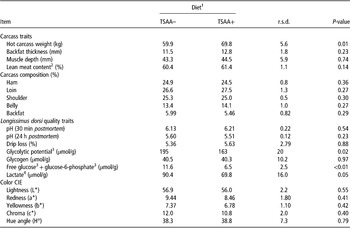
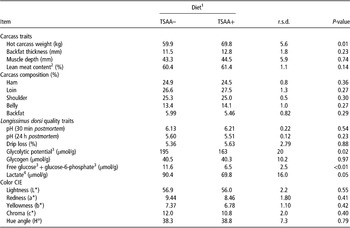
Carcass quality traits were not affected by the TSAA supply. As for the final BW, the hot carcass weight was lower (P<0.01) in pigs receiving diet TSAA– (Table 4). Technological meat quality traits of LM are given in Table 4. The free glucose, glucose-6-phosphate and lactate contents, and glycolytic potential were increased in TSAA– pigs (P<0.05). Neither the initial and ultimate pH nor the CIELab coordinates of LM were affected by the TSAA supply.
Effects of a diet deficient (TSAA–) or sufficient (TSAA+) in total sulfur amino acids on carcass quality and technological quality traits of the longissimus dorsi muscle in pigs at 23 weeks of age
TSAA=total sulfur amino acids.
1 Pigs received diets TSAA– or TSAA+ for 17 weeks and were slaughtered thereafter (six pigs per treatment).
2 Calculated from the wholesale cuts (Daumas, Reference Daumas2008).
3 Expressed as micromoles per gram of wet tissue.
4 Expressed as micromoles of equivalent lactate per gram of wet tissue.
Discussion
Different mechanisms can be used by the animal to cope with a deficient AA supply, including a reduction in growth rate and changes in body composition. In this study, a deficient TSAA supply resulted in the use of both strategies by the animal and a Met deficiency of 19% resulted in a 15% reduction in ADG. In a previous study on weaned piglets with a short but more severe deficiency (40%), we observed a 20% reduction in ADG (Conde-Aguilera et al., Reference Conde-Aguilera, Barea, Le Floc'h, Lefaucheur and van Milgen2010). Therefore, a prolonged and moderately deficient TSAA supply may have a proportionally greater effect on ADG than a short and severely deficient TSAA supply. Because of differences in final BW, differences in tissue weight can be anticipated because of the TSAA deficiency. However, also the relative weights of LM and RM were reduced by the deficient TSAA supply. In contrast, there was a tendency for an increase in the relative weight of proximal jejunum, resulting in a similar tissue weight in pigs receiving diet TSAA–. Similar results were observed by Ebner et al. (Reference Ebner, Schoknecht, Reeds and Burrin1994) and Hamard et al. (Reference Hamard, Seve and Le Floc'h2007), which suggest that the intestines have a greater priority (or take a greater share) for nutrients than the skeletal muscle when the AA or protein supply is limiting.
The animals responded to a deficient TSAA supply by reducing the protein content of LM and RM, which agrees with other reports (Martinez-Ramirez et al., Reference Martinez-Ramirez, Jeaurond and de Lange2008). Moreover, the reduction in protein content was moderate for both the muscles (6%), which is smaller than the 20% reduction in protein content of LM observed by Conde-Aguilera et al. (Reference Conde-Aguilera, Barea, Le Floc'h, Lefaucheur and van Milgen2010) during a severe TSAA deficiency in weaned piglets. It is likely that the reduction in protein content in the muscle is accompanied by an increase in lipid deposition, as observed by others (e.g. Martinez-Ramirez et al., Reference Martinez-Ramirez, Jeaurond and de Lange2008; Conde-Aguilera et al., Reference Conde-Aguilera, Barea, Le Floc'h, Lefaucheur and van Milgen2010). The protein content of other tissues (i.e. liver, small intestine and skin) was not affected, supporting the hypothesis that the tissues responded differently to a limiting TSAA supply.
The deficient TSAA supply resulted in an increased Met content in liver protein, but a reduced Cys content in RM, distal jejunum and ileum. Our observations for the intestines are in contrast with those of Ebner et al. (Reference Ebner, Schoknecht, Reeds and Burrin1994) and Hamard et al. (Reference Hamard, Seve and Le Floc'h2009), who reported that the composition of the intestines was relatively resistant to protein and AA deficiencies. However, the latter studies lasted for a relatively short period (2 weeks) with a moderate AA deficiency. Although the intestines may be given a priority during the early phase of a nutrient deficiency, it is possible that this situation cannot be maintained for prolonged periods of time. In addition, the three sections of the small intestine responded differently to the TSAA deficiency. Retained protein in the proximal part of the small intestine mostly comes from luminal AA, due to being positionally the first section receiving dietary AA, whereas the distal parts probably rely more on arterial AA for protein synthesis (Schaart et al., Reference Schaart, Schierbeek, van der Schoor, Stoll, Burrin, Reeds and van Goudoever2005). Stoll et al. (Reference Stoll, Chang, Fan, Reeds and Burrin2000) observed that the distal ileum maintained a positive protein balance in parenterally fed piglets, whereas a net protein loss occurred in the jejunum and proximal ileum. This may explain the difference in responses observed for the different sections of the small intestine when pigs receive a TSAA-deficient diet.
Not only Met and Cys but also the contents of other AA in tissue protein were affected by the deficient TSAA supply. The contents of a large number of mostly essential AA in protein of LM, RM, proximal jejunum and ileum, and to a lesser extent of the liver and skin, were affected by the TSAA supply. This also supports the hypothesis that tissues respond differently to a deficient TSAA supply. The AA composition of the skin was less affected by the TSAA supply, and the observed AA composition agrees with the literature data (Pearson and Young, Reference Pearson and Young1989). The content of essential AA in the skin is very low, and the skin (without bristles) contains <1.5% TSAA. However, bristles contain ∼13% Cys on a weight basis and more than 7% of the whole body Cys content may be found in bristles (Mahan and Shields, Reference Mahan and Shields1998). Collagen accounts for ∼70% of skin protein (Caperna et al., Reference Caperna, Gavelek and Vossoughi1994). Because of its composition, skin protein may be relatively resistant to a limiting supply of essential AA.
Muscles are composed of different types of proteins with different AA composition (Pearson and Young, Reference Pearson and Young1989). This was observed in the current study by the different AA composition of LM and RM in the TSAA+ pigs, but has also been reported for other muscles (Purchas et al., Reference Purchas, Morel, Janz and Wilkinson2009). The differences in AA composition between the muscles may be due to differences in function, contractive properties and oxidative capacities of the skeletal muscles (Spangenburg and Booth, Reference Spangenburg and Booth2003), which could explain the different responses of the muscles when pigs receive a diet deficient in TSAA. The LM and RM responded differently to a TSAA-deficient supply in the present study, which appears to be in contrast with results from Chang and Wei (Reference Chang and Wei2005), who observed no changes in the AA composition of four muscles in pigs fed a Lys-deficient diet. As indicated earlier for the intestines, the lack of response in that study may be because of the short experimental period (17 days). Irrespective of the mechanisms, the present study demonstrates that the growing pig has a potential to modulate the AA composition of muscle protein.
The TSAA content of the diet had little effect on carcass traits and composition and on technological meat quality. Our values for these traits in TSAA+ pigs are consistent with those reported in the literature for conventional pigs (Lebret et al., Reference Lebret, Meunier-Salaun, Foury, Mormede, Dransfield and Dourmad2006). A greater glycolytic potential, as observed in the TSAA– pigs, may indicate a difference in the rate of postmortem glucose metabolism in the hours after slaughter. This may be explained by greater muscle stores (mainly glycogen) before slaughter, a higher glycogen utilization postmortem in TSAA– pigs, or both because the glucose-6-phosphate, free glucose and lactate contents, as products from glycogen consumption, were much higher in TSAA− pigs, whereas the glycogen content (after slaughter) was not different (Table 4). The differences in muscle carbohydrate metabolism may be the result of an increase in AA catabolism in TSAA− pigs. Because of the limiting TSAA supply, AA not used for protein deposition are deaminated and may have been used for gluconeogenesis and fatty-acid synthesis.
In conclusion, a reduction in TSAA supply differently affects the AA composition of tissues with little effect on meat quality. This indicates the ability of the pig to alter the tissue growth rate and the composition of different tissue proteins. This illustrates the plasticity of the animal to respond to a limiting AA supply.
Acknowledgments
The authors gratefully acknowledge N. Mézière, P. Ecolan, N. Bonhomme and Y. Jaguelin for their excellent assistance with sampling and laboratory analyses, G. Guillemois, J.-F. Rouaud, P. Touanel, F. Guerin, B. Carrissant, H. Demay, M. Alix, P. Roger and J. Delamarre (INRA, Saint-Gilles, France) for expert animal care, and B. Lebret and R. Castellano for their helpful scientific discussions. J.A. Conde-Aguilera and this work were supported by the Rhodimet® Research Grant 2010 from Adisseo SAS (France).