Introduction
People frequently make economic decisions in social contexts. In later life, social economic decisions may exert greater impact than in younger adulthood. Older adults face many such decisions including preparation of a will, placing a family member or spouse in a nursing home, and determining how to utilize retirement money. Poor economic decision-making may have greater consequences in later life because there is less time and fewer resources to recover. The public cost of this state of affairs is amplified by the rapid growth of the older adult sector of the population (Wilmoth and Longino, Reference Wilmoth and Longino2006).
Despite extensive evidence for age-related differences in economic decision-making in non-social contexts (Denburg et al., Reference Denburg, Tranel and Bechara2005; Fein et al., Reference Fein, McGillivray and Finn2007; for a review see Brown and Ridderinkhof, Reference Brown and Ridderinkhof2009), decision-making in a social context has rarely been studied, with a few exceptions (see Bellemare and Kröger, Reference Bellemare and Kröger2007; Sutter and Kocher, Reference Sutter and Kocher2007). Previous studies of non-social decision-making have shown that relative to younger adults, older adults typically need more time to learn the association between a stimulus and reward, and show difficulties learning to associate a new stimulus with a reward that was previously linked to a different stimulus (i.e. reversal learning, reviewed in Brown and Ridderinkhof, Reference Brown and Ridderinkhof2009). This phenomenon is relevant to social economic decision-making because real-life economic interactions often involve partners who may change their behavior over time (and, as a consequence, the association between stimulus and social reward will change as well). Age-related changes extend to online decision-making requiring implicit learning of the reward value of a stimulus (Denburg et al., Reference Denburg, Tranel and Bechara2005; Fein et al., Reference Fein, McGillivray and Finn2007). For example, studies have shown impairment by some older adults on the Iowa Gambling Task (IGT), where participants must decipher which card decks are advantageous in order to obtain the best financial outcome (Denburg et al., Reference Denburg, Tranel and Bechara2005; Fein et al., Reference Fein, McGillivray and Finn2007). In economic decision-making that occurs in a social context, individuals must learn the relationship between a decision and its social reward in addition to its associated monetary value.
Social economic decision-making, fairness, and empathy
Social rewards that occur in the context of economic decision-making, such as generous or fair treatment by an opponent in an economic game, may have arguably greater motivational value for older than younger adults due to older individuals’ purported prioritization of meaningful relationships, as suggested by the socio-emotional selectivity theory (Carstensen et al., Reference Carstensen, Isaacowitz and Charles1999). Yet recent work also suggests that relative to younger individuals, older adults show poorer functioning on abilities integral for social competence (Davis, Reference Davis1983) including cognitive empathy (i.e. the ability to take the mental perspective of another person) and theory of mind (Sullivan and Ruffman, Reference Sullivan and Ruffman2004; Bailey et al., Reference Bailey, Henry and Von Hippel2008).
Economists have begun to consider empathy and “other-regarding” motivation as critical variables in predicting economic decision-making (for a review see Kirman and Teschl, Reference Kirman and Teschl2010). Empathy has been shown to facilitate prosocial behavior towards others in the context of economic games, such as in the form of greater cooperation or generosity (Batson and Moran, Reference Batson and Moran1999; Barraza and Zak, Reference Barraza and Zak2009; Crockett et al., Reference Crockett, Clark, Hauser and Robbins2010). A motivation towards relationship enhancement may make older adults more likely to make economic decisions benefiting others (Carstensen et al., Reference Carstensen, Isaacowitz and Charles1999). Yet because of their potentially low levels of cognitive empathy, older adults may not be able to accurately read the mental states of others. Thus older adults may inaccurately predict what the other person wants and therefore behave in a way that is not consistent with their needs. Consequently, older adults’ economic decision-making behavior may reflect both their motivation to enhance relationship quality and their lower capacity for cognitive empathy.
The Ultimatum Game
Laboratory economic games set in social contexts serve as standardized and controlled approaches to measure social economic decision-making (Guth et al., Reference Guth, Schmittberger and Schwarze1982; Sanfey et al., Reference Sanfey, Rilling, Aronson, Nystrom and Cohen2003). However, the behavior of older adults on the Ultimatum Game (UG) has rarely been investigated as previous studies have either focused on the trust game (Sutter and Kocher, Reference Sutter and Kocher2007) or the investment game (Bellemare and Kröger, Reference Bellemare and Kröger2007). The UG is a useful measure of social economic decision-making, as evidenced by the differential behavior shown on this game as a function of social context (Sanfey et al., Reference Sanfey, Rilling, Aronson, Nystrom and Cohen2003) and empathy (Barraza and Zak, Reference Barraza and Zak2009; Crockett et al., Reference Crockett, Clark, Hauser and Robbins2010) in younger adults. The UG as a measure of social decision-making has been used in contexts ranging from economics to neuroscience (Guth et al., Reference Guth, Schmittberger and Schwarze1982; Sanfey et al., Reference Sanfey, Rilling, Aronson, Nystrom and Cohen2003; Koenigs and Tranel, Reference Koenigs and Tranel2007). In the UG, one player (the Proposer) splits a sum of money with another player (the Responder) who has the choice to either accept the offer (whereby both receive the proposed monetary division) or reject the offer (whereby neither person receives any money). If a player is given a low offer by a computer, the offer is rejected at a significantly lower rate than if the player is given the same low offer by a human (Sanfey et al., Reference Sanfey, Rilling, Aronson, Nystrom and Cohen2003), suggesting an important role for social context in determining behavior during decision-making.
There are two primary versions of the UG, the 1-Shot UG, hereafter UG-1 (where an individual plays the game once against another person), and the Repeated Fixed Opponent UG, hereafter UG-R (where the Proposer and Responder are fixed and play against each other for the entire game, consisting of several rounds of consecutive game play). These two versions of the UG can be thought of as representing two different types of real world social interactions. The UG-1 is reminiscent of interacting one time with a stranger, while the UG-R is indicative of interacting repeatedly with an individual over time. The UG-R represents a type of social interaction that is similar to building a relationship (albeit temporary) with another individual over time. The UG-R is especially relevant for research on older adults who are believed to prioritize experiences with emotional meaning, including relationships with others (Carstensen et al., Reference Carstensen, Isaacowitz and Charles1999). In addition, because cognitive empathy has been found to be lower in later life (Sullivan and Ruffman, Reference Sullivan and Ruffman2004; Bailey et al., Reference Bailey, Henry and Von Hippel2008), the UG-R may elicit age-related differences because it involves repeated social interactions that often recruit empathic processing.
In summary, at least two scenarios can be expected on the UG-R. On the one hand, because older adults are more likely to display relationship-enhancing behavior, increased fairness or generosity on the UG-R may be expected as indicated by a lower rate of rejection of low offers and a lower bar for fairness (i.e. willingness to accept most offers). On the other hand, because older adults are purported to have lower cognitive empathy, they may not be able to discern what the other person considers to be fair, and instead rely on their personal perception of fair behavior. In this case, older adults with low cognitive empathy may set a bar for fairness based upon their personal opinion, such as considering all offers of $5 and greater to be fair, and this may not match up with the game opponent's fairness standards. Thus, a disconnect between the Proposer and the Responder in terms of fairness standards may result in higher rejections by older adult Responders with low cognitive empathy.
In economic theory, rejection of any offer on the UG, no matter how low, goes against the notion of a “rational agent” (since some money is always better than no money). Yet in reality, rejection of low offers often occurs. Various theories explain why individuals act in a seemingly “irrational manner” (Pillutla and Murnighan, Reference Pillutla and Murnighan1996; reviewed in Fehr and Fischbacher, Reference Fehr and Fischbacher2003). One such theory purports that individuals experience negative emotion (e.g. anger) due to perceived unfair offers (Pillutla and Murnighan, Reference Pillutla and Murnighan1996), while another theory suggests that individuals reject as a form of punishment to the Proposer as a means of promoting future group cooperation (Fehr and Fischbacher, Reference Fehr and Fischbacher2003).
Research on the UG has found that fairness may be a primary determinant of behavior. Offers where a Responder is given less than an equal split of the total are often categorized in the literature as “unfair” offers, while offers in which the Responder is given an equal split or greater than half of the total are considered to be “fair” (Fehr and Fischbacher, Reference Fehr and Fischbacher2003; Sanfey et al., Reference Sanfey, Rilling, Aronson, Nystrom and Cohen2003). However, in practice, studies of the UG-1 have found that Responders do not necessarily reject all “unfair” offers, but rather those that are less than 20% (e.g. $1 or $2 out of $10 total) of the total which are rejected about half of the time (Guth et al., Reference Guth, Schmittberger and Schwarze1982). Offers of 50% of the total and greater are rarely rejected (Fehr and Fischbacher, Reference Fehr and Fischbacher2003). The decision to reject low offers is thought to be due to perceived unfair treatment by the Proposer, and has been associated with feelings of anger (Pillutla and Murnighan, Reference Pillutla and Murnighan1996) and recruitment of brain regions involved in negative emotion (e.g. anterior insula; Sanfey et al., Reference Sanfey, Rilling, Aronson, Nystrom and Cohen2003). Compared to the UG-1, the rejection rate for “unfair” offers is slightly higher in the UG-R, where offers of £3 and £4 out of £10 are rejected as well as a small proportion of offers above £5 (12.8%, currency was in pounds for this study; Slembeck, Reference Slembeck1999). This higher level for fairness sensitivity in the UG-R is thought to be due to a strategy to obtain higher offers on the subsequent rounds (Slembeck, Reference Slembeck1999). Furthermore, rejection rates of “unfair” offers can also vary across individuals based on differences in personality traits such as empathy (Barraza and Zak, Reference Barraza and Zak2009). In summary, in the UG perceived fairness standards clearly affect behavioral decisions. While generally in the literature the threshold for “fair” offers is viewed to be an equal split, looking at this issue more closely reveals that the level at which individuals consider an offer to be unfair may vary depending on the version of the UG and individual differences in personality.
Age-related empathy, motivation, and economic decision-making in late life
Previous literature investigating aging effects on non-social economic decision-making, empathy, and motivation provide insights about how older adults may behave on social economic decision-making games (Carstensen et al., Reference Carstensen, Isaacowitz and Charles1999; Sullivan and Ruffman, Reference Sullivan and Ruffman2004; Denburg et al., Reference Denburg, Tranel and Bechara2005; Fein et al., Reference Fein, McGillivray and Finn2007; Bailey et al., Reference Bailey, Henry and Von Hippel2008). Together these studies suggest that older adults may behave in a way that is relationship-enhancing but not especially sensitive to either the mental state of their opponent or changing stimulus–reward associations over time (Carstensen et al., Reference Carstensen, Isaacowitz and Charles1999; Denburg et al., Reference Denburg, Tranel and Bechara2005; Bailey et al., Reference Bailey, Henry and Von Hippel2008; Brown and Ridderinkhof, Reference Brown and Ridderinkhof2009).
The current study extends previous literature by examining for the first time in the aging literature the effect of cognitive empathy on UG behavior. It is well established that older adults tend to be a heterogeneous group both cognitively and emotionally (Mungas et al., Reference Mungas2010; Stanley and Isaacowitz, Reference Stanley and Isaacowitz2011), and even in the domain of decision-making, particular subgroups of older adults perform differently than others (Denburg et al., Reference Denburg, Tranel and Bechara2005). Therefore it was expected that only a subgroup of older adults would show low empathy. It was hypothesized that there would be an interaction between age and cognitive empathy on prosocial behavior shown on the UG. Specifically, older adults with high cognitive empathy (in comparison to younger adults with high cognitive empathy) were hypothesized to show more prosocial behavior on the game based on prior research suggesting that older adults are more likely to be motivated to prioritize relationships with others than younger adults. This motivation to behave in a prosocial way was expected to be shown through lower rejection rates of “unfair” offers by older adults with high cognitive empathy than younger adults with high cognitive empathy. Specifically, older adults with high cognitive empathy were expected to show greater prosocial behavior (i.e. fewer rejections of “unfair” offers) because greater cognitive empathy may allow them to understand their opponent's fairness standards relative to older adults with low cognitive empathy who may rely on personal fairness standards due to relatively lower cognitive empathy.
Methods
Participants
The sample included 80 healthy, community-dwelling adults ranging in age from 24 to 81 years (M = 48.5, SD = 19.2). There were 32 men and 48 women and 93.8% of the participants were of Caucasian ancestry. Exclusion criteria included self-reported history of neurological or psychiatric disease. Adults of ages 46 to 54 years were not recruited in an attempt to maximize age-related differences based on established aging research conventions (e.g. Gunning-Dixon et al., Reference Gunning-Dixon2003; Denburg et al., Reference Denburg, Tranel and Bechara2005). Fifty-five years was chosen to be the minimum age cut-off for the older age group based upon evidence that the earliest age-related structural brain changes that affect cognition are likely to begin in the mid-fifties (Raz et al., Reference Raz2005). For the younger group, the oldest age was selected to be 45 years due to evidence that age-related brain changes that may affect cognition have not begun to occur at this point (Raz et al., Reference Raz2005). Specifically, the older group (55–81 years, M = 66.2, SD = 7.6) was compared with the younger group (24–45 years (M = 30.8, SD = 6.6). Each age group consisted of similar numbers of males and females (older: 17 males, 23 females; younger: 15 males, 25 females). The two age groups were not significantly different in years of education [t(78) = 1.38, p = 0.17]. To investigate the role of empathy on UG behavior as a function of age, the two age groups were also subdivided based upon their level of empathy using a median split of the empathy scores of the entire sample. The age groups were separated into low cognitive empathy-young, low cognitive empathy-old, high cognitive empathy-young, and high cognitive empathy-old subgroups. This study was conducted in accordance with Institutional and Federal Human Subjects regulations. All subjects were compensated and gave their informed consent.
Empathy measure
Empathy was assessed through a multidimensional measure of trait empathy, the Interpersonal Reactivity Index (IRI; Davis, Reference Davis1979). This questionnaire has high reliability and validity (Davis, Reference Davis1979). It consists of four subscales, of which one measures cognitive empathy (Perspective Taking subscale, IRI-PT) and the other measures emotional empathy (Empathic Concern subscale, IRI-EC). Cognitive empathy is measured by such items as, “When I'm upset at someone, I usually try to ‘put myself in his shoes’ for awhile,” and emotional empathy is assessed by items such as, “I often have tender, concerned feelings for people less fortunate than me.” The questionnaire consists of a total of 28 items, but each subscale is typically scored separately. Each subscale consists of seven items in which the participant responds by indicating the degree to which each item describes them from 0 (does not describe me well) to 4 (describes me very well). Some items involve negative wording and these are reverse scored.
Design
Previous studies in which participants play the UG through a computer interface are somewhat artificial compared to real world social interactions. To enhance the ecological validity of the game, we used a naturalistic design involving the exchange of offers and responses between two participants through an oral communication system (a speakerphone). To discern whether participants believed they were playing a real person, participants were given a post-experimental questionnaire in which they circled either “yes” or “no” to the question: “Did you believe you were playing this game against a real person in another room?” In answer to this question, 100% (80/80) of the participants responded “yes,” indicating that our goal of having participants involved in a realistic interpersonal interaction was accomplished successfully. In the context of the naturalistic design, we attempted to reduce the influence of other factors that could affect social decision-making. For instance, by preventing the participants from meeting or having additional communication with their opponents, they were unable to obtain further socially relevant information that could affect their decisions (e.g. physical attractiveness.)
Participants were informed that they would be paid $15 for participating in the study, but would not be paid for their actual winnings in the UG. They were instructed to “imagine as if you are playing this game for real money.” The rationale for not using contingent incentives (monetary payment based upon performance in the game) was practical (helping to avoid inequity in participant compensation). In addition, it is well established that playing with real money or no monetary incentive typically does not affect the mean offer amount given by Proposers or the acceptance thresholds of Responders in the UG (for review, see Camerer and Hogarth, Reference Camerer and Hogarth1999).
Players were organized into Proposer and Responder pairs based upon age group (younger vs. younger and older vs. older). Player role (either Proposer or Responder) was randomly assigned. Although the role of sex has been studied extensively in bargaining behavior, in the UG it has been less frequently examined and generally effects have been of small magnitude, such as women rejecting offers with slightly lower frequency (Eckel and Grossman, Reference Eckel and Grossman2001). In our study, the variable of sex was not a variable of interest.
Participants played the UG-R in which opponents remained paired together (“fixed”) for 20 consecutive rounds of game play and maintained the same role (either Proposer or Responder). In the game, one participant (the Proposer) decided how to split $10 with another participant (the Responder), and the Responder then chose whether to “Accept” or “Reject” the offer. If the offer was accepted, both individuals earned the proposed division of money, whereas if it was rejected neither individual earned any money. The game occurred in two separate testing rooms and offers/responses were communicated through a hands-free speakerphone system and were audio-recorded. Audio-recording served as an unobtrusive measurement that allowed for more natural social interaction. The research assistant was not present during the game in order to avoid distractions that could affect social interaction between the opponents.
The Proposer followed four rules, which were presented orally and through a written script to the participant: (1) offers of $0 or $10 are not allowed; (2) offers must be made in whole dollar amounts (i.e. not x dollars and y cents); (3) offers (the proposed split) must add up to $10; and (4) offers may be repeated over the course of the 20 trials. They were asked to word each offer using the following language: “You get $x, I get $y out of $10,” and were given a written script with this wording to serve as a reminder. Responders were asked to word their decisions as either, “I accept,” or “I reject,” (depending on their decision) and were given a written script.
Following previous UG studies (Guth et al., Reference Guth, Schmittberger and Schwarze1982; Sanfey et al., Reference Sanfey, Rilling, Aronson, Nystrom and Cohen2003; Koenigs and Tranel, Reference Koenigs and Tranel2007), social decision-making behavior was measured by the dependent variable of the Responders’ rejection rates of “unfair” offers (offers in which the Responder receives less than the Proposer, i.e. offers below $5), and “fair” offers (offers in which the Responder receives equal to or more than the Proposer, i.e. offers of $5 and greater). In addition, the focus of this research was to determine the effect of empathy and age on financial outcome (payoff). The Responder Payoff variable was computed as a ratio of the sum of the Responder Payoff over the course of the game divided by the sum of the Proposer Payoff. The Proposer Payoff is used in this calculation because of the experimental design, which reflects an ecologically applicable setting where each Proposer opponent offers differing amounts and therefore potentially receives differing payoff amounts.
Results
Age-related differences in empathy
Previous studies have found that older adults report lower cognitive empathy than younger adults, while findings on emotional empathy suggest no age-related differences (Phillips et al., Reference Phillips, MacLean and Allen2002; Sullivan and Ruffman, Reference Sullivan and Ruffman2004; Bailey et al., Reference Bailey, Henry and Von Hippel2008). In order to verify these findings in the present sample, younger and older adults were compared on the domains of cognitive and emotional empathy.
Older Responders reported lower cognitive empathy scores on the IRI-PT subscale than younger Responders (Older: M = 17.70, SD = 3.36; Younger: M = 19.75, SD = 3.37; t(38) = 1.93, p < 0.05, Cohen's d = 0.63, one-tailed). In contrast, on the emotional empathy subscale (IRI-EC), older did not differ from younger Responders (Older: M = 20.78, SD = 2.64; Younger: M = 21.75, SD = 3.45; t(38) = 1.01, p = 0.16, Cohen's d = 0.33, one-tailed). Based upon these results, the following analyses examined age-related differences in the cognitive dimension of empathy only on social economic decision-making behavior.
Effects of age and cognitive empathy on social economic decision-making
The interaction of cognitive empathy and age on social economic decision-making as measured by rejection rate of “fair” and “unfair” offers was examined. To determine the effect of cognitive empathy on Responder rejection rate, older and younger participants were categorized into low and high cognitive empathy subgroups based upon their score in reference to a median split of the entire sample of Responders on the IRI-PT subscale (median = 19; low = scores 0 to 18; high = scores 19 to 28). The subgroups consisted of a low cognitive empathy younger group (N = 7), a low cognitive empathy older group (N = 10), a high cognitive empathy younger group (N = 13), and a high cognitive empathy older group (N = 10). A repeated measures ANOVA examining Responder rejection rate (%) as a function of offer type (“unfair”, “fair”), age group (younger, older), and cognitive empathy level (low, high) was computed. Offer type was considered to be a within-subjects variable because an individual Responder receives both “fair” and “unfair” offers during the course of the game. This variable was categorical: offers less than $5 ($1–$4) were labeled as “unfair,” while offers $5 and greater ($5–$9) were labeled as “fair.” The between subjects variables were also categorical and included age group (younger, older) and cognitive empathy (low or high).
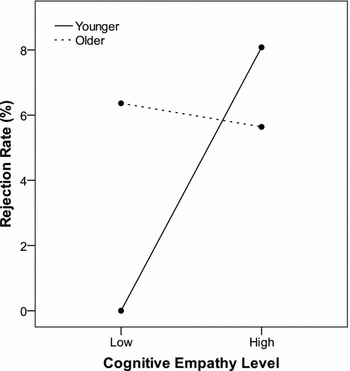
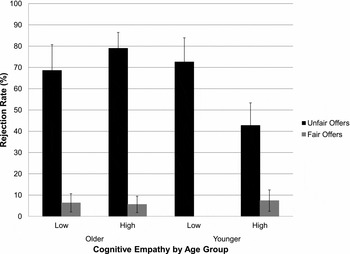
The results of the repeated measures ANOVA revealed that there was a main effect of offer type, signifying that “unfair” offers were rejected at a higher rate than “fair” offers irrespective of age-group (“Unfair” Offers: M = 64.02, SE = 5.62; “Fair”: M = 5.36, SE = 2.1; F(1,34) = 117.12, p < 0.001, η р2 = 0.78). Because “fair” offers were rejected at such a low rate, this resulted in low variability either between or within the groups for that category of offers (see Figures 1 and 2).
Rejection rate (%) of offers $5 and above (“fair” offers) as a function of age group (younger, older) and level of cognitive empathy (low, high). Cognitive empathy level is indicated by a median split on the IRI-PT subscale. This graph depicts estimated marginal means based upon the repeated measures ANOVA.

Rejection rate (%) by offer type (“unfair,” “fair”) as a function of age group and level of cognitive empathy. Uncorrected means are depicted and error bars represent standard error of the mean.

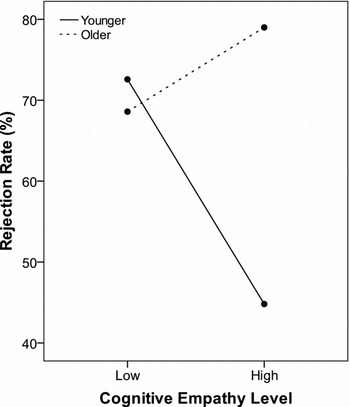
The age group × offer type × cognitive empathy interaction effect was found to be significant (F (1,34) = 4.31, p < 0.05, η р2 = 0.11, see Figures 1–3). No other effects were found to be significant (age group, F(1,34) = 1.90, p = 0.18, η р2 = 0.05; cognitive empathy, F(1,34) = .16, p = 0.69, η р2 = 0.01; offer type × age group, F(1,34) = 1.35, p = 0.25, η р2 = 0.04; offer type × cognitive empathy, F(1,34) = 1.19, p = 0.28, η р2 = 0.03; age group x cognitive empathy, F(1,34) = 1.41, p = 0.24, η р2 = 0.04).
Rejection rate (%) of offers below $5 (“unfair” offers) as a function of age group (younger, older) and level of cognitive empathy (low, high). This graph depicts estimated marginal means based upon the repeated measures ANOVA.

To further interpret the three-way age group × offer type × cognitive empathy interaction, post-hoc t-tests were computed based upon the study's hypotheses. Older Responders with high cognitive empathy were predicted to show more prosocial behavior (i.e. less rejection of “unfair” offers) than younger Responders with high cognitive empathy due to their prioritization of their relationships with others. To test this hypothesis, prosocial behavior on the UG in response to “unfair” offers was compared between older and younger Responders with high cognitive empathy. This comparison was statistically significant, but not in the expected direction. Specifically, older Responders with high cognitive empathy showed less prosocial behavior (i.e. more rejection of “unfair” offers) than younger Responders with high cognitive empathy (older-high empathy: M = 79% (SE = 7.46); younger-high empathy: M = 42.74% (SE = 10.60); t(20) = 2.69, p < 0.05, Cohen's d = 1.20, indicating a difference of large effect size). Among older adults, Responders with high cognitive empathy were hypothesized to show greater prosocial behavior than Responders with low cognitive empathy, due to their greater reported ability to understand the mental states of others. This comparison revealed that older Responders with high cognitive empathy do not significantly differ from older Responders with low cognitive empathy in their rejection rates of “unfair” offers (older-high empathy: M = 79 (SE = 7.46); older-low empathy: M = 68.59 (SE = 12.11); t(18) = 0.73, p = 0.47, Cohen's d = 0.35). In terms of prosocial behavior towards “fair” offers, no statistically significant differences were found between younger and older Responders who had low cognitive empathy (t(15) = 1.23, p = 0.24; Cohen's d = 0.63) or high cognitive empathy (t(20) = 0.27, p = 0.79; Cohen's d = 0.12.)
Effects of age and cognitive empathy on monetary payoff
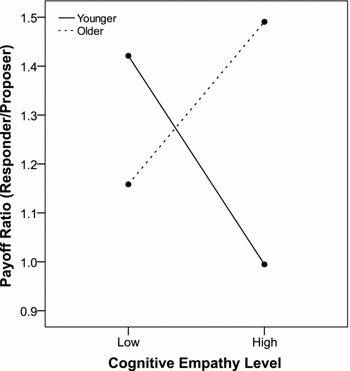
Next, age and cognitive empathy were examined for their effects on game outcome, as measured by the Payoff Ratio (Responder Payoff sum divided by Proposer Payoff sum). This measure was preferred over the Responder Payoff sum to account for the fact that each Responder may have received different offers from their Proposer partner. Payoff was quantified as the sum of all offers given to an individual that were accepted (i.e. rejected offers were not included). An ANOVA was conducted comparing the dependent variable Payoff Ratio as a function of the independent variables age group and cognitive empathy level. This analysis revealed an age group x cognitive empathy interaction (F(3,36) = 5.9, p < 0.05, η р2 = 0.14; Figure 4). The main effects for age group and cognitive empathy level did not reach the significance level of p < 0.05 (age group: F(3,36) = 0.56, p = 0.46, η р2 = 0.02; cognitive empathy level: F(3,36) = 0.09, p = 0.77, η р2 = 0.003).
Payoff Ratio (Responder Payoff divided by Proposer Payoff) as a function of age group (younger, older) and cognitive empathy (low, high). Payoff is the sum of all accepted offers. Estimated marginal means are depicted.

Follow-up analyses were conducted to examine the age group × cognitive empathy interaction. For those participants with high cognitive empathy, older Responders (M = 1.49, SE = 0.13) had a greater Payoff Ratio than younger Responders (M = .99, SE = 0.13; t(21) = 2.64, p < 0.05, Cohen's d = 1.15, indicating large effect size). In the older age group, Responders with high cognitive empathy did not differ in their Payoff Ratio from Responders with low cognitive empathy (older-high empathy: M = 1.49 (SE = 0.13); older-low empathy: M = 1.16 (SE = 0.13), t(18) = 1.77, p = 0.09, Cohen's d = 0.83).
In summary, the results indicated that rejection rate and payoff were affected by age, empathy, and fairness (i.e. “unfair” offers: less than half of the total; “fair” offers: half of the total or greater). Older adults reported lower cognitive empathy than younger adults. On average, “unfair” offers were rejected at a much higher rate than “fair” offers. For “unfair” offers, older Responders with high empathy showed less prosocial behavior than younger Responders with high empathy, and also obtained higher payoffs.
Discussion
The focus of the present study was the examination of age-related effects on economic decision-making in a social context as a function of empathy. Empathy and the rejection rate of “fair” and “unfair” offers on the UG-R were measured in younger and older healthy volunteers. Consistent with previous studies, the present study found that older adults reported lower cognitive empathy than younger adults (Sullivan and Ruffman, Reference Sullivan and Ruffman2004; Bailey et al., Reference Bailey, Henry and Von Hippel2008). Corroborating previous research on the UG in younger adults, the present study found that for both younger and older adults fairness played an important role in determining rejection rates (i.e. “unfair” offers were rejected at a significantly higher rate than “fair” offers which were rarely rejected; Slembeck, Reference Slembeck1999; Sanfey et al., Reference Sanfey, Rilling, Aronson, Nystrom and Cohen2003; Koenigs and Tranel, Reference Koenigs and Tranel2007).
Behavioral and payoff outcome differences on the game emerged as a function of age, cognitive empathy, and fairness. It was predicted that older adults with high cognitive empathy would show greater prosocial behavior (i.e. lower rejection rates of “unfair” offers) than younger adults with high cognitive empathy due to their greater motivation to maintain quality relationships with others (Carstensen et al., Reference Carstensen, Isaacowitz and Charles1999). Contrary to predictions, for “unfair” offers older adults with high cognitive empathy showed less prosocial behavior than younger adults with high cognitive empathy, and this difference was of large magnitude. Among the older age group, adults with low cognitive empathy were predicted to show less prosocial behavior than adults with high cognitive empathy due to their reduced ability to understand others’ mental states and their potential reliance on personal impressions of fairness instead. This comparison revealed no significant differences in prosocial behavior between older adults with low and high cognitive empathy. In terms of monetary payoffs based upon behavior on the UG, a large age-related difference was found in terms of the high cognitive empathy subgroups, whereby older adults with high cognitive empathy achieved greater payoffs than younger adults with high cognitive empathy. In summary, this study found that age-related differences in prosocial behavior emerged as a function of high cognitive empathy, whereby older Responders with high cognitive empathy showed less prosocial behavior and obtained greater payoffs than younger Responders with high cognitive empathy.
Fairness in the Ultimatum Game
In the context of the UG, rejection of offers less than an equal split is thought to be primarily driven by concerns for fairness and serves to promote more equitable behavior in subsequent interactions. This study extends previous research on the UG by demonstrating that fairness is a primary motivator of rejection rates in older as well as younger adults. In the Repeated Fixed Opponent UG, the present study showed that for both age groups there is a clear, sharp distinction between behavior on the “fair” offers (which are rarely rejected) and “unfair” offers (which are often rejected). This corroborates previous studies of both the UG-R and UG-1, which showed differential behavior towards “fair” versus “unfair” offers (Slembeck, Reference Slembeck1999; Sanfey et al., Reference Sanfey, Rilling, Aronson, Nystrom and Cohen2003; Koenigs and Tranel, Reference Koenigs and Tranel2007). The rejection of unfair offers has been described as a form of punishment for an unfair action that serves to promote future fair and cooperative behavior (Fehr and Fischbacher, Reference Fehr and Fischbacher2003), at a personal cost to the punisher. There is also evidence that inequitable offers elicit Responders’ anger (Pillutla and Murnighan, Reference Pillutla and Murnighan1996). Moreover, functional neuroimaging (Sanfey et al., Reference Sanfey, Rilling, Aronson, Nystrom and Cohen2003) and lesion studies (Koenigs and Tranel, Reference Koenigs and Tranel2007) have shown that responses to perceived inequitable treatment during the UG are linked to brain regions subserving emotion, including the insula and ventromedial prefrontal cortex.
Empathy in aging
The present study corroborates previous literature on empathy and theory of mind showing that older adults report lower cognitive empathy than younger adults on self-report trait measures of empathy (Bailey et al., Reference Bailey, Henry and Von Hippel2008). Most previous aging studies have focused specifically on the cognitive component of empathy and have shown through both self-report questionnaires and theory of mind tasks that older adults have lower cognitive empathy than younger adults (Sullivan and Ruffman, Reference Sullivan and Ruffman2004; Bailey et al., Reference Bailey, Henry and Von Hippel2008). However, the emotional component of empathy (i.e. the ability to experience the emotions of others as if one's own) has only been directly investigated in two studies that included similar older adult sample sizes to the present study (N = 30, Phillips et al., Reference Phillips, MacLean and Allen2002; N = 49, Bailey et al., Reference Bailey, Henry and Von Hippel2008). In line with the results of the present study, Bailey et al. (Reference Bailey, Henry and Von Hippel2008) showed no significant age-related difference in emotional empathy, while Phillips et al. (Reference Phillips, MacLean and Allen2002) did initially show an age-related difference but this age effect was no longer significant when intelligence and education were included as covariates.
Empathy, prosocial behavior, and economic decision-making
Empathy may play a role in the type of behavior exhibited during social economic decision-making. Individuals with high state empathy after empathic induction show more generous behavior, as demonstrated through higher UG offers (Barraza and Zak, Reference Barraza and Zak2009), suggesting that higher levels of empathy in general lead to more prosocial behavior on economic games. Further, people with high dispositional empathy who have undergone an increase in serotonin levels (a neurotransmitter associated with prosocial behavior; Crockett et al., Reference Crockett, Clark, Hauser and Robbins2010) show increased prosocial behavior (e.g. reduced rejection of “unfair” offers on the UG) in comparison to people with either lower dispositional empathy or those who received a drug to enhance noradrenaline function instead (implicated in executive function capacity; Crockett et al., Reference Crockett, Clark, Hauser and Robbins2010). However, the relationship between empathy and prosocial behavior on economic games is not necessarily direct, as research has shown that fairness modulates empathy towards others (Singer et al., Reference Singer, Seymour, O'Doherty, Stephan, Dolan and Frith2006). For instance, in the sequential Prisoner's Dilemma Game, men showed less functional brain activity in empathy-associated regions (e.g. insula) when seeing an “unfair” player in pain in comparison to a “fair” player (Singer et al., Reference Singer, Seymour, O'Doherty, Stephan, Dolan and Frith2006), suggesting that perception of fairness may affect the degree of empathy experienced towards others. As a whole, the previous literature suggests that high levels of empathy lead to more prosocial behavior during economic decision-making.
Aging, cognitive empathy, and economic decision-making
In the present study, there were age-related differences on the UG as a function of fairness and empathy. Although it was expected that older adults with high cognitive empathy would show greater prosocial behavior than younger adults with high cognitive empathy, instead they showed less. This finding may be partially explained by considering the heterogeneity of emotion function in aging and by taking a closer look at the type of relationships older adults prioritize. In general, older adults have shown lower cognitive empathy than younger adults (Sullivan and Ruffman, Reference Sullivan and Ruffman2004; Bailey et al., Reference Bailey, Henry and Von Hippel2008). However, research on emotion in aging has demonstrated that older adults’ performances can be heterogeneous (Stanley and Isaacowitz, Reference Stanley and Isaacowitz2011). Thus, those older adults who do have higher cognitive empathy may be a high-functioning older subgroup. As cognitive empathy has been shown to be related to executive functions (German and Hehman, Reference German and Hehman2006), older adults with higher cognitive empathy may enjoy greater planning, cognitive flexibility, and, in the end, better overall decision-making than older adults with low empathy. Furthermore, although older adults have been shown to prioritize relationships with others, typically this is thought to be specific to close personal relationships rather than interactions with strangers (Carstensen et al., Reference Carstensen, Isaacowitz and Charles1999). Because the social interaction in this study is more similar to interacting with strangers, older adults may not have been as “socially” motivated as they would be with a close other. Thus for older adults in the present study, behavior appears to be better explained by cognitive empathy level than a motivation to enhance relationship quality with others.
Rationale regarding why high levels of cognitive empathy may be associated with low prosocial behavior in older adults may be partially explained by the fact that certain components of empathy may affect prosocial behavior differentially. Cognitive empathy as a dispositional trait, or the tendency to adopt another's mental state to understand their thoughts and feelings (Davis, Reference Davis1979), has been associated with social competence (Davis, Reference Davis1983). On the other hand, dispositional emotional empathy, the tendency to experience vicariously the emotional state of another person (Davis, Reference Davis1979), is often associated with experiencing emotions towards others’ situations (Davis, Reference Davis1983). Although it has been generally found that empathy is associated with prosocial behavior (Batson and Moran, Reference Batson and Moran1999; Barraza and Zak, Reference Barraza and Zak2009; Crockett et al., Reference Crockett, Clark, Hauser and Robbins2010), most studies examining this issue in economic decision-making have measured empathy as a unidimensional construct (without differentiating cognitive and emotional components; Barraza and Zak, Reference Barraza and Zak2009; Crockett et al., Reference Crockett, Clark, Hauser and Robbins2010). Thus, the specific relationship between cognitive empathy and prosocial behavior on the ultimatum game has not been examined.
Since cognitive empathy facilitates the detection of another person's mental state, this information may be used in different ways depending on the individual's motivational state. For example, it could be used in economic decision-making to: (1) benefit the self, or (2) benefit others. Therefore in the context of the present UG, older adults with high cognitive empathy may have used this ability to maximize their own gain, as they showed higher rejection rates of “unfair” offers and higher payoffs than younger adults with high empathy. In contrast, the low rejection rates of “unfair” offers and low payoffs of the younger group with high empathy may indicate a tendency to benefit others through generous or prosocial behavior. Consequently, high cognitive empathy may play different roles in younger and older adults’ social economic decision-making. While older adults may employ this ability to obtain higher financial payoffs on the ultimatum game, younger adults may utilize it to behave in a prosocial manner towards their opponents.
Limitations and future directions
This study has some limitations. Older adult participants were highly educated and may not be representative of the entire US population but are consistent with the population of a small Midwestern university city. Participants were not randomly selected for the study but were volunteers responding to an advertisement. As a consequence, individuals seeking out social interaction (including through participation in a research study) may be over-represented. The present study focused on social economic decision-making in aging involving interactions with strangers. Further research should be aimed at replicating these findings in the case where the Proposer and Responder share a social relationship (e.g. spouse or friend). To isolate age-related effects on decision-making, the present study utilized participant pairings in which individuals played opponents from their own age group (i.e. older adults were paired with older adults while younger adults were paired with other younger adults). Nonetheless, in everyday life older adults interact constantly with younger adults. Consequently, further research should extend to examine this question. Offers in the present study were divided into “fair” and “unfair” categories based upon the general notion in the literature that “fair” offers are those which include an equal split of the total while “unfair” offers include those in which the Responder receives less than half of the total. However, it could be that individuals with low empathy may have higher standards for fairness (e.g. $5 out of $10 for a lower empathy individual vs. $3 out of $10 for a higher empathy individual) due to their tendency to be less able to discern another person's feelings, and consequently their standard of fairness may reflect a higher level of self-interest. Thus, future research may consider whether empathy may affect the level at which offers are considered to be unfair.
Conclusions
The findings in the present study may have important implications for understanding social decision-making behavior among older and younger adults. Older and younger adults may differ in the manner in which they make economic decisions based on their level of dispositional cognitive empathy. Older adults with higher levels of cognitive empathy showed higher rejection rates of “unfair” offers and higher financial payoffs than younger adults with higher levels of cognitive empathy. Therefore increasing cognitive empathy levels in older adults with lower dispositional cognitive empathy may have both financial and social benefits. In contrast, for younger adults, the finding suggests that having greater cognitive empathy may not necessarily serve to benefit them financially during economic decision-making, but instead may primarily serve to facilitate building social relationships. Taken together, these findings suggest that both younger and older adults should consider their personal goals when entering into economic decision-making (whether they are to obtain the maximum monetary reward or to enhance social relationships) because one's personal cognitive empathy level may affect both financial and social outcomes.
Conflict of interest
None.
Description of authors’ roles
J. Beadle designed the study, collected and analyzed the data, and wrote the paper. S. Paradiso was involved in designing the study, data analysis, interpreting the results, and writing the paper. C. Kovach assisted with statistical design and analysis, and writing the paper. L. Polgreen contributed to statistical analysis and writing the paper. N. Denburg assisted with writing the paper. D. Tranel assisted with designing the study, interpreting the results, and writing the paper.
Acknowledgments
We thank Erika Holm-Brown and Brian Keady for their assistance in the process of data collection. J. Beadle received fellowship support through the Brandeis University Neuroscience Program training grant from the National Institutes of Health (T32 NS007292). S. Paradiso was supported by the National Institute on Aging (5K23AG027837), the Mallinckrodt and Dana foundations and by NARSAD. D. Tranel was supported by the National Institute on Drug Abuse (R01 DA022549) and the National Institute of Neurological Disorders and Stroke (P50 NS19632).