Introduction
Reducing the harm of tobacco use requires the prevention of non-smokers from commencing smoking, as well as supporting current smokers to quit, through the use of behavioural counselling and smoking cessation medications. Varenicline (Champix®/Chantix®) is the most effective medication marketed as a smoking cessation aid, and has demonstrated superior efficacy both in clinical trials and in clinical practice to alternative therapies, such as Nicotine Replacement Therapy and Bupropion (Cahill, Stevens, Perera, & Lancaster, Reference Cahill, Stevens, Perera and Lancaster2013).
However, even when utilised correctly alongside behavioural therapies, abstinence rates in clinical settings still fall short, with smokers usually requiring multiple quit attempts to achieve long-term abstinence and avoid relapse. Several factors affect the efficacy of varenicline as a smoking cessation aid, including a lack of accessibility and affordability, intolerable adverse events, poor medication adherence, post-treatment cravings and withdrawal symptoms, or a patient perception of a lack of efficacy or need for the medication (Catz et al., Reference Catz, Jack, McClure, Javitz, Deprey and Zbikowski2011; Fiore et al., Reference Fiore, Jaen, Baker, Bailey, Benowitz and Curry2008).
Modifying the standard varenicline regimen may influence not only the likelihood of prolonged smoking abstinence, but also the ease of achieving initial abstinence by reducing the occurrence and severity of adverse events, cravings, and withdrawal symptoms commonly experienced. Some modifications tested in clinical trials have resulted in changes in standard clinical practice, whilst others have been discarded, while some require further research to determine practicality and implementation into clinical practice (Catz et al., Reference Catz, Jack, McClure, Javitz, Deprey and Zbikowski2011; Rennard et al., Reference Rennard, Hughes, Cinciripini, Kralikova, Raupach and Arteaga2012; Tonstad et al., Reference Tonstad, Tǿnnesen, Hajek, Williams, Billing and Reeves2006).
This systematic review evaluates smoking cessation outcomes from published randomised clinical trials (RCTs), which have evaluated smokers’ responses to modifications in the varenicline regimen. Methods of dose modification will be discussed individually, including their impact on quit rate, adverse event, cravings, and withdrawal symptoms, allowing conclusions to be drawn and recommendations for further research to be made.
Questions to be answered from this systematic review include: (1) What modifications to standard varenicline dosing have been trialled? (2) Which of these modifications have been shown to improve efficacy and contributed to clinical practice guidelines for the use of varenicline in smoking cessation? (3) Which modifications have been ineffective in improving smoking cessation compared to placebo? (4) Which modifications have insufficient results and require further research to determine effectiveness in promoting smoking cessation rates?
Methodology
This systematic review was written according to the PRISMA (Preferred Reporting Items for Systematic Reviews and Meta-Analyses) guidelines (Moher, Liberati, Tetzlaff, & Altman, Reference Moher, Liberati, Tetzlaff and Altman2009).
Eligibility Criteria
English language peer-reviewed studies were included if they: (1) were published randomised controlled trials, (2) administered varenicline to participants in a regimen different from the standard, (3) enrolled only smokers who were motivated to quit smoking and had at least moderate nicotine dependence (a mean score of at least 5 on the Fagerstrӧm Test for Nicotine Dependence [FTND]), and (4) biochemically confirmed participant smoking status by measuring end-expiratory carbon monoxide, with a cut-off value of 10ppm, at the end of treatment and at the end of the study. In this review, the standard regimen is considered as 12 weeks of therapy, with a one-week dose titration of 0.5mg once daily for 3 days, then 0.5mg twice daily for 4 days, at which point the target quit date (TQD) is set, followed by 1.0mg twice weekly for 11 weeks.
Search Strategy
RCTs were found using the following search terms with iterations of similar terms in brackets; ‘varenicline randomized (randomised) (RCT)’, ‘varenicline quit rates (efficacy) (abstinence)’, ‘varenicline safety (adverse effects) (adverse events) (side effects)’, ‘varenicline smoking cessation (quitting) (quit)’. The following databases were searched up to June 2016: PubMed, Medscape, CINAHL, ClinicalTrials.gov, Web of Science, and the Cochrane Collaboration. Titles and abstracts were read to identify potentially relevant RCTs, followed by full-article reading to confirm eligibility. References of eligible RCTs were scanned to identify potential additional studies for inclusion. Three tobacco-dedicated journals (Tobacco Control, Nicotine and Tobacco Research, and Journal of Smoking Cessation) were also scanned to identify articles not retrieved through the primary search.
Data Collection and Outcome Measures
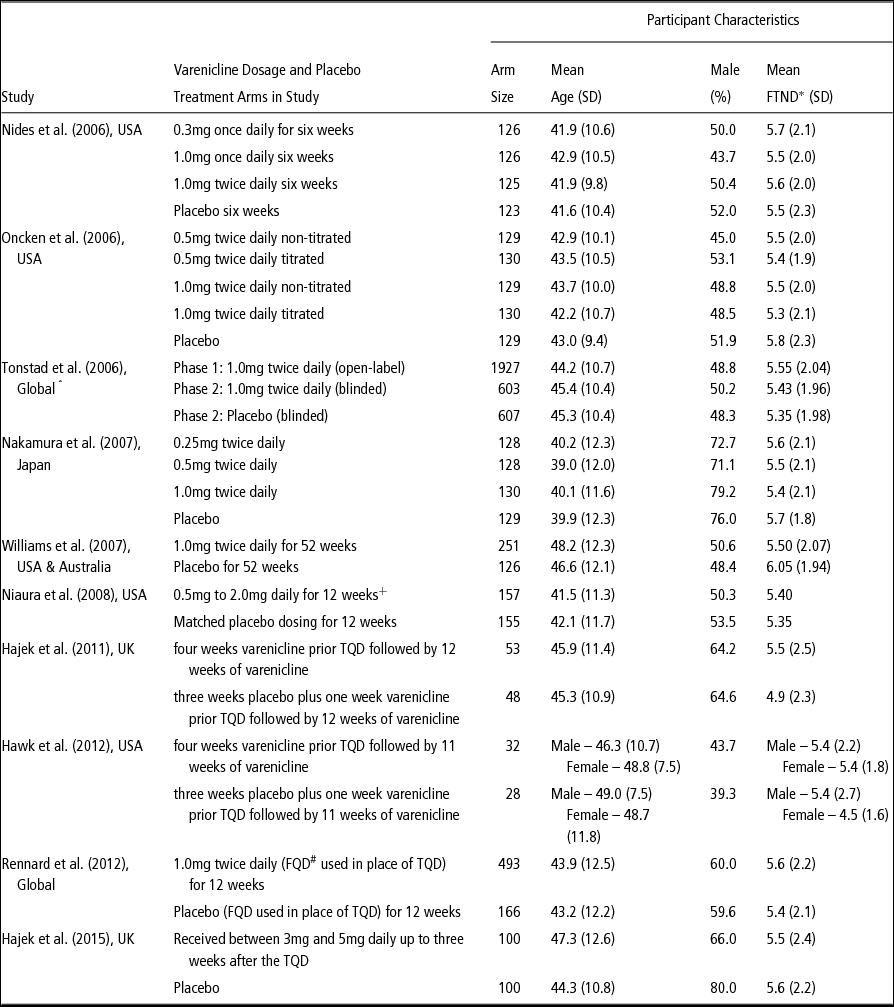
The authors ADD and BMA independently assessed data for extraction, with disagreements resolved by consensus. Data items included: main author and year of publication, country of participant enrolment, varenicline and matching placebo regimens used, participant numbers per study arm, the mean age of participants, gender distribution in each study, and the mean Fagerström Test for Nicotine Dependence score. These data are summarized in Table 1.
Summary of participant demographics of studies included in this systematic review

*Fagerström Test for Nicotine Dependence # Flexible Quit Date.
+Niaura et al. (Reference Niaura, Hays, Jorenby, Leone, Pappas and Reeves2008) evaluated patient-determined flexible daily dosing.
^Tonstad et al. (Reference Tonstad, Tǿnnesen, Hajek, Williams, Billing and Reeves2006) recruited from the USA, Canada, and several European countries.
Primary outcome measures included carbon monoxide-confirmed continuous abstinence rates (CAR) and 7-day point prevalence abstinence rates, changes in cravings and withdrawal symptoms, rates and reasons for premature discontinuation from treatment, and adverse event rates. Secondary outcome measures include the effects of dose modification on smoking reward and smoking behaviours reported throughout the eligible studies.
Results
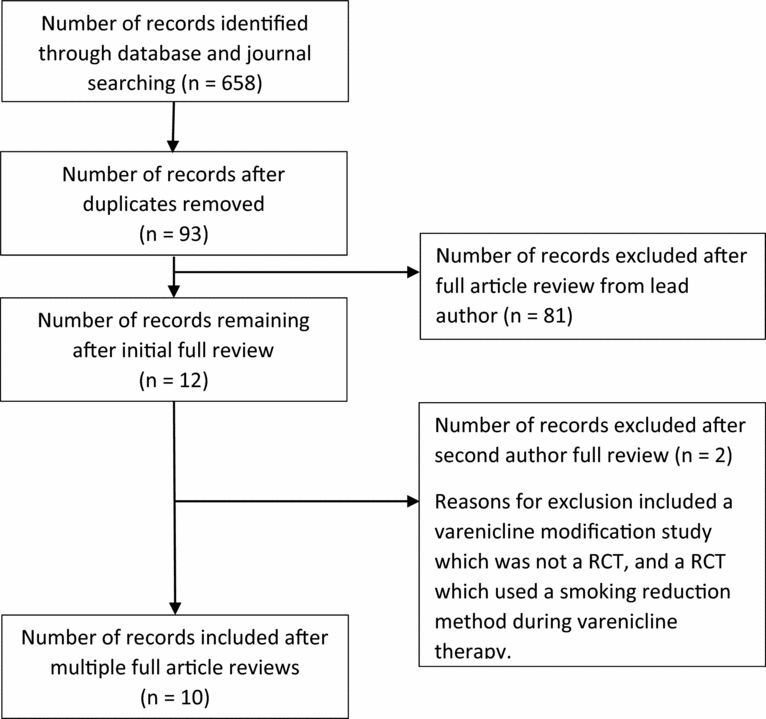
The search strategy initially identified 658 articles, with 93 remaining after the removal of duplicates. After full review by ADD, a further 81 were excluded due to ineligibility, leaving 12 articles. A final two were excluded after a secondary full text review by BMA and subsequent consensus. This resulted in ten RCTs matching the eligibility criteria for inclusion in this systematic review (see Figure 1).
Flow chart of the literature search for this systematic review.

Quality Assessment and Risk of Bias
The ‘Jadad scale for reporting randomised controlled trials’ was used to assess RCT quality in this systematic review (Jadad et al., Reference Jadad, Moore, Carroll, Jenkinson, Reynolds and Gavaghan1996). 8 of the 10 RCTs scored the maximum score of 5, having adequately explained their randomisation and blinding procedures, and fully accounted for the status of all participants during their respective studies. Two studies failed to clarify their method of randomisation, resulting in a Jadad score of 4 out of 5 (Oncken et al., Reference Oncken, Gonzales, Nides, Rennard, Watsky and Billing2006; Williams, Reeves, Billing, Pennington, & Gong, Reference Williams, Reeves, Billing, Pennington and Gong2007).
A total of 5,298 smokers are included in this systematic review, with 3,687 smokers in the interventional groups, and 1,611 smokers in the control groups. Seven studies recruited smokers from the USA and UK, one study recruited smokers within Japan (Nakamura et al., Reference Nakamura, Oshima, Fujimoto, Maruyama, Ishibasi and Reeves2007), one study recruited smokers from the USA, Canada, and several European countries (Tonstad et al., Reference Tonstad, Tǿnnesen, Hajek, Williams, Billing and Reeves2006), and one study recruited smokers from North America, South America, Asia, and Europe (Rennard et al., Reference Rennard, Hughes, Cinciripini, Kralikova, Raupach and Arteaga2012). The average-age range of recruited smokers was between 39.9 and 48.2 years old, with an average-FTND range of 4.90–6.05.
Varenicline dose modification methods identified and evaluated included: three trials which compared several different daily doses of varenicline (Nakamura et al., Reference Nakamura, Oshima, Fujimoto, Maruyama, Ishibasi and Reeves2007; Nides et al., Reference Nides, Oncken, Gonzales, Rennard, Watsky and Anziano2006; Oncken et al., Reference Oncken, Gonzales, Nides, Rennard, Watsky and Billing2006), two trials which used an extended duration of varenicline therapy (Tonstad et al., Reference Tonstad, Tǿnnesen, Hajek, Williams, Billing and Reeves2006; Williams et al., Reference Williams, Reeves, Billing, Pennington and Gong2007), one trial which evaluated patient-controlled flexible daily dosing (Niaura et al., Reference Niaura, Hays, Jorenby, Leone, Pappas and Reeves2008), one trial which evaluated flexible quit dates between weeks 1 and 5 of therapy (Rennard et al., Reference Rennard, Hughes, Cinciripini, Kralikova, Raupach and Arteaga2012), two trials which increased the duration of varenicline therapy to 4 weeks prior to quitting (Hajek, McRobbie, Myers, Stapleton, & Dhangi, Reference Hajek, McRobbie, Myers, Stapleton and Dhangi2011; Hawk et al., Reference Hawk, Ashare, Lohnes, Schlienz, Rhodes and Tiffany2012), and one trial which increased the daily varenicline dose above the standard maintenance dose of 2mg/day (Hajek et al., Reference Hajek, McRobbie, Smith, Phillips, Cornwall and Dhanji2015).
Abstinence Rates
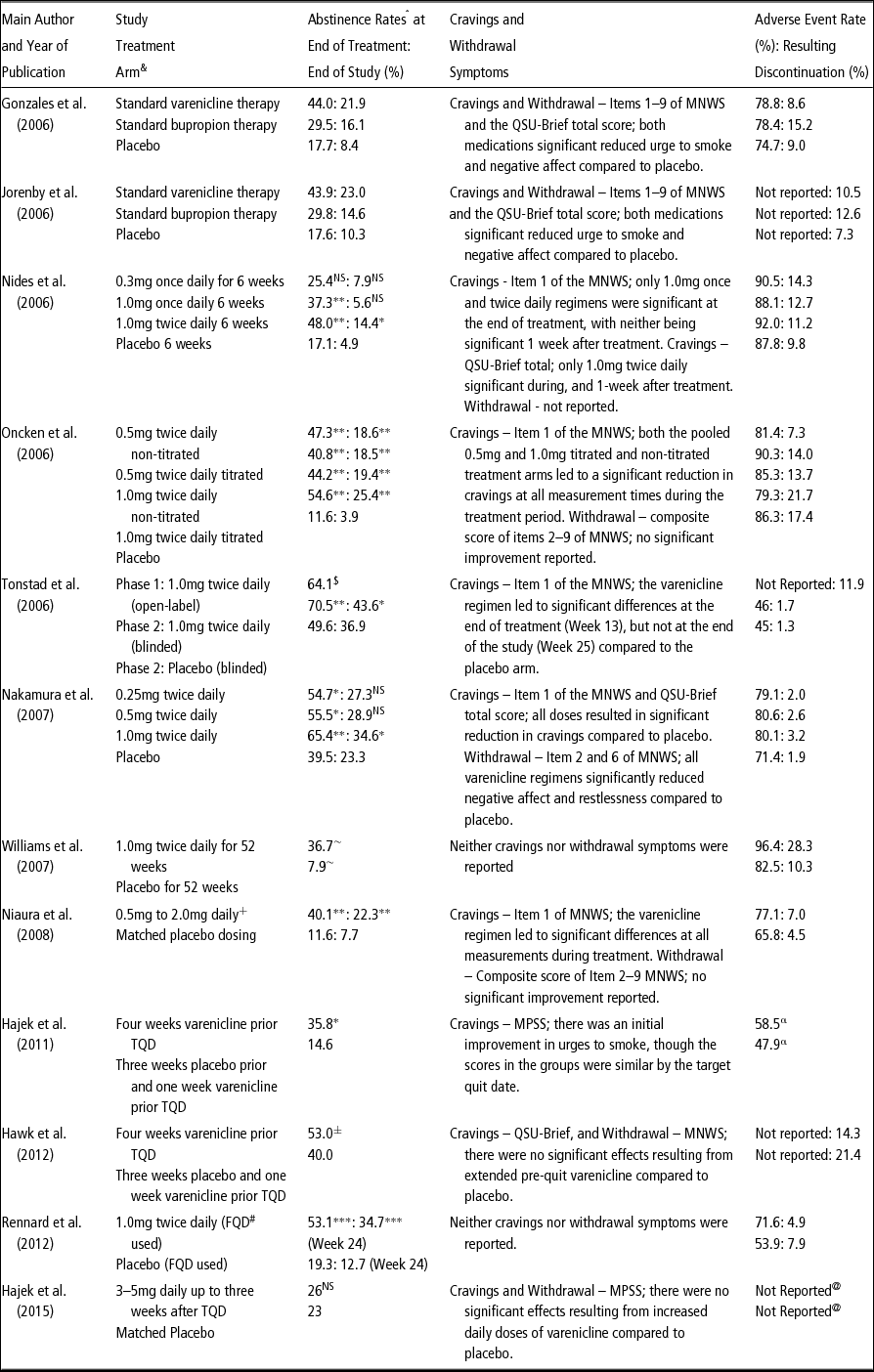
The end of treatment and the end of study abstinence rates, changes in cravings, withdrawal symptoms, adverse events, and resulting discontinuations were of primary interest in this systematic review. These results, alongside the results of two phase three comparative clinical trials by Gonzales et al. (Reference Gonzales, Rennard, Nides, Oncken, Salomon and Billing2006) and Jorenby et al. (Reference Jorenby, Hays, Rigotti, Azoulay, Watsky and Williams2006) (both of which had end of study durations of 52 weeks) are summarized in Table 2. All 10 of the eligible RCTs reported outcome of efficacy for the interventional and control groups, through reporting 7-day point prevalence rates, four-week carbon monoxide CARs, or both.
Summary of primary outcomes of comparative studies, and studies included in this systematic review

^Abstinence rates included are 4-week carbon-monoxide confirmed continuous abstinence rates at the end of the treatment period and the end of the study (Week 52) unless otherwise stated.
+Niaura et al. (Reference Niaura, Hays, Jorenby, Leone, Pappas and Reeves2008) evaluated patient-determined flexible daily dosing.
#Flexible Quit Date & Treatment durations are the standard of 12 weeks unless otherwise stated.
NSResults were not statistically significant compared to placebo in the same study (p>.05).
$Those who successfully quit during Phase 1 were randomized to either a varenicline or placebo in Phase 2.
*p<0.05 ** p<0.01 ***p<0.001.
~Williams et al. (Reference Williams, Reeves, Billing, Pennington and Gong2007) reported abstinence using 7-day point prevalence rates, with both the treatment period and study period being 52 weeks long (no follow-up).
±The overall effect was not significant in the extended run-in group, though the effect in women was statistically significant (67% vs. 35%, OR = 4.3, 95% CI 0.978–18.65, p=.05).
αHawk (Reference Hawk, Ashare, Lohnes, Schlienz, Rhodes and Tiffany2012) only reported on nausea, and did not report discontinuations from therapy.
@Hajek et al. (Reference Hajek, McRobbie, Smith, Phillips, Cornwall and Dhanji2015) did not report therapy discontinuations, nor adverse event rate, but did display a table of adverse events with only nausea, vomiting, and decreased appetite significantly higher in the varenicline group.
Of the three trials, comparing different daily doses of varenicline against placebo (Nakamura et al., Reference Nakamura, Oshima, Fujimoto, Maruyama, Ishibasi and Reeves2007; Nides et al., Reference Nides, Oncken, Gonzales, Rennard, Watsky and Anziano2006; Oncken et al., Reference Oncken, Gonzales, Nides, Rennard, Watsky and Billing2006), most doses produced statistically significant improvements in end of treatment CARs against placebo. In Nides et al. (Reference Nides, Oncken, Gonzales, Rennard, Watsky and Anziano2006), the end of treatment CAR, odds ratio (OR) and 95% confidence interval (CI) for the 1.0mg once daily and 1.0mg twice daily regimens compared to placebo was 37.3% vs. 17.1% (OR 2.97 [CI 1.63–5.40], p≤.001) and 48.0% vs. 17.1% (OR 4.71 [CI 2.60–8.53], p<.001), respectively, after applying the Dunnett adjustment for multiple comparisons. Oncken et al. (Reference Oncken, Gonzales, Nides, Rennard, Watsky and Billing2006) reported that both pooled treatment groups were superior to placebo, with the end of treatment pooled 0.5mg twice daily and 1.0mg twice daily treatment arms being 44.0% vs. 11.6% (OR 6.32 [CI 3.47–11.50], p<.001) and 49.4% vs. 11.6% (OR 8.07 [CI 4.42–14.70], p<.001), respectively. Nakamura et al. (Reference Nakamura, Oshima, Fujimoto, Maruyama, Ishibasi and Reeves2007) also reported superiority of all treatment groups compared to placebo, with the 0.25mg twice daily, 0.5mg twice daily, and 1.0mg twice daily treatment arms compared to placebo being 54.7% vs. 39.5% (OR 1.88 [CI 1.14–3.12], p=.013), 55.5% vs. 39.5% (OR 1.94 [1.17–3.22], p=.01), and 65.4% vs. 39.5% (OR 2.98 [1.78–4.99], p<.001), respectively.
However, two of the trials found only the 1.0mg twice daily varenicline regimen to be statistically superior to placebo by the end of the study at week 52 (Nakamura et al., Reference Nakamura, Oshima, Fujimoto, Maruyama, Ishibasi and Reeves2007; Nides et al., Reference Nides, Oncken, Gonzales, Rennard, Watsky and Anziano2006) with CARs of 14.4% vs. 4.9% (p=.002), and 34.6% vs. 23.3% (OR 1.81 [CI 1.04–3.17], p=.036), respectively. Oncken et al. (Reference Oncken, Gonzales, Nides, Rennard, Watsky and Billing2006) reported that both pooled treatment arms retained their superiority to placebo at the end of the study, with the 0.5mg treatment arms and 1.0mg treatment arms compared to placebo being 18.5% vs. 3.9% (p<.001) and 22.4% vs. 3.9% (p<.001), respectively.
Extension of varenicline therapy past the standard 12-weeks led to a significant increase in end of study and end of treatment CAR (Tonstad et al., Reference Tonstad, Tǿnnesen, Hajek, Williams, Billing and Reeves2006), reporting end of treatment and end of study CAR for the phase 2 treatment compared to the placebo group of 70.5% vs. 49.6% (OR 2.48 [CI 1.95–3.16], p<.001) and 43.6% vs. 36.9% (OR 1.34 [CI 1.06–1.69], p=.02), respectively. Williams et al. (Reference Williams, Reeves, Billing, Pennington and Gong2007) reported end of study 7-day point prevalence rates of 36.7% for the treatment group and 7.9% for the placebo group, though no statistical comparison was made.
Allowing a flexible or patient-controlled regimen resulted in significantly increased CAR compared to placebo (Niaura et al., Reference Niaura, Hays, Jorenby, Leone, Pappas and Reeves2008; Rennard et al., Reference Rennard, Hughes, Cinciripini, Kralikova, Raupach and Arteaga2012). The end of treatment CAR was 40.1% vs. 11.6% (OR 5.66 [CI 3.08–10.40], p<.001), and end of study CAR was 22.3% vs. 7.7% (OR 3.75 [CI 1.82–7.76], p<.001) at week 52 in the varenicline and placebo groups, respectively, in Niaura et al. (Reference Niaura, Hays, Jorenby, Leone, Pappas and Reeves2008), and 53.1% vs. 19.3% (OR 5.9 [CI 3.7–9.4], p<.0001) and 34.7% vs. 12.7% (OR 4.4 [CI 2.6–7.5], p<.0001) at week 24 in Rennard et al. (Reference Rennard, Hughes, Cinciripini, Kralikova, Raupach and Arteaga2012). Increasing the daily varenicline dose above 2mg/day did not improve CARs at any time point in the study by Hajek et al. (Reference Hajek, McRobbie, Smith, Phillips, Cornwall and Dhanji2015). The authors reported CARs of 26% in the varenicline group compared to 23% in the placebo group at the end of the study, twelve weeks after the TQD.
Extending the pre-quit duration of varenicline from one to four weeks led to a limited improvement in CAR compared to placebo during the pre-quit period (Hajek et al., Reference Hajek, McRobbie, Myers, Stapleton and Dhangi2011; Hawk et al., Reference Hawk, Ashare, Lohnes, Schlienz, Rhodes and Tiffany2012). Hajek et al. (Reference Hajek, McRobbie, Myers, Stapleton and Dhangi2011) found CAR to be non-significant between the two treatment arms at week four at 49.1% vs. 33.3% (p=.11), but was significant at week 12 at 35.8% vs. 14.6% (p=.02). Hawk et al. (Reference Hawk, Ashare, Lohnes, Schlienz, Rhodes and Tiffany2012) found that only female smokers had significant improvement in CAR during the final four weeks of treatment with 67% vs. 35% (p=.05) abstinent, whereas male smokers had no improvement.
Cravings and Withdrawal Symptoms
All RCTs except for Williams et al. (Reference Williams, Reeves, Billing, Pennington and Gong2007) and Rennard et al. (Reference Rennard, Hughes, Cinciripini, Kralikova, Raupach and Arteaga2012) reported changes in participant nicotine cravings and withdrawal symptoms. Most daily doses of varenicline were significantly superior to placebo in preventing cravings (assessed through Item 1 of the Minnesota Nicotine Withdrawal Scale [MNWS] and the Questionnaire on Smoking Urges [QSU-Brief]) at the end of treatment (Nakamura et al., Reference Nakamura, Oshima, Fujimoto, Maruyama, Ishibasi and Reeves2007; Nides et al., Reference Nides, Oncken, Gonzales, Rennard, Watsky and Anziano2006; Oncken et al., Reference Oncken, Gonzales, Nides, Rennard, Watsky and Billing2006). Nides et al. (Reference Nides, Oncken, Gonzales, Rennard, Watsky and Anziano2006) reported that both the 1.0mg once daily and 1.0mg twice daily regimens significantly reduced cravings assessed through Item 1 of the MNWS (p<.05 and p<.001, respectively), though this effect did not extend past the end of the treatment. The QSU-Brief total score found that only the 1.0mg twice daily regimen significantly reduced cravings at the end of treatment, and one week after treatment was completed (p<.01).
Oncken et al. (Reference Oncken, Gonzales, Nides, Rennard, Watsky and Billing2006) reported both the pooled 0.5mg (p<.001) and 1.0mg (p<.001) titrated and non-titrated groups significantly reduced cravings throughout and at the end of treatment according to Item 1 of the MNWS. Nakamura et al. (Reference Nakamura, Oshima, Fujimoto, Maruyama, Ishibasi and Reeves2007) reported that all three regimens significantly reduced cravings between weeks one and seven of treatment for Items 1 of the MNWS and the total score of the QSU-Brief (p=.01 for the 0.25mg twice daily regimen for both scores, and p<.001 for the 0.5mg and 1.0mg twice daily regimens for both scores).
Withdrawal symptoms assessed by Items 2–9 of the MNWS in both Nides et al. (Reference Nides, Oncken, Gonzales, Rennard, Watsky and Anziano2006) and Oncken et al. (Reference Oncken, Gonzales, Nides, Rennard, Watsky and Billing2006) were mild, with no varenicline regimen showing any clear benefits. Nakamura et al. (Reference Nakamura, Oshima, Fujimoto, Maruyama, Ishibasi and Reeves2007) reported that increased appetite and insomnia were not significantly different between varenicline and placebo groups, though all three treatment groups (0.25mg twice daily, 0.5mg twice daily, and 1.0mg twice daily) significantly reduced negative affect (p=.046, p<.001, p<.001, respectively) and restlessness (p=.018, p<.001, p<.001, respectively).
Allowing a patient-controlled flexible regimen also led to a significant reduction in urges to smoke (Item 1 of MNWS) during and at the end of treatment (p<.01) compared to placebo (Niaura et al., Reference Niaura, Hays, Jorenby, Leone, Pappas and Reeves2008). Withdrawal however (Items 2 to 9 of MNWS) was not significantly different between the varenicline and placebo groups. Extending the duration of varenicline therapy did not significantly reduce cravings one week post-treatment (Tonstad et al., Reference Tonstad, Tǿnnesen, Hajek, Williams, Billing and Reeves2006). Extending the duration of pre-quit varenicline also appeared to have no effect on cravings or withdrawal symptoms during the pre-quit period compared to placebo (Hajek et al., Reference Hajek, McRobbie, Myers, Stapleton and Dhangi2011; Hawk et al., Reference Hawk, Ashare, Lohnes, Schlienz, Rhodes and Tiffany2012). Increasing the daily varenicline dose above 2mg/day had no effect on frequency and intensity of cravings after the target quit date, and withdrawal symptoms, including any single withdrawal symptom, and the overall withdrawal score were similarly unaffected by the increased dosage (Hajek et al., Reference Hajek, McRobbie, Smith, Phillips, Cornwall and Dhanji2015).
Adverse Events and Discontinuations
Nine RCTs reported on the occurrence of adverse events and resulting discontinuations, while Hajek et al. (Reference Hajek, McRobbie, Smith, Phillips, Cornwall and Dhanji2015) only reported on the occurrence of nausea. The use of daily doses lower than the standard maintenance dose of 1.0mg twice daily indicated that the likelihood of experiencing any adverse event is not dose related, as seen in the last column of Table 2 (Nakamurai et al., Reference Nakamura, Oshima, Fujimoto, Maruyama, Ishibasi and Reeves2007; Nides et al., Reference Nides, Oncken, Gonzales, Rennard, Watsky and Anziano2006; Oncken et al., Reference Oncken, Gonzales, Nides, Rennard, Watsky and Billing2006). However, the incidence and severity of specific adverse events do appear to be either proportional or inversely proportional to daily varenicline dose. Nausea for instance, increased in incidence and severity with increases in daily dosing, whereas respiratory tract infections and appetite were decreased.
An extended duration of varenicline therapy did not lead to an adverse event incidence noticeably greater than other studies, with both Tonstad et al. (Reference Tonstad, Tǿnnesen, Hajek, Williams, Billing and Reeves2006) and Williams et al. (Reference Williams, Reeves, Billing, Pennington and Gong2007) stating that adverse events were most common within the first few weeks of therapy, and the onset of new adverse events after this period being infrequent. An extended pre-quit duration of varenicline therapy led to an initial increase in adverse event incidence in the active groups compared to the control groups, though this effect became insignificant once the control groups switched from placebo to varenicline therapy (Hajek et al., Reference Hajek, McRobbie, Myers, Stapleton and Dhangi2011; Hawk et al., Reference Hawk, Ashare, Lohnes, Schlienz, Rhodes and Tiffany2012). Allowing a patient-controlled daily dosing regimen or flexible quit dates resulted in a lower incidence of adverse events compared to other varenicline RCTs. Niaura et al. (Reference Niaura, Hays, Jorenby, Leone, Pappas and Reeves2008) reported an adverse event rate of 77.1% vs. 65.8%, and Rennard et al. (Reference Rennard, Hughes, Cinciripini, Kralikova, Raupach and Arteaga2012) reported 71.6% vs. 53.9% in the varenicline and placebo groups, respectively.
Smoking Reward
Six RCTs (Hajek et al., Reference Hajek, McRobbie, Myers, Stapleton and Dhangi2011; Hawk et al., Reference Hawk, Ashare, Lohnes, Schlienz, Rhodes and Tiffany2012; Nakamura et al., Reference Nakamura, Oshima, Fujimoto, Maruyama, Ishibasi and Reeves2007; Niaura et al., Reference Niaura, Hays, Jorenby, Leone, Pappas and Reeves2008; Nides et al., Reference Nides, Oncken, Gonzales, Rennard, Watsky and Anziano2006; Oncken et al., Reference Oncken, Gonzales, Nides, Rennard, Watsky and Billing2006) used the modified cigarette evaluation questionnaire (mCEQ) to assess changes in smoking satisfaction and reward during varenicline therapy. Nides et al. (Reference Nides, Oncken, Gonzales, Rennard, Watsky and Anziano2006) reported that only the 1.0mg twice daily regimen significantly reduced smoking satisfaction (p<.001), respiratory tract sensations (p<.05), and intensified cigarette aversion (p<.01) compared to placebo. Oncken et al. (Reference Oncken, Gonzales, Nides, Rennard, Watsky and Billing2006) reported that both the pooled 0.5mg twice daily and 1.0mg twice daily varenicline regimens reduced psychological reward (p<.01 each), smoking satisfaction (p<.001 each), and enjoyment (p<.001 each) by week seven of treatment compared to placebo. All varenicline regimens in Nakamura et al. (Reference Nakamura, Oshima, Fujimoto, Maruyama, Ishibasi and Reeves2007) (0.25mg twice daily, 0.5mg twice daily, and 1.0mg twice daily) significantly inhibited feelings of psychological reward (p=.036, p<.001, p<.001, respectively), respiratory tract sensations (p=.004, p<.001, p<.001, respectively) and cigarette aversion (p<.001, p<.001, p=.007, respectively) compared to placebo, however only the 0.5mg twice daily and 1.0mg twice daily regimens produced significant reductions in smoking satisfaction (p<.001, p<.001, respectively).
Extended pre-quit varenicline led to a significant reduction in the enjoyment of the sensation of smoking (p=.001) and enjoyment of smoking (p<.05) (Hajek et al., Reference Hajek, McRobbie, Myers, Stapleton and Dhangi2011), and a significant reduction in the ‘rush’ provided by smoking (p=.009) (Hawk et al., Reference Hawk, Ashare, Lohnes, Schlienz, Rhodes and Tiffany2012) during the pre-quit period compared to placebo. Patient-controlled daily dosing led to a short-term reduction in smoking satisfaction during weeks 2–5 (p<.05), though this effect (and enjoyment of respiratory tract sensations) was insignificant by the end of treatment (Niaura et al., Reference Niaura, Hays, Jorenby, Leone, Pappas and Reeves2008).
Smoking Behaviour
Four RCTs (Hajek et al., Reference Hajek, McRobbie, Myers, Stapleton and Dhangi2011; Hawk et al., Reference Hawk, Ashare, Lohnes, Schlienz, Rhodes and Tiffany2012; Rennard et al., Reference Rennard, Hughes, Cinciripini, Kralikova, Raupach and Arteaga2012; Tonstad et al., Reference Tonstad, Tǿnnesen, Hajek, Williams, Billing and Reeves2006) reported on changes in participant smoking behaviours during participation. An extended treatment duration in the study by Tonstad et al. (Reference Tonstad, Tǿnnesen, Hajek, Williams, Billing and Reeves2006) led to significant changes in the median time to first lapse, with the varenicline median being twice as long at 198 days (95% CI 159–260, p<.001) compared to placebo of 87 days (95% CI 58–143). Rennard et al. (Reference Rennard, Hughes, Cinciripini, Kralikova, Raupach and Arteaga2012) allowed a flexible quit date for participants and reported that there was no significant difference between the varenicline and placebo groups in the percentage of participants who had quit by the target date. There was however a significant difference in the timing of first quit attempts, with a median first quit day of 17 days for the varenicline group compared to 24 days for the placebo group (p=.0074).
Both Hajek et al. (Reference Hajek, McRobbie, Myers, Stapleton and Dhangi2011) and Hawk et al. (Reference Hawk, Ashare, Lohnes, Schlienz, Rhodes and Tiffany2012) reported the effect of extended pre-quit treatment on smoke intake during the ad lib smoking period (prior the TQD). Hajek et al. (Reference Hajek, McRobbie, Myers, Stapleton and Dhangi2011) reported that during the first week of treatment, when the daily dose was only 1mg, there was little effect on smoking behaviour. However, after three weeks of treatment, participants receiving varenicline had reduced their smoking intake significantly more than participants receiving placebo (p=.02). Hawk et al. (Reference Hawk, Ashare, Lohnes, Schlienz, Rhodes and Tiffany2012) found that men received no benefit from extended pre-quit varenicline therapy, while women did experience a significant reduction in smoking intake from week three of treatment onwards compared to those assigned to the standard duration of pre-quit varenicline (p=.003).
Discussion
This systematic review reported on smoking cessation outcomes for participants enrolled in RCTs where varenicline was administered differently from the standard regimen. Four types of varenicline therapy modification were included: (1) increased therapy duration, (2) increased duration of pre-quit therapy, (3) patient-controlled quit dates or daily dosing, and (4) daily doses lower or higher than the standard maintenance dose.
Achieving prolonged smoking abstinence is difficult due to the withdrawal symptoms and cravings that occur during a quit attempt and the persistent cravings, which can lead to lapses and relapse years after achieving abstinence (Krall, Garvey, & Garcia, Reference Krall, Garvey and Garcia2002). The partial agonist activity of varenicline at the α4β2 nicotinic receptor is theorised to attenuate these effects, though RCTs have demonstrated that further efficacy is desired (Coe et al., Reference Coe, Brooks, Vetelino, Wirtz, Arnold and Huang2005). Making accurate comparisons between trials is difficult due to differences in trial design, conduct, and participant demographics. However, some trends were found resulting from modifications to the varenicline regimen, which would benefit from further research as to how they influence the success of varenicline therapy.
Extended Duration of Varenicline Therapy
Extending the duration of varenicline therapy led to 12-month CAR greater than those achieved in RCTs using the standard 12-week varenicline regimen (Gonzales et al., Reference Gonzales, Rennard, Nides, Oncken, Salomon and Billing2006; Jorenby et al., Reference Jorenby, Hays, Rigotti, Azoulay, Watsky and Williams2006, Rigotti et al., Reference Rigotti, Pipe, Benowitz, Arteaga, Garza and Tonstad2010; Tashkin et al., Reference Tashkin, Rennard, Hays, Ma, Lawrence and Lee2011). At the end of 12 weeks of therapy, these RCTs had reported CAR of between 42.3% and 47.0% for the varenicline group and between 8.8% and 17.8% for the placebo group. At 12 months, the CAR for these studies was between 18.6% and 23.5% for the varenicline groups and between 5.6% and 10.4% for the placebo groups.
The increase in CAR in Tonstad et al. (Reference Tonstad, Tǿnnesen, Hajek, Williams, Billing and Reeves2006) through extended treatment duration, neither results in an increase in adverse events reported, nor adverse-event attributable discontinuations compared to other RCTs. It should be noted that in the study by Tonstad et al. (Reference Tonstad, Tǿnnesen, Hajek, Williams, Billing and Reeves2006), there was an initial open-phase treatment period of 12-weeks, with only successful quitters during this period (64.1% of the Phase 1 participants) being enrolled into phase 2. Having successful quitters continue participation will have contributed to the higher CAR achieved, as demonstrated by the placebo week 52 CAR of 36.9%, which is 3- to 7-fold higher than other varenicline RCTs (Cahill et al., Reference Cahill, Stevens, Perera and Lancaster2013).
While the difference in the week 52 CAR between varenicline and placebo (28.8%) reported by William et al. (Reference Williams, Reeves, Billing, Pennington and Gong2007) was higher than in the study by Tonstad et al. (Reference Tonstad, Tǿnnesen, Hajek, Williams, Billing and Reeves2006), they did report a higher adverse event rate and attributable discontinuation rate during the 52 weeks of treatment. The majority of adverse events occurred within the first four weeks of treatment with events after this period being infrequent, possibly implying that the high discontinuation rate was due in part to the long treatment duration and a lack of participant persistence (Blaschke, Osterberg, Vrijens, & Urquhart, Reference Blaschke, Osterberg, Vrijens and Urquhart2012). The lack of a follow-up period in Williams et al. (Reference Williams, Reeves, Billing, Pennington and Gong2007) necessitates further research into the safety and efficacy of 12 months of continuous varenicline therapy. Follow-up at one week after the end of treatment found a 1.6% drop (4/251) in abstinence in the varenicline group and a 0.8% drop (1/126) in the placebo group, which is less than observed in other varenicline RCTs, including Tonstad et al. (Reference Tonstad, Tǿnnesen, Hajek, Williams, Billing and Reeves2006).
As well as being effective in initiating abstinence, extended treatment may also inhibit longer term lapses and relapse, with Tonstad et al. (Reference Tonstad, Tǿnnesen, Hajek, Williams, Billing and Reeves2006) reporting the median time to the first lapse after randomisation at the beginning of phase 2 was 198 days for the varenicline group and 87 days for the placebo group. Preventing lapses and relapse is an ongoing issue, as these undermine the already difficult task of achieving initial abstinence. A Cochrane review reported that extended varenicline therapy is effective in preventing relapse (Hajek et al., Reference Hajek, Stead, West, Jarvis, Hartmann-Boyce and Lancaster2013).
Extended Duration of Pre-Quit Therapy
Extending the pre-quit duration of varenicline did not appear to improve CARs compared to placebo, with the end of treatment four-week CAR being comparable to studies employing the standard regimen, and smoking behaviours being unaffected (Hajek et al., Reference Hajek, McRobbie, Myers, Stapleton and Dhangi2011; Hawk et al., Reference Hawk, Ashare, Lohnes, Schlienz, Rhodes and Tiffany2012). Both of these studies reported that they found no change in cravings or withdrawal symptoms between the varenicline and placebo groups during the pre-quit period, which are the main issues encountered during a quit attempt, likely leading to the lack of improved efficacy of varenicline. However, both studies had small participant numbers, with larger RCTs needed to confirm the ineffectiveness of this method of varenicline dose modification. Adverse events in these RCTs were similar to other RCTs, though Hawk et al. (Reference Hawk, Ashare, Lohnes, Schlienz, Rhodes and Tiffany2012) reported that women were more likely to experience nausea, possibly attributable to stopping smoking and not the varenicline therapy, as doses used during the extended pre-quit period were lower than in the standard regimen.
Patient-Controlled Therapy
Allowing smokers to have increased control over their quit attempt led to end-of-study CARs similar to other varenicline RCTs (Niaura et al., Reference Niaura, Hays, Jorenby, Leone, Pappas and Reeves2008; Rennard et al., Reference Rennard, Hughes, Cinciripini, Kralikova, Raupach and Arteaga2012). In the study by Niaura et al. (Reference Niaura, Hays, Jorenby, Leone, Pappas and Reeves2008) composite withdrawal symptoms were not significantly reduced, potentially due to the lower than normal daily dosing used in the varenicline compared to the placebo group. The mean dose was 1.35mg per day for the varenicline group, possibly due to a fear of taking the ‘maximum’ daily dose, or due to experiencing adverse events early during treatment, and not persisting with the standard maintenance dose throughout therapy.
This may have led to sub-therapeutic plasma concentrations of varenicline at the time of the quit date, resulting in both the removal of nicotine from cigarettes alongside under-dosing with varenicline leading to more severe withdrawal symptoms than normally experienced during quit attempts (Nakamura et al., Reference Nakamura, Oshima, Fujimoto, Maruyama, Ishibasi and Reeves2007; Nides et al., Reference Nides, Oncken, Gonzales, Rennard, Watsky and Anziano2006). Conversely, the use of flexible quit dates in the study by Rennard et al. (Reference Rennard, Hughes, Cinciripini, Kralikova, Raupach and Arteaga2012) would have likely led to prolonged, higher plasma concentrations than normally achieved at the time of the quit date, leading to an enhanced reduction in smoking reinforcement, extinction of cue-reactivity, and higher confidence in quitting smoking. This effect as a result of allowing patient-controlled extended pre-quit therapy and a longer period for gradual cessation has also been demonstrated in RCTs with nicotine replacement therapy (Hughes, Solomon, Livingston, Callas, & Peters, Reference Hughes, Solomon, Livingston, Callas and Peters2010; Shiffman, Ferguson, & Strahs, Reference Shiffman, Ferguson and Strahs2009)
Whilst the end of study CARs were similar to those of other varenicline RCTs, the adverse event rates and attributable discontinuations were lower in both of these studies (particularly Rennard et al., Reference Rennard, Hughes, Cinciripini, Kralikova, Raupach and Arteaga2012) compared to other studies included in this systematic review, and those not included (Gonzales et al., Reference Gonzales, Rennard, Nides, Oncken, Salomon and Billing2006; Jorenby et al., Reference Jorenby, Hays, Rigotti, Azoulay, Watsky and Williams2006; Nides et al., Reference Nides, Oncken, Gonzales, Rennard, Watsky and Anziano2006; Oncken et al., Reference Oncken, Gonzales, Nides, Rennard, Watsky and Billing2006; Rigotti et al., Reference Rigotti, Pipe, Benowitz, Arteaga, Garza and Tonstad2010; Williams et al., Reference Williams, Reeves, Billing, Pennington and Gong2007). This outcome may make patient-controlled therapy more suitable for smokers, who have previously attempted to quit with varenicline, but found its adverse event profile intolerable.
Nonstandard Maintenance Doses
Doses outside the standard maintenance dose demonstrated the superiority of a 1.0mg twice daily maintenance regimen in smoking cessation, compared to lower and higher maintenance doses. In each study comparing multiple daily doses of varenicline (Nakamura et al., Reference Nakamura, Oshima, Fujimoto, Maruyama, Ishibasi and Reeves2007; Nides et al., Reference Nides, Oncken, Gonzales, Rennard, Watsky and Anziano2006; Oncken et al., Reference Oncken, Gonzales, Nides, Rennard, Watsky and Billing2006), the 1.0mg twice daily regimen had the highest CAR compared to placebo, and effectively managed cravings and withdrawal symptoms without any significant increase in total adverse event occurrence or severity. The incidence of gastrointestinal adverse effects did appear to increase with dose, though the severity and resulting discontinuations did not appear to change significantly between strengths of varenicline.
While these results suggest the potential increased efficacy of higher daily doses, the study by Hajek et al. (Reference Hajek, McRobbie, Smith, Phillips, Cornwall and Dhanji2015) reported no clear benefit of increasing daily doses above the standard 1.0mg twice daily. Quit rates did not improve with higher doses, with these doses also causing an increase in the occurrence of nausea and vomiting compared to placebo. Individualised therapy and patient-centred care has become an increasingly important aspect of medical practice, including in smoking cessation (Fiore et al., Reference Fiore, Jaen, Baker, Bailey, Benowitz and Curry2008). Informing patients of the options available, detailing the advantages and disadvantages of each, and discussing suitable option(s) leads to greater patient confidence in quitting and the prevention of unnecessary drug costs and adverse events (Haynes, Ackloo, Sahota, McDonald, & Yao, Reference Haynes, Ackloo, Sahota, McDonald and Yao2008). Further individualisation can, therefore, occur through changing individual regimens to suit demographics, smoking behaviours, and initial confidence in quitting.
Adverse events are more prominent in both frequency and severity during the first weeks of therapy, and are a common cause of discontinuation of therapy (Drovandi, Chen, & Glass, Reference Drovandi, Chen and Glass2016) and failed quit attempts, (Tonstad et al., Reference Tonstad, Tǿnnesen, Hajek, Williams, Billing and Reeves2006). While poly-pharmacy is generally avoided where possible, the short term co-prescribing of anti-emetics or sleeping aids may facilitate a more agreeable experience when quitting smoking. The health benefits of quitting smoking would outweigh the negative effects of these short-term medications in most smokers making their consideration prudent.
This systematic review identified modifications to the varenicline regimen, such as an extended duration of therapy, and patient-controlled therapy, which may lead to improvements in CAR, and would benefit from direct-comparison trials. However, other modifications such as higher than standard daily doses, and extended pre-quit therapy may not result in any benefit. Based on these findings, and due to the absence of more effective pharmacological agents for smoking cessation, future research should be aimed at evaluating additional methods of modifying varenicline therapy. Using these methods in combination with evidence-based behavioural therapies will likely result in further improvements in CAR.
Limitations
Limitations of this systematic review include the range of modifications and reporting standards of the included RCTs, preventing the application of a meta-analysis and statistical analysis of each type of therapy modification. Results of the modifications made in the included studies also cannot be directly compared to results investigating the standard regimen, as studies did not compare the non-standard vs. the standard regimen. Nides et al. (Reference Nides, Oncken, Gonzales, Rennard, Watsky and Anziano2006) did not have varenicline therapy run for the currently minimum recommended duration of 12 weeks, and several studies did not assess smoking reward or behaviours, or withdrawal symptoms during or after treatment (Nides et al., Reference Nides, Oncken, Gonzales, Rennard, Watsky and Anziano2006; Rennard et al., Reference Rennard, Hughes, Cinciripini, Kralikova, Raupach and Arteaga2012; Tonstad et al., Reference Tonstad, Tǿnnesen, Hajek, Williams, Billing and Reeves2006; Williams et al., Reference Williams, Reeves, Billing, Pennington and Gong2007). Follow-up durations were also varied, with the end of study point being between 12 and 52 weeks from treatment commencement, making comparison between modifications and gauging long term CAR difficult. The average age range of recruited smokers (~40–45 years old) may also mean results of these studies cannot be simply extrapolated to younger and older smokers. Last, all but one (Rennard et al., Reference Rennard, Hughes, Cinciripini, Kralikova, Raupach and Arteaga2012) of the studies included in this systematic review had their participants recruited entirely from developed, westernized countries (USA, UK, Canada, Australia, and Japan). The findings presented in this review may, therefore, not be generalisable to many Asian and Middle-Eastern populations, due to differences in socio-political views on smoking, and potential genetic differences, resulting in varied responses to varenicline therapy (Nakamura et al., Reference Nakamura, Oshima, Fujimoto, Maruyama, Ishibasi and Reeves2007; Tsai et al., Reference Tsai, Cho, Cheng, Kim, Hsueh and Billing2007).
Conclusions
Modifications to the standard varenicline regimen and tailoring individual therapy may lead to improvements in efficacy and tolerability. Smokers who have previously attempted to quit using varenicline and found its adverse effects to be intolerable or have lapsed or relapsed shortly after achieving abstinence may particularly benefit from these dose modifications. A reduction in smoking reward and reinforcement, reduced withdrawal symptoms, and reduced adverse effects may contribute to these improved quit rates. Further research evaluating varenicline therapy modifications against standard therapy, and alongside research into behavioural and other relapse prevention therapies are required until more effective pharmacological agents are developed.
Acknowledgements
None.
Financial Support
This research received no specific grant from any funding agency, commercial, or not-for-profit sectors.
Conflict of Interest
None reported.
Ethical Standards
Not applicable.