1. Introduction
In the phonology of Classical Latin, the entity written 〈gn〉 is something of a puzzle, especially in word-initial position. Its reconstructible history has a clear beginning and endpoint. It started as Proto-Indo-European *[gn] and finished as (Late) Latin [n], as in the word gnatus [na tus] ‘son’. However, the details and the precise chronology of the loss of the initial [g] are not entirely clear. No attempt will be made here to settle the second issue, viz. the chronology of the process (at least in absolute terms); at any rate, it is generally agreed that by classical times (beginning with the mid-1st century bc) the initial stop was lost and its retention in writing was an archaism. What will be addressed here is the process of the phonological demise of the original initial [g], which raises interesting questions in view of the data, and lends itself, it will be argued, to an autosegmental analysis. The argument to be presented crucially hinges on prefixed forms of 〈gn〉-initial stems. These show an interesting asymmetry in the particular prefixes that could attach to such stems in that an older and a more recent layer can be quite clearly distinguished, the former with the prefixes ad-, con- and (negative) in-, the latter with almost all others (a few prefixes are not attested with such stems at all, but this is probably not a phonological issue). It will be demonstrated that this curious asymmetry can be explained if we assume that at a certain stage in the prehistory of the Latin language 〈gn〉-initial stems involved, in initial position, a floating C-Place node dominating a Dorsal node which, in turn, dominated the features [+high, +back]. Thus, the loss of initial [g] was a two-stage depletion process, with all manner features, the Laryngeal node as well as the Root node disappearing first, the C-Place node only later, and the delimitation of the prefixes that could combine with these stems to the three listed above dates from the stage preceding the disappearance of the floating C-Place node.
Analyses involving floating features have long been present in the phonological literature. As is well known, such analyses initially involved tonal phenomena but were then extended to non-tonal (melodic) features to explain harmony phenomena or to describe certain types of non-segmental morphological constituents.Footnote 2 In this paper it is neither a harmony phenomenon nor a morphological entity that is analysed in terms of a floating node; it is argued that a handful of lexical stems involved such a structure and this influenced their behaviour with respect to concatenative morphology (prefixation).
In what follows, we will first introduce the phonological representations assumed in this paper. Then the data involving 〈gn〉 will be discussed under three headings (in simplex forms, word-initially and after prefixes), and then, after summarising our findings, we will elaborate a hypothesis of what the precise phonological representation of the entity 〈gn〉 was and how it may have developed from Proto-Indo-European to post-classical Latin. As mentioned above, the argument crucially hinges on prefixed forms, so the central section of the paper is devoted to these. Finally, those words are discussed that appear to present a problem to the argument developed here.
2. The phonological representations
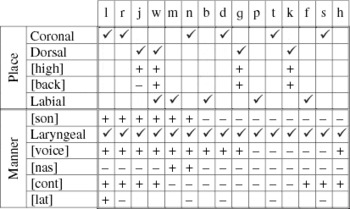
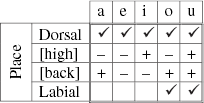
The representations we assume for the Classical Latin segmental inventory involve the feature set given in Tables 1 and 2.Footnote 3
Distinctive features for Classical Latin consonants

Distinctive features for Classical Latin vowels
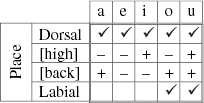
As regards manner, all vowels are redundantly [+son], [+voice], [+cont], and underlyingly [−nas]. On the surface, however, there is a contrast between (long) [−nas] and [+nas] vowels (des [des] ‘you should give’ vs. dens [dẽs] ‘tooth’), with the latter derivable from vowel+nasal consonant sequences. The featural composition of the glides [j] and [w] is the same as that of [i] and [u], respectively. The difference between glides and vowels is encoded in their syllabic position rather than their subsegmental structure.Footnote 4
As regards place features, we follow the assumption embodied in recent work on feature geometry that the place features of consonants and those of vowels are organised under two different nodes. Generally speaking, vowels and glides only have a V-place node, whereas consonants only have a C-Place node.Footnote 5 Exceptions involve secondary place in consonants, which is found in Latin only in predictable environments (e.g. velarised [ł] in preconsonantal position and before back vowels) and will not be discussed in this paper. The following charts illustrate the basic configurations for vowels and glides (see (1)) and for consonants ((2)), and exemplify a consonant with secondary articulation ((3)).
(1) The structure of vowels and glides


(2) The structure of consonants
(3) The structure of a consonant with secondary articulation (velarised l)
In this paper consonants with secondary articulations will be generally irrelevant; their structure is shown here for completeness.
3. Medial 〈gn〉 in simplex forms
It is generally agreed that instances of the entity written 〈gn〉 go back etymologically to a prehistoric cluster *[gn] (in some cases *[kn]), but by the time Latin came to be written, 〈gn〉 was the graphic representation of the cluster [ n] medially (as well as at prefix–stem boundaries), thus agnus [anus] ‘lamb’, ignis [inis] ‘fire’ etc. The arguments, succinctly summarised in e.g. Allen (Reference Allen1978: 23–25), or indeed any of the relevant handbooks, are the following:
• In the prehistory of Latin, there was a tendency for stops to be nasalised before nasals (e.g. [pn]>[mn], as in *swepnos>somnus ‘sleep, dream’, cf. Old English swefn or Greek hupnos ‘dream’, or [tn]>[nn], as in *atnos>annus ‘year’, cf. Gothic aþn).Footnote 6
• Inscriptional evidence includes several forms like 〈INGNES〉 for ignes ‘fire(s)’, attesting to the outcome of the nasalisation of [g] before nasals.
• The sound change [e]>[i], which was conditioned by (especially velar) NC sequences (*[te
g-]>tinguere ‘dip’, *[pekwe]>quinque ‘five’), but by no other type of consonant cluster,Footnote 7 was also triggered by 〈gn〉: *[dekn-]>dignus ‘worthy’ (scil. via *[den-]).• The spelling of n-final prefixes provides additional evidence. For example, negative in- is optionally spelled 〈im〉 before the labial stops and [m] (as in 〈im+politus〉 ‘unpolished’, 〈im+berbis〉 ‘beardless’, 〈im+mortalis〉 ‘immortal’), 〈il〉 before [l] (as in 〈il+lepidus〉 ‘lacking refinement’) and 〈ir〉 before [r] (as in 〈ir+rasus〉 ‘unshaved’). As one would expect, it is written 〈in〉 before the velar stops, there being no distinct spelling for [
] (as in 〈in+celebratus〉 [ikelebratus] ‘unrecorded’). Before other consonants as well as before vowels, it is consistently written 〈in〉 (as in 〈in+ermis〉 ‘unarmed’, 〈in+decens〉 ‘unseemly’). Before an original 〈gn〉-initial stem, however, the spelling of n-final prefixes involves the apparent (unparalleled) loss of an 〈n〉 as in 〈ignoscere〉 ‘forgive’ from 〈in〉+〈gnoscere〉 ‘know’, but this is easily explained if this written form represents [inoskere] ‘forgive’. Where the morpheme boundary actually falls is a tricky question but will be clearer after the ensuing discussion of prefixed forms.
4. Initial 〈gn〉
Word-initially 〈gn〉 is slightly more problematic than medially because (i) it is restricted to a handful of words; (ii) in all these words except the proper name Gnaeus it is variably replaced by 〈n〉; and (iii) an initial cluster [n] would be very odd phonotactically in that there are no onset clusters consisting of two sonorants either internally or initially.Footnote 8 An exhaustive list of attested lexemes with initial 〈gn〉 is the following:
(4) Gnaeus [proper name]
gnarus (overwhelmingly)~narus ‘expert’
gnatus (esp. pre-classical)~natus (overwhelmingly)Footnote 9 ‘born, son’
gnavus~navus (more frequently) ‘diligent’
gnoscere (sporadically)~noscere ‘know’
gnobilis (2 pre-classical occurrences)~nobilis ‘noble’
Etymologically, all these words apart from Gnaeus Footnote 10 go back to two Proto-Indo-European stems, *genh 3- (>gnarus, gnavus, gnobilis, cf. English can, know) and *genh 1- (>gnatus, cf. English kin). It is clear that the gross diachronic process we are interested in here began with PIE *[gn-] and finished at some point in Late Latin with [n-], but what happened in between and which stage does Classical Latin belong to?
We are going to argue that the middle stage of the process involved a floating C-Place node in the place of the original *[g] stem-initially. Later the stems beginning with the floating C-Place node were gradually relexicalised either without it (i.e. with a single initial [n]) or, when prefixed, with a [n] cluster (like medially) and the phonological forms of alternating lexemes split into two. This relexicalisation was caused by prefixation in the first place, and is also evidenced best by it, so it is to the prefixation of 〈gn〉-initial stems that we now turn.
5. Prefixed 〈〈gn〉-initial stems
As in older Indo-European languages generally, prefixation was an important and widely used derivational process throughout the history of Latin. In terms of productivity, transparency and phonological interference, the prefixed words of Classical Latin can be arranged on a cline with strongly lexicalised and opaque forms at one extreme and relatively transparent formations at the other. This cline is related, though certainly not in an isomorphic fashion, to the diachronic emergence of these forms.Footnote 11 Prefixation led in many cases to lexicalisation, which in turn resulted in drastic phonological modifications at the prefix–stem boundary as well as within the stem.Footnote 12 The pace and the extent of lexicalisation, however, were highly variable (which explains the cline mentioned above). Furthermore, prefixation also involved recomposition in all periods of the documented history of Latin. An early case of recomposition is seen in perjūrare ‘to forswear’, which is the recomposed variant of the older form peierare [pejjerare]. Later recompositions can be reconstructed on the evidence of Romance languages; it is well known that reflexes of forms like rétinet ‘he keeps’ (<re+tenet) often derive not from the inherited Classical Latin forms but from recomposed variants such as *reténet (>Fr retient etc.).
The phonological processes that occur at prefix–stem boundaries are mostly assimilations (all regressive). Two generalisations emerge quite clearly: (i) in place assimilations, coronals generally assimilate to non-coronals and labials often assimilate to velars (see (5) below); (ii) in full assimilations, consonants only assimilate to consonants of higher sonority (see (6) below).
(5) Place assimilation at prefix–stem boundary
in+politus→impolitus ‘unpolished’
dis+fidere→diffidere ‘mistrust’
ad+gradior→aggredior ‘go up to’
sub+gerere→suggerere ‘pile up’
(6) Total assimilation at prefix–stem boundary
in+rigare→irrigare ‘make wet’
sub+ferre→sufferre ‘endure’
sub+rapere→surripere ‘steal’
Both generalisations represent tendencies that are well attested cross-linguistically. The first is an instantiation of the general ‘weakness’ of the coronal place of articulation (see Paradis & Prunet Reference Paradis and Prunet1991).Footnote 13 The second generalisation is evidently related to the observation that heterosyllabic clusters preferentially show falling sonority, which was first proposed and amply documented in Hooper Reference Hooper1976 and Murray & Vennemann Reference Murray and Vennemann1983, and came to be known as Syllable Contact Law.Footnote 14
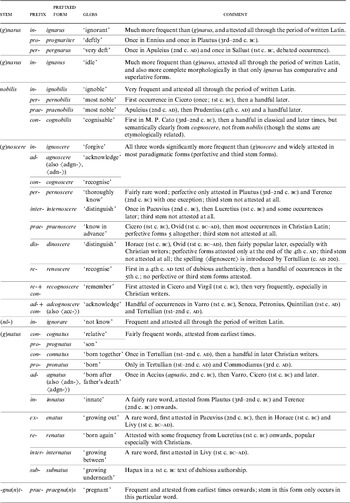
In Table 3 all the prefixed words based on 〈gn〉-initial stems are listed with comments. The data were taken from volume 1 of the Brepols Corpus (CLCLT-5).
Prefixed 〈gn〉-initial stems (exhaustive list)

A careful examination of the data very strongly suggests a distinction between two types of prefixed forms, one of which is likely to be more archaic and the other more recent. The five features that tend to cluster in the older forms and distinguish them from the newer ones are the following:
• earlier attestation
• higher frequency in the corpus
• more complete paradigms
• written with 〈gn〉 rather than 〈n〉
• sometimes less transparent meaning
While these criteria do not pattern together in all cases, they quite clearly distinguish between many of the prefixed 〈gn〉-words (e.g. ignoscere ‘forgive’ vs. praenoscere ‘know in advance’ or cognatus ‘relative’ vs. internatus ‘growing between’). In general, prefixation with ad-, con- and negative in- appears to be more archaic in the set of 〈gn〉-words than all other cases of prefixation (with a few exceptions to which we will return). The common feature of these three prefixes is that they end in the consonants that are most prone to assimilation.
How can one possibly explain this? What is the phonological structure that accounts for the odd distribution of prefixes on 〈gn〉-initial words and how did it develop? As we see it, the diachronic process can be desribed in three stages through which the phonological representation of 〈gn〉-initial words changed.
5.1. Stage 1: [gn-]
At the earliest stage, identical in the relevant respect to that reconstructed for Proto-Indo-European, these words began with [gn-] (and possibly internal [gn] still existed unchanged).Footnote 15 This cluster was somewhat untypical of Proto-Indo-European, though not unheard of, and it resulted from the loss of a vowel between the two consonants through ablaut (cf. Eng knee ~ Lat genu, or Lat genitus ‘engendered, born’ vs. gnatus ‘son’). It is clear that this phonological form does not explain why prefixation with certain morphemes was preferred to prefixation with others; it is hardly conceivable that the prefix *ad- or * - (>in-) would have resulted in phonologically well-formed words but a liquid- or vowel-final prefix such as those historically underlying per- and de-, respectively, would not. Even if one assumed phonological simplification along the lines presented in (7), the conspicuous absence of vowel-final prefixes from the archaic set would still be unexplained.
(1) [
gn]>[n] (e.g. in the etymon of cognoscere ‘recognise’)[dgn]>[ggn]>[gn] (>later [
n]) (e.g. in the etymon of agnoscere ‘acknowledge’)
It may be surmised that at this stage prefixation was indeed freer with these stems and the restriction seen in (early) documented Latin dates from a later (but still prehistoric) stage.
5.2. Stage 2: floating C-Place
At some point in the prehistory of Latin, initial [g] was lost as a full segment and what remained in its place was a floating C-Place node dominating a Dorsal node which, in turn, dominated the features [+high, +back]. This change, which only took place in the environment #_[n], can be formalised as shown in (8).
(8) Loss of structure in initial [g]
The lexical representation of words like gnatus thus involved the configuration in (9).Footnote 16
(9) Phonological representation of initial 〈gn〉
The realisation of this configuration on the surface must have involved a degree of variation whose details are no longer fully recoverable. Assuming that floating (unlinked) features and nodes could not surface, it is conceivable that the floating C-Place node was deleted; it is also possible that a con-servative surface realisation [gn] persisted for some time.
At this point it will be clear why the set of prefixes that attach to 〈gn〉-initial stems was restricted to ad-, con- and in- precisely at this stage. The most readily assimilating consonants are [d] and [n], which means that it is primarily coronals that delink their place specification and relink to the place specification of the following consonant. What happens in the case of the 〈gn〉-initial words is analogous to that process. Whenever one of the above three prefixes was associated with such a stem, the floating C-Place node with a Dorsal specification triggered assimilation in the same way as any stem-initial velar (or labial) consonant, i.e. it spread leftwards, the only direction allowed in Latin. But when a non-assimilating consonant (such as [r], which does not undergo place-assimilation at allFootnote 17) or a vowel would have been adjacent to the floating C-Place node, the reassociation of the C-Place node could not take place and thus an ill-formed word would have emerged with a stranded floating node in non-initial position.Footnote 18 The diagrams in (10) and (11) illustrate this with ignoscere vs. the then impossible **re(g)noscere.Footnote 19
(10) Assimilation in in+〈gn〉
(11) Lack of assimilation in **re+〈gn〉
Note that the internal cluster in a word like regnum [renũ] ‘kingdom’ is, of course, well-formed since it does not involve a floating C-Place node; this is the difference between that word and **re+gnoscere.
With ad- the place assimilation process is formally the same (see (12) below). The only difference is that the outcome of the relinking of the floating C-Place to the [d] is [g], and the resulting [gn] cluster has yet one more process to undergo, scil. [gn]→[n], which eventually levelled out the variation internally (and which has to be postulated independently because of the regnum-type words).
(12) Assimilation in ad+〈gn〉-
The behaviour of con- is, on the face of it, like that of in-. Descriptively they are alike before 〈gn〉-initial stems. However, there is a very important difference between the two prefixes: the nasal of con- regularly drops before vowel-initial stems (coegi ‘I coerced’, coire ‘join’ as opposed to inultus ‘unavenged’, inermis ‘unarmed’ etc.). This can be explained if we assume that con- ended in a placeless nasal, which could only get a place specification from a (following) consonant (since primary place features do not spread from consonants to vowels or vice versa). If there was no consonant in its immediate vicinity, the placeless nasal was not maintained. Before a stop, however, the placeless nasal assumed the C-Place node of the following consonant, as in componere ‘compose’ or co[]quirere ‘collect’, and the same happened before 〈gn〉-initial stems (e.g. cognoscere ‘recognise’, see (13)):
(13) Assimilation in con+〈gn〉-
A little detour is in order here concerning the prefix con-. If one assumes a placeless nasal in this prefix, the question arises how it acquires a coronal place of articulation before glides, as in convertere ‘turn around, translate’ and conjungere ‘join’ (stem-initial [w] and [j], respectively). The answer is not straightforward, for two reasons. The empirical issue is whether the nasal was actually coronal in such forms. Before [j] virtually the only spelling one finds is with 〈n〉, though inscriptional evidence of 〈COIV(N)X 〉 ‘spouse’ and similar variants exists. Of course, Latin spelling had no way to indicate palatality, so one may imagine that [n] developed a palatal allophone [ ] before [j]. Before [w] there is some evidence of a labial pronunciation coming from the grammarian Marius Victorinus (4th century ad). He explicitly claims that the relevant forms are 〈comvalescit〉 ‘convalesce’, 〈comvocat〉 ‘summon’ with 〈m〉 rather than 〈n〉 (Ars Grammatica 4.65). The problem is not only that such forms are extremely rare generally, but also that Marius Victorinus's other claims seem to be so far-fetched (e.g. 〈ovvertit〉 ‘turn back’ and 〈ovvius〉 ‘facing’ instead of 〈obvertit〉, 〈obvius〉) that one feels one has to take even this apparently plausible piece of information regarding 〈comvocat〉 etc. with a pinch of salt. Note, however, that he does not claim the same for in-, which seems to be in line with our assumption that in-ended in a coronal nasal, whereas con-ended in a placeless nasal.
Besides the empirical issue there is a theoretical issue as well: how could a place feature spread from a glide to a consonant if glides have the same structure as vowels (i.e. they have no C-Place node, only a V-Place node, as explained in Section 2) and so their place features are not on the same tier as those of consonants? A possible solution is to assume that the spelling 〈con〉 stood for [kõ] rather than [kon] before glides (as well as before [s]), so there was actually no spreading (and no true labial nasal in the putative 〈comvocat〉-type words!). This would also explain why Marius Victorinus gives examples of the 〈in〉>〈im〉 assimilation before the labial consonants [p b f m], but not before [w].Footnote 20
Concerning the hypothesis of the floating C-Place node at stage 2, there is one more possible objection that needs to be addressed. Given that the b-final prefixes also assimilate more or less systematically to stem-initial velars (sub+gerere→suggerere ‘pile up’, ob+gerere→oggerere ‘heap’), why do we not find forms like **sugnoscere [sun-]<[sugn-]<[sub]+[Dorsal][n]- next to suggerere and oggerere? The answer is that, in all likelihood, the absence of such words is not due to their phonological shape (which would indeed be well-formed) but to semantic reasons and pure lexical contingencies. A possible argument for this position is that none of the three [b]-final prefixes combined with any of the 〈gn〉-initial stems even in the latest period of native Latinity, by which time the floating velar was certainly lost; as is shown in Table 3 above, the only such form attested is the hapax subnatus ‘growing underneath’ found in a text of unclear provenance.
5.3. Stage 3: relexicalisation without floating C-Place
For a while the alternations of the noscere ~i[]noscere, natus ~ co[]natus type maintained the representations with the floating C-Place node even if it was not realised phonetically (in word-initial position). But it is clear that the literary period saw the gradual disappearance of the floating C-Place node and the lexical split of words in which it occurred. The unprefixed forms were relexicalised with a single initial [n], whereas the prefixed forms were relexicalised with a fully specified [n] sequence which was no different from the [n] sequence found internally in the regnum and ignis-type words, and from this point on the relation between these unprefixed and prefixed forms was no longer motivated phonologically. This made it possible for other prefixes to attach to 〈gn〉-initial (now phonologically n-initial) stems, hence the novel formations like renatus ‘born again’, praenoscere ‘know in advance’ and pernobilis ‘most noble’. Interestingly, the phonologically no longer motivated, lexicalised relation between unprefixed and prefixed 〈gn〉-words also made it possible for authors like Tertullian to introduce the deliberately archaising form (spelling variant?) 〈dignoscere〉 for the novel formation dinoscere ‘distinguish’, itself made possible by the relexicalisation of noscere.
As for the morphological structure of the forms involved, at stage 2 the morpheme boundary in prefixed forms of the ignoscere-type actually divided the prefix-final nasal in that its C-Place node was on the right of the boundary, being part of the stem, but its root node and its manner features were on the left of the boundary, being part of the prefix. At stage 3, however, the morpheme boundary was between the two nasals, with the prefix variants [i ko a] reanalysed as lexically selected exceptional allomorphs before certain n-initial stems.
6. Problematic words
Problematic items remain, however, and we will now turn to these.
(i) Gnaeus (proper name). This name is consistently written in this way and abbreviated Cn throughout Antiquity. This could, in theory, indicate that the loss of the floating C-Place node did not take place. But if we consider that this was a proper name, scribal conservatism is likely to have been especially strong and need not point to anything particular about the phonology of this word. It is, of course, also conceivable that a spelling pronunciation [gnajjus] existed until the end of Classical Latin, maybe even later.
(ii) prognatus ‘son’. There is no doubt that this is one of the early prefixed forms of gnatus along with cognatus ‘relative’ and possibly agnatus/agnatio ‘born/birth after father's death’. Why then does it have pro-, a prefix that otherwise does not attach to 〈gn〉-initial stems for reasons discussed above? As we see it, there are three possible explanations. One is that this word was reanalysed as a single word already at stage 1, which is possible but unprovable without circularity. The other explanation could be analogical interference from cognatus, which was well-formed at stage 2 as well. This explanation suffers from the weakness that traditional analogical accounts generally face in that it basically acknowledges the isolated nature of the interference: why did cognatus give rise to prognatus but not cognoscere ‘recognise’ to **prognoscere, and so on? The third possibility is that the word prognatus is originally not composed of pro+gnatus but of prod+gnatus. The appearance of the prevocalic variant of the prefix (cf. prod+ire ‘go forth’) in this word would be unusual, but not inconceivable. The regularity governing the distribution of the variants of pro- is known not to be watertight: the d-less variant appears with a shortened vowel when attached to some vowel-initial stems as in pr
avus ‘forefather’, but the same variant is also found with many f-initial words such as pr fugus ‘fugitive’, where the shortening of the prefix vowel is unexplained. On the other hand, if we assume original prod+gnatus rather than pro+gnatus, this word falls into the same category as the ad-words, and its phonology is then perfectly regular.(iii) praegna(n)s ‘pregnant’. This word is odd on several counts. On the one hand, it is clearly an early formation attested frequently from the beginnings of Latin literacy and including a stem form gnat- or gnant-, which is not found anywhere else in the lexicon, though it is obviously related to the stem of gnatus (historically *gnato-s). On the other hand, the prefixation of prae- to 〈gn〉-initial words is predicted not to happen if the above arguments are to hold. Furthermore, the synchronic phonology of this word in Classical Latin is also unusual: a cluster [j
n], or indeed any cluster consisting of three sonorants, is unattested even at prefix–stem boundary. The only explanation that we can think of is that this word was lexicalised already at stage 1, and thus it escaped the phonologically motivated restriction that resulted, at stage 2, from the replacement of initial [g] by a floating C-Place node before [n]. This scenario is made plausible by the isolated stem-variant, and it implies a parallel between praegna(n)s and prehendere ‘grab’, where the latter shows an isolated prefix-variant as well as a stem not attested anywhere else in the language, both good indicators of early lexicalisation. The problem of the synchronic phonology of the form still remains, however.(iv) innatus ‘innate’. This word is attested from pre-classical times onwards, though not with any great frequency. It is exceptional in including the locative (rather than the negative) in-, and its form is also a counterexample to the hypothesis detailed above in that it is not **ignatus. We do not have much in the way of explanation apart from the seemingly trivial remark that the form of this word may be due to early vacillation in the lexical form of the stem.
(v) ignominia ‘disgrace’, cognomen ‘surname’, agnomen ‘nickname’. These words are prefixations of the stem nomen ‘name’, which is not a 〈gn〉-stem, and yet, the prefixed form shows -gn- instead of the etymologically correct **innominia, **connomen, adnomen.Footnote 21 This has long been explained with reference to the analogical influence of gnoscere ‘know’ and its prefixed variants.Footnote 22
 avus ‘forefather’, but the same variant is also found with many f-initial words such as pr
7. Conclusion
We have argued that in the initial cluster *[gn] the velar stop was lost diachronically in two stages: first it was replaced by a floating C-Place node dominating a Dorsal node which, in turn, dominated the features [+high, +back]; this floating C-Place node was subsequently also lost. The argument crucially hinges on the observation that those prefixes that end in assimilating consonants ([d], [n] and the placeless nasal) combined with *[gn]-initial stems earlier than the rest of the prefixes. This can be explained if one assumes that with prefixes ending in non-assimilating consonants and vowels, to which the place node of consonants cannot spread for structural reasons, the resulting form would have included a stranded floating C-Place node and would thus have been ill-formed. After the loss of the stem-initial floating C-Place, prefixation was no longer constrained in this way and new forms were free to appear.