Introduction
Cochlear implantation is an effective treatment method in patients with bilateral severe to profound hearing loss. Nevertheless, cochlear re-implantation may be required for various reasons such as device-related problems, or medical or surgical issues.Reference Zeitler, Budenz and Roland1,Reference Olgun, Bayrak, Catli, Ceylan, Aydin and Duzenli2
Device failures are classified as either hard or soft failures. Hard failures include broken devices as a result of trauma. Soft failures include decreased auditory performance, and stimulation problems such as intermittency or non-auditory side effects. Medical complications include wound breakdown, infection, cholesteatoma, and electrode extrusion or malposition.Reference Sorrentino, Côté, Eter, Laborde, Cochard and Deguine3
Hochmair-Desoyer and BurianReference Hochmair-Desoyer and Burian4 reported the first revision cochlear implant surgery in 1985. Many studies since then have reported the incidence of, reasons for and results of revision cochlear implant surgery. The reported rate of revision cochlear implant surgery is between 3.8 per cent and 7.2 per cent.Reference Zeitler, Budenz and Roland1,Reference Amaral, Reis, Massuda and Hyppolito5
To our knowledge, this is the first published study to investigate 20 years of experience in revision cochlear implant surgery in an experienced cochlear implantation clinic with a large number of patients, in terms of signs indicating device failure for audiologists. The present study aimed to report device failures and other reasons for revision surgery, and to discuss the audiological signs that might indicate a need to perform revision cochlear implant surgery.
Materials and methods
Revision cochlear implant surgery procedures carried out between November 1997 and August 2017 were retrospectively analysed using the database of the Departments of Otorhinolaryngology and Audiology at Hacettepe University, Ankara, Turkey. Data collection began following approval from the Non-Interventional Clinical Research Ethics Board (approval number: GO 17/688).
During the 20-year study period, 2181 cochlear implant operations were performed in Hacettepe University's Department of Otorhinolaryngology.
The study investigated: aetiology, otoscopic and radiological findings, the reasons for revision surgery, electrode insertion depth, device failure (established by the manufacturer), and the number of active electrodes.
The results for quantitative variables are shown as mean ± standard deviation (SD), and those for categorical variables are shown as frequencies or percentages. The comparisons for independent samples were performed using a paired sample t-test.
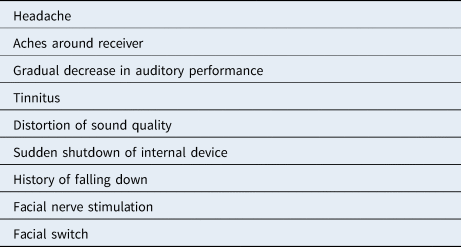
Patients (or caregivers) were evaluated via telephone a minimum of one year post-operatively. A questionnaire was used to assess their complaints before the revision cochlear implant surgery. In the telephone interview, 61 patients’ complaints from before revision cochlear implant surgery were evaluated retrospectively via a checklist (Table 1). The patients were also asked to rate auditory performance before and after revision surgery on a visual analogue scale (VAS), which assessed hearing levels in 1-digit increments, from 0 (‘very poor’) to 10 (‘very good’).
Pre-revision cochlear implant surgery complaints assessed via questionnaire

Results
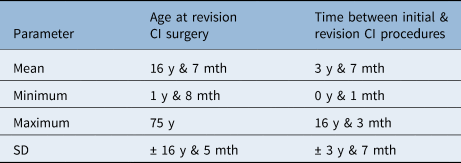
Over the 20-year study period, 114 patients underwent 127 revision operations; 55 of the patients were female (48 per cent) and 59 were male (52 per cent). Age at the time of revision cochlear implant surgery and the duration of cochlear implant use are given in Table 2. The mean age at implantation was 16 years and 7 months (age ranged from 1 year and 8 months, to 75 years). The mean time between the initial cochlear implant surgery and the revision surgery was three years and seven months. The minimum time between procedures was one month, and the maximum time was 16 years and 3 months.
Patients’ demographic information

CI = cochlear implant; y = years; mth = months; SD = standard deviation
Otoscopic examination before revision surgery revealed a normal tympanic membrane in 107 ears. In eight ears, there was otitis media with effusion. Other findings of the otoscopic examination included: cholesteatoma (n = 3), external ear canal obliteration (n = 3), cochlear implant extrusion from the tympanic membrane (n = 4), a mastoid cavity (n = 1) and infection (n = 1). Otoscopically visible cholesteatoma was not identified on computed tomography in two cases.
When considering aetiology, hearing loss was most commonly idiopathic (59.8 per cent); other causes included inner-ear malformation (11.8 per cent) and meningitis (9.4 per cent).
All patients underwent computed tomography before the second surgical procedure. Radiological examination of the patients who underwent revision surgery revealed normal anatomy in 87 ears (68.5 per cent), inner-ear malformation in 15 ears (12 per cent), partial ossification in 8 ears (6.3 per cent) and a mastoidectomy cavity resulting from previous surgery in 7 ears (5.5 per cent). Less common findings included electrode malposition (n = 5), fracture (n = 1) and cholesteatoma (n = 1).
A total of 102 patients, or 80.3 per cent of the whole revision surgery group, underwent the initial surgery in our department; 25 revision cases (about 19.7 per cent) were referred to our department from other centres.
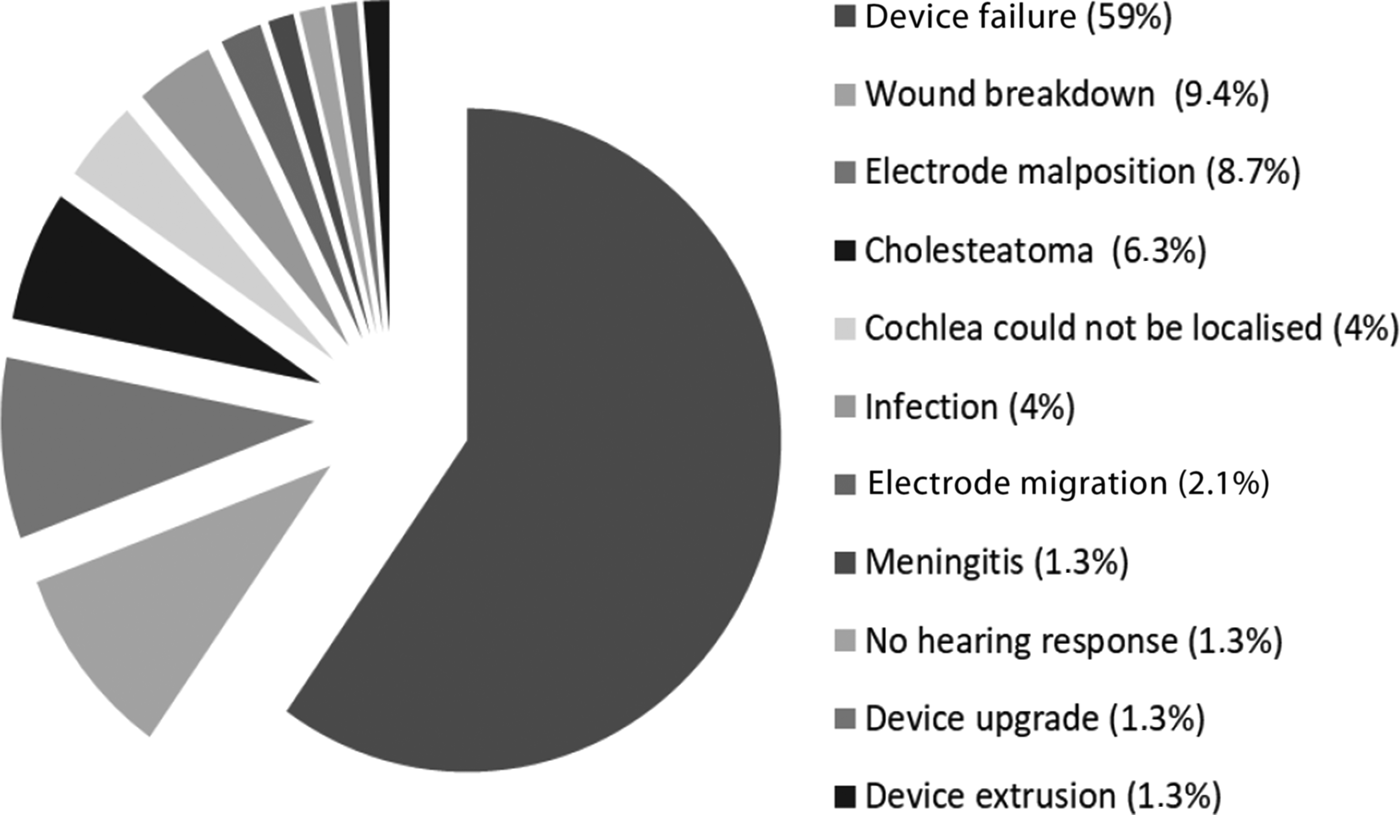
The reasons for revision surgery varied from device failure to medical or surgical causes. The three most frequent reasons for revision surgery were: device failure (59 per cent), wound breakdown (9.4 per cent) and electrode malposition (8.7 per cent). Only 2 of the device failure cases were hard failures (broken devices); the remaining 64 cases were classified as soft failures. The reasons for revision surgery are indicated in Figure 1.
Reasons for revision cochlear implant surgical procedures.

Regarding electrode insertion depth, full electrode insertion was obtained in 112 revision procedures (88.2 per cent). In 11 revision procedures (8.7 per cent), electrodes could be partially inserted. In the remaining four ears (3.1 per cent), insertion depth was not investigated because of electrode explantation. The aetiology in three of these partial electrode insertion patients was meningitis (33.3 per cent). Other partial electrode insertion patients had: progressive hearing loss (n = 2), inner-ear malformation (n = 1), idiopathic aetiology (n = 1), Ménière's disease (n = 1) and febrile disease (n = 1). In the remaining four patients (3.1 per cent), the electrode was explanted because of skin infection.
A total of 117 re-implantation procedures (92.1 per cent) were performed in the same ear as the initial procedure. However, in six patients, implantation was carried out in the contralateral ear. In the remaining four ears, the cochlear implant electrode was explanted, and no electrode was re-implanted in that ear. In these patients, the implant body had to be removed because of wound breakdown, and the intracochlear part of the electrode was left in the cochlea for future revision surgery. In one patient, there was complete destruction of the otic capsule, and it was not possible to insert the electrode into the cochlea. Therefore, auditory brainstem implantation surgery was planned.
The relationship between device failure and device manufacturer was also explored. When considering only the revision surgery patients whose initial surgery had been conducted in our department (102 out of 127), the revision rates were: 4.44 per cent for Advanced Bionics (16 out of 360), 3.55 per cent for Cochlear™ (41 out of 1154) and 6.59 per cent for Med-El devices (45 out of 667). The device failure rates were: 2.78 per cent for Advanced Bionics (10 out of 360), 1.82 per cent for Cochlear (21 out of 1154) and 5.25 per cent for Med-El systems (35 out of 667).
Sixty-one out of 113 patients participated in the questionnaire via telephone. The results of the questionnaire were categorised according to the reasons for revision surgery. The most common complaints among the 61 patients were: gradually decreased auditory performance (n = 27; 44.2 per cent), sudden internal device shutdown (n = 14; 22.9 per cent) and headaches (n = 14; 22.9 per cent).
The data for patients who experienced device failure were analysed according to the patients’ complaints. Thirty-nine patients who underwent re-implantation for device failure completed a questionnaire via telephone to identify complaints before the revision surgery. Of the 39 patients, 6 used Advanced Bionics, 16 used Cochlear and 17 used Med-El cochlear implant systems. Before the revision surgery, the most common complaint was a gradual decrease in auditory performance (20 out of 42; 47.6 per cent), followed by sudden turning off of the device (13 out of 42; 30.9 per cent), headaches (12 out of 42; 28.5 per cent) and intermittent shutting down (10 out of 42; 23.8 per cent). In six users of Advanced Bionics devices, the most common complaints were facial twitching when the sound processor was first worn (n = 3; 50 per cent) and the sudden shutting down of the internal device (n = 3; 50 per cent). In 18 users of Cochlear devices, the most common complaint was the sudden shutting down of the internal device (n = 9; 50 per cent). In 18 users of Med-El devices, the most common complaints were a gradual decrease in auditory performance (n = 12; 66.6 per cent) and a history of falling down (n = 7; 38.8 per cent).
The mean VAS scores for subjective auditory performance before and after revision surgery were 5.26 (range, 1–10; SD = 1.41) and 7.30 (range, 2–10; SD = 2.12), respectively. The VAS score decreased after revision cochlear implant surgery in only 6 out of 39 patients. There was a significant difference between the subjective auditory performance rating scores before and after the surgery. After the revision surgery, auditory performance was improved subjectively.
The number of active electrodes was also analysed before and after revision surgery. Only those patients for whom there were data on active electrode numbers before and after revision surgery (n = 41) were included in this analysis. In 5 Advanced Bionics device users, the average number of active electrodes was 16 before revision surgery and 15.6 (range, 14–16 electrodes) after revision surgery. In 15 Cochlear device users, the average number of active electrodes was 21.2 (range, 13–22 electrodes; 96.3 per cent) before revision surgery and 21.1 (range, 13–22 electrodes; 95.7 per cent) after revision surgery. In 26 Med-El device users, the average number of active electrodes was 5.4 (range, 1–12 electrodes; 45 per cent) before revision surgery and 10.53 (range, 9–12 electrodes; 87.8 per cent) after revision surgery. When comparing the different devices, there was a significant increase in the number of active electrodes only for Med-El devices (p < 0.001) after revision surgery.
Discussion
Cochlear implant device malfunctions may present as negative integrity test results or as the loss of sound quality (despite normal findings in an integrity test), which are respectively termed hard and soft failures.Reference Blanchard, Thierry, Glynn, De Lamaze, Garabédian and Loundon6 In previous literature, common reasons for re-implantation included device failure and wound problems.Reference Ray, Proops, Donaldson, Fielden and Cooper7 In line with previous research, device failure was the most common reason for revision cochlear implant surgery in the present study.
Revision surgery is more challenging than the initial surgery, and should be carried out by experienced surgeons. In our study, it was possible to obtain full electrode insertion in 88.2 per cent of the patients. This result is similar to that of a previous study published by Marlowe et al. in 2010, which reported that full electrode insertion was possible in 90 per cent of revision cochlear implant surgery patients.Reference Marlowe, Chinnici, Rivas, Niparko and Francis8 One factor responsible for incomplete insertion was the use of a different electrode from the previous one in revision surgery.Reference Shin, Park, Lee, Kim and Choi9 Shin et al. (2013) reported that four of five patients who had to be implanted with a different electrode in revision surgery had incomplete insertion; three of these patients were implanted with a thicker electrode.Reference Shin, Park, Lee, Kim and Choi9
There was variation in the numbers of active electrodes for different manufacturers. Following revision surgery, all electrodes could usually be activated. Electrodes rarely had to be deactivated because of partial insertion, inadequate auditory simulation, or non-auditory stimuli such as facial nerve stimulation. There were differences in device failure between companies. While certain devices demonstrated immediate shutdown, others showed progressive electrode inactivation. There was a decrement in the mean number of active electrodes in Advanced Bionics systems, from 16 to 15.2, because two channels were deactivated in a patient due to inadequate stimulation after the revision surgery. The same situation was seen in one user of a Cochlear device with partial electrode insertion. Regarding Med-El implants, there was a significant increment in the number of active electrodes because of the possible device failure initially. In 2008, Rivas et al. reported on the results of revision cochlear implant surgery in adults, and showed an increase in the proportion of active electrodes from 40.9 per cent to 71.8 per cent,Reference Rivas, Marlowe, Chinnici, Niparko and Francis10 similar to that in the present study.
According to our clinical experience, Cochlear and Advanced Bionics internal devices automatically shut down the implant when there is a device failure. No decrease in the number of active electrodes was observed over time for these systems, as was seen with the Med-El devices. With Med-El implants, in cases of increased impedance, open circuit electrodes or a progressive decrement in the number of active electrodes, the patient should be evaluated by a company representative, and device failure should be established before the implant fails completely. Some Cochlear devices, especially those from the CI512 series of implants, conveyed an error indicating ‘no communication with implant’ during the telemetry measurement in Cochlear fitting software. In these cases, stimulation was not possible with the implant.
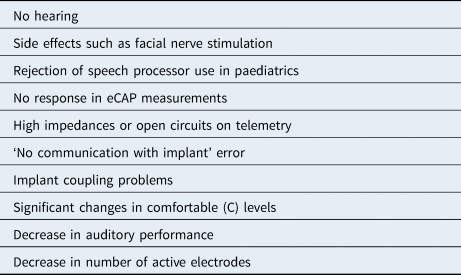
Possible indications for revision cochlear implant surgery include decrements in auditory performance, difficulties in programming, changes in impedance measurement and progressive decreases in the number of active electrodes.Reference Marlowe, Chinnici, Rivas, Niparko and Francis8 Similar to previous studies, common complaints in the present study were: no hearing, side effects such as facial nerve stimulation, and rejection of speech processor use in paediatrics. Re-implantation resolved these complaints in all our patients. Common findings during the fitting session included high impedances and/or short circuits in telemetry measurements, decreases in auditory performance, and decreases in the number of active electrodes. With such findings, patients should be evaluated for possible device failure and follow up should be more frequent. The possible signs indicating soft device failure, for audiologists, are given in Table 3.
Possible signs indicating soft device failure to audiologists

eCAP = electrically evoked compound action potential
At the onset of device failure, auditory performance and cochlear implant benefits might be reduced before device failure is confirmed. Until device failure is confirmed, the manufacturer will not accept the device failure verdict, and for a while the patient's condition remains unclear. Companies could be more helpful at this stage and develop better tests to ensure earlier device failure confirmation. This is especially important for children with a unilateral cochlear implant.
The receiver/stimulator fixation technique is critical for avoiding device and wound complications. Pamuk et al. showed that the bone recess with suture receiver/stimulator fixation technique was associated with a lower revision rate than the subperiosteal pocket technique.Reference Pamuk, Pamuk, Jafarov, Bajin, Saraç and Sennaroğlu11 Based on our experience, modified minimal access surgery, as described by Sennaroglu et al.,Reference Sennaroglu, Sarac and Turan12 allows the surgeon to perform the time-consuming work of drilling holes for tie-down sutures using a smaller post-auricular incision than is possible with other surgical methods. The present findings seem to support Shelton and Warren's theoryReference Shelton and Warren13 that micro-movement of the fantail can lead to wire fatigue and fantail damage. In addition, we think that disrupted anatomical layers cannot maintain the tightness required to fix the receiver/stimulator to bone during revision surgery. Therefore, the bone recess with suture fixation technique should be preferred for both initial implantation and revision surgery (regardless of the fixation technique used during the initial procedure).
The round window approach (so-called soft surgery) is also crucial for the success of revision surgery. It is easier to remove the cochlear implant and re-insert the new implant through the round window as opposed to cochleostomy.
Revision procedures may be required for cochlear implant users. Audiologists should pay attention to signs that indicate the need for revision surgery, offering quick and effective measures, to minimise loss of precious auditory stimulation time, especially for paediatric cochlear implant users.
There is a noteworthy limitation to this study. The study was planned retrospectively and the auditory perception test results were unavailable, thus speech recognition outcomes before and after the revision cochlear implant surgery could not be investigated. Nevertheless, this study shows 20 years of valuable results of an experienced cochlear implant clinic, and provides important information for audiologists by describing the possible signs that indicate the need for revision cochlear implant surgery.
• The most common reason for revision surgery was device failure (59 per cent)
• The revision cochlear implant surgery rate was 4.67 per cent
• The most common complaints before revision surgery were: gradually decreased auditory performance, sudden internal device shutdown and headaches
• Device failure can be indicated by a number of factors in cochlear implant patients during the fitting session
• These factors include high impedances and/or short circuits on telemetry, decreased auditory performance, and decreased active electrode numbers
Conclusion
In line with previous research, the most commonly observed reason for revision cochlear implant surgery is device failure. Patients should be evaluated for device failure in cases of: no hearing despite appropriate follow up, side effects such as facial nerve stimulation, and rejection of speech processor use in paediatric patients. Over the 20-year study period, 102 cochlear implant revision procedures were performed among 2181 cases, giving a revision rate of 4.67 per cent. The full electrode insertion rate for revision cochlear implant surgery was 88.2 per cent. After revision cochlear implant surgery, with proper surgical technique, most patients have successful outcomes.
Acknowledgement
The authors would like to thank Master's degree student Selvet Akkaplan for their support in acquiring data during clinical practice.
Competing interests
None declared