Introduction
We study the local and regional polygonal peatland history of the Pur-Taz interfluve, northwest Siberia, in order to understand past and current peatland dynamics within a particular regional peculiarities of ice wedge formation, especially age of ice wedges. As it was supposed, ice wedges in the peatlands of the northern region of the northwest Siberia are syngenetic, i.e., they grew together with peat (Vasil’chuk et al. Reference Vasil’chuk, Vasil’chuk, Jungner, Geyh, van der Plicht, Sonninen and Budantseva2003). The aim of our investigation was to obtain the age of ice wedges and to identify syngenetic or epigenetic origin of ice wedges in the Pur-Taz interfluve. The study focused on a 1.7-m-thick Holocene polygonal peatland with ice wedges. Our AMS 14C dating of organic extracted direct from ice wedge has significantly refined the age of ice wedges in the studied fragment of the vast Pur-Taz polygonal peatland and the mean January air paleotemperature during the period of active ice wedge growth. The findings indicate a complex interaction between climatic conditions and the formation of these ice wedges. The research not only enhances our understanding of past environmental changes but also provides valuable insights into future climate scenarios in permafrost regions. Detailed studies of permafrost polygonal peatlands in the Pur-Taz interfluve have been conducted since 2016. These studies include a study of the topography changes in polygonal peatlands (Babkin et al. Reference Babkin, Babkina, Leibman, Khairullin and Khomutov2022; Danko and Khomutov Reference Danko and Khomutov2024, Reference Danko and Khomutov2025), a study of soils and vegetation (Loiko et al. Reference Loiko, Klimova, Kritckov and Kuzmina2023), measurements of permafrost temperatures (Khomutov et al. Reference Khomutov, Babkin and Tikhonravova2019, Reference Khomutov, Babkina, Babkin, Danko, Ivanov, Koroleva, Leibman, Nesterova, Opokina, Slagoda, Fakashuk and Khairullin2021), the structure and isotopic composition of different ground ices in peatland (Tikhonravova et al. Reference Tikhonravova, Slagoda, Rogov, Butakov, Lupachev, Kuznetsova and Simonova2020, Reference Tikhonravova, Slagoda, Butakov, Koroleva, Simonova and Sysolyatin2022), the radiocarbon age of peat (Koroleva Reference Koroleva2022; Shefer et al. Reference Shefer, Loiko, Krickov and Lim2024; Tikhonravova et al. Reference Tikhonravova, Slagoda, Butakov, Koroleva, Simonova and Sysolyatin2022, Reference Tikhonravova, Kuznetsova, Slagoda and Koroleva2023).
Site description
The syngenetic Holocene ice wedges in polygonal peatland have been studied at the Pur-Taz interfluve (67°11′41.2353″N, 78°48′45.8422″E) at the southern limit of the continuous permafrost in northwestern Siberia (Figure 1).
Location of the study area, and distribution of ice wedges in northwestern Siberia.

Figure 1 Long description
A map of northwestern Siberia showing the distribution of ice wedges and the study area. The map highlights the Yamal, Gydan, and Taz regions, with the Ob River and its bays prominently labeled. The Kara Sea is located to the north. The map includes an inset showing a detailed view of a studied peatland with ice wedges. Key labels include 'Actively growing mainly syngenetic ice wedges in mineral and peaty sediments and peatlands,' 'Growing syngenetic ice wedges in mineral sediments,' and 'Buried and growing mainly epygenetic ice wedges.' The map also indicates the southern limit of subaqueous ice wedge growth and the southern limit of modern polygonal network distribution. The inset shows two black polygons representing ice wedges, with a scale bar indicating 300 meters and a north arrow for orientation.
The region is a topographically flat plain with many lakes. The area is defined by a simplistic landscape structure and little species diversity. In the river valleys and drained lakes, polygonal peatlands are common. According to observations from the nearest weather station Tazovsky (67°28′ N; 78°44′E) for 1991-2021, the average temperature of the coldest month (January) is –25.4 °C, of the warmest month (July) is +14.4 °C, and the average annual temperature is –6.8 °C. The average annual precipitation reaches 515 mm (Climate data for cities around the world url: https://ru.climate-data.org/). The Pur-Taz interfluve features continuous permafrost with thicknesses between 30 and 300 m. Within the Pur-Taz polygonal peatland, an increase in the average annual temperature of permafrost from –2.8 to –2.0°C was fixed (Khomutov et al. Reference Khomutov, Babkina, Babkin, Danko, Ivanov, Koroleva, Leibman, Nesterova, Opokina, Slagoda, Fakashuk and Khairullin2021).
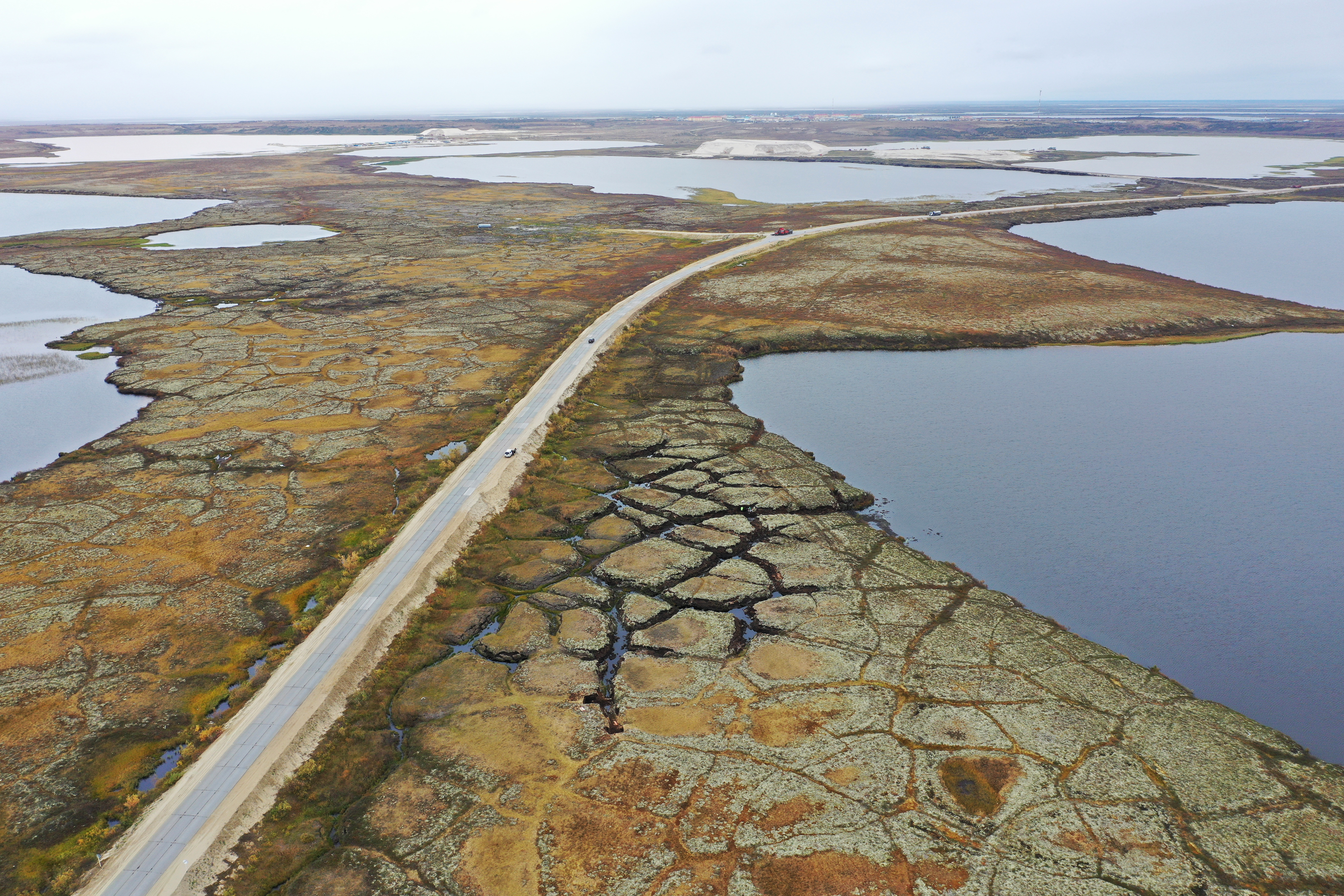
Sphagnum-cotton grass communities with Polytrichum sp. and Andromeda sp. grow on the polygons. Moss-lichen communities of Ledum sp., Rubus chamaemorus, Vaccinium vitis-idaea, and Andromeda sp. are found in the inter-polygonal depressions. Thick peatlands with polygonal networks (Figure 2) and ice wedges (IW) up to 3.5 m in height have been previously studied here.
Typical high-centered polygonal peatland with syngenetic ice wedges, Pur-Taz interfluve. Oblique view from a drone, photo by Khairullin R.R.

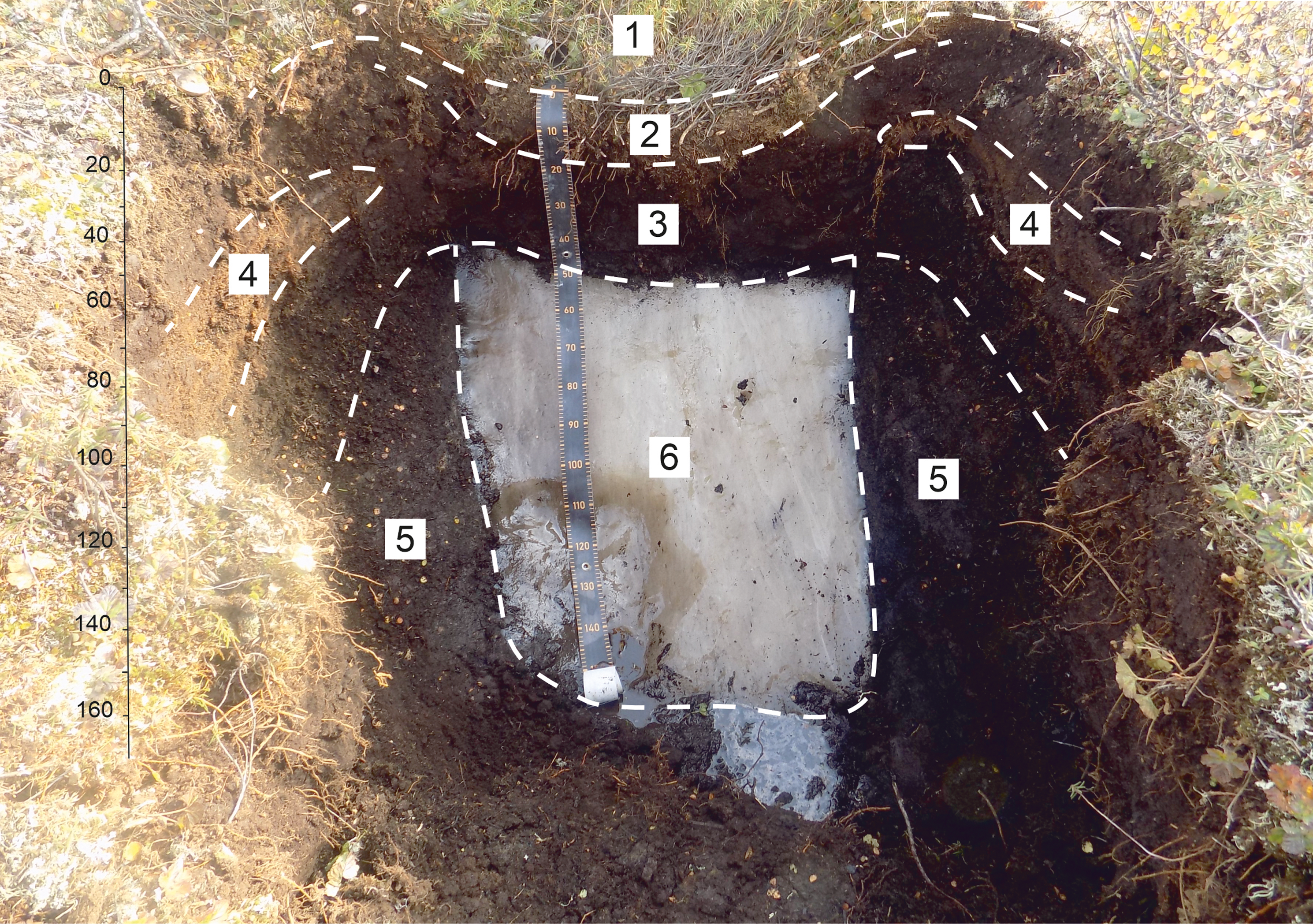
The studied 1.7 m ice wedge without shoulders mostly has transparent appearance with vertical bands (Figure 3). It occurs in frozen reddish dark brown icy peat with a curved, layered, cryogenic structure. Thawed, highly decomposed dark brown peat covers frozen peat and ice wedges. There are lenses of yellow peat in this layer.
Ice wedge in the polygonal peatland on the Pur-Taz interfluve:1 – Modern vegetation; 2 – Light brown litter, thawed, weakly decomposed; 3 – Dark brown peat, thawed, highly decomposed, curdy structure; 4 – Yellow peat, thawed, moderately decomposed, occurs as lens; 5 – Reddish dark brown icy peat, frozen, curved layered, cryogenic structure; 6 – Ice wedge, transparent with slight yellowish tint, vertically banded.

Methods
Radiocarbon dating
Radiocarbon dating of microinclusions of organic material (particular organic carbon) extracted directly from ice wedges carried out at the “Laboratory of Radiocarbon Dating and Electron Microscopy” of the Geography Institute of the Russian Academy of Sciences (sample synthesis) and the Center for Applied Isotope Studies, University of Georgia (USA), was carried out on the 500 kV NEC 1.5SDH-1 pelletron (CAMS) (AMS 14C dating). According to the international agreement, the obtained dates are marked as IGANAMS. Organic microinclusions for 14C AMS analysis were extracted from 6 ice wedge samples. For the sample treatment, the Carbon Samples Graphitization System AGE 3 (manufactured by Ion Plus, Switzerland) coupled with an element analyzer Vario Isotope for preparation of samples for radiocarbon analysis using accelerator mass spectrometry (AMS) and determination of carbon, hydrogen, sulfur, and nitrogen in samples was used in the IG RAS radiocarbon laboratory. Radiocarbon dates were calibrated using OxCal 4.4 based on the IntCal20 data set and given as yrs cal BP (Bronk Ramsey Reference Bronk Ramsey2021; Reimer et al. Reference Reimer, Austin, Bard, Bayliss, Blackwell, Butzin, Cheng, Edwards, Friedrich, Grootes, Guilderson, Hajdas, Heaton, Hogg, Hughen, Kromer, Manning, Muscheler, Palmer, Pearson, van der Plicht, Bronk Ramsey, Reim, Richards, Scott, Southon, Turney, Wacker, Adolphi, Büntgen, Capano, Fahrni, Fogtmann-Schulz, Friedrich, Köhler, Kudsk, Miyake, Olsen, Reining, Sakamoto, Sookdeo and Talamo2020).
Stable water isotope analyses
Measurements of the stable oxygen and hydrogen isotope composition in ice were carried out using a Picarro L 2130-i laser isotope analyzer spectrometer (in use since 2021) at the Research Park, Saint Petersburg State University (Dr. I. Tokarev); analytical precision was ±0.02‰, for δ18O and 0.8‰ for δ2H. International reference materials V-SMOW-2, GISP, GRESP, SLAP, USGS-45, and USGS-46 were used for the calibration. Deuterium excess (dexc) is calculated as dexc = δ2H – 8δ18O (Dansgaard Reference Dansgaard1964).
January paleotemperature reconstructions
Stable isotope ratios (δ18O and δ2H) in precipitation serve as reliable indications of winter air temperature, especially in high-latitude regions. Since ice wedges are primarily composed of snow meltwater, they may provide a winter paleoclimate record since they retain the stable isotope signature of winter precipitation for millennia. Since Prof. Vasil’chuk first proposed a regression equation (Vasil’chuk Reference Vasil’chuk1991) to calibrate the stable isotope composition of ice wedges to mean January air temperatures (TmJ) in the Siberian permafrost area, stable oxygen isotope values of ice wedges have been used as a basis for mean January paleotemperature reconstructions:
TmJ = 1.5δ18Oiw (± 3°C) (1),
where TmJ and δ18Oiw are the mean January air temperature and δ18O values in modern ice veinlets, respectively. This equation (with an acceptable error of ±3°C but no intercept) was obtained after analyzing mean January air temperatures for weather stations of the Salekhard-Pur-Taz permafrost area in northwest Siberia (Vasil’chuk et al. Reference Vasil’chuk, Vasil’chuk and Budantseva2023b) and stable oxygen isotope values for modern ice veinlets (not older than 60–100 years).
The slope of the local meteoric water line (LMWL) for the precipitation of the cold season of the Salekhard-Pur-Taz permafrost area is close to 8, i.e., close to that of the global meteoric water line—GMWL (Craig Reference Craig1961).
Results
14C dating of Holocene peat surrounding the ice wedges
Radiocarbon dating of peat sampled in the depth range from 0.2 to 1.7 m demonstrated very close ages: 9432, 9813 and 9473 cal BP (Table 1).
Radiocarbon dates of Holocene peat surrounding the ice wedges

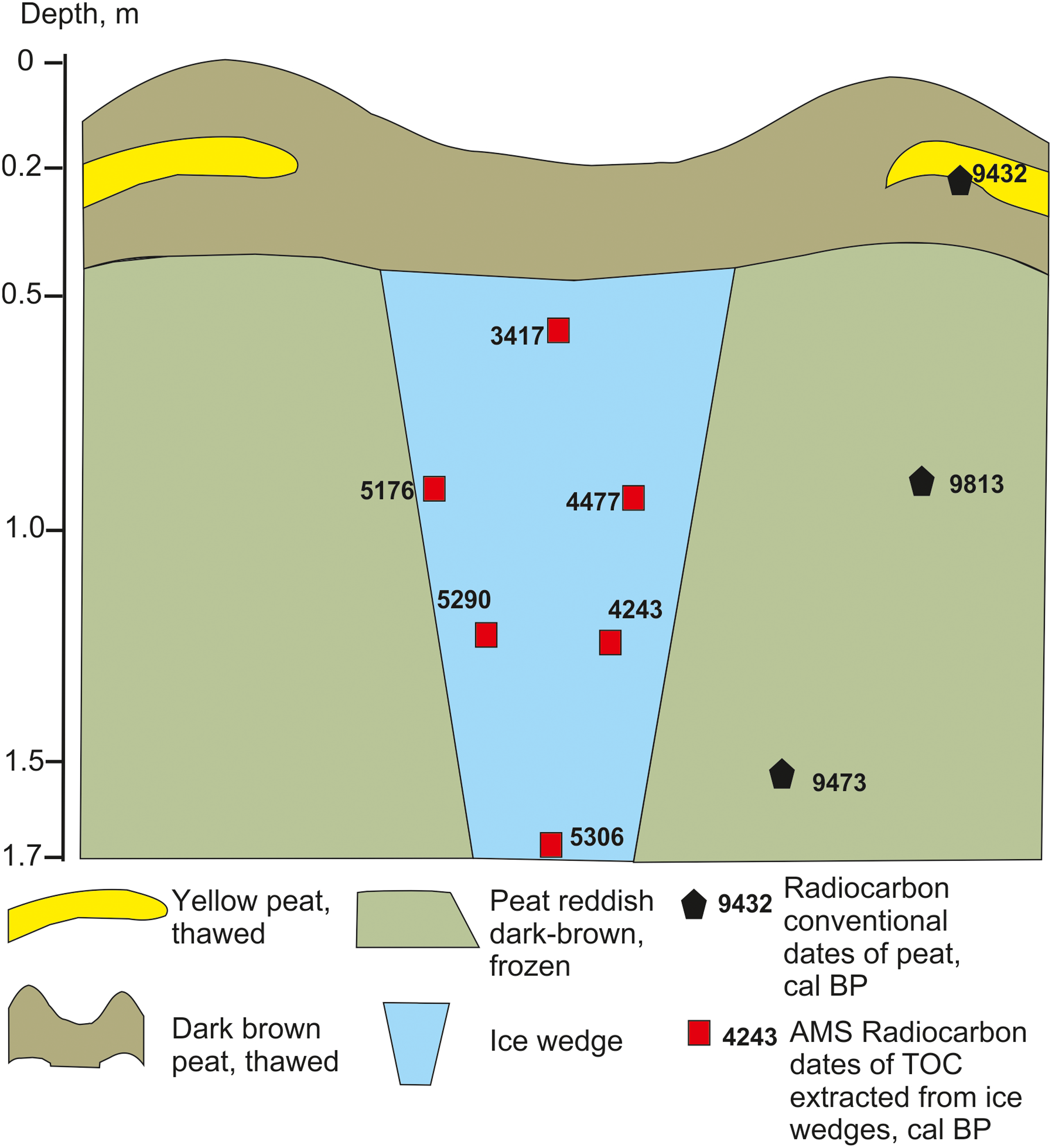
Most likely, this is a result of a predominantly allochthonous rapid accumulation of this more than 1.5-m-thick peat layer. It is supported by location of the studied peatland between small lakes (see Figure 1). The lower date (Figure 4) 9473 ± 70 cal BP seems to us the most reliable, indicating that the peatland at this site began to accumulate at the Greenlandian stage about 9.4 cal BP.
Radiocarbon dating of Holocene ice wedge and surrounding peat, polygonal peatland on the Pur-Taz interfluve.

Direct AMS 14C dating of Holocene ice wedges
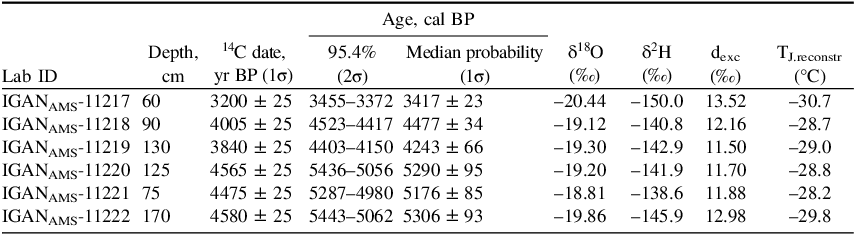
Six samples from an ice wedge (see Figure 4) were dated to establish the age of Holocene wedges. Finite radiocarbon dates from 5.3 to 3.4 cal ka BP have been obtained for all samples (Table 2).
AMS radiocarbon dates of TOC extracted from ice wedges, isotope composition of the dated ice and paleotemperature interpretation

δ18О and δ2H values in 14C dated ice wedges
Stable isotope measurements were carried out in the 14C-dated ice samples; δ18О values vary from –20.44 to –18.81‰, δ2H values – from –150.0 to –138.6‰, and dexc values – from 11.5 to 13.52‰.
Discussion
Holocene ice wedges in northwestern Siberia
An aerial visual study of the polygonal network along the Khanty-Mansiysk-Tazovsky transect, carried out by Yu. Vasil’chuk in 1979, revealed that the southernmost region of reliably identifiable polygons, obviously associated with ice wedge growth is near the town of Tarko-Sale (64°54′53″N, 77°46′22″E), where the mean annual ground temperature is slightly below –1°C. The southern limit of active ice wedges in northwestern Siberia can be roughly plotted along 63° N, and the southern limit of inactive and buried ice wedges—along 64–65°N (Vasil’chuk Reference Vasil’chuk2006, Reference Vasil’chuk2013). Recently, in 2023–2024, the Holocene ice wedges were studied near the southern limit of their distribution in northwestern Siberia: near the town of Labytnangi (Chizhova et al. Reference Chizhova, Kuzyakin, Vasilchuk, Rogova and Dunaev2025) in the Lower Ob River region (66°39′29″N, 66°23′02″E) and near the Yary settlement on the Baydarata Bay (68°51′20.27″N, 66°52′6.51″E; Vasil’chuk et al. Reference Vasil’chuk, Budantseva, Tokarev, Ginzburg, Vasil’chuk and Vasil’chuk2023a). In southern areas of northwestern Siberia permafrost large ice wedges were studied near the town of Salekhard (66°32′N, 66°38′E; Danilova Reference Danilova1962), in the Poilovo-Yakha River valley in the Taz Peninsula (68°30′N, 77°16′E; Danilov and Polyakova Reference Danilov and Polyakova1978; Melnikov Reference Melnikov1983), near the town of Novy Urengoy (66°05′05″N, 76°40′44″E; Vasil’chuk Reference Vasil’chuk2006, Reference Vasil’chuk2013), in the Shchuch’ya River valley, southern Yamal Peninsula (67°03′18″N, 68°19′12″E; Vasil’chuk et al. Reference Vasil’chuk, Vasil’chuk, Jungner, Geyh, van der Plicht, Sonninen and Budantseva2003), in the Igarka region (68°06′50″N, 86°33′00″E; 67°28′00″N, 86°34′00″E; Karpov Reference Karpov1986).
Radiocarbon age of thick peatlands and adjacent areas of the Pur-Taz region
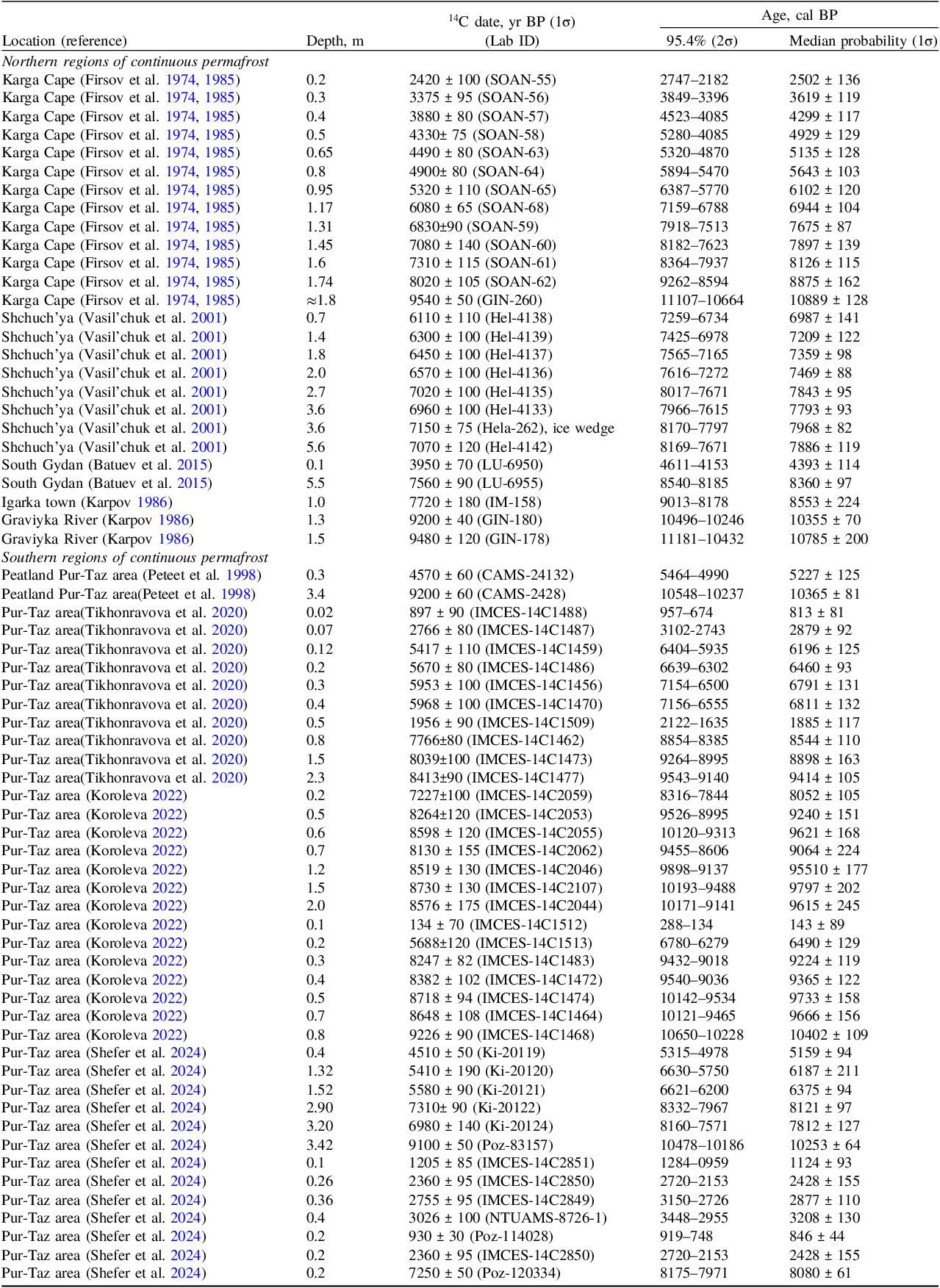
The thoroughly dated Holocene peatlands in Western Siberia are located mainly in the southern regions of the tundra. In the east it was a polygonal peatland about 2 m thick on the right bank of the Yenisei River in the upper part of a 32-m-high terrace (69°57′27″N, 83°34′3″E). Fourteen 14C dates were obtained for the peatland in the range from 10889 to 2427 cal BP without age inversions (Table 3), indicating that peat accumulation here lasted during most of the Holocene, from the Greenlandian to the Meghalayan stages (Firsov et al. Reference Firsov, Troitsky, Levina, Nikitin and Panychev1974). Polygonal peatlands with ice wedges began to form in Yenisey River valley near the town of Igarka (Karpov Reference Karpov1986) during the Greenlandian stage of Holocene, 10.8–8.5 cal ka BP (Table 3).
Radiocarbon dating of Holocene polygonal peatlands of the Pur-Taz and adjacent regions, northwestern Siberia

Ice wedges at different stages, from newly forming to retreating, have been studied in the Igarka region. During the Greenlandian stage of the Holocene, 10.8–8.5 cal BP, polygonal peatlands began to form here (Table 3). In the west, polygonal peatland more than 5.5 m thick with large syngenetic ice wedges was studied in the outcrop of the first terrace of the Shchuch’ya River (67°03′18″N, 68°19′12″E). Ten 14C dates for the peatland ranged from 7886 to 6987 cal BP (Table 3) (Vasil’chuk et al. Reference Vasil’chuk, Jungner and Vasil’chuk2001, Reference Vasil’chuk, Vasil’chuk, Jungner, Geyh, van der Plicht, Sonninen and Budantseva2003), and a fragment of green moss extracted from the ice wedge was dated to 7968 cal BP, which corresponds to the date of enclosing peat at the same depth (Vasil’chuk et al. Reference Vasil’chuk, Vasil’chuk, Jungner, Geyh, van der Plicht, Sonninen and Budantseva2003). Therefore, ice wedges in the peatland were formed soon after the beginning of peat accumulation. Several 14C dates from 8360 to 4393 cal BP for the thick peatland obtained in the Gydan Peninsula at 69°12′N, 81°23′E, for the 5.4 m peatland (Batuev et al. Reference Batuev, Ganul and Novikov2015). Kremenetski et al. (Reference Kremenetski, Sulerzhitsky and Hantemirov1998, Reference Kremenetski, Velichko, Borisova, MacDonald, Smith, Frey and Orlova2003), using published and unpublished radiocarbon dates, show that peatlands started to accumulate at the end of the Last Glacial, with a rapid initiation between 11 and 10 cal ka BP. After 8 cal ka BP peat growth slowed and reached a maximum at 4 cal ka BP.
14C dating of Holocene peat surrounding ice wedges in the Pur-Taz interfluve and adjacent regions, northwestern Siberia
The site closest to the studied peatland is located at 66°42′N, 79°44′E, an area of low-elevation peatlands between the Pur and Taz Rivers. Here, to a depth of 3.44 m, five dates (from 10365 to 5227 cal ka BP; Table 3) were obtained (Peteet et al. Reference Peteet, Andreev, Bardeen and Mistretta1998), indicating a high rate of peat accumulation between 10.3 and 5.2 cal ka BP and termination of peat accumulation by 4.5 cal ka BP. According to Tikhonravova et al. (Reference Tikhonravova, Slagoda, Rogov, Butakov, Lupachev, Kuznetsova and Simonova2020, Reference Tikhonravova, Slagoda, Butakov, Koroleva, Simonova and Sysolyatin2022, Reference Tikhonravova, Kuznetsova, Slagoda and Koroleva2023), a significant part of the frozen polygonal peatland studied in the khasyrey (alas) of the Pur-Taz interfluve was formed 9414–813 cal BP (Table 3). During this period of the Holocene, a 2-m-thick peat layer was formed over ∼2.8–3 ka. The section does not contain dates in the range of ∼6.5–3.5 cal ka BP that was previously noted for thick peatlands of the Yamal-Gydan region (Vasil’chuk and Vasil’chuk Reference Vasil’chuk and Vasil’chuk2016). In the 2-m-thick peat section, researchers (Koroleva Reference Koroleva2022) obtained a number of 14C ages that are very close to those found in our study, ranging from 9615 to 8052 cal BP (Table 3). In another peatland section less than 1 m thick in the Pur-Taz interfluve, Koroleva (Reference Koroleva2022) obtained a series of dates from 10402 to 143 cal BP (Table 3).
The “fossil wooden” horizon at the bottom peat, typical for the peatlands in northwestern Siberia, was dated (Tikhonravova et al. Reference Tikhonravova, Kuznetsova, Slagoda and Koroleva2023) between 10500 and 9390 cal BP, indicating the presence of forest tundra in the area of typical modern tundra. Since the thickness of the upper layer is only 0.2 m, it is likely that during the Greenlandian to the Meghalayan stages, the rate of peat accumulation decreased or the peat was washed away.
The peat and charcoal in the polygonal peatland of the Pur-Taz interfluve was dated in detail by Shefer et al. (Reference Shefer, Loiko, Krickov and Lim2024). As it was shown, thereafter, the intensity of peat growth became highly variable in lateral, as radiocarbon dates vary significantly along the lateral direction. For example, at a depth of 0.2 m in different locations of the same peatland, charcoal dates of 846 cal BP, 2428 cal BP, and 8080 cal BP were obtained (Table 3). This study confirms the heterochronicity of the peatland accumulation along the lateral direction: the peat did not accumulate simultaneously but could subsequently be subject to erosion and reworking. The 340 cm peat deposit is dated to 10253–5159 cal BP. The highest intensity of peat accumulation was during the period from 8 to 5.5 cal ka BP.
14C age and peculiarities of studied ice wedge formation
Intensive peatland accumulation in the Pur-Taz region commenced approximately 11 to 10 cal ka BP and finished about 8 cal ka BP. The analyzed fragment is dated to 9.5 cal ka BP; 14C dates inversion in the section indicates allochthonous accumulation in the middle and upper parts of the peat. The phenomenon may be attributed to the occurrence near a shallow water basin in the coastal area, which eroded an older peatland. During this period and for some time afterward, ice wedges did not grow. The intensive formation of ice wedges in this section of the peatland occurred much later. The peat accumulation during this period was insignificant. Active ice wedge growth began about 5.3 cal ka BP as a result of intense frost cracking followed by drainage of the peatland surface. The ice wedge growth probably lasted about 2 ka up to 3.4 cal ka BP. During this period, the rate of peat accumulation significantly ceased. This pattern of ice wedge growth forces us to reconsider the prevailing idea of syngenetic ice wedge growth in peatlands and to conclude that the ice wedges in the peatlands in the Pur-Taz area were formed epigenetically. In peatlands accumulated in the southern tundra, similar to the Pur-Taz peatland, the ice wedges are formed in previously accumulated peat and only in subaerial conditions. This phenomenon accounts for the substantial gap in dates between the host sediments and ice. To understand the process of syngenetic formation of ice wedges in peatlands, direct dating of ice wedge ice is critical. In the northern tundra, where the average annual ground temperature is lower than −3°C and winter is cold, strictly syngenetic formation of ice wedges prevails, as in these areas ice wedges are formed in areas with thin peat cover and even in flooded areas of peatlands or in subaqual conditions. Therefore, it is possible to detect ice wedges more than 5 m high even in sandy loam, less often in sand overlain by a thick layer of peat (Vasil’chuk and Vasil’chuk Reference Vasil’chuk and Vasil’chuk2016). Peat layers and mineral-enclosing sediments are usually bent upwards at the contact with ice wedges, indicating their syngenetic growth. If in the northern tundra in the Shchuch’ya River valley the gap between the dates of the peat and the ice wedge is less than 1 ka, then in the Pur-Taz peatland this difference reaches 2–3 ka or more.
Paleotemperature reconstruction
Using the obtained δ18О values (from –20.44 to –18.81‰) for the ice wedge in the studied peatland, reconstructed mean January air temperatures for the period from 5.3 to 3.4 cal ka BP vary from –30.7 to −28.2°С, while the modern mean January air temperature in the study area is about −26.2°C. For comparison, Tikhonravova et al. (Reference Tikhonravova, Slagoda, Butakov, Koroleva, Simonova and Sysolyatin2022) obtained the similar stable isotope data for ice wedges studied in another section (67°20′14.8″N, 078°55′47.1″E) of the peatland in the Pur-Taz interfluve: δ18О values range from −21.9 to −20.7‰, δ2H values from −154.6 to −141.0‰, and dexc values from 18 to 31‰. While the δ18О value of the veinlet is −19.4 ‰, the δ2H value is −141.4‰, dexc value is 13.8‰. Mean January air paleotemperatures calculated using the same Vasil’chuk equation range from −33 to −27°С (Tikhonravova et al. Reference Tikhonravova, Slagoda, Butakov, Koroleva, Simonova and Sysolyatin2022), which is close to our results.
Conclusions
-
1. Ice-wedge formation in the peatlands in the Pur-Taz interfluve was mainly epigenetic; only the uppermost parts of the ice wedges formed syngenetically.
-
2. Using the results of the AMS 14C dating of organic matter extracted from ice wedges and the 14C dates of the host peat, we have established that the formation of ice wedges near the southern limit of their distribution had occurred by 3–4 thousand years or more later than the accumulation of the host peat.
-
3. About 11–10 cal ka BP, peat began to accumulate in the gradually draining khasyrey (alas) in the Pur-Taz interfluve.
-
4. Intensive syngenetic formation of ice wedges in the studied fragment of the peatland took place between 5.3 and 3.4 cal ka BP. Peat dated in this time interval has not been found among radiocarbon dates of Pur-Taz peatlands.
-
5. The variations in δ18O values in the ice wedge were within the range of 1.63‰, from −20.44 to −18.81‰, and δ2H values ranged from −150 to −138.6‰.
-
6. The approximate average temperature in January during the period 5.3–3.4 cal ka BP was between −30.7 and −28.2 °C
-
7. Formation of syngenetic ice wedges in khasyrey (alas) in the Pur-Taz interfluve occurred mainly under subaerial conditions after the accumulation of a peat layer of about 0.3–0.6 m.
Acknowledgments
The study was conducted under the state assignment of Lomonosov Moscow State University. Constructive comments by Associate Editor Dr. Yaroslav Kuzmin, and Managing Editor Kimberley Elliott provided clear guidance that improved the content of this paper.