Introduction
Research on exploring bioactive compounds is focused primarily on anti-nutritional proteins because of their enormous potential in plant biotechnology. The success of transgenic crops based on Bt toxin from the soil bacterium Bacillus thuringiensis against some insect pests has paved the way for exploration of other proteins for their toxic and anti-nutritional properties against major insect pests. Plants have a wide array of defence proteins that are induced in response to insect attack. Proteinase inhibitors (PIs) are inducible plant defences that are abundantly present in storage organs. They are synthesized as a direct response to injury and insect herbivory (Ryan, Reference Ryan1990). In insects, PIs act by inhibiting gut proteinases of the insect, which adversely affects protein digestion in the gut leading to growth retardation (Jongsma and Bolter, Reference Jongsma and Bolter1997). The introduction of specific PIs into plants, which do not produce these molecules, is an alternative strategy being explored for obtaining crops resistant to insect pests.
Studies on the effects of dietary plant protease inhibitors on the development of insects were first reported by Lipke et al. (Reference Lipke, Fraenkel and Liener1954) following an observation that the larvae of the flour beetle Tribolium confusum Jacquelin du Val (Coleoptera: Tenebrionidae) failed to develop on raw soybeans. Since then, some investigations have been carried out to ascertain the toxicity of plant protease inhibitors towards herbivorous insects, belonging to the insect orders Lepidoptera, Coleoptera and Orthoptera. Serine protease inhibitors have been found to affect growth, development and protease activity of many lepidopteran pests including corn borer larvae Ostrinia nubilalis (Hubner) (Lepidoptera: Crambidae) (Steffens et al., Reference Steffens, Fox and Kassell1978), cutworm Spodoptera litura (Fab.) (Lepidoptera: Noctuidae) (McManus and Burgess, Reference McManus and Burgess1995; Telang et al., Reference Telang, Srinivasan, Patankar, Harsulkar, Joshi, Deshpande, Sainani, Ranjekar, Gupta, Birah, Rani, Kachole, Giri and Gupta2003), American bollworm Helicoverpa armigera (Hubner) (Lepidoptera: Noctuidae) (Johnston et al., Reference Johnston, Gatehouse and Anstee1993; Gatehouse et al., Reference Gatehouse, Christeller, Gatehouse and Zou2002; Chougule et al., Reference Chougule, Hivrale, Chhabda, Giri and Kachole2003; Telang et al., Reference Telang, Srinivasan, Patankar, Harsulkar, Joshi, Deshpande, Sainani, Ranjekar, Gupta, Birah, Rani, Kachole, Giri and Gupta2003; Tamhane et al., Reference Tamhane, Chougule, Giri, Dixit, Sainani and Gupta2005; Srinivasan et al., Reference Srinivasan, Giri, Harsulkar, Gatehouse and Gupta2005; Shukla et al., Reference Shukla, Arora and Sharma2005), cotton bollworm Helicoverpa zea (Boddie) (Lepidoptera: Noctuidae) (Broadway, Reference Broadway1995, Reference Broadway1997), sugarcane borer Diatraea saccharalis (Fab.) (Lepidoptera: Crambidae) (Pompermayer et al., Reference Pompermayer, Lopes, Terra, Parra, Falco and Silva-Filho2001), velvetbean caterpillar Anticarsia gemmatalis (Hubner) (Lepidoptera: Noctuidae) (Pereira et al., Reference Pereira, Dorr, Peixoto, Lima-Garcia, Dorr and Brito2005) and Mediterranean flour moth Anagasta kuehniella (Zeller) (Lepidoptera: Pyralidae) (Macedo et al., Reference Macedo, Freire, Cabrini, Toyama, Novello and Marangoni2003). In coleopterans, cysteine PIs were found to be more effective in retarding the growth and development of various insects such as red flour beetle Tribolium castaneum (Herbst) (Coleoptera: Tenebrionidae), and bruchids such as Callosobruchus maculatus F. (Coleoptera: Chrysomelidae), bean weevil Acanthoscelides obtectus Say (Coleoptera: Chrysomelidae), corn rootworm Diabrotica spp. (Coleoptera: Chrysomelidae) and willow leaf beetle Galerucella lineola Fabricius (Coleoptera: Chrysomelidae) (Hines et al., Reference Hines, Osuala and Nielson1991; Liang et al., Reference Liang, Brookhart, Feng, Reeck and Kramer1991; Chen et al., Reference Chen, Johnson, Wen, Muthukrishnan, Kramer, Morgan and Reeck1992; Seldal et al., Reference Seldal, Dybwad, Andersen and Hoegstedt1994; Oliveira et al., Reference Oliveira, Pereira, Lima, Morais, Melo, Franco, Bloch, Grossi-De Sa and Sales2002; Macedo et al., Reference Macedo, De Sa, Freire and Parra2004). However, similar investigations with dipteran pests pertain only to fruit fly Ceratitis capitata Wiedemann (Diptera: Tephritidae), where Gomes et al. (Reference Gomes, Barbosa, Macedo, Pitanga, Moura, Oliveira, Moura, Queiroz, Macedo, Andrade, Vidal and Sales2005) and Silva et al. (Reference Silva, Alcazar, Macedo, Oliveira, Macedo, Abreu, Santos and Sales2006) reported reduction in larval mass of C. capitata with trypsin inhibitor from Crotalaria pallida Aiton (Fabaceae) and soybean.
The melon fruit fly Bactrocera cucurbitae (Coquillett) (Diptera: Tephritidae) is distributed all over the world. It damages over 80 plant species, and plants belonging to the family Cucurbitaceae are preferred most by it (Allwood et al., Reference Allwood, Chinajariyawong, Drew, Hamacek, Hancock, Hengsawad, Krisaneepaiboon, Leong and Vijaysegeran1999). The extent of losses caused by the pest varies from 30 to 100%, depending on the cucurbit species and the season. Singh et al. (Reference Singh, Mishra, Bisan, Malik and Mishra2000) reported 31% damage on bitter gourd and 28% on watermelon in India. The melon fruit fly remains active throughout the year on one or the other host. Therefore, keeping in view the anti-insect activity of the proteinase inhibitors and the pest status of the melon fruit fly, we investigated the effect of some plant proteinase inhibitors on the growth and survival of B. cucurbitae.
Materials and methods
Rearing of insects
The melon fruit fly, initially procured as immature stages from infested bitter gourd Momordica charantia L. (Cucurbitaceae) collected from a vegetable market in Amritsar and from kitchen gardens of Guru Nanak Dev University, Amritsar (India), was reared according to the procedure described by Gupta et al. (Reference Gupta, Verma and Kashyap1978) with slight modifications. Adult flies were kept in wire mesh cages (Rescholar equipment; L45 × B45 × H50 cm) and were provided with Proteinex (Pfizer Ltd, Mumbai, India) and 20% sugar solution as food. Pumpkin fruits Cucurbita moschata Duchesne (Cucurbitaceae) were provided for oviposition and also served as natural food for the larvae. The stock cultures of flies were maintained in an insect culture room with regulated temperature (25 ± 2 °C), relative humidity (70–80%) and photoperiod (10 h light-14 h dark).
Bioassay
Fresh pumpkin pieces were kept in wire mesh cages with approximately 100 gravid females for 6–8 h. These charged (egg laid) pumpkin pieces were removed from the cages and dissected after 44 h (for first instar) and 88 h (for third instar) for harvesting the larvae. The harvesting was done in saline water, and the larvae were washed using distilled water before shifting them into culture vials (25 mm OD × 100 mm length) containing culture medium with trypsin inhibitors (SBTI and SBBI; Sigma-Aldrich Ltd, St Louis, MO, USA, labelled as treated) and culture medium without trypsin inhibitors (control). The artificial culture medium used in the bioassay was prepared according to Srivastava (Reference Srivastava1975) for this fruit fly.
The first and third instar larvae were treated with five concentrations (12.5, 25, 50, 100 and 200 ppm) of two soybean trypsin inhibitors, i.e. trypsin inhibitor (Kunitz type) and trypsin–chymotrypsin inhibitor (Bowman-Birk type). The experimental vials were kept in the culture room and observed daily for various developmental parameters such as larval and pupal period, total development period, percentage pupation, percentage emergence and morphological aberrations. There were six replications for each concentration with 10–15 larvae in each vial.
Statistical analysis
To assess the relativity and significance of the effects of SBTI and SBBI on the growth and development of larvae of B. cucurbitae, data were analysed using one-way ANOVA. The means were compared with Tukey's post hoc test using SPSS 11 for Windows. Probit lines were drawn for emergence to calculate lethal concentration (LC)50 values. Correlation coefficient (r) was also calculated to study the relationships between various concentrations and parameters.
Results
The two plant-based protease inhibitors, belonging to class serine PIs, tested for their bioefficacy against melon fruit fly affected the development period, pupation and emergence of the insects.
Effect of PIs on growth and development
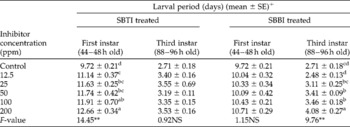
The larval period of both the first and third instar larvae was prolonged when treated with various concentrations of SBTI and SBBI. However, in SBTI-treated larvae, the increase was significant (F 5,25 = 14.45, P < 0.01) only in first instar larvae where the larval period increased by 2.94 days at 200 ppm (Table 1). The prolongation in the larval period was positively correlated (r = 0.799, P < 0.01) with increased inhibitor concentrations for first instar larvae. On the other hand, in SBBI-treated larvae, the increase was significant (F 5,25 = 9.32, P < 0.01) in third instar larvae with the larval period prolonged by 1.37 days at 200 ppm. Similarly in SBBI-treated larvae, the prolongation in larval period was positively correlated (r = 0.916, P < 0.01) with increased inhibitor concentrations for third instar larvae.
Larval period of Bactrocera cucurbitae after feeding first and third instar larvae ad libitum on SBTI- and SBBI-incorporated artificial diet

SBTI, trypsin inhibitor (Kunitz type); SBBI, trypsin–chymotrypsin inhibitor (Bowman-Birk type); ppm, parts per million; **, significant at 1%; NS, non-significant.
Values with same superscript letters per column are not significantly different (Tukey's post hoc test).
+ Mean of six replications.
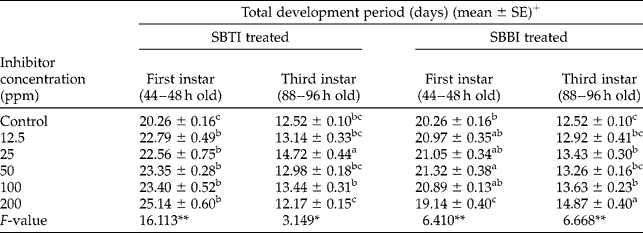
The total development period was significantly prolonged in the first (F 5,25 = 16.11, P < 0.01) and third (F 5,25 = 3.15, P < 0.05) instar larvae treated with SBTI. The effect was more pronounced in the first instar larvae where the development period was delayed by 4.88 days at 200 ppm (Table 2). Moreover, in SBTI-treated first instar larvae, the prolongation in development period was positively correlated with SBTI concentrations (r = 0.846, P < 0.01). In SBBI-treated larvae, the development period was delayed significantly in both the first (F 5,25 = 6.41, P < 0.01) and third (F 5,25 = 6.67, P < 0.01) instar larvae (Table 2). In the third instar larvae, the development period was prolonged by 2.35 days at 200 ppm, and the delay was positively correlated with increase in inhibitor concentration (r = 0.96, P < 0.01). However, for the first instar larvae, no correlation was observed between development period and increase in SBBI concentration.
Total development period of Bactrocera cucurbitae after feeding first and third instar larvae ad libitum on SBTI- and SBBI-incorporated artificial diet
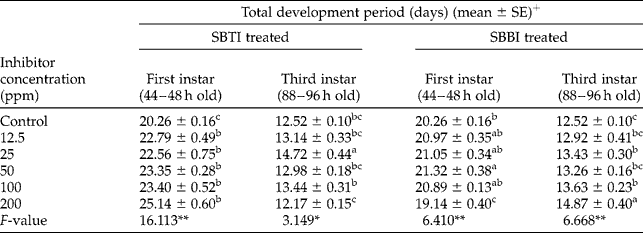
SBTI, trypsin inhibitor (Kunitz type); SBBI, trypsin–chymotrypsin inhibitor (Bowman-Birk type); ppm, parts per million; **, significant at 1%; *, significant at 5%.
Values with same superscript letters per column are not significantly different (Tukey's post hoc test).
+ Mean of six replications.
Effect of PIs on percentage pupation
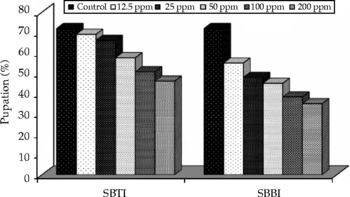
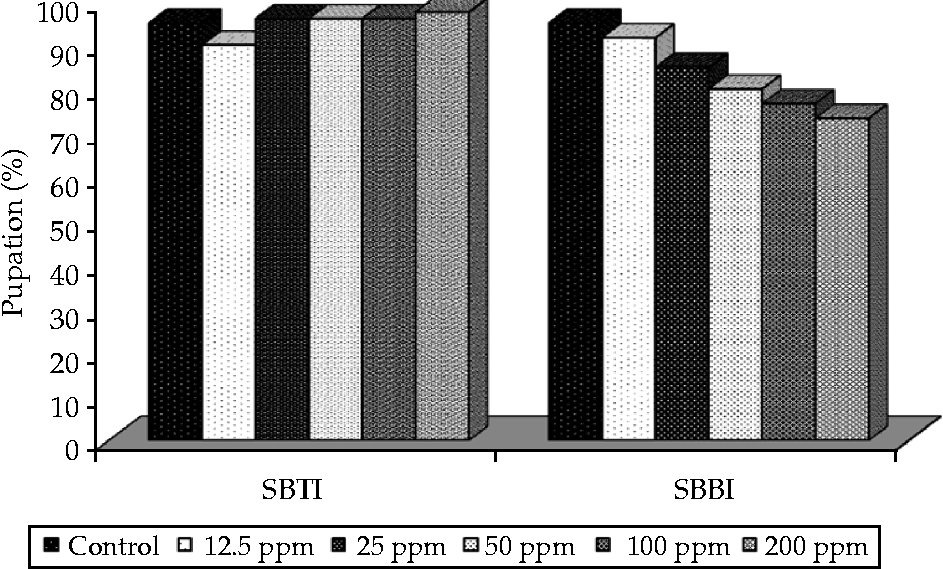
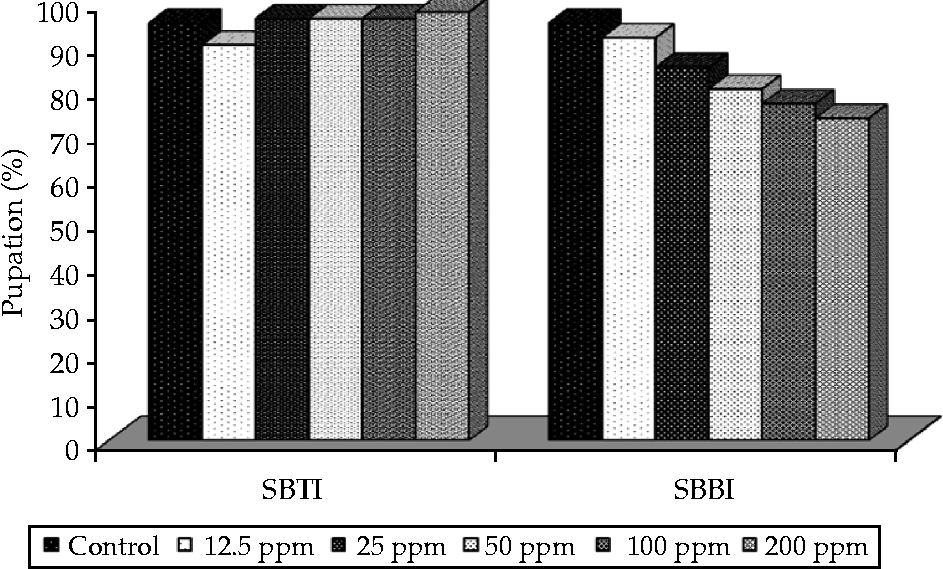
The deleterious effects of PIs on melon fruit fly were evident as a decrease in percentage pupation was observed in the first and third instar larvae treated with different concentrations of SBTI and SBBI. The percentage pupation declined non-significantly to 64% of the control in the SBTI-treated first instar larvae at the highest concentration of 200 ppm, whereas in SBBI-treated larvae, it declined to 48.6% of the control. In both the treatments, percentage pupation was negatively correlated with increase in concentrations of PI (Fig. 1). However, the survival of the larvae was not much affected in the third instar larvae where the percentage pupation after an initial decrease increased, though not significantly, with SBTI treatment. Yet in SBBI-treated third instar larvae, the percentage pupation significantly decreased (F 5,25 = 6.4, P < 0.01) with increase in concentration (Fig. 2).
Percentage pupation of first instar larvae (44–48 h old) of melon fruit fly under the influence of SBTI and SBBI.

Percentage pupation of third instar larvae (88–96 h old) of melon fruit fly under the influence of SBTI and SBBI.
Effect of PIs on percentage emergence
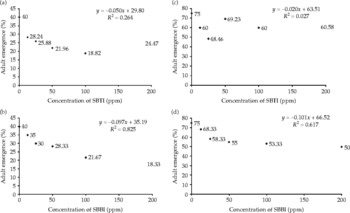
A decrease in adult emergence was recorded in both instars when the larvae were treated with trypsin inhibitor from soybean as the adult emergence increased at higher concentrations after an initial decrease at lower concentrations of SBTI. Among the two larval instars, the most profound inhibitory effect of SBTI on emergence was observed in the first instar larvae (F 5,25 = 4.75, P < 0.01) (Fig. 3(a)). The LC50 values for the first and third instar SBTI-treated larvae were 53.10 and 86.00 ppm, respectively. Percentage emergence was reduced significantly in both the instars of larvae treated with SBBI, and the decrease was dose dependent in both the instars. In first instar larvae, the effect was more profound as the adult emergence reduced significantly (F 5,25 = 5.83, P < 0.01) from 40% in control to 18.33% at 200 ppm (Fig. 3(b)). The decrease in emergence was also significant (F 5,25 = 2.69, P < 0.01) for third instar larvae (Fig. 3(d)). The LC50 values for first and third instar SBBI larvae were 159.54 and 315.49 ppm, respectively.
Percentage emergence of first (44–48 h old) and third (88–96 h old) instar larvae of melon fruit fly under the influence of SBTI and SBBI. (a) Percentage emergence of first (44–48 h old) instar larvae under the influence of SBTI. (b) Percentage emergence of first (44–48 h old) instar larvae under the influence of SBBI. (c) Percentage emergence of third (88–96 h old) instar larvae under the influence of SBTI. (d) Percentage emergence of third (88–96 h old) instar larvae under the influence of SBBI.

Discussion
In the present study, the two inhibitors of serine proteases from soybean were tested for their bioefficacy against melon fruit fly. It was found that both of them affected the development of the immature stages of this dipteran fly. The larval period of melon fruit fly was prolonged in the first (48–56 h old) and third (88–96 h old) instars after treatment with SBTI and SBBI. Studies conducted on lepidopteran insect pests had shown a significant delay in pupation after their treatment with different plant PIs belonging to the serine group of inhibitors. Steffens et al. (Reference Steffens, Fox and Kassell1978) observed that O. nubilalis larvae had grown on soybean inhibitor diet and that the controls showed a wide variation in the time of pupation. On the soybean inhibitor diet, pupation was delayed by an average of 6 days compared with the control. Consumption of soybean proteinase inhibitor significantly delayed the developmental time of D. saccharalis to pupation and adult emergence (Pompermayer et al., Reference Pompermayer, Lopes, Terra, Parra, Falco and Silva-Filho2001). More recently Bhavani et al. (Reference Bhavani, Bhattacherjee and Prasad2007) and Kansal et al. (Reference Kansal, Gupta, Koundal, Kuhar and Gupta2008) have also reported a delay in pupation of H. armigera larvae under the influence of Subabul PI and mung bean PI. Among the other insect pest orders, a dose-dependent delay in larval period was observed in the cotton boll weevil Anthonomus grandis under the effect of chickpea trypsin inhibitor (Gomes et al., Reference Gomes, Barbosa, Macedo, Pitanga, Moura, Oliveira, Moura, Queiroz, Macedo, Andrade, Vidal and Sales2005). SBTI also affected the development time of migratory grasshopper Melanoplus sanguinipes Fab. (Orthoptera: Acrididae) (Hinks and Hupka, Reference Hinks and Hupka1995).
SBTI and SBBI also significantly affected the total development period of first and third instar melon fruit fly that got delayed with the treatment. Pompermayer et al. (Reference Pompermayer, Lopes, Terra, Parra, Falco and Silva-Filho2001) had suggested that the full normal pattern of development of the larvae might not be possible under conditions of nutritional stress, as imposed by the ingestion of the inhibitors. This suggestion was based on their observations in D. saccharalis larvae where they observed a significant delay in the development time to emergence after consumption of a SBTI diet. Also, about 56% of larvae reared on SBTI-treated diet presented six instars as compared with five instars in control-fed larvae.
Although the delay in growth is not striking, Steffens et al. (Reference Steffens, Fox and Kassell1978) had reported that small changes of this nature might be sufficient to tip the ecological balance in favour of the plant. Severe delay in the growth and development caused by inhibitors, if occurring in a natural setting, provides a much longer period in which the larvae would be subject to their natural enemies (Mochizuki et al., Reference Mochizuki, Nishizawa, Onodera, Tabei, Toki, Habu, Ugaki and Ohashi1999).
A significant reduction in the percentage pupation and percentage adult emergence was observed when the larvae were treated with the two inhibitors. The effect was more pronounced in the first instar than in the third instar. SBTI significantly decreased pupation only in the first instar, whereas SBBI affected both the first and third instars. Araujo et al. (Reference Araujo, Bezerra, Oliveira, Moura, Macedo, Gomes, Barbosa and Sales2005) found that trypsin inhibitor from Tamarindus indica seeds affected the mass of C. capitata larvae at 53.2% and produced ~34% mortality at a level of 4.0% w/w of tamarind trypsin inhibitor. Gomes et al. (Reference Gomes, Barbosa, Macedo, Pitanga, Moura, Oliveira, Moura, Queiroz, Macedo, Andrade, Vidal and Sales2005) observed that trypsin inhibitor from C. pallida seeds was effective against C. capitata larvae as it caused 27% mortality at 1% w/w level; however, they further observed that the action was constant at higher doses from 2 to 4% w/w with 15% mortality. A similar kind of study with SBTI against C. capitata showed that larvae of fruit fly were susceptible to this inhibitor as it affected larval mass at effective dose (ED)50 3.01% when incorporated into artificial diet. The larvae were more affected at initial inhibitor concentrations of 0.25 and 0.5%, causing 20% mortality, but at high SBTI concentrations mortality decreased to 10%. Shukla et al. (Reference Shukla, Arora and Sharma2005) also reported a decrease in the percentage pupation and percentage adult emergence in H. armigera under a SBTI treatment. Percentage pupation ranged from 40% in treated diet to 90% in untreated diet. They also studied the effect of SBTI through surface treatment of artificial diet and reported 16.7 and 20% mortality compared with 10% in control, and the percentage pupation decreased in the treated diet. Broadway (Reference Broadway1995) also observed that dietary amendment with semi-purified cabbage PIs reduced larval growth by 35% and adult emergence by 66% in the cabbage looper Trichoplusia ni at 1% in diet. Serine PIs from different plants are also potent inhibitors of growth and development of some coleopteran insect pests. For instance, Gomes et al. (Reference Gomes, Barbosa, Macedo, Pitanga, Moura, Oliveira, Moura, Queiroz, Macedo, Andrade, Vidal and Sales2005) observed that PIs from chickpea caused several deformities and a mortality rate of ~45% in cotton boll weevil A. grandis. Similarly Macedo et al. (Reference Macedo, De Sa, Freire and Parra2004) reported 50% mortality, reduced fecundity and oviposition and severe deformities in adults emerged from C. maculatus larvae treated with Kunitz-type inhibitor from Adenanthera pavonina seeds.
In our studies, we found that SBTI has more potential in inhibiting the growth and development of first instar larvae of melon fruit fly than SBBI. These results also suggest that the melon fruit fly uses serine proteases as both the inhibitors were serine protease inhibitors. Also, trypsin might be the major digestive enzyme as SBTI has a more pronounced effect than SBBI. Further studies are required to determine whether the activity of gut proteases has been altered in the treated larvae fed on PIs to better understand the mechanism by which these PIs affect the growth and development of this dipteran fly.