Introduction
The 1-year prevalence of depressive disorders in US adults is around 10% (Kessler et al., Reference Kessler, Berglund, Demler, Jin, Koretz, Merikangas, Rush, Walters and Wang2003) and account for the most years lived with the disability of any illness (Üstün et al., Reference Üstün, Ayuso-Mateos, Chatterji, Mathers and Murray2004). While depressive disorders result in substantial impairment over time for many individuals, some have only a few, discrete episodes. Numerous prospective studies have sought to categorize diverse courses of illness and to identify their clinical and biological correlates.
The metrics used to classify courses of illness have included likelihoods of, or times to, recovery, remission, and relapse, as well as morbidity indices derived from averages of symptom levels over a period of observation. However, none of these measures adequately captures temporal trends. One individual might recover within a few weeks and then relapse into a chronic episode, and another might recover many months after an episode's onset but then remain well for an extended period. The individuals, in either case, might differ markedly in average symptom levels as reflected in a morbidity index, but such a number would not adequately describe the disparate courses over time.
Such problems are, of course, not unique to mood disorders and, in aggregate, these concerns account for an increasing interest in trajectory analyses (Nagin and Odgers, Reference Nagin and Odgers2010). Such approaches provide person-centered perspectives that identify subgroups based on common patterns in longitudinal observations (Shore et al., Reference Shore, Toumbourou, Lewis and Kremer2018). Trajectory analyses of mood disorders in adolescents are particularly important because this age group encompasses the years of onset for a substantial proportion of individuals who experience mood disorders.
A recent meta-analysis of trajectory studies described 20 prospective follow-up studies with identified trajectories that ranged in number from three to eleven (Shore et al., Reference Shore, Toumbourou, Lewis and Kremer2018). To summarize the findings of risks factors that distinguished between trajectories, the authors subsumed the symptom patterns in these studies into three groups they labeled as ‘low,’ ‘moderate,’ and ‘high or increasing’. Female sex was consistently associated with the highest symptom trajectory. At least four studies found low SES, substance abuse, or a ‘negative parental relationship’ to also be significantly more characteristic of the highest symptom trajectory.
Notably, this meta-analysis did not examine childhood trauma. Yet, childhood trauma is firmly established as a risk factor for later development of depressive disorders, particularly those characterized by early-onset, chronicity, and treatment resistance (Barnhofer et al., Reference Barnhofer, Brennan, Crane, Duggan and Williams2014; Nelson et al., Reference Nelson, Klumparendt, Doebler and Ehring2017). Childhood trauma increases the likelihood of anxiety disorders to at least the same degree as it does of depressive disorders (Li et al., Reference Li, D'arcy and Meng2016) and is also associated with high levels of neuroticism (Hengartner et al., Reference Hengartner, Cohen, Rodgers, Müller, Roessler and Ajdacic-Gross2015). Both anxiety disorders (Coryell et al., Reference Coryell, Solomon, Fiedorowicz, Endicott, Schettler and Judd2009, Reference Coryell, Fiedorowicz, Solomon, Leon, Rice and Keller2012; Newman et al., Reference Newman, Llera, Erickson, Przeworski and Castonguay2013) and neuroticism (Coryell et al., Reference Coryell, Langbehn, Norris, Yao, Dindo and Calarge2017) are, in turn, well-established risk factors for symptom persistence in depressive disorders. However, efforts to describe interactions between anxiety disorders and neuroticism on the course of depressive illness are scarce and we are aware of no studies that do so using trajectory analysis.
In consideration of these issues, we sought to answer the following questions. If clear trajectory groupings emerge as predicted, will childhood adversity be associated with trajectories of higher depressive morbidity? If so, will correlations between measures of childhood adversity and neuroticism, or between childhood adversity and anxiety disorder, account for its prognostic effects on depressive morbidity? Does anxiety disorder mediate the relationship between neuroticism and membership in higher morbidity trajectory groups? Finally, do higher degrees of neuroticism, or rates of anxiety disorder, account for relationships between female sex and trajectory grouping. Evidence for the primacy of one risk factor over another can serve to more productively shape approaches to prognostic formulations and to shift the focus of research toward more fundamental etiological mechanisms.
Methods
Participants
As part of a study designed to examine the effects of selective serotonin reuptake inhibitors (SSRIs) on bone metabolism in adolescents and emerging adults, individuals 15–20 years of age were recruited from inpatient and outpatient settings, and through e-mail solicitations, to comprise two groups (Calarge et al., Reference Calarge, Butcher, Burns, Coryell, Schlechte and Zemel2014, Reference Calarge, Mills, Janz, Burns, Schlechte, Coryell and Zemel2017). Those in one were taking no psychotropic medications and those in the other had begun taking an SSRI within the previous month. Treatment with psychotropics, other than SSRIs, during the 2 years prior to study entry resulted in exclusion, with the exception of the use of benzodiazepines, trazodone, α 2-agonists, or stable doses of psychostimulants. Also excluded were individuals with an eating disorder, substance dependence, pregnancy, significant medical or surgical history, chronic use of medications potentially affecting bone metabolism, or with plans to move out of state within a year. As the presence of a mood disorder was not a requirement for inclusion in the parent study for either group, the current analyses restricted participants to those who had ever met criteria for a major depressive disorder (MDD) or who endorsed depressive clinically significant symptoms at study entry, including those who were naive to psychotropic medications (n = 186). The local Institutional Review Board approved the study and adult participants provided written informed consent. The parent/guardian of minor participants provided written informed consent while the minors gave written assent to the study.
Procedures
Experienced research coordinators collected demographic and clinical data in an initial interview that included the NIMH Diagnostic Interview Schedule for Children (DISC-IV) (Shaffer et al., Reference Shaffer, Fisher, Lucas, Dulcan and Schwab-Stone2000) as well as an unstructured interview by a child psychiatrist (CAC). Consensus diagnoses were generated based on the structured interview, an unstructured assessment, and information from self-completed symptom rating scales. Parents of minors were also interviewed.
The intake assessment included the Early Trauma Inventory-Self Report (ETISR) (Bremner et al., Reference Bremner, Bolus and Mayer2007). This is a 19-item questionnaire that covers general adverse life events that occurred before the age of 18 and that includes scores for physical, sexual, and emotional abuse, as well as a total score. Participants also completed the Multidimensional Personality Questionnaire (MPQ) (Patrick et al., Reference Patrick, Curtin and Tellegen2002) at their first follow-up visit. This is a factor-analytically derived inventory of personality that generates 11 primary scales. These loads, in turn, on three higher-order factors: positive emotionality (wellbeing, social potency, social closeness, and achievement), negative emotionality (stress reaction, alienation, and aggression), and constraint (control, harm avoidance, and traditionalism). The negative emotionality measure has been shown to strongly correlate with the NEO Personality Inventory dimension of neuroticism (McCrae and Costa, Reference McCrae and Costa1987; Church, Reference Church1994). Some attrition occurred between the first visit and the first follow-up so the number of individuals with MPQ data is smaller.
Face-to-face visits occurred at 4-month intervals over the subsequent 2 years. The symptom status of the disorder considered to be primary at the initial evaluation was also monitored with monthly telephone calls to the participants. Interviewers guided individuals to identify any change points in levels of psychopathology that had taken place since the last interview. Participants then quantified the number of symptoms present between those change points and results were recorded according to conventions in the A-LIFE (Calarge et al., Reference Calarge, Butcher, Burns, Coryell, Schlechte and Zemel2014), a modification of the Longitudinal Interval Follow-up Evaluation (LIFE) (Keller et al., Reference Keller, Lavori, Friedman, Nielsen, Endicott, Mcdonald-Scott and Andreasen1987) that includes additional disorders more commonly seen in youth. This yielded symptom level ratings during each week of follow-up interval on a scale of 1–6. The time period for this coverage included the 4 months preceding the initial face-to-face interview.
Statistical methods
Participants' weekly MDD symptom levels from the A-LIFE were analyzed using group-based trajectory modeling (GBTM), a statistical method used to find clusters of individuals following similar patterns of symptom change over time (Nagin and Odgers, Reference Nagin and Odgers2010). The GBTM approach was chosen because it is designed to identify subgroup trajectories across time in a manner that is easy to summarize and understand. GBTM models with three and four groups were generated using the censored normal distribution and the polynomial function of time (linear, quadratic, or cubic) that best fit the data. In each model, individuals were assigned to the group where the GBTM-determined probability of membership was highest. The choice of best-fitting model was informed by model fit indices (Akaike, Reference Akaike1974) and ultimately made by maximizing the number of non-redundant MDD patterns. The GBTM analysis was conducted using PROC TRAJ in SAS 9.4 (Jones et al., Reference Jones, Nagin and Roeder2001).
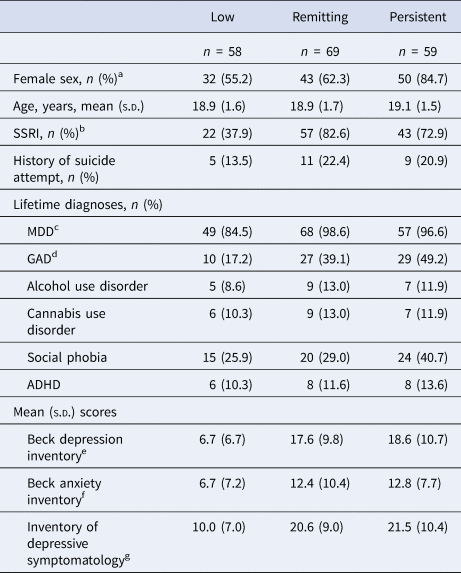
Baseline characteristics of the three trajectory groups were then compared using c2 tests for categorical variables and ANOVA models for continuous variables. Group differences for ETISR (from baseline) and MPQ (from the first follow-up visit) scores were also examined using ANOVA models. Stepwise statistical comparisons across the three trajectory groups were followed by those pairwise comparisons that reached significance (Tables 1 and 2). A non-significant (p = 0.133) test of parallel lines justified the use of ordinal logistic regression model to assess the relationship of the GTBM groups with multiple predictors (sex, total ETISR, negative emotionality, and GAD) and all possible 2-way interaction effects.
Baseline demographic and clinical characteristics of the participants divided into three trajectory groups

SSRI, selective serotonin reuptake inhibitor use at study entry; GAD, generalized anxiety disorder; ADHD, attention deficit hyperactivity disorder.
a χ2 = 12.8, p = 0.002; 2 < 3, χ2 = 0.0, p = 0.005; 1 < 3, χ2 = 12.2, p = 0.000.
b χ2 = 29.9, p = 0.000; 1 < 2, χ2 = 28.6, p = 0.000; 1 < 3, χ2 = 13.0, p = 0.000.
c χ2 = 11.7, p = 0.003; 1 < 2, χ2 = 8.6, p = 0.004.
d χ2 = 13.6, p = 0.001; 1 < 2, χ2 = 5.6, p = 0.014; 1 < 3, χ2 = 13.0, p = 0.000.
e F = 30.4, p = 0.000; Bonferroni: 1 < 2, p = 0.000; 1 < 3, p = 0.000.
f F = 9.1, p = 0.000; Bonferroni: 1 < 2, p = 0.001; 1 < 3, p = 0.001.
g F = 31.0, p = 0.000; Bonferroni: 1 < 2, p = 0.000; 1 < 3, p = 0.000.
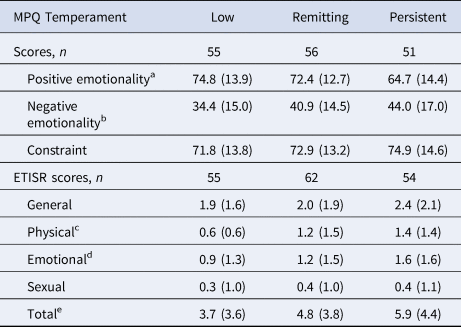
Measures of temperament and childhood adversity for the participants divided into three trajectory groups, mean (s.d.)
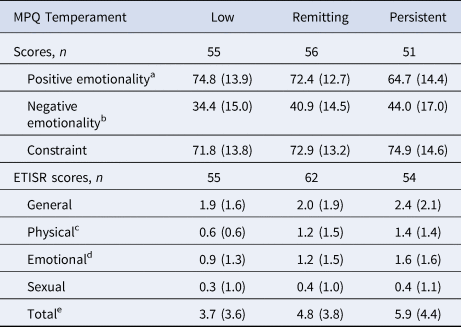
MPQ, Multidimensional personality questionnaire from the first follow-up visit; ETISR, early trauma inventory – self-report from the baseline visit.
a F = 7.9, p = 0.001; Bonferroni: 1 < 3, p = 0.001; 2 < 3, p = 0.012.
b F = 5.3, p = 0.006; Bonferroni: 1 < 3, p = 0.005.
c F = 4.0, p = 0.019; Bonferroni: 1 < 3, p = 0.021.
d F = 3.4, p = 0.037; Bonferroni: 1 < 3, p = 0.032.
e F = 4.1, p = 0.019; Bonferroni: 1 < 3, p = 0.015.
Results
The sample of participants with past or present evidence of a depressive disorder (n = 186) is described in Table 1. Of these, 126 (67.7%) completed the full 2 years of follow-up. None of the variables listed in Table 1 differed significantly between those who did and those who did not complete the 2 years though a trend emerged for higher baseline IDS scores among non-completers: mean (s.d.) values for completers and non-completers were 16.6 (10.6) and 19.8 (9.4), respectively (p = 0.052).
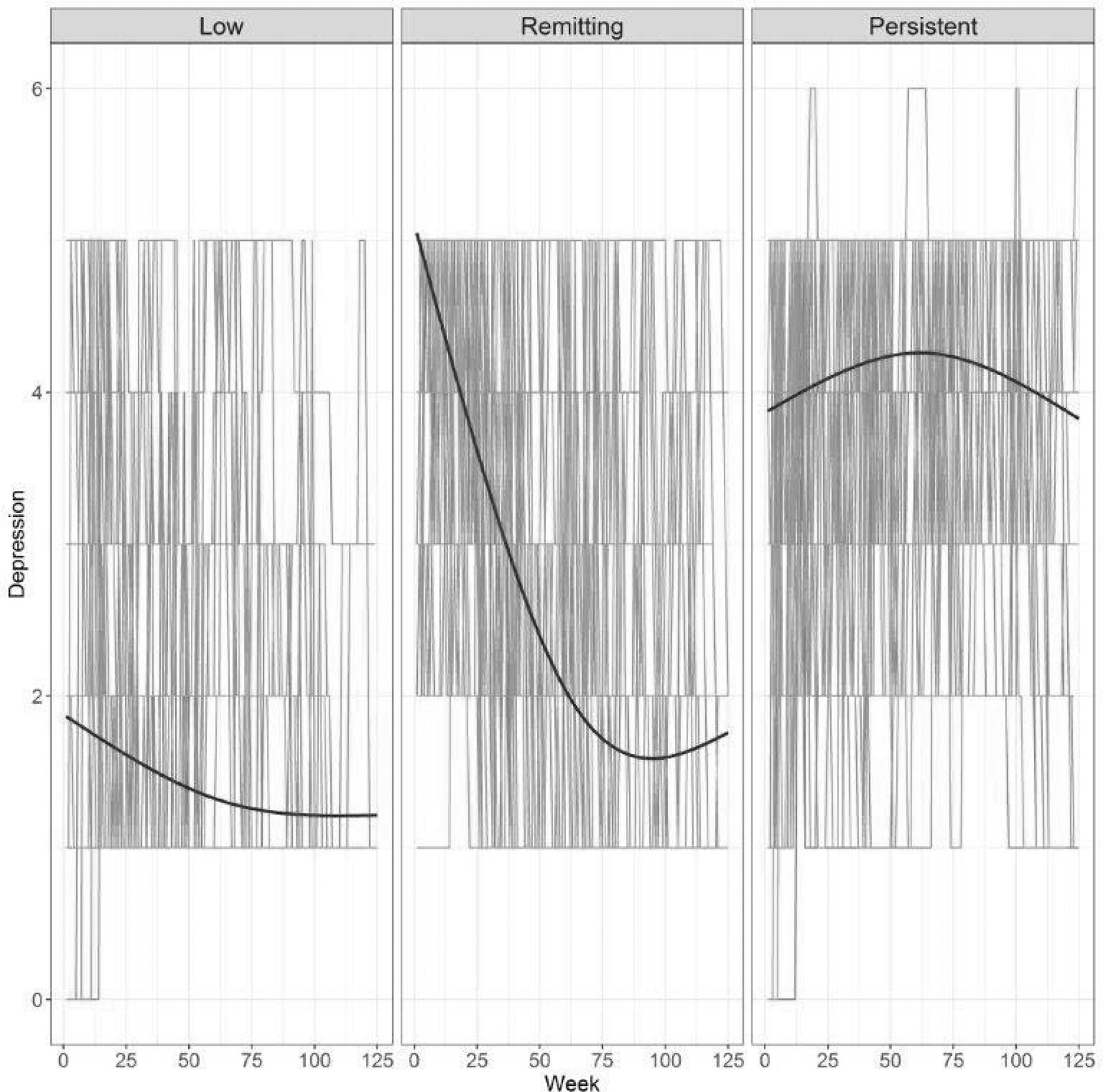
A three-group trajectory model with a cubic function of time was chosen as the final model. Although this model did not have the lowest AIC value (three-group quadratic AIC = 28 388, three-group cubic AIC = 28 349; four-group quadratic AIC = 27 667, four-group cubic AIC = 27 585), it did have three distinct patterns of depressive symptoms over time (Fig. 1). The four-group model had two very similar patterns of remission, suggesting redundancy in the four-group solution. For the three-group model, symptom levels in the first group began at a relatively low level and declined somewhat over time. The second group began at high symptom levels but then decreased markedly such that the depression ratings resembled those of the first group by the end of follow-up. This pattern is consistent with a remitting depressive episode. The last group began at a high symptom level and showed a minimal decline over time, suggestive of a chronic, persistent course. Accordingly, we assigned the descriptors of ‘Low,’ ‘Remitting,’ and ‘Persistent’ to the three groups. The average probability of membership was >0.99 in each group.
Two-year depressive symptom trajectories.

The proportion of females and of individuals with generalized anxiety disorder (GAD) increased in a stepwise fashion across the groups with increasing morbidity (Table 1). Negative emotionality, the three symptom severity measures, and each of the ETISR childhood adversity scores showed equivalent stepwise increases across the three groups (Table 2). Positive emotionality decreased progressively across the groups while constraint did not vary significantly.
To simplify subsequent analyses, we selected the total ETISR score to represent childhood adversity and focused on negative emotionality from among the three measures of temperament. The two anxiety measures, the Beck Anxiety Inventory (BAI) score and the presence or absence of a GAD diagnosis, were both significantly associated with trajectory grouping in a logistic regression analysis but the association with GAD (OR 3.39, χ2 = 14.2, p = 0.000) was more robust than the BAI score (OR 1.05, χ2 = 7.9, p = 0.005). The presence of GAD was therefore used to represent anxiety morbidity in subsequent analyses.
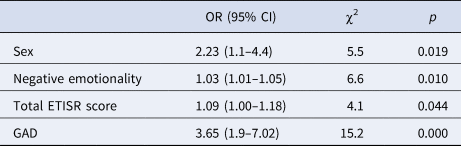
The total ETISR score was significantly correlated with negative emotionality (Pearson's r = 0.36, p = 0.000). The introduction of negative emotionality to the logistic regression reduced the OR for ETISR from 1.11 (χ2 = 6.8, p = 0.009) to 1.03 (χ2 = 3.8, p = 0.052) and negative emotionality remained significantly predictive (OR 1.03, χ2 = 6.0, p = 0.015). In contrast, the ETISR score did not differ between individuals with and without GAD. The introduction of GAD to the model had little effect on the relationship of ETISR scores to trajectory grouping (OR 1.11, χ2 = 6.6, p = 0.010) and GAD status remained highly predictive (OR 3.65, χ2 = 15.6, p = 0.000).
Females and males had mean (s.d.) negative emotionality scores of 37.0 (16.6) and 35.2 (16.9) (p = 0.316, Mann–Whitney U) and inclusion of negative emotionality in the logistic model had little effect on the relationship of sex to trajectory. Values for sex were OR 2.38 (χ2 = 7.0, p = 0.008) and for negative emotionality were OR 1.03 (χ2 = 7.7, p = 0.005). Similarly, the ETISR score did not differ by sex (p = 0.410) and both sex (OR 2.68, χ2 = 9.0, p = 0.003) and ETISR score (OR 1.12, χ2 = 7.6, p = 0.006) were significantly associated with trajectory grouping when tested together.
GAD was more prevalent among females (47/132 or 35.6%) than among males (17/89, 19.1%) (χ2 = 7.0, df = 1, p = 0.006). Both GAD and sex were nevertheless significantly related to trajectory when tested together. Values for sex were OR 2.25 (χ2 = 0.6 p = 0.014) and for GAD were OR 3.30 (χ2 = 13.7, p = 0.000).
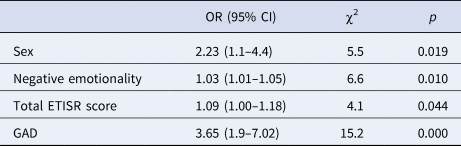
When included together in the logistic regression model, each of these four variables was significantly related to trajectory groupings (Table 3). The presence of a GAD diagnosis was by far the variable most robustly associated with higher morbidity. Of the six possible interaction effects between these four variables only the sex by negative emotionality interaction effect was significant (χ2 = 5.8, p = 0.016). Further exploration revealed that the relationship between negative emotionality and trajectory grouping existed for females but not for males.
Risk factors for trajectory group membership: ordinal logistic regression
Specifically, for females, mean (s.d.) negative emotionality scores were 31.5 (15.4), 42.6 (16.1) and 44.9 (15.9) across the three trajectory groups (F = 6.9, p = 0.002). In contrast, for males, the corresponding mean (s.d.) values were 37.8 (15.4), 38.0 (11.2) and 38.5 (23.5), respectively (F = 1.3, p = 0.994).
Discussion
This analysis applied group-based trajectory modeling to 2 years of weekly depressive symptom ratings collected from individuals in late adolescence who had lifetime histories of major depressive episodes. A three-group model offered the best statistical fit to the diverse temporal fluctuations seen across individuals and conformed to labels of ‘low,’ ‘remitting,’ and ‘persistent’. The results thus resemble the three groups described by Shore et al. (Reference Shore, Toumbourou, Lewis and Kremer2018) from their meta-analysis of trajectory studies as ‘low,’ ‘moderate,’ and ‘high or worsening’.
Though the results of trajectory analyses are likely to vary by the sampling methods used to identify the individuals being studied, the similarities in the number, in the qualities of the resulting groups, and in the robustness with which sex was associated with increasing depressive morbidity provides some indication that these results are generalizable.
The analysis sought to quantify the prognostic import of four risk factors that were selected a priori and to test the extent to which each was independently related to trajectory group membership. The proportions of females and of individuals with GAD increased in step-wise fashion across ‘low,’ ‘remitting,’ and ‘persistent’ trajectory groups. Mean scores for childhood adversity (ETISR) and for negative emotionality likewise increased across these three groups. ETISR and negative emotionality were positively correlated and the latter appeared to be the more important predictor of poorer outcomes. Otherwise, female sex, negative emotionality, and the presence of GAD were each independently associated with trajectory groupings of increasing morbidity.
The most consistent finding among studies of depressive symptom trajectories is the association of female sex with higher levels of morbidity (Shore et al., Reference Shore, Toumbourou, Lewis and Kremer2018). The present results are in full accord with the predicted pattern in showing a progressively higher percent of women across the three groups. The likelihood of GAD comorbidity also increased across trajectory groups in order of increasing depressive symptom morbidity (Brown et al., Reference Brown, Chorpita and Barlow1998). Though a trend emerged for higher rates of GAD among females this did not account for the higher morbidity they experienced. Nor did the three other risk factors tested appear to account for the higher levels of morbidity among females. A novel finding in this report is that the presence of GAD was a stronger predictor of high morbidity group membership than was female sex while controlling for negative emotionality and childhood adversity.
Twin studies show that genetic diatheses for GAD and MDD overlap substantially (Kendler et al., Reference Kendler, Neale, Kessler, Heath and Eaves1992) and this may account for the observation that GAD is the most likely of the DSM disorders to co-exist, either sequentially or concurrently, with MDD (Moffitt et al., Reference Moffitt, Caspi, Harrington, Milne, Melchior, Goldberg and Poulton2007). Both GAD and MDD are associated with disability but the disability is substantially higher when the two disorders occur together (Kessler et al., Reference Kessler, Berglund, Dewit, Bedirhan Üstün, Wang and Wïttchen2002). The importance of GAD to the persistence of MDD symptoms over time helps to explain observations that the prognosis of mood disorders worsens progressively with increasing levels of anxiety symptoms, whatever the quality of those symptoms (Coryell et al., Reference Coryell, Solomon, Fiedorowicz, Endicott, Schettler and Judd2009, Reference Coryell, Fiedorowicz, Solomon, Leon, Rice and Keller2012). However, most earlier studies of the prognostic importance of anxiety to mood disorder outcome used either an anxiety diagnosis or a measure of those anxiety symptoms present at the time of interview. They did not test whether diagnosis or a cross-sectional measure was more important for prognosis. The findings described here suggest that the diagnosis of GAD is the stronger predictor of morbidity, perhaps because it requires a persistence of symptoms of at least 6 months.
Of six possible interaction effects between the four risk factors tested in this analysis, only the one between sex and NE was significant. This personality measure was robustly associated with trajectories of higher symptom morbidity in women but had little relation to these groupings in men. These results are consistent with findings from a large twin study in which neuroticism was over 30% more potent as a risk factor for the development of MDD in women than it was in men (Kendler and Gardner, Reference Kendler and Gardner2014). Also in support of these results are those of a large-community-based study in which the inclusion of neuroticism in a regression model substantially reduced the relationship between female sex and the diagnosis of major depression (Goodwin and Gotlib, Reference Goodwin and Gotlib2004).
An earlier publication from this cohort assessed the relationships between mean symptom levels over the first year of follow-up and baseline measures of erythrocyte concentrations of eicosapentaenoic acid (EPA), an omega-3 essential fatty acid, negative emotionality, and childhood adversity (Coryell et al., Reference Coryell, Langbehn, Norris, Yao, Dindo and Calarge2017).
Both EPA concentrations and ETISR emotional adversity scores were independently predictive of morbidity during follow-up but both exerted these effects largely through their influence on NE. In the current analysis, both ETISR scores and NE were again predictive of depressive morbidity, this time expressed as depressive symptom trajectories assumed over a 2-year prospective follow-up. With this new measure of depressive chronicity, however, NE and childhood adversity, though significantly correlated with each other, were independently related to trajectory groupings that reflected higher symptom levels.
Weaknesses attached to these analyses include the fact that they were secondary in nature. Participants were recruited to examine the effects of recently initiated SSRI treatment on bone density in a late adolescent population. The study was not powered by design to test the hypothesis addressed here. In particular, additional interactions between risk factors for high morbidity trajectories might have manifested had the sample been larger. The age range of the participants was also quite limited and the sample was heavily skewed toward college students, a reflection of the study's setting. This, in turn, limited the range of socioeconomic status and, possibly, childhood adversity. Findings may not generalize well to other sociodemographic groups. The follow-up length was also relatively short and in that the large majority of the studies listed in the Shore et al. (Reference Shore, Toumbourou, Lewis and Kremer2018) were longer. A longer follow-up may have captured morbidity patterns more typical of individuals' lifetime illness.
Among the study's strengths is the breadth of baseline assessments. These extended well beyond that was necessary to test the original hypotheses. The surveillance intensity of the prospective follow-up comprised another strength. Few follow-up studies have employed thrice-yearly, in-person visits supplemented with intervening telephone assessments of the disorder considered primary at intake. Finally, this analysis went beyond the simple identification of risk factors for poorer outcomes to focus on the degree to which prognostically important factors operated independently or through their associations with other predictors and on whether interactions existed between them. The finding that anxiety co-morbidity, in the form of a GAD diagnosis was the most robust of the prognostic factors identified and this underscores the importance of further efforts to identify the genetic and phy substrates of co-existing anxiety and depressive symptomatology. Similarly, the observation that negative emotionality was of prognostic importance only in women has some support in the literature but needs replication before it is widely accepted.
Acknowledgements
This research received support from the National Center for Advancing Translational Sciences (2UL1TR000442-06) and the National Institute of Mental Health (R01MH090072).
Conflict of interest
None.