INTRODUCTION
Fruits may suffer damage during harvest, handling, transport and processing due to contact with other objects and the stresses resulting from these impacts may differ according to the shape of both the fruits and the object it has contacted. Bruising is one of the most important types of mechanical damage that can be incurred during the post-harvesting process. For most fruits, surveying typical bruise damage to determine effective parameters and ways of reducing damage during post-harvest processing such as transporting, handling, sorting, etc. is important. Such surveys have used different terms to describe the susceptibility of fruits and vegetables to bruising: for example, bruise sensitivity, bruise susceptibility, bruise threshold and bruise resistance have all been used (Bajema & Hyde Reference Bajema and Hyde1998). Bruise susceptibility can be determined as the ratio of the bruise volume (BV) to the impact energy (or absorbed energy) (Van Zeebroeck et al. Reference Van Zeebroeck, Van Linden, Darius, De Ketelaere, Ramon and Tijskens2007a). The bruise susceptibility of fruits and vegetables is a measure of external loading reaction and depends on several parameters such as variety, texture, maturity, water status, firmness, temperature, size, shape and other factors such as cell wall strength and elasticity, cell shape and internal structure (Studman Reference Studman, Jeronimidis and Vincent1997; Van Linden et al. Reference Van Linden, De Ketelaere, Desmet and De Baerdemaeker2006a). Baritelle & Hyde (Reference Baritelle and Hyde2001) showed that the bruise threshold must be relative to tissue failure stress, impact-induced stress, elastic modulus, mass and radius of curvature. Elements such as the physiological and biological makeup of the fruit, as well as variations in cell wall thickness, cell packing arrangement and cell turgidity may affect the bruise susceptibility of fruits (Schulte et al. Reference Schulte, Brown and Timm1992). Bruise prediction models connect the impact characteristics (drop height and peak contact force) with bruise damage, taking into consideration some fruit properties (temperature, maturity, etc.) that determine bruise sensitivity (Bajema & Hyde Reference Bajema and Hyde1998; Bajema et al. Reference Bajema, Hyde and Baritelle1998b). The extent of bruising to a fruit is usually described in terms of BV (Blahovec & Paprstein Reference Blahovec and Paprstein2005), which can also be described in terms of absorbed energy (Van Zeebroeck et al. Reference Van Zeebroeck, Van Linden, Darius, De Ketelaere, Ramon and Tijskens2007b). Not all absorbed energy is transformed into plastic deformation (bruise); it can be divided into plastic and viscous energy. The viscous energy loss is dependent on the material's viscosity (Van Zeebroeck et al. Reference Van Zeebroeck, Van Linden, Darius, De Ketelaere, Ramon and Tijskens2007b). It seems that bruising is influenced by fruit mass, energy absorbed by the fruit during impact and impact velocity, the last resulting from the viscoelastic nature of fruit texture (Schulte-Pason et al. Reference Schulte-Pason, Timm, Ladd and Brown1991; Lin & Brusewitz Reference Lin and Brusewitz1994). While the external factors that cause physical injuries are more or less known, the internal factors contributing to bruise development have not been thoroughly investigated, probably because of the generally slow development of the bruise (Van Linden et al. Reference Van Linden, De Ketelaere, Desmet and De Baerdemaeker2006a).
Detailed information about bruise estimation models for Golden Delicious apples is limited. Several researchers (Marshall & Burgess Reference Marshall and Burgess1991; Pang et al. Reference Pang, Studman and Banks1991; Schulte et al. Reference Schulte, Brown and Timm1992; Bajema & Hyde Reference Bajema and Hyde1998; Bajema et al. Reference Bajema, Hyde and Peterson1998a,Reference Bajema, Hyde and Baritelleb; Timm et al. Reference Timm, Bollen, Dela Rue and Woodhead1998; Menesatti et al. Reference Menesatti, Beni, Paglia, Marcelli and D'Andrea1999; Berardinelli et al. Reference Berardinelli, Donati, Giunchi, Guarnieri and Ragni2005; Van Zeebroeck et al. Reference Van Zeebroeck, Van Linden, Darius, De Ketelaere, Ramon and Tijskens2007a, Reference Van Zeebroeck, Van Linden, Darius, De Ketelaere, Ramon and Tijskensb, Reference Van Zeebroeck, Van Linden, Ramon, De Baerdemaeker, Nicolaï and Tijskensc; Ahmadi et al. Reference Ahmadi, Ghassemzadeh, Sadeghi, Moghadam and Zarif Neshat2010) have used both multiple linear and non-linear regression models for bruise prediction in fruit. Bruise prediction models have two sets of independent variables, primary and secondary. Primary (main) variables are related to impact characteristics and can include elements such as peak contact force, impact energy, duration of the impact and drop height. Secondary variables relate to fruit properties such as temperature, firmness, how long the fruit has been in storage (storage time), harvest date and radius of curvature (Van Zeebroeck et al. Reference Van Zeebroeck, Van Linden, Darius, De Ketelaere, Ramon and Tijskens2007a, Reference Van Zeebroeck, Van Linden, Darius, De Ketelaere, Ramon and Tijskensb). The statistical models also include either impact energy or peak contact force (PF) as the main independent variable (Van Zeebroeck et al. Reference Van Zeebroeck, Van Linden, Darius, De Ketelaere, Ramon and Tijskens2007a, Reference Van Zeebroeck, Van Linden, Darius, De Ketelaere, Ramon and Tijskensb); both have advantages and disadvantages. The advantage of PF models is that they can be generalized for materials with different properties and radii of curvature. Impact energy models were designed for fruit impacting on metal and cannot be used for fruit impacting on another fruit because here the impact energy is identical (Van Zeebroeck et al. Reference Van Zeebroeck, Van Linden, Ramon, De Baerdemaeker, Nicolaï and Tijskens2007c). However, a disadvantage of using PF regression models is that the PF is most likely influenced by the fruit factors themselves (temperature, ripeness, etc.). In contrast, the impact energy is not influenced by the fruit factors; consequently, impact energy models are better suited to investigate the effect of fruit factors on bruise susceptibility (Van Zeebroeck et al. Reference Van Zeebroeck, Van Linden, Darius, De Ketelaere, Ramon and Tijskens2007a, Reference Van Zeebroeck, Van Linden, Darius, De Ketelaere, Ramon and Tijskensb, Reference Van Zeebroeck, Van Linden, Ramon, De Baerdemaeker, Nicolaï and Tijskensc).
The objective of the present study was to develop bruise estimation models for Golden Delicious apple using PF or impact energy together with fruit properties such as fruit temperature, acoustic stiffness and radius of curvature as independent variables.
MATERIALS AND METHODS
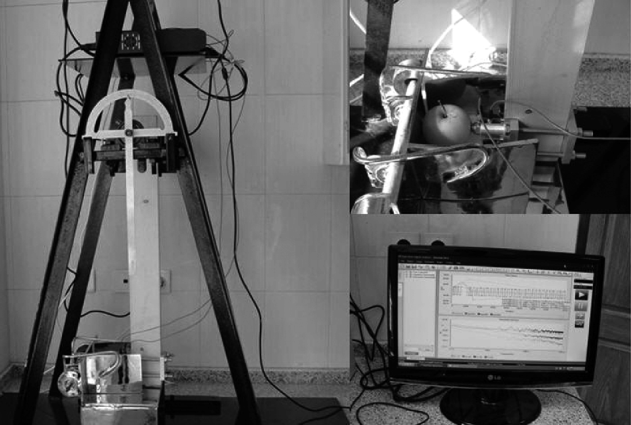
The Golden Delicious apples used in the present work were harvested in 2011 from an educational research orchard ‘Abbas Abad’ district, Hamedan (34°48′N, 48°31′E, 1850 m a.s.l.), Iran. Apples (120 in total) were hand-picked from four trees, chosen at random, to ensure freshness and avoid damage during harvesting and transporting. There was no rainfall before or during harvest. Fruits were stored in optimal conditions (6 °C, 85% relative humidity) during measurement, with maximum storage time before measurement being 6 days. Two measurement temperatures, 6 and 24 °C, were used as independent variables. The temperature in the room where the fruits were being measured was 24 °C: apples to be measured at 6 °C were measured within 15 min to minimize fruit warming, while fruits to be measured at 24 °C were kept at that temperature for 10 h before starting the measurements. The 120 apples utilized in the experiments were divided into six groups to study temperature and impact level effect. For each temperature–impact level combination, 20 apples were tested and each apple was impacted once. Apples were placed on a pendulum equipped with a force sensor (PCB208C02, PCB piezotronics, USA, sensitivity: 10·97 mV/N) and an incremental optimal encoder (Autonics E5058, Korea, Resolution 0·018°) to measure impact energy and impact velocity and hit by an impactor (diameter = 12·7 mm). A data acquisition and analysis system (ECON, AVANT Lite, model: MI-6004) was used to analyse the data (Fig. 1).
General view of the pendulum device for measuring the impact force and impact velocity of the apple fruit.

The dependent variable was the BV, which determined the bruise model. The BV was measured 24 h after impact and determined based on the method used by Chen & Sun (Reference Chen and Sun1981):
 $${\rm BV} = \displaystyle{\pi \over 6}dD^2 $$
where BV is the bruise volume (mm3), d is the bruise depth (mm) and D is the bruise diameter (mm).
Bruise prediction models used either the impact energy (the kinetic energy of the pendulum rod just before the collision) or the PFas an independent variable, along with other variables:
• Impact energy (E i) (Joules (J)),
• PF (Newtons (N)),
• Two apple temperatures (T): 6 and 24 °C,
• Curvature radius of apple (R) at the location of impact,
• Apple ‘acoustic stiffness’ (S) (kg2/3/s2) – explained below.
The texture of fruit and vegetables can be judged by a sensory panel or by market experts. More objectively, firmness can be determined with a range of different destructive or non-destructive measuring devices.
The acoustic impulse response technique is a fast non-destructive firmness measurement normally applied on spherical fruit such as apples, peaches and tomatoes. In this technique, the fruit is impacted gently and the response frequency spectrum is recorded using an accelerometer or by measuring the corresponding pressure wave by means of a microphone. To indicate firmness, the so-called acoustic stiffness factor ‘S’ is then calculated from the first resonance frequency and the mass of the fruit. The natural frequencies of the intact fruit are obtained by recording the sound, which is produced by hitting the fruit and then performing a Fourier transformation on the signal.
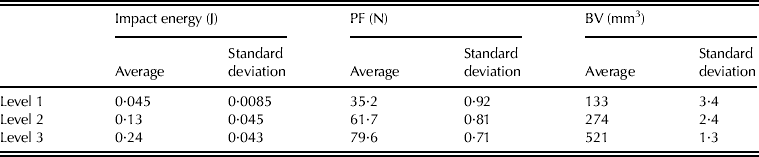
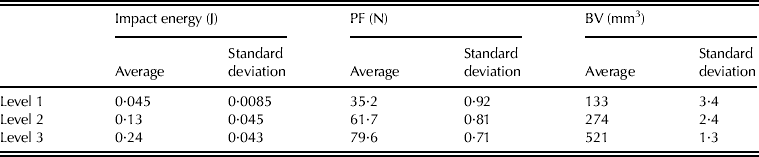
Three impact levels, above the critical impact level of apple (i.e. lack of plastic deformation), were used as summarized in Table 1. All three were recorded during mechanical harvest, handling and transporting. The lowest impact level was based on the impact force and acceleration measured during handling and transporting, whereas the highest impact level was based on levels measured in a mechanical harvester.
Overview of different nominal impact levels applied to golden delicious apples
The radius of curvature was measured locally at the location of contact by a radius of curvature meter (an appropriate measuring device was not commercially available. It was, therefore, constructed on the basis of an analogue height metre). The apple acoustic stiffness was calculated prior to impact with the pendulum based on the acoustical impulse-response method. The acoustic response of each fruit was measured by hitting the fruit with an impactor and detecting the output sound by a microphone on the opposite side. The signals of this microphone were collected and a fast Fourier transform (FFT) of the signal was performed to determine the frequency spectrum, and subsequently, the first resonance frequency of the apple was determined. The acoustic stiffness was calculated as:
 $$S \cong f^2 m^{{2 / 3}} $$
where S is the acoustic stiffness (kg2/3/s2), f is the first resonance frequency (1/s) and m is the mass of the apple (kg).
Statistical analysis
The dependent variable was the BV of apple. In the first model, independent variables were PF, R, S and T. The second model was similar to the first model except that PF was replaced by E i. A backward multiple regression method was applied to choose the relevant independent variables influencing the dependent variable at P < 0·05. Furthermore, in order to verify the accuracy of multiple regression models, a chi-square test was carried out using the predicted and experimental data. SPSS software (version 16) was used for data analysis.
RESULTS
Bruise prediction model with PF as independent variable
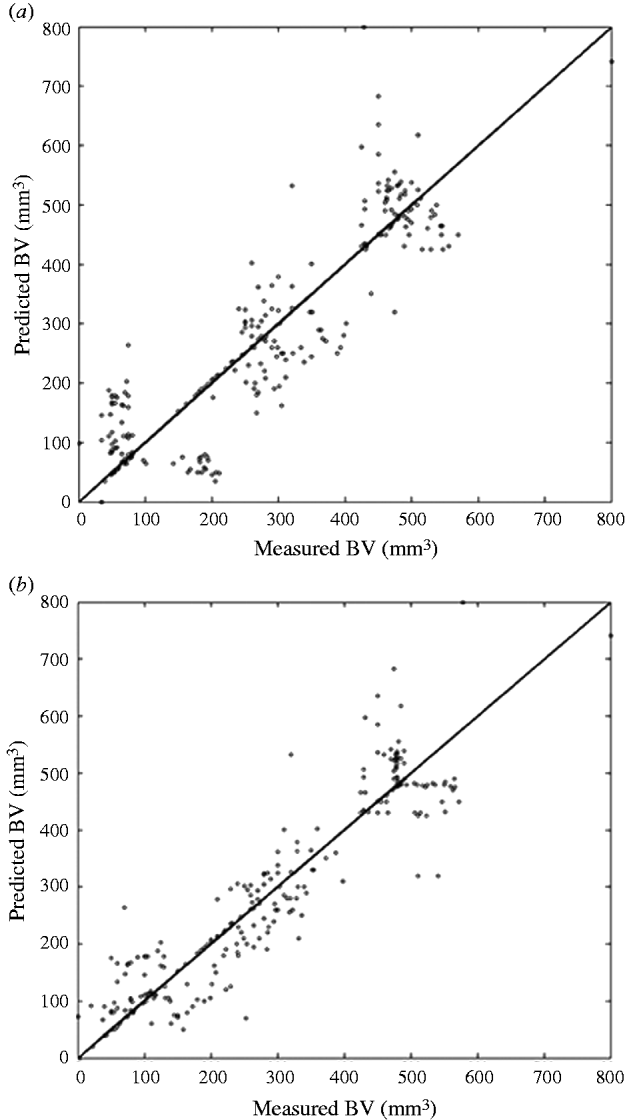
The significance of main effects (PF, T, S and R) and interactions were observed at P < 0·05. Table 2 shows the final model with all of the independent variables. For this model, the plot of predicted BV against measured BV is depicted in Fig. 2a. A good fit was observed between the measured and predicted bruise volume.
(a) Measured BV (mm3) v. BV predicted by model 1. (b) Measured BV (mm3) v. BV predicted by model 2.
Regression equations of BV (mm3) of the golden delicious apple (BV) in relation to PF ‘Model 1’, impact energy (Ei) ‘Model 2’, temperature (T), acoustic stiffness (S) and radius of curvature (R) as independent variables

Bruise prediction model with impact energy as independent variable
The results of a multiple linear regression analysis between BV and series of independent variables (E i, R, S and T) are presented in Table 2. All of the terms in model 2 had a significant effect at P < 0·05. Figure 2b presents the predicted BV plotted against the measured BV in relation to model 2.
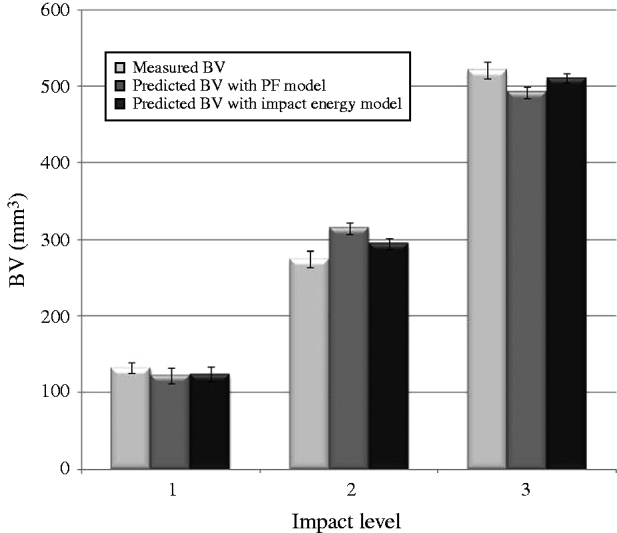
No significant differences were observed between the predicted BVs of the first and second model at all impact levels (Fig. 3).
Average of the measured and predicted values of BV (mm3) for the apple fruit by models 1 and 2 at different impact levels. The error bars represent standard error of the mean.
Effect of apple temperature on BV
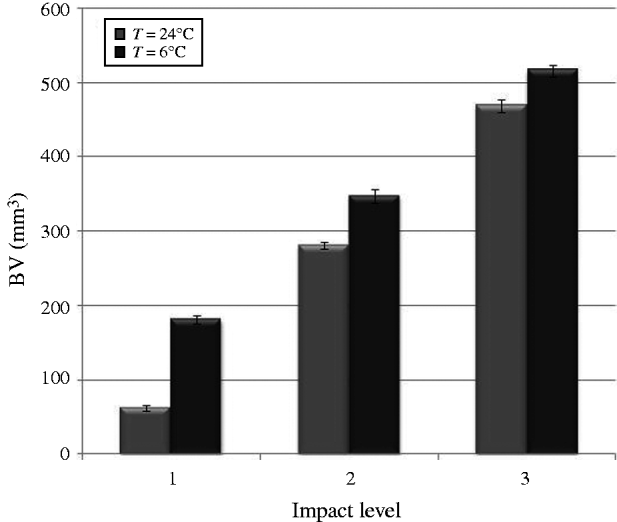
Temperature had a negative effect on BV (Table 2, Fig. 4), with lower temperatures causing more bruising. The significant interaction term (P < 0·05) between apple temperature and PF describes how the effect of temperature on the BV increased with increasing peak force. The largest difference between temperatures in the first model was observed at lower impact forces (Fig. 4). This difference ranged from about 65% for the lowest impact (35·2 N) to only 9% for highest impact (79·6 N). In the second model, at low impact energy (0·045 J) the BV of apples at 6 °C was 56% higher than for apples at 24 °C; at the high impact level (0·24 J) the difference was 11%.
Effect of the temperature on the BV (mm3) of apple fruit for each impact PF level. The error bars represent the standard error of the mean.
Effect of apple radius of curvature on BV
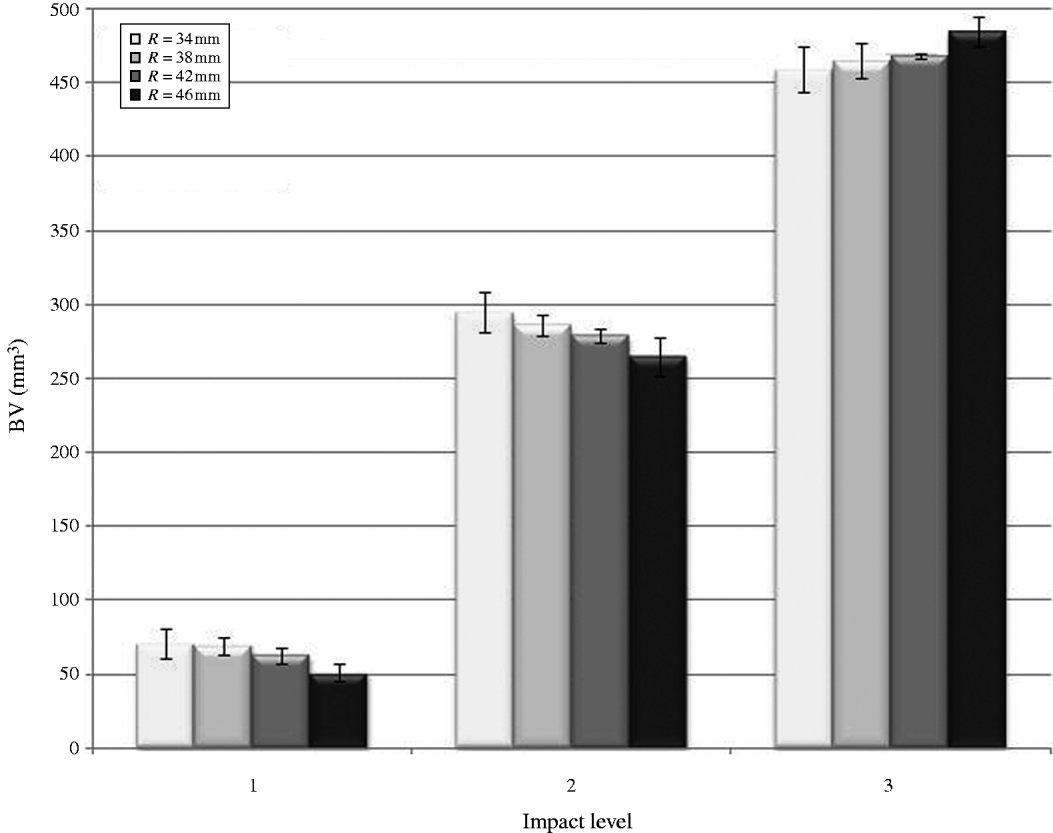
Apple radius of curvature had a different effect in low v. high impact levels. Apples with a low curvature radius created more BV compared with apples with a large curvature radius in low impacts, but the inverse is true for high impacts, with less damage for apples with a low curvature radius (Fig. 5). The difference in BV between two extreme values of curvature radius (34 and 46 mm) was not the same at low and high impact forces. The results of model 1 indicated that at the low impact force (35·2 N) the BV of an apple with a curvature radius of 34 mm was 28% higher than the fruit with a curvature radius of 46 mm. At the high impact force (79·6 N) the BV of the apple with a curvature radius of 46 mm was only 5% higher than the apple with a curvature radius of 34 mm.
Effect of the curvature radius on BV (mm3) of apple at 24 °C for each PF level in relation to model 1. The error bars represent standard error of the mean.
Effect of apple acoustic stiffness on BV
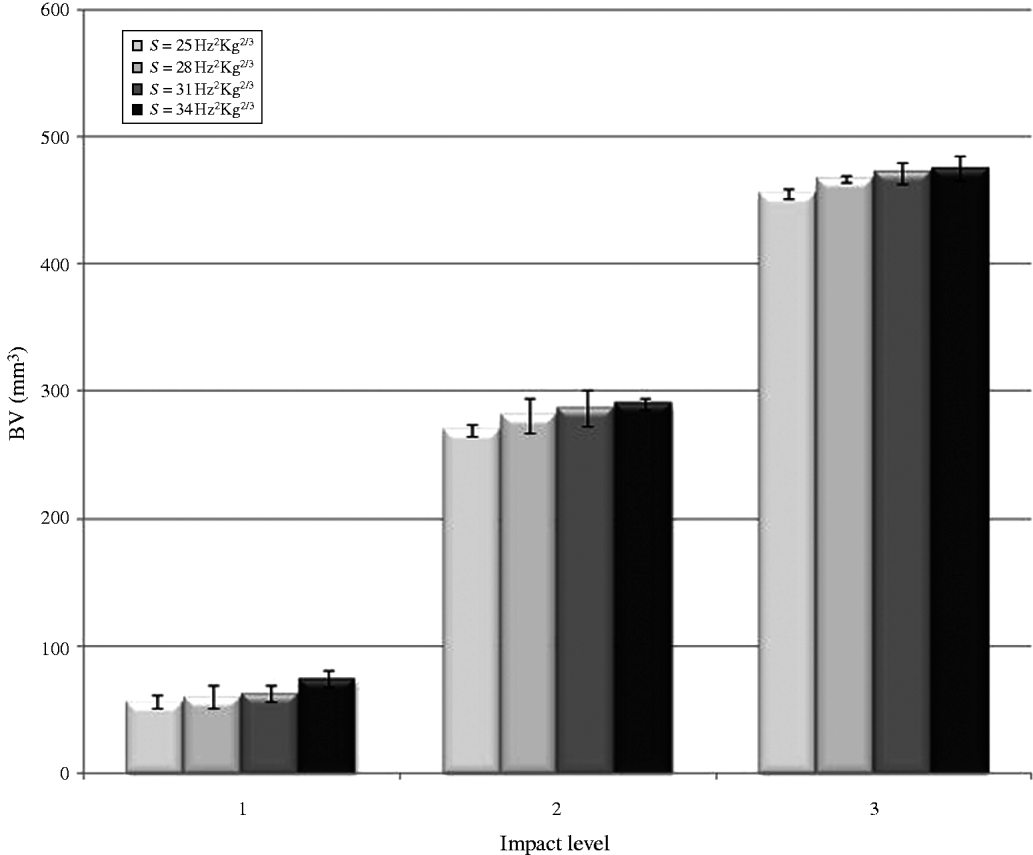
The data indicated that BV increased with increasing S (Table 2, Fig. 6). In relation to model 2 at low-impact energy (0·045 J) for apples of S = 34 kg2/3/s2, BV was up to 51% higher than apples with S = 25 kg2/3/s2 and up to 7% higher than at the high impact level (0·24 J).
Effect of the acoustic stiffness on the BV (mm3) of apple fruit at 24 °C for each peak contact force level in relation to model 1. The error bars represent the standard error of the mean.
DISCUSSION
Two bruising models were described by combinations of impact level and fruit properties. Both models indicated that post-harvest apples were more sensitive to bruising when their curvature radius was lower and when maintained at a lower temperature. The probability of developing a bruise was greatly increased at higher impact levels, and high impact levels also resulted in high peak contact stress. Therefore, higher impact levels increased fruit damage. Ahmadi et al. (Reference Ahmadi, Ghassemzadeh, Sadeghi, Moghadam and Zarif Neshat2010), Van Linden et al. (Reference Van Linden, De Ketelaere, Desmet and De Baerdemaeker2006a, Reference Van Linden, Scheerlinck, Desmet and De Baerdemaekerb) and Van Zeebroeck et al. (Reference Van Zeebroeck, Van Linden, Darius, De Ketelaere, Ramon and Tijskens2007a, Reference Van Zeebroeck, Van Linden, Darius, De Ketelaere, Ramon and Tijskensb) also reported that bruising damage in peach, tomato and apple increased with increasing impact level.
Effect of apple temperature on BV
In the present study, higher temperatures decreased bruising damage. Temperature might be expected to influence the mechanical properties of apples and therefore bruising, but reports of temperature effects on bruising are conflicting. Previous reports have found no effect of temperature on apple bruising (Schoorl & Holt Reference Schoorl and Holt1977; Klein Reference Klein1987). However, according to Knee & Miller (Reference Knee, Miller and Knee2002), the data presented by Schoorl & Holt (Reference Schoorl and Holt1977) showed that BVs were smaller at 30 °C compared with lower temperatures. Saltveit (Reference Saltveit1984) reported a progressively higher BV for fruit at 0–30 °C for two apple varieties. Van Lancker (Reference Van Lancker1979) showed a decreasing BV with higher temperature for ‘Golden Delicious’ apples; the present results agree with those studies. Van Zeebroeck et al. (Reference Van Zeebroeck, Van Linden, Ramon, De Baerdemaeker, Nicolaï and Tijskens2007c) observed results similar to the present research for bruising in ‘Jonagold’ apples, whereas Pang et al. (Reference Pang, Studman and Ward1992) and Mowatt (Reference Mowatt1997) found slightly higher bruise susceptibility for apples at 1 °C compared with apples at room temperature. A physical explanation of the effect of temperature on the firmness of tissue is given by Hertog et al. (Reference Hertog, Ben-Arie, Róth and Nicolaï2004). Temperature influences stiffness (firmness) through the activity of cell-wall degrading enzymes. The overall effect of temperature will be the result of its effects on both tissue tension and cell-wall viscosity (Bajema et al. Reference Bajema, Hyde and Baritelle1998b; Hertog et al. Reference Hertog, Ben-Arie, Róth and Nicolaï2004). However, another explanation contradicts the above statement: with increasing and decreasing temperature, the water inside the fruit expands and contracts leading to an effect comparable to that of turgor. Increased cell tension due to increased turgor or temperature will increase the acoustic stiffness and the elastic modulus of the tissue (Chen Reference Chen1993; Johnston et al. Reference Johnston, Hewett, Banks, Harker and Hertog2001; Hertog et al. Reference Hertog, Ben-Arie, Róth and Nicolaï2004). The contribution of temperature and the mechanical strength of the cell wall to stiffness might change depending on the type of fruit and its physiological conditions.
Effect of apple radius of curvature on BV
The bruise threshold is a function of impact-induced stress, tissue failure stress, tissue stiffness, mass and radius of curvature of specimen (Baritelle & Hyde Reference Baritelle and Hyde2001). Based on the elasticity theory reported in Timoshenko & Goodier (Reference Timoshenko and Goodier1951), Horsfield et al. (Reference Horsfield, Fridley and Claypool1972) developed an equation-relating maximum pressure at the centre of the contact area to the elastic moduli and radii of curvature of two colliding spheres and the weight and drop height of the smaller sphere as follows:
 $$\sigma _i = C\left( {mgh} \right)^{{\raise0.7ex\hbox{$1$} \!\mathord{\left/ {\vphantom {1 5}}\right.} \!\lower0.7ex\hbox{$5$}}} \left[ {\displaystyle{{1 - \nu _1 ^2} \over {E_1}} + \displaystyle{{1 - \nu _2 ^2} \over {E_2}}} \right]^{{\raise0.7ex\hbox{${ - 4}$} \!\mathord{\left/ {\vphantom {{ - 4} 5}}\right.} \!\lower0.7ex\hbox{$5$}}} \left[ {\displaystyle{1 \over {R_1}} + \displaystyle{1 \over {R_2}}} \right]^{{\raise0.7ex\hbox{$3$} \!\mathord{\left/ {\vphantom {3 5}}\right.} \!\lower0.7ex\hbox{$5$}}}\hskip-12pt $$
where σ i is the peak contact stress (N/m2), C is the empirical constants, m is the mass of the apple (kg), g is the gravitational acceleration (9·81 m/s2), h is the drop height (mm), v is the Poisson's ratio, E is the elastic modulus (N/m2) and R is the radius of curvature (mm).
From Eqn (3), it can be concluded that a large curvature radius results in a lower peak stress and therefore leads to less bruise damage. This was confirmed by the present results for low impact levels, where a low curvature radius led to more bruise damage. However, another equation inferred from Herz theory by Siyami et al. (Reference Siyami, Brown, Burgess, Gerrish, Tennes, Burton and Zapp1988) indicated an inverse influence of apple curvature radius on bruise diameter (and BV) as shown below:
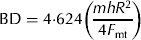 $${\rm BD} = 4 {\cdot} 624\left( {\displaystyle{{mhR^2} \over {4F_{{\rm mt}}}}} \right)$$
where BD is the bruise diameter (mm), m is the mass of the apple (kg), h is the drop height (mm), R is the radius of curvature (mm) and F mt is the Magness–Taylor force (kg).
According to Eqn (4), a larger radius of curvature leads to a larger bruise diameter and thus to a larger bruise volume. This equation supports the results of the present study for the high impact level. Van Zeebroeck et al. (Reference Van Zeebroeck, Van Linden, Darius, De Ketelaere, Ramon and Tijskens2007b) stated that at with low impact force, a higher radius of curvature decreased bruise damage, but with high impact, a higher radius of curvature increased bruise damage. More bruise damage at higher impact forces results from more tissue being involved in the collision rather than induction of high peak stress, whereas more bruise damage at lower impact forces result from higher peak stress instead of a larger contact area during impact: hence the radius of curvature has a double effect on bruise damage.
Effect of apple acoustic stiffness on BV
Firmness in fruits can be an indication of immaturity or overmaturity. In the present study, advanced ripeness (i.e. low firmness) reduced bruise damage. Based on the Hertz theory (Hertz Reference Hertz1881), it can be concluded that fruits with a higher elastic modulus will sustain more bruise damage, since Eqn (3) shows that higher elastic moduli of colliding bodies results in higher peak stresses for the same drop height. Since bruise damage is positively related to this peak stress at the contact area, a higher BV is expected for apples with a higher elastic modulus. A higher tissue strength for stiffer/firmer apples means that they are more resistant to bruising. The fact that at the low impact levels, stiffer apples were less susceptible to bruise damage could be due to the dominant effect of the higher firmness or failure stress rather than the higher peak contact stress, but at the high impact, the higher peak contact stress had a more dominant role than the higher failure stress (stiffness). Stiffer apples develop higher peak contact forces when dropped from the same height compared with less stiff apples. Another effect of the acoustic stiffness on bruise damage is that for an equal PF the peak stress could be higher, because the latter depends on both the PF and the contact surface. Thus at equal peak contact forces, peak stress can vary. Stiffer apples have a slightly higher threshold, but when they are dropped from considerable height, they suffer larger bruises. Therefore, the effect of acoustic stiffness is dependent on peak contact stress; i.e. for overall bruise damage the effect of the peak stress is more important.
CONCLUSIONS
The aim of the present study was to determine the most reliable statistical model among linear multiple regressions for estimating the bruising susceptibility of apple fruit by BV. Bruise prediction models were constructed for the Golden Delicious apple, with impacts controlled by a pendulum. Bruise prediction models contained either the impact energy or the PF as independent variables, along with the fruit properties (acoustic stiffness, radius of curvature and fruit temperature). The impact energy was obtained from the calculated kinetic energy of the pendulum arm just before impact. Significant main effects and also significant interactions between fruit properties and impact properties (PF or impact energy) were observed. Severity of damage depended on fruit physiological and biochemical properties. The mechanical stress that was provoked by mechanical impact induced cell wall and membrane rupture. Fruit bruising depended on the radius of curvature at the location of impact, temperature and acoustic stiffness. When fruit was impacted with a high impact force, the possibility of developing a bruise was greatly increased. The effect of curvature radius on bruise damage depended on the impact level. For low impacts, smaller radii of curvature led to more bruise damage, which was up to 28% for extremely small apples with a radius of curvature of 34 mm compared with extremely large apples with a radius of curvature of 46 mm. In contrast, high impacts caused up to 5% less bruise damage for extremely small apples compared with extremely large fruit.
The increase in ripeness of the apples, as indicated by lower stiffness, resulted in a lower bruise susceptibility of apple fruits. A higher peak contact stress (elastic moduli) for stiffer fruits meant that they were more susceptible to bruising. Apples of 34 kg2/3/s2 acoustic stiffness developed 20 mm3 more bruise damage than apples of 25 kg2/3/s2, regardless of the level of impact. Apples at 6 °C showed more bruise damage than apples at 24 °C. The effect was most pronounced for low impacts, with 118 mm3 more BV for apples at 6 °C compared with fruit at 24 °C. As viscosity of the cell walls increased with decreasing temperature, the cell walls may have become more brittle, resulting in decreased cell wall strength. No significant difference was observed between predicted BV of models with PF and impact energy.