Introduction
Hormone activity during fetal development may have profound, long-lasting impacts on health, well-being, and disease Reference Schooling, Houghton and Terry1–Reference Schepanski, Buss, Hanganu-Opatz and Arck4 ; however, research in this area has been hindered by the challenges of measuring fetal hormone exposure. Although a small number of studies have measured hormones in amniotic fluid, Reference Auyeung, Ahluwalia and Thomson5,Reference Sarkar, Bergman, O’Connor and Glover6 with amniocentesis falling out of favor as a clinical tool, more recent work has focused on maternal, placental, and cord blood hormone measures as indirect measures of the fetal endocrine environment. These approaches, however, are not without their own limitations including confounding by maternal hormone production, inaccessibility of specimens during critical periods in early-mid gestation, and more generally, the costliness and difficulty of prenatal and birth biospecimen collection and analysis on a large scale. Reference O’Connor and Barrett7 For this reason, there has been great interest in identifying simple, reliable, noninvasive biomarkers that may yield insights into the prenatal hormone environment, particularly those that can be measured postnatally.
Several such measures have been proposed; however, none has garnered as much attention as digit ratio or “2D:4D”, the relative length of the second and fourth fingers. Numerous studies in adults have observed that on average, digit ratio is a sexually dimorphic phenotype and lower in males than in females (reviewed in Reference de Sanctis, Soliman, Elsedfy, Soliman, Elalaily and Di Maio8 ). That is, males typically have a longer fourth digit relative to their second digit than females do, leading to the hypothesis that this ratio reflects the prenatal hormone environment, specifically, prenatal androgen exposure. Supporting this hypothesis are data from a small number of animal model studies in which manipulation of in utero androgen exposure results in changes to digit ratio. Reference Abbott, Colman, Tiefenthaler, Dumesic and Abbott9–Reference Zheng and Cohn11 Human studies further suggest that individuals with developmental androgen-related disorders (e.g. congenital adrenal hyperplasia, androgen insensitivity syndrome, Klinefelter’s syndrome) may have altered digit ratios compared to controls. Reference Berenbaum, Bryk, Nowak, Quigley and Moffat12–Reference Rivas, Moreira, Santo, Marques, El-Hani and Toralles16 Based on the appealing premise that this simple, noninvasive measure may yield insight into otherwise hidden data on the prenatal environment, thousands of published papers have now examined digit ratio in relation to a wide variety of outcomes (e.g. reproductive cancers, Reference Bunevicius17 cardiovascular health, Reference Manning, Bundred, Kasielska-Trojan, Smith-Straney and Mason18,Reference Wang, Huo, Lu, Bai, Li and Ma19 athletic performance, Reference Kim and Kim20,Reference Frick, Hull, Manning and Tomkinson21 sexuality, Reference Xu and Zheng22,Reference Martin, Puts and Breedlove23 and personality Reference Aycinena and Rentschler24,Reference Neyse, Bosworth, Ring and Schmidt25 ), with inconsistent results in adults. By comparison, relatively few studies have examined digit ratio in childhood.
Amid this large and ever-expanding literature, there remain limited data directly linking digit ratio to prenatal hormones and hormone-sensitive measures in early life. In theory, higher prenatal androgen exposure is predicted to be associated with lower, more masculine, digit ratio in offspring although the developmental course is unclear. While some associations were observed in three small studies of amniotic sex steroid concentrations in relation to digit ratios in childhood, results varied in terms of hormone and digit measurements of interest. Reference Richards, Gomes and Ventura26–Reference Lutchmaya, Baron-Cohen, Raggatt, Knickmeyer and Manning28 A handful of larger studies of cord blood sex steroids in relation to digit ratios in childhood and early adulthood have yielded largely null results, and cord blood hormone concentrations measured at delivery may not reflect androgen exposures during critical periods in early gestation. Reference Mitsui, Araki and Imai29–Reference Hickey, Doherty and Hart31 Similarly, a handful of studies have examined maternal steroid hormones in relation to digit ratios in offspring, again with varied timing of exposure assessment and digit measurement techniques. Reference Richards, Gomes and Ventura26,Reference Hickey, Doherty and Hart31 A final complication is that the standard radioimmunoassay techniques utilized by many studies may have inadequate sensitivity to accurately measure androgens present in extremely low concentrations, such as those observed in pregnant women. Reference Barrett, Mbowe and Thurston32
Beyond digit ratio, alternative indirect measures of prenatal androgen exposure have been proposed, most notably anogenital distance (AGD), an anatomic measure from the anus to the genitals. Like digit ratio, AGD is readily measured with standard calipers. Reference Sathyanarayana, Grady and Redmon33 AGD is approximately 1.5–2 times longer in males than females across most mammalian species (including humans) Reference Sathyanarayana, Grady and Redmon33–Reference Hotchkiss and Vandenbergh37 and in animal models is highly sensitive to manipulation of the prenatal hormone environment. For example, administration of known anti-androgenic chemicals such as diethylhexyl phthalate (DEHP) during critical windows of gestation results in shorter, less masculine AGD in male offspring. Reference van den Driesche, Kilcoyne and Wagner38,Reference Foster39 Conversely, administration of exogenous androgens during early gestation masculinizes AGD in female primate offspring. Reference Abbott, Colman, Tiefenthaler, Dumesic and Abbott9 Given that both AGD and digit ratio have been proposed as markers of the prenatal androgen environment, it is plausible that the two would be correlated; specifically, we would predict an inverse association, such that shorter (less masculine) AGD is associated with a greater (less masculine) digit ratio within each sex. To date, a conceptual link has been made between the two measures, supported by overlap in developmental pathways involved in genital and limb development. Reference Cobb and Duboule40–Reference Dean and Sharpe42 However empirical data to test this hypothesis are scarce. To our knowledge, a single epidemiological study has examined the association between AGD and digit ratio in infancy, observing low correlations ranging from 0.04 to 0.11. Reference Arbuckle, Agarwal and MacPherson43
A final area of ongoing interest in the context of digit ratios is their association with hormone-sensitive neurodevelopment in childhood. Previous work has observed, for example, that testosterone levels during critical perinatal periods predict gender-typed play behavior. Reference Auyeung, Baron-Cohen and Ashwin44,Reference Hines45 Similarly, in animal models, experimental prenatal androgen modulation alters play behavior. Reference Pellis46,Reference Goy, Bercovitch and McBrair47 Several studies (in Germany, Japan, and the United Kingdom) have examined digit ratio in relation to children’s play behavior, most often showing an association in the predicted direction (lower digit ratio associated with more masculine play behavior); however, the findings have varied by sex and hand across studies. Reference Körner, Schaper, Pause and Heil48–Reference Honekopp and Thierfelder51 To our knowledge, no study has examined this relationship in U.S. children, which may be important given cross-cultural differences in play behavior.
In light of the great interest in digit ratio as a marker of prenatal androgen exposure, but limited evidence to support that association, we analyzed data from a large, multicenter U.S. pregnancy cohort study to address four key questions: (1) Does digit ratio differ between boys and girls in early childhood?; (2) Are maternal sex steroid concentrations in early pregnancy associated with digit ratio in the resulting offspring?; (3) Is digit ratio associated with AGD?; and (4) Is digit ratio associated with gender-typed play behavior in early childhood?
Methods
Study overview and participants
The Infant Development and the Environment Study (TIDES) recruited women in their first trimester of pregnancy from 2010 to 2012. Recruitment occurred at four major academic medical centers: University of California, San Francisco (UCSF), University of Minnesota (UMN), University of Rochester Medical Center (URMC), and Seattle Children’s Hospital/University of Washington (UW). Eligibility criteria included being less than 13 weeks pregnant, no serious medical conditions, and English speaking. Women were asked to participate in a study visit in each trimester during which they completed questionnaires on demographics, lifestyle, and reproductive history. Urine samples were collected in each trimester, and a single blood sample for hormone analysis was collected in early pregnancy (up to 20 weeks gestation). Additional details on TIDES and prenatal visits have been described elsewhere. Reference Barrett, Sathyanarayana and Janssen52 At age 4, TIDES children participated in face-to-face visits during which anthropometric measurements were collected and parents completed questionnaires regarding their children’s behavior including the Preschool Activities Inventory (PSAI). Reference Golombok and Rust53 The study was reviewed and approved by Institutional Review Boards at the participating sites, and all participants provided informed consent prior to the start of any study activities.
Maternal hormone measurement
A single serum sample from each pregnant TIDES participant, generally in the first trimester. Frozen specimens were shipped overnight on dry ice to The Lundquist Institutes at Harbor-UCLA Medical Center. Sex steroid hormone concentrations were assayed using standard validated protocols detailed elsewhere. Reference Sathyanarayana, Butts and Wang54 Briefly, total testosterone (TT) was measured by LC–MS/MS using a Shimadzu HPLC system (Columbia, MD) and an Applied Biosystems API5500 LC–MS/MS (Foster City, CA) equipped with a Turbo-Ion-Spray source using positive mode. For TT, the linear response for calibration ranged from 2.0 to 2000 ng/dl. Spiked samples were run for quality control; intra- and inter-run variation was <5%; and the accuracy was between 100 and 113% for the steroid spiked samples. The limit of quantification for TT was 2 ng/dl. Free T (fT), representing the unbound biologically active fraction, was measured by equilibrium dialysis using labeled T. Reference Qoubaitary, Meriggiola and Ng55 LC–MS/MS was also used to measure serum concentrations of estrone (E1), estradiol (E2), and estriol (E3). The Shimadzu HPLC system was paired with a triple quadrupole mass spectrometer (API5000 LC–MS/MS, Foster City, CA). To separate the estrogens on a column, the system was operated in the negative mode and multiple-reaction monitoring was used with a gradient from 63 to 100% methanol. The calibration curves were linear from 2 to 2000 pg/ml for E1 and E2 and from 50 to 5000 pg/ml for E3. The within-run coefficient of variation was 2.6–5.2 for E1, 4.3–5.0 for E2, and 4.1–5.7 for E3. The between-run coefficient of variation was 3.9–4.6 for E1, 4–6–5.2 for E2, and 5.2–8.7 for E3. Across different estrogen concentrations, the accuracy was 91.9–101.2 for E1, 93.0–100.3 for E2, and 87.2–104.3 for E3.
AGD measurement
At birth (typically before hospital discharge), trained study coordinators administered birth examinations on TIDES infants as previously described. Reference Sathyanarayana, Grady and Redmon33 These exams included measurement of AGD. Using dial calipers, a trained examiner measured two distances on each infant, with each measurement representing distance from the center of the anus to a genital landmark. In male infants we measured: (1) anopenile distance (AGD-AP; distance from the center of the anus to the anterior base of the penis) and (2) anoscrotal distance (AGD-AS; distance from the center of the anus to the base of the scrotum where penile tissue meets pubic bone. In female infants, we measured: (1) anoclitoral distance (AGD-AC; distance from the center of the anus to the anterior side of the clitoral hood) and (2) anofourchette distance (AGD-AF; distance from the center of the anus to the posterior end of the fourchette where the labia fuse). Each AGD measurement was measured in triplicate with the mean used in the current analysis. Because AGD is strongly associated with infant body size, rather than using the raw AGD values, we used residual AGD (residuals from the sex-specific regression of AGD on age and weight-for-length Z-score, whereby weight-for-length Z-score is used to adjust for body size). Infant weight-for-length Z-scores were calculated from World Health Organization (WHO) standard curves 56 as reported in our previous work on AGD in this cohort. Reference Swan, Sathyanarayana and Barrett57
Digit length measurement
At a study-wide in-person meeting shortly before implementation of the age 4 visit, an experienced examiner trained study staff from all sites to conduct digit measurements following standard protocols. Reference Manning, Scutt, Wilson and Lewis-Jones58 At the training and afterward at their individual study sites prior to implementation, study staff practiced conducting measurements on adults as well as children age 3–5, with weekly team-wide telephone check in’s to review any issues/concerns. New study staff who joined after the initial training were trained by experienced coordinators at their own sites and overall, each site had 2–3 examiners who measured digit lengths over the study duration. At the age 4 visit, for each child, the length of the 2nd (index finger) and 4th (ring finger) digits of the right hand were measured using Vernier dial calipers. The child’s hand was placed on a flat surface palm up with outstretched fingers. The tip of one caliper was rested on the most proximal line of the ventral crease separating the finger from the palm and the caliper was extended until the other tip rested at the distal end of the digit. Reference Manning, Scutt, Wilson and Lewis-Jones58 Digit length was then recorded in mm to one decimal place. Each digit was measured two times (with calipers zeroed between), and the average of the two closer measurements was used for analyses. When the two measurements were off by more than 5 mm, a third replicate was taken and the closest two averaged for analysis. Following convention, digit ratio (2D:4D) was calculated as the average of the two second digit measurements divided by the average of the two fourth digit measurements. Reference Manning, Scutt, Wilson and Lewis-Jones58 This measurement technique has demonstrated high reproducibility in prior work. Reference Scutt and Manning59 Digits with injuries (crush injuries, fractures, sprains) were not measured.
Gender-typed play behavior assessment
As part of the age 4 visit, mothers completed a study questionnaire including the PSAI, a tool that has been validated and widely used to examine variation in children’s gender-typed play behavior. Reference Golombok and Rust53 The PSAI includes 24 items that ask about types of toys, activities, and characteristics. Each item is answered on a 5-point Likert scale (never, hardly ever, sometimes, often, very often). Twelve items are considered stereotypically “feminine” (e.g. how often did the child play with dolls during the last month), and the other twelve are considered stereotypically “masculine” (e.g. how often did the child plan with a tool set during the last month). A composite PSAI score is derived by subtracting the sum of the feminine items from the sum of the masculine items, after which a transformation factor is applied. Reference Golombok and Rust53 Higher composite scores indicate more masculine-typed play and lower composite scores indicate more feminine-typed play. Our primary analyses using PSAI data focus on composite scores; secondarily, we consider scores on the masculine and feminine subscales.
A potentially important determinant of children’s gender-typed play behavior is parents’ attitudes toward their child playing with toys that are traditionally associated with the opposite sex. To assess this, as we have done in prior work, we asked each mother four questions about the parental response to gender-atypical play. Reference Barrett, Redmon, Wang, Sparks and Swan60,Reference Swan, Liu and Hines61 Mothers were first asked, “What would you do if you had a boy who preferred toys that girls usually play with?” and “What would you do if you had a girl who preferred toys that boys usually played with?”. Mothers responded to each question with one of the following: “Strongly Encourage,” “Encourage,” “Neutral,” “Discourage,” and “Strongly Discourage.” Mothers also reported how the child’s father would answer the same questions. Responses to each question were converted into a numerical score ranging from 1 (“strongly encourage”) to 5 (“strongly discourage”). The two maternal and paternal responses (each 1–5) for boys were added, creating a “parental attitude boys” (PAB) scale ranging from 2 (strongest encouragement of gender atypical play in sons) to 10 (strongest discouragement of gender atypical play in sons) and an analogous scale was created for girls (“parental attitude girls” or PAG).
Statistical analysis
We first examined descriptive statistics (mean, standard deviation, minimum, median, maximum, frequencies) for all variables of interest in the whole cohort as well as stratified by child sex. In preliminary analyses, we determined that digit ratios from UCSF participants (n = 103) were systematically larger than digit ratios from the other sites. UCSF digit ratios also included multiple outliers with improbable values, suggesting possible measurement error (Supplementary Fig. S1). ANOVA testing indicated a significant difference in digit ratios by testing site with UCSF having a significantly greater average digit ratio and standard deviation (1.01 ± 0.09) than the other sites (UMN : 0.97 ± 0.04; URMC: 0.95 ± 0.05; UW: 0.96 ± 0.04). After further observation that the main examiner at UCSF (83/104 exams) was responsible for all of the outlier measurements, we felt that the most conservative approach was to exclude all data from that site. For this reason, our primary analyses include the n = 321 participants from only the UM, URMC, and UW sites. In supplemental material (Tables S1–S3), we report results from the entire cohort including all UCSF participants.
We fit crude regression models to address each hypothesis, as well as multivariable adjusted models that included a set of covariates selected a priori. Digit ratio was non-normally distributed and was therefore log10 transformed in all regression models in which it was an outcome. Due to the extremely small values and small range of log10(2D:4D) (mean = −0.014, SD = 0.023), the outcome of log10 (2D:4D) was multiplied by 1000 prior to fitting models with this as the outcome variable. This puts the slopes and standard errors on a more readable scale, while not changing significance. Models with 2D:4D as the outcome adjusted for child’s age at the time of 2D:4D measurement (continuous) child’s race (non-Hispanic white/other) and study center (URMC, UM, UW) and also adjusted for or stratified by sex.
To examine whether digit ratio differed by child sex, we regressed digit ratio on the covariates specified above. To examine the relationship between AGD and 2D:4D, we fit sex-specific regression models of 2D:4D on AGD, adjusting for the same set of covariates. Stratification by sex was necessary given that the AGD measurements in males and females may not be strictly analogous and that sex-specific associations are plausible. To examine the relationship between maternal hormone concentrations and child digit ratio, we regressed 2D:4D on each hormone (E1, E2, E3, TT, fT) in separate models, adjusting for the covariates specified above. All hormones were log10 transformed and these models additionally adjusted for gestational age at blood sampling. Since the impact of hormones on the child digit ratio may differ by sex, these models included interactions of sex with log(hormones) to allow sex-specific slopes.
Models examining the associations between digit ratio and PSAI scores adjusted for a different set of covariates that were also specified a priori. Because parental attitudes toward a child’s gender-typed play behavior is likely to be specific to the sex of the child, models for PSAI scores as outcome adjusted for PAG for female children, and for PAB for male children. Our PSAI models also adjusted for child sex, maternal education (less than college graduate versus college graduate or greater), child’s race, number of female siblings, number of male siblings, and center. Because the association between digit ratio and PSAI scores may differ by sex, these models also included a sex by 2D:4D interaction.
Results
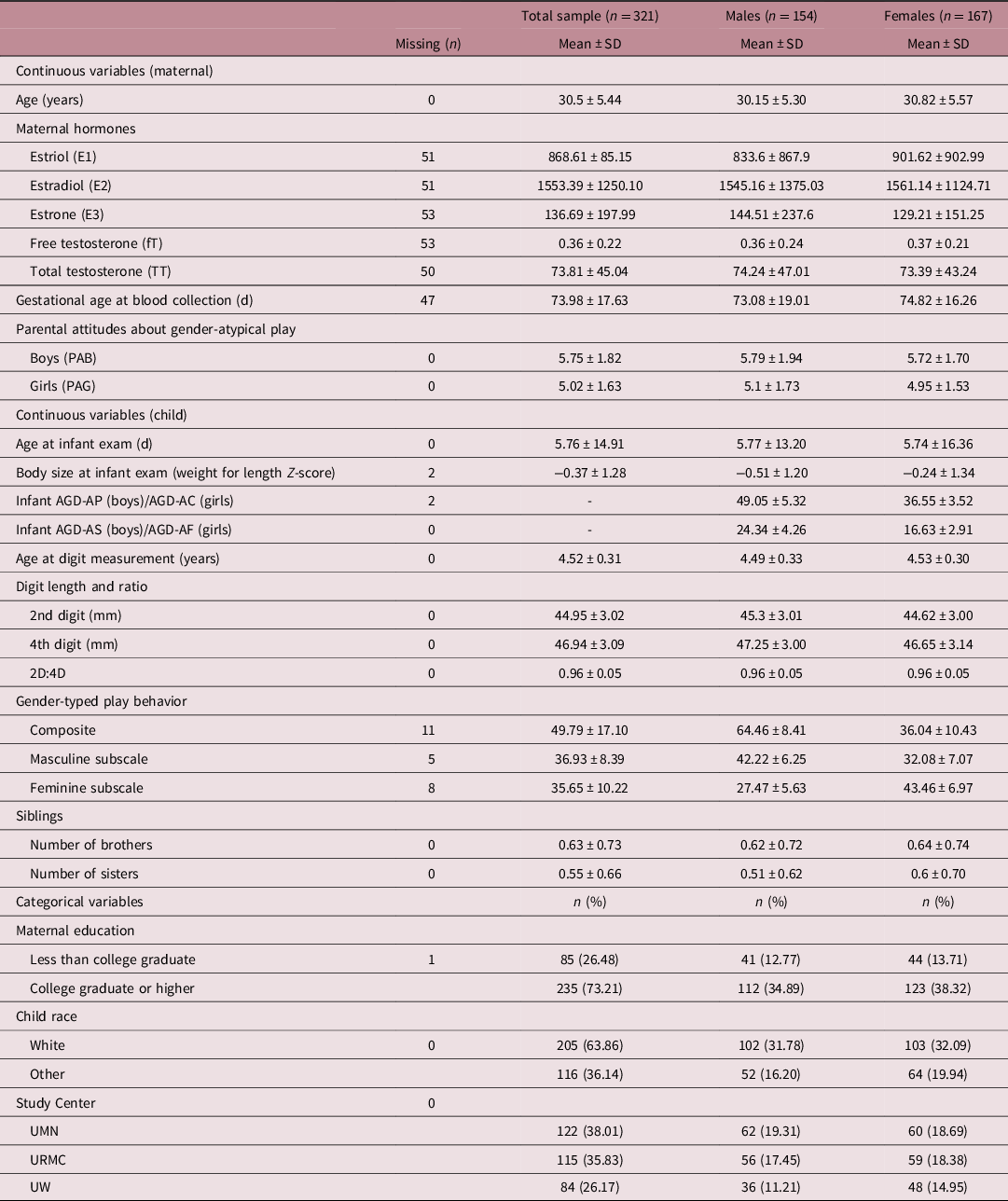
In total, 424 mother–child dyads contributed data to the current analysis; however, after excluding participants from UCSF, data from 321 dyads were included in the analyses described below. Mothers were 30.5 ± 5.4 years old on average and 73% had at least a college education (Table 1). Gestational age at blood collection occurred on average at 10.6 weeks gestation (range: 5.7–19.7 weeks). The average age at infant birth (AGD) exam was 5.76 ± 14.91 d; however, the median age was 1 day old. Approximately 2/3 of the participating children were non-Hispanic White and digit measurement occurred at a mean age of 4.52 ± 0.31 years.
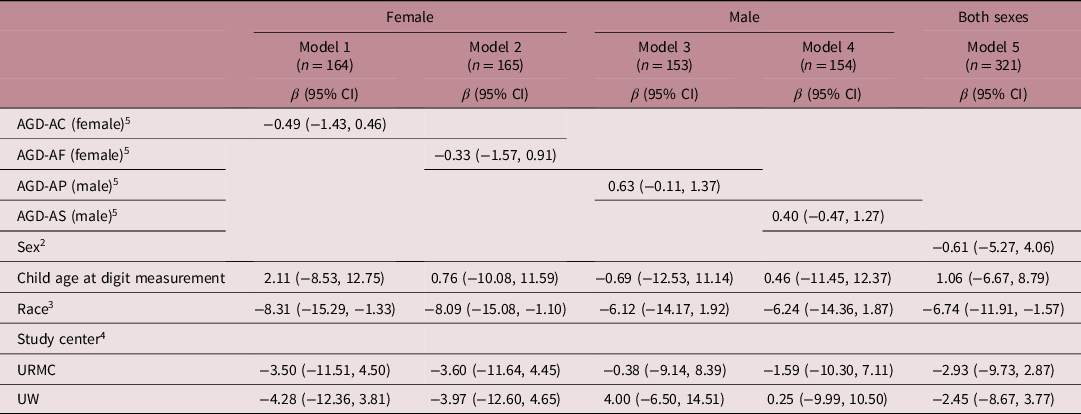
In bivariate models, no sex difference in digit ratio was observed; mean 2D:4D was 0.96 ± 0.05 for both male and female participants. After adjusting for child’s age, race, and study center, child’s sex was not a significant predictor of digit ratio (β = −0.61 for females compared to males, 95% CI: -5.27, 4.06) (Table 2, Model 5). In that model, only race was significantly associated with digit ratio, whereby 2D:4D ratio was greater in non-Hispanic White children compared to children of other races/ethnicities (β = −6.74, 95% CI: −11.91, −1.57).
Characteristics of TIDES study participants excluding UCSF (n = 321)

The two AGD measures were moderately correlated with one another in boys (r = 0.54) and girls (r = 0.45). In girls, correlations between digit ratio and AGD were close to zero (r = 0.05 for AGD-AC; r = 0.02 for AGD-AF). In boys, digit ratio was weakly correlated with AGD-AP (r = 0.14), but less so AGD-AS (r = 0.06). In linear regression models, digit ratio was not associated with AGD-AC (β = −0.49, 95% CI: −1.43, 0.46) or AGD-AF (β = −0.33, 95% CI: −1.57, 0.91) in girls (Table 2, Models 1 and 2). Similarly, in boys, digit ratio was not associated with AGD-AP (β = 0.63, 95% CI: −0.11, 1.37) or AGD-AS (β = 0.40, 95% CI: −0.47, 1.27) (Table 2, Models 3 and 4). 2D:4D ratios were again greater in non-Hispanic White children compared to other races/ethnicities, though only statistically significantly in girls.
Digit ratio 1 in relation to anogenital distance (Models 1–4), sex (Model 5), and covariates

1 Dependent variable (digit ratio) is log10 transformed and multiplied by 1000.
2 Reference = male.
3 Reference = white.
4 Reference = UMN.
5 Residual AGD after adjusting for age at exam and weight for length Z-score.
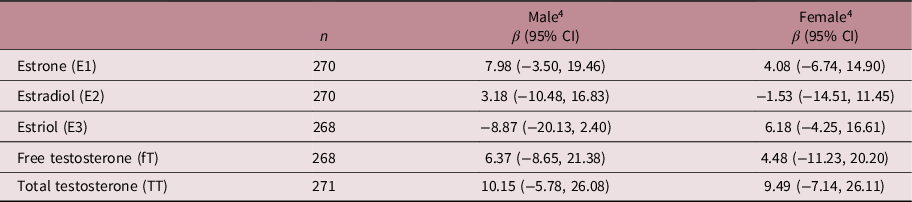
In the combined cohort and with all hormones log-transformed, strong correlations were observed between TT and fT (r = 0.83) and E1 and E2 (r = 0.85). All correlations between hormones and digit ratio in the combined sample and in sex-stratified analyses were close to 0 (not shown). In multivariable linear regression models, no hormone was associated with child digit ratio in children of either sex (Table 3). The slopes for hormones, moreover, did not significantly differ between the two sexes (not shown). None of the other covariates included in models were significantly associated with child digit ratio (not shown).
Adjusted linear regression models examining maternal hormones 1 in relation to child digit ratio 2 ,3

1 All hormones are adjusted for gestational age at blood collection and log10 transformed.
2 Dependent variable (digit ratio) is log10 transformed and multiplied by 1000.
3 Adjusted for child sex, sex*hormone, child age at digit measurement, race, study center.
4 Models were reparameterized to provide coefficients for the sex-specific slopes.
Composite PSAI scores were strongly associated with masculine (r = 0.80) and feminine PSAI scores (r = −0.88) in the whole cohort, with slightly attenuated correlations when considering females and males separately. Similarly, parental attitudes about gender-atypical play in boys were strongly associated with parental attitudes about gender-atypical play in girls (r = 0.76). In girls, parental disapproval of gender-atypical play was weakly associated with lower masculine (r = −0.24) and composite scores (r = −0.19), whereas among male children, parental disapproval of gender-atypical play behavior was correlated with higher composite scores (r = 0.16) and lower feminine scores (r = −0.43). In the combined cohort as well as sex-stratified analyses, correlations between digit ratio and PSAI scores were close to zero. In multivariable models that were reparameterized to provide sex-specific estimates, digit ratio was not associated with composite PSAI scores in boys (β = −11.59, 95% CI: −42.93, 19.75) or girls (−12.77, 95% CI: −45.46, 19.92) (Table 4). The slope for digit ratio was not significantly different for the two sexes in any model (not shown). Higher maternal education was positively associated with composite scores, while parental disapproval of gender-atypical play was associated with more feminine composite scores in girls (β = −1.01, 95% CI: −2.13, −0.06), but more masculine composite scores in boys (β = 1.04, 95% CI: 0.23, 1.86). Similarly, digit ratio was not associated with scores on the PSAI masculine subscale in boys (β = −9.01, 95% CI: −30.97, 12.95) or girls (β = −16.71, 95% CI: −39.48, 6.05). In that model only parental disapproval of gender atypical play was associated with lower masculine scores (girls only; not shown). Finally, digit ratio was not associated with PSAI feminine scores in boys (β = 2.40, 95% CI: −18.03, 22.83) or girls (β = −6.29, 95% CI: −27.96, 15.38). Maternal education was inversely associated with scores on the feminine scale as was parental disapproval of gender atypical play (boys only; not shown).
Adjusted linear regression models examining child digit ratio in relation to gender-typed play behavior (PSAI scores) 1

1 Adjusted for child sex, maternal education, child’s race, parental attitudes about gender-atypical play for the gender of the child, number of brothers, and number of sisters.
2 Models were reparameterized to provide coefficients for the sex-specific slopes.
Summary of results of supplemental models including UCSF
In supplemental analyses, we refit all models including all UCSF participants. Across many analyses, the inclusion of UCSF changed the direction of effect estimates, though for the most part, results remained nonsignificant. For example, without UCSF, there was a nonsignificant positive association between child age and digit ratio (β = 1.06, 95% CI: −6.67, 8.79), but with UCSF added into the analysis, the direction of association flipped (β = −1.67, 95% CI: −10.14, 6.81) (Table S2). In all supplemental analysis in which digit ratio was an outcome, UCSF study center emerged as a highly significant predictor with estimates far greater than for any of the other covariates of interest (Tables S2 and S3).
Discussion
In this U.S. pregnancy cohort, digit ratio at age 4 did not differ in boys and girls. Additionally, we observed no association between digit ratio and early pregnancy maternal serum concentrations of estrogens (E1, E2, and E3) or androgens (fT and TT). Digit ratio was not associated with an alternative hypothesized marker of the prenatal hormone milieu, newborn AGD, nor was it associated with gender-typical play behavior in early childhood in either sex.
While the lack of sex difference in digit ratio that we observed differs from the results of most adult studies, in children, sex differences have been less consistent and effect sizes tend to be small compared to those observed in adults. Reference Richards, Gomes and Ventura26,Reference Arbuckle, Agarwal and MacPherson43,Reference Manning and Fink62–Reference Knickmeyer, Woolson, Hamer, Konneker and Gilmore65 Examining children within relatively small age ranges may be particularly important given the rapid growth of the digits across childhood as well as the dynamic changes in hormone levels that occur around puberty. Reference Knickmeyer, Woolson, Hamer, Konneker and Gilmore65–Reference Trivers, Manning and Jacobson68 In the subset of studies that focused on healthy preschoolers, as we did here, some studies have reported higher ratios in girls (mirroring results in adults), Reference Körner, Schaper, Pause and Heil48,Reference Wong and Hines49,Reference Velez, Arbuckle, Monnier and Fraser69,Reference Da Silva, Moreira and Da Costa70 while a smaller number of studies have observed higher ratios in boys, Reference Saenz and Alexander71 or no significant sex difference. Reference Lutchmaya, Baron-Cohen, Raggatt, Knickmeyer and Manning28,Reference Honekopp and Thierfelder51 However even across studies of preschoolers, the age at digit measurement varies considerably (from <1 year up to age 6), making results less comparable to our cohort of 4-year-olds.
Differences in measurement techniques may also contribute to disparate results across studies. Soft tissue measurements can be made through direct assessments with a ruler Reference Arbuckle, Agarwal and MacPherson43 or calipers Reference Lutchmaya, Baron-Cohen, Raggatt, Knickmeyer and Manning28,Reference Manning and Fink62 or indirect measurement of photocopied Reference Mitsui, Araki and Imai29,Reference Knickmeyer, Woolson, Hamer, Konneker and Gilmore65 or scanned handprints. Reference Körner, Schaper, Pause and Heil48,Reference Wong and Hines49,Reference Honekopp and Thierfelder51 A smaller number of studies have measured phalangeal bone lengths on radiographs. Reference McIntyre, Cohn and Ellison66,Reference McIntyre67 There is ongoing controversy as to the relative accuracy of the various methods, Reference Allaway, Bloski, Pierson and Lujan72–Reference Manning, Fink, Neave and Caswell74 and no single gold standard has emerged. We employed direct measurement of the digits via calipers to facilitate ease of implementation as part of a large, complex cohort study; however, indirect measurements offer greater opportunity to assess quality control and collect additional data (for instance on other digit lengths) on a less time-sensitive basis. Reference McIntyre, Cohn and Ellison66
A main goal of this analysis was to compare two proposed measures of prenatal androgen activity, digit ratio, and AGD. Although theoretical comparisons of the two measures have been made, Reference Dean and Sharpe42 empirical evidence examining their relationship is quite limited. We observed no associations between digit ratio and AGD measurements in either sex, consistent with results reported by a single prior study on this topic. Reference Arbuckle, Agarwal and MacPherson43 That study, like ours, was a large, multisite cohort that measured AGD in neonates; however in their study, digit lengths were measured at 6 months of age. In that study, moreover, digit ratio was not associated with prenatal exposures to endocrine disrupting chemicals that may perturb fetal hormone activity. At a minimum, the results of these studies suggest that AGD and digit ratio are not interchangeable measures of the prenatal hormone environment. One possibility is that the two measures reflect different periods of prenatal hormone activity; however for both measures, there is evidence of a critical window occurring in the first trimester of gestation. Reference Galis, Ten Broek, Van Dongen and Wijnaendts75,Reference Jain, Goyal and Chowdhary76 Results from a cohort of deceased fetuses, in which digit ratios were overall smaller than is typically reported for children and adults, suggest that postnatal factors may also be important to consider. Reference Galis, Ten Broek, Van Dongen and Wijnaendts75 Indeed, there is increasing evidence of dynamic androgen fluctuations occurring during childhood, such as the “mini-puberty” in early infancy and rising adrenal androgen concentrations in early to mid-childhood. Reference Kim, Lee and Lim77–Reference Bergadá, Milani and Bedecarrás81 This raises the possibility that digit growth may respond to postnatal androgen activity as well as (or rather than) prenatal androgens, a hypothesis that needs further testing.
It is also possible that AGD and digit ratio are both reflective of prenatal hormones, but that their classifications as markers of prenatal androgen exposure are an over-simplification. For example, a large Japanese cohort (n = 1800) observed differences in boys’ digit ratio in relation to estrogen receptor 1 (ESR1) polymorphisms. Reference Nishimura, Moriya and Kobayashi82 Additionally, they went on to note that prenatal exposures to the estrogenic chemical bisphenol A (BPA) and the anti-androgenic chemical mono(2-ethylhexyl) phthalate (MEHP) were associated with altered 2D:4D, but only in boys with a particular ESR1 polymorphism. Reference Nishimura, Moriya and Kobayashi83 In our prior work, we observed associations between BPA and AGD in girls, suggesting the possibility that AGD responds to estrogens as well as androgens. Reference Barrett, Sathyanarayana and Mbowe84 In the TIDES cohort, we previously reported that maternal sex steroid concentrations in early pregnancy were not associated with newborn AGD in either sex, Reference Sathyanarayana, Butts and Wang54 and our current results indicate that they were not associated with offspring digit ratio either. To our knowledge, no other study has examined early pregnancy hormone concentrations and digit ratio; however, prior studies have examined maternal hormones in mid- to late-pregnancy, typically observing no association. Reference Richards, Gomes and Ventura26,Reference Hickey, Doherty and Hart31 One exception is Hickey et al.’s borderline significant association between maternal androstenedione at 18 weeks gestation and left-hand digit ratio. Reference Hickey, Doherty and Hart31 The timing of maternal sampling may pose an issue, as well as the constraint that maternal circulating hormones reflect contributions from mother, placenta, and fetus and may not be an accurate gauge of the fetal hormone milieu. Reference Kuijper, Ket, Caanen and Lambalk85
Cord blood is arguably a better matrix as it provides a closer approximation of fetal hormone exposure; however, concerns persist about maternal hormone contributions as well as the role of parturition in altering hormone levels. Reference Kuijper, Ket, Caanen and Lambalk85–Reference Clifton, Bisits and Zarzycki87 In addition, sampling of cord/fetal blood during critical periods of interest (e.g. first trimester) is infeasible. Studies of sex steroid hormone concentrations in cord blood and child digit ratio have typically produced mostly null results Reference Mitsui, Araki and Imai29–Reference Hickey, Doherty and Hart31 with the exception of a small Japanese study (n = 117) in which cord blood concentrations of dehydroepiandrosterone (DHEA) (but no other sex steroid hormone) were associated with digit ratio in male (but not female) children in mid-childhood. Reference Mitsui, Araki and Goudarzi63 Amniotic fluid is perhaps the ideal matrix for assessment of the fetal hormonal milieu, though limited access to that matrix exists in healthy cohorts. In a Portuguese study, second trimester amniotic fluid testosterone was negatively correlated with digit ratio at birth in girls, but not boys. Reference Richards, Gomes and Ventura26,Reference Ventura, Gomes, Pita, Neto and Taylor27 Similarly, in a second small study, the free testosterone to free estradiol ratio (FT:FE) was inversely associated with digit ratio at age 2. Reference Lutchmaya, Baron-Cohen, Raggatt, Knickmeyer and Manning28 Notably, both of the amniotic fluid studies were on small samples ranging from 36 to 106 children) and presented unadjusted analyses using raw (rather than transformed) hormone data.
Finally, in light of evidence that digit ratio may be associated with gender-typed behaviors in children and adults, Reference Körner, Schaper, Pause and Heil48–Reference Honekopp and Thierfelder51 we examined digit ratio in relation to gender-typical play behavior as assessed by the PSAI. We and others have previously demonstrated that exposure to endocrine disrupting compounds is associated with altered PSAI scores, Reference Swan, Liu and Hines61,Reference Percy, Xu and Sucharew88–Reference Vreugdenhil, Slijper, Mulder and Weisglas-Kuperus90 and studies of girls with congenital adrenal hyperplasia further suggest that alterations of the typical endocrine milieu are associated with changes in gender-typical play. Reference Pasterski, Geffner, Brain, Hindmarsh, Brook and Hines91,Reference Berenbaum and Hines92 Nevertheless, there is currently little direct evidence to suggest that prenatal hormones within the typical range of variation are associated with PSAI scores. Reference Mitsui, Araki and Miyashita93 To date, four recently published studies have examined associations between child digit ratio and PSAI scores, all of which have offered at least some support for the hypothesis that lower 2D:4D is associated with more stereotypically masculine play behavior. However, considerable inconsistencies remain across studies. While some studies report associations in both sexes (49,50), others report them only in boys (51) or in girls (48). There are also discrepancies in terms of which hand’s digit ratio is associated with PSAI scores (right: (49); left: (51); both: (48); or mean: (50)). However, it is worth noting that all of these studies employed indirect measurement techniques (e.g. scanning, digital photograph, photocopy), whereas our study using direct measurement of the digit did not detect any differences. Another final notable difference was the greater demographic diversity of our cohort compared to the others, which may be relevant not only for digit ratio measurements but for parental reporting of gender-typed play behavior. For example, we observed that maternal education and parental attitudes about gender atypical play behavior were both important predictors of PSAI scores, though neither of these factors was adjusted for in previous studies.
Our study has several notable strengths. TIDES is a large, well-characterized prospective cohort in which data were collected at multiple time points from early gestation through early childhood. With multiple study centers representing different U.S. geographic regions, our sample is also relatively diverse. Although several environmental epidemiology cohorts now routinely measure AGD, ours is among a very small number to have also assessed digit ratio as a potential measure of the prenatal hormonal milieu. Finally, we utilized gold standard LC−MS/MS methods for hormone quantification which represent a considerable advance compared to prior methods with poor sensitivity for hormones such as androgens that are present at very low doses in adult women. Reference Barrett, Mbowe and Thurston32 Extensive data collection from participating mothers and children allowed us to adjust for confounding and precision variables, which is an advance upon the many studies in this area that present only unadjusted models.
At the same time, we note several limitations. First, we assessed digit ratio on a single hand and used direct measurements. While direct measurements have been used in many studies (e.g. Reference Arbuckle, Agarwal and MacPherson43,Reference Manning and Fink62,Reference Uludag, Tekin and Ertekin94 ), we cannot evaluate whether associations might have differed for the left hand nor could we assess additional digit measures as we could have using an indirect measurement technique (e.g. photocopy or scan). In addition, the multicenter nature of our cohort may have contributed to inconsistencies in measurements across centers despite joint face-to-face group training for all centers. We note that this was an issue at one center (UCSF), resulting in the need to analyze those data separately (included in Supplemental tables). Digit ratio measurements were similar across the remaining centers and intersite variation was less of an issue for AGD measurements as previously reported. Reference Sathyanarayana, Grady and Redmon33 Finally, as noted, measurement of hormones in maternal circulation provides only partial insight into the fetal hormone milieu during critical windows of development; unfortunately, the other leading alternatives (e.g. amniotic fluid, cord blood) also have limitations, which is one of the reasons why identifying measures of the prenatal hormone environment (such as AGD and digit ratio) is so appealing. Lacking postnatal hormone measurements in children, we cannot test hypotheses regarding postnatal androgen concentrations and digit ratio; however, we suggest this as an important future direction.
In conclusion, in this large, multicenter cohort, digit ratio did not differ by child sex and was not associated with prenatal hormone concentrations, AGD at birth, or gender-typical play behavior in early childhood. Our results suggest that digit ratio may not be a straight-forward marker of fetal androgen exposure in young children and raise a number of methodological questions that may complicate interpretation of digit ratio data in young children. Additional research in large cohorts is needed to resolve outstanding issues about predictors of childhood digit ratio as well as sequelae.
Supplementary material
To view supplementary material for this article, please visit https://doi.org/10.1017/S2040174420001270
Acknowledgments
We acknowledge the entire TIDES study team including Coordinating Center: Aria Mattias, Sarah Evans; UCSF: Stephanie Grover, Simar Singh, and Alana Cordeiro; UMN: Stacey Moe and Pamela Carr-Manthe; URMC: Andrea French, Tye Johnson, and Annabel Victor-Halliday; UW/SCH: Jennifer Powell and Sarah Wang. In addition, we thank the staff who assisted with prenatal data collection and TIDES families for their participation.
Financial support
This work was supported by the following grants from the National Institutes of Health: R01ES016863, R01ES025169, T32ES007271; P30ES005022; P30 ES001247; UH3OD023271.
Conflicts of interest
None.
Ethical standards
The authors assert that all procedures contributing to this work comply with the ethical standards of the relevant national guidelines on human experimentation and with the Helsinki Declaration of 1975 as revised in 2008 and has been approved by the institutional committees at the Icahn School of Medicine at Mount Sinai, Rutgers University, University of Rochester, the University of California-San Francisco, the University of Washington, and the University of Minnesota.