INTRODUCTION
As rice is currently the basic food source of more than 50% of the global population, rice production will need to increase by 40% by the end of 2030 to meet the demand for food from the growing population worldwide (FAO, 2011). On the other hand, agricultural activities contribute to approximately one-fifth of the present emissions of atmospheric greenhouse gases (GHGs) (Hütsch, Reference Hütsch2001). The emissions of methane (CH4) and nitrous oxide (N2O) from paddy fields are especially relevant (Hütsch, Reference Hütsch2001). So minimizing the GHGs from paddies is of utmost importance to mitigate their adverse impacts on climate change. The application of materials such as biochar (Zhang et al., Reference Zhang, Cui, Pan, Li, Hussain, Zhang, Zheng and Crowley2010) or steel slag (Wang et al., Reference Wang, Sardans, Lai, Wang, Zeng, Tong, Liang and Peñuelas2015) is widely studied for both increasing rice yields and mitigating GHG emissions. Industrial and agricultural wastes contain high concentrations of electron acceptors, such as the active and free oxide forms of iron, sulphur, nitrogen and phosphorus.
Steel slag and biochar are particularly commonly used in crop amendment in several areas of the world (Revell et al., Reference Revell, Maguire and Agblevor2012; Wang et al., Reference Wang, Sardans, Lai, Wang, Zeng, Tong, Liang and Peñuelas2015). Ali et al. (Reference Ali, Oh and Kim2008) observed that steel slag application reduced CH4 emissions in a temperate paddy field. Biochar is also a commonly used waste product (Revell et al., Reference Revell, Maguire and Agblevor2012), and its use can reduce N2O emissions from paddies (Zhang et al., Reference Zhang, Cui, Pan, Li, Hussain, Zhang, Zheng and Crowley2010). However, biochar effectiveness in mitigating CH4 emissions has not been ever observed and depends on the type of biochar (Feng et al., Reference Feng, Xu, Yu, Xie and Lin2012). The effects of slag and biochar on the reduction of CO2 emissions have been less studied compared to the emissions of CH4 and N2O from paddies. Few studies have provided an overall evaluation of the total global-warming potential (GWP) from the combined emission contributions of the three main GWPs that are CO2, CH4 and N2O (Wang et al., Reference Wang, Sardans, Lai, Wang, Zeng, Tong, Liang and Peñuelas2015). Waste of the steel slag and silicate and calcium slag are rich in Fe. Fe is one of the controlling factors affecting the CO2, CH4 and N2O production and emission (Huang et al., Reference Huang, Chen and Liu2012; Wang et al., Reference Wang, Sardans, Lai, Wang, Zeng, Tong, Liang and Peñuelas2015). The application of waste rich in Fe will increase the amount of iron plaque on the rice roots limiting the transport of materials between rice roots and soil (Huang et al., Reference Huang, Chen and Liu2012), and thus limiting the gas release from roots to the atmosphere. Moreover, when soil Fe3+ concentrations increase, the rate of Fe3+ reduction can also increase, thus also increasing Fe2+ accumulation in soil (Wang et al., Reference Wang, Sardans, Lai, Wang, Zeng, Tong, Liang and Peñuelas2015), which could inhibit microbial activity (Huang et al., Reference Huang, Yu and Gambrell2009) and thus affect soil CO2 and CH4 production and emission. However, the effect of Fe on the N2O production and emission is more complex (Huang et al., Reference Huang, Yu and Gambrell2009; Wang et al., Reference Wang, Sardans, Lai, Wang, Zeng, Tong, Liang and Peñuelas2015). Industrial and agricultural wastes are far less commonly applied in subtropical compared to temperate paddy fields (Ali et al., Reference Ali, Oh and Kim2008; Wang et al., Reference Wang, Sardans, Lai, Wang, Zeng, Tong, Liang and Peñuelas2015), and less information is available on their impacts in GHG emissions and yield in subtropical paddy fields.
China has the second largest area of rice cultivation in the world, and GHG emissions from rice cultivation account for about 40% of the total agricultural source of GHGs. Ninety percent of the paddies in China are in the subtropics, such as in Fujian, Jiangxi and Hunan Provinces. Developing effective strategies to increase crop yield and mitigate GHG emissions from paddies in subtropical China to minimize future problems of food shortage and adverse climate change is thus of national and global importance.
Previous studies reported that steel slag was an effective amendment to reduce CH4 flux and increase rice yields in a subtropical paddy in Fujian Province in China over growing season (Wang et al., Reference Wang, Sardans, Lai, Wang, Zeng, Tong, Liang and Peñuelas2015). The effect on N2O emissions, however, was uncertain during the growth period of the rice crop (Wang et al., Reference Wang, Sardans, Lai, Wang, Zeng, Tong, Liang and Peñuelas2015). A silicate and calcium fertilizer produced from steel slag can be also useful as a chemical fertilizer that does not decrease water retention (Pernes-Debuyser and Tessier, Reference Pernes-Debuyser and Tessier2004). Industrial and agricultural wastes represent an inexpensive and highly available potential source of fertilizer that can be useful tools to increase rice yield and mitigate GHG emissions. Shell slag from coastal fishing is easily obtained in large amounts in several areas of China and can be used in coastal rice croplands, and thus we have included this compound as fertilizer for the first time in rice crops. Gypsum slag is also produced in large amounts as waste from building activities due to the rapid growth of cities in China and is thus a good candidate to be used in rice croplands near cities. To reuse waste in the local region is very important to solve two problems at once: reduce residual accumulation and improve paddy field management.
Our objective was thus to obtain information for the use of waste materials to mitigate GHG emissions and increase rice yield by studying the effects of the application of various waste materials (steel slag, shell slag, biochar, gypsum slag and a silicate and calcium fertilizer produced from steel slag) under field conditions. We pursued this objective by (i) determining the response of CO2, CH4 and N2O emissions to the application of different types of industrial and agricultural waste in a paddy, (ii) analysing the soil variables changed by industrial and agricultural wastes that thereafter were related with CO2, CH4 and N2O emissions changes and (iii) assessing the impacts of the applications on crop productivity.
MATERIALS AND METHODS
Study site and experimental design
We studied the effect of the application of 8 Mg ha−1 of steel slag, biochar, shell slag, gypsum slag and a silicate and calcium fertilizer (produced from steel slag) on GHG emissions and on rice yield in a subtropical paddy field in southeastern China. The management (including soil plow, water management, and fertilizer dosage) was the typical management in subtropical paddy field of China (Wang et al., Reference Wang, Sardans, Lai, Wang, Zeng, Tong, Liang and Peñuelas2015). We applied 8 Mg ha−1 because it is an intermediate dose in the range used in other previous experiments (Ali et al., Reference Ali, Oh and Kim2008), and because this dose was earlier found to be the best one for reducing GHG emission and improving rice yield in this paddy field (Wang et al., Reference Wang, Sardans, Lai, Wang, Zeng, Tong, Liang and Peñuelas2015).
Our study was conducted at the Wufeng Agronomy Field of the Fujian Academy of Agricultural Sciences in Fujian Province, southeastern China (26.1°N, 119.3°E, 40 m a.s.l) (Supplementary Figure S1, available online at https://doi.org/10.1017/S001447971700031X). The field experiment was carried out during the early paddy season (16 April–16 July) in 2014. Air temperature and humidity during the studied period are shown in Figure S2. The soil of the paddy was poorly drained, and the proportions of sand, silt and clay particles in the top 15 cm of the soil were 28%, 60% and 12%, respectively. Other properties of the top 15 cm of soil at the beginning of the experiment were as follows: bulk density, 1.1 g cm−3; pH (1:5 with H2O), 6.5; organic carbon (C) concentration, 18.1 g kg−1; total nitrogen (N) concentration, 1.2 g kg−1 and total phosphorus (P) concentration, 1.1 g kg−1. Crop was kept under flooding from 0 to 37 days after transplanting (DAT) and water level was maintained at 5–7 cm above the soil surface by an automatic water-level controller. Each plot was kept under drainage between 37 and 44 DAT. The soil of each treatment plot was then kept under moist conditions between 44 and 77 DAT. Finally, the paddy field was drained two weeks before harvest (77 DAT). Rice (Oryza sativa) was harvested at 92 DAT.
We established triplicate plots (10 m × 10 m) for five treatments and control in which rice seedlings (Hesheng 10 cultivar) were transplanted to a depth of 5 cm with a spacing of 14 cm × 28 cm using a rice transplanter. The soil of the fertilized plots received a dose of 8 Mg ha−1 with granules (2 mm in diameter) of the corresponding fertilizer type: steel slag, rice biochar, shell slag, gypsum slag or a silicate and calcium fertilizer produced from steel slag. The steel slag was collected from the Jinxing Iron & Steel Co., Ltd in Fujian. The rice biochar was collected from the Qinfeng Straw Technology Co., Ltd in Jiangsu Province. The gypsum slag was collected from building waste (from indoor-decoration of buildings). The silicate and calcium fertilizer was collected from the Ruifeng Silicon Fertilizer Co., Ltd in Henan Province. The industrial and agricultural wastes used in this study were rich in silicon, calcium and potassium, which are essential nutrients for rice growth (Wang et al., Reference Wang, Sardans, Lai, Wang, Zeng, Tong, Liang and Peñuelas2015). The chemical composition of these wastes is shown in Table S1.
All control and treatment plots received the same amount of water and fertilizer. The field was plowed to a depth of 15 cm with a moldboard plow and was levelled two days before rice transplantation immediately after plow. Mineral fertilizers were applied in three times as complete (N–P2O5–K2O at 16–16–16%; Keda Fertilizer Co., Ltd.) and urea (46% N) fertilizers. The first application was one day before transplantation at rates of 42 kg N ha−1, 40 kg P2O5 ha−1 and 40 kg K2O ha−1. The second application was broadcasted during the tiller initiation stage (7 DAT) at rates of 35 kg N ha−1, 20 kg P2O5 ha−1 and 20 kg K2O ha−1. The third application was broadcasted during the panicle initiation stage (56 DAT) at rates of 18 kg N ha−1, 10 kg P2O5 ha−1 and 10 kg K2O ha−1.
Measurement of CO2, CH4 and N2O emissions
Static closed chambers were used to measure CO2, CH4 and N2O emissions during the study period. The chambers were made of polyvinyl chloride (PVC) and consisted of two parts, an upper transparent compartment (100 cm height, 30 cm width, 30 cm length) placed on a permanently installed bottom collar (10 cm height, 30 cm width, 30 cm length). Each chamber had two battery-operated fans to mix the air inside the chamber headspace, an internal thermometer to monitor temperature changes during gas sampling and a gas-sampling port with a neoprene rubber septum at the top of the chamber for collecting gas samples from the headspace. We deployed three replicate chambers in each treatment. A wooden boardwalk was built for accessing the plots to minimize disturbance of the soil during gas sampling.
Gas flux was measured weekly in all chambers. Gas samples were collected from the chamber headspace using a 100-mL plastic syringe with a three-way stopcock. The syringe was used to collect gas samples from the chamber headspace 0, 15 and 30 min after chamber installation. The samples were immediately transferred to 100-mL air-evacuated aluminium foil bags (Delin Gas Packaging Co., Ltd., Dalian, China) sealed with butyl rubber septa and transported immediately to the laboratory for the analysis of CO2, CH4 and N2O.
CO2, CH4 and N2O concentrations in the headspace air samples were determined by gas chromatography using a stainless steel Porapak Q column (2 m length, 4 mm OD and 80/100 mesh). CO2 and CH4 were analyzed in a Shimadzu GC-2010, whereas N2O was evaluated with a Shimadzu GC-2014, Kyoto, Japan. A methane conversion furnace, flame ionization detector and electron capture detector (ECD) were used for the determination of the CO2, CH4 and N2O concentrations, respectively. The operating temperatures of the column, injector and detector for the determination of CO2, CH4 and N2O were adjusted to 45, 100 and 280 °C; to 70, 200 and 200 °C and to 70, 200, and 320 °C, respectively. Helium (99.999% purity) was used as a carrier gas (30 mL min−1), and a make-up gas (95% argon and 5% CH4) was used for the ECD. The gas chromatograph (GC) was calibrated before and after each set of measurements using 503, 1030 and 2980 μL CO2 L−1 in He; 1.01, 7.99 and 50.5 μL CH4 L−1 in He and 0.2, 0.6 and 1.0 μL N2O L−1 in He (CRM/RM Information Center of China) as standards. CO2, CH4 and N2O fluxes were then calculated as the rate of change in the mass of CO2, CH4 and N2O per unit of surface area and per unit of time. Three different injections were used for each analysis. One sample was injected to the GC for each analysis. The detection range of the instrument for CO2 was 1 ppm, CH4 was 0.1 ppm, N2O was 0.05 ppm. We used linear calculation for CO2, CH4 and N2O fluxes.
Global warming potential (GWP)
To estimate GWP, CO2 is typically taken as the reference gas, and a change in the emission of CH4 or N2O is converted into ‘CO2-equivalents’. The GWP for CH4 is 34 (based on a 100-year time horizon and a GWP for CO2 of 1), and the GWP for N2O is 298. The GWP of the combined emission of CH4 and N2O was calculated according to Ahmad et al. (Reference Ahmad, Li, Dai, Zhan, Wang, Pan and Cao2009): GWP = (cumulative CO2 emission × 1 + cumulative CH4 emission × 34 + cumulative N2O emission × 298).
Measurement of soil properties
Three sample replicates of soil for each treatment and also for control were collected. After collecting and transporting them to the laboratory, the samples were stored at 4 °C until analyses. Soil temperature, pH, salinity, redox potential (Eh) and water content of the top 15 cm of soil were measured in triplicate in situ at each plot on each sampling time. Temperature, pH and Eh were measured with an Eh/pH/temperature meter (IQ Scientific Instruments, Carlsbad, USA), salinity was measured using a 2265FS EC meter (Spectrum Technologies Inc., Paxinos, USA) and water content was measured using a TDR 300 meter (Spectrum Field Scout Inc., Aurora, USA). We also collected soil samples from 0 cm to 15 cm layer from each plot for the determination of ferric, ferrous and total Fe contents. Total Fe content was determined by digesting fresh soil samples with 1 M HCl. Ferrous ions were extracted using 1,10-phenanthroline and measured spectrometrically (Wang et al., Reference Wang, Sardans, Lai, Wang, Zeng, Tong, Liang and Peñuelas2015). Ferric concentration was calculated by subtracting the ferrous concentration from the total Fe concentration.
Statistical analysis
Differences in soil properties and CO2, CH4 and N2O emissions among the fertilization treatments and controls were tested for statistical significance by repeated-measures analyses of variance. The relationships between mean GHG emissions and soil properties were determined by Pearson correlation analysis. These statistical analyses were performed using SPSS Statistics 18.0 (SPSS Inc., Chicago, USA).
We also performed multivariate statistical analyses using general discriminant analysis (GDA) to determine the overall differences of soil salinity, pH, water content, redox potential (Eh) and temperature between fertilization treatments and sampling dates. We also assessed the component of the variance due to the sampling time as an independent categorical variable. Discriminant analyses consist of a supervised statistical algorithm that derives an optimal separation between groups established a priori by maximizing between-group variance while minimizing within-group variance. GDA is thus an appropriate tool for identifying the variables most responsible for the differences among groups while controlling the component of the variance due to other categorical variables. The GDAs were performed using Statistica 8.0 (StatSoft, Inc., Tulsa, USA). We used structural equation modelling (SEM) to identify the factors explaining the maximum variability of the CO2, CH4 and N2O emissions and rice yield throughout the study period as functions of the soil-amendment treatments to detect total, direct and indirect effects of the amendment treatments on CO2, CH4 and N2O emissions and rice yield. SEMs allow the detection of indirect effects on the soil traits (water content, temperature, salinity, pH, Eh, [Fe2+] and [Fe3+]) due to the amendment treatments that can be correlated with CO2, CH4 and N2O emissions and rice yield. We fit the models using the sem R package (Fox et al., Reference Fox, Nie and Byrnes2012) and acquired the minimally adequate model using the Akaike information criterion. Standard errors and significance levels of the direct, indirect and total effects were calculated by bootstrapping (1200 repetitions).
RESULTS
CO2, CH4 and N2O emissions from the paddy
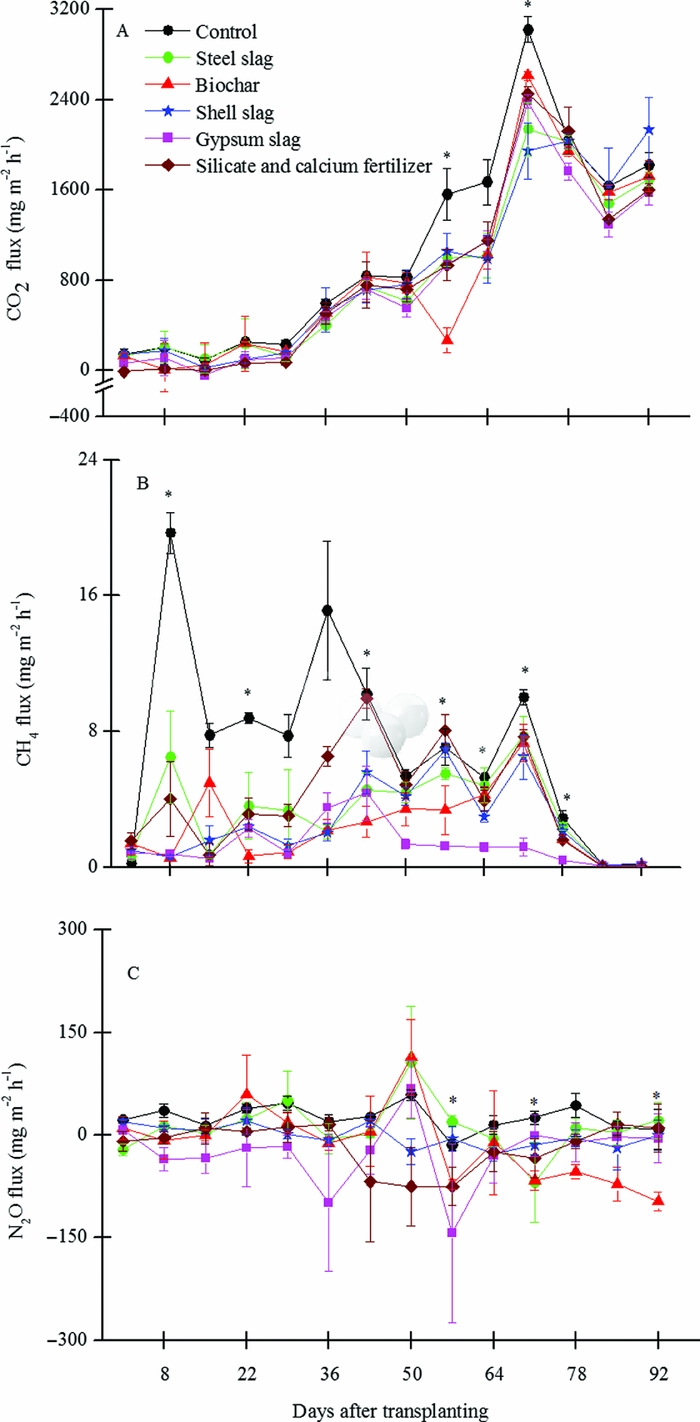
Plots fertilized with steel slag, biochar, gypsum slag and the silicate and calcium fertilizer had significantly 20.2, 20.6, 22.2 and 21.4% lower mean CO2 emissions than the control plots (P < 0.05, Tables 1 and S2). Mean CO2 emissions in shell slag plots did not differ significantly from those in the control plots (P > 0.05). CO2 emission varied significantly among treatments and sampling dates, and the steel slag and biochar treatments had significant interactions with time (P < 0.01, Table S2). CO2 flux generally remained low (<254 mg m−2 h−1) during the first 29 DAT but then increased to a seasonal peak (>1296 mg m−2 h−1) at 71 DAT (Figure 1A). The rice was nearly ripe by 71 DAT, with a corresponding decrease in CO2 emissions until harvesting in July.
CO2 (A), CH4 (B) and N2O (C) emissions in control and treatment plots during the studied period. Error bars indicate one standard error of the mean of triplicate measurements. Different letters indicate significant differences (P < 0.05) between fertilization treatments.

Steel slag, biochar, shell slag and gypsum slag fertilized plots had 53.8, 66.7, 62.7 and 81.5% lower mean CH4 emissions than those in the control plot (P < 0.05, Table S2). Mean CH4 emissions in plots fertilized with the silicate and calcium fertilizer did not differ significantly from those in the control plots (P > 0.05). Maximum fluxes were earlier in the control plots than in treatments (Figure 1B). The CH4 flux peaked by 43 DAT in the plots amended with gypsum slag and the silicate and calcium fertilizer and peaked by 71 DAT in the steel slag, biochar and shell slag treatments. The paddy was drained after the rice reached maturity, with CH4 emissions decreasing until rice harvest in July.
Plots with biochar had lower N2O emissions (by 56.5%) in comparison with control (P < 0.05, Tables 1 and S2). At 57 DAT, mean N2O emission was higher in the control plots, in shell slag and in steel slag plots than in the gypsum slag and silicate and calcium fertilizer treatments (Figure 1C). At 71 DAT, mean N2O emission was higher in the steel slag treatment and control plot than in biochar treatment (Figure 1C). At 92 DAT, mean N2O emission was lowest in the biochar treatment (–97.3 μg m−2 h−1) than in all other treatments and control plot (Figure 1C). The negative values of N2O emission were because our study site was strongly limited by N, and in such conditions N2O is reduced to NH4+, thus, the soils acted as sink of N2O in all treatments.
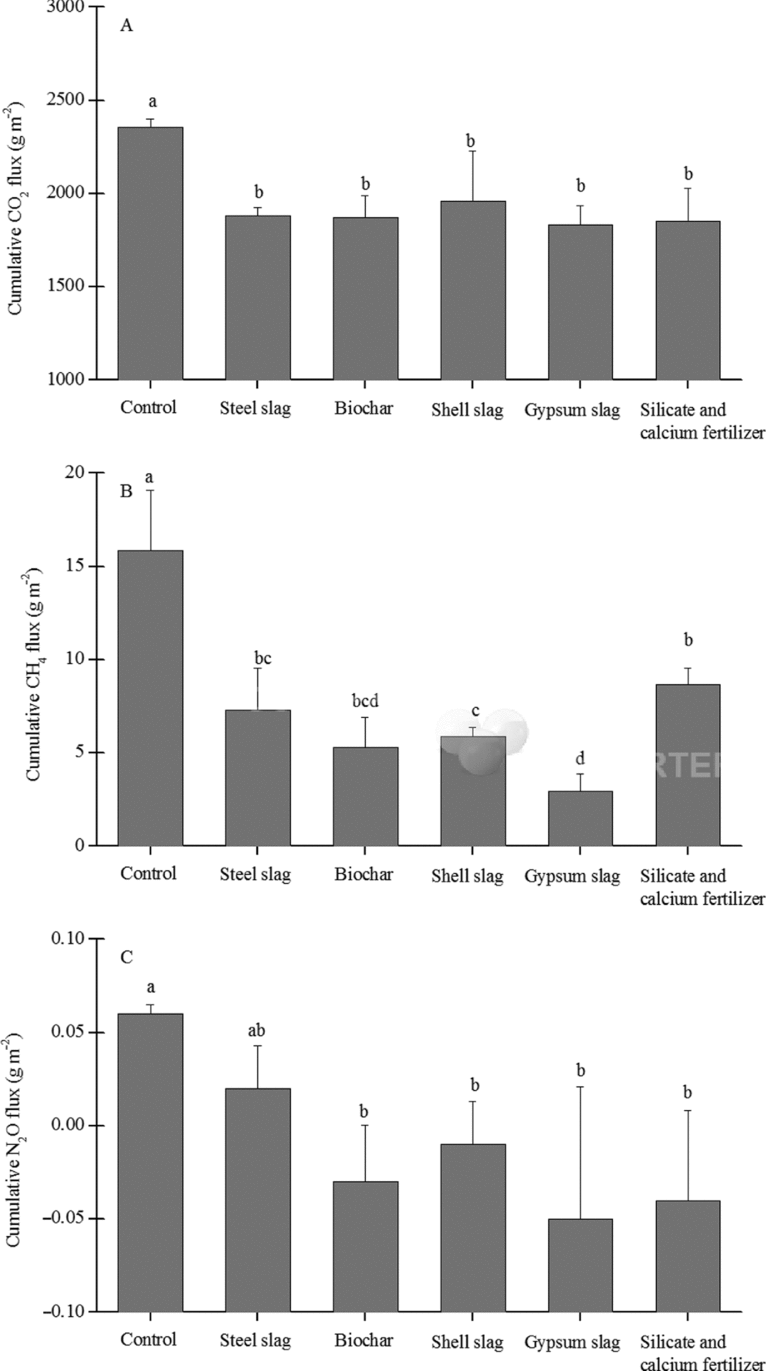
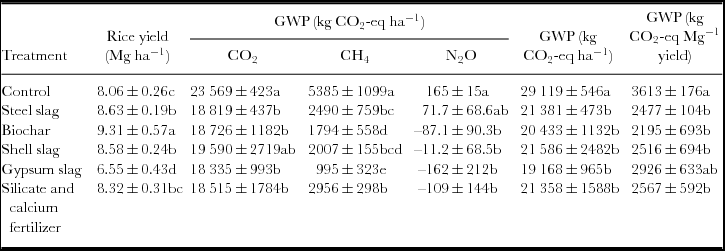
The cumulative CO2 and CH4 emissions during the studied period were lower in all treatments than in control plots (Figure 2A and B). The plots fertilized with biochar, shell slag, gypsum slag and Si plus Ca fertilizer had also lower cumulative N2O emissions than control plots during the studied period (Figure 2C). The average rice yield was higher in the plots fertilized with steel slag, biochar and shell slag compared to the control treatment (Table 1). The GWP was higher for CO2 than for CH4 and N2O emissions, with a contribution >80%. The total GWPs for all emissions were 26.6, 29.8, 25.9, 34.2, and 26.7% lower in the steel slag, biochar, shell slag, gypsum slag and silicate and calcium fertilizer treatments, respectively, compared to the control. Compared to the control, the total GWPs per unit yield were lower in the steel slag, biochar, shell slag and silicate and calcium fertilizer treatments by 31.4, 39.25, 30.4 and 29.0%, respectively.
Cumulative emissions of CO2 (A), CH4 (B), N2O (C) cumulative emissions among control and treatment plots during the studied period. Error bars indicate one standard error of the mean of triplicate measurements. Different letters indicate significant differences (P < 0.05) between fertilization treatments.

Effect of the different fertilization treatments on the global warming potential (GWP).

Different letters within a column indicate significant differences between the treatments and control plots (P < 0.05) obtained by Bonferroni's post hoc test.
Differences in soil properties among plots with different fertilization treatments
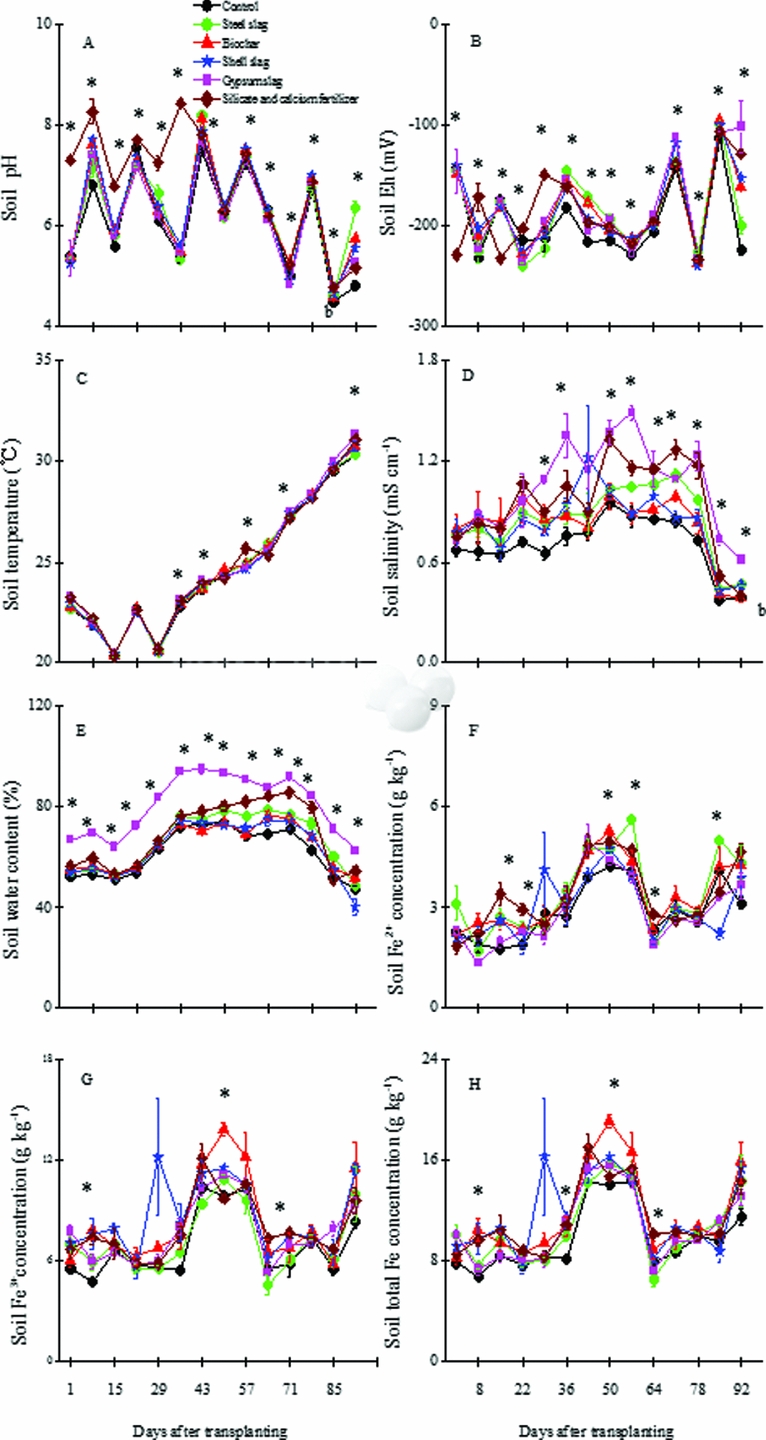
Soil pH, Eh, temperature, salinity, water content and ferrous, ferric and total Fe concentrations varied throughout the growing season (P < 0.001; Figure 3, Table S3). Soil pH was higher in the plots with steel slag, biochar, shell slag and the silicate and calcium fertilizer compared to the control treatment (P < 0.05). Soil Eh and total Fe concentration were higher in the plots with steel slag, biochar, gypsum slag and the silicate and calcium fertilizer compared to the control (P < 0.05). Soil temperature was higher in the plots with gypsum slag compared to the control (P < 0.05). Soil salinity was higher in the plots with steel slag, shell slag, gypsum slag and the silicate and calcium fertilizer compared to the control (P < 0.05). Soil water content was higher in the plots with steel slag, biochar, gypsum slag and the silicate and calcium fertilizer compared to the control (P < 0.05). Soil Fe2+ concentration was higher in the plots with steel slag, biochar and the silicate and calcium fertilizer compared to the control (P < 0.05). Soil Fe3+ concentration was higher in the plots with biochar, shell slag, gypsum slag and the silicate and calcium fertilizer compared to the control (P < 0.05).
Soil pH (A), Eh (B), temperature (C), salinity (D), water content (E), Fe2+ concentration (F), Fe3+ concentration (G) and total Fe concentration (H) in the control and treatment plots. Error bars indicate one standard error of the mean of triplicate measurements. Different letters indicate significant differences (P < 0.05) between fertilization treatments.

Relationships between CO2, CH4 and N2O emissions and soil properties
Seasonal CO2 emission was positively correlated with soil temperature in all plots (R = 0.81–0.88, P < 0.01, Table S4); positively correlated with soil Eh in the biochar, shell slag, gypsum slag and the silicate and calcium fertilizer treatments (R = 0.29–0.40, P < 0.05); positively correlated with soil water content in the control and the steel slag, biochar, gypsum slag and silicate and calcium fertilizer treatments (R = 0.28–0.46, P < 0.05); positively correlated with soil Fe2+ concentration only in the control plot (R = 0.35, P < 0.05) and negatively correlated with soil pH in the control and the biochar, shell slag, gypsum slag and silicate and calcium fertilizer treatments (R = –0.28 to –0.63, P < 0.05).
Seasonal CH4 emission was positively correlated with soil salinity (R = 0.27–0.65, P < 0.05, Table S4) and water content in all plots (R = 0.28–0.67, P < 0.01), positively correlated with soil Fe2+ concentration in the shell slag, gypsum slag and silicate and calcium fertilizer treatments (R = 0.26–0.44, P < 0.05) and positively correlated with soil Fe3+ and total Fe concentration in the silicate and calcium fertilizer treatment (R = 0.50 and 0.44, P < 0.05).
Seasonal N2O emission was positively correlated with soil salinity in the biochar treatment (R = 0.46, P < 0.05, Table S4), positively correlated with soil Fe3+ and total Fe concentration in the steel slag treatment (R = 0.30 and 0.27, P < 0.05) and negatively correlated with soil water content and Fe2+, Fe3+ and total Fe concentrations in the silicate and calcium fertilizer treatment (R = –0.32 to –0.42, P < 0.05).
Discriminant general analyses (DGA)
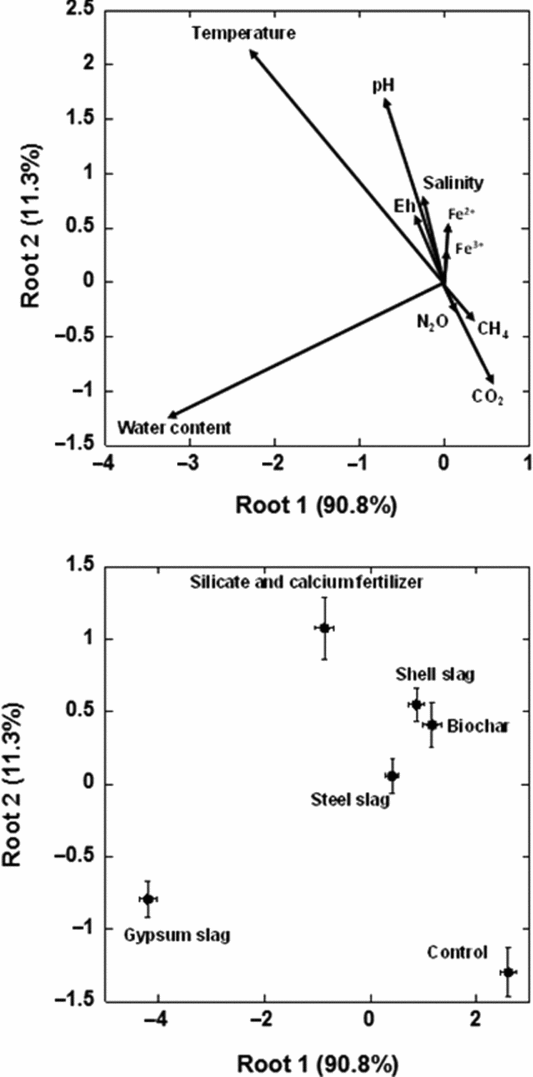
The DGA conducted with soil pH, Eh, temperature, salinity, water content and Fe2+ and Fe3+ concentrations and the CO2, CH4 and N2O emissions as independent continuous variables, sampling time as the categorical independent variable and plots receiving the fertilization treatments as the categorical dependent variable indicated statistical differences among all treatments except between the biochar and the steel slag and shell slag treatments (Table S5, Figure 4). Soil pH, Eh, salinity, water content and Fe2+ and Fe3+ concentrations and the CO2, CH4 and N2O emissions contributed significantly to these separations in this DGA model (Table S6).
Standardized canonical discriminant function coefficients for the root representing the gas emissions and soil variables as independent continuous variables, the days of sampling as a categorical independent variable and different grouping dependent factors corresponding to the fertilization treatments. Bars indicate the confidence intervals (95%) of the scores of each grouping factor along Root 1 and Root 2.

SEM analyses
The SEM analyses identified some of the soil variables underlying the relationships between the fertilization treatments and CO2, CH4 and N2O emissions. The negative relationship between steel slag fertilization and CO2 emission was due to direct negative effect plus and indirect positive relationships with soil Fe2+ concentration that in turn was negatively associated with CO2 emission (Figures S3A and S4A). The negative direct relationship of steel slag fertilization with CH4 emission was partially counteracted by a positive relationship of the steel slag fertilization with soil salinity, which thereafter was positively associated with CH4 emission (Figures S3B and S4B). Biochar fertilization had negative relationships with CO2, CH4 and N2O emissions. These negative relationships in the case of CH4 and N2O emissions were slightly counteracted by an indirect positive effect through the positive relationship of biochar fertilization with soil salinity (Figures S5A–C and S6A–C). Biochar fertilization had a strong positive relationship with rice yield that was slightly counteracted by the negative relationship of biochar fertilization with CH4 emission (Figures S5D and S6D).
As found for biochar fertilization, shell slag fertilization was negatively correlated with CH4 emission. This direct negative relationship was counteracted by an indirect positive effect of shell slag fertilization in soil salinity (Figures S7 and S8), resulting in absence of any global total effect. The gypsum slag and silicate and calcium fertilizer treatments also had negative direct relationships with CO2 and CH4 emissions. These negative direct relationships were partially but significantly counteracted by an indirect positive effect of the gypsum slag and silicate and calcium fertilizer treatments on soil water content (Figures S9–S12).
DISCUSSION
Effects of treatments on CO2 emissions
CO2 emission varied seasonally (Figure 1A), changing with rice growth and temperature (Figure 3). Temperature controls CO2 production and emission (Asensio et al., Reference Asensio, Yuste, Mattana, Ribas, Llusià and Peñuelas2012) by not only increasing soil microbial activity, but also by altering plant respiration (Slot et al., Reference Slot, Wright and Kitajima2013). In our study, the steel slag, biochar, gypsum slag and silicate and calcium fertilizer treatments significantly decreased CO2 emissions (Figure 2A). These fertilizers are all alkaline and then increase soil pH, facilitating the absorption of CO2 by water through the carbonate–bicarbonate buffer system (Revell et al., Reference Revell, Maguire and Agblevor2012). The steel slag, gypsum slag and silicate and calcium fertilizer are also rich in Ca2+, which can combine with CO2 to form CaCO3. Such product is deposited in the soil and decreases CO2 emission (Phillips et al., Reference Phillips, Lauchnor, Eldring, Esposito, Mitchell, Gerlach, Cunningham and Spangler2013).
Soil Fe3+ concentration also increased in the steel slag and silicate and calcium fertilizer treatments (Figure 3G and H), thereby enhancing the formation of iron plaque on the rice roots and thus limiting the transport of nutrients, water and soil dissolved organic carbon to rice roots (Huang et al., Reference Huang, Chen and Liu2012). Iron plaques decrease root ventilation, so less CO2 is transported through the internal system of interconnected gas lacunae of the plants. Moreover, when soil Fe3+ concentration increases, the rate of Fe3+ reduction also increases. Then, reduced Fe2+ accumulates in the soil (Wang et al., Reference Wang, Sardans, Lai, Wang, Zeng, Tong, Liang and Peñuelas2015) and inhibits microbial activity, lowering CO2 emissions (Huang et al., Reference Huang, Yu and Gambrell2009). The steel slag treatment accordingly had an indirect effect on CO2 emissions by increasing soil Fe2+ concentrations.
The gypsum slag fertilization treatment increased soil SO42− (Chen et al., Reference Chen, Liu, Huang, Shiau and Wang2013), thereby increasing the rate of SO42− reduction and its accumulation in the soil. Higher sulphide concentrations in soil can inhibit microbial activity and subsequently decrease CO2 emissions (Chen et al., Reference Chen, Liu, Huang, Shiau and Wang2013). The gypsum slag and silicate and calcium fertilizer treatments decreased CO2 emissions, an effect also associated with increases in soil water content. Linn and Doran (Reference Linn and Doran1984) reported that soil water contents >60% decreased aerobic microbial activity and increased anaerobic processes, which decreased CO2 production and emission. In our study, the average water content in the control, gypsum slag and silicate and calcium fertilizer treatments were all >60% during the growing season: 62% in the control plots and 80% and 69% in the gypsum slag and silicate and calcium fertilizer treatments, respectively (Figure 3E and F). Biochar fertilization also reduced CO2 emission, which is in accordance with previous research (Revell et al., Reference Revell, Maguire and Agblevor2012). Biochar is highly stable, has a high capacity to absorb atmospheric CO2 and can remain in the soil for long periods (Revell et al., Reference Revell, Maguire and Agblevor2012; Zhang et al., Reference Zhang, Cui, Pan, Li, Hussain, Zhang, Zheng and Crowley2010).
The DGA (Figure 4) and SEM (Figures S3–S12) analyses indicated that all fertilization treatments had some positive effects on CO2 and CH4 emissions by increasing soil salinity and water content. However, these indirect positive effects, although significant, were not large enough to prevent the total negative relationships with the CO2 and CH4 emissions (Figures S3–S12). Biochar amendment also increased the soil C:N ratio. Higher C:N ratios are associated with limited N availability, which impedes mineralization and stabilizes microbial biomass carbon (Revell et al., Reference Revell, Maguire and Agblevor2012), thereby lowering CO2 emissions (Chen et al., Reference Chen, Liu, Huang, Shiau and Wang2013). In fact, decreases in the release of N and P from litter have been associated with sudden decreases in CO2 emissions (Asensio et al., Reference Asensio, Yuste, Mattana, Ribas, Llusià and Peñuelas2012).
Effects of treatments on CH4 emissions
CH4 emission varied seasonally (Figure 1B), with emissions of CH4 being low soon after rice transplantation when the soil was not strictly anaerobic. CH4 emissions were also lower during the final ripening and drainage periods. These results agreed with those by Minamikawa et al. (Reference Minamikawa, Fumoto, Itoh, Hayano, Sudo and Yagi2014), in which a lowering of the water table decreased the abundance of the methanogenic archaeal population and hence CH4 production and increased the abundance of methanotrophs and thus CH4 oxidation.
Both Fe3+ and SO42− are alternative electron acceptors that will use C substrates before methanogens (Jiang et al., Reference Jiang, Sharma and Yuan2013) thus decreasing the amount of CH4 production (Ali et al., Reference Ali, Oh and Kim2008), which compete with methanogens for C substrates (Jiang et al., Reference Jiang, Sharma and Yuan2013). The steel and gypsum slag treatments increased Eh, which is also consistent with the decrease in CH4 emissions. Recent studies have found that the presence of ferric iron and sulphate can support the oxidation of CH4 under anaerobic conditions (Wang et al., Reference Wang, Sardans, Lai, Wang, Zeng, Tong, Liang and Peñuelas2015). Fertilization with steel and gypsum slags would thus decrease the release of CH4 to the atmosphere as a result of a decrease in CH4 production, an increase in CH4 oxidation, or both (Wang et al., Reference Wang, Sardans, Lai, Wang, Zeng, Tong, Liang and Peñuelas2015).
Biochar can also reduce CH4 emissions (Figure 2B), as previously reported (Revell et al., Reference Revell, Maguire and Agblevor2012; Zhang et al., Reference Zhang, Cui, Pan, Li, Hussain, Zhang, Zheng and Crowley2010). Biochar amendment increases soil ventilation (Revell et al., Reference Revell, Maguire and Agblevor2012), which increases methane oxidation and thus decreases methane production. Biochar fertilization also decreases and stabilizes the microbial biomass carbon, which may also account for decreases in CH4 emission (Revell et al., Reference Revell, Maguire and Agblevor2012). Furthermore, biochar is very stable, highly porous, can absorb CH4 and increase the oxidation of CH4 (Revell et al., Reference Revell, Maguire and Agblevor2012; Zhang et al., Reference Zhang, Cui, Pan, Li, Hussain, Zhang, Zheng and Crowley2010). As consequence, the soil fertilized with biochar in our study released low amounts of CH4. The shell slag also decreased CH4 emission but increased soil salinity due to its marine origin.
Effects of fertilization treatments on N2O emissions
N2O emission had no obvious patterns of seasonal variation. N2O emission was low throughout the growing season. The paddies in our study region are strongly N limited (Wang et al., Reference Wang, Sardans, Lai, Wang, Zeng, Tong, Liang and Peñuelas2015), so together with the low levels of soil O2, most of the N2O produced is likely reduced to N2, which would lead to the apparently very low emissions or even a net uptake of N2O (Zhang et al., Reference Zhang, Cui, Pan, Li, Hussain, Zhang, Zheng and Crowley2010).
Biochar significantly decreased N2O emission, as previously reported (Cayuela et al., Reference Cayuela, Oenema, Kuikman, Bakker and Van Groenigen2010). Biochar is rich in alkaline material, so it can increase soil pH, stimulate N2O reductase activity, and thereby induce N2O reduction to N2 (Cayuela et al., Reference Cayuela, Oenema, Kuikman, Bakker and Van Groenigen2010). The porous structure of biochar can also absorb NH4+–N and NO3−–N from soil solution, thereby inhibiting nitrification and denitrification and thus decreasing N2O emission (Cayuela et al., Reference Cayuela, Oenema, Kuikman, Bakker and Van Groenigen2010). Biochar may also improve soil aeration and impede the function and diversity of denitrifying bacteria, thereby decreasing N2O emission (Zhang et al., Reference Zhang, Cui, Pan, Li, Hussain, Zhang, Zheng and Crowley2010).
Steel slag, shell slag, gypsum slag and the silicate and calcium fertilizer also decreased N2O emissions. Our experiment, however, was conducted within a single growing season, and the variation in N2O emission within a treatment group was quite large, so identifying a discernible effect of the different fertilization treatments on mean N2O emissions was difficult. The lack of significant decreases in N2O emission by an amendment material likely has several causes. Steel slag and the silicate and calcium fertilizer are rich in Fe3+, which would increase the soil Fe3+ concentration. Huang et al. (Reference Huang, Yu and Gambrell2009) suggested that soil Fe3+ concentration was one of the most sensitive factors regulating N2O emissions from paddies. Fe3+ concentrations and N2O emissions, however, were not correlated in our study. A previous study reported both positive and negative correlations between Fe3+ concentrations and N2O production, which were due to different soil conditions and hence the presence of various forms of Fe3+ (active, Fe3+ and complex ferric oxide, Fe2O3) (Huang et al., Reference Huang, Yu and Gambrell2009).
The absence of a consistent effect of the steel slag and silicate and calcium fertilizer on N2O flux from the paddy could be attributed an inhibition of the enzymatic reduction of N2O by higher levels of Fe3+ increasing N2O release or an atmospheric inhibition of the enzymatic reduction of N2O in soils (Huang et al., Reference Huang, Yu and Gambrell2009), an increase in the production of hydroxylamine by the biological oxidation of ammonia favoured by higher Fe3+ concentrations and the further reaction of hydroxylamine with Fe3+ to generate N2O (Noubactep, Reference Noubactep2011). The increase in Fe2+ concentrations by direct release from fertilizers or by microbial reduction (Ali et al., Reference Ali, Oh and Kim2008) can further promote the reduction of nitrites to N2O (Hansen et al., Reference Hansen, Borggaard and Sørensen1994).
Gypsum slag is rich in SO42−, which has the same function as Fe3+ in N cycling. The gypsum slag decreased N2O emission during the period of continuous flooding and slightly increased N2O emission in the drained paddy field. These results are consistent with the expected competition between SO42− and NO3− as electron acceptor in denitrification process under the anaerobic conditions of a flooded paddy (Yavitt et al., Reference Yavitt, Lang and Wieder1987). Thus, the relationships of the gypsum slag with N2O emissions changed depending on the period during the flooded (decrease) and drained (increase) as a consequence the gypsum slag did not significantly decrease overall N2O emissions throughout the entire growing season.
Best management practices to reduce GWP
Our results suggested that the application of steel slag, biochar, shell slag and a silicate and calcium fertilizers all effectively reduced the adverse impacts of rice agriculture on climate change, with lower total GWPs per unit yield compared to the control treatment. The alkalinity of the steel slag, biochar, shell slag and the silicate and calcium fertilizer also improved the soil quality in this rice-producing area impacted by acid deposition. The rice biochar was rich in N, which increased soil N-concentration in biochar amendment plots (Wang et al. unpublished data, Wang et al., Reference Wang, Zeng, Sardans, Wang, Zeng and Peñuelas2016) and lead to higher grain yield as compared to the control plot. Moreover, the application to soil of all the studied wastes is able to increase soil N, P and S availability in porewater and also to prevent the losses of these elements by leaching (Wang et al., Reference Wang, Zeng, Sardans, Wang, Zeng and Peñuelas2016), improving soil fertility.
This study was based only on the results in a very important but short time period. More studies are thus warranted to assure the suitability of the application of industrial and agricultural wastes during the crop cycle. Moreover, some of these wastes can introduce pollutants (such as heavy metal) to the environment, and this should be also assessed. However, some of our previous studies showed that steel slag application to rice crops in equivalent doses to those of this study did not significantly impact on heavy metal concentrations in soil and in rice yields (Wang et al., Reference Wang, Sardans, Lai, Wang, Zeng, Tong, Liang and Peñuelas2015). One would argue that a continuous application of wastes in the paddy field could decrease soil bulk density and consequently raise soil pore diameter, increasing the loss of water and nutrients and being detrimental to rice growth (Zhao, Reference Zhao2012). However, 8 Mg ha−1 waste amendment had increased the water content and porewater nutrient concentrations (Wang et al., Reference Wang, Zeng, Sardans, Wang, Zeng and Peñuelas2016).
The fertilizer materials chosen for this study were in abundant supply for application to rice paddies. They also have a low cost and recycle wastes. In a sustainable agriculture, steel slag, biochar, shell slag and silicate and calcium fertilizers can all increase C sequestration by paddy soils, improve soil fertility, increase rice yields and mitigate GHG emissions. Our results thus provide strong evidence for several benefits from the application of these industrial and agricultural wastes in rice fields.
Acknowledgements
The authors would like to thank Hongchang Ren, Xuming Wang and Qinyang Ji for their assistance with field sampling. Funding was provided by the National Science Foundation of China (41571287, 31000209), Natural Science Foundation Key Programs of Fujian Province (2014R1034-3, 2014Y0054 and 2014J01119), the Program for Innovative Research Team at Fujian Normal University (IRTL1205), the European Research Council Synergy grant ERC-SyG-2013-610028 IMBALANCE-P, the Spanish Government grant CGL2013-48074-P and the Catalan Government grant SGR 2014-274.
SUPPLEMENTARY MATERIALS
For supplementary material for this article, please visit https://doi.org/10.1017/S001447971700031X