This note records the reinvestigation of a whetstone which, when first examined, was attributed to a Lower Jurassic source rather than to the Lower Cretaceous Kentish rag (Hythe Beds). Other widely reported whetstones of a similar character to the Boreham example have been ascribed to the Kentish rag, but are now known on the basis of further research to have been made from an older Lower Cretaceous formation.
Whetstones are unassuming but necessary items of everyday use, called into play in Roman Britain whenever edge-tools and implements, such as scythes, knives, swords, chisels and razors, required sharpening.Footnote 1 In addition to reused querns and local pebbles, two purpose-made whetstones were recovered from the excavation in 1992–94 of the medium-rank Roman villa at Boreham, Essex, situated near the main London–Colchester road on the northern slopes of the Chelmer valley, some 12 km to the north-east of Roman Chelmsford (Caesaromagus).Footnote 2 The items were initially submitted to Dr Graham Lott of the British Geological Survey, who reported on their microscopic petrography after having thin-sections cut. The two whetstones were found to differ sharply. One, a dense, indurated, feldspathic sandstone with an argillaceous matrix, was suggested by Lott to be from a Lower Palaeozoic and possibly extra-British source. The other, a calcareous sandstone and the subject of this note was thought to be of a Lower Jurassic sandstone, perhaps from exposures on the Channel or Yorkshire coasts.Footnote 3 Kentish rag (Hythe Beds, Lower Cretaceous) was rejected by Lott, on the grounds that no glauconite was detected. In the light of recent research the attribution to the Lower Jurassic must be considered incorrect and it is now possible to show that the Boreham whetstone is a further representative of a major industry based on Wealden (early Lower Cretaceous) sandstones, the products of which have a national distribution in Roman Britain.
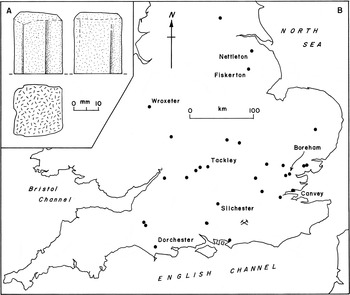
fig. 1A shows the whetstone as it was returned to the Chelmsford Museums from the British Geological Survey. It is a small fragment from a sharpening stone which, by comparison with other examples of the type, is likely to have been originally roughly one Roman foot in length.Footnote 4 The fragment now measures 25 by 21 by 19 mm, having lost some 16 mm during the original thin-sectioning process (thin-section now lost). It is parallel-sided and bar-like with an almost square cross-section. The uncut end is partly rubbed smooth, with narrow chamfers on three sides. Conspicuous on one face are shallow, sub-rectangular rebates parallel with the long edges; traces of such a rebate can also be seen along one long edge of the opposite face. A third face is smooth but the face opposite shows a deep groove a few millimetres wide, that falls short of the end of the fragment, where a narrow chisel could have been sharpened.
Whetstones from the Weald Clay Formation. A. The Boreham whetstone; B. Known distribution of Weald Clay Formation whetstones in Roman Britain (adapted from Allen Reference Allen2014a).

In hand-specimen, the rock forming the whetstone is a dense, pale grey-green, faintly laminated, fine- to medium-grained, calcareous sandstone. No fossils can be seen, but on some laminae there is a scattering of mica flakes and also black particles that are probably carbonaceous.
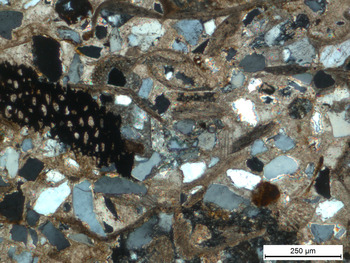
fig. 2 shows the rock under the microscope, a second thin-section having been made from an offcut returned from the first effort. The rock is dominated by very well-sorted, angular quartz accompanied by subordinate bioclastic material, chiefly ostracod valves but with some sea-urchin plates and spines and occasional foraminifera. Noted as rare are grains of coarsely microcrystalline chert and flakes of muscovite, and as very rare feldspars and yellow-brown, rounded pellets of partly oxidized glauconite. A few phosphatic grains of organic origin were noted. Dispersed conspicuously throughout the rock, and interpreted as charred plant material or charcoal, are opaque particles commonly much larger than the associated quartz grains, some displaying minute fractures and others clear anatomical structure, as can be seen in fig. 2. The rock is cemented by finely lustre-mottled, dusty to granular calcite.
Photomicrograph of the Boreham whetstone. Plain-polarized light. Quartz: angular, colourless; ostracod valve: dark grey straight to curved; sea-urchin fragments: light pinkish grey with colourless speckles; carbonaceous fragments: black, some with regularly distributed light grey cells; calcite cement: light pinkish grey.

The Boreham whetstone is impossible to distinguish in hand-specimen and thin-section from whetstones recently examined in these modes from Canvey (Castle Point),Footnote 5 Dorchester (Colliton Park),Footnote 6 Fiskerton,Footnote 7 Nettleton,Footnote 8 Silchester,Footnote 9 TackleyFootnote 10 and Wroxeter as dug by Atkinson.Footnote 11 All are clearly from the same geological source, Wroxeter affording a convenient and important ‘type-site’ for the artefacts and their mode of manufacture. Excavations there (1923–27) afforded about 100 unused, roughly foot-long, bar-shaped whetstones of grey-green, calcareous sandstone in association with substantial nests of plain and decorated samian vessels and Mancetter–Hartshill mortaria, all buried under building rubble. Atkinson interpreted the find as the stock of shops in the forum which had been engulfed in a fire. He showed that the rebates found on the long edges of the whetstones were due to a manufacturing process that involved sawing parallel grooves on opposite faces of a thin slab of sandstone and then breaking off the individual bars. A wide-ranging geological analysis of the Wroxeter whetstones revealed their distinctive character.Footnote 12 The quartz grains are typically very well sorted and accompanied by variable amounts of bioclastic debris, mainly ostracod valves and some sea-urchin spines. Carbonized wood and charcoal displaying anatomical structure are invariably present, in some cases strewn over laminae in considerable abundance. Glauconite is normally seen, but never more than a few grains per thin-section. Invariably the cement is finely lustre-mottled calcite. In terms of the heavy-mineral assemblage present, the rock most closely resembles sandstones from the Weald Clay Formation (early Lower Cretaceous) in the north-west Weald, an attribution strongly supported by field and petrographic evidence collected by the British Geological Survey from this general area.Footnote 13 No longer tenable is the previous, widely held belief that whetstones of this kind are to be attributed to Kentish rag, a younger formation of Lower Cretaceous date in south-east England.
The Boreham whetstone (fig. 1A) is the eighth that, on the basis of combined hand-specimen and thin-section characteristics, can be ascribed to the Weald Clay Formation. This site, together with the seven already mentioned, is shown in fig. 1B, together with 21 other excavations at which, on the basis of credible published descriptions, whetstones from this source appear to be present. The distribution ranges through the civilian zone from the Channel coast at least as far north as York. Indeed, there is some evidence that the scatter may reach as far as Corbridge in the northern frontier area.Footnote 14
Presciently, Atkinson was in no doubt that the Wroxeter whetstones represented ‘a quarry which did a large and widespread business’.Footnote 15 The scatter shown in fig. 1B handsomely bears out his proposal and points to the existence of a substantial stone-based industry in the south-east of Roman Britain, in addition to those better-known, but less pervasive, enterprises producing milling equipment.Footnote 16 That these Wroxeter-style whetstones were valuable and valued possessions is plausibly demonstrated by their presence as votive objects at second-century Fiskerton.Footnote 17 Here two little-used complete whetstones and two shorter portions were dropped upright into alluvium by the side of a wooden causeway built out into the river Whitham.
ACKNOWLEDGEMENTS
I am greatly indebted to Nicholas Wickenden (Museums Manager, Chelmsford Museums) for the opportunity to examine the whetstone from Boreham and, at the University of Reading, to John Jack and Michael Andrews for thin-section and photographic work respectively.