




No CrossRef data available.
Article contents
The Stick Design test: A new measure of visuoconstructional ability
Published online by Cambridge University Press: 26 August 2005
Abstract
Visuoconstructional ability is an important domain for assessment in dementia. Use of graphomotor measures dominate this area; however, participants with low education produce results that cannot be easily interpreted. Our objective was to develop and validate a nongraphomotor assessment of visuoconstructional ability for use in dementia evaluations in persons with low or no education. In a longitudinal, population-based study of dementia among Yoruba residents of Ibadan, Nigeria aged 65 years and older, participants underwent clinical assessment with a battery of cognitive tests and consensus diagnosis. Performance on two visuoconstructional tests, Constructional Praxis and Stick Design, were compared. Gender, age, and education affected performance on both tests. The Stick Design test was more acceptable than Constructional Praxis as measured by the number of participants with total test failure (3.9% vs. 15.1%). The Stick Design test was significantly more sensitive to cognitive impairment and dementia than the Constructional Praxis test. We conclude that Stick Design is a reasonable test of visuoconstructional ability in older cohorts with very limited educational exposure and literacy. (JINS, 2005, 11, 598–605.)
Information
- Type
- Research Article
- Information
- Journal of the International Neuropsychological Society , Volume 11 , Issue 5 , September 2005 , pp. 598 - 605
- Copyright
- © 2005 The International Neuropsychological Society
INTRODUCTION
Diagnosis of dementia requires impairments in memory and a nonmemory cognitive domain that in combination produce significant social or adaptive dysfunction (American Psychiatric Association, 1994). The nonmemory cognitive domains are assessed by tests of linguistic, visuospatial, and executive skills. Visuospatial skills are frequently assessed by tests requiring a graphomotor response, for example, the reproduction of geometric figures using pencil and paper.
The popularity of drawing-based visuoconstructional tests relates to their ease of administration, relatively objective scoring, and presumed cultural invariance (Carlesimo et al., 1993). However, the performance of persons with low education on these tests cannot be unambiguously interpreted. Literacy-related low graphomotor function has been reported (Ganguli et al., 1996) and presumably affects performance independent of any specific visuospatial dysfunction. Even when the response does not involve writing letters, words, or numbers, the requirement of a pencil in the response can be perceived as threatening or otherwise inappropriate to illiterate participants, thus providing another barrier to performance and complication to interpretation of results. In addition, there is growing evidence that the development of literacy affects the functional (Castro-Caldas et al., 1998) and structural organization (Castro-Caldas et al., 1999) of the brain through interactions with the visual system (Matute et al., 2000; Reis et al., 2001).
These limitations form a particular problem for cross-national studies of dementia involving developing countries, because formal education and literacy are often extremely limited among the elders at these sites. The large gap in visuospatial assessment can hinder clinical dementia assessments in these populations. The Consortium to Establish a Registry for Alzheimer's Disease (CERAD) neuropsychological battery (Morris et al., 1988) contains a visuoconstructional task called Constructional Praxis that requires the drawing of geometric figures. This test has been administered to elderly, community-dwelling Nigerians (Guruje et al., 1995) and Jamaicans (Unverzagt et al., 1999), with the less educated participants showing negative emotional reactions and very low scores.
In response to these problems, we have adapted a nongraphomotor measure of visuoconstructional ability from the World Health Organization (WHO) Construction Test. In our version, called Stick Design, participants arrange wooden match sticks to conform to standard stimulus patterns. In this article, we provide normative information on Stick Design and Constructional Praxis and compare the acceptability and clinical utility of these tests in the cognitive assessment and differential diagnosis of dementia in low education and illiterate elders in a cross-national study of dementia.
METHOD
Design and Sampling Frame
The Indianapolis-Ibadan Dementia Project is a two-stage, longitudinal, cross-national study of dementia and Alzheimer's disease. Details of the study design can be found elsewhere (Hendrie et al., 1995, 2001). This article is focused on the Ibadan site, which is located in the southwestern part of Nigeria and consists predominantly of Yoruba peoples. A total population census was carried out by means of a door-to-door enumeration of a geographically defined area within the Idikan ward of the city. The elders of Idikan are artisans, craftsmen, and small traders with low income and little formal education. Nearly 85% of the sample is illiterate (Hendrie et al., 1995). All participants or their next of kin gave informed consent. The study was approved by the Joint Ethical Committee of the College of Medicine University of Ibadan and the University College Hospital Ibadan.
Screening and Clinical Assessment
In the first stage, 2535 residents aged 65 years and older were eligible and 2494 agreed to participate and were screened in their homes with the Community Screening Interview for Dementia (CSI-D; Hall et al., 1993, 1996). The CSI-D consists of a direct cognitive assessment with the participant that includes tests of memory, orientation, language, attention, calculation, and reasoning and a structured interview with an informant that provides information on the onset and progression of any cognitive symptoms and the adequacy of the participant's daily functioning. Scores from each portion are combined into a total score that is used to determine selection for the second, clinical assessment and diagnosis stage. All participants with poor CSI-D performance and a subset with good performance were selected for the clinical assessment.
The clinical assessment consisted of a physician examination, structured informant interview, and cognitive testing. The physician examination included physical, neurological, and mental status examinations. The informant interview is a structured interview conducted by a research nurse with a family member who knows the participant well. A series of queries probe for history of impairment or decline affecting memory, language, reasoning, and personality. Historic involvement and current performance in daily functioning involving food preparation, household chores, finances, travel in the community, and personal care is also assessed in this interview. Cognitive testing was done with a modified version of the CERAD neuropsychological battery (Guruje et al., 1995; Unverzagt et al., 1996). Laboratory and radiological investigations including head computed tomography (CT) scans were carried out as needed and when feasible.
Diagnosis
All clinically assessed participants were diagnosed as Normal, Cognitive Impairment No Dementia (CIND), or Dementia using a consensus diagnosis panel approach. Local norms were used to guide interpretation of the CERAD scores (Guruje et al., 1995). Criteria for dementia were according to DSM-III-R (American Psychiatric Association, 1987). Criteria for CIND were as follows: informant-reported decline in cognition; or physician-detected impairment in cognition; or CERAD test score below approximately the 7th percentile of the normative reference sample; and normal daily functioning based on informant interview or physician examination. This definition of CIND includes a heterogonous group of clinically significantly impaired persons. The cognitive dysfunction may be caused by any number of conditions, diseases, or disorders including: incipient Alzheimer's disease, stroke, seizures, alcoholism, head injury, schizophrenia or other serious psychiatric disorder, developmental disability, or serious medical disorders (Baiyewu et al., 2002; Unverzagt et al., 2001). Although the cognitive dysfunction is clinically significant, it does not seriously limit daily function, thus distinguishing this condition from dementia (Graham et al., 1997; Petersen, 2004; Petersen et al., 1995). All other participants were diagnosed as Normal.
Longitudinal Follow-up
An attempt was made to rescreen all nondemented participants from the initial prevalence wave at 2-, 5-, and 8-year follow-up assessments. The two-stage design was implemented on the remaining nondemented cohort at each follow-up wave. Selection for clinical assessment was again based on CSI-D performance with sampling for false negatives. All available data were used in the consensus conference to arrive at a diagnosis.
Visuospatial Measures
On Constructional Praxis (see Figure 1), participants are presented with a geometric figure and asked to draw a copy of the figure on the same sheet of paper. There are four designs, a circle (2 points), a diamond (3 points), overlapping rectangles (2 points), and a cube (4 points). Scores for each item are summed to give a total possible score of 11.

Stimuli for Constructional Praxis (panel A) and Stick Design (panel B).
The Stick Design test was derived from the WHO Construction Test from the larger WHO/MNH Cognitive Battery of Cognitive Assessment Instruments. In Stick Design, a representation of an arrangement of four wooden matches is printed on a page. The designs approximate a square, a triangle with stem, a chevron, and a rake-like figure (see Figure 1). For the first item (square), the examiner demonstrates how to arrange the matches to copy the stimulus, explicitly noting in the process the need to correctly orient the match heads. The matches are then collected and handed to the participant who is told to make an exact copy of the stimulus. Each item is scored on three dimensions: general configuration, orientation of the whole figure, and orientation of the match heads within the figure. Criteria for Item 1 (square) are as follows: a four sided figure (yes = 1, no = 0); figure rests on a side (yes = 1, no = 0); match heads are correctly oriented (yes = 1, no = 0). Criteria for Item 2 (triangle with stem): a three-sided figure is present (yes = 1, no = 0); the base of the triangle is closest to the participant (yes = 1, no = 0); match heads are oriented correctly (yes = 1, no = 0). Criteria for Item 3 (chevron): all sticks angled in a “V” configuration (yes = 1, no = 0); apex points away from participant (yes = 1, no = 0); match heads are oriented correctly (yes = 1, no = 0). Criteria for Item 4 (rake): two middle sticks are aligned head to toe (yes = 1, no = 0); side sticks angle outward from the top match head (yes = 1, no = 0); match heads are oriented correctly (yes = 1, no = 0). Total possible score is 12. A rigorous training and certification procedure was used to assure that examiners were competent in administration and scoring of all tests. Formal interrater reliability studies were not conducted.
Statistical Analysis
The Stick Design test was first introduced at the 5-year follow-up. Participants with a valid Stick Design and Constructional Praxis score from either the 5- or 8-year follow-up were used. If a participant was seen in both follow-up waves, only data from the 5-year follow-up (the first exposure) was used. Chi-square tests were used to compare the three diagnostic groups on categorical demographic characteristics. Following a significant p-value from the chi-square test, each pair of groups was compared using individual chi-square tests and the resulting p-values were adjusted using Sidak's multiple comparison procedure. Analysis of variance (ANOVA) models were used to compare the three diagnostic groups on continuous demographic characteristics and test scores. Following a significant p-value from the ANOVA, means of the three diagnostic groups were compared using the Tukey-Kramer multiple comparison test. In the participants diagnosed as Normal, we regressed age, gender, education (present vs. absent), and occupation (craftsman/artisan vs. all others) on each test to examine the role of demographic factors on performance.
Clinical diagnostic utility was compared in two ways. First raw score cut-offs were defined for each test based on the 10th percentile in the Normal sample. The sensitivity of the tests is compared by cross-tabulating the number of CIND and Demented participants scoring below the cut-off scores by test. In this approach, specificity is set at 90% by definition. McNemar's tests were used to compare the sensitivity estimates at fixed specificity levels between the two tests within the demented and the CIND groups.
Second, separate logistic regression models were used to compare the accuracy of Constructional Praxis and Stick Design in predicting diagnosis (Normal and CIND vs. Dementia). Receiver operating characteristic (ROC) curves and the area under the curve (AUC) were calculated from each model. Standard errors were estimated using the method proposed by Hanley and McNeil (Hanley & McNeil, 1982). The AUCs from the various models were compared using the method proposed by Hanley and McNeil (Hanley & McNeil, 1983).
RESULTS
A total of 724 participants completed Constructional Praxis and Stick Design for the first time during the 5- and 8-year follow-up waves. The relative acceptability of the two tests is revealed in the fact that total test failure (responses resulting in a zero score or participant refusal to attempt the items) was much more frequent for Constructional Praxis (109/724, 15.1%) than Stick Design (28/724, 3.9%, p < .0001).
Table 1 presents the demographic and clinical characteristics for the overall sample and each of the three diagnostic groups. The full sample had an average age just over 78 years, a predominance of females, and little education (less than 10% of the participants had any formal schooling). The diagnostic groups were comparable in percentage of females and education. The Dementia group was significantly older than the Normal group and had lower Mini-Mental State Examination scores than both Normal and CIND groups.
Characteristics of the full sample and diagnostic groups

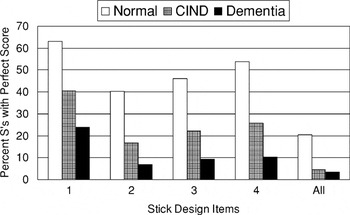
Information on item difficulty of Stick Design is presented in Figure 2. The expected relationship between cognitive dysfunction and overall performance was obtained: The Normal group performed better than the CIND group and the CIND group performed better than the Dementia group. The relative item difficulty was also preserved across diagnostic groups with item 1 passed (i.e., a perfect score) by the most participants, followed in decreasing order by items 4, 3, and 2.

Percent of participants with a perfect score on Stick Design by item by diagnosis.
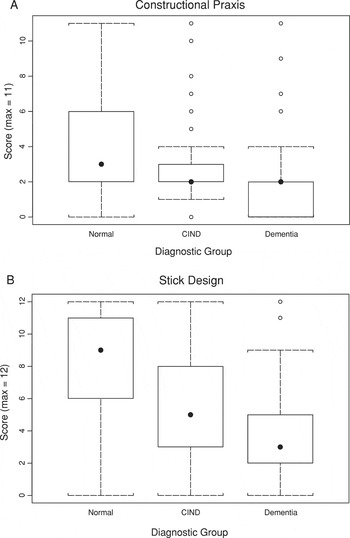
Although each diagnostic group differs significantly from each other on both tests (Table 1), the average score for Stick Design in the total sample is approximately 55% of the maximum possible points (6.6/12) compared to 28% (3.1/11) of the maximum score for Constructional Praxis. Box plots of each test by diagnostic group indicate that CIND and Dementia groups have very close overlap, with nearly indistinguishable medians on Constructional Praxis (Figure 3). In contrast, Stick Design has a somewhat more reasonable spread of scores across the three diagnostic groups and in particular better separation between CIND and Dementia groups.

Box plots of visuospatial tests by diagnostic group. The boundary of each box represents the interquartile range. The central dot represents the median and the error bars include scores 1.5 box-lengths from the end of the box. The open circles are scores outside 1.5 box lengths.
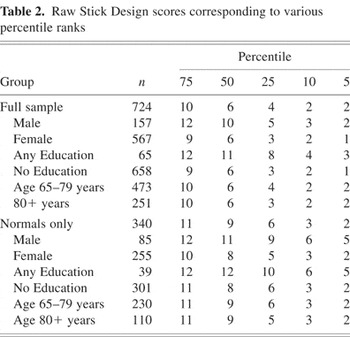
The multiple regression of demographic variables on test performance was conducted on 340 Normal participants. The results were comparable for Stick Design and Constructional Praxis with significant effects for gender (females did more poorly than males), education (better scores from participants with education compared to those without education), and age (better scores for younger participants). The largest partial correlation coefficients were for gender (R2 = .085 for Constructional Praxis, R2 = .077 for Stick Design), followed by education (R2 = .059 for Constructional Praxis, R2 = .023 for Stick Design), and age (R2 = .016 for Constructional Praxis, R2 = .009 for Stick Design). The model explained 30.3% of the variance in Constructional Praxis and 17.5% of the variance in Stick Design. There was no significant effect of occupation. Normative data are presented for the full sample and Normal subsample separately by test in Tables 2 and 3.
Raw Stick Design scores corresponding to various percentile ranks

Raw Constructional Praxis scores corresponding to various percentile ranks

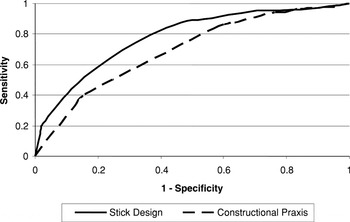
The clinical diagnostic utility of the tests is compared in Table 4. For each test the raw score corresponding to the 10th percentile of the Normal group was defined as the cut-off score. Each participant's performance was then dichotomized as impaired (raw score less than 10th percentile) or not impaired and cross-tabulated across diagnostic groups. This has the effect of setting specificity at 90% and allowing comparability of the sensitivity of each test to cognitive impairment. Stick Design correctly classified 58% of the Dementia group compared to 41% for Constructional Praxis, a difference in rate of correct classification that is statistically significant (p = .0009). Similarly, Stick Design was more efficient in detecting cognitive dysfunction of any kind (36% correct classification of a combined CIND and Dementia grouping) compared to Constructional Praxis (27% correct classification of the combined CIND and Dementia groups, p = .0025). The ROC analysis (Figure 4) also supports the increased accuracy in discrimination of Stick Design (AUC = .779) over Constructional Praxis (AUC = .691; difference between AUCs, p = 0.004) for dementia.
Tests performance and clinical classification by diagnostic group (Normal vs. CIND and Dementia)a


ROC curves of dementia vs. no-dementia for Stick Design and Constructional Praxis.
DISCUSSION
In this article, we describe the development and performance of a nongraphomotor-based assessment of visuoconstructional ability, the Stick Design test, in a cross-national study of dementia involving a cohort with limited formal education and literacy.
The Stick Design test was more acceptable than Constructional Praxis to these elderly, largely illiterate, community-dwelling Nigerians. Gender, education, and age affected performance on both tests to a degree. Approximately 15% of the participants completely failed the Constructional Praxis compared to about 4% for Stick Design. Our analysis also suggests significant differences in the clinical diagnostic utility of the measures. Specifically, Stick Design was more sensitive than Constructional Praxis to all levels of cognitive dysfunction in this sample (Dementia alone or Dementia and CIND combined). These data indicated that a raw score of 3/12 or less on Stick Design had a moderate sensitivity to dementia (58%) when specificity is set at 90%. In contrast, Constructional Praxis had significantly lower sensitivity to dementia (41%) at the same level of sensitivity.
The sample-wide levels of performance on Constructional Praxis reported in this study (M = 3.1, SD = 2.6) are much lower than the scores obtained in our sample of older African Americans from Indianapolis where education and literacy were nearly universal (M = 9.0, SD = 1.6; (Unverzagt et al., 1996). This is consistent with literature that suggests that the development of literacy affects the functional organization of the brain beyond linguistic areas (Matute et al., 2000; Reis et al., 2001).
Our finding of difficulty with graphomotor-based assessment of visuoconstructional ability is also consistent with reports from Ganguli and colleagues in their cross-national study of aging and dementia, which focused on rural whites outside Pittsburgh and rural residents of the Ballabgarh district of northern India (Chandra et al., 1998b; Ganguli et al., 1996). The Hindi-speaking elders in that study had little formal education and about 70% illiteracy (Chandra et al., 1998a), which is comparable to the approximately 85% illiteracy in our Ibadan sample.
Although stick-based constructions are not immune to effects of illiteracy, our study is among the few to demonstrate that this format has better clinical utility than graphomotor-based tests in identifying cognitive impairment in elderly persons with low education and low literacy.
This study has limitations. The consensus diagnostic conference was not blind to performance on Stick Design or Constructional Praxis. It is important to note that these two tests form a small part of a large body of clinical information that included: an examination by a physician that consisted of bedside mental status, neurological, and physical exams; a detailed structured interview with a relative; and a broad-based neuropsychological assessment. Decision-making at the consensus diagnosis conference involves several clinicians weighing all aspects of this multidimensional informational set. As such, it is unlikely that a systematic bias would have led to the pattern of findings reported in this article.
The mechanisms that underlie visuoconstructional ability are complex and subject to developmental and degenerative influences (Carlesimo et al., 1993; Castro-Caldas et al., 1998; Matute et al., 2000; Reis et al., 2001). Cross-national studies of dementia create a context where these factors interact in a complex fashion and underscore the need for careful development and validation of assessment tools. Nongraphomotor assessment of visuoconstructional ability, such as the Stick Design test, appears to hold promise for use in these studies, particularly when education or literacy rates may be low.
ACKNOWLEDGMENTS
Supported by grants from the National Institute on Aging (R01 AG09956; P30 AG10133) and the Alzheimer Association (IIRG-95-084). We gratefully acknowledge the assistance of Ms. G. Oyin Awosika and Stephen Odunbaku.
References
REFERENCES
American Psychiatric Association.
(1994).
DSM-IV: Diagnostic and Statistical Manual of Mental
Disorders.
(4th ed.).
Washington, DC:
American Psychiatric Association.
American Psychiatric Association.
(1987).
DSM-III-R: Diagnostic and Statistical Manual of Mental
Disorders.
(Revised 3rd ed.).
Washington, DC:
American Psychiatric Association.
Baiyewu, O.,
Unverzagt, F.W.,
Ogunniyi, A.,
Hall, K.S.,
Gureje, O.,
Gao, S.,
Lane, K.A., &
Hendrie, H.C.
(2002).
Cognitive impairment in community-dwelling older Nigerians: Clinical
correlates and stability of diagnosis.
European Journal of Neurology,
9,
573–580.CrossRefGoogle Scholar
Carlesimo, G.A.,
Fadda, L., &
Caltagirone, C.
(1993).
Basic mechanisms of constructional apraxia in unilateral
brain-damaged patients—Role of visuo-perceptual and executive
disorders.
Journal of Clinical and Experimental Neuropsychology,
15,
342–358.CrossRefGoogle Scholar
Castro-Caldas, A.,
Miranda, P.C.,
Carmo, I.,
Reis, A.,
Leote, F.,
Ribeiro, C., &
Ducla-Soares, E.
(1999).
Influence of learning to read and write on the morphology of the
corpus callosum.
European Journal of Neurology,
6,
23–28.CrossRefGoogle Scholar
Castro-Caldas, A.,
Petersson, K.M.,
Reis, A.,
Stone-Elander, S., &
Ingvar, M.
(1998).
The illiterate brain: Learning to read and write during childhood
influences the functional organization of the adult brain.
Brain,
121,
1053–1063.CrossRefGoogle Scholar
Chandra, V.,
Ganguli, M.,
Pandav, R.,
Johnston, J.,
Belle, S., &
DeKosky, S.T.
(1998a).
Prevalence of Alzheimer's disease and other dementias in rural
India—The Indo-US study.
Neurology,
51,
1000–1008.Google Scholar
Chandra, V.,
Ganguli, M.,
Ratcliff, G.,
Pandav, R.,
Sharma, S.,
Belle, S.,
Ryan, C.,
Baker, C.,
DeKosky, S., &
Nath, L.
(1998b).
Practical issues in cognitive screening of elderly illiterate
populations in developing countries. The Indo-US cross-national dementia
epidemiology study.
Aging—Clinical & Experimental Research,
10,
349–357.Google Scholar
Ganguli, M.,
Chandra, V.,
Gilby, J.E.,
Ratcliff, G.,
Sharma, S.D.,
Pandav, R.,
Seaberg, E.C., &
Belle, S.
(1996).
Cognitive test performance in a community-based nondemented elderly
sample in rural India: The Indo-U.S. cross-national dementia epidemiology
study.
International Psychogeriatrics,
8,
507–524.Google Scholar
Graham, J.E.,
Rockwood, K.,
Beattie, L.B.,
Eastwood, R.,
Gauthier, S.,
Tuokko, H., &
McDowell, I.
(1997).
Prevalence and severity of cognitive impairment with and without
dementia in an elderly population.
Lancet,
349,
1793–1796.CrossRefGoogle Scholar
Guruje, O.,
Unverzagt, F.W.,
Osuntokun, B.O.,
Hendrie, H.C.,
Baiyewu, O.,
Ogunniyi, A., &
Hall, K.S.
(1995).
The CERAD Neuropsychological Test Battery: Norms from a
Yoruba-speaking Nigerian sample.
West African Journal of Medicine,
14,
29–33.Google Scholar
Hall, K.S.,
Hendrie, H.C.,
Brittain, H.M.,
Norton, J.A.,
Rodgers, D.D.,
Prince, C.S.,
Pillay, N.,
Blue, A.W.,
Kaufert, J.N.,
Nath, A.,
Shelton, P.,
Postl, B.D., &
Osuntokun, B.O.
(1993).
The development of a dementia screening interview in two distinct
languages.
International Journal of Methods in Psychiatric Research,
3,
1–28.Google Scholar
Hall, K.S.,
Ogunniyi, A.O.,
Hendrie, H.C.,
Osuntokun, B.O.,
Hui, S.L.,
Musick, B.S.,
Rodenberg, C.A.,
Unverzagt, F.W.,
Gureje, O., &
Baiyewu, O.
(1996).
A cross-cultural community based study of dementias: Methods and
performance of the survey instrument Indianapolis, U.S.A., and Ibadan,
Nigeria.
International Journal of Methods in Psychiatric Research,
6,
129–142.3.3.CO;2-A>CrossRefGoogle Scholar
Hanley, J.A. &
McNeil, B.J.
(1982).
The meaning and use of the area under a receiver operating
characteristic (ROC) curve.
Radiology,
143,
29–36.CrossRefGoogle Scholar
Hanley, J.A. &
McNeil, B.J.
(1983).
A method of comparing the areas under receiver operating
characteristic curves derived from the same cases.
Radiology,
148,
839–843.CrossRefGoogle Scholar
Hendrie, H.C.,
Ogunniyi, A.,
Hall, K.S.,
Baiyewu, O.,
Unverzagt, F.W.,
Gureje, O.,
Gao, S.,
Evans, R.M.,
Ogunseyinde, A.O.,
Adeyinka, A.O.,
Musick, B., &
Hui, S.L.
(2001).
Incidence of dementia and Alzheimer disease in 2 communities: Yoruba
residing in Ibadan, Nigeria, and African Americans residing in
Indianapolis, Indiana.
JAMA,
285,
739–747.CrossRefGoogle Scholar
Hendrie, H.C.,
Osuntokun, B.O.,
Hall, K.S.,
Ogunniyi, A.O.,
Hui, S.L.,
Unverzagt, F.W.,
Gureje, O.,
Rodenberg, C.A.,
Baiyewu, O.,
Musick, B.S.,
Adeyinka, A.,
Farlow, M.R.,
Oluwole, S.O.,
Class, C.A.,
Komolafe, O.,
Brashear, A., &
Burdine, V.
(1995).
Prevalence of Alzheimer's disease and dementia in two
communities: Nigerian Africans and African Americans.
American Journal of Psychiatry,
152,
1485–1492.Google Scholar
Matute, E.,
Leal, F.,
Zarabozo, D.,
Robles, A., &
Cedillo, C.
(2000).
Does literacy have an effect on stick construction tasks?
Journal of the International Neuropsychological Society,
6,
668–672.Google Scholar
Morris, J.C.,
Mohs, R.C.,
Rogers, H.,
Fillenbaum, G., &
Heyman, A.
(1988).
Consortium to Establish a Registry for Alzheimer's Disease
(CERAD) clinical and neuropsychological assessment of Alzheimer's
disease.
Psychopharmacology Bulletin,
24,
641–652.Google Scholar
Petersen, R.C.,
Smith, G.E.,
Ivnik, R.J.,
Tangalos, E.G.,
Schaid, D.J.,
Thibodeau, S.N.,
Kokmen, E.,
Waring, S.C., &
Kurland, L.T.
(1995).
Apolipoprotein E status as a predictor of the development of
Alzheimer's disease in memory-impaired individuals.
JAMA,
273,
1274–1278.CrossRefGoogle Scholar
Petersen, R.
(2004).
Mild cognitive impairment as a diagnostic entity.
Journal of Internal Medicine,
256,
183–194.CrossRefGoogle Scholar
Reis, A.,
Petersson, K.M.,
Castro-Caldas, A., &
Ingvar, M.
(2001).
Formal schooling influences two- but not three-dimensional naming
skills.
Brain and Cognition,
47,
397–411.CrossRefGoogle Scholar
Unverzagt, F.W.,
Gao, S.,
Baiyewu, O.,
Ogunniyi, A.O.,
Gureje, O.,
Perkins, A.,
Emsley, C.L.,
Dickens, J.,
Evans, R.,
Musick, B.,
Hall, K.S.,
Hui, S.L., &
Hendrie, H.C.
(2001).
Prevalence of cognitive impairment: Data from the Indianapolis study
of health and aging.
Neurology,
57,
1655–1662.CrossRefGoogle Scholar
Unverzagt, F.W.,
Hall, K.S.,
Torke, A.M.,
Rediger, J.D.,
Mercado, N.,
Gureje, O.,
Osuntokun, B.O., &
Hendrie, H.C.
(1996).
Effects of age, education, and gender on CERAD neuropsychological
test performance in an African American sample.
The Clinical Neuropsychologist,
10,
180–190.CrossRefGoogle Scholar
Unverzagt, F.W.,
Morgan, O.S.,
Thesiger, C.H.,
Eldemire, D.A.,
Luseko, J.,
Pokuri, S.,
Hui, S.L.,
Hall, K.S., &
Hendrie, H.C.
(1999).
Clinical utility of CERAD neuropsychological battery in elderly
Jamaicans.
Journal of the International Neuropsychological Society,
5,
255–259.Google Scholar

Stimuli for Constructional Praxis (panel A) and Stick Design (panel B).

Characteristics of the full sample and diagnostic groups
Percent of participants with a perfect score on Stick Design by item by diagnosis.
Box plots of visuospatial tests by diagnostic group. The boundary of each box represents the interquartile range. The central dot represents the median and the error bars include scores 1.5 box-lengths from the end of the box. The open circles are scores outside 1.5 box lengths.
Raw Stick Design scores corresponding to various percentile ranks

Raw Constructional Praxis scores corresponding to various percentile ranks

Tests performance and clinical classification by diagnostic group (Normal vs. CIND and Dementia)a
ROC curves of dementia vs. no-dementia for Stick Design and Constructional Praxis.
 You have
Access
- 71
- Cited by