During the summer of 2006, I interviewed Samiya, a Palestinian refugee still living in the Jewish Quarter where she was born and raised.Footnote 1 Her family was forced to leave Palestine in 1948 and eventually settled in the neighborhood located in the southern part of the Old City, the historic urban center of present-day Damascus. In the early 1950s, the Syrian government relocated several other refugee families to the quarter, a move that resulted in crowded living conditions for many Palestinians. In 1957, to alleviate the congestion of refugees in the Old City, the government constructed Yarmouk Camp five miles outside the municipal borders of Damascus. However, several Palestinian families remained in the Jewish Quarter. Five decades later, hundreds of Palestinian refugees and their descendants continued to live there, forming one of the many refugee communities, or tajamuʿat, found outside the camps in Syria.Footnote 2 That summer, Samiya and I spent several hours talking about being a Palestinian urban refugee in the Old City. She took me on tours of the neighborhood during which she pointed out the houses in which Palestinian families lived. To emphasize the Palestinian presence in the historic urban core, she also showed me the center and school run by the United Nations Relief and Works Agency (UNRWA). In one of our conversations Samiya described the Palestinian community in the Jewish Quarter as shibih mukhayyam (like a camp). When I asked for an explanation she replied: “It is not a camp in the true meaning of a camp but here [in Syria] they [Syrians] think Palestinians preserve their traditions and values if they all live in a camp. This is not true.”
As Samiya proceeded to discuss identity, place, and exile, I remained fixated on the role of the camp in her urban refugee experience. On 6 January 2020, UNRWA's home page stated that only a third of registered Palestinian refugees live in refugee camps, yet, as numerous scholars have noted, the camp remains a powerful symbol of displacement and a metonym for the lost homeland.Footnote 3 Although Palestinian refugee camps vary widely, makeshift congested housing along narrow winding alleys and UNRWA buildings remain the prototype of the Palestinian spatial experience in exile. Moreover, “camp” is a powerful referent for Palestinians and has come to describe any form of their spatial agglomeration outside of historic Palestine.Footnote 4 This association of the camp with the state of exile is not limited to the Palestinian experience. Although over half of the refugees in the world today live in cities, the socio-spatial form associated with displacement and dispossession remains the refugee camp.Footnote 5 For practical and political reasons host governments and humanitarian organizations prefer the camp for containing, warehousing, and maintaining refugees, as it is widely perceived that “urbanism [has] become incompatible with refugee status.”Footnote 6
Many host countries seek to limit the intermingling of their citizens with refugees for fear of political and moral contamination, and thereby offer shelter and construct temporary accommodations for the exiled away from major population centers. Consequently, refugees cannot disrupt the “national order of things.”Footnote 7 The United Nations High Commissioner for Refugees (UNHRC), while recognizing that most refugees live in cities, is concerned that urban refugees, unlike camp refugees, might not know of or receive their full legal rights, or might suffer violence inflicted on them by hostile host governments.Footnote 8 Moreover, the space of refuge results in different exilic experiences, as some studies have demonstrated. The exilic experience of urban refugees is subverted, if not diluted and corrupted, by the possibility of assimilation and integration into the host country. Therefore, it is assumed that the city erodes the collective national identity of the exiled, whereas the camp remains “both the spatial and politico-symbolic site for imagining a moral and political community while in exile.”Footnote 9 Although such assertions have been challenged, the impact of the space of refuge on the experience of exile is illustrated by the continuous use of the terms urban refugee and camp refugee.Footnote 10 These labels render both the city and the camp static constructs in the daily lives of refugees, who often have no choice in where they live. In addition, counterposing the daily experiences of camp refugees to urban refugees tends to posit camp dwellers as “authentic” refugees and in turn the camp as shorthand for the ordeals of exile.
Although Samiya was aware that the government and people of Syria assumed refugees belong in camps—Yarmouk was constructed based on this assumption—she contested that the camp was the only space for a refugee to be a refugee. By describing the Old City neighborhood as “like a camp” she recognized the significance of encampment in the official Palestinian narrative of exile. The camp metaphorically and geographically is never far from the Old City: in addition to Yarmouk Camp, there are three other camps in the immediate environs of Damascus. In conversations with several other members of the Palestinian community in the Old City, it became clear that the camp informed their lives in the city and the ways in which they conceptualized their exilic experiences in Syria. The mechanisms of the state and UNRWA as well as how refugees understand their political status allowed the actual and conceptual camp to impact the ways in which they navigated their collective identity and personal aspirations while living in the Old City. Thus, I contend that both city and camp are necessary for understanding the ways in which Palestinian urban refugees reflect on identity and place in exile.Footnote 11
In this article, I explore what I call the camp in the city. It is based on ethnographic research conducted mainly during the summer of 2006 among Palestinian urban refugees living in the Jewish Quarter of the Old City of Damascus. Since the urban neighborhood functioned like a camp even though it was never officially designated as such, it provides a unique glimpse into the city-camp dynamics in the refugee experience of space, exile, and identity. My ultimate aim is to place Palestinian urban refugees in the larger Palestinian narrative of exile. Although there are several refugee camps in the country that have attracted scholarly attention, the majority of Palestinians in Syria live in cities among Syrians. Prior to the civil war, the Palestinian experience in Syria was unique on several levels as they were largely integrated within Syrian society. Palestinians found a relatively hospitable environment that allowed them to flourish in exile and establish deep bonds with their host country and its people. The presence of the Palestinian community in the historic urban core of Damascus reflects the extent of Syrian tolerance, but also its limits. Due to a series of historical events and the coordination of the Syrian state with UNRWA, several thousand refugees came to live in the Jewish Quarter, forming a robust Palestinian community in the city. I interviewed approximately twenty refugees who had been living in the area for decades, most of whom remembered life in Palestine, although some like Samiya were born and raised in the quarter. In this article I focus on the individuals who chose to remain in the Old City rather than move to Yarmouk; in their decisions lie the ways in which the camp is a fluid concept in the exilic experience of urban refugees. Exploring the camp in the city, or the Palestinian space in the historic urban center, allows for rethinking the city and the camp in the process of refuge seeking.
The Camp and the City
The history of refuge comprises a shift from the city to the camp as a space of shelter for individuals forcibly displaced from their homes. Since medieval times in Europe, the city had been considered the safe haven for the exiled, especially when most of the refugees were of urban origin and the numbers of exiled manageable.Footnote 12 This began to change during the early 20th century with conflicts that led to massive population displacement of those from both urban and rural backgrounds in disintegrating empires. Provision of shelter for the exiled became institutionalized after World War I and World War II when several refugee camps were established in Europe, taking their form from prisoner of war and internment camps.Footnote 13 As the numbers of the forcibly displaced populations began to increase in different parts of the world during the post–World War II decolonization period, refugees were considered undesirable urban dwellers and measures were taken to protect the city from them. This trend was especially noticeable in former European colonies in Asia and Africa, where millions were forced into exile as a result of independence movements and ensuing ethnic conflict. Host countries and humanitarian organizations constructed refugee camps in remote and rural areas, at a safe distance from major cities, to contain refugees who were deemed a potential threat to the nascent national body. The distance served as a buffer zone that clearly delineated the boundary between inclusion in and exclusion from the nation–state.Footnote 14 Refugee camps were constructed as temporary solutions for an emergency situation, yet their continued existence in many instances rendered them quasi-permanent; they assumed many features of the urban without ever becoming cities but rather something in between: “city-camps.”Footnote 15 Nevertheless, since its inception in modern times the refugee camp was the antithesis of the city in both form and function.
The spatialization of political inclusion and exclusion as manifested by the city and the camp is a major theme in the writings of Giorgio Agamben on modern governance. His work remains influential in the scholarship on camps in general and refugee camps in particular.Footnote 16 However, Agamben was not interested in the spatial form of the camp specifically, but in how it was the “materialization of the state of exception” that defines the relationship of the sovereign with citizens in the world today.Footnote 17 Building on the work of the German philosopher Carl Schmitt, Agamben's state of exception describes the “bare life” that is the result of the sovereign suspending law and thereby stripping citizens of social and political rights. The state of exception in Agamben's conception is no longer confined to an emergency situation, as Schmitt described, but has become the norm in the modern practice of power. The spatialized form of this new political practice is the camp: “The camp is the space that is opened when the state of exception begins to become the rule.”Footnote 18 Agamben further asserts that the camp also is everywhere and even “securely lodged within the city's interior.”Footnote 19 By placing the camp within the city's interior Agamben declares that it has replaced the city as “the fundamental biopolitical paradigm of the West.”Footnote 20 Cities in the modernity project were “the models for the governmental rationality” that managed and regulated society, but according to Agamben this ceased to be the case.Footnote 21 Yet, the camp “can only be defined in relation, or perhaps rather in ‘non-relation,’ to what is historically termed a ‘city.’”Footnote 22
Since the publication of Agamben's seminal work, numerous studies on forced migration have demonstrated how refugees are the embodiment of bare life confined to camps, the spaces of exception. At the same time, many scholars have been critical of the limits of Agamben's camp, which by reducing the inhabitants of the camp to bare life denied them any political agency. Moreover, Agamben's description of the spatial form for modern governance did not recognize that “space as the product of interrelations” changed over time.Footnote 23 Although refugees might be confined to a space of exception (the camp), their daily practices “transgressed” its form and intended function.Footnote 24 Yet one must remember that Agamben is not concerned with actual refugees and refugee camps per se, but with modern governance and its impact on citizens. He is not interested in the multilocality of the camp or how it can be transgressed or reconfigured by the activities of its dwellers in ways contrary to the intentions of its builders.Footnote 25 His main focus is on how “the logic of the camp tends to be generalized throughout the entire society.”Footnote 26 His conceptualization of the camp evinces that an “exceptional site situated on the margins of the polis to neutralize its ‘failed citizens’ or ‘enemies’” has become the norm.Footnote 27 Nonetheless, his work on the camp has led many scholars to examine the ways in which the state of exception is simultaneously upheld and challenged through the daily practices of refugees.Footnote 28 What remains unchallenged in much of this research is the camp's non-relation to the city.
It is Michel Agier who brings the many strands of the work of Agamben and his critics to his own study of protracted camps that have become what he terms city-camps.Footnote 29 These quasi-permanent camps form the “anti-city” as they assume social hierarchies and spatial practices typically associated with the urban, but without ever becoming full-fledged cities. According to Agier, although refugee camps develop urban characteristics over time, “the camp remains a stunted city-to-be-made” and cannot transcend the state of exception that led to its creation.Footnote 30 He further adds, “The city is in the camp but always only in the form of sketches that are perpetually aborted.”Footnote 31 Recognizing that refugees can be empowered by living in camps, he nonetheless sees them as unable to transgress the space of exception that relegates them to the margins of the host country, away from the main cities. Therefore, Agier does not dispute the concept of Agamben's camp; it continues to be understood through what it is not, the city.Footnote 32
Several scholars have revisited the protracted Palestinian camps that were originally built outside municipal boundaries to house refugees but over time have merged with nearby cities.Footnote 33 These “urban camps” located near some of the major cities in Syria, Lebanon, Jordan, Gaza, and the West Bank vary from one another based on the local conditions and policies put in place by the host government aimed at regulating the relationship between the camp and the urban center. This is most pronounced in Lebanon, where Adam Ramadan, challenging Agamben's state of exception, has observed: “The camp simultaneously is part of the city and divergent, an enclave of exceptional sovereignty impinging upon but never truly integrated with the city, existing both in the here and now and simultaneously within another spatial-temporal dimension.”Footnote 34 However, he maintains the city-camp differential, so the city continues to be delinked from the Palestinian refugee experience even though it constantly intrudes on daily life.Footnote 35 Although urban camps in Lebanon remain in “another spatial-temporal dimension,” other Palestinian urban camps are configured differently. Wihdat in Jordan and the urban camps in the West Bank have merged with the neighboring cities but continue to be distinguished by their physical layout and built environment.Footnote 36 In Syria, Yarmouk Camp, originally built outside of Damascus, over the decades became not only physically indistinguishable but incorporated within the municipal boundaries of the Syrian capital. Moreover, camps in Syria were not exclusive Palestinian spaces, as many Syrians lived in them as well. Before the war, Yarmouk Camp was recognized as a Palestinian space although 80 percent of its population was Syrian.Footnote 37 The physical segregation of Palestinian refugees from Syrian society was never fully attempted nor achieved.
These examples demonstrate that what physically separates the city from the Palestinian refugee camp is contingent on local conditions and policies. In Lebanon urban camps remain detached from the surrounding neighborhoods by checkpoints and legislative measures designed to curb the movement of people and goods in and outside the camps. The government insists on separating citizens from the refugees. This was not the case in Syria, especially prior to 2011. Nonetheless, in all situations, refugees tend to engage in daily acts of transgression to overcome barriers that prevent them from accessing the city. Yet in the scholarship the city-camp dichotomy is not transgressed, even when the camp is absorbed by, is jutting against, or is next to the city.
Persistence of the tension between the city and the camp when describing the refugee experience reveals “Western bourgeois conceptions of what it means to be human” by privileging citizens and cities and ignoring subaltern histories and ways of being.Footnote 38 Moreover, the city-camp binary does not adequately explain the Palestinian refugee experience in the Jewish Quarter in Damascus. Although the area was never indexed as a camp, the line between inclusion in and exclusion from the Syrian national body remained inscribed in Law 260 of 1956, granting Palestinians residency but not citizenship.Footnote 39 Thus, the camp in the Old City is another iteration of the spatialization of exile that offers different insight into the ways in which refugees remake their lives in non-refugee space. It should be noted that this is not the same camp that Agamben declared is in the city, as he was concerned with the “logic of the camp” that had taken over the organization of an increasingly disjointed society.Footnote 40 The city until recently clearly separated order and civilization from lawlessness. In this conception the city continued to be an artifact of Western tradition, and this understanding remained unchallenged even when the camp supplanted the city as the paradigm of social and political organization in the West. The city, in this depiction, falls under what Katherine McKittrick has described as “traditional geographies,” seen and experienced from “a stable (white, patriarchal, Eurocentric, heterosexual, classed) vantage point.”Footnote 41 Traditional geography is rendered the norm by a “corresponding language of insides and outsides, borders and belongings, and inclusions and exclusions” that spatializes “social differences.”Footnote 42 In the spatial experience of those whose lives have always been on the margins, the city and the camp are not opposites; rather they both function to exclude and marginalize. As Veena Das and Deborah Poole remind us in their critique of Agamben, his concept of “exception invites attention to one sense of margins . . . as sites that do not so much lie outside the state but rather, like rivers, run through its body.”Footnote 43 For urban refugees, as one of today's many marginalized populations, the camp has always been in the city.
The Camp in the City
Um Radwan recalled the flood of 1952. She was pregnant that year and suffered a miscarriage when water from the Barada River inundated the Tekkiye Mosque where her family was living. She was one of over 750,000 Palestinians expelled from Palestine as a result of the 1948 Arab-Israeli war and one of the approximately100,000 who made their way to Syria. The refugees in need of assistance were lodged by the Syrian government and humanitarian organizations in temporary accommodations for what was considered at the time to be a transient refugee crisis. In Damascus, shelter was found throughout the city in mosques, schools, and tents pitched in the fields outside the Jewish Quarter. The Tekkiye Mosque was one of these shelters.
Built during the 16th century, the mosque complex sits on the riverbank of the Barada near the present-day center of the city and about a mile from the western entrance to the Old City. The complex included a soup kitchen that catered to the city's impoverished population when it was first constructed. It was similar to a courtyard house, with several rooms surrounding on open space. In many ways, it was an ideal place to shelter refugees, as historically it had served a humanitarian purpose. According to Um Radwan, several Palestinian families lived in the mosque, and their well-being was overseen by UNRWA. When the mosque became unlivable as a result of the flood, alternative housing had to be found. Um Radwan remembered how “they [UNRWA] sent us to the Jewish Quarter, to the abandoned houses.” Um Radwan did not mention the role of the Syrian government, probably because the agency was more visible in the logistics of the move than the government. However, the move to the Jewish Quarter would not have been possible without the government's permission, as UNRWA has always worked at the behest of the host state. The quarter already hosted refugees, but the flood coincided with another event that made the abandoned houses Um Radwan referred to suitable for rehousing the once again homeless refugees. By this time the return of the refugees to their homes in Palestine was becoming uncertain.
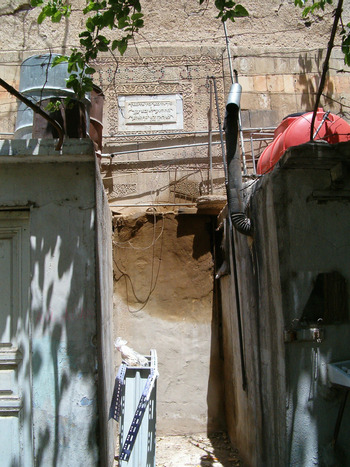
Refugees were already in the Old City and the Jewish Quarter but in temporary shelters—schools and mosques—that were not practical for what was turning into a protracted exile. The wall on the southern border of the Jewish Quarter separated it from the fields that lay outside. Impoverished refugees who could not find accommodations in mosques or schools were living in these fields in tents. In the early 1950s, the government passed a law allowing the state to expropriate the abandoned property and assets of absentee Syrian Jews who fled Syria for Israel in the wake of the Arab-Israeli conflict.Footnote 44 Several courtyard houses had stood empty for years became the property of the state, which in turn leased rooms to Palestinian refugees at a subsidized rate (Fig. 1). Many of the Palestinians who moved to these houses were the ones staying in schools and mosques and could afford the rent. The government also opened these houses for the refugees displaced from the flooded Tekkiye Mosque. UNRWA facilitated the process of relocation, keeping records of the refugee families and providing services in coordination with the government, but the properties were managed by the Syrian state. The design of the Damascene courtyard house with numerous rooms surrounding an open interior space was convenient for lodging several families in a building typically intended for single-family use. The size of the room was proportional to the size of the family and served as its own personal space, whereas the courtyard and any amenities that existed in the house were shared areas. The result was massive congestion in the courtyard houses as several families and dozens of individuals crowded into one building. It was to ease this congestion and to house the refugees that still lived in tents outside the Jewish Quarter that the state constructed Yarmouk Camp in 1957.
A Jewish courtyard house accommodating Palestinian refugees (photo by the author).

Thus, several events converged during the early 1950s to allow a Palestinian community to form in the Jewish Quarter. Yet, it was not only this series of random and deliberate acts by officials that led Palestinians to concentrate in this particular area. There were political motivations as well. As a young child Abu Fadi fled Haifa with his family, and eventually they all came to live in the courtyard house in which I interviewed him in 2006. They were relocated to this house from a nearby school where they spent their early years in exile. He remained in the Jewish Quarter long after his siblings moved out. Over the span of five decades he developed a distinct perspective on the relocation. “They apposed gasoline and fire,” he said, to describe the volatility of housing Palestinians, expelled from their homes by Zionist Jews, next to Syrian Jews when the memory of 1948 was still raw.Footnote 45 He saw the arrangement as an attempt to exploit the tension between Palestinians and Jews to the benefit of the Syrian state. Other Palestinians I spoke with remained circumspect about their relations with Syrian Jews. They may have shared the same convictions or they may have been uninterested in what happened fifty years ago. Yet containment remains a defining feature of camps; they are spatial devices of power.Footnote 46 It may be surmised from Abu Fadi's assertion that by having refugees live in the Jewish Quarter the state was employing informal means to create an “otherness” of the Palestinians and contain them in a non-camp setting. The control and monitoring of the neighborhood was facilitated by the assumed mistrust each group had of the other.
By housing Palestinians in Jewish homes and next to Syrian Jews, the state juxtaposed the different degrees of belonging in the Syrian nation. Although the refugees were categorically outside the national body, the Syrian Jews were placed at the interstice of belonging and not belonging as a result of the Arab-Israeli conflict. The Jewish Quarter was already under heavy surveillance by the time Palestinians were resettled there. After 1948, Jews qualified as a contradictory category of citizen; they were considered Syrian, and they were assumed to accept, if not endorse, the notion of a Syrian nation. Yet their loyalty to the nation remained under scrutiny during the turbulent 1950s and 1960s, with more draconian measures imposed on Jews than on any other Syrian ethnic or religious group. Moreover, the regional geopolitical tensions continued to cast suspicion on this insider-outsider group. The state also mistrusted Palestinian refugees, for not only were they refugees, but they were non-Syrians with a separate national agenda that was not always aligned with the interests of the Syrian state. During the tense geopolitical climate of the decades after 1948, competing national agendas were not tolerated.Footnote 47 Therefore, it served the interests of the government to contain two problematic populations in one area.
There was, nonetheless, an important distinction between the two groups that should not be discounted and served to reinforce the refugee status of Palestinians. The Jews were Syrian citizens and the Palestinians were not. The experience of Palestinian refugees in the Old City was largely shaped by their legal status in Syria.Footnote 48 Within a decade of their arrival in Syria, they were granted residency, and legislative measures were enacted to allow them certain rights for the duration of their stays in the country. Despite widespread support for Palestinians, Law 260 precluded their becoming full-fledged citizens. Hence, the houses were not given or sold to Palestinian refugees; rather individual rooms were leased to them to remind them that their sojourns in Syria were temporary. Although the Palestinian presence in the Jewish Quarter was neither recognized as a camp by UNRWA or the Syrian government nor clearly demarcated as a distinct space from the rest of the city, it functioned much like a camp in that it contained Palestinians in a marginal district that was heavily monitored by the Syrian government. In the 1950s the center of political and social power was moving from the Old City westward to the new modern neighborhoods constructed outside the wall. The attempt to build a modern nation–state, by abandoning the traditional quarters, led to the marginalization of the historic urban core.
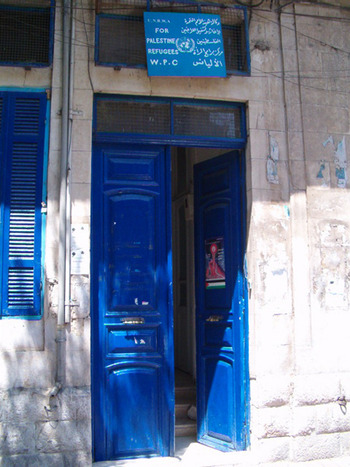
Until recently, the UNHCR considered urban refugees a challenge to both humanitarian agencies and host countries, especially when it came to the monitoring and control of refugees, delivery of services, and protection. Although the humanitarian agency's policy on urban refugees has evolved to accept the limits of refugee camps, concerns over the welfare of urban refugees remains, and with it the distinction between urban and camp refugees.Footnote 49 The UNHCR request for alternatives to the camp recognized the unique challenges faced by urban refugees. But the Jewish Quarter, through the efforts of both the government and UNRWA, functioned as a camp. The refugees’ daily needs in the neighborhood were provided for or subsidized by UNRWA (Fig. 2).
Entrance to the UNRWA Center in the Jewish Quarter (photo by the author).

One tangible aspect of being a Palestinian refugee in the Middle East is the UNRWA-issued rations card that allows the holder provisions and access to health care as well as other services accorded only to those officially registered with the agency. Unlike the rations distributed by UNRWA, the rooms in the courtyard houses were allocated to displaced families who could afford the monthly rent paid to the government agency in charge of absentee Jewish property. Several of the Palestinians I interviewed in 2006 were still paying rent to this agency.
The position of Palestinian refugees in the Jewish Quarter was unlike that of other ethnic or religious groups living in the Old City. As refugees they remained outside the national social hierarchy, unlike ethnic and religious minorities such as Jews, Armenians, and Shi‘a who also lived there and were incorporated into the national body. These ethnic and religious groups were recognized as important components of the social and cultural diversity in the historic quarter. Moreover, ethnic and religious districts in Middle Eastern cities tended to be named after the group living there, as for instance the Christian Quarter or the Armenian Quarter. The Old City area where Palestinians have lived for decades remains known as the Jewish Quarter though the number of Jews living there had dwindled to a handful by the early 2000s. Even with their permanent residency status, Palestinians were still considered transient migrants, and as refugees they did not warrant having an urban neighborhood named after them, especially one located in the historic city core.
Building A Community in Exile
The placard was difficult to miss for anyone walking into the UNRWA center, as it was fixed on the wall directly opposite the entrance. The sign stated that the purpose of the center was to serve the more than 16,000 registered refugees living in the Jewish Quarter. According to Samiya, this amounted to 600 to 700 families, but it was difficult to substantiate these figures as I had no access to the official records. Nonetheless, the circulation of these figures gave the Palestinians a sense that they constituted a critical mass in the Old City, hence Samiya's assertion that the quarter was “like a camp.” Others I spoke too agreed, because a Palestinian community, not unlike the ones typically associated with a camp, existed. Um Radwan described what it meant for her as a Palestinian to live in the Jewish Quarter:
During ʿīd [a religious holiday] you can smell Palestinian cookies in the neighborhood. The atmosphere is Palestinian, mā binasī ([it] does not allow one to forget [Palestine]). If there is a problem, we all get together. If someone dies the neighbor's house is open for mourners. There is ulfa (familiarity). The smell of cookies unites us.
She did not think Palestinian solidarity and community were less in the Old City than in the camp. Over the years the neighborhood became marked as a Palestinian space in a predominantly Syrian environment, sometimes in subtle ways that were only perceptible to the inhabitants, as in the aroma of Palestinian cookies. It was the daily practices of the members of the community that continued to reinforce the Palestinian presence in an urban space.
As it became a distinct Palestinian space within the Old City, the Jewish Quarter attracted Palestinians from other parts of the city and beyond. In 1969, Um ʿAli voluntarily moved from Shaghur, the predominately Sunni Muslim neighborhood west of the Jewish Quarter where she lived with her family for seventeen years, seeking more affordable accommodations and a Palestinian community. Moves such as these were always possible in Syria, and the government and UNRWA typically relocated the destitute among the refugees. Um Nadir moved to the Old City to be closer to her friend and neighbor Um Salma, who was sitting next to her during the interview. Um Salma, who remained mostly silent as Um Nadir did the talking, simply nodded. When it came to buying a home, Abu Adam could have moved outside the quarter but decided to remain. When I interviewed him in the apartment he eventually purchased, he told me the reason was the sense of community: “We look out for one another, we Palestinians. We get together Christian and Muslim. We live next to one another.” Although other Palestinians in the quarter moved out when their situations allowed them to, Abu Adam and Um Nadir preferred to remain close to friends and relatives. By gathering in the quarter, they were able to recreate some of the social bonds they lost as a result of their displacement from Palestine. They came from different towns and villages, and they had all left Palestine as children or young adults. What they had in common was the experience of exile, which they shared with the wider Palestinian community inside and outside of Syria. This experience of exile became a marker of the Palestinian national identity. On a more personal level, they felt at home when living in a contained Palestinian community.
Living in close proximity and sharing the same exilic experiences, the refugees engendered the “camp-society” in which spatialized social relations reinforced Palestinian identity and values in exile.Footnote 50 Through the “spatial practices” associated with living in a camp-like space Palestinian refugees were able to transgress the function of the camp as a device of power and construct a space for preserving a Palestinian community in exile.Footnote 51 The neighborhood was in this way inscribed with several layers of meaning, by the authorities, by humanitarian organizations, and by the refugees. Living in an urban neighborhood did not result in assimilation or dilution of the Palestinian identity. It did not erase memories of displacement and dispossession. As Margaret Rodman has noted: “Places are not inert containers. They are politicized, culturally relative, historically specific, local and multiple constructions.”Footnote 52 As such the Jewish Quarter was inscribed with multiple meanings to which the Palestinians added their own. The workings of the state with the assistance of UNRWA during the 1950s turned it into a space of containment for both refugees and the Jewish community. In this same space the Palestinians were able to forge communal ties and social solidarities that enriched their experiences of exile while maintaining their distinct national identity. It is between Henri Lefebvre's “representations of space,” or the planned space, and “representational spaces,” or the lived space, that Palestinians identify the camp as a “feeling inside” that they carry with them, whether or not they actually live in one, as a constant reminder of their exile and a talisman against forgetting.Footnote 53
Staying in the Old City
When the Yarmouk Camp was established, the government offered Palestinian refugees in the Old City the option to move there. The camp was built to ease the congestion of Palestinian refugees in the quarter and offer more durable housing for those still living in tents outside the wall. From the beginning it was conceptualized as an alternative to the city. Yarmouk was an atypical refugee camp as it was constructed almost a decade after the expulsion of Palestinians from Palestine, when the possibility of a return was becoming unlikely. Law 260 in 1956 indirectly acknowledged the permeance of the temporary Palestinian refugee situation; the establishment of the camp a year later was no coincidence. In light of these new realities, refugees were allowed permanent accommodations and could construct their own homes in Yarmouk. Nonetheless, several individuals I interviewed decided to remain in the Old City. Whereas some could not afford to build in Yarmouk, others clung to the dream of return. However, several Palestinians I interviewed also described logistical and practical considerations for remaining in the quarter. Abu Adam worked as a head clerk in a trading firm in Suq al-Hal outside the Old City and decided not to move to the camp because of his job. He woke up at half past three in the morning and walked approximately one mile in the dark to start his shift before daylight. It was inconvenient to move to the camp five miles from the city center at a time when transportation was unreliable. Both Um ʿAli and Um Qassim stayed in the Old City because their respective husbands also wanted to remain close to their jobs. In addition, some families stayed because of better educational opportunities for their children, who were allowed to enroll in Syrian universities. Since UNRWA provided services in the neighborhood there was no need to move to the camp to access these same services. Thus many refugees chose the city over the camp for practical reasons.
However, in the course of interviews with these individuals, as the discussion focused on how the camp had evolved over the years to become more accessible and a flourishing neighborhood, the practicality of living in the city began to give way to other compelling reasons. Housing costs remained a deterrent, but non-material considerations were emerging. Um ʿAli eventually revealed that her husband “did not like the camp” because “the camp is ͑ajqa (chaos).” She also added, “There is too much quarreling in the camp.” Um Qasim also described the camp as ͑ajqa, the true reason her family remained in the Old City all these years. The descriptor ͑ajqa was commonly used among interlocutors and others when talking of the camp, although it was not always clear if they meant Yarmouk or one of the other camps around Damascus. Um Radwan best described what this word meant when she said: “Life in the camp is not good. There are a hundred milla (people of different backgrounds) and hundreds of problems.” Um Khalil also believed only those who were living in tents, pitched outside the quarter, went to the camps. She implicated, although she did not elaborate on, the issue of class and status among Palestinian refugees in the spaces they inhabit in exile. There is a kernel of truth in her belief, as Yarmouk Camp was built to replace the tent camp still in existence several years after 1948, when the hope of a return had faded. Moreover, those who still lived in tents almost a decade after their initial displacement were the most destitute of the refugees and more in need of aid, and so more likely to be moved there. Living in tents meant these refugees could not exercise choice over where to live and remained entirely dependent on humanitarian organizations and the authorities to provide them with shelter. Um Khalil tactfully did not state outright that her ability to pay the small monthly rent for the rooms she lived in separated her from impoverished refugees, but it was certainly implied in whom she believed belonged in the camps.
Although I could not determine when these women developed their preference for the city, their conceptualization of the refugee camp, even one that loosely fit the description such as Yarmouk, was through their experience of the city. Although they were living in a marginal neighborhood in derelict buildings deliberately left unmaintained by the government agency that acted as the landlord, the urban neighborhood in the historic center was considered better than a camp, even Yarmouk, which regardless of its relative prosperity was still labeled as a camp. These women were concerned about the stigma attached to the space of the camp because of the chaos and the possibility of moral contamination from living in close proximity to people of different backgrounds. Ironically, they shared this same concern with officials who built refugee camps far from urban centers. Nevertheless, this perception did not negate the concept of the camp in the city, as they were able to distinguish between the symbolic camp, where Palestinian national identity and solidarity flourished, from the actual camp, where there was chaos. The camp was important for recognition of their plight as a displaced and dispossessed people, but it was the city that allowed for individual and moral aspirations. Although the camp was an important space for engendering a collective Palestinian identity, in everyday life it stigmatized those who lived in it and limited the possibility of social mobility. As Diana Allan noted in her work on Palestinians in a Lebanese refugee camp, Palestinian identity should not be transfixed by “national doxa” but by daily realities.Footnote 54 In the Jewish Quarter Palestinian refugees negotiated the camp-city binary for “emergent forms of subjectivity” that might “privilege individual aspirations over collective, nationalist imperatives.”Footnote 55
In 1977 Rosemary Sayigh noted that the blanket term “Arab refugee,” used at the time to designate the Palestinians, ignored the social hierarchies and sect differentials of pre-1948 Palestine that were not eliminated in exile.Footnote 56 Humanitarian organizations and authorities tend to reduce the socioeconomic distinction among refugees based on an assumption that to receive aid refugees should be “bare life,” stripped of their individuality, agency, and moral standing.Footnote 57 Um Khalil insisted on maintaining social distinction in exile by identifying with the city rather than the camp. According to her and the other women, the status of the urban refugee was higher than the camp refugee, even though their legal status was the same. The social distinction was important; Um Khalil wanted to underscore that not all refugees were of the same class and status still mattered in exile. Displacement and dispossession did not eliminate the differences between the rich and poor, the urban and rural of historic Palestine; the city-camp tension reconfigured these differences through the lens of moral contamination.
Moral contamination was the result of mixing people from different social classes, and also different nationalities. As a result, the refugee camp was “a place for banal cosmopolitanism” and this worried these women because it ascribed to them an inferior multiculturalism they did not seek or want.Footnote 58 Um Khalil saw the lower classes, whether Palestinians or Syrians, who were most likely to live in camps, as the source of contamination. Um ʿAli believed the mixing of people from different backgrounds had an undesirable impact on raising children in general and girls in particular. She described the daughter of the camp as qawiyya—in this instance, a derogatory expression for a headstrong and insolent girl—and believed that in the Old City “our children are different.” According to Um ʿAli, people in the neighborhood knew one another and as city dwellers were urbane, which meant their upbringing was “better than in the camp.” These women believed that in the city they exercised more control over the impact of the social environment on their children. The camp, as a space created by authorities and officials for the containment of refugees of different backgrounds, resulted in chaos that in turn limited the ways refugees were able to mitigate moral pollution. As in many societies, group morality hinges on the behavior of females, especially girls, the mothers of the future. For Palestinians the morality of women becomes politically charged, as they are the keepers of collective identity in exile. Perhaps this was why it was mostly the women I interviewed who expressed concern about the impact of the chaos of the actual camp on moral well-being. The morality of Palestinian women refugees in exile has been informed in the camps between the contradictions of the political national movement demanding freedom from traditional gender practices and the desire to maintain attachment to pre-1948 societal norms.Footnote 59 Living in the city allowed them to overcome these contradictions and having an address in the city, even in a marginalized neighborhood and paying rent, was preferred to one in a camp, even in Yarmouk, where many middle-class refugees owned a home.
Although the impact of the neighborhood on the upbringing of children also was a concern for Abu Fadi, he felt more strongly about the national struggle: “The child of the city is more politically aware than the child of the camp. The child of the camp remains limited in his experiences.” According to Abu Fadi, the city offered a sophisticated cosmopolitanism that allowed children to be more articulate in their speech and polished in their behavior. It was a common perception among many Syrians that the city refined the rough manners of rural migrants and disciplined their supposed village uncouthness. The cosmopolitanism of the city was superior to the banal worldliness of the camp. Abu Fadi did not suggest that the children of the camp were less politically aware or active, but that the children of the city were more moral in their political activity. He further suggested that “the son of the city is in constant confrontation with the Syrian,” and this interaction refined the art of altercation, resulting in better representatives for the Palestinian cause. He added that the city served to educate Palestinians about nationalism and empowered them to be effective political leaders. The city, Abu Fadi maintained, offered better educational opportunities than the camps. He was not only referring to schools or universities, but to life in a more diverse urban social environment, where one had to learn the art of negotiation and confrontation with individuals of different backgrounds, superior to the people who inhabited the camp. Accordingly the camp, where chaos reigned, bred children to use their brawn instead of their brains. He also challenged the common perception that camps were the birthplace of the revolution and named several individuals from the Jewish Quarter who became involved in the political struggle and went on to assume major leadership roles. Because urban refugees lived and labored under the legal designation of refugee in a non-refugee space, they negotiated more intensely and creatively than camp refugees the different registers of identity, collective and individual.
Conclusion
Although refugee camps are difficult to define, “arguments about what a camp is are also arguments about how to be a refugee.”Footnote 60 By conceptualizing the Palestinian community in the Old City in terms of a camp, these refugees are able to assert their Palestinian identity and insist that it has remained undiluted by life in the city, lived in close proximity to Syrians. Yet there are different ways to be an exile, and Palestinian urban refugees in the Old City of Damascus offer a new iteration on the theme of displacement and dispossession. The Palestinians quoted above demonstrate how refugees have always lived in the city without losing their collective identity or assimilating. Nevertheless, the symbolism of the camp remains essential in the national and personal narrative of exile. At the same time, refugees posit themselves as urban dwellers and assume the social privileges associated with dwelling in the city. In addition, although camp refugees are assumed to be “authentic” exiles, urban refugees in the Old City insist on their political membership in the wider Palestinian diaspora while aspiring for a better life, especially for their children. It is in the space between the city and the camp that these refugees are able to articulate both their personal aspirations and a national sense of belonging.
The Palestinian experience in the Old City offers another approach to understanding how urban refugees navigate exile. Many nation–states discourage refugees from living in urban areas, preferring to contain them in camps located at a safe distance from cities. Urban refugees incur mistrust and fears of the host government because their presence may exacerbate myriad urban problems, not limited to congestion, crime, and pollution. They are therefore considered “unwelcome guests.”Footnote 61 Cities also allow urban refugees anonymity and invisibility, making it easier to disappear among the throngs of urban masses or to fabricate new identities, so that they are more difficult for authorities to track and detect.Footnote 62 The Palestinian presence in the Jewish Quarter does not reflect the typical experience of urban refugees. Hyper-visible to both UNRWA and the Syrian government, they received the rights they were entitled to as refugees and lived under constant state surveillance. Their experience demonstrates that the state and humanitarian organizations can create an actual camp in the city and track and contain urban refugees. The relocation of Palestinian refugees to the Jewish Quarter was planned and executed by the host government and the humanitarian organization overseeing their well-being, and their presence in the city did not disrupt the local status quo. At the same time, refugees were able to create a distinct Palestinian space in a predominately Syrian environment, something considered more possible in a camp.
The city and the camp are never absolute oppositional spatial forms in the refugee experience. Neither the physical camp nor its abstract can be understood without its relation to the city: the city-camp interplay is relevant to the experiences of all refugees. Yet the camp in the refugee experience continues to dominate the work on the exilic experience of Palestinians and other refugees. In an article entitled “Plantation Futures,” McKittrick describes how the geography of slavery as embodied in the plantation continues to define the contemporary black experience in impoverished urban neighborhoods and the prison system. In many ways the same can be said of the refugee camp in the Palestinian experience; the concept of the camp can not be disregarded, even by refugees living in the city. For Palestinians, the camp remains central to their exilic narrative at both the collective and individual levels. To think beyond the plantation, McKittrick suggests, “What if the plantation offered us something else? What if its practices of racial segregation, economic exploitation, and sexual violence mapped not a normal way of life but a different way of life?”Footnote 63 The Jewish Quarter has offered Palestinian urban refugees a different way of life, allowing them latitude to conceptualize the camp beyond the meaning ascribed to it by the authorities and dominant Palestinian narratives of exile. They maintain their attachment to the camp as it allows them to inscribe their presence on a non-Palestinian space. They also have interpreted the camp-city binary to situate themselves as socially and morally superior to camp dwellers. The limits of this practice have been exposed by the current Syrian civil war, which prohibits Palestinians from conceiving of a different way of life either in the camp or in the city.
The ongoing war has highlighted the precariousness of Palestinian refugees caught in the quagmire of the Syrian conflict. Whereas some Palestinians remain staunch supporters of the regime and others have sided with the rebel forces, most have opted to remain neutral; it is not their war and their presence in Syria is contingent upon remaining good guests by not upsetting the delicate internal political dynamics. By insisting on remaining at the margins of the Syrian civil conflict, Palestinians hoped to escape some of the violence. Unfortunately, in the current political climate in Syria, this is not an option. The civil war underscores not only the limits of quasi-citizenship but also the limits of refuges. Yarmouk Camp was destroyed during a brutal battle between the pro- and anti-regime forces in 2012. Although it was not a typical refugee camp, but rather a vibrant suburb of Damascus where most inhabitants were Syrians—Palestinians comprised less than 20 percent of the population—Yarmouk never escaped its inception as a camp. Its strategic location and its association with refugees led to its siege early in the Syrian civil conflict. The war also has exacerbated the humanitarian crisis, as Palestinian refugees more than ever are dependent on aid from UNRWA at a time when funding for the agency is in jeopardy. As of this writing, the Old City has not been destroyed by the fighting, and it is safe to assume Palestinians continue to live in the Jewish Quarter. Perhaps some of the Palestinians expelled from Yarmouk Camp have found refuge in the city. During times of war, it is not unusual for urban refugees to be more secure in the city than refugees in camps. After all, in this state of exception, the city and not the camp is the first choice of refuge.
Acknowledgments
This research was funded principally by a research fellowship from the Palestinian American Research Center (PARC). I would like to thank the anonymous IJMES reviewers and journal editor Joel Gordon for their incisive observations regarding revisions of the article. During spring 2019, a residential fellowship with the Humanities Research Center at Virginia Commonwealth University allowed for time and space to think through some of the issues raised here with three other fellows, Winnie Chan, Ryan Smith, and Nicole Turner Smith. I am grateful for their careful reading of an earlier draft. Nell Gabiam also graciously read the earlier draft. Special mention goes to Nicole Turner Smith for introducing me to the scholarship of Katherine McKittrick. In fall 2019, parts of this manuscript were presented at the American Anthropological Association (AAA) Annual Meeting and the Southeast Regional Middle East and Islamic Studies Society (SERMEISS) fall meeting. My most deep and sincere gratitude goes to the Palestinians in Syria, especially those living in the Old City of Damascus, who made this research possible.