Sources
The principal sources of information on which this chronicle is based are British Broadcasting Corporation, Monitoring Global News line – Asia-Pacific Political and British Broadcasting Corporation, Monitoring Global News line – Asia-Pacific Economic. These sources, now only available electronically, do not have reference numbers and are only identifiable by date of publication of material. The inclusion of each of these dates would unnecessarily clutter the text and such dates have therefore been omitted, except, at many points, for the original sources from which the BBC reports themselves are taken.
Abbreviations
- XHNA
Xinhua (New China) News Agency
- CNA
Central News Agency (Taipei)
- RTHK
Radio-Television Hong Kong
- ZTS
Zhongguo tongxun she (China Reporting Agency), Hong Kong
- ZXS
Zhongguo xinwen she (China News Agency), Beijing
- RMRB
Renmin ribao (People's Daily)
- SCMP
South China Morning Post
- KCNA
Korean Central News Agency
1. Internal Developments
aThe Sixth Plenum of the 17th Central Committee
bParty and Political Affairs
cStanding Committee of the National People's Congress
dEconomic Affairs
eSocial and Cultural Affairs
fScience and Technology
gMilitary
hTibet and Xinjiang
iHong Kong and Macau SAR
2. Foreign Relations
aDiplomatic Tours
bCountries, Territories and Regions
cMultilateral Diplomacy
dClimate Change
eForeign Trade and Business
1. Internal Developments
a The Sixth Plenum of the 17th Central Committee
The Sixth Plenum of the 17th Central Committee was held in Beijing from 15 to 18 October. It was attended by 202 full and 163 alternate members of the Central Committee and presided over by General Secretary Hu Jintao. The theme of the meeting was the development of socialist culture in China, and the Plenum adopted a “Decision of the CPC Central Committee on Certain Questions about Deepening Reform of the Cultural System and Promoting the Great Development and Great Flourishing of a Socialist Culture” (full text in Chinese at http://news.xinhuanet.com/politics/2011-10/25/c_122197737.htm). General Secretary Hu Jintao made an important speech which was not published at the time but was later used as the basis of an article by him in the Party magazine Qiushi. He also delivered a work report on behalf of the Politburo. Li Changchun, the Politburo Member in charge of the propaganda system, introduced the draft Decision. The Plenum decided that the 18th Congress of the Chinese Communist Party would be held in the second half of 2012.
A People's Daily editorial on the Plenum described culture as the lifeblood of a nation and the spiritual homeland of the people. The new emphasis on culture was designed in part to fill the void left by the booming economy. It also noted that
the world today is in a period of great development, great change and great restructuring The exchange and mingling of all kinds of ideas and their mutual contentions are more frequent, the role and impact of culture in the competition over comprehensive national strength is more pronounced, the task of safeguarding national cultural security is more difficult, and the demand to boost the soft power of national culture and the international appeal of the Chinese culture is more urgent … The China of today has entered a crucial period of building a moderately well off society in an all-round way as well as a period of assault in deepening reform and opening up and in speeding up transformation of the pattern of economic growth. Increasingly, culture has become an important source of national cohesiveness and creativity, an important factor in the competition of comprehensive national strength, and an important support for economic and social development” (People's Daily, 18 Oct.).
b Party and Political Affairs
The Central Leading Group for Cultural Structural Reform held a plenary meeting on 25 November to study how best to implement the Decision of the Sixth Plenum. Liu Yunshan, Head of the Propaganda Department, and Liu Yandong, State Councillor and Politburo Member, both addressed the meeting (XHNA, 25 Nov.).
The Central Committee of the Party announced on 1 November the guidelines for the election of delegates to the forthcoming Party Congress in 2012. There would be 2,270 delegates from 40 electoral units, representing over 80 million Party members. In the elections, the number of candidates should be at least 15 per cent greater than the number of delegates to be chosen. The number of grassroots Party members should be increased to 32 per cent (up two points from the previous Congress) and officials and cadres should make up no more than 68 per cent of the total. Ten per cent should be workers, from both state-owned and private businesses. All delegates were required to “abide by and implement the Party constitution; carry out the Party's guidelines and policies; follow major principles of the CPC and socialist core values which mean serving the people, being law-abiding, industrious, honest and upright; set an example at work; and be in close touch with the public and honestly represent their opinions and demands” (XHNA, 1, 2 Nov.).
Seven provinces and autonomous regions were reported to have completed the elections for deputies to county and township People's Congresses (a further 13 provinces had either started or were about to start the process) by October. It was stated that the Electoral Law had been fully complied with and that over 90 per cent of the electorate had registered to vote. The national process will be completed in 2012, with elections in more than 2,000 counties and 30,000 townships (XHNA, 19 Oct.). The elections in Beijing took place on 8 November, and Xinhua reported that President Hu Jintao and other leaders had been out to cast their votes (XHNA, 8 Nov.). The Hong Kong press reported, less happily, that some of the independent candidates who had stood for election had been complaining of harassment by the authorities (SCMP website, 9 Nov.).
The PRC held a ceremony on 9 October to mark the 100th anniversary of the 10 October 1911 Revolution which overthrew the Qing Dynasty. Senior members of the leadership attended including former President Jiang Zemin, whose death had been rumoured earlier in the year. President Hu Jintao delivered a speech entitled “Patriotism is the soul of the Chinese nation and a powerful force mobilizing and uniting the whole nation to strive to revitalize China.” He described the event as “a thoroughly modern, national and democratic revolution” which had shaken the world and ushered in unprecedented social changes in China. He added that the history of the 100 years since the Revolution of 1911 showed that a correct path and a core force leading the Chinese people forward are key to the rejuvenation of the Chinese nation, saying that “the Chinese people eventually found them through painstaking efforts and enormous sacrifices.… The correct path is the path of socialism with Chinese characteristics, and the core force is the Communist Party of China.” Xinhua noted that “the revolution not only rid Chinese men of humiliating ponytails and women of the excruciatingly painful foot-binding, but also removed the people's blind faith in the emperor, as well as the fear of foreign powers. The event has since been emancipating people's minds from thousands of years of oppression and self-enclosure” (XHNA, 9 Oct.).
A shake up of China's regulators was announced on 29 October. Shang Fulin was appointed Chairman of China Banking Regulatory Commission, replacing Liu Mingkang. Guo Shuqing took over Shang's former post as Chairman of China Securities Regulatory Commission, and Xiang Junbo was appointed Chairman of China Insurance Regulatory Commission (XHNA, 29 Oct.). The State Council announced some mid-level appointments on 18 November. Li Jinzao was appointed Vice Minister of Commerce, and Jiang Zhigang was appointed deputy director of the State-owned Assets Supervision and Administration Commission (XHNA, 18 Nov.). Wang Xia was appointed Director of the National Population and Family Planning Commission by the NPC Standing Committee in December (XHNA, 31 Dec.). Li Fanrong was appointed CEO of the China National Offshore Oil Corporation on 24 November (XHNA, 24 Nov.). Zhu Xiaodan, aged 58, was named acting Governor of Guangdong on 4 November following the resignation of Huang Huahua (aged 65) (XHNA, 4 Nov.). Wang Sanyu, 59, was appointed Secretary of Gansu provincial Party Committee on 11 December, replacing Lu Hao. He was previously Governor of Anhui (XHNA, 11 Dec.).
The Party Committees of China's provinces began holding their five-yearly Party Congresses. After each Congress closed, a new leadership for the provincial Party Committees was elected. The following leaders were confirmed in their existing positions as provincial Party Secretary: Lu Zhangong (aged 59) in Henan (30 Oct.); Zhang Baoshan (aged 61) in Anhui (30 Oct.); Zhang Chunxian (aged 58) in Xinjiang (31 Oct.); Yuan Chunqing (aged 59) in Shanxi (1 Nov.); Luo Zhijun (aged 60) in Jiangsu (10 Nov.); Hu Chunhua (aged 48) in Inner Mongolia (14 Nov.); Chen Quanguo (aged 56) in Tibet (15 Nov.); Zhang Qingli (aged 60) in Hebei (18 Nov.); Zhou Qiang (aged 51) in Hunan (23 Nov.).
A steady trickle of high-level corruption cases continued to be reported in the media. Li Chengyun, a Deputy Governor of Sichuan province, was reported to have been dismissed following allegations of corruption. According to Taiwan media, he had been in charge of industry, science and technology, as well as of the defence sector in Sichuan. He had apparently been suspected of financial irregularities and of being too close to a Taiwanese woman suspected of being a spy (SCMP website, 1 Oct.). A Vice Governor of Shandong province, Huang Sheng, was removed from his post for “severe violation of discipline” on 1 December. A former Vice Chairman of the Zhejiang Provincial People's Congress Standing Committee, Zhang Jiameng, was put on trial on 1 December charged with taking 7.35 million yuan worth of bribes during the time he was Mayor of Zhoushan. He was sentenced to life imprisonment on 20 December (XHNA, 20 Dec.).
c Standing Committee of the National People's Congress
The 23rd session of the Standing Committee of the National People's Congress was held in Beijing from 24 to 29 October, presided over by Chairman Wu Bangguo. Its agenda included discussion of amendments to the Civil Procedure Law and draft laws or amendments on mental health, occupational health, military service and the promotion of clean production. It also considered a resolution on improving anti-terrorism work, government reports on affordable housing and environmental protection, and reports from the Supreme People's Court and the Supreme People's Procuratorate on promoting justice in the judicial system. The Session adopted amendments to the Military Service Law and the Resident Identity Card Law. The aim of the amendments to the Military Service Law was to promote the recruitment of more well educated young people into the armed forces, and to improve welfare provisions for service personnel. The amendments to the Resident Identity Card Law were intended to prevent counterfeiting and to better protect people's personal information. It also adopted a resolution on strengthening anti-terrorism work, the “Decision of the Standing Committee of the National People's Congress Regarding Strengthening Anti-terror Efforts.” The decision provided definitions of terrorist acts, organization and terrorists, and provided mechanisms for freezing the assets of terror-related groups and individuals (XHNA, 24, 29 Oct.).
The 24th Session of the NPC Standing Committee was held in Beijing between 26 and 31 December, with Chairman Wu Bangguo presiding over the meetings. The session adopted a decision on interpreting the annexes of the Basic Law of the Macau Special Administrative Region. The interpretation followed similar lines to that of the 2004 interpretation for the Hong Kong Basic Law and concerned the arrangements for the selection of the Chief Executive and formation of the Legislative Council. It was the first formal NPC interpretation of the Macau Basic Law. The session adopted amendments to the Law on Occupational Illness Prevention and Control. It decided that amendments to the Criminal Procedure Law should be debated at the full session of the NPC in March. It approved an agreement with Russia on co-operation in fighting terrorism, separatism and extremism, and ratified two treaties with Italy on extradition and mutual judicial assistance. It adopted a decision on holding the annual session of the NPC on 5 March 2012, and a report on the qualification of NPC delegates. The session debated a new draft law on entry and exit administration including provisions on the entry and employment of foreigners in China, and another new law on insurance for service men and women. It debated draft amendments to the Budgetary Law (XHNA, 26, 31 Dec.).
d Economic Affairs
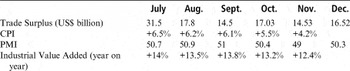
The Director of Economic Forecasting at the State Information Centre, Fan Jianping, said on 15 October that China's growth rate would ease to 9.4 per cent in 2011 and slow down further to 8.7 per cent in 2012 (see Table 1 for key economic indicators over the period). The Consumer Price Index would stand at 5.5 per cent for 2011 and would fall to 4 per cent in 2012 (XHNA, 15, Oct.). Overall economic growth showed a slight slowdown over the period (see Table 2).
Key Economic Indicators, 2011

Sources: XHNA, 15, 18 Oct., 9 Nov., 9 Dec. PMI: Bloomberg, China Customs Administration.
GDP Growth, 2011

Source: XHNA, 15, 18 Oct.
The People's Bank of China announced that it would be lowering the reserve requirement ratio by 50 basis points from 5 December. This was the first such cut in three years and it was intended to replenish liquidity in the banking system as fears over inflation eased (XHNA, 30 Nov.).
The annual Central Economic Work Conference was held in Beijing on 12 December to analyse the domestic and international economic situation and map out plans for 2012. In advance of the meeting the Politbureau met on 9 December and decided that China would maintain its prudent monetary policy and proactive fiscal policy next year, and make its macroeconomic regulation more targeted, flexible and forward looking. China would continue to balance efforts to “ensure stable and relatively fast economic growth, while adjusting the economic structure and regulating inflationary expectations” (XHNA, 12 Dec.). Speeches were made to the conference by President Hu Jintao and by Premier Wen Jiabao. The conference agreed on five main areas of concentration in the coming year:
1. Continue to strengthen and improve macro regulation and control to promote the steady and relatively fast development of the economy. Continue with a proactive fiscal policy and a prudent monetary policy.
2. Make unremitting efforts to successfully carry out work related to agriculture, rural areas and farmers, and improve China's capability in safeguarding the supply of agricultural products. A system of responsibility would be enforced whereby Governors were responsible for their provinces' “rice bags.”
3. Accelerate economic restructuring and promote the independent, co-ordinated development of the economy. It was necessary to boost domestic demand, consumer demand in particular.
4. Deepen reform of key areas and raise the level of opening up.
5. Vigorously safeguard and improve the people's livelihood and innovate in social management (XHNA, 14 Dec.).
The annual conference on rural work was held in Beijing, concluding on 28 December. Vice Premier Hui Liangyu said that agriculture was vital to ensure stable price levels, fast economic growth and social stability. Development had been continuous and comprehensive over the past year. In the coming year, the authorities would be concentrating on the effective supply of farm produce, fiscal spending on infrastructure building, and farmers' livelihoods. Grain output rose to 571.21 million tonnes, an increase of 4.5 per cent, but labour and input costs were rising and there was limited space to expand acreage. Premier Wen told the conference that next year would be hard as China faced complicated macroeconomic conditions. He urged that more measures be taken to protect farmers' rights in land properties (XHNA, 28 Dec.).
A Central Work Conference on Poverty Alleviation and Development was held in Beijing on 29 November. It was attended by President Hu Jintao who made a speech, and by other central leaders including Premier Wen Jiabao who also spoke. Vice Premier Li Keqiang chaired the meeting. President Hu said that:
China's poverty alleviation task has entered from a phase of solving food and clothing problems for the poor to a new phase of consolidating the results in solving food and clothing issues, speeding up poverty reduction, improving the ecological environment, strengthening development capabilities, and narrowing wealth gaps
He added that:
by 2020, the general objective of the in-depth advancement of poverty alleviation and development is: steadily solving food and clothing issues for the targets of poverty reduction and ensuring their access to compulsory education, basic medical care, and housing. The annual net income of farmers in poverty-stricken regions will be higher than the national average; the indexes of basic public provisions in key areas will also be near the national levels; and the current trend of a widening rich-poor gap will be reversed.
It was also announced that China was raising the threshold for the definition of poverty from 1,274 yuan to 2,300 yuan a year. This would mean that about 128 million people would be at or below the threshold and eligible for anti-poverty support. The new definition brings China's own definition closer to that of the World Bank which puts the threshold at US$1.5 a day (XHNA, 29 Nov.).
China published a White Paper on poverty reduction (http://news.xinhuanet.com/english2010/china/2011-11/16/c_131249948_7.htm) on 16 November. The paper noted that development-oriented poverty reduction would continue to be a long-term task for the Chinese government, which was extremely difficult to achieve in a country like China. The number of those defined as living in poverty in the rural areas fell from 94.22 million in 2000 to 26.88 million by the end of 2010, although as many as two thirds of those currently living in poverty had at one time managed to rise above the poverty line but had sunk back down again. The current poverty line in rural areas was defined as an income of less than 1,274 yuan (about US$200 a year), which is lower than the World Bank definition of US$1.25 a day (XHNA, 16 Nov.).
The State Council adopted a five-year plan on improving disaster relief on 8 December. According to the plan, survivors of disasters should be guaranteed access to food, water, clothes, medical aid and shelter within 24 hours. Some 2.75 million people would be trained in disaster rescue and relief to enable every rural and urban community to have at least one disaster information clerk. It was hoped to achieve an obvious decrease in the deaths caused by natural disasters over the period and keep the direct economic losses to less than 1.5 per cent of GDP. In the first ten months of 2011, 1,090 people were killed in natural disasters, and 480 million people affected by them (XHNA, 8 Dec.).
The authorities announced that the subway crash in Shanghai on 27 September had been caused by negligence and that 12 people had been disciplined in connection with the incident, including the chief dispatcher on the line involved. There had been a loss of power to the signal system and operators had failed to follow proper procedures. The signal system was the same as that involved in the Wenzhou crash and had been built by a Sino-French joint venture, CASCO. Normal service was resumed on 9 October (XHNA, 8 Oct.). The Ministry of Railways announced that it would be resuming operation of the high-speed trains suspended after the crash in July. A Ministry official said that problems with the trains had now been fixed, and trials would start on 16 November with full service being resumed if the trials were successful on 6 December (XHNA, 14 Nov.). The Ministry of Railways announced the full resumption of the high-speed train service between Beijing and Shanghai from 12 December (XHNA, 1 Dec.). The Chinese government finished its investigation into the July train crash in December, and was said to be gathering and sorting out the results into a report (XHNA, 6 Dec.). It was reported that 54 individuals, including the former Minister of Railways, Liu Zhijun, and its chief engineer, Zhang Shuguang, would face disciplinary punishment over the Wenzhou rail crash. The final report into the incident suggested that the crash was caused by flaws in the train operation control system and an inadequate emergency response by the railway authorities (XHNA, 28 Dec.).
e Social and Cultural Affairs
The village of Wukan in Guangdong became an international cause célèbre when villagers staged prolonged protests against the behaviour of local authorities. The protests began on 21 and 22 September when the local government rejected petitions by local people against the requisition of farmland. They were also enraged by issues relating to the election of unpopular local officials. Two months later, several thousand villagers took to the streets accusing the local government of failing to follow through on promises it had made in September (SCMP website, 7 Dec.). On 11 December, Xue Jinbo, who had been one of the leaders of the protests, died in police custody. The authorities stated that the cause of death was cardiac arrest. He and two others had been detained on 9 December on suspicion of damaging public property, and had apparently admitted his guilt under interrogation. Rumours immediately began to spread that he had been beaten to death. In a press statement on 9 December, the Shanwei city government claimed that it had settled some of the issues that led to the September riots (XHNA, 14 Dec.). In the face of continued protests, the authorities tried to cut off the village, following further demonstrations when the villagers sought the return of the body of Xue Jinbo and called for democratic elections (SCMP, 19 Dec.). A special task force was sent to the area by the Guangdong provincial authorities, led by provincial deputy Party Secretary Zhu Mingguo. Following discussions, the village leader, Lin Zuluan, said that the protestors had agreed not to march on Lufeng City government headquarters provided that the government recognize the legal status of the village's temporary ruling committee, release three young villagers who had been arrested, and release the body of Xue Jinbo (SCMP website, 20 Dec.). Eventually Zhu accepted that the villagers' main request were reasonable and promised a fair and open investigation into their grievances. At a later provincial meeting he acknowledged that “we are facing new challenges as ideas of democracy, equality and rights are taking root among the public … We need to resolve people's immediate interests in a timely manner … we need to improve the conflict resolution mechanism to provide channels for people freely to express their concerns” (XHNA, 27 Dec.). Provincial official subsequently announced that the elections against which the villagers were protesting had been invalid and that another election would be held soon (XHNA, 28 Dec.).
The Chinese authorities made a number of changes to the central mechanisms for dealing with “social management” to improve their functioning and to take account of the changes in Chinese society. The Central Committee for Comprehensive Management of Public Security was renamed the Central Committee for Comprehensive Social Management in September, and was considerably expanded with 51 subordinate departments (11 more than previously). The new body would address major issues which threatened social harmony and stability, and enact new laws and regulations for social management (XHNA, 8 Oct.).
A huge scandal erupted across China, and in particular through the new media, over the shocking incident in which a two-year-old child was run over, twice, in a market street in Foshan on 13 October. Neither van driver stopped, and surveillance video which was widely relayed showed that she was completely ignored for several minutes by passers-by, until eventually she was carried out of harm's way by an old woman rubbish collector who alerted her mother. The child, Wang Yueyue, died of her injuries in hospital on 21 October. There was much discussion of morality and the state we now find ourselves in, not only in China but elsewhere in world, as a result of the incident, and of the general unwillingness of people to help others. Even the official Xinhua acknowledged that the incident had left many people to wonder if China's rapid economic development had had an effect on the ethics and morality of the general public. The Party Secretary of Guangdong, Wang Yang, told a meeting on the issue that it should be a “wake up” call for society and that such incidents should not be allowed to happen again. “We should look into the ugliness in ourselves with a dagger of conscience and bite the soul searching bullet,” he said (XHNA, 21 Oct.).
China issued a White Paper on the “Socialist System of Law with Chinese Characteristics) on 27 October (text in XHNA, 27 Oct.). It described how a socialist legal system with Chinese characteristics was now firmly in place. By 2011 China had enacted 240 laws, 706 administrative regulations and 8,600 local regulations. The Paper concluded that:
The vitality of laws lies in their enforcement. The formation of the socialist system of laws with Chinese characteristics has generally solved the basic problem of having laws for people to follow. Now, the problem of ensuring that laws are observed and strictly enforced and that lawbreakers are prosecuted has become more pronounced and pressing. Therefore, China will take active and effective steps to guarantee the effective enforcement of the Constitution and laws, and accelerate the advance of the rule of law and the building of a socialist country under the rule of law.
The paper was arranged in four main chapters:
Foreword;
I. Establishment of the Socialist System of Laws with Chinese Characteristics;
II. Composition of the Socialist System of Laws with Chinese Characteristics;
III. Features of the Socialist System of Laws with Chinese Characteristics;
IV. Improvement of the Socialist System of Laws with Chinese Characteristics;
Concluding Remarks.
The authorities continued their harassment of the dissident artist Ai Weiwei, facing him with a very substantial tax demand. The Beijing tax authorities summoned his wife on 28 October (the day she was due to attend the opening of an exhibition of Ai's work in Taiwan) and later notified her that the company, Fake Cultural Development, owed 15.22 million yuan in back taxes and penalties (SCMP website, 4 Nov.). When the news got out in China, thousands of his supporters found ways to lend him money to help with the demands. By 8 November, some 17,600 supporters had offered 4.7 million yuan. Ai described it as a vote of defiance in the face of government persecution (SCMP website, 8 Nov.). Ai later claimed that he had been coerced into depositing 8.45 million yuan into a bank account as a guarantee before he could take forward an administrative review into the tax authorities demand for 15 million yuan in back taxes and penalties (SCMP website, 15 Nov.). A few days later, he revealed that he was also being investigated by police over a series of allegedly pornographic photographs posted on the internet some time before (SCMP website, 19 Nov.).
Supporters of the blind legal activist, Chen Guangcheng, were prevented from visiting him at home in Shandong where he has been confined by the authorities (SCMP website, 13 Nov.). On 16 December a Beijing court withdrew the probation that had been granted to the dissident lawyer Gao Zhisheng and returned him to jail for three years. He had originally been sentenced for inciting the overthrow of state power in 2006 (XHNA, 16 Dec.). The decision came right at the end of his probation term which had originally been for five years, and he was said to have violated his probation rules a number of times. His family fled to the United States in January 2009, and he disappeared shortly afterwards, reappearing briefly in March 2010, and presumed to have been under some form of detention. Chen Wei, a former student leader during the 1989 protests, was jailed for nine years in Sichuan for inciting subversion. The prosecution claimed that he had published inflammatory articles critical of the government of overseas websites. He had previously been imprisoned in 1989 and again in 1992 (SCMP website, 20 Dec.).
f Science and Technology
On 3 November China successfully completed an unmanned docking between two spacecraft, which was described as crossing a critical threshold in outer space adventure. China also announced that following the successful mission, it would be completing the second phase of its three-step development strategy with the establishment of its own space lab in 2016. A manned space station is planned for 2020 (XHNA, 3 Nov.). China issued a White Paper on the development of its space industry on 29 December (text in XHNA, 29 Dec.). The paper was entitled “China's Space Activities in 2011.” It was the third White Paper on the subject, the previous two being issued in 2000 and 2006. During the next five years, the Paper said, China would launch the Shenzhou-9 and Shenzhou-10 spaceships and achieve unmanned or manned rendezvous and docking with the in-orbit Tiangong-1 vehicle. In addition, China would launch space laboratories, manned spaceship and space freighters, make breakthroughs in and master space station key technologies, including astronauts' medium-term stay, regenerative life support and propellant refuelling. It would conduct studies on the preliminary plan for a human lunar landing. China would launch orbiters for lunar soft landing, roving and surveying to implement the second stage of lunar exploration in next five years (the three steps being orbiting, landing and returning). The White paper reiterated that China would continue to use outer space for peaceful purposes only. The paper was divided into five main sections:
Preface;
I. Purposes and Principles of Development;
II. Progress Made Since 2006;
III. Major Tasks for the Next Five Years;
IV. Development Policies and Measures;
V. International Exchanges and Co-operation.
g Military
The PLA was reported to have established a strategic planning department, affiliated to the PLA General Staff Headquarters. It would be responsible for studying key strategic issues, drawing out development and planning for the military's growth, and raising proposals on the general allocation and macro control of the military's strategic resources. It would also be in charge of checking and evaluating the implementation of the military's development plan (XHNA, 22 Nov.). A Military Training Department under the PLA General Staff Department was formally established on 21 December. Its establishment was described as a historic overhaul for military training in the PLA. It would oversee the management of military training for all branches of the services (XHNA, 21 Dec.).
China's refitted aircraft carrier, the former Varyag, started its second sea trial on 29 November (XHNA, 29 Nov.). The Ministry of Defence spokesman said on 28 December that the Chinese aircraft carrier was undergoing scientific testing as follow up to its sea trials. He denied reports that Russia had refused to supply aircraft arrester wires, but said that the main equipment on the carrier, including arrester wires, had been developed and converted by China independently (XHNA, 28 Dec.).
China's representative on disarmament, Wang Qun, called for the international community to develop a viable long-term plan to reach the goal of complete and thorough nuclear disarmament, including the negotiation of a convention on the complete prohibition of nuclear weapons, and a Fissile Material Cut-off Treaty. He noted that China was a co-sponsor, along with Russia, Tajikistan and Uzbekistan, of an “International Code of Conduct on Information Security,” and called for open and democratic deliberations on the code, with the object of reaching an early consensus so as to safeguard the interests of all parties and endure that information and cyber space would be used the better to promote international peace and security. He also called for the negotiation of an Arms Trade Treaty (XHNA, 7 Oct.). On 20 October, Wang Qun called on the international community to work together towards a peaceful secure and equitable information and cyber space. He put forward five principles: of peace, sovereignty, balance between freedom and security in information flow, co-operation and equitable development for handling issues (XHNA, 20 Oct.).
Wang Qun said on 17 October in Geneva that China remained firmly opposed to the weaponization of outer space. China had been a co-sponsor of the UNGA resolution on the Prevention of an Arms Race in Outer Space, and China and Russia had jointly submitted to the Committee on Disarmament a draft treaty on the Prevention of the Placement of Weapons in Outer Space in 2009. He said China wanted to see discussion on the treaty as soon as possible, and in the meantime attached importance to outer space transparency and confidence-building measures (XHNA, 17 Oct.).
Two Chinese warships, on their way home from the ninth Chinese detachment to the Gulf of Aden paid formal ship visits to Kuwait and Oman in early December (XHNA, 4 Dec.). They stopped over in Singapore on 18 December for resupply and to have exchanges with the Singaporeans on anti-piracy work (XHNA, 18 Dec.). A Chinese naval hospital vessel, the Peace Ark, visited Latin America and the Caribbean to provide medical treatment and operations for local people. It set sail from Zhoushan on 16 September and visited Cuba, Jamaica, Trinidad and Tobago, and Costa Rica (XHNA, 30 Nov.).
The Minister of Defence, Liang Guanglie, visited Seychelles from 1 to 4 December. China announced on 12 December that its navy might seek supplies or recuperate at Seychelles ports as necessary during escort missions. The Ministry of Defence played down the idea that this amounted to the establishment of a Chinese naval base in the region. It described the arrangement as normal international practice, and pointed out Chinese naval vessels had used facilities in Djibouti, Oman and Aden to take on supplies (XHNA, 12 Dec.).
China announced that the PLA navy would be undertaking routine training exercises in the western Pacific in late November. The Ministry of Defence said that the exercises were in accordance with international law and not directed against any other party. He added that China's lawful rights include passage through relevant waters, and should not be hindered (XHNA, 23 Nov.). Some saw this as a response to recent US moves to strengthen its position in the region, and one Chinese commentator was quoted as saying: “a military drill is never a simple act as it hides so many reasons and aims, with the key target being to show our navy's muscle to the outside world and that we are capable of defending our territorial sovereignty in the South China Sea as well as other areas” (SCMP website, 24 Nov.).
h Tibet and Xinjiang
It was reported that the South African government had apparently bowed to Chinese pressure and delayed issuing a visa to the Dalai Lama who had been invited to attend Archbishop Desmond Tutu's birthday celebrations in October. The South African government stated that it had never refused a visa for the Dalai Lama, but he nonetheless cancelled his trip saying that he did not wish to cause South Africa any inconvenience. Archbishop Tutu was reported to be furious with the behaviour of the government describing it as “disgraceful” and “worse than the apartheid government.” He pointed out that when the Dalai Lama had been denied a visa in 2009 because of the World Cup, a government minister had said publicly that he could come at any other time (Business Day website, South Africa, 5 Oct.).
Another Tibetan was injured after setting himself on fire on 3 October, in Aba County, Sichuan. He was reported to have suffered slight burns on his leg (XHNA, 3 Oct.). The Ministry of Foreign Affairs spokesman said on 11 October that religious activities in south-western Sichuan remained normal despite the series of incidents in which local monks had set themselves on fire. He claimed that the “Dalai Lama clique” had not only failed to condemn these actions but had actually played them up and spread rumours to encourage more. He said this was a disguised form of violence and terrorism (XHNA, 11 Oct.). A former monk from the Gulden Temple set himself on fire on 15 October, in the marketplace of Aba County. He was rushed to hospital. The President of the Sichuan Buddhist Association was quoted by Chinese sources as saying that these self-immolation incidents had aroused disgust amongst the local people who were calling for vigilance against such religious extremism (ZXS, 15 Oct.). Xinhua quoted local religious affairs officials as claiming that the recent spate of self-immolations showed signs of having been instigated by “a clique jockeying for power in the overseas Tibetan community under the Dalai Lama.” All those involved had been associated with the Kirti monastery, the former living Buddha of which had once been a close aide to the Dalai Lama but had left the post some years ago resulting in a loss of influence for his group. They were now trying to regain influence through these acts (XHNA, 18 Oct.). A young nun, Tenzin Wangmo, burnt herself to death on 17 October near her nunnery, bringing the number of self-immolations in the Aba area to ten in the course of 2011. She was reported to have shouted slogans calling for the return of the Dalai Lama and for religious freedom as she burned. The previous day, Chinese security personnel were alleged to have shot two Tibetans engaged in protest outside a police station in Sichuan. The Chinese Foreign Ministry spokesman said that “some overseas media and some organizations have been playing up the issue” and said that the reports of police firing on protestors were merely rumours (SCMP website, 19 Oct.). On 3 November there was another incident in which a Tibetan nun, Qiu Xiang, died after setting herself on fire in Dawu County in the Garze Tibetan Prefecture in Sichuan. Xinhua reported that an investigation into her death was underway. Initial police investigations apparently quickly established that “the case was masterminded and instigated by the Dalai Lama clique, who had plotted a chain of self-immolations in the past months for splitting motives” (XHNA, 3 Nov.). A Tibetan farmer, Tenzin Phuntsog, from the village of Jintong in Qamdo County in Tibet, set himself on fire on 2 December. Xinhua said that he was a farmer who had been accused of illegally cutting down public trees, and that he was widely considered an eccentric. According to the South China Morning Post, he was also a former monk at the Karma monastery in the region where there had been reports of an explosion in October (XHNA, SCMP website, 2, 3 Dec.).
The Tibet Buddhist Theological Institute was opened in Tibet on 20 October. It was described as Tibet's only regional level theological academy, and its opening was attended by 600 people including government officials and Buddhist delegates. It had a first intake of 150 students to study Exoteric Buddhism, Esoteric Buddhism and a special course for living Buddhas (XHNA, 20 Oct.).
The Chinese government announced that an agreement had been signed between the Tibetan government and the national Tourism Administration to help Tibet become a major world tourist destination. There would be more direct flights into Lhasa from Chinese cities and elsewhere, and the Tourism Administration would launch a major promotional campaign (XHNA, 20 Oct.). The authorities in Tibet announced that the number of impoverished farmers, taking the poverty line as annual income of 1,300 yuan, had been reduced from 1.48 million in 2001 to 168,000 by the end of 2010. As a result of poverty alleviation measures, the average per capita income of farmers had risen from 1,404 yuan in 2001 to 4,138 in 2010 (XHNA, 8 Dec.). The Tibetan authorities announced that pensions and medical insurance policies would be offered to all monks and nuns in Tibet. All registered clergy over 18 could apply for the benefits (XHNA, 24 Nov.).
The State Council announced more support for the development of two economic development zones in Xinjiang – the Kashgar and Korgas Economic Development Zones – which would get new fiscal subsidies and tax preferences. The cities of Kashgar and Yining would also be developed as regional hubs for China's opening up to central, southern and western Asia and to Eastern Europe. The central government would also invest in the building of a China–Kyrgyzstan–Uzbekistan Railway and a China–Pakistan Railway (XHNA, 8 Oct.).
i Hong Kong and Macau SARs
The Foreign Ministry Commissioner in Hong Kong, Lu Xinhua, told reporters that he had repeatedly asked the US Consul General in Hong Kong not to make critical comments about the city's internal affairs. On 16 December he said that “it would be inappropriate for foreign consulates to comment on any issue concerning Hong Kong's elections. This is what we strongly oppose.” His office expressed strong dissatisfaction with “meddlesome remarks” he had made about the district council elections and the forthcoming election of the Chief Executive. The US Consulate General responded that “We categorically reject any assertion that the behaviour of US diplomatic and consular staff in Hong Kong has been anything other than appropriate.” The British Consulate General also made it clear that it considered that the discussion of political and economic issues was part of the regular duties of consular staff (SCMP website, 17 Dec.).
The Chief Executives of Hong Kong and of Macau visited Beijing in late December for regular annual consultations with the central leadership. They were received by Premier Wen Jiabao and by President Hu Jintao. Premier Wen expressed his appreciation of the work done by both governments over the year, and President Hu pronounced the overall situation in both regions to be good and urged them to ensure future prosperity and seek benefits for their citizens (XHNA, 26 Dec.).
The Hong Kong government refused a visa to the 16-year-old grandson of Kim Jong-il, Kim Han-sol, who had been seeking to enrol in the Li Po Chun United World College. The Department of Immigration refused to comment on the case (SCMP, 6 Oct.). A visa was also refused to Yang Jianli, a US-based Chinese dissident who had been hoping to attend an event organized by the Civic Party to commemorate the 1911 Revolution. He had been denied entry twice before in 2008 and 2009 (SCMP, 10 Oct.).
2. Foreign relations
a Diplomatic Tours
Jia Qinglin, Chairman of the Chinese People's Political Consultative Conference, visited Greece, the Netherlands and Germany from 23 October to 4 November (XHNA, 17 Oct.). A Xinhua commentary on 24 October noted that Jia would be reiterating China's confidence in Europe's ability to cure its financial malaise and restating China's willingness to assist in dealing with the challenge. The commentary said that the key to fixing Europe's problems lay in the hands of the European countries themselves, and that fundamental reforms were needed. As a friend and an indispensable trading partner of the EU, China always had a helping hand available, rolling out concrete programmes to boost China–EU economic and financial co-operation. Keeping the edifice of the EU economy in good shape served the interests of the whole world. It would buoy up investor confidence and thus propel forward world economic recovery and growth. China would live up to its promised role as a responsible heavyweight player on the world stage and a staunch promoter of world peace and common development (XHNA, 24 Oct.). While in Greece, he said that the Greek government had provided unswerving support to China on issues of major concern, and that he believed that the Greek people could work with their government to get over their current economic difficulties. He said that Chinese investment in Greece had risen to US$500 million, and that trade in 2010 had risen 18.4 per cent to US$4.35 billion (XHNA, 24 Oct.). In the Netherlands, he said that the Netherlands should continue to respect China's core interests and major concerns in order to contribute to the long-term and steady development of the relationship (XHNA, 27 Oct.).
President Hu Jintao paid a state visit to Austria from 30 October to 2 November on his way to the G20 Summit in Nice. He had talks with President Heinz Fischer, Chancellor Werner Faymann, and the Speaker Barbara Prammer. Seven framework agreements were signed in economics and trade, environmental protection, water conservancy, education and culture. Bilateral trade between China and Austria reached US$6.1 billion in 2010, and was up 18.4 per cent in the first eight months of 2011 (XHNA, 29 Oct.). In his meeting with Chancellor Faymann, President Hu put forward a three-point proposal for improving relations: a) to further promote co-operation and expand the volume of trade, doubling trade by 2015; b) to exploit their respective advantages to expand “green co-operation”; and c) to further tap their co-operative potential for future growth (XHNA, 31 Oct.). President Hu was reported to have told his hosts that China wanted to take the relationship to a new level and enhance the political relationship based on equality and mutual trust. He urged them to take a more active role in pushing for the EU's recognition of market economy status for China and lifting the restrictions on high-tech exports to China (XHNA, 20 Nov.).
Vice President Xi Jinping paid an official visit to Vietnam (20 to 22 December) and to Thailand (22 to 24 December). In Vietnam, he met Nguyen Phu Trong, General Secretary of the Communist Party and the Prime Minister Nguyen Tan Dung. He also had talks with Le Hong Anh, a member of the Politburo, and Vice President Nguyen Thi Doan. In these talks, Xi put forward a five-point proposal for promoting their comprehensive strategic partnership: a) strengthen strategic communications and enhance mutual political trust; b) enhance party-to-party exchanges; c) deepen practical co-operation and boost their bilateral trade to US$60 billion by 2015 (from US$30 billion in 2010); d) expand people-to-people exchanges including establishing Confucius Institutes in Vietnam; and e) enhance multilateral co-operation, including in economic co-operation in the Greater Mekong. They exchanged views on the South China Sea and agreed to implement the agreement on properly handling disputes that they had reached when the Vietnamese General Secretary visited China in October. After the talks the two sides signed agreements on economy and trade, health, press and other matters (XHNA, 21 Dec.). With the Prime Minister, Xi highlighted three areas for co-operation: a) better co-ordination of their economic development strategies, and push forward joint programmes in areas such as agriculture, fisheries, transport and energy; b) expand bilateral trade, and c) work on key construction projects such as infrastructure construction and the building of an economic and trade co-operation zone in Vietnam (XHNA, 23 Dec.).
In Thailand, Xi met Princess Maha Chakri Sirindhorn and the Prime Minister Yingluk Shinawatra. With the Thai Prime Minister, Xi noted that the two countries were good neighbours, friends, partners and relatives. He put forward a four-point proposal for developing the relationship: a) elevate their strategic co-operation to a higher level; b) enhance high-level exchanges; c) deepen practical co-operation and reach a trade volume of US$100 billion by 2015; promote co-operation in such areas as railway, finance, disaster reduction and prevention, maritime and military affairs, and law enforcement; and d) expand cultural exchanges. After the talks, agreements were signed on strengthening co-operation in economy and trade, financing, justice, disaster reduction and other areas (XHNA, 22 Dec.).
b Countries and Regions
Africa (Angola, Central Africa, Eritrea, Ethiopia, Seychelles, Somalia, South Sudan, Sudan)
China continued to defend its record in Africa strongly. The Chinese Foreign Ministry spokeswoman commented on allegations in the Japanese Economic News that Chinese investment in Africa would not help the long-term development of the region. She said that some countries did not have a comprehensive and accurate understanding of China's policy towards Africa, and the behaviour of some companies might have been generalized as the way all Chinese companies acted. She said any problems would be taken seriously and properly addressed. China was committed to developing mutually beneficial and win-win economic and trade relations with Africa (XHNA, 19 Oct.). China denied allegations that it had been buying up land in Africa to feed itself. The Foreign Ministry spokesman said that China always sought food self-sufficiency through its own output. It was not grabbing land in Africa but providing technical assistance to help develop agriculture there. He denied that China was in any way involved in “neo-colonialism” and said that China was an important strategic partner of Africa which had made great contributions to its development (XHNA, 8 Dec.). In advance of a Forum on China–Africa Co-operation (FOCAC), senior officials meeting in Hangzhou with Lu Shaye, Director General of the African Affairs Department of the Foreign Ministry, gave some facts and figures on China's growing involvement with Africa. He said that educational exchanges were developing rapidly. In 2010–11 China had provided 5,710 government scholarships to Africa fulfilling its commitment to provide 5,500 scholarships two years ahead of schedule. China had also opened 28 Confucius Institutes in 21 African countries. China had made its largest-ever donation of grain (worth 443.2 million yuan) to alleviate the famine in the Horn of Africa. Bilateral trade with Africa exceeded US$100 billion in 2010 and rose 29 per cent to US$79 billion in the first half of this year. Africa was now China's fourth largest investment destination. He noted that China and Africa had achieved progress in many fields, including debt cancellations, tariff exemptions, preferential loans, agriculture, education and clean energy. China was pushing forward on 100 clean-energy projects, and between 2009 and August 2001 China delivered 113 end-to-end projects, 137 batches of supplies and 13 cash donations, and launched 66 technical co-operation projects (XHNA, 23 Oct.).
Police in China and Angola broke up a criminal gang that had been involved in kidnapping Chinese women and forcing them into prostitution in Angola. Nineteen Chinese women were rescued in an operation on 25 October. Eleven suspects were caught in Angola and five in China. The women and the suspects were all transferred back to China (XHNA, 15 Nov.).
In the UN Security Council debate on Central Africa, the Chinese representative condemned the Lord's Resistance Army (LRA) for its attacks on government forces and violence against civilians. China demanded that the LRA lay down its weapons immediately and cease all violence and hostilities. He added that China welcomed the efforts by the African Union to form a strategy to deal with the LRA (XHNA, 14 Nov.).
China, along with Russia, abstained from the vote on UN Security Council resolution 2023 which had condemned Eritrea's provision of support to armed opposition groups in the Horn of Africa, including Al-Shabaab, and imposing sanctions on the country. China's permanent representative said that China supported solving African problems in African ways, through dialogue and negotiations. China hoped the African Union could play a positive role in this respect. China believed that sanctions, far from achieving expected results, could lead to further complications of the situation and affect the economic development and welfare of the country concerned (XHNA, 5 Dec.).
China provided two batches of emergency food aid to Ethiopia worth US$24 million to help combat the effects of the drought in the Horn of Africa. The first portion arrived on 22 October and the rest was scheduled to be delivered in November and December (XHNA, 22 Oct.).
The President of Seychelles, James Alix Michel, visited China for one day on 20 October. He had talks with Vice President Xi Jinping and they discussed co-operation in culture, education, public health and tourism (XHNA, 20 Oct.).
China's deputy representative to the UN said that a fundamental settlement of the Somali piracy issue hinged on the country's political stability, economic development and social tranquillity. Military action could do no more than mitigate the piracy problem. He called on the international community “to remain focused on the situation in Somalia, continue to adopt a holistic and multifaceted strategy to provide support to the country, tackle both the symptoms and root causes of the problem, and follow through on its commitments to provide assistance to Somalia.” He said that China had so far despatched ten naval escort missions to the region, escorting more than 4,228 vessels, and rescuing 46 vessels which were being attacked by pirates. China had also provided US$2.2 million to the African Union peace-keeping operations in Somalia (XHNA, 18 Nov.).
The Secretary General of Sudan's ruling party, the Sudan People's Liberation Movement, visited China in October and was received by Wang Jiarui, Head of the Party's International Liaison Department (XHNA, 20 Oct.). He also met Politburo Standing Committee member Li Changchun, who said that the Chinese Communist Party wanted to improve party-to-party co-operation on the basis of the four principles of party co-operation (XHNA, 21 Oct.). Foreign Minister Yang Jiechi had talks with the special envoy from South Sudan, Salva Kiir Mayardit, on 24 November. He said that China attached importance to friendly ties with South Sudan and wanted to increase exchanges in fields such as education and culture (XHNA, 25 Nov.). China's spokesman called for Sudan and South Sudan to find a friendly and rational way of solving their disputes after Sudan had announced that it was halting all South Sudan's oil exports through its territory. He said that China thought that it was crucially important for the governments of Sudan and South Sudan to keep normal oil production going (XHNA, 29 Nov.).
The Chinese Foreign Ministry spokesman said that China was concerned that oil negotiations between Sudan and South Sudan had stalled. China hoped that both sides could exercise calm and restraint and resolve disputes through consultations. He added that China's special envoy for African affairs, Liu Guijin, would visit the two countries shortly to promote talks between them (XHNA, 5 Dec.). Liu held talks first in Juba and said that China would be working with both parties to resolve differences and achieve cordial neighbourliness between the two countries as soon as possible. He noted that “South Sudan is a newly born state and preservation of peace, dealing with Sudan and developing cordial relations with it is in the interest of all concerned parties including South Sudan” (XHNA, 8 Dec.). Following talks in Khartoum, he issued a similar statement emphasizing the interest of both sides in preserving peace and stability. He said that China believed that the leaders of the two countries were capable of resolving the issues, although he expressed concern over the escalation of tension in the border areas, the failure to make any tangible progress in negotiations, and their differences over the oil issue (XHNA, 11 Dec.).
Americas (Bahamas)
The Chinese Foreign Minister, Yang Jiechi, visited the Bahamas in October and had talks with the Governor General, Arthur Foulkes, and the Prime Minister, Hubert Ingraham. He said that China hoped to deepen co-operation in the areas of finance, shipping, tourism, cultural exchange and education. China would encourage strong and reputable enterprises to invest in the Bahamas (XHNA, 22 Oct.).
Australasia (Fiji, New Zealand)
China and Fiji signed an economic and technical co-operation agreement on 22 December, thus strengthening ties with Fiji since the “political desertion from neighbours Australia and New Zealand.” The agreement includes a grant of 20 million yuan. Other agreements concluded included one for the construction of a hospital, and the delivery of a Chinese built multi-purpose cargo vessel. In recent years China has provided concessional loans to finance road upgrades, housing projects, and information technology upgrades, and has given leadership training. China is about to start taking deliveries of bauxite from a new mining site in 2012 (XHNA, 22 Dec.).
China opened a Consulate General in Christchurch on 2 December, with Tan Xiutian as the first Consul General (XHNA, 2 Dec.).
Central Asia (Kyrgyzstan, Turkmenistan)
The Chinese Foreign Ministry commented on the presidential election in Kyrgyzstan saying that China respected the people's choice and was pleased to see the stable situation in the country, its sustainable economic development and continuously improving standard of living. China would work with Kyrgyzstan to consolidate their traditional friendship and strengthen co-operation (XHNA, 20 Nov.).
President Gurbanguly Berdimuhamedov of Turkmenistan paid a state visit to China from 22 to 25 November. He had meetings with President Hu Jintao, Premier Wen Jiabao and Wu Bangguo, Chairman of the NPC Standing Committee. He also visited Guangdong, Hong Kong and Macau. Following the talks with President Hu, the two sides signed 14 agreements on natural gas supply, loans to purchase oil and gas equipment, internal affairs co-operation, police training co-operation, as well as anti-money laundering and anti-terrorism.
Europe (Denmark, Germany, Italy, Greece, Greenland, Poland, Serbia)
Foreign Minister Yang Jiechi visited Denmark in October, the first visit at this level for 11 years. He had talks on 19 October with the Danish Foreign Minister, Villy Sovendal, on deepening their comprehensive strategic partnership. Yang said that they should work together in energy, environmental protection, green economy, agriculture and food safety, and enhancing people-to-people exchanges. He also welcomed more Danish investment in China. He expressed the hope that Denmark would properly handle sensitive issues concerning China's core interests. Yang also met the Prime Minister Helle Thorning-Schmidt and gave a speech at Copenhagen University. In a press conference, Yang said that China supported European integration and believed that Europe would overcome its current difficulties. He said that China enjoyed unprecedented democratic rights and China was open to holding dialogues on human rights with other countries on the basis of mutual respect and equality (XHNA, 20 Oct.).
The Chinese Ambassador to Germany, Wu Hongbo, said that bilateral trade had totalled US$142.4 billion in 2010, and had reached US$127 billion in the first nine months of 2011. German investment in China now was US$18.03 billion while Chinese investment in Germany was only US$1.73 billion. Some 1,300 Chinese enterprises now had branches in Germany, and Huawei had established its European headquarters and R&D centre in Germany (XHNA, 22 Oct.). Foreign Minister Yang Jiechi visited Germany from 4 to 7 December to attend the Bonn Conference on Afghanistan and to take part in the Second Foreign Minister strategic dialogue with Germany. He met President Wulff on 6 December. He said that he hoped that Germany could play a more active role in advancing Sino-European economic and trade ties and countering trade protectionism. Both sides looked forward the Chinese Cultural Year in Germany in 2012 (XHNA, 6 Dec.). In his talks with the German Foreign Minister, Guido Westerwelle, Yang said that China had confidence in Europe and the Euro and would continue to support the EU's efforts to tackle the debt crisis. He added that China attached great importance to the EU's role in international affairs, and fully backed the European integration process. Yang also had talks with the German Chancellor, Angela Merkel (XHNA, 7 Dec.).
The Foreign Ministry spokesman refused to be drawn into comment on the changes of government in Italy and Greece. He said that China had noticed the relevant media reports and believed that changing governments should be considered as part of the internal affairs of the two countries. He went on to say that China hoped that the relevant countries, as well as the EU as a whole, would overcome their current difficulties and promote economic recovery and growth as soon as possible (XHNA, 14 Nov.).
The Prime Minister of Greenland, Kuupik Kleist, was interviewed by Xinhua on 4 November. He said that China was beginning to take an interest in Greenland: the number of Chinese visitors had increased in recent years, and Chinese companies were showing a rising interest in Greenland. The Greenland Minister for Minerals, Industry and Labour was going to visit China, and he looked forward to future co-operation with China (XHNA, 5 Nov.).
The Polish President, Bronislaw Komorowski, paid a state visit to China from 18 to 21 December, the first for 14 years. Bilateral trade was US$11.14 billion in 2010, a 23.8 per cent increase over the previous year. He began the visit in Shanghai and then travelled to Beijing for talks with Chinese leaders including President Hu Jintao. Following the talks, the two sides signed a joint statement taking their relationship to the level of strategic partnership (XHNA, 21 Dec.).
The Serbian Foreign Minister, Vuk Jeremic, visited Beijing for the Serbia China Joint Committee on Economic Co-operation. He described bilateral relations as excellent and noted that the timing was perfect for a dramatic increase in the depth, breadth and quality of their economic engagement (XHNA, 9 Oct.). China's permanent representative to the UN told the Security Council that China was gravely concerned about the situation in Northern Kosovo and called on all parties to take measures to ease the tension in the area and prevent the escalation of violence. He also called on the European Rule of Law Mission in Kosovo and the KFOR to play a constructive role in maintaining stability and security. He added that the sovereignty and territorial integrity of Serbia should be respected (XHNA, 29 Nov.).
European Union
The Chinese watched the unfolding of the eurozone crisis with rising disquiet, while continuing to express optimism about the European economy. The Foreign Ministry spokesman said on 13 October that China was confident about the European economy and backed European countries in tackling the global financial crisis. He said that China was naturally concerned as a major trading partner of Europe, and had provided assistance to the EU and to European countries. He also expressed concern about Chinese investments in Europe and called for Europe to take tangible action to protect Chinese assets (XHNA, 13 Oct.). China became the EU's largest trading partner in July when total trade exceeded €35.6 billion, an increase of 13.4 per cent (XHNA, 13 Oct.). The annual China–EU Summit meeting was scheduled to take place in Tianjin on 25 October, but was postponed at the last moment by the European side because of the crisis. The meeting had been expected to cover responses to the debt crisis, market access issues, and the start of negotiations over an investment protection agreement (SCMP website, 20 Oct.). In reporting the postponement, Xinhua noted that Premier Wen Jiabao had expressed his understanding of the decision and said that the eurozone debt crisis was not just closely related to the unstable recovery of the global economy against the backdrop of the international financial crisis, but was also a result of long-term accumulation of internal problems within the EU and the eurozone. He suggested that the EU undertake fundamental financial reforms in addition to emergency bail-out measures. He said that the most important thing now was to adopt decisive measures to prevent the crisis causing further turbulence. He said that China supported the EU's efforts to cope with the crisis, and stood ready to beef up its co-ordination and co-operation with the EU (XHNA, 21 Oct.). Catherine Ashton, the EU High Representative for Foreign Affairs and Security Policy continued with her visit to Beijing. She met the Minister of Defence, Liang Guanglie, on 24 October. Liang said that China and the EU had interacted well in defence security and co-operated successfully in escort operations off Somalia and in the Gulf of Aden. The Commissioner for Education, Culture, Multilingualism and Youth, Androulla Vassiliou, also met State Councillor Liu Yandong to discuss educational and cultural exchanges (XHNA, 24 Oct.).
Xinhua welcomed the package agreed by European leaders for dealing with the eurozone crisis on 27 October, although it warned that the details still needed ironing out and new rounds of haggling were to be expected. It noted that the international community needed to keep reminding Europe to shoulder its due responsibilities and take swift action. It said that the problems had been exacerbated by the global financial crisis but in essence they were the result of a long-term accumulation of internal mechanism problems within the EU. It suggested that the crisis had revealed deep-seated weaknesses in the EU, and that while the emergency measures might be able to alleviate the immediate crisis, a deep-seated reform of EU institutions was necessary. It also made it clear that in China's view it was unfair to expect China and other developing economies to shoulder the same burdens as those responsible for the crisis (XHNA, 27 Oct.). A further Xinhua commentary on the summit said that China and Europe were facing an historic opportunity for developing their co-operation which at once was the only way to overcome the obstacles facing them and a valuable way forward for their economic development. The restructuring of the Chinese economy and the Europe 2020 Strategy “offered broad prospects for the two sides to upgrade their bilateral co-operation.” The commentary noted that in the recent eurozone crisis, “China did not stand on the side-line and do nothing. Instead, it extended a helping hand promptly and provided assistance within its means. China sent an important message: “It supports the integration process of Europe, has faith in the Euro, believes that Europe will be able to overcome the Europe debt crisis, and is willing to step up co-operation with Europe.” But it also called on Europe to “unblock” the policy and institutional constraints on Chinese investment in Europe, and to deal with “obstacles and frictions” in markets, tariffs and technology which affected the flow of trade between the two sides. It also complained of the continuing European restrictions on high-technology exports, the ban on arms sales and failure to recognize China's market economy status (XHNA, 28 Oct.).
Premier Wen Jiabao and President Hu Jintao had telephone conversations respectively with Herman Van Rompuy, President of the European Commission, and with President Sarkozy of France. Premier Wen repeated his position that China was ready to “beef up co-ordination and co-operation with the EU to contribute to a global economic recovery,” but he refused to be drawn on any massive new commitment to the new European bail-out fund (XHNA, 27 Oct.). The head of the new fund, Klaus Regling, visited China on 28 and 29 October and then Japan, giving rise to considerable speculation that he had been directly seeking Chinese assistance. He tried to play down the speculation, describing the meetings he had had with Chinese financial officials as “regular consultations” rather than meetings with potential investors. Vice Minister of Finance, Zhu Guangyao, said after his meeting with Regling that China welcomed the consensus that the Europeans had reached but it had not yet decided if it would invest in the fund. Xinhua commented that the crisis could also be an opportunity for deeper co-operation between China and Europe, but that strategic vision was needed. Both sides should seek to lift barriers, and treat each other “from a reciprocal perspective.” This meant that the Europeans needed to reflect on problems such as the long delay in according China market economy status, and their persistent practice of protectionism in the name of fair trade which was “a clear sign of short sightedness” (XHNA, 28 Oct.).
China displayed growing irritation with the perceived unwillingness by the Europeans to treat it with proper fairness and respect, given the efforts it was making to support them. A Xinhua report of 2 November complained that China's willingness to help the EU out of its debt problems had become politicized as some Europeans feared that China would be seeking concessions on controversial political issues. The report said that this assumption reflected the EU's mistrust of its strategic partner. In fact, even without the debt crisis China would still have argued demanded that the EU abandon its obsolete mentality and “and take a more open-minded approach on issues of currency disputes, high-tech export restrictions, arms sales embargo and human rights censure.” What China was seeking was fairness and trust in return for the goodwill it was showing and the confidence it was expressing in the European economy. It claimed that the market economy status issue was being used by the EU as an invisible bargaining chip, and while it denied the status to China on technical grounds, it employed double standards in granting the status to other countries which also failed to meet the standards. China was not unduly worried by this but it continued to cast a shadow over the relationship and “to recognize China's status as early as possible could be viewed as a manifestation of the EU's strategic trust with China and its political sincerity, wisdom and vision to expand bilateral relations. Otherwise, the one-sided trust cannot persist” (XHNA, 2 Nov.). The Chinese Vice Finance Minister, Zhu Guangyao, said on 2 November on the eve of the G20 Summit that China had no concrete plans for investing in the European Financial Stability Facility (EFSF), pointing out that “the two new investment tools under the EFSF, namely to offer insurance and to offer special purpose investment vehicle, have not been fully established yet, thus it is too early to talk about China's investment.” He also noted that the Greek decision to put the bailout package to a referendum had been unexpected, and said that China would respect the independent decision taken by Greece. Nonetheless, China hoped that the uncertainty would be reduced as much as possible so as to help stabilize the market and restore investor confidence (XHNA, 2 Nov.).
Hua Chunying, a Counsellor in the Department of European Affairs at the Ministry of Foreign Affairs, told a conference that the arms embargo and market economy status issues were symbols of political prejudice and inequality, and that if China–EU relations were to be further developed then real trust needed to be built up and the Cold War mentality ditched. Early resolution of these two issues might be a small step towards resolving many issues in the overall relationship, and would be a major and significant step towards building real political trust. A PLA representative said that China's wish to resolve the arms embargo issue was driven mainly by political reasons and that China was not seeking to buy more advanced weapons from Europe (XHNA, 29 Nov.). Vice Foreign Minister, Fu Ying told the Lanting forum that China could not use its foreign exchange reserves to rescue Europe. That was not how reserves were managed. But she added that China had not been absent from international efforts to support Europe and had despatched more than 30 procurement missions there since the crisis started. She also urged the Europeans not to politicize China's investment in Europe: “Successful investment should be reciprocal. We hope our economic activities are not interpreted from a political perspective and are not imbued with political interests. We should follow market economy principles.” She added that Europe should show sincerity in overcoming obstacles to the relationship, notably the arms embargo and market economy status (XHNA, 2 Dec.). The Foreign Ministry spokesman welcomed the agreement on a new fiscal compact at the EU summit in Brussels, following Britain's opt out of any treaty change. He said that: “We hope relevant measures can help stabilize the market, boost confidence in the market, stop the crisis from worsening, promote employment and economic growth, and push forward European integration.” He added that China was confident of Europe and the eurozone and believed that the EU had the ability and wisdom to solve its sovereign debt crisis (XHNA, 12 Dec.).
China expressed strong opposition to the EU's decision to impose a mandatory and unilateral carbon emission tax on airlines. The Foreign Ministry spokesman said that China had made its stand clear on the issue and expressed its concern to the EU. It hoped the EU would act with caution and settle the issue in a positive and pragmatic way through consultation with the relevant countries. Chinese airlines stated that they would file a lawsuit against the decision in Germany, despite the fact that the European Court had already turned down a legal challenge by Canada and the United States (XHNA, 22 Dec.).
The Foreign Ministry spokesman responded angrily to the comments by Catherine Ashton, Vice-President or the European Commission, on the case of Gao Zhisheng and her call for his release. He said that no country had the right to interfere in China's internal affairs and judicial sovereignty, and expressed the hope that the EU would proceed from the overall interests of Sino-European relations and make more positive contributions to promoting mutual trust and co-operation (XHNA, 23 Dec.).
Japan
The Japanese Foreign Minister, Koichiro Gemba, visited China on 23 November and met Premier Wen Jiabao, State Councillor Dai Bingguo and the Foreign Minister, Yang Jiechi. The visit was partly to prepare for the visit of the Prime Minister in December. The two sides also agreed to establish a crisis management mechanism to deal with incidents in the East China Sea (XHNA, and Kyodo News Agency, 23 Nov.). The 12th strategic dialogue was held between China and Japan in Beijing on 2 December, with the two sides led by Vice Foreign Minister Zhang Zhijun and his Japanese counterpart Sasae Kenichiro (XHNA, 2 Dec.). The Japanese Prime Minister, Yoshihiko Noda, paid an official visit to China from 25 to 26 December. He had talks with Premier Wen Jiabao and meetings with President Hu Jintao and Wu Bangguo, Chairman of the National People's Congress Standing Committee. According to Kyodo News Agency, the major focus of his talks with Premier Wen was maritime security and the aftermath of the death of Kim Jong Il (Kyoto News Service, 25 Dec.). Premier Wen said that China and Japan should be good neighbours and partners rather than opponents, and that peaceful coexistence was in the long-term interests of both sides and of the world more generally. The two sides reached wide consensus on bilateral relations in their talks. Premier Wen also said that China would be willing to work with Japan on using their respective currencies in settling cross-border transactions (XHNA, 25 Dec.).
The Japanese authorities detained a Chinese fishing boat and its crew in early November. But the incident was quickly resolved. The Chinese Foreign Ministry spokesman said on 8 November that it was “an ordinary fishing boat issue” and expressed the hope that the issue would be resolved as soon as possible. The Captain and his vessel were released on the payment of a fine (XHNA, 8 and 9 Nov.). A further Chinese fishing boat captain was detained by the Japanese authorities for illegal fishing in Japanese territorial waters off the Goto Islands (XHNA, 20 Dec.). The captain of another boat detained on 21 December was released after the payment of a fine, but the captain detained on 20 December was going to be formally indicted (XHNA, 30 Dec.). China sent its newest and largest patrol vessel on its maiden voyage to the East China Sea. The 3,000-tonne Haijian 50 was scheduled to patrol the oil and gas fields of Chunxiao and Pinghu and the China–Japan joint development zones. It is three times bigger than most patrol vessels and capable of flying Z9A helicopters (XHNA, 13 Dec.).
The Chinese Ministry of Defence complained that close-in reconnaissance by Japanese ships and aircraft was undermining China's security interests. The Ministry spokesman stated that the Japanese had greatly increased patrols in the East China Sea which affected China's security, and had disturbed Chinese military training activities and endangered the safety of Chinese aircraft and vessels. He dismissed allegations of Chinese violations of Japanese air space (XHNA, 26 Oct.).
Koreas (DPRK, South Korea)
Vice Premier Li Keqiang visited Pyongyang from 23 to 25 October and then went on to Seoul for a visit on 26 and 27 October. The Chinese Foreign Ministry spokeswoman said that China believed that the visit would have a positive impact on China's relations with the two countries, and that China sincerely supported North–South co-operation to improves ties and seek reconciliation on the peninsula. China wanted to work with other parties to make positive efforts to seek peace and stability in the region. Xinhua reported that China's trade with North Korea had reached US$3.10 billion in the first seven months of the year, an increase of 87.6 per cent. It had totalled US$3.47 billion in 2010 (XHNA, 19 Oct.). Bilateral trade with South Korea was US$207 billion in 2010 and expected to reach US$300 billion by 2015. There were 68,000 Korean students in China, and 80,000 Chinese students in Korea (XHNA, 20 Oct.). On arrival in Pyongyang, Li said that China appreciated the positive efforts made by North Korea in improving North–South relations. It wanted to continue to play a constructive role and work side by side with all parties to make positive contributions to promoting the denuclearization process on the Korean peninsula. He had talks with Choe Yong Rim, the Premier, and witnessed the signature of an agreement on economic and technical co-operation. He also briefed Choe on the outcome of the Party Plenum (XHNA, 23 Oct.). The following day he had talks with President Kim Jong Il and with Kim Yong Nam, Chairman of the Supreme People's Assembly. President Kim was quoted as saying that he hoped that the Six-Party talks would restart as soon as possible, and Li responded that China wanted to play a constructive role in helping improve ties between North and South and maintaining peace and stability on the peninsula. He said that “China buttresses the DPRK in keeping and strengthening contact and dialogue with relevant parties, working for positive achievements, creating conditions for reopening the Six-Party talks at an early date, and pushing forward further mitigation of tensions on the peninsula” (XHNA, 24 Oct.). Li was the last senior Chinese leader to meet Kim Jong Il before his death and he also encountered Kim Jong Un who was present among Korean leaders at the formal banquet for Li, although there was no public mention of any exchanges between them.
In South Korea, Li met President Lee Myung-bak and the Premier. According to the South Korean press, President Lee said that China should continue to play an important role in persuading North Korea to give up its nuclear ambitions and to reform and open up (Yonhap News Agency, 27 Oct.). Li also put forward a six-point proposal for promoting trade and cultural co-operation, including speeding up the formation of the China Korea Free Trade Zone (XHNA, 28 Oct.).
The Foreign Ministry spokeswoman welcomed the talks held in Geneva between the US representative Stephen Bosworth and the North Korean Vice Foreign Minister Kim Kye Gwan on 24 and 25 October. She called on both sides to create conditions for the restart of the Six-Party talks (XHNA, 24 Oct.). A Xinhua commentary noted that while the two sides claimed that some progress had been made, there was little to show the international community. It nonetheless welcomed the “positive and well-meaning signals” sent by both sides in contrast to previous talks which had ended in disarray almost immediately, and noted that a small step forward was better than marking time (XHNA, 29 Oct.). The North Korean negotiator, Vice Minister Kim Kye Gwan, visited Russia and China on the way back (Kyodo News Service, 29 Oct.). South Korea's chief nuclear negotiator, Lim Sung-nam, visited Beijing on 1 and 2 November for talks with his Chinese counterpart, Wu Dawei (Yonhap News Agency, 30 Oct.). The Foreign Ministry spokesman reiterated China's hopes that contacts between the US and North Korea could create favourable conditions for the resumption of the Six-Party talks. This came as the US Special Representative on Korea was in Beijing, as was the head of the North Korean Foreign Ministry's American Affairs Bureau (XHNA, 14 Dec.).
Kim Jong Il gave a dinner for the Chinese Ambassador, Liu Hongcai, on 31 October and they discussed bilateral relations. Kim Jong Un was present in his capacity as a Vice Chairman of the Military Commission of the Workers' Party of Korea (WPK) (XHNA, 31 Oct.). General Li Jinai, Director of the PLA General Political Department visited North Korea from 15 to 18 November. He was received by Kim Jong Il, with Kim Jong Un in his military office among those in attendance (XHNA, 17 Nov.).
The Chinese Foreign Ministry offered “deep condolences” on the death of Kim Jong Il. The spokesman said on 19 December that “we are shocked to learn that DPRK top leader comrade Kim Jong Il passed away and we hereby express our deep condolences on his demise and send sincere regards to the DPRK people.” He added that: “China and the DPRK will work together to continue to make positive contributions to consolidating and developing traditional party-to-party, state-to-state and people-to-people friendship between the two sides and maintaining peace and stability of the Korean Peninsula and the region.” China sent a formal message of condolence in the name of its leading bodies in the Party, government and army. It was delivered to the North Korean chargé d'affaires at their Beijing embassy by Foreign Minister Yang Jiechi. It described Kim as “a great leader of the WPK and the DPRK people who dedicated the whole of his life and rendered immortal service to the great cause of the DPRK people in building a DPRK-style powerful and prosperous socialist country.” It said that Kim had been a close friend of the Chinese people who had developed with the utmost enthusiasm the traditional friendship between China and North Korea. He would be remembered for ever by the Chinese people. The message gave full support to Kim Jong Un: “We believe that the DPRK people will carry forward his unfulfilled wishes, rally closely around the WPK, and under the leadership of Comrade Kim Jong Un, turn their sorrow into strength, continuously advance toward the goal of building a strong and prosperous socialist nation and achieving sustained peace on the Korean Peninsula.” Kim's death provoked a flurried round of diplomacy and conversations among key players in the region. China reported the Foreign Minister's conversations with the US, South Korea, Japan and Russia, all emphasizing the need to maintain stability on the peninsula at this uncertain time. President Hu Jintao and other leaders visited the North Korean Embassy to express their condolences. There was no official Chinese delegation to the funeral, although the Chinese Ambassador laid wreaths at Kim's bier during his lying in state (XHNA, 21 Dec.).
Conflicts over fishing rights continued to strain the relationship between China and South Korea. South Korean marine police seized three Chinese fishing boats and detained their crews on 22 October. The Chinese Foreign Ministry demanded that the South Koreans “avoid the use of violence in the law enforcement process, civilly and properly handle relevant issues and protect the legitimate rights and interests of the Chinese crews” (XHNA, 24 Oct.). The South Korean press reported that Chinese officials had accepted that some Chinese fishermen had been in the wrong in using violence against South Korean Coast Guard officers during consultations between Foreign Ministries on the subject. The Chinese had agreed to provide guidelines and instructions to their fishermen and had said that law enforcement should not be resisted by violent means (Yonhap News Agency, 5 Dec.). South Korean maritime police seized five Chinese fishing boats on suspicion of illegal fishing on 25 November (Yonhap News Agency, 26 Nov.). Soon afterwards Chinese fishermen, who had been illegally fishing in the Yellow Sea, clashed with South Korean coastguards on 12 December, leaving one coastguard dead and another injured. The captain of the Chinese vessel and his nine crew were taken to Incheon for investigation. The Korean Foreign Ministry summoned the Chinese ambassador to protest at the incident. Another Chinese vessel and its crew were detained at the same time (Yonhap News Agency, 12 Dec.). The Chinese Foreign Ministry said China would co-operate actively with the South Korean authorities, and expressed regret having initially merely called on the South Korean authorities to handle the matter properly (XHNA, 13 Dec.). There were protests outside the Chinese embassy in Seoul, followed by protests at the Korean Embassy in Beijing during which the Embassy was hit by an iron bead apparently shot from an air gun. The Chinese authorities said they were investigating (XHNA, 14 Dec.). On 15 December, the South Korean authorities announced that they were seeking an arrest warrant for the captain of the second boat involved in the incident, claiming that he had rammed the vessel that was being boarded by the coastguards.
Middle East (Bahrain, Egypt, Iran, Libya, Palestine, Syria, Tunisia, Yemen)
China said that it hoped that Bahrain would settle its domestic differences through political means, following the issue of a report on the social unrest there by the Gulf Co-operation Council. The Foreign Ministry spokesman said that China had noticed the report and welcomed the King's comments on it (XHNA, 28 Nov.).
The Chinese Foreign Ministry spokesman said that China hoped that religious groups in Egypt would maintain harmony and make joint efforts to safeguard social stability. He was commenting on clashes between Copts and Muslims which had led to 19 people being killed (XHNA, 10 Oct.). On 21 November, the Foreign Ministry spokesman said that China hoped that Egypt's elections and power transfer would go smoothly, despite recent clashes between protestors and police (XHNA, 21 Nov.).
China reacted with distinct coolness to the US imposition of new sanctions on Iran following the thwarting of the conspiracy to assassinate the Saudi Arabian ambassador to the US in which the Iranian government was alleged to have been complicit. The Foreign Ministry spokesman said that China had noted the reports and reactions. China stood for abiding by international laws and the basic norms of international relations. It hoped that the relevant parties would handle the issue properly through negotiations. A Xinhua article, more directly, described the allegations as bizarre (XHNA, 14 Oct.). The Chinese Foreign Ministry spokeswoman said that China would continue to co-operate closely with the International Atomic Energy Agency (IAEA) and “unswervingly adhere to resolving the Iranian nuclear issue through diplomatic negotiations.” She added that China and Russia had presented their shared views to the IAEA head, and both hoped that the IAEA would remain “independent and professional with an objective and impartial attitude” (XHNA, 28 Oct.). China commented carefully on the report by the IAEA which claimed that credible evidence existed that Iran was engaged in activities relevant to the development of nuclear weapons. China reiterated its formal opposition to nuclear proliferation in any Middle Eastern country. China was still studying the report but expected Iran to fulfil its relevant international obligations. The Iran issue should be resolved through dialogue and co-operation (XHNA, 9 Nov.). China continued to hold out against sanctions, despite the evidence presented in the IAEA report, and reiterated its opposition to sanctions following the announcement that the US, Britain and Canada would be adopting new sanctions on 23 November (XHNA, 23 Nov.). It also abstained from the draft resolution in the UN on the alleged Iranian involvement in the plot to kill the Saudi ambassador in the United States (XHNA, 18 Nov.). China called for calmness and restraint following Britain's decision to close the Iranian Embassy in London after the British mission in Tehran had been attacked by protestors. The Foreign Ministry spokesman said that “we hope the countries involved will keep calm, rational and restrained to avoid emotional actions that can intensify the conflict.” He added that China had taken note of the aggressive responses to the incident in Tehran and was concerned with the development of the situation (XHNA, 1 Dec.). Following the Iranian threat to block the Strait of Hormuz, China's Foreign Ministry spokesman said that China hoped that stability could be maintained in the area (XHNA, 29 Dec.).
China continued to try to make the best of its position in Libya, and to reposition itself with the transitional authorities, despite its continued reservations over the use of force and in particular the involvement of foreign countries in the overthrow of the previous regime. The Foreign Ministry spokesman said on 11 October that the international community should release frozen Libyan assets to help in post-war reconstruction (XHNA, 11 Oct.). The Chinese Red Cross society announced that its second shipment of emergency relief to Libya would arrive in Tripoli by 15 October, the first having arrived on 18 August (XHNA, 13 Oct.). Xinhua stated that the death of Muammar Gadhafi marked a major turning point for Libya. It meant that there was now no more reason for his loyalists to continue their confrontation with the transitional authorities, and the National Transitional Council could now put its efforts into reconciliation and reconstruction. But it warned that the future would not necessarily be plain sailing. The situation remained complex and uncertain, and there would be new rounds of disputes and struggles in the future. It called on the international community to ponder the role it could play in helping Libya back to the path of stability and development (XHNA, 20 Oct.). The Chinese Foreign Ministry spokeswoman said that “Libya has turned a new page on its history and [China] hopes that Libya can launch an inclusive political transition process as early as possible, safeguard Libyan national solidarity and unity, realize social stability as soon as possible, and start economic reconstruction in order to enable the Libyan people to lead peaceful and happy lives.” She added that “China unswervingly respects the Libyan people's choice and the important position of Libya's National Transitional Council in solving problems” (XHNA, 21 Oct.). China welcomed the formation of the new Libyan interim government, which it described as an important step forward in Libya's transition process. China hoped that Libya could develop smoothly in political and economic reconstruction and maintain social stability and achieve national reconciliation (XHNA, 23 Nov.).
China welcomed the exchange of prisoners between Israel and Palestine, saying it would help ease tensions in the region, and appreciated the role of Egypt and others in the process. China hoped that the Israelis and the Palestinians would continue taking constructive measures to ease the situation, reduce disputes and resume the Israeli-Palestinian talks at an early date. China also expressed support for international efforts to resume negotiations between the two sides (XHNA, 18 Oct.).
China joined Russia in vetoing a draft UN resolution condemning the Syrian authorities and threatening punitive measures on 4 October. China's Permanent Representative to the UN said that China was highly concerned about the developments in Syria and urged all parties to exercise restraint and avoid all forms of violence and more bloody conflicts. The Foreign Ministry spokesman said that China wanted the actions of the UN Security Council to help ease the tension in Syria, promote political dialogue and maintain peace and stability. The draft resolution put pressure “blindly” on Syria and “would not help ease Syria's situation.” He added that: “We call upon all parties concerned in Syria to stop all forms of violence, promote the government to put its commitment of reform into practice, start the Syrian-led inclusive political process as soon as possible, and actively support conciliation efforts of regional countries and organizations” (XHNA, 5 Oct.). The Foreign Ministry spokesman said on 11 October that China believed that the Syrian government should accelerate implementing its reform commitments, “open up and promote an inclusive political process with extensive involvement of various parties, respond to the rational expectations and appeals of Syrian people, and properly resolve problems through dialogue and consultations.” China supported all efforts that were conducive to achieving a political resolution and restoring stability to Syria (XHNA, 11 Oct.). A People's Daily commentator's article, written under the pseudonym Zhong Sheng, explained the veto (only China's seventh) in terms of three principles:
a) Non-interference in internal affairs. Intervention was only justified when a country's situation threatened world and regional stability. This was not the case in Syria. The Syrian issue should be resolved by the Syrian people themselves. Both Syria and Libya had suffered heavily from colonialism in the past and were strongly opposed to foreign intervention and occupation. In a similar way, the riots in the UK and the “occupy Wall Street” protests were matters for the UK and the US to deal with themselves.
b) To preserve peace and stability in the Middle East. Syria was in a strategic position in the Middle East and had played a significant role in all Middle East wars. Preserving peace and stability in Syria was in the interests of all countries in the region and more widely. Syria did not need “sticks” or threats but tolerable political dialogue between the government and the opposition.
c) To oppose imitation of the “Libyan pattern.” Western countries used force to overthrow the Libyan government under cover of protecting civilians, and they failed to protect civilians as they had promised. The article claimed that the Cold War mentality of using sanctions or even military force to threaten others was unpopular and went against the mainstream of pursuing peace and development (People's Daily website, 13 Oct.).
China's special envoy to the Middle East, Wu Sike, visited Syria in late October and met the Vice President and the Foreign Minister. In a press conference on 27 October, he supported the Arab League's efforts to resolve the crisis and called for an end to all forms of violence. He said that “the people's legitimate demands should be respected as it's a pre-condition for pushing the reform process,” but emphasized that China did not side with any Syrian party, although China remained firmly opposed to any interference in Syria's internal affairs (XHNA, 27 Oct.). China welcomed the agreement between Syria and the Arab League on 3 November saying that it considered “the move as an important step toward easing Syria's internal situation and an early launch of the inclusive political process that involves all parties in Syria” (XHNA, 3 Nov.). China reiterated its support for the Arab League's efforts to resolve the crisis on 14 November, following the decision by the League to suspend Syria's membership and to call on its members to withdraw their ambassadors and impose sanctions until the peace plan that the League had brokered was implemented (XHNA, 14 Nov.). China abstained in the vote on the human rights situation in Syria in the third committee of the General Assembly. It said that constructive dialogue and co-operation was the only right approach to the promotion and protection of human rights and that exerting pressure through country specific resolutions was not conducive to resolving differences (XHNA, 22 Nov.). The Chinese Ambassador to Syria said on 29 November that all the 800 Chinese nationals in Syria were safe and that there were no immediate plans to evacuate them (XHNA, 29 Nov.). China welcomed the despatch of an observer team from the Arab League to conduct objective investigations into the situation in Syria (XHNA, 29 Dec.).
The Chinese Foreign Ministry spokeswoman, Jiang Yu, offered China's congratulations to Tunisia on the successful constituent assembly elections it had just held and said that China expected Tunisia to take the election as a new start, launch an inclusive political transition, ensure social stability and restore economic development (XHNA, 24 Oct.).
The Foreign Ministry spokeswoman said that action being taken in the UN Security Council on Yemen should be conducive to reducing tensions in the region. She said that China expected the will of the people in Yemen to be fully respected. “China is keeping a close watch on the situation in Yemen. It expects all sides to use restraint and avoid escalating the violence, and calls for all sides to resolve the current issues through official channels and promptly launch an inclusive, peaceful, orderly and Yemeni-led process of political transition (XHNA, 21 Oct.). China reiterated its support for the efforts of the international community, including the UN, the Arab League and the Gulf Co-operation Council, in peacefully resolving the crisis in Yemen. Following further demonstrations in Sana'a, China called for rationality and restraint on all sides to avoid violence and bloody conflicts (XHNA, 17 Nov.). China welcomed the signature of political settlement agreement on 24 November, describing it as an important step in the country's transition process (XHNA, 24 Nov.). China welcomed the establishment of a new government in Yemen and the Foreign Ministry spokesman said that: “We hope Yemen can realize normal social order as soon as possible through peaceful means, including using dialogues and negotiations in resolving disputes” (XHNA, 8 Dec.).
Russia
The Russian Prime Minister Vladimir Putin visited China on 11 and 12 October. Previewing the visit, the Chinese Ambassador to Russia said that the visit would facilitate the comprehensive development of their strategic co-operative partnership. He hoped that in the future the two sides would continue to support each other's mode of development based on its own realities and backing each other's efforts to defend its core interests. He looked forward to bilateral trade, which was currently US$60 billion, reaching US$100 billion by 2015 and US$200 billion by 2020 (XHNA, 9 Oct.). It was widely expected that energy co-operation would be a main focus of the visit and that a natural gas supply deal, based on a framework agreement reached in 2009, would be finalized. The visit was preceded by the sixth high-level China–Russia Economic Forum, attended by Vice Premier Wang Qishan and Deputy Prime Minister Alexander Zhukov. During the forum contracts worth US$7 billion and covering trade, technology transfers, joint technical research and development, investment and mining were signed (XHNA, 10 Oct.). Prime Minister Putin had successful talks with Premier Wen Jiabao, President Hu Jintao and Wu Bangguo, Chairman of the National People's Congress Standing Committee. His Deputies Igor Sechin and Alexander Zhukov had concurrent talks with Vice Premier Wang Qishan and State Councillor Liu Yandong on energy and people-to–people co-operation respectively. President Hu described Putin as an old friend of the Chinese people and the atmosphere of the visit was strong, but in the event despite considerable business being transacted, including agreement on crude oil prices, no final agreement on the gas contract was reached (XHNA, 12 Oct.).
Russia and China held the sixth round of their strategic security talks in Beijing on 19 to 22 October. The Russian side was led by Security Council Secretary Nikolai Patrushev, and he had talks with State Councillor Dai Bingguo and Minister of Public Security Meng Jianzhu, and a meeting with Vice President Xi Jinping (XHNA, 21 Oct.). The Chinese Foreign Ministry spokesman said that the result of the Duma election reflected the will of the Russian people. China respected their choice and supported Russia proceeding along the path in keeping with its national conditions. He noted that international observers had generally affirmed the election result (XHNA, 9 Dec.). The first meeting of the China–Russia Joint Border Inspection Committee was held in Moscow on 10 and 11 November. They had “friendly and candid” talks and agreed on working plans for further co-operation. They also agreed the first ever joint border inspection to cover some 4,000 kilometres of border. It would not change the agreed border but take into account changes to the landscape in recent years due to human and natural factors (XHNA, 11 Nov.).
South Asia (Afghanistan, India, Nepal, Pakistan)
Foreign Minister Yang Jiechi addressed the international conference on Afghanistan on 5 December. He said that the peace process in Afghanistan had to be Afghan led and Afghan owned. The international community should firmly support capacity building in Afghanistan so that it could take over the responsibility for safeguarding national peace and security as soon as possible. It should help Afghanistan in advancing reconciliation through its own efforts when honouring its commitments to provide support and assistance. China had played an active part in supporting and promoting Afghan reconstruction and provided sincere assistance. It would continue to do so in accordance with its own capacity and Afghanistan's needs (XHNA, 5 Dec.). China National Petroleum Corporation signed an agreement with the Afghan government to start its first major oil exploration. The field is in the Amu Darya Basin and expected to start producing in October 2012 with a yield of 80 million barrels over 25 years (XHNA, 28 Dec.).
The Indian press reported that border talks between China and India were postponed by the Chinese in protest at a speech given in India by the Dalai Lama, after the Indian government did not respond to Chinese pressure to cancel it. The Defence Dialogue did however take place and China and India held the fourth Dialogue in New Delhi on 9 December. The talks were said to have been held in a cordial atmosphere. Military exchanges had been suspended between August 2010 and July 2011 following China's refusal to grant permission to a senior Indian Army officer for a trip to Beijing (Press Trust of India, 9 Dec.).
The Nepalese Army Chief of Staff, Chhatraman Singh Gurung, visited China in October and had talks with Chen Bingde, Chief of the PLA General Staff Department on 31 October. Chen noted the good relations between the two countries and said that “China approves of Nepal's firm stance on issues relating to Tibet and heartily appreciates Nepal's sincere co-operation in that area.” Guring said that Nepal viewed China as a friend for all time and that “Nepal has always adhered to the one-China policy and will never allow any force to make use of the Nepalese territory to engage in anti-China activities” (XHNA, 31 Oct.).
Commenting on the NATO bombing of two Pakistani border posts, the Foreign Ministry spokesman said that China was shocked by the incident and held that Pakistan's independence, sovereignty and territorial integrity should be properly respected (XHNA, 28 Nov.). State Councillor Dai Bingguo paid an official visit to Pakistan to mark the 60th anniversary of diplomatic relations. He had meetings with the Foreign Minister, the Prime Minister Gillani and with President Zardari. After the meeting with the Prime Minister, the two sides signed six bilateral agreements worth over US$700 million, including a Currency Swap Agreement to further bolster their existing trade and economic co-operation. Bilateral trade was worth almost US$10 billion. President Zardari said that “China is an all-weather friend of Pakistan and has provided tremendous help for Pakistan's national development and economic construction and the Pakistani government and people will never forget this.” Friendship with China was a cornerstone of Pakistan's external strategy (XHNA, 25 Dec.).
South East Asia (ASEAN, Brunei, Philippines, Thailand, Timor Leste, Vietnam, Mekong River, South China Sea)
The eighth China–ASEAN Expo and the eighth China–ASEAN Business Summit were held in Nanning, Guangxi, on 20 October. Premier Wen Jiabao attended the opening ceremony and had meetings with senior leaders who were present, including the Malaysian Prime Minister, the ASEAN Secretary General and Vietnamese Deputy Prime Minister, and the Thai Deputy Prime Minister (XHNA, 21 Oct.).
Premier Wen Jiabao visited Brunei on 20 and 21 November after attending the ASEAN summit meetings in Indonesia. He had meetings with Sultan Hassanal Bolkiah and other members of the royal family (XHNA, 21 Nov.).
A Philippine warship collided with a Chinese fishing boat which it had challenged for fishing in Philippines-claimed waters in the South China Sea on 18 October. The incident happened near Reed bank, 180 nm from Palawan. The Philippine vessel became entangled in tow lines, after spotting a large Chinese vessel towing some 35 smaller fishing boats, and detained some of the boats (which were unoccupied). The Philippine Navy was reported to have sent an apology to the Chinese Embassy. The Philippine coastguard also announced that it was adding a fourth light aircraft to its patrols over the “West Philippine Sea” (Straits Time website, 20 Oct.). China promptly demanded the return of the boats “unconditionally” and that the Philippines “properly handle” related issues (XHNA, 20 Oct.). The Philippine authorities rejected the demand and said that the matter would be dealt with through proper legal processes. The Philippine Navy deployed its newly acquired warship BRP Gregorio del Pilar to the West Philippine Sea. A spokesman for the Department of Defence said that it would not exacerbate tensions in the region, and was intended merely to secure the Philippine exclusive economic zone (Philippine Star website, 18 Dec.).
The Chinese Foreign Ministry confirmed that 11 Chinese nationals had been killed, and two were missing, after their boats were attacked on the Mekong River in the Golden Triangle area on 5 October. The Ministry said that China had urged the “relevant” authorities to take effective measures to protect Chinese vessels and sailors on the Mekong (XHNA, 9 Oct.). The Thai army blamed a Shan drug trafficker for the attack and said that large quantities of methamphetamines had been found on the two Chinese vessels (Bangkok Post website, 10 Oct.). It was later confirmed that all 13 sailors had been killed. Local Thai authorities said that they were investigating the incident and promised to help Chinese officials with any investigation and with protecting other Chinese vessels (XHNA, 10 Oct.). China despatched a group of patrol vessels to escort those Chinese sailors and ships back home who had been stranded in Thailand since the attack on two Chinese ships (XHNA, 13 Oct.). The Chinese sent an investigation team, with officials from the Ministries of Foreign Affairs, Public Security and Transport, to investigate the incident. It started work on 15 October (XHNA, 17 Oct.). The People's Daily overseas edition reported that piracy along the Mekong had become quite common and was threatening the lives of the people of the region as well as normal economic business. It noted that China's consular protection of its nationals was improving, but this could not deal with such sudden incidents as the Mekong tragedy. The paper suggested that China should send police attachés to countries where there were serious threats to Chinese citizens, and should set up armed convoys, according to international laws, in regions where pirates and drug smugglers were rampant (People's Daily (Overseas) website, 19 Oct.). On 28 October, nine Thai army officers were reported to have been charged with murder and tampering with the evidence relating to the incident (Bangkok Post, 29 Oct.). The Thai Deputy Prime Minister told Xinhua that the officers concerned would be given a fair and just trial (XHNA, 31 Oct.). Later the Thai Army chief, General Prayuth Chan-ocha, said that they had surrendered themselves in good faith to the authorities, but this did not mean they were guilty of the murder and they should be given a fair trial (Bangkok Post website, 4 Nov.).
China sent a plane load of aid (small boats and water purifiers) on 12 October to help with the floods in central and northern Thailand, worth 10 million yuan (XHNA, 12 Oct.). China announced that it would send a further 30 million yuan worth of aid on 18 October (XHNA, 18 Oct.). A third batch of relief goods arrived in Bangkok on 22 October, bringing China's aid in kind to 40 million yuan, in addition to a direct cash donation of US$1 million (XHNA, 22 Oct.). Premier Wen Jiabao told the Thai Prime Minister that China had decided to give more aid on 31 October (XHNA, 31 Oct.).
During the Security Council debate on Timor Leste, China's deputy permanent representative said that China hoped that the presidential and legislative elections to be held next year would provide a fresh opportunity to consolidate political stability there. He called on the various parties to solve their differences through dialogue. He said that China expected that Timor Leste would increasingly improve its own capacity for maintaining security and stability. He said that lasting peace and security depended on further economic development and called on the international community to support Timor Leste in this. He said that China hoped that the UN Integrated Mission in Timor Leste (UNMIT) would withdraw as planned (XHNA, 22 Nov.).
Nguyen Phu Trong, General Secretary of the Communist Party of Vietnam, visited China from 11 to 15 October at the invitation of Hu Jintao. Vietnamese sources said that the main objective was to promote their strategic and comprehensive co-operative partnership. China was now a major trade partner and investor in Vietnam, with 805 projects worth US$4.2 billion (Vietnam News Agency website, 11 Oct.). During the visit the two sides signed an agreement on the basic principles to be followed for guiding the settlement of maritime issues. The agreement called for solving disputes through negotiations, and abiding by agreements already reached. A hotline for disputes was set up and the heads of their negotiating teams agreed to meet at least twice a year (XHNA, 12 October, and full text in Vietnam News Agency, 11 Oct.). General Secretary Hu Jintao held talks with him on 11 October and they agreed to take their strategic and co-operative partnership forward in a stable and healthy way. Hu noted that there had been a stable and healthy growth in their bilateral relationship. Vice President Xi Jinping sat in on the meeting (XHNA, 11 Oct.). Nguyen Phu Trong also had meetings with Jia Qinglin, Chairman of the Chinese People's Political Consultative Conference, Vice Premier Li Keqiang, and Premier Wen Jiabao (XHNA, 12 Oct.). After his calls in Beijing, he visited Guangdong province, before returning home. The two sides issued a joint statement at the conclusion of the visit (full text in Vietnam News Agency, 15 Oct.). The statement described the two countries as “good neighbours, good friends, good comrades and good partners.” The statement covered a whole range of relations, including Party-to-Party relations (with the implementation of a Party Co-operation Plan for the period 2011–15), and military relations where they agreed to have more contact and to conduct a number of joint patrols and exercises. A Five-Year Plan for Vietnam–China Economic Trade Co-operation was signed, as well as an education exchange agreement.
In the aftermath of the attack on Chinese sailors on the Mekong, representatives from China, Laos, Burma and Thailand met in Beijing on 31 October to discuss the establishment of joint law enforcement and security mechanism to improve the maintenance of order along the Mekong. This initiative was strongly pressed by senior Chinese leaders including Premier Wen Jiabao (XHNA, 31 Oct.). Joint patrols along the Mekong, involving China, Laos, Burma and Thailand were inaugurated on 10 December when five patrol vessels sailed from Xishuangbanna in China escorting ten Chinese cargo vessels (XHNA, 10 Dec.). State Councillor Dai Bingguo travelled to Burma for the Fourth Greater Mekong Sub-region meeting. He met the Thai Prime Minister in the side-lines of the meeting and said that he hoped that the two sides could maintain the good momentum in their exchanges including in law enforcement, especially in protecting the security of the Mekong river channel. He put forward a five-point proposal to the meeting: a) the need to engage in comprehensive and multi-tiered co-operation (including building a well-connected highway and railway network, and improving international shipping on the river); b) promote transport and trade facilitation; c) improve co-operation in environmental protection, agriculture, science and technology and human resource training; d) mobilize resources for co-operation in the region (China would donate US$20 million to renew the PRC Regional Co-operation and Poverty Reduction Fund in the ADB); e) more co-operation between local governments and the private sector in the region (XHNA, 20 Dec.).
China established a remote medical station near the Yonghsu reef in the Spratleys (Nansha Islands). It would be operated by the Chinese navy and would provide Chinese servicemen and fishermen living on the islands with advanced medical support and equipment (XHNA, 11 Oct.). The Chinese Foreign Ministry spokesman said that disputes in the South China Sea should be settled by through negotiations between those countries directly involved, and that multinational talks would not help and would only make the issue more complicated. This was in response to a Japanese proposal for a multilateral framework in which to settle maritime disputes in the area (XHNA, 17 Oct.). China reacted angrily to US attempts to get the South China Sea issue discussed at the East Asia Summit in Bali. Xinhua said that the recent high profile US strategic return to Asia and its attempts to interfere in territorial disputes in the South China Sea had overshadowed the summit. The article stated that it was known to all that the issues were bilateral ones between China and the parties concerned, and that the US had failed to show due respect for China's position in trying to get the issue on the agenda (XHNA, 19 Nov.).
Taiwan
The Director of the Department of Treaty and Law of the Ministry of Foreign Affairs went to Taiwan on 9 October for a further round of talks on a bilateral investment protection agreement, following an earlier round in September which had left three major items outstanding: protection of the personal safety of Taiwanese investors in China, a dispute mechanism, and Taiwanese restrictions on Chinese investment (CNA, 9 Oct.). China announced that ARATS President Chen Yunlin and SEF Chairman Chiang Pin-kung would meet in Tianjin on 19 to 21 October (the seventh in their series of meetings). It was hoped to sign an investment protection agreement and a nuclear safety agreement (XHNA, 12 Oct.). Chiang Pin-kung arrived in China on 19 October, and a preliminary meeting was held between the ARATS Vice President Zheng Lihong and the SEF Vice Chairman Kao Koong-lian. The two sides duly signed the nuclear safety agreement, but some issues remained outstanding on investment protection, requiring further communication and co-ordination. It was hoped that the agreement would be signed at the next meeting. The two sides also reached agreement on a number of measures to boost cross-Strait industrial co-operation (XHNA, 20 Oct.).
President Ma Ying-jeou was reported to have said that cautious consideration would be given to signing a cross-Strait peace accord with China so long as it had public support, met the genuine needs of the nation, and was monitored by the legislative branch. This aroused considerable controversy in Taiwan, and he was forced to clarify that it did not mean that this was a negotiation on unification with the mainland, and reiterated his position that there would be no unification with the mainland, including no discussion of the topic. The opposition DPP leader said that this was a dangerous and highly controversial issue which was increasing public unease and would further polarize Taiwanese society (CNA, 18 Oct.). On 20 October, Ma added a further qualification that the government would seek approval through a referendum before starting any negotiation on a peace agreement with China (CNA, 20 Oct.). Chinese officials were less circumspect. Yang Yi, spokesman for the Taiwan Affairs Office, said on 26 October that a peace agreement was the common aspiration of compatriots on both sides of the strait, and the inevitable future of the peaceful development of cross-Strait relations (XHNA, 26 Oct.). In similar vein, Fan Liqing, also of the Taiwan Affairs Office, said that a peace pact would benefit both sides and that more effort should be made towards creating a proper environment to achieve it (XHNA, 16 Nov.).
United States
China media and officials reacted strongly to the debate over a bill in the US Senate which would empower US companies to seek retaliatory tariffs on goods imported from countries deemed to have “undervalued” their currencies. A Xinhua commentary of 3 October said that it was unwise and unfair to make China a scapegoat for economic woes of America's own making. It noted that it was quite normal for countries to have disputes over trade matters, but the point was it was necessary to stay rational and hold negotiations over such matters rather than take unilateral action such as the bill which would do no good to anyone (XHNA, 3 Oct.). The Foreign Ministry spokesman said on 4 October that the bill was a serious violation of WTO rules and obstructed the trade relationship between China and the US. He called on the US to abandon protectionism and stop politicizing economic issues. The People's Bank of China expressed great regret over the bill and said that it could seriously affect China's currency reform and could result in trade war between the two countries (XHNA, 4 Oct.). People's Daily described the bill as an act of buck passing and self-deception on the part of the US (XHNA, 5 Oct.). The Currency Exchange Rate Oversight Reform Act was passed by the Senate on 11 October. The Chinese Foreign Ministry spokesman called on the US government, its Congress and others to firmly oppose the legislation which was designed to pressure China's currency into rising further, and to tackle protectionism. He pointed out that the bill would not resolve problems in the US economy, but would seriously disturb trade relations with China and undermine efforts made by both of them and the international community to promote recovery and growth in the world economy (XHNA, 12 Oct.). Vice Premier Li Keqiang told Condoleezza Rice that politicizing economic and trade issues would only harm economic and trade ties between the two countries. This message was repeated regularly to senior US visitors to China (XHNA, 14 Oct.).
The US Senate passed a unanimous resolution on 6 October apologizing for the immigration laws in the 19th century targeted at Chinese immigrants. It acknowledged the contributions made by Chinese immigrants to US economic growth and spoke of deep regret over legislation that had wronged and discriminated against persons of Chinese descent (XHNA, 7 Oct.).
China reported with some satisfaction on the Occupy Wall Street protests in the US. A Xinhua commentary pointed to the irony of the US, which had long portrayed itself as a defender of human rights, now being faced with its own people defending their rights against a greedy Wall Street and demanding change. It concluded with a warning that if Washington failed to put its house in order, and address its fundamental problems, this messy house could become a headache for the rest of the world as well (XHNA, 9 Oct.).
China and the US held the second round of their Asia Pacific consultations in Beijing on 11 October. The Chinese side was led by Vice Foreign Minister Cui Tiankai, and the US by Deputy Secretary of State, Kurt Campbell. Topics under discussion included the value of the yuan and the row over “currency manipulation,” US arms sales to Taiwan, and the South China Sea. Vice Minister Cui again warned that if the bill became law it could trigger a trade war (XHNA, 11 Oct.).
The US Deputy Secretary of State, William Burns, visited Beijing in late October for talks with State Councillor Dai Bingguo. Dai noted that the relationship had entered a crucial and key period in its development, and said that both sides should work seriously to build a co-operative partnership. A State Department release said that visit reflected a sustained high level of US engagement with China and the United States' commitment to building a positive, co-operative and comprehensive relationship with China. Burns also had talks with the Foreign Minister, Yang Jiechi, and with Vice Foreign Ministers Zhang Zhijun and Cui Tiankai (XHNA, 28 and 29 Oct.).
President Obama and President Hu Jintao had a bilateral meeting in the margins of the APEC meeting on 12 November. According to Chinese reports of the meeting, President Hu said that China and the US should become co-operative partners that respected and trusted one another. They should strengthen their exchanges at every level and respect each other's core interests. He suggested that they should construct a mutually beneficial and reciprocal co-operative partnership, and should seek to pull together in times of trouble such as the current global economic situation. He refuted any idea that China's exchange rate policy was responsible for the structural problems in the US, and said that any sudden appreciation of the yuan would not solve America's problems. President Obama responded that the US welcomed a stronger, successful, prosperous and stable China to play an even greater role in international affairs (XHNA, 13 Nov.).
Chinese commentary in the period responded strongly to the perceived strategic return of the US to Asia claiming that US attempts to interfere in territorial disputes in the South China Sea had overshadowed the East Asia Summit. Despite the disputes being a bilateral issue between China and the relevant countries the US had insisted on bringing the topic up for discussion. The commentary pointed out that any attempt by outside forces to internationalize the issue would only make it more complicated and undermine peace and security in the region. It concluded: “China respects other countries' development while other countries should also respect China's peaceful rise. The Pacific Ocean is big enough to accommodate the interests of all parties” (XHNA, 19 Nov.). In similar vein, another commentary criticized the United States' so-called return to Asia through President Obama's presence at the ASEAN summit. It claimed that Washington had taken a number of steps to highlight its return to the Asia Pacific, expanding military deployment in Australia and attempting to court several East Asian countries and interfere in long-standing disputes in the region. It suggested that “China as well as other Asian nations never considered the United Sates had left the Asia Pacific and had never tried to squeeze it out of the region. They are also unlikely to approve of the United States' attempt to impose its values on them or the so-called “leadership” it aspires to exercise in Asia. What they need right now is a reliable partner, not a country that yearns for leadership and intends to act as an arbitrator” (XHNA, 19 Nov.).
The annual defence consultations were held between China and the US in Beijing on 7 December between Ma Xiaotian, Deputy Chief of the PLA General Staff, and Michele Flournoy, Under Secretary of Defence. General Ma was quoted as saying that the fact of the exchanges was a sign that both sides were sincere about maintaining military exchanges. He hoped that that would make use of the opportunity to expand common ground, keep risks under control and avoid misjudgement (XHNA, 7 Dec.).
The US special representative on Korea, Glynn Davies, visited Beijing in mid-December and had talks with Foreign Minister Yang Jiechi, and China's special representative, Wu Dawei. He had previously visited South Korea and Japan (XHNA, 13 Dec.).
The Chinese Consulate General in Los Angeles was shot at on 15 December. There were no injuries. An Asian man later turned himself in to the police, claiming responsibility for the incident (XHNA, 16 Dec.).
c Multilateral Diplomacy
G20
Vice Foreign Minister Cui Tiankai previewed China's position on the G20 Summit at a press conference on 28 October. He said that the G20 had become an important platform for global economic governance and that strong signal of growth and stability was required. China hoped that the G20 members could become more united and co-ordinated and pursue policies that were mutually supportive in stabilizing the financial markets and restoring market confidence. He thought that the summit should focus on the critical economic and financial issues such as the sovereign debt crisis in some developed countries and the growing inflationary pressures across the world. The G20 should also continue to concern itself with the unbalanced growth between North and South and properly recognize the contributions made by the emerging economies and developing countries to the world recovery. Their opinions should be taken seriously when discussing reform of the international currency system, global economic governance or commodity prices (XHNA, 28 Oct.).
A Xinhua commentary in advance of the meeting noted the continued global concerns about the world economy, leading people to wonder what was wrong with Western economies in particular. It argued that Western politicians had sought to blame others when it was really their problems and policies that lay at the root of the crisis:
If Western politicians continue to regard China as a scapegoat, they will not only stoke disappointment and frustration in emerging economies, but also miss the opportunity to address the fundamental problems that created the crisis in the first place and the systematic deficiencies that are hindering their efforts to seek strong, balanced and sustainable economic development in the future.
The first step was to be honest with themselves, examine what went wrong with their systems, and put aside differences to resolve the crisis together. China was far from gloating at their troubles as it also suffered from the sustained economic turbulence (XHNA, 31 Oct.). Further commentary suggested that China would continue to take its due responsibility for helping to maintain world economic stability and would co-operate with other G20 members to address immediate problems and strengthen the foundation of the world economy. But courtesy demanded reciprocity.
China has reaffirmed its willingness to help debt-ridden Europe and, in return, China, which represents the interests of a wide range of developing countries, deserves to be treated in a reciprocal way. Western leaders with great insight have begun to consider lifting barriers and reducing trade frictions with China, and recognizing its full market economy status and muzzling criticism of the yuan currency will serve as a win-win strategy. To dump any kind of protectionism would be mutually beneficial as well (XHNA, 1 Nov.).
President Hu arrived in Cannes on 2 November. Hu had an extensive set of bilateral meetings in the margins of the summit. He exchanged views with President Nicolas Sarkozy on advancing China–France ties and obtaining positive results from the G20 Cannes Summit. He also had separate discussions with President Dmitry Medvedev and President Dilma Rousseff on the deepening of co-operation among BRICS countries and agreed to further strengthen China–Russia and China–Brazil ties. He exchanged views with President Barack Obama on China–US relations, the G20 Cannes Summit and other issues. He also met the South African President Jacob Zuma, Ethiopian Prime Minister Meles Zenawi, German Chancellor Angela Merkel, British Prime Minister David Cameron, Japanese Prime Minister Yoshihiko Noda, Turkish Prime Minister Recep Tayyip Erdogan, UN Secretary General Ban Ki-moon, IMF Managing Director Christine Lagarde, and WTO Director General Pascal Lamy, during the summit (XHNA, 5 Nov.). In his address to the G20 summit, President Hu said that the world's major economies should work together to promote growth and financial stability. The G20 must address key problems, boost market confidence, defuse risks and meet challenges to promote growth and stability. He noted that the global recovery was fraught with instability and uncertainty, and some major economies were experiencing economic slowdown and acute sovereign debt problems. He put forward a five-point plan for what the G20 needed to do: ensure growth while paying attention to balance; strengthen unity and send a strong signal to the world to address the lack of confidence in the markets; global governance should be improved through reform (including of the IMF, and the build up a new international reserve currency system); countries should strive for progress through innovation; and the G20 countries should help the developing economies grow (XHNA, 3 Nov.).
South Asian Association for Regional Co-operation (SAARC)
Chinese Vice Foreign Minister Zhang Zhijun led the Chinese delegation to the 17th Summit of the SAARC in the Maldives. He said that China was ready to strengthen exchanges and co-operation with the SAARC and its member states (XHNA, 11 Nov.).
APEC
President Hu Jintao attended the 19th APEC Leaders' meeting in Hawai῾i from 10 to 14 November. Foreign Minister Yang Jiechi and Commerce Minister Chen Deming went to the preparatory meetings (XHNA, 7 Nov.). There were numerous bilateral meetings in the margins of the meeting. President Hu met President Obama, Lien Chan, Honorary Chairman of the Kuomintang on Taiwan, the President of Peru, the Japanese Prime Minister, the Vietnamese President and the Canadian Prime Minister. In his address to the APEC Summit, President Hu put forward a four-point proposal on the economic development of the Asia Pacific Region. First, the mechanisms for global economic governance should be improved, reflecting the changes in the economic landscape. Second, APEC leaders needed to implement the APEC Strategy for Growth agreed last year. Third, Asia Pacicif economies needed to uphold the multilateral trading regime and deepen regional economic integration. Fourth, the business community should strengthen public private partnerships and jointly promote world economic growth and business co-operation (XHNA, 12 Nov.).
East Asia Summit
Assistant Foreign Minister Liu Zhenmin said on 15 November that China kept an open mind towards any co-operative proposals, including the idea of the Trans-Pacific Partnership. But he made clear that China would not be discussing the concept at the East Asia Summit (XHNA, 15 Nov.). Premier Wen Jiabao went to Bali for the series of East Asian leaders' meetings, including the 14th Summit of China and ASEAN, the sixth East Asian Summit and 14th ASEAN + 3 Summit. Premier Wen met President Obama on the side-lines of the summit, and he also had held talks with Indonesian President Susilo Bambang Yudhoyono, Indian Prime Minister Manmohan Singh, Thai Prime Minister Yingluck Shinawatra, Australian Prime Minister Julia Gillard and Singaporean Prime Minister Lee Hsien Loong On.
Shanghai Co-operation Organization (SCO)
Premier Wen Jiabao attended the Shanghai Co-operation Organization Prime Ministers' meeting in St Petersburg on 7 November. He had bilateral meetings in the side-lines with the Russian Prime Minister Vladimir Putin and the Prime Ministers of Pakistan, Tajikistan and Kazakhstan. After the visit, the Chinese Foreign Minister Yang Jiechi said that “it had been Premier Wen's key objective, as well as the common expectation of other SCO members, to plan for the future, enhance solidarity and trust and step up co-operation for the next decade.” To this end, Premier Wen had presented a thorough analysis of SCO's current status and its obligations, elaborated China's views on the regional organization's development and tabled a series of proposals for deepening co-operation. These included building a multi-level and multi-channel financing co-operation system, diversifying their energy supply, optimizing the food security co-operation mechanism, and stepping up exchanges among youth (XHNA, 8 Nov.).
d Climate Change
The State Council approved a plan to contain greenhouse gas emissions, to help realize China's commitment to achieving a 17 per cent reduction in CO2 emissions per unit of GDP by 2015 (XHNA, 9 Nov.). China issued a new White Paper on climate change entitled China's Policies and Actions on Addressing Climate Change on 22 November (full text in http://news.xinhuanet.com/english2010/china/2011-11/22/c_131262368.htm). It was arranged in eight sections:
Foreword;
I. Mitigating Climate Change;
II. Adapting to Climate Change;
III. Enhancing Basic Capability;
IV. Participation of the Whole Society;
V. Participation in International Negotiations;
VI. Strengthening International Co-operation;
VII. Objectives, Policies and Actions during the 12th Five-Year Programme Period;
VIII. China's Basic Position in International Climate Change Negotiations;
Concluding Remarks.
The White Paper identified three tangible results that China would be looking for from the Durban conference. First, the emission reduction plan for developed countries in the second commitment period under the Kyoto Protocol should be made clear as soon as possible, as this task was vital to the conference's success. Second, it should define the emission reduction commitment in the UNFCC for developed countries outside the protocol, which should be the same as for those inside. Third, the conference should specify mechanisms and arrangements for adaptation, funding, technological transfer and capacity building (XHNA, 22 Nov.). The Chinese said that Canada's withdrawal from the Kyoto Protocol would hurt the international community's endeavours to cope with climate change and add new obstacles to the negotiations (XHNA, 29 Nov.). The Head of the Chinese delegation said after the conference that the outcomes had been progressive and balanced. He noted that the conference had made decisions on the arrangements for the second commitment period under the Kyoto Protocol which had been the issue of most importance to developing countries. Decisions had also been taken to establish a Green Climate Fund and a new process to arrange emission cutting pledges after 2020. But he also warned that some developed countries were reluctant to reduce emissions and support developing countries. He noted a lack of political will as the main hindrance to deeper co-operation and said that China expected developed countries to show political sincerity next year in Qatar (XHNA, 11 Dec.).
e Foreign Trade and Business
China issued a White Paper on foreign trade on 7 December (full text in http://www.chinadaily.com.cn/china/2011-12/07/content_14226654_9.htm) The paper was divided into six main sections:
Foreword
I. Historic Progress in China's Foreign Trade;
II. Reform of and Improvements to China's Foreign Trade System;
III. The Development of China's Foreign Trade Contributes to the World Economy;
IV. Promoting Basically Balanced Growth of Foreign Trade;
V. Constructing All-round Economic and Trade Partnerships with Mutually Beneficial Co-operation;
VI. Realizing Sustainable Development of Foreign Trade;
Conclusion.
The paper noted that China's foreign trade had grown 144 times since 1978 and now stood at US$2.97 trillion. China's trade had greatly pushed forward the country's modernization drive and brought benefits to the world, significantly contributing to world economic growth. It concluded that:
At present, the underlying impact of the international financial crisis, the protracted, arduous and complicated nature of the world economic recovery is manifesting itself, and the global economic structure and trade layout face in-depth readjustment. China will make new adjustments to its foreign trade, in an effort to turn foreign trade from scale expansion to quality and profit improvement, and from mainly relying on its low-cost advantage to enhancing its comprehensive competitive edge, thereby turning China from a big trading country to a strong trading power. China's foreign trade is still hampered by many uncertainties and is bound to meet new difficulties and challenges. During the 12th Five-year Plan period China will open itself wider to the outside world as a driver for further reform, development and innovation, make full use of its advantages, strengthen international co-operation in all respects, and integrate itself into the world economy on a wider scale and at a higher level. China is willing to work with its trading partners to cope with the various challenges facing the world economy and trade, and promote its foreign trade to realize a more balanced, co-ordinated and sustainable development, and share prosperity and mutually-beneficial results with its trading partners.
The Vice Minister of Commerce, Zhong Shan, told a conference on foreign trade that China's trade faced new difficulties and problems, including weakening external demand, rising trade frictions, fierce competition, and increasing production costs for exporters. China would be targeting important emerging markets with large populations and rich resources (XHNA, 13 Dec.). A similar message was given by a former Vice Minister, Wei Jianguo, who suggested that China's trade growth might fall to single digits in 2012 and that the coming year would be “unpredictable, complicated, grim and difficult.” He warned that China should be prepared for a trade deficit, and that more anti-subsidy and anti-dumping cases against China were likely (XHNA, 24 Dec.).
The Chinese authorities decided that from 15 October all foreigners living and working in China would be liable to pay social insurance contributions. According to Xinhua, this had led to some complaints from foreign businessmen that the new charges were making the investment climate worse in China. Xinhua responded that such payments were common international practice, and dismissed complaints saying that foreign companies needed to abandon their old mind-set and adapt to new conditions. As China developed its market economy, the trend was towards equality of treatment, and the lenient policies of the past had outworn their usefulness. It continued: “Ample opportunities exist for foreign investors who are eyeing China for future growth. Rather than airing grievances, they should simply change their China strategy and share more knowledge with their Chinese partners.” In the final analysis, “what foreign companies care about most are China's one billion consumers and stable long-term growth prospects. Regardless of their motivation, it is in their best interest to change their mentality and embrace new conditions in order to avoid missing the boat” (XHNA, 30 Oct.).
China announced that it would be encouraging more foreign investment in a number of new sectors from 30 January 2012. These included: energy-saving and environmentally friendly technologies, new-generation information technology, biotechnology, high-end equipment manufacturing, alternative energy, advanced materials and alternative-fuel cars. It also announced that support for foreign capital in auto-manufacturing would be withdrawn, and that no support would be given to investment in polycrystalline silicon or coal chemicals due to over capacity. China attracted US$103.77 billion of foreign investment in the first 11 months of 2011, and approved the establishment of 25,086 foreign-invested companies (XHNA, 30 Dec.).
President Hu Jintao gave a speech to mark the tenth anniversary of China's accession to the WTO (text in XHNA, 11 Dec.). He said that reform and opening up would continue to underpin China's development, and that it would implement a more proactive opening-up strategy in the future. Since joining the WTO, China had become the world's second largest economy, the largest commodity exporter, and the second largest commodity importer. China would build a fair, stable and transparent investment environment for domestic and overseas business, reduce government regulation and enhance protection of intellectual property rights. There would be new measures to boost domestic demand and retail sales in China were expected to grow by more than 15 per cent annually in the next five years. Attendant publicity noted that since 2001, China had reviewed over 2,300 domestic laws and regulations, and fulfilled its WTO commitments in tariff and non-tariff areas and further opened its service markets. China's trade volume had risen from 4.3 per cent of world trade to 10.4 per cent, and its trade in goods had reached almost US$3 trillion. China's robust economy had helped the world weather the global economic storms and its imports had created more than 14 million jobs for its trading partners. At the same time trade frictions, particularly in the fields of textiles, shoes, tires, auto parts, iron and steel, and chemical products had grown. But this was only natural, and should be properly settled within the WTO framework (XHNA, 11 Dec.).
A Ministry of Commerce official said that China was opposed to the abuse of trade remedies and hoped that China's trade disputes with the US could be resolved under the WTO dispute settling mechanism. He made the remarks following China's appeal for the WTO to set up an expert team to help settle disputes over measures imposed by the US on Chinese shrimp and diamond saw imports (XHNA, 14 Oct.). China announced that it would impose anti-dumping tariffs on imports of caprolactam, a synthetic polymer used in textiles, from the EU and the US for five years from 22 October. The Ministry of Commerce had conducted a six-month enquiry and found that domestic industries had incurred “material injury” from the imports (XHNA, 18 Oct.).
The Ministry of Commerce expressed “deep concerns” over a preliminary ruling by the US International Trade Commission that Chinese enterprises were harming the US solar panel industry. The Ministry claimed that insufficient evidence had been adduced and that the ruling showed the US strong tendency towards trade protectionism. It said that the US should avoid abusing trade remedies which would affect bilateral trade and impede the progress of global efforts to deal with climate change (XHNA, 3 Dec.). The US International Trade Commission launched a probe into television and Blu-ray players from the Haier Group and Vizio Inc after US companies had complained of violation of patents (XHNA, 16 Dec.). In China, the Ministry of Commerce said it would be extending its anti-dumping investigation into certain types of animal feed from the US for another six months because of the complexity of the case (XHNA, 28 Dec.).