INTRODUCTION
Mass female literacy in Vietnam was only achieved in the twentieth century. It was then that the first magazines for women were published and that women began to participate in the public sphere. That much seems clear. This is not to say, of course, that literate women were virtually unknown before 1900 or that there were no books published explicitly for women readers; rather, it is simply to say that dramatic strides were made after 1900. In this essay we seek to explore the antecedents of those dramatic strides and to bring to light part of the early history of female literacy in Vietnam by examining the surviving texts written for women up to the early twentieth century. To a greater or lesser extent, all of these texts had some connections with the tradition of Confucian moral texts for women, a tradition which has a long history in East Asia. They therefore reflect a moral climate in which women's lives were to be constrained and directed in predetermined channels.
In the cases of China, Japan and Korea, a considerable amount of bibliographic and analytic work has been done on the production of texts for women before the twentieth century. Drawing upon this work, we shall focus here on a number of such texts produced in Vietnam in order to investigate how Chinese moral texts for women were refracted in Vietnam, to consider how the production of such texts differed in Vietnam from Japan and Korea, and thus to lay the groundwork for an East Asian perspective upon the dissemination, adaptation and vernacularization of Chinese texts for women. It is nevertheless important not to lose sight of the particularities of the Vietnamese context, in particular questions of language, literacy and gender. We shall consider these questions in the conclusion.
It was during the Han dynasty in China that the two oldest extant texts for women were written. The first was Lienü zhuan 列女傳 (Biographies of women), which adapted the form of the usual biographical sections found in the dynastic histories to present a series of biographies of exemplary and virtuous women. In conception it was not necessarily a conduct book, but in the Ming dynasty it was certainly published in editions that were intended to provide women readers with examples of how to behave.Footnote 1 The other early text is Nü jie 女誡 (Admonitions for women), which was written by Ban Zhao 班昭 (41–c.120), a widow who, remarkably, fulfilled the role of scholar historian in succession to her brother. In Nü jie she amplified passages in the Classic of Rites (Li ji 禮記) and other ancient texts to explain how women should behave after marriage in their new home and the need to be submissive to their parents-in-law.Footnote 2Nü jie was in the seventeenth century combined with three other works to form the Four books for women (Nü si shu 女四書), first published in China in 1624. These other three works were: Nü lun yu 女論語 (Analects for women), written in the Tang dynasty and obviously modelled on the Confucian Analects; Neixun 内訓 (Instructions for the inner quarters) written by empress Xu 許 in 1405; and Nü fan jie lu 女範捷錄 (Brief record of models for women), which dates from the Ming dynasty.Footnote 3
In common with many other books for women (but unlike books intended for male readers) these books all had gendered titles. Yet it is important to note that the very existence of works explicitly aimed at women marks the emergence of an imagined female audience for books. The staple diet presented in these books, at least in their first incarnations, was that of female submission to male authority and a wife's submission to the will of her parents-in-law, presented in the form of such notions as the “three obediences” or “three followings” (of a woman to her father, then to her husband and finally to her son), the “four virtues” and similar formulations.
Between them, Biographies of women and Admonitions for women provided the basic patterns of texts for women throughout East Asia for almost two millennia. Like other Chinese texts, they were transmitted to neighbouring societies where Chinese was understood and used, particularly to Japan, Korea and Vietnam, and they eventually stimulated the production of indigenous texts for women in those societies that made use of the vernacular languages rather than literary Chinese. It is for this reason that the transmission of these Chinese texts merits attention, for the perception, by no means always justified, that women in these societies could not handle Chinese texts encouraged men, and sometimes women, to produce bilingual editions or translations so that the moral messages contained in these texts could reach their intended audiences.
Precisely when Chinese texts such as Biographies of women and Admonitions for women were transmitted beyond China is, of course, impossible to ascertain. In the case of Japan, we are fortunate to have the Nihonkoku genzaisho mokuroku 日本國見在書目録, a catalogue of Chinese books available in Japan that was compiled in the late ninth century by Fujiwara no Sukeyo 藤原佐世, and survives in a manuscript of the twelfth century. This includes Admonitions for women, several different versions of Biographies of women, and another work, Nü xiao jing 女孝經 (Classic of filial piety for women), which was written in the Tang dynasty.Footnote 4 Thus we know that these works certainly had reached Japan by the ninth century. So, although there is no other trace of Biographies of women or of Admonitions for women in Japan before the seventeenth century, the survival of the Fujiwara no Sukeyo catalogue makes it incontrovertibly clear that they had in fact reached Japan by the ninth century. No such catalogue is extant in Korea or in Vietnam, and the most that can be said now is that the balance of probabilities must be that if these books had reached Japan by that time, then they had also reached Korea and Vietnam by then as well. Whether or not this hypothesis is accepted, it remains a fact that not only in Vietnam and Korea but also in Japan many centuries still had to elapse before we can find any hard evidence, in the form of documentary references or extant copies, that these texts were actually being read and put to use.
In the sixteenth and seventeenth centuries, conduct books for women were produced in profusion in China, often in attractive illustrated editions. One of the individuals who contributed to the profusion of new titles was Lü Kun 呂坤. In 1591 he wrote in the preface to his Gui fan 閨範 (Models for the women's quarters) that since ancient books for women were difficult and dull he had put together a new collection of model lives with illustrations and helpful notes.Footnote 5 In other words, he sought to produce an updated version of Biographies of women. The works produced during this new wave of writing for women (of which Lü's work is but one example among many) were made easily available in printed editions. They subsequently made their way to Korea, Japan and Vietnam and demonstrably stimulated the production of books for women in all three societies. In Korea, however, interest in Chinese books for women anticipated this new wave by more than a century, because there the books had a political role to serve.
KOREA AND JAPAN
The earliest evidence relating to the reception, rather than mere transmission, of Biographies of women and Admonitions for women outside China is from early fifteenth-century Korea, found amongst the meticulous records contained in the Annals of the Chosŏn Dynasty (Chosŏn wangjo sillok 朝鮮王朝實録). An entry for 1404, for example, records that a Korean ambassador returning from China brought back gifts from the Chinese emperor including what appears to have been a Ming edition of Biographies of women. This is in fact the first mention in the Korean archive of the presence of these Chinese texts for women in Korea.Footnote 6 A few years later, in 1409, the king ordered that extracts from a Chinese text written in Korea be put together as a guide to behaviour for women at court and that they be obliged to read it.Footnote 7 This suggests some confidence that elite women at this time could read Chinese and some sense of a need for moral guidance. Sixty years later, in 1470, King Sŏngjong gave orders for scholars to furnish the text of Admonitions for women with kugyŏl 口訣 reading marks. This was, of course, well after the invention of the Korean hangŭl alphabet in 1443; prior to the invention of hangŭl, kugyŏl reading marks had provided a mechanism for construing the Chinese text as if it were a Korean text, and the object of providing kugyŏl for Admonitions for women was, of course, to make the text more accessible to readers with a weak command of Chinese without actually translating it into Korean.Footnote 8
By 1517, however, it was observed in a memorial to the throne that the sort of books that could be safely recommended to women, works such as Biographies of women, Admonitions for women and another book of instruction for women, Nü ze 女則 (Examples for women), were all too difficult to read in Chinese. It was suggested, therefore, that they be translated using the “demotic characters”, in other words hangŭl.Footnote 9 Thus, justly or unjustly, the assumption was that most women would be unable to read the Chinese text and that, for women readers, vernacular versions were indispensable.
In fact the perception that women needed vernacular versions already had been acted upon in 1475, when Queen Sohye, the mother of King Sŏngjong, wrote a book of instructions for women called Naehun 内訓 (Instructions for the inner quarters).Footnote 10 She took extracts from Biographies of women, from Xiao xue 小學 (Lesser learning, a Song-dynasty moral primer attributed to Zhu Xi) and from other works and then added comments of her own and Korean translations of the Chinese extracts. These comments, together with her preface, presented a firm defence of the importance of educating women so that they could fulfil their proper roles both in marriage and in society. Thus she took the first step in the development of locally produced moral reading matter for women and defended the value of the educated woman. Naehun was first printed in 1522, if not earlier, and today survives in two different typographic editions of 1573. The significant point is that it made extensive use of the hangŭl alphabet as well as of Chinese characters, for this made the text accessible to those who did not know Chinese.Footnote 11
At this stage, as far as we can tell, no Korean edition of Biographies of women had been published. It seems then that the provision of vernacular books for women was seen as the priority, as is apparent from the 1517 memorial mentioned above. In 1543, the proposal made in 1517 was taken a step further when discussions took place about producing a Korean translation of Biographies of women, but nothing came of them.Footnote 12 Nevertheless, eminent Confucian scholars such as Yi Hwang (T'oegye; 1501–1570) were by this time addressing themselves to the question of suitable reading matter for women and recommending a range of Chinese canonical and historical works for moral improvement. By the eighteenth century, there was growing anxiety among male Korean intellectuals about the reading habits of women, who, it was noticed, were applying their literacy to Chinese historical fiction and other supposedly unsuitable works. The suggested remedy was, unsurprisingly, a better familiarity with improvement books such as the Classic of filial piety or Four books for women.Footnote 13
From all this it is clear that in fifteenth- and sixteenth-century Korea some attention was being paid to the question of the moral education of women. For this purpose Chinese texts were perceived as morally beneficial, but some effort had also gone into the preparation of vernacular books for women. Since this was an enterprise of the state, however, it was only morally beneficial books that were produced in vernacular editions. The historical fiction of the Ming dynasty remained accessible only to those who could read Chinese. Although the production of vernacular editions of Chinese texts for women was clearly intended to provide the women of Korea with the moral lessons they were thought to require, in fact the lack of a commercial market for books in Korea until the nineteenth century suggests that the audience for such books must necessarily have been small, limited largely to women in elite families.
Perhaps in answer to the anxieties expressed by male scholars mentioned above, in 1734 the throne ordered Yi Tŏksu 李徳壽 (1673–1744) to undertake a translation of Four books for women; the translation was published in 1736 with a preface by the translator lamenting declining standards of moral education. There can be no doubt that ventures such as this were undertaken as a means of extending the “Confucian transformation” of Korean society by means of making moral guidance available in the vernacular, and women were not exempt from this social imperative, even though Korean family mores traditionally had differed considerably from those of China.Footnote 14
It should finally be emphasized, with respect to Korea, that the state had a central part to play in the dissemination of Chinese books for women and of Naehun. Although there is record of one provincial edition of Biographies of women, until the nineteenth century commercial publishing and bookselling barely existed, so there is no sense of a market of women readers.Footnote 15 Thus although the Korean engagement with Chinese books for women began very early, at the beginning of the fifteenth century, it resulted not in an ever-growing stream of books for women but in a limited number of texts that were either translations of Chinese texts or, like Naehun, compilations largely based on Chinese texts.
In Japan, by contrast, it is only when we come to the seventeenth century that we find similar evidence for the dissemination and use of these Chinese texts for women, even though the ninth-century catalogue mentioned above indicates that some of them had been transmitted to Japan much earlier. In fact, until the early decades of the seventeenth century very few secular Chinese texts of any description were printed in Japan and virtually no books were printed using the Japanese kana script. Thus the Chinese text of Biographies of women was first printed in a Japanese edition in 1653. It then appeared in a Japanese translation under the title Kana retsujoden 假名列女傳 (Biographies of women in kana) in 1655. Subsequent versions include Honchō jokan 本朝女鑑 (Mirror for women of our land; 1661) and Honchō retsujoden 本朝列女傳 (Biographies of women of our land; 1668), both of which featured biographies of worthy Japanese women of the past, and Kenjo monogatari 賢女物語 (Tales of outstanding women; 1669), which included biographies of both Chinese and Japanese women. Meanwhile, Admonitions for women was first printed in 1651 not as a Chinese text but in Japanese translation. In 1656 it was included in a different translation of Four books for women by Tsujihara Genpo 辻原元甫, although he replaced Models for women with the Classic of filial piety for women, thus departing from the standard collection that made up the Four books for women. Footnote 16 A much later edition in 1835, under the title Onna shisho geibun zue 女四書藝文圖會 (Illustrated four books for women), further replaced Instructions for the inner quarters with an illustrated version of Biographies of women.
By the middle of the seventeenth century male scholars were beginning to become anxious about women's reading, particularly since they were worried about the moral consequences of women reading Japanese fictional works such as the Tale of Genji, which had become much more accessible owing to the publication of popular editions with illustrations and explanatory material. One of the first to address this issue was the influential sinologist, Yamaga Sokō 山鹿素行 (1622–1685), who recommended that women follow Zhu Xi's advice and read the Analects, the Classic of filial piety and Biographies of women rather than the Tale of Genji.Footnote 17
By 1670 it is clear that there was a commercial market in Japan for women's books, as the classified catalogue issued by the guild of booksellers in that year included a new section, nyosho 女書 (books for women). This contained nineteen titles including etiquette guides, calligraphy manuals and letter-writing manuals in addition to the works mentioned above.Footnote 18 It is clear, then, that by this time there was already a considerable demand for books of this kind. It was somewhat later, in the early eighteenth century, that one of the key texts for women in Japan was written, Onna daigaku 女大學 (Greater learning for women), a work produced in a huge variety of editions right up to the nineteenth century.Footnote 19 All of these works, it is important to note, were in the vernacular and were published commercially, and the same remained true right up to the end of the Edo period (1600–1868). Many of these books were something more than mere conduct books; they were always illustrated and many offered practical, rather than moral, guidance on such matters as childbirth, childrearing, social etiquette and medicine. There was, however, clearly no market in Japan for conduct books for women in Chinese.
Thus the production of books for women in Japan was markedly different from that in Korea. In the first place, it began several centuries after Korea, in the middle of the seventeenth century, but it was immediately dominated by commercial publishers rather than by the state, which at this stage concerned itself only with the educational needs of the male samurai elite. Partly as a result of this, Chinese texts for women were published in their original form only in the early stages, and then gave way to vernacular texts. And, perhaps for similar reasons, moral guidance ceased to be the raison d'être of books for women; entertainment increasingly had a part to play, particularly in the second half of the eighteenth century. Underpinning this phenomenon, of course, was the growth of educational opportunities for women, even outside the home, as private schools for commoners (terakoya) began to spread throughout Japan. A further factor was the rising premium on literacy, which was seen as desirable not only by those of the merchant class, who relied upon females to help run the family business, but also by male moralists, who considered that educated girls made better mothers for boys.Footnote 20
BOOKS FOR WOMEN IN VIETNAM
When we turn to Vietnam, it is a sad fact that due to wars and climatic conditions, printed books and manuscripts have had a poor rate of survival. The oldest surviving imprints date only from the seventeenth century, although there is clear documentary evidence that printing was carried out in Vietnam in the fifteenth century, if not earlier.Footnote 21 As a result, it is difficult to trace the transmission of any Chinese texts to Vietnam with confidence, let alone those for women; what is more, official histories such as Đại nam thực lục chính biên 大南實録正編 (The veritable records of the Great South) contain far fewer details than the Annals of the Chosŏn Dynasty. These are serious handicaps; in consequence, the earliest traces we can find of Chinese texts for women in Vietnam date only from the nineteenth century. We can merely speculate about what undoubtedly has been lost. A further complication in the case of Vietnam is the loss of independence and incorporation into French Indochina during the second half of the nineteenth century. In the colonial context, of course, French outranked Chinese as the language of power and prestige and increasingly as the language of elite education.Footnote 22 To what extent French colonial priorities affected the survival of Chinese books is impossible to say.
For a combination of these reasons, therefore, no copies of Biographies of women appear to survive today either in imported editions or in Vietnamese imprints. Nevertheless, it is evident from a number of surviving printed books and manuscripts that the text of Biographies of women was indeed known in Vietnam. Perhaps the earliest of these derivative works is a manuscript entitled Liệt nữ tiệp lục giải âm 列女捷録解音 (Brief records of women explained in the vernacular; AB.127), which includes a preface dated 1856 and consists of a selection of biographies of Chinese women translated into Vietnamese verse in Nôm characters, the demotic script of Vietnam.Footnote 23 Another nineteenth-century manuscript, Nhị thâp tứ nữ tắc diễn âm 二十四女則演音 (Twenty-four rules for women in the vernacular; AB.307), presents twenty-four biographies with Chinese text on the upper half of the page and Nôm translation on the lower half; six of these biographies are taken explicitly from Biographies of women, while the others come from different or unspecified sources. In addition, there are a number of other manuscripts surviving from the nineteenth century that reveal in their titles or contents some familiarity with Biographies of women, for example, Liệt nữ truyện thi 列女傳詩 (Biographies of women in verse; R.1614).
There was, however, only one book printed in Vietnam in response to Biographies of women and that was Quỳnh lưu tíết phụ truyện 瓊璢節婦傳 (Biographies of virtuous women of Quỳnh Lưu district; VHv.1734), which was published in 1900. This work is entirely in Chinese, and, as the preface indicates explicitly, was inspired by Biographies of women; it was written by Phạm Đình Toái, whose family came from Quỳnh Lưu and who passed the lowest level of official examination in 1842. The biographies, however, turn out all to be of Vietnamese women from Quỳnh Lưu and two other districts in Nghệ An province. It is clear that Phạm was familiar with Biographies of women and naturalized it by adapting the concept of morally exemplary biographies to the realities of Vietnamese society, just as Honchō retsujoden had done for Japan in the middle of the seventeenth century and others were to do in twentieth-century Vietnam with an anti-colonial flavour.Footnote 24
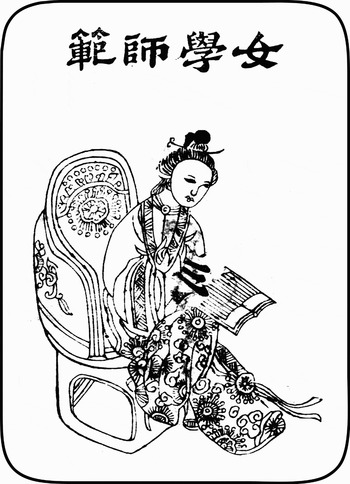
If we turn now to Admonitions for women, the only extant Vietnamese edition is Taò đại gia nữ giới 曹大家女誡 (Cao Dagu's Admonitions for women; AB.557), which was published in 1908. Dagu is an honorific title for the author, Ban Zhao, whose husband's surname was Cao. She is shown in the frontispiece with a book in her hands and the caption “a model of women's learning” but the pose and design are unmistakably taken from a Chinese original (see Figure 1).Footnote 25 However, it is clear from the publishing information at the front of the book that this is in fact a reissue of an earlier edition prepared by Phạm Đình Hổ 范廷虎 (1768–1839), which does not appear to be extant. What is more, the text is presented in a way that reflects much older reading practices more closely tied to the Chinese original. Thus the text is in large characters with each phrase followed by two columns of smaller characters consisting not only of notes on the phonetic value of particular characters and on Chinese terms in the text but also of a rendering into Nôm prose. The Nôm rendering is not so much a translation as a Vietnamese reading of the Chinese text rather similar to the kundoku style of reading Chinese texts common in Japan. It seems, then, that this book provides indirect evidence of an edition dating from the early part of the nineteenth century in which the reader was expected to engage with the Chinese text with the help of the Nôm glosses provided; whether this reader was a literate woman or a father giving instruction to his daughters is, however, unclear. Nevertheless, the frontispiece was clearly intended to encourage reading among Vietnamese women, and since the very fact that Ban Zhao had written this irreproachable work had the effect in China of rendering it respectable for women to read and write, it is difficult to suppose that the example was lost on Vietnamese women.Footnote 26
Illustration of Ban Zhao from the 1908 Vietnamese edition of Admonitions for women (Hán-Nôm Institute, Hanoi: AB.557)

Another Chinese text reprinted in Vietnam was Jiao nü yigui 教女遺規 (Rules bequeathed for the instruction of women), which was originally written in 1742 by Chen Hongmou 陳宏謀 (1696–1771), a provincial governor.Footnote 27 This work includes the text of some works mentioned above such as Admonitions for women and Analects for women but much of it was taken from late Ming conduct books for women, and as a whole it reflected Chen's view that women needed a literate education, even though he considered that the point of such an education was moral rather than cultural or intellectual. The Vietnamese edition, Giáo nữ di qui, was published in 1878 in Hưng Yên province, close to Hanoi, and consists solely of the Chinese text. It survives in four printed copies and a manuscript copy; possibly the fact that so many copies have survived is some indication of its popularity.Footnote 28
The emphasis on women's literacy in Chen's book is also to be found in a women's version of the San ji jing 三字經 (Three character classic), which was published in Vietnam some time in the late nineteenth or early twentieth centuries under the title Nữ huấn tam tự thư 女訓三字書 (Three character book for the instruction of women; AB.22). It is not clear if this work is of Vietnamese or Chinese authorship, for the sole surviving copy carries no indication of date or authorship. However, the likelihood is that it was at least inspired by the writings of the Chinese reformer Chen Zibao 陳子褒 (Ronggun 荣衮, 1862–1922) whose many works include a similar sort of book for girls, Furu san ji shu 婦孺三字書 (Three character classic for girls). Irrespective of its origins, it is important to note that Nữ huấn tam tự thư includes the following passage: “It is good for women to read books. If they do not read books, then they cannot but be idiots. When there are many idiots, then the country goes into decline” (p. 9b). The encouragement to read, which is found in Chinese, Korean and Japanese texts for women, can be construed as a reinforcement of the value of literacy for women in Vietnam, however rare it might have been and however unpromising the prospects of achieving it were for many.
Several other books for women written in Chinese have survived, albeit in manuscript. There is Lan phòng pháp ngữ 蘭房法語 (Sermon for the women's quarters; AB.162), a manuscript produced in 1860 and, according to the preface, intended for rural women readers. It contains various extracts from canonical Chinese texts, such as the Great learning, the Classic of history and Lesser learning, relating to women's behaviour and duties, each of which is followed by a Nôm verse translation. The emphasis is on ancient Chinese texts and drawing the proper lessons from them, and it therefore is indistinguishable from Chinese conduct books in its basic message. Another manuscript, Trinh ác phụ nữ tục biến 貞惡婦女續編 (Good and bad women, supplement; A.2567), contains twenty-eight biographies of Chinese women: as the preface puts it, the work describes, “virtuous and modest women of times ancient and new as a model for later ages, and lustful and bad women as a warning for later ages”.
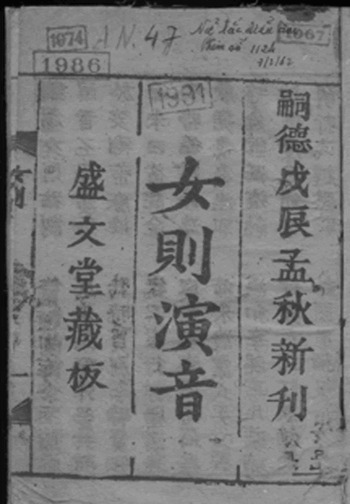
Some Vietnamese works for women were not in Chinese but in the vernacular and they took the form of Nôm verse, even though they always retained Chinese for the title. One of the earliest of these is Nữ tắc diễn âm 女則演音 (Rules for women in the vernacular), which was written by Vạn An Trần 萬安陳 and published in 1845 (R.96; see Figure 2); another edition was printed from newly cut blocks in 1868 (R.52 and AB.47). Nü ze 女則 (Rules for women) was one of the Chinese books mentioned in the Korean dynastic records in 1517, although there seem to have been several works of this name produced in the Ming dynasty.Footnote 29 In this case, however, instead of the Chinese text there is just a translation, without any illustrations.
The 1845 edition of Rules for women in the vernacular (National Library of Vietnam, Hanoi: R.96)

A similar work is Huấn nữ tử ca 訓女子歌 (Poems for teaching girls; AB.85), which was published in 1875; here, too, prescriptions for women's moral behaviour are presented in Nôm verse for ease of memorization. Works of this kind continued to be published well into the twentieth century, as two further examples show. The first is Phượng Sơn nữ kính bảo lục 鳳山女鏡寶籙 (Phượng sơn's treasury – a mirror for women; AB.501), which was published in 1912. This is a conduct book consisting partly of poetic biographies, some relating to Vietnamese women while others come from Biographies of women. Two years later Nữ học diễn ca 女學演歌 (Learning for women in vernacular verse; VNv.59) was published. Although the title is suggestive of women's education, this book simply makes use of various Chinese examples, translated into Nôm verse with Chinese notes, to drive home the need for traditional womanly virtues. So as late as 1914, Chinese texts were still being drawn upon to instil familiar moral lessons, albeit in the form of vernacular verse texts.
We have now examined most of the books for women preserved in the Hán-Nôm Institute and the National Library of Vietnam except Lesser learning for women, to which we shall turn in the next section. Although these are the largest collections in Vietnam, there are probably a few other works preserved in private or public collections elsewhere. But it will be clear nevertheless that in the two most substantial collections of pre-modern books in Vietnam fewer than twenty titles have survived and most of them in a solitary copy. There undoubtedly were other texts for women. Marr identifies four titles, including Gia huấn ca 家訓歌 (Family lessons in verse), which he says was, “clearly meant to be circulated widely among the people, by rote recitation if not reading”. However, we have only been able to trace copies of two of the four titles, and neither of them in a printed edition.Footnote 30
The books that are extant show an overwhelming preference not only for the vernacular, even if accompanied by an original Chinese text, but also for verse forms, and this has a parallel with conduct literature in poetic form in Korea.Footnote 31 It suggests an oral context for the reception of such works, in which recitation and memorization had a part to play.Footnote 32 However, as is always the case with books for women in pre-modern societies, it is essential to recall that we know very little about reading practices or about the degree to which the moral lessons imparted were taken seriously. It is worth recalling that in Japan, Tadano Makuzu 只野真葛 (1763–1825) distanced herself from Japanese conduct books when she wrote, “traditional teachings for women … are wrong in trying to suppress young women's preference for the up-to-date”.Footnote 33 Furthermore, we have no grounds for assuming that women read or had access only to books written for their moral guidance. Male scholars in Japan and Korea, as we have seen, became concerned about the tendency of literate women to indulge in the reading of fiction, and in all likelihood the same phenomenon was to be found in Vietnam.
What is most striking about the books considered here is the longevity of traditional moral prescriptions for women and the sobriety of their presentation. In Ming China and Tokugawa Japan there was an increasing tendency for conduct books to be packed with illustrations and information. Carlitz suggests that “the packaging of women's virtue as a commodity” resulted in “ethics as entertainment”, and this is equally applicable to Japan, where lavish editions packed with entertainment and information reduced the ethical content to a fraction of the whole.Footnote 34 Conduct books for Vietnamese women, by contrast, rarely carried an illustration or information, let alone entertainment.Footnote 35 Similarly, there is no sign, even in the books published in the early twentieth century, of the rise of nationalism, of colonial modernity or of any reflection of the contemporary world.
The exception to this rule, in a limited sense, is a manuscript entitled Tân nữ huấn 新女訓 (New lessons for women; AB.423), which carries a preface by the scholar-official Phạm Văn Thụ 范文樹 (1858–1930) and probably was written in the early twentieth century.Footnote 36 The preface uses Chinese expressions newly coined in Japan such as 自由 (freedom) and 平等 (equality), but the author is convinced of the need to preserve long-standing customs in the midst of change and thus to conserve the “national essence”. To this end, then, the text itself is in Nôm verse and offers women familiar lessons on their moral duties. This much it shares with some of the published books from the early twentieth century mentioned above. The difference lies in an unprecedented section entitled “enjoyments”, which encourages women to read books in the library, to participate in sports, to go to the theatre, to converse with their friends and to go to parties. This is the sole instance in which new patterns of sociability for women are recognized and encouraged, but, it must be remembered, this is a manuscript and these unusually liberal sentiments were not circulated in print.
LESSER LEARNING FOR WOMEN
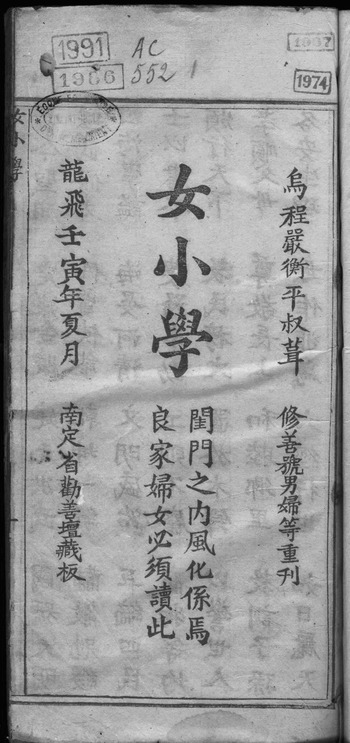
One of the most interesting of the extant Vietnamese books for women is Nữ tiểu học 女小學 (Lesser learning for women), which survives in two identical printed copies (AC.552 and R.1022). It should be admitted at the outset that Nữ tiểu học poses some tricky bibliographical problems, for it consists of two quite distinct parts, which originally seem to have had quite separate identities. The first part, however, is dominated by a Chinese text that carries the same title as the book as a whole (see Figure 3). The title suggests that the text is a women's version of the Song-dynasty moral primer Xiao xue 小學 (Lesser learning) attributed to Zhu Xi, and since books with identical titles in Chinese characters were produced in Japan and Korea in the eighteenth and nineteenth centuries respectively, the obvious inference is that we might be dealing here with a text transmitted from China. If that is so, however, it has to be said that examples of a Chinese source text bearing the title Nü xiaoxue 女小學 have proved extremely elusive. The only example we have been able to locate is a flimsy volume in the Naikaku Bunko in Tokyo.Footnote 37 This book is a popular Ming edition and seems to have been edited by the scholar and bookseller Hu Wenhuan 胡文煥; at the end of the text there is an internal reference to the date 弘治甲子 [1504], which indicates that it was probably composed at the beginning of the sixteenth century. However, the editor, Hu Wenhuan, was active at the end of the sixteenth century and produced editions of Biographies of women and other works for women, so in all likelihood this edition dates from that time.Footnote 38 Although it is clear that similar popular conduct books for women were being produced in Ming and Qing China, such as the copy of Xun younü ge 訓幼女歌 (Song for the instruction of young girls) published in Sichuan and found by Brokaw, these books are by their very nature ephemeral and rarely survive, and we have so far been unable to locate any other Chinese edition of Nü xiaoxue. Footnote 39
Title page of Lesser learning for women (Hán-Nôm Institute, Hanoi: AB.552)

What, then, is the relationship between the Ming-dynasty text and the various editions produced in Japan, Korea and Vietnam? The title Onna shōgaku 女小學 appears in the printed Japanese booksellers' catalogues from 1729 onwards, and at first sight this might appear to be a Japanese reprint of the Ming text or at least a Japanese adaptation or translation of it.Footnote 40 On closer examination, however, this turns out not to be the case. The work in question was actually published in 1725 and the preface claims that it was written in Kyoto.Footnote 41 Later editions bearing the same title or alternative titles like Onna shōgaku oshiegusa 女小學教艸 or Onna shōgaku takarabunko 女小學寶文庫 are no more than revised editions with illustrations by different artists, including one in the Bibliothèque Nationale in Paris, which was published in 1763 with illustrations by Kitao Sekkōsai, and another in the Victoria and Albert Museum in London, which was published in 1852 with illustrations by Ōishi Matora.Footnote 42 The text in all of these editions is entirely in Japanese and consists of short passages extolling the virtues of filial piety, of duty to one's parents-in-law and of service to one's husband, and the benefits of learning to write, read ancient texts and compose waka poetry. Although decidedly moral in intent, therefore, it is clear that this Japanese book has no connection whatever with the Ming text of the same name.Footnote 43 The same is true of two later texts bearing the same title: the first, by Yamagata Jun 山県順, which was published in 1875, recommends girls to read foreign as well as Japanese books and so is clearly a contemporary work, while the second was not published until 1901.Footnote 44 Thus quite independently of the Ming text, there were in Japan several texts bearing the same title and reflecting a perceived need for an introductory conduct book for women.
The same seems to have been the case in Korea, too. The Korean version, Yŏsohak 女小學, was written by Pak Munho 朴文鎬 (1846–1918) in 1882, and so this, too, has no direct connection with the Ming text mentioned above. Pak Munho was a Confucian scholar who wrote commentaries on a number of key Confucian texts, but this particular work was written for the use of his own family, and so was not printed in his lifetime.Footnote 45 Nevertheless, Yŏsohak clearly was based conceptually on the Chinese Lesser learning of the Song dynasty. It draws not only upon Chinese works such as Biographies of women and Admonitions for women but also upon Korean texts, such as historical works and a Korean translation of Lesser learning. Each extract in Chinese is furnished with ample hangŭl glosses giving the meaning and Korean pronunciation of each character, and is then followed by a translation into Korean using hangŭl alone. In short, the compiler seems to have identified a need for an easy introduction to Confucian morality for women in the vernacular, and to have borrowed the title Lesser learning without being aware that a women's version had been produced in China some four hundred years earlier.
In contrast to the Japanese and Korean works of the same name, all of which turn out to have no connection with the Ming version except for the title, the Vietnamese edition, Nữ tiểu học, indubitably stands in a close relationship with the Ming edition, for the first part of the text is largely identical. Nữ tiểu học actually consists of two parts, as mentioned above, and the bulk of the first part consists of a long passage in Chinese with characters in blocks of four, laid out in the same way as the Ming edition in the Naikaku Bunko. The passage consists of aphoristic statements about eternal verities and ethically desirable behaviour, particularly relating to women: “From morning until night the wife serves her parents-in-law just as she served her own parents,” “Do not show your teeth when laughing,” “When a girl is ten years old her mother teaches her hard work,” etc. The Chinese text in the Vietnamese edition departs in places from the Ming edition in fairly insignificant ways (e.g., the Vietnamese edition gives 四海 where the Ming edition has 四方) but it also omits a substantial section of the Ming text. At a later point the Vietnamese edition contains a substantial section that is not in the Ming edition, including a reference to the value of having a wise wife for the avoidance of unexpected disasters. The date at the end, however, is the same as in the Ming edition and most of the text is in fact identical. There are two possible explanations for these differences; one is that there were other versions of the Ming text that do not appear to have survived, and the other is that the departures represent an intervention by the Vietnamese editor of the text. Given that the editor has, as we will see, made other interventions, it may well be that the latter is the correct explanation.
The rest of the first part of this book consists of a passage in Chinese on the conduct of married women, which begins with a quotation from Biographies of women.Footnote 46 Thus the whole of this first part of Nữ tiểu học makes no concessions whatsoever to vernacular needs and is entirely in Chinese. Nevertheless, the title-page declares that “women and girls of good families should read it without fail”, so the Chinese text is here presented as a text for women to read, not simply a text they should have explained to them by their fathers.
The first part of Nữ tiểu học is distinguished from the second part by the fact that the central fold (版心) of each page carries the title Nữ tiểu học marked off with a pair of horizontal lines above and below, while the second part carries traditional “fishtail” markings and separate pagination on the central fold. Thus it is clear that this is a composite work printed from two separate sets of woodblocks, which, it must be supposed, had been used earlier to print the two parts quite separately. The publication of such a composite work was probably dictated by commercial pressures to increase the appeal of a book by including multiple texts, as was common in seventeenth-century Japan. If this hypothesis is correct, it implies that the market for women's conduct books in Vietnam was still not robust.
The title page at the beginning of the first part is dated, according to the cyclical calendar, to the year 壬寅, which could be 1842 or 1902. It also indicates that it was published by an organization in Nam Định province called Khuyến Thiện Đàn that sought to “encourage virtue” and that retained the printing blocks (勸善壇蔵板), but that it had been reprinted by an association of men and women called Tu Thiện (修善號男婦等重刋).Footnote 47 The second part of the book carries a different title: Huấn nữ diễn âm ca tân đính 訓女演音歌新訂 (Lessons for girls in vernacular rhyme; newly revised), a title that is reminiscent of the Sichuan book found by Brokaw mentioned above. The title is followed by indications that the text had originally been published at Anqing in Anhui province in China (庚子年春月奉刋于安慶逢海好善之私淑堂) and that this, too, had been reissued in the year 壬寅. The preface in Chinese, however, refers to a Vietnamese date, the eleventh year of Thành Thái 成泰, which corresponds with 1899. In view of this, it seems that it was in 1902, not 1842, that this composite volume was printed in the form in which we now have it. However, given the close connection between the Chinese text of Lesser learning for women and the Ming edition, it seems unlikely that the Ming-dynasty text had not been transmitted to Vietnam before the end of the nineteenth century. Therefore, it is perhaps more appropriate to see this book as the end of a process in which the Ming text was transmitted to Vietnam and then adapted for local use.
Most of the second part of Nữ tiểu học is taken up by Lessons for girls in vernacular rhyme, which consists of Vietnamese verse in 6–8 metre with a Chinese summary in the upper margin. The instruction offered here is of a kind that would have been familiar to those acquainted with Chinese conduct books for women. Girls were urged to adhere to the “three obediences and four virtues” and to obey their parents in all things – “when father calls you must answer ‘yes’ and go to him”. After marriage they were to set their husbands' minds at rest by treating parents-in-law with politeness and attention, putting up their mosquito nets before they went to bed and fanning them to keep them cool in the summer.
However, section 34 of this part of the book has a strong Buddhist flavour of a kind that is not to be found in other works for women, in that it related to the prohibition on taking life. The passage refers to the “heart-rending cries of animals” and the cruelty of cutting them up to eat, and urges readers not to take the lives of animals if they wish to avoid disasters and sadness in their lives. Other books were in circulation that made similar arguments, such as Giới sát phóng sinh diễn âm 戒殺放生演音 (Against killing and in favour of setting free the living, in the vernacular; AB.489), published by Càn Yên temple in Hanoi in 1848. This contains, on the upper half of each page, various stories in Chinese showing how those who respect life are rewarded while those who take life are punished, with a Nôm verse translation on the lower half. Amongst them, for example, is the story of a woman in Hangzhou who used fire and hot water to kill the ants in her kitchen and then came home one day to find her son burnt to cinders. Whereas in Japan and Korea, Buddhist precepts had no place in conduct books for women, in Vietnam, it seems, it was not so. It is therefore appropriate that, following Lessons for girls in vernacular rhyme, the book concludes with some instruction from a Buddhist text for girls and women, again translated into Nôm verse.
It will be clear, then, that Nữ tiểu học is a hybrid work, consisting of various texts in Chinese and the vernacular. It therefore required dual literacy to engage with it all, unlike other books, which opted for either Chinese or the vernacular. Given that the title page urged women and girls to read this book themselves, it would appear that the author had some confidence in the literacy levels of reading women.
CONCLUSIONS
It has often been pointed out that, both in terms of legal status and of social practices, the position of women was better in Vietnam than in China, that social practices in Vietnam were less restrictive than the prescriptions of the Lê Code (in operation from the fifteenth to the eighteenth centuries), and that orthodox Confucian morality was not so strictly applied as it was in China.Footnote 48 However, it is equally clear that the educated male elite was increasingly pressing for what Whitmore has described as “a proper modernity, male-dominated, modelled on that of contemporary Ming/Qing China, which came to stand as Vietnam's exemplar even after several centuries of independence from Chinese rule”.Footnote 49 From the early nineteenth century onwards, with the onset of the Nguyễn dynasty, these pressures bore fruit in the form of a revision of gender relations as defined in laws and administrative procedures so as to conform with Chinese practice. In these ways the state was unmistakably carrying out the gradual confucianization of Vietnamese society, with a corresponding emphasis on male-dominated family morality.Footnote 50
In this climate, education for girls did not flourish. Although it became increasingly common for boys to be educated outside the home even in rural areas, for girls the norm seems to have been education at home, and that did not necessarily mean a literate education.Footnote 51 According to French colonial records, as late as 1930 less than 10 percent of primary school pupils were girls.Footnote 52 Of course, there were always exceptions, especially among the elite, such as the poet Hồ Xuân Hương who is known for her Nôm verse and who, as Durand notes, “certainly did not fit the feminine ideal of her age”.Footnote 53 But it remains unclear what part literacy had to play in women's education outside elite circles. In this respect, the situation in Vietnam was very similar to that in Korea, except that the Korean state made explicit attempts to extend the process of confucianization to women through the publication of books, in spite of the lack of educational opportunities for women.Footnote 54 Hence neither in Korea nor in Vietnam was there much demand for standardized books for women that could be used in schools, let alone a commercial market for publishers to exploit. In Japan, by contrast, the lack of a mandarinate and the pressures for female education in the growing urban and mercantile segments of the population created a commercial market for educational books for women as early as the seventeenth century. In all of these East Asian societies, of course, males were uniformly expected to engage with Chinese texts, starting out with the Four books and the Five classics of the Confucian tradition: the differences between these societies lay in the degree to which vernacular texts were provided for women and in the context of that provision.
We have drawn attention above to the longevity of traditional moral prescriptions for women in Vietnamese conduct books. In a survey of Vietnamese society published in 1915, Phan Kế Bính noted the persistence of notions such as the “three obediences” and “four virtues”, but while he argued for better communication between spouses and regretted the oppression of women, he could not bring himself to condemn these hallowed notions.Footnote 55 It may be appropriate to attribute this and the longevity of traditional moral prescriptions to social conservatism and/or to abiding “Confucian” attitudes towards women, but in the colonial context in which Vietnam found itself other aspects come into view. After all, in 1913 interested Vietnamese had founded the Collège des jeunes filles indigènes de Saigon which offered Vietnamese girls a French education, as did, too, the École normale and other institutions in Hanoi, such as the two schools for girls founded by the colonial authorities in 1887; and the Tonkin Free School (Đông Kinh Nghĩa Thục 東京義塾), founded in 1907 but closed down in 1908, not only provided lectures for women but also had two women teachers, one of whom taught Chinese.Footnote 56
Thus, even if it can be argued that the writers and publishers of the texts for women discussed in this article were motivated by some sort of desire to preserve women from the “contamination” of the colonial power and its views of women, others were already turning their backs on the traditions of writing for women in Chinese or Vietnamese and instead turned to books and journals in French or at least to quốc ngữ, Vietnamese written in the Roman script. Similarly, in Japan the foundation of progressive journals for women like Jogaku zasshi 女學雑誌 (Magazine for women's learning; founded 1885) did not by any means put an end to the publication of traditional books for women: the Four books for women, for example, were reissued in various forms in Japan in 1883, 1893 and 1911 and in Korea in 1907, which is surely sufficient to show that there was still a demand for it.
But in Vietnam, unlike in Korea and Japan, access to newer forms of writing for women required a command of a new script, quốc ngữ, if not of French itself. A few of the older books for women were in the nineteenth century reissued in quốc ngữ editions, such as Nữ tắc 女則 (Rules for women), which had been published in Nôm editions in 1845 and 1868 but was published in quốc ngữ at Saigon in 1911.Footnote 57 These were in some ways the last gasp of the older tradition of books for women. However, new conduct books for women published in quốc ngữ from 1918 onwards may have placed a new emphasis on educated women and may have taken an increasingly nationalist outlook, but still peddled familiar notions like the “three obediences”.Footnote 58 In that same year, 1918, the first periodical for women, Nữ giới chung (Women's bell) was published; not only was it in quốc ngữ but it was also edited by a woman, Sương Nguyệt Anh. Thus while women who could only read Vietnamese in Nôm script had to make do with moral texts that barely acknowledged the changing world, those who could read quốc ngữ had access to increasingly diverse messages.
Were these moral texts, then, an instrument for the oppression of women in a more or less Confucian society? The message that they carried is certainly one that seems to lead easily to that conclusion. And yet, in the similar circumstances holding in China, Korea and Japan, it has been suggested that some women successfully carved out spaces for themselves as writers and intellectuals, even Queen Sohye, the author of Naehun.Footnote 59 And of course a crucial consideration here is how these works were used and read. We do not yet have sufficient evidence for Vietnam, but it would be surprising if there were not in Vietnam some women, as in China, Korea and Japan, whose lives demonstrated that there was more space for literate women, as poets, diarists or simply readers, than is suggested by the conduct books.
One final question needs to be raised and that is the question of literacy and readership. Estimates of pre-modern literacy in East Asia are notoriously unreliable, but there seems no reason to doubt the consensus that female literacy was much lower than male literacy. Nevertheless, the publishing activities of the state in Korea and of commercial booksellers in Japan suggest a belief in the existence of at least a small literate female population – that is to say, a female population able to read the vernacular scripts if not Chinese itself. In Vietnam neither the state nor commercial publishers played an active part in the production of texts for women; the few that were printed were mostly, it is true, commercially published, but the paucity of surviving copies and the fact that many works survive only as manuscripts do not suggest a large market. Although French administrators in the nineteenth century tended to enthuse about the profusion of schools in rural areas, there is nothing to suggest that these were open to girls as well as boys, and what little evidence there is suggests that female literacy was low.Footnote 60 Indeed the very fact that many works were in rhythmical Nôm verse implies connections with a world of oral recitation and rote memorization, and it may be that in some cases they were not “read” so much as listened to and memorized. Be that as it may, in the absence of any evidence to the contrary, it must be supposed that the audience of reading women for books in the nineteenth century was small and largely confined to elite circles.
The conduct books for women examined in this essay, then, reveal a transitional stage in the emergence of a literate female public in Vietnam. Print was coming into use to disseminate many of these texts, though manuscript production remained strong, and there was a growing preference for the vernacular, first in the form of Nôm and later in the form of quốc ngữ. Nevertheless, although the medium was changing, the message was slower to change.
We hope to have shown in this essay that, while men were expected to receive a sinological education, for the education of women there was an increasing preference for vernacular texts, in Vietnam as elsewhere. This raises questions (too large to address here) about the relationship between the vernaculars and gender in East Asia, and calls for more research into the actualities of education for women. Further, while there are many commonalities there are also marked differences, particularly the development of commercial publishing in Ming China and Tokugawa Japan, but not in Korea or Vietnam until much later, and the impact of French colonialism in Vietnam and of Japanese colonialism in Korea. Full consideration of these issues must await further work.