

INTRODUCTION
China has witnessed rapid social change since its economic reform in 1978. One noticeable change is the spatial mobility and career advancement of China's labor force. In this article, we define labor force as including people within the age range of 16–64 who are working and actively looking for work. Spatial mobility refers to moving across a county boundary to live in the destination for six months or longer, following the official definition of the Chinese Census. Career advancement, or career upward mobility, usually refers to individuals’ trajectory of occupational status over the lifetime, and here it is confined to the change in occupational status from the first job to the current job.Footnote [1] Developing a better understanding of the scale, degree, and source of these changes has high relevance to multiple fields in sociology, including inequality and mobility, labor, and population studies. We propose a framework of stratification and social change and offer a comprehensive description and explanation of spatial and career mobility of not only urban labor but also rapidly transforming rural labor. This description and explanation of the distributions and attributes of the workforce between the public and private sectors are fundamental for human resource management, work relation, and firm and external market connections.
Two strands of research address China's labor force: Research on rural migration examines the spatial mobility of rural labor, while research on career mobility investigates the career mobility of urban labor. This article brings the two strands together to address the three limitations of unidimensional mobility, undercoverage of rural-origin labor with spatial mobility experiences, and the career mobility of only urban-origin labor. To this end, we depart from existing frameworks and develop one that extends our horizon to conceive of the two dimensions of labor mobility in the context of rapid marketization, large inflows of foreign capital and fast accumulation of domestic capital, burgeoning export-oriented industries, a flourishing private sector, and gradual relaxation of citizen control. Social stratification and social change theories provide guiding principles for this investigation.
This article has four primary objectives. First, we minimize the undercoverage of rural migration to provide a near-complete account of the spatial mobility of the entire Chinese labor population. Second, we include rural labor in describing career mobility patterns using an occupational index appropriate for the China case. Third, we describe and analyze the two dimensions of labor mobility simultaneously. Last, through these detailed analyses, we provide the necessary context for understanding the organization and management of Chinese labor. Our empirical work exploits the innovative survey design and measurement of a nationally representative sample of 15,512 individuals aged 16–64 from the baseline China Labor-force Dynamics Survey (CLDS) in 2012. Results from this study advance our understanding of China's labor mobility in ways that are fundamental for scholarship and policy domains both domestically and internationally.
THEORETICAL BACKGROUND
China has witnessed deepening reform, a rising private sector, and a continuous, large-scale exodus of rural labor since the Reform of 1978. A labor market has emerged in the private sector, absorbing much surplus rural labor. Nee and Opper (Reference Nee and Opper2012) documented that the household responsibility policy of 1978 accounted for 80% of agricultural production growth, unveiled the massive extent of underemployment in agriculture, and resulted in 35–55% of the rural labor that was surplus. Despite its geographic relaxation, the household registration (hukou) system continued to control access to the urban public sector and effectively shut rural migrants out of public sector jobs almost the same as in the pre-reform years described in Whyte and Parish (Reference Whyte and Parish1984). According to these authors, the small farm assigned to each rural household served as a quasi–social security arrangement that set a low level of reservation wage for rural migrants’ off-farm employment. Degradation, desertification, mining, and conversion of arable land to industrial and commercial use have intensified the rural labor surplus (Ho & Lin, Reference Ho and Lin2004). Thus, the supply of rural labor workers, the majority of whom are literate, is abundant, contributing to private sector expansion and an unprecedented growth of the gross domestic product. This expansion was simultaneously fueled by foreign direct investment (FDI). Evidence from 23 countries suggests that government institutional commitment, infrastructure development of sites, and lower tax rates are important conditions to attract FDI (Hsiao & Shen, Reference Hsiao and Shen2003). These conditions appeared to be favorable in China, and by 2003, China had become one of the largest destinations for international capital (Wu, Reference Wu, Wu and Lansdown2009). At the same time, domestic capital accumulation in the urban private sector accelerated, attracting a growing rural labor surplus.
The booming private sector and the intensified rural labor surplus worked in tandem to boost rural-to-urban migration. At the micro level, a migratory act is worthwhile only if the migration benefit exceeds the migration cost. The prospect of having a nonfarm job at the destination is greater if one is higher educated, male, and younger. Starting from the early 1980s, China's internal migration has grown quickly into the world's largest single human migration in history, transferring 241 million people to the urban sector by 2010 (Cai, Reference Cai2014), of which rural-urban migration accounted for about 80% (Chinese National Bureau of Statistics, 2013). Rural outmigration from major sending provinces has arrived at the stage of perpetuation sustained by cumulative causation, where the cost of migration to specific destination provinces decreases, suggesting the emergence of interprovincial migration systems (Hao, Reference Hao2012). Replenishing information regarding off-farm employment and self-employment from rural migrants of the same origin within these migration systems may explain why direct job applications by rural migrants from other provinces and employment agencies’ direct recruitment of workers in sending provinces were the top two modes of labor recruitment channels in the Yangtze Delta region in 2009, as documented in Nee and Opper (Reference Nee and Opper2012).
At the same time that labor has been transferring from rural to urban, rural migrants’ occupational status has been upscaling from farm to nonfarm. Although segmented labor markets separate rural migrants from urban workers, according to segmented labor market theory (Edwards, Reference Edwards1975), the self-selection of rural migrants by education, gender, age, and unobserved motivation and ability makes them different from those who are reluctant to change from farm work to off-farm work. This route of career mobility is the most significant one during industrialization, but it is less recognized in the career mobility literature. Scholars of space economy, who address the geographical dynamics of production and work, have waged a similar criticism (Storper & Scott, Reference Storper and Scott2009). According to these scholars, urban market expansion depends on the formation of a localized space economy, and the earliest moments of urban development via migration must be fully accounted for. The conventional career mobility literature, however, considers urban labor exclusively, and among urban workers, it considers those in the primary labor market with a functioning internal labor market (Doeringer & Piore, Reference Doeringer and Piore1985).
A relatively small proportion of China's entire labor population is of urban origin and follows the logic of the internal labor market in career advancement. Specific theoretical models explaining the China case in the 1990s include a dual-path model: Superior education leads to professional elites of high social prestige, while educational credentials and party membership combined lead to administrative elites with social prestige, authority, and material privileges (Walder, Reference Walder1995). Other work on career mobility in China focuses on the career ladder climbing of state and party bureaucrats, while omitting the majority of the labor force (Cao, Reference Cao2001; Zhou, Reference Zhou2001). This omission would seriously distort our view of China's labor mobility and the effective, differential management of workers on different career trajectories. As Bian (Reference Bian2002: 108) correctly pointed out, two parts of the labor force were missed under rapid social changes: ‘Massive migration from rural to urban areas and between economic sectors opens opportunities of mobility in an economy of growing inter-region variation’.
Social Stratification, Social Change, and Labor Mobility
To gain a better understanding of China's labor mobility, we describe its patterns and sources under a parsimonious framework of social stratification and social change. The two separate literatures on labor migration and career advancement consistently point to the fundamental stratification order in China: the hukou system. A large body of literature has examined the detrimental aspects of the hukou system in Chinese society (Chan, Reference Chan1994; Hao, Hu, & Lo, Reference Hao, Hu and Lo2014; Wu & Treiman, Reference Wu and Treiman2007). In the 1950s, the hukou dichotomy was used to assign people to agricultural (rural) hukou vs. nonagricultural (urban) hukou, initially according to the residence place and then according to the mother's hukou status, creating an ascribed characteristic for hierarchical sorting (Chan, Reference Chan1994). Earning a college degree and a promotion to a military official rank have been the tickets for converting one's rural hukou to urban hukou (Wu & Treiman, Reference Wu and Treiman2004). Some cities recently have enacted local policies by which home ownership and business ownership with multiple employees in cities have satisfied the criteria of rural-to-urban hukou conversion (Chan, Reference Chan2009; Cheng & Selden, Reference Cheng and Selden1994). Thus, hukou conversion based on rural-hukou holders’ socioeconomic achievement at urban destinations constitutes the achieved facet of hukou, which is often the consequence of labor spatial and career mobility.
In this article, we distinguish between the ascribed and achieved facets of individuals’ hukou status and propose that only the ascribed facet should be considered as a stratification factor. Theoretically, an at-birth disadvantage can have a long-term impact even for those who later successfully convert to urban hukou. Methodologically, it is necessary to rule out the reciprocity between hukou status and labor mobility. We propose that under the condition of rapid social change characterized by private-sector growth and geographic relaxation of citizen control, rural-origin people (the people with at-birth rural hukou) at the bottom stratum could have a greater degree of enhancement in social status than the population mean, even though this enhancement still does not lead to flipping the hierarchical order. This proposition departs from the conventional rigidity of social stratification because of the rapid social change happening in China.
The second stratification factor is education, which is also consistently highlighted by the two strands of literature reviewed above. Educational expansion, in compulsory education and higher education, benefits individuals of both hukou statuses, although less for rural-hukou people. Higher educated rural people are more likely to migrate, and higher education increases the likelihood of career advancement. Although education is achieved, most people complete their education before migrating or making a career. In that sense, the level of completed education can be considered as an antecedent to migration and occupation.
Although China's socialist and postsocialist ideology has emphasized gender egalitarianism, gender inequality has been the reality. The migration literature finds greater odds of migration among men than among women, while women are catching up (Cai, Reference Cai2014; Liang & White, Reference Liang and White1997). The occupational mobility literature provides strong evidence on women's disadvantage in earnings and occupational status in gender-segregated workplaces (Hannum & Xie, Reference Hannum and Xie1994; Shu, Reference Shu2005). Thus, we expect greater gender differences in career mobility than in spatial mobility.
The above propositions regarding social stratification factors are indispensable aspects of the social change contexts along the time dimension, as the literature shows that social change is the basic driving force of labor spatial and career mobility. To this end, we introduce the demographic concept of birth cohort to study the effects of social change (Ryder, Reference Ryder1965). Rather than the period effect of a social change on the whole population, the cohort effect is the impact of a historical event specifically for a group of people sharing the same experience during a life stage (a cohort). For instance, Chinese baby boomers spent their youth in the Cultural Revolution and under a very rigid hukou system. In contrast, when the post-1980ers were coming of age, they faced huge demands for labor from the booming manufacturing sector and a gradual relaxation of the hukou system. Thus, a cohort perspective sees the labor of different birth cohorts being exposed to different spatial and career mobility opportunities as they pass through the different life stages. Because young people are more likely to migrate, the degree of citizen control via hukou during a cohort's youth stage should be the main determinant of the probability of spatial mobility. Career advancement from farm to nonfarm is also likely to occur during the youth stage, while career advancement inside internal labor markets is more likely to occur during prime-age and middle-age stages. These expectations can guide us to examine cohort effects on spatial and career mobility differentially.
METHOD
Data
The empirical data source of this article draws from the CLDS collected by the Center for Social Survey, Sun Yat-sen University, China. The CLDS is a large-scale, nationally representative, longitudinal survey of the Chinese labor-force population. The baseline survey in 2012 covered three rotation groups, including 16,253 individuals aged 15 and older in 10,612 families from 303 communities across the whole nation, except for Hainan, Tibet, Hong Kong, and Macao. The second wave that followed the baseline sample and added a new rotation group was completed in 2014, but the data are not available for the analysis of this article. The CLDS is a household-based survey, using a sampling design characterized by stratified, multistage sampling with probability proportionate to size and rotation groups. Both China Census 2010 summary tables and an on-site map drawing of dwelling units were used to construct the multilevel sampling frames. For the theme of labor-force dynamics, the questionnaires are also multilevel, including community, family, and individual. The questionnaire contents were guided by an integrated framework of sociological, economic, public policy, and public health perspectives, including not only standard, internationally comparable questions on the multiple domains of the labor force but also unique questions regarding the labor force in the China context.Footnote [2]
This article capitalizes on two unique advantages of the 2012 CLDS baseline survey. First, the CLDS national coverage, with 202 villages and 101 city communities, effectively overcomes the shortcoming of other national surveys, such as the Chinese General Social Survey, which are urban heavy and rural light. The sufficient number of villages allows for an origin approach to capture rural migrants, given their frequent, sometimes long, visits to their home villages to attend important life events, such as house building, marriage, birth, and death. With this coverage, we are able to provide a more complete picture of spatial labor mobility unavailable in the literature. Second, the CLDS includes a comprehensive set of event history calendar modules, including hukou transfer and conversion, migration, education, and occupation, that make it possible to derive accurate information on the experience of spatial and career mobility. These event history calendar modules helped respondents recall important life events occurring from adolescence until the survey time, improving the accuracy and reliability of individuals’ reports of their spatial and career mobility experiences.
Measures
Using the CLDS, with its unique advantages, we measure the key variables of this study. These include two dependent variables – individuals’ spatial mobility experience and career mobility comparing the occupational status of individuals’ first job and current job – as well as key explanatory variables, including individuals’ at-birth and current hukou status, educational attainment, gender, and birth cohort.
Spatial mobility experience
This dependent variable records a person's experience of any spatial movement across a county boundary to live in the destination for six months or longer. We adopted the census definition of floating population and expanded it to cover people who have already returned to their home villages (return migrants). Most migration studies are subject to the scrutiny of the validity of migration status due to an inevitable incomplete coverage of migrants, as they are often hard to reach. A serious undercoverage problem has plagued previous research on rural-to-urban migration in China. First, many migrants live in unstable nonresidential places, such as construction sites and commercial shops that even censuses would fail to cover. A second source of noncoverage by surveys stems from migrants’ close ties to their home villages. Migrants with short-term or unstable jobs might temporarily return home during unemployment periods. Most rural migrants take a relatively long leave to attend to such family matters as building a new farmhouse, marriage, childbirth, and death. Third, a dominant trend in China is that middle-aged migrants return to their home village permanently for two primary reasons: the depleting probability of urban employment with age and the increasing need to care for their aging parents back in the home village. The CLDS addressed the first source by including migrants’ nonresidential dwellings while drawing the community sampling maps. The latter two sources of noncoverage were addressed by including three modules of questions unavailable in censuses and other surveys: (1) a module for spatial mobility before the first job, (2) a module of hukou transfer and conversion histories, and (3) a module of rural residents’ migration and occupation histories. Together, these sets of information effectively minimized the undercoverage of rural outmigration experience as compared with the traditional measure from urban residential areas. Nevertheless, this sample still misses a small proportion of the sample in urban destinations at survey time. We can estimate the degree of this undercoverage, because the CLDS implemented a parallel module to collect information about non-coresident adult sons and daughters from any parents living in villages. This origin approach captures a sample of rural-urban migrants currently living in cities that is twice the size of the sample collected using the conventional destination approach.Footnote [3] Fortunately, the undercoverage is relatively small (estimated at about 5%) compared to the other categories of rural-origin migrants that the CLDS successfully captures, as described below.
Specifically, we identified six types of rural-origin people (with at-birth rural hukou): (1) those living in urban areas with a current rural hukou, captured in urban areas (4.8% of the total labor force population); (2) those currently paying a temporary visit to the home village, captured in rural areas (8.8%); (3) those living in urban areas, having converted their rural hukou to urban hukou, captured in urban areas (10.2%); (4) those living in an urban community that was administratively converted from a village due to urban expansionFootnote [4] or community turnover (1.2%); (5) those who out-migrated but have now returned to the home village permanently (12.3%); and (6) those who never migrated, captured in rural areas (48.9%). The migration experience among people of urban origin (with at-birth urban hukou) is simpler: (7) those having ever had migrated, captured in urban areas (5.6%); and (8) those having never migrated, captured in urban areas (8.1%). The first six types are aimed to exhaust the experience of ever having had spatial mobility among rural-origin people. Type 1, accounting for only 4.8% of the nation's labor, is usually termed ‘rural migrants’ captured by surveys in urban areas. This destination approach clearly misses the majority of rural-origin people who have had spatial mobility, particularly temporary return migrants (10.2%) and permanent return migrants (12.3%), as well as those who migrated and converted their at-birth rural hukou to urban hukou (8.8%). This latter group was able to convert their hukou type, because they have higher education or military official experience or because they have attained higher socioeconomic status after rural-urban migration.
Career mobility experience
Our second dependent variable is career mobility, defined by comparing the status of the current occupation (precisely the occupation during the period from January 2011 to the survey time in 2012) with the status of the first occupation. Among individuals with current rural hukou, we took the reported nonagricultural occupation of their first job or farming for their first job if they reported having agricultural work experience. The CLDS requested respondents to use 10 or more words to describe their occupation, based on which a standard three-digit occupational code was created. Much previous research on occupational mobility in non-Western countries has adopted Treiman's (Reference Treiman1977) international socioeconomic index (ISEI), a composite of income, education, and prestige of occupations for international comparisons. This approach, however, has been criticized as lacking empirical validity, and a simplified approach using the mean education level of each occupation based on the three-digit code was proposed (Hauser & Warren, Reference Hauser and Warren1997). Education has played a consistently important role in occupational attainment from pre-reform to the reform period in China, but occupational income and prestige may have changed dramatically to make the first occupation and current occupation incompatible. In addition, China's two-track economic policy may lead occupations in priority industries to have unique levels of income and prestige (Lin, Reference Lin2011; Lin & Monga, Reference Lin and Monga2010). As suggested in Tsui's (Reference Tsui2006) editorial, we aim to better conceptualize China labor-force mobility by using the Hauser–Warren approach rather than the Treiman approach. Based on the CLDS's large sample, we first grouped the three-digit codes into 14 categories and then calculated the weighted mean educational level for each category. The mean education index of occupation is highly correlated with the ISEI score, but the former is smoother than the latter along the 14 ranked occupational categories; thus, the mean education index of occupation better retains the population variation in China. We took the difference in the mean-education index of occupation between the first job and the current job. If the current job is the first job, the difference is 0. The career mobility has three ordered categories: (1) downward, (2) same, and (3) upward. We further created a dichotomous variable to indicate career upward mobility vs. downward mobility and immobility combined.
Explanatory variables
Our explanatory variables include demographic variables and work organization ownership. Our theoretical framework focuses on the role of social stratification and social change in shaping spatial mobility and career mobility. A primary stratification factor that has existed from the pre-reform era to the reform era is hukou status. A social stratification perspective suggests that at-birth hukou status is the root of disadvantage, because an at-birth rural hukou status constrains life opportunities in education, employment, and political and civic participation from childhood to adulthood. Although rural-urban hukou conversion improves the opportunity set, it cannot undo the disadvantage before conversion, and it may be the consequence of spatial and career mobility. The CLDS contains information on both at-birth and current hukou status for each respondent.
A second stratification factor is respondents’ educational attainment. Overcoming the common problem in the crude measure of education in most Chinese data sources, the CLDS obtained each respondent's educational history, including when the respondent completed or dropped out of an educational stage. Based on this information, a precise measure of highest grade completed is possible.
A third stratification factor is gender. We measure the cohort effects of social change by dividing the current labor population into four birth cohorts. The oldest cohort is what we call ‘Chinese baby boomers’ born during the period 1948–1957, before the prolonged famine started in 1958, unlike the Western baby boomers born during the period 1946–1964. The subsequent three cohorts include those born during the following timespans: 1958–1967, 1968–1980, and post-1980. Contrasting the baby boomers with the post-1980ers captures the differential cohort effects of the pre-reform era vs. the deepening reform era.
The reform that started in 1978 has given rise to three burgeoning private sectors, which operate side by side the state-owned or collective-owned enterprises. Capital from abroad has facilitated expert-oriented industries that critically rely on the cheap labor of rural migrants. Domestically accumulated capital has the support of numerous firms of different sizes, absorbing both urban labor and rural migrant labor. The service sector has also been expanding from mushrooming small businesses and urban and rural surplus labor. We classify nonfarm work organizations by three types of ownership: state-/collective-owned enterprises, private-owned firms, and private-owned small businesses. Farms are considered as quasi–private owned, given the household responsibility policy.
Models
Our descriptive analysis aims to provide a complete, national, representative picture of the spatial mobility and career mobility of urban- and rural-origin labor by social stratification factors and birth cohorts. We progress from the description of spatial mobility and career mobility separately and then analyze them simultaneously. Our multivariate analysis examines how demographic variables and work organizations shape spatial and career mobility simultaneously. Our goal is modest: to describe partial association rather than causal relationships. The analysis uses both univariate and bivariate probit modeling strategies.
RESULTS
The results section starts with descriptive patterns for career and spatial mobility separately and then moves to the conditional patterns and association patterns. Finally, estimates from modeling the two dimensions of social mobility are presented and interpreted to advance our understanding of the Chinese labor force's social mobility.
Characteristics of Chinese Labor
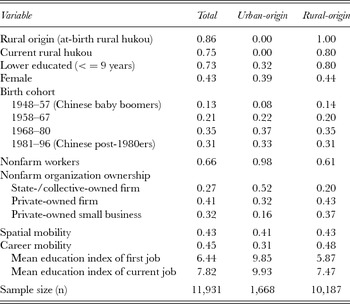
The weighted distributions of variables used in the analysis are presented in Table 1 for the total labor force and by at-birth hukou status. Rural-origin people account for 86.3% whereas urban-origin people account for 13.7% of the total labor population. This seemingly low percentage of urban origin is not surprising. First, the labor force excludes students, retirees, the disabled, and people voluntarily opting out of the labor force, who are more of urban origin (23.1%) than the average (13.7%) of the current labor population. Second, some rural-origin people had their rural hukou converted to urban hukou sometime in the past, contributing to 45.4% of the current urban-hukou population. Thus, the labor population exhibits a 25% share with current urban-hukou status and a 75% share with current rural-hukou status, which is consistent with the composition based on Census 2010 (Cai, Reference Cai2014). This overwhelming rural-origin share and its overlapping with current urban hukou suggest that any labor policies must address the characteristics of rural-origin people, including those who are holding current urban-hukou status.
Weighted descriptive statistics of variables used in analysis

The demographic characteristics of urban- vs. rural-origin labor differ markedly. Although the share with nine or fewer years of schooling is 32% for urban-origin labor, an overwhelming share (80%) is found among rural-origin labor. Female accounts for a smaller proportion of urban-origin labor (39%) than rural-origin labor (44%). The cohort distributions show that, compared to urban-origin baby boomers, more rural-origin baby boomers were working. The greater labor force participation among female and older rural-origin labor can be attributed to the ‘full employment’ assumption for farming. The nonfarm share is 98% for urban-origin labor and 61% for rural-origin labor.
Work organization characteristics differ strikingly between urban- and rural-origin labor. Among nonfarm workers, sharper distinctions are found in ownership types: 52% of urban-origin workers were in state-/collective-owned enterprises, and the number was 20% for rural-origin labor; 43% of rural-origin workers were in private-owned firms, which is 11 percentage points higher than that for urban-origin workers. If we extend the private ownership to include small businesses, the percentage is 48% for urban-origin labor and 80% for rural-origin labor.
The last section of Table 1 shows that 43% of Chinese labor experienced spatial mobility and 45% had experienced career mobility. Rural-origin labor is more mobile than urban-origin labor. At 43%, rural-origin labor's spatial mobility rate is much higher than the traditional measure (i.e., those with a current rural hukou captured in urban areas at 5.6%), because we have taken into account temporary and permanent return migrants, as well as those who previously converted their rural hukou to urban hukou. Rural-origin labor exhibits higher career mobility than urban-origin labor (31% for urban origin and 48% for rural origin). The two dimensions of mobility point to the same social change. The similarly spatially mobile urban- and rural-origin labor suggests a greatly expanded urban labor market. Although the career mobility of rural-origin labor is a byproduct of the expanded urban labor market and rapid industrialization and urbanization, the differential distribution of career mobility by social lines and work organization ownerships can illuminate our understanding of the career mobility process. Below we take an in-depth look into how career mobility is distributed.
Career Mobility Patterns over the Life Course
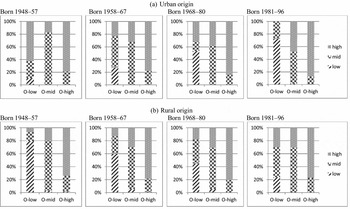
We measure career mobility by the first job, usually when one was young, and the current job, the timing of which depends on birth-cohort membership. For instance, at the time of the survey, baby boomer respondents were approaching retirement, whereas post-1980 respondents were in their young adulthood. Thus, career mobility patterns over various life course stages can be ascertained by examining career mobility across birth cohorts. As we argued above, at-birth hukou is an ascribed stratification factor that makes a permanent dent in one's life course and persistently affects one's life chances. Therefore, we depict career mobility trends separately for urban-origin labor and rural-origin labor. The urban-origin trends can be seen as the core of what the literature depicts for urban labor (defined either by urban residence or urban hukou). The rural-origin trends have been overlooked in the literature. In our view, it is imperative to incorporate the rural labor into career mobility research in the context of rapid industrialization and urbanization. Figure 1 consists of two panels, and each panel includes four charts, one for each of the four birth cohorts. Each chart presents three cumulative percentage bars of low, middle, and high levels of the occupation index (the mean education) of the current job, conditional on a fixed level of the occupational index of the first job.
Career mobility from first occupation to current occupation

We examine career mobility patterns from a fixed occupational index level of the first job. First, we compare the bar at O-low (low occupational index of the first job) across the four birth cohorts between urban- and rural-origin labor. Many interesting patterns can be seen, but we draw attention to three of them. (1) A striking difference is the very low immobility among urban-origin baby boomers and the very high immobility among rural-origin baby boomers, suggesting a prolonged urban bias in upward mobility opportunities for those with a low-status first job. (2) The immobility of the O-low increases as urban-origin cohorts become younger; in contrast, this trend reverses for rural-origin cohorts, implying that the deepening reform benefits rural-origin youth much more than the rural-origin old. (3) The two-level jump of upward mobility from O-low steadily decreases as urban-origin cohorts become younger; this is reversed for rural-origin labor, further reinforcing our last point about the benefit of reform being mainly for rural-origin youth. Second, we compare the bar at O-high (high occupational index of the first job) across the four birth cohorts between urban- and rural-origin labor. We observe that, regardless of urban vs. rural origin, the prospect of maintaining high status in the current job is remarkably similar (albeit with some minor magnitude differences): It increases when the cohorts get younger. Third, we compare the bar at O-mid (middle occupational index of the first job) across the four birth cohorts between urban- and rural-origin labor. We find that the probability of remaining in the same occupational status is high for both urban- and rural-origin workers; yet a discernible difference can be spotted, in that only rural-origin workers experienced downgraded occupations.
Taking all this together, upward career mobility appears to be concentrated among workers from low-status first jobs, with one- to two-step jumps. The downward career mobility is rather moderate, occurring for workers from high-status first jobs with one downward step. This suggests that the structural mobility of occupation upgrading in the era of expanding labor markets and rapid industrialization and urbanization outweighs circular mobility.
Career and Spatial Mobility by Demographics
We are interested in the distribution of demographics within each mobility status. For career mobility, we distinguish among downward, same, and upward; for spatial mobility, we separate nonmigrants from migrants. We examine each mobility status within urban origin and rural origin; as we showed above, the demographic characteristics of these two subpopulations are very different.
Career mobility
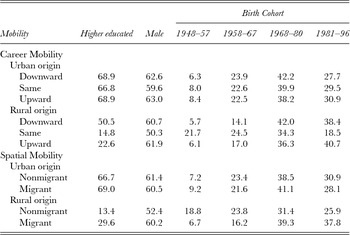
From the top panel of Table 2, we observe that there are no patterns of career mobility of urban-origin workers by education levels. In contrast, a large percentage of downwardly mobile rural-origin people were better educated, at 50.5%; among the upward mobile rural-origin workers, only 27.1% had more than nine years of education. These results are not surprising if we consider the permanent return migrants who left their urban jobs, with most resuming farm work. In addition, from a higher-ranked first job, better-educated people's upward mobility should be less possible than their lower-educated counterparts by the rule of ceiling effect.
Weighted percentage distribution of career and spatial mobility by demographics: Chinese workforce, 2012

The next ‘male’ column shows that the cohort patterns of career mobility among the urban origin are not clear. In contrast, rural-origin males are more mobile, either downward or upward, than their female counterparts. This suggests that labor markets are more open toward rural-origin men than rural-origin women. Career mobility varies by birth cohorts only mildly among urban-origin labor, but it varies greatly among rural-origin labor: A greater share of rural-origin baby boomers and those born between 1958 and 1967 were career immobile; more of those born between 1968 and 1980 experienced downward mobility; and the rural-origin post-1980ers had the greatest opportunities for upward mobility, followed by downward mobility.
Spatial mobility
The bottom panel of Table 2 shows the weighted percentage distribution of spatial mobility experienced by urban- and rural-origin workers and by demographic characteristics. The ‘higher educated’ column shows that education is not decisive for spatial migration among urban-origin workers. In contrast, we see a clear relationship between education and spatial mobility among rural-origin people: While 13.4% of rural-origin nonmigrants have more than nine years of schooling, the percentage is more than double among rural-origin migrants (29.6%). A similar pattern for gender is found in the ‘male’ column. The male share is almost the same between urban-origin migrants and nonmigrants. We observe, however, a greater male share of rural-origin migrants than that of rural-origin nonmigrants. We use birth cohorts to capture the influence of major social change on birth cohorts during their youth stage, because younger people are more responsive to migration opportunities than their older counterparts. Thus, the spatial mobility experience of an early birth cohort would reflect the impact of historical events in the early years, which construct time trends to some degree. Along birth cohorts, we see an inverse U shape among urban-origin workers: The 1968–80 urban-origin cohort was more likely to experience spatial mobility. The trend for rural-origin workers monotonically increases as the birth cohorts become younger. This trend conveys a general pattern of an increasingly flexible labor market as the reform deepens but mainly for rural-origin labor. These patterns suggest very different mechanisms of spatial mobility between rural-origin and urban-origin labor. In particular, the spatial mobility among rural-origin workers is highly selected so that the better educated, male, and younger are more likely to experience spatial mobility. An emerging picture of differential spatial mobility and career mobility by demographics leads us to explore whether and how the two dimensions of mobility are related.
Career Mobility Conditional on Spatial Mobility and Nonfarm Work Organizations
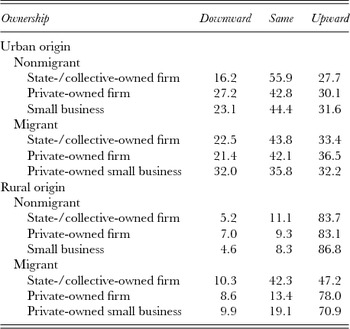
The rising private sector, both firms and small businesses, may offer differential opportunities for urban- and rural-origin nonfarm workers with or without spatial mobility. Table 3 displays the percentage distribution of the career mobility of urban- vs. rural-origin workers conditional on spatial mobility and nonfarm organizations by spatial and career mobility experiences. We first observe urban-origin nonmigrant workers. The private sector provides a greater opportunity for upward career mobility than the public sector. Compared to 27.7% of those in state-/collective-owned firms who had upward career mobility, 30.1% of private-owned firms’ workers and 31.6% of small business owners experienced upward career mobility. At the same time, the private sector is more volatile, consisting of a relatively smaller percentage of career-stable workers and a relatively larger percentage of downward career mobile workers when compared with other ownerships. Migrants in general have higher upward career mobility experience. Private-owned firms provide urban-origin migrants with the greatest upward opportunities (36.5%), followed by private-owned small businesses (32.2%). The small-business sector is also a flexible labor market, generating a greater percentage of workers who slipped down their career ladder (32.0%).
Weighted career mobility by spatial mobility and organization ownership: Chinese workforce, 2012

Turning to rural-origin nonfarm workers, we note that nonmigrants achieved their upward career mobility by taking up nonfarm jobs in any type of work organization near their home villages. As a result, public and private sectors are indiscriminant in providing upward career mobility opportunities (83.1–86.8%). In contrast, migrant workers were offered the best career prospects by the private firm sector and the small business sector. We also note that the public sector offers substantial upward mobility opportunities (47.2%). Taken together, Table 3 suggests that career mobility has a stronger relationship with spatial mobility and private sectors for rural-origin labor than for urban-origin labor.
Joint Spatial and Career Mobility by Demographics
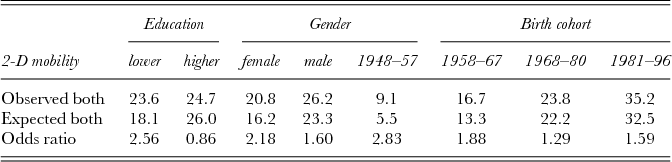
In the above analysis of career mobility, we distinguished downward, same, and upward types. We now highlight the fundamental nature of the two dimensions of labor mobility by cross-classifying two dichotomous measures: spatially mobile or not and upwardly (career) mobile or not. Table 4 shows three types of statistics of this joint distribution by demographic variables. Addressing both spatial and upward career mobility, we present the observed percentage and the expected percentage under the null hypothesis of independence. We also show the odds ratio (the odds of upward career mobility for those who had ever migrated to the odds for those who did not migrate). The likelihood ratio test of each of these 2 × 2 tables rejects the null hypothesis of independence.
Weighted observed and expected joint probability for spatial and career mobility and odds ratio by demographics: Chinese labor forces, 2012

The association between the two dimensions of mobility is stronger for the more disadvantaged: lower educated, female, and baby boomers. For instance, among the lower educated, the odds of upward career mobility for those who had ever migrated are 2.56 times the odds of those who never migrated. Likewise, the odds of upward career mobility for baby boomers who migrated are 2.83 times the odds for their counterparts who never migrated. There is an exception, however: Higher-educated people's odds of career upward mobility are negatively associated with spatial mobility. The odds of career upward mobility for those who had ever migrated are 86% of the odds for those who never migrated. The internal labor market for career ladders of more-educated people, which is dominant in the public sector and the primary labor market, does not necessitate spatial migration, whereas the external labor market, which is flourishing in private sectors, may offer lower-educated people greater upward mobility, especially when one moves from a less developed rural to a more developed urban environment.
Mobility Patterns Overview
Thus far, the descriptive results give rise to three new findings not seen in the literature. First, rural-origin workers, an overwhelming majority of the disadvantaged, were similarly likely to experience spatial mobility as urban-origin workers; and among rural-origin workers, the better educated, men, and post-1980ers were more spatially mobile. Second, when examining career mobility alone, we saw a similar pattern as that for spatial mobility, except that education plays an opposite role. Third, private ownership is the organizational environment in which rural-origin labor is given greater mobile opportunities. Fourth, examining the two dimensions of mobility jointly reveals that spatial mobility is an important ticket to get ahead for those with low occupational status. Whether this association stands with a multivariate check is the question we investigate next.
Multivariate Analysis of Spatial and Career Mobility
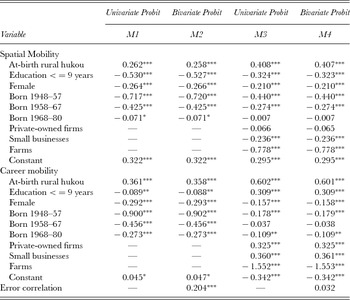
The multivariate analysis estimates four models. Model 1 (M1) is a univariate probit model that considers spatial mobility and career mobility separately as a function of demographic variables. Model 2 (M2) is a bivariate probit model for spatial and career mobility simultaneously using the M1 specification, while allowing for the error terms of the two equations to be correlated and for this correlation to be estimated. Model 3 (M3) adds ownership types of work organizations to M1. Finally, Model 4 (M4) is the bivariate version of M3. The results are presented in Table 5.
Probit estimates for spatial and career mobility
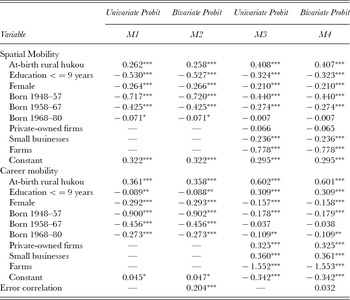
We first compare the estimates of M1, which assumes spatial mobility and career mobility to be independent, and those of M2, which assumes the two dimensions of mobility to be correlated. The error correlation is significant with a size of 0.204, suggesting that M2 captures the majority source of correlation between the two mobility dimensions by including observed demographics in the model while leaving a substantial source unexplored. As a result, the estimates from the two models are largely similar. We focus on interpreting the M2 results. The negative partial correlations of spatial mobility with disadvantaged social positions and earlier birth cohorts in this multivariate framework remain strong and significant, as the descriptive patterns previously showed. While at-birth rural hukou predicts a greater probability of spatial mobility, other disadvantages, lower education, female, and earlier birth cohorts, predict a lower probability of spatial mobility as well. Thus, for people with at-birth rural hukou, their greater probability of spatial mobility is hampered by lower education, since rural-origin people are more likely to be lower educated. The negative partial correlations of career mobility with disadvantaged demographics are similar to those of spatial mobility with one exception: The correlation of career mobility with education is much weaker, such that the greater probability of career mobility for people with at-birth rural hukou is not much hindered by their lower education.
M3 and M4 seek to estimate how the ownership types of work organizations can illuminate the positive correlation between the error terms of the two equations in M2. To preserve the whole sample, we include farms as another type of work organization. Indeed the error correlation in M4 drops to 0.032, approaching zero. The model controlling for work organization ownerships reveals their important and yet differential relationship with spatial mobility vs. career mobility. Specifically, controlling for work organizations in the spatial mobility equation does not alter the estimates for the demographic variables much. The spatial mobility experience of workers in private-owned firms does not differ from that of workers in state-/collective-owned firms, but small business owners are less likely to have had spatial mobility experience. Controlling for work organizations in the career mobility equation, however, alters the estimates of at-birth hukou and lower education. First, the coefficient for at-birth hukou on upward career mobility almost doubles, given that most rural-origin workers remained on the farm and were less likely to be recruited by nonfarm work organizations. Our analysis of ownership types (not shown here) found that state-/collective-owned organizations were the most restricted for rural-origin people, followed by private-owned firms and then small businesses. Second, the sign of the coefficient for lower education flips from negative to positive; at the same time, workers in both private-owned firms and small businesses were more likely to exhibit past upward career mobility experience. This suggests that being recruited in a nonfarm work organization, people with lower education have already advanced in their careers. In other words, the negative coefficient for lower education in the M1 and M2 career mobility equations is now captured by the role of the private sector (which negatively selects the low educated) and low education (which now compensates for the negative selection of private sector). For example, the coefficient for working in private-owned firms is positive and significant, with a magnitude at 0.325, which translates into an increase in the probability of past upward career mobility by 0.126, similar to the increase of having low education (0.115), evaluated at the mean value of all covariates in the model. These findings from the multivariate analysis suggest that analyzing the two dimensions of labor force mobility simultaneously can help illuminate the process of spatial and career mobility and the moderating role of work organizations.
DISCUSSION
Departing from the separate literatures on rural vs. urban labor, this article provides a comprehensive understanding of China's current labor population, with a focus on its two dimensions of mobility experience: spatial mobility and career advancement. Contextualizing the labor mobility patterns in China's social change over the past four decades establishes a fundamental condition for better organization and management. Our approach addresses several shortcomings in the literature. First, separate past research on rural labor's migration and urban labor's career mobility depicts inconsistent and fragmented pictures. Second, the definition of urban labor in the literature is not standard, either including rural migrants or excluding them. Third, for most rural-origin people, spatial mobility occurs in tandem with career advancement from farming to nonfarm jobs within the individual's lifetime, making it difficult to define urban labor vs. rural labor on an absolute standard. Fourth, not only might earlier spatial migration promote later career mobility, but also those having never moved spatially by a time point are potential migrants to move after a time point. Finally, the two dimensions of labor mobility are generally treated as if they were independent of each other.
Integrating theories on stratification and social change and using the demographic perspective of cohort effects, we exploited the innovative design of the CLDS and made special efforts to minimize the undercoverage problem of rural-urban migrants that seriously discredited much research on the rural migrant population in China. Our refined categories of rural-origin people who have ever had migration experiences underscore the distinction between those captured in urban areas and those captured in rural areas, such as temporary return migrants.
Limitations and Future Research Directions
This article makes several contributions to the labor mobility literature, but it is not without limitations. First, although we successfully capture temporary and permanent returned migrants, we still could not fully count rural migrants in cities, thereby underestimating the expanding external labor markets in private sectors and the resulting career advancement through spatial mobility. Second, our career advancement is captured in the two ends between the first occupation and the occupation at the survey time, which is responsible for two problems. Under a wide age range (16–64), these two ends mean different life spans across individuals. In addition, the two-end approach misses the actual pathways of career advancement. Third, this article pays insufficient attention to the contextual constraints for individual career advancement. For example, national and provincial capital cities are disproportionally higher in occupational status, while county seats are at the opposite end of the continuum. Much location-bound career advancement could be explained by contextual factors. Finally, career advancement without spatial mobility could be better understood if firm-level factors, such as organizational structure and labor management, were incorporated in the study.
Future research should address any one or more of the limitations in this article. For instance, a latent occupational trajectory approach can address the two-end weakness and take into account individuals’ entire occupational history. Variables describing the occupational structure of geographic units can be combined with individual data, to which we apply multilevel modeling. Respondent reported firm-level information such as the ownership (used in this article) and size, contract rules, and industry (not used in this article) should be further explored. To get to the heart of management and organization research, one can randomly select a number of large firms from the pool of self-reported large firms and combine with the externally obtained firm level data used, to which we apply multilevel models.
Theoretical Implications
Our findings make a significant contribution to the field of management and organization, as they provide the necessary context for understanding the organization and management of Chinese labor. Through examining Chinese labor's spatial and career mobility, we depict labor mobility as channeling employees to flow in or out of work organizations in distinctive ownership types. Microlevel demographic characteristics, such as at-birth hukou, educational attainment, gender, and birth cohorts, and firm-level characteristics, such as ownership types, together shape the mobility process. Here we list only a few of many potential implications. Our analysis provides organization researchers and work unit managers with comprehensive information about labor flows in and out of firms. These flows are constantly balancing or reinforcing the employee stock of work units. Managers in the private sector may consider effective ways to manage labor flows via direct formal recruitment from rural areas to facilitate the realization of joint spatial and career mobility. Managers of private-owned firms could increase their knowledge about the large number of farmers turned workers. How are rural-origin individuals selected on the basis of their education, gender, and youthfulness? What does it mean for employees who have experienced both rural-to-urban migration and farm-to-nonfarm occupational advancement? Should their inferior rural origin or their strong motivation for upward mobility be considered when selecting individuals for potential leadership positions? More generally, our article uniquely provides ‘the history, the geography, its ecology, and all that has transpired over time and in space that have produced what and why a context is the way it is today’ (Tsui, Reference Tsui2006: 2).
CONCLUSION
This article provides strong evidence for four take-away messages. First, people born with a rural hukou exhibit greater spatial mobility and career advancement than people born with an urban hukou do. This is not surprising if we are reminded of the booming expert-oriented economy; the burgeoning private sector; the large demand for literate, low-skilled workers; the gradually relaxed control over rural-origin people's geographic mobility; and the rising occupational status from farming to nonfarm jobs. Second, education, gender, and age differentiate rural-origin people in this Great Migration Era: Individuals who are higher educated, male, and younger are more likely to become a new segment of the urban labor, leaving lower-educated, female, and old individuals behind in villages. This is reshaping the composition of urban labor and rural labor, increasing the heterogeneity of urban labor while decreasing the heterogeneity of rural labor. Third, the progressively lax hukou policy favors younger cohorts over older cohorts. A series of historical events from collectivization to the Cultural Revolution already limited China's baby boomers’ access to opportunities in education and occupation, opposite to baby boomers in developed counties. The earlier harsher hukou policy and smaller demand for low-skilled workers further limited China's baby boomers’ spatial and career mobility. In contrast, China's post-1980ers fare much better. Fourth, among demographically comparable people, having experienced spatial mobility is a ticket to career advancement. Work organizations are the arena where the two dimensions of mobility can happen jointly. The bankruptcy and downsizing of many state-owned enterprises mean attenuating primary labor markets and their internal labor markets. In contrast, the mushrooming private sector suggests that secondary labor markets and their external labor markets are flourishing. This prosperous external labor market opens the door for both spatial and career mobility, and rural migrants working in private-owned firms contribute a great deal to joint spatial mobility and career mobility.
SUPPLEMENTARY MATERIAL
To view supplementary material for this article, please visit http://dx.doi.org/10.1017/mor.2015.35