1. INTRODUCTION
In the context of the worldwide movement for the revitalization of regional and minority languages currently under way (cf. Hinton, Reference Hinton, Hinton and Hale2001: 4; Grenoble and Whaley, Reference Grenoble and Whaley2006: 1), it is not surprising that France has made progress in acknowledging and embracing, to some extent, its own linguistic diversity. However, one must recognize that some of its regional languages have benefited from these new policies more than others. For example, Basque, Breton and Occitan are widely recognized as autonomous languages and, as a result, are the object of courses and bilingual programmes offered in public schools as well as immersion programmes offered in private schools. Unfortunately, this educational policy is limited to a small list of languages. Of the Oïl languages spoken in Northern France, only Gallo can be included in the official school curriculum, an exception attributable in part to the fact that Gallo is the other regional language of Brittany (D’Hervé, Reference D’Hervé2005). Other Oïl languages face important challenges in their quest for recognition due to their perceived similarity with French. Because Norman, Poitevin, Bourguignon and other such varieties share much of their vocabulary, phonology and grammar with French, the Oïl variety that became the official language of France, politicians, citizens and even some linguists are unsure as to whether these are autonomous linguistic varieties or dialects of French. An example of this uncertainty is found in the conclusions reached in two reports submitted to the French government in the late 1990s. Whereas the Poignant report submitted in Reference Poignant1998 concluded that the Oïl varieties had been absorbed into French and did not deserve to be recognized as regional languages, the Cerquiglini report, submitted the following year, took the opposite position, arguing that they had diverged from French over time and now deserved official recognition as autonomous languages.
As linguists, we believe that the autonomy of an Oïl variety must be established on the basis of analyses of its linguistic structure. In the current context of revitalization movements that characterize many of them, we argue, contra Éloy (Reference Éloy1997), that phonological or morphosyntatic elements whose distribution is constrained by complex combinations of linguistic factors constitute the strongest support for an autonomous grammar. Indeed, it is not sufficient to insert structures from a given Oïl variety into one’s French to provide evidence for an autonomous Oïl grammar.
In order to assess the extent to which Picard differs from French, we decided to focus on morphosyntactic structures for two reasons. First, many scholars recognize that Oïl varieties, that is, Gallo-Romance varieties from northern France and southern Belgium, significantly differ from each other and from French in terms of phonology, morphology and lexicon, but they have explicitly denied the existence of significant morphosyntactic differences (e.g., Remacle, Reference Remacle1952: 7 for Walloon; Carton, Reference Carton and Holtus1990: 609 and Éloy, Reference Éloy1997: 137 for Picard). The second reason is the possibility that the failure of our predecessors to recognize the specificity of Picard syntax relative to colloquial French stems from the absence of detailed analyses.Footnote 1 For instance, while recognizing that Picard and colloquial French share many structures, we suspected that the specific linguistic conditioning for each structure differs in the two varieties. In order to test this hypothesis, we examined four constructions shared by the two varieties: verbal negation, subject doubling, auxiliary alternation and the expression of future temporal reference (Auger and Villeneuve, Reference Auger, Villeneuve, Meyerhoff and Nagy2008; Villeneuve and Auger, Reference Villeneuve and Auger2013; Auger and Villeneuve, Reference Auger and Villeneuve2017). In our work, we adopt the comparative methodology developed by Shana Poplack. This approach, which has been used to analyse language/dialect pairs for which issues of borrowing, autonomy or possible common origin have been raised (e.g., Poplack and Tagliamonte, Reference Poplack and Tagliamonte2001; King, Reference King2013; Carvalho, Reference Carvalho2016; Comeau, Reference Comeau2016), has provided conclusive evidence that detailed analyses of the distribution of variants help gain a deeper understanding of the structure of a variety and its connection with another. Through these analyses, we have shown that while some structures function fairly similarly in Picard and in French, others differ considerably in the two varieties. Our previous work has also revealed marked differences in co-occurrence patterns, that is, how different structures combine and interact, in Picard and in French.
This article focuses on interrogatives, more specifically on yes/no questions. We compare older and contemporary written data, as well as contemporary oral data, and show that Vimeu Picard and French use their shared structures differently. The choice of the Vimeu region, located in the westernmost part of France’s Somme département, for our work stems from the fact that use of Picard has persisted among rural populations longer than in other regions and that this region has given rise to a sizeable revitalization movement that continues to this day. This combination of factors, which makes this region more favorable to the study of Picard, also means that our analyses and conclusions may not extend to varieties of Picard used in regions where obsolescence is more advanced and/or convergence toward French more evident, such as those analysed by Hornsby (Reference Hornsby2006) and Pooley (Reference Pooley1996). In section 2, we begin by providing an overview of our broader research programme, which aims to assess the distance between the two varieties. We then review the literature on interrogative structures in French and in Picard, focusing on variation patterns uncovered in previous studies, and highlighting the important gap that we attempt to fill: the dearth of empirical studies of interrogative structures in Picard. Section 4 describes the methodology used in our study, while section 5 presents our main findings. A discussion and concluding remarks are provided in Section 6.
2. MORPHOSYNTACTIC DISTANCE BETWEEN PICARD AND FRENCH: THE CASE OF VIMEU
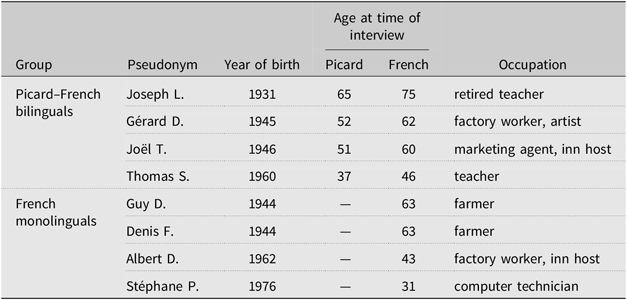
Picard and French constitute an ideal pair for assessing subtle similarities and differences between a regional minority language and its national, dominant counterpart. Indeed, in situations where the two varieties have a common ancestor and thus share an important portion of their lexicon, morphosyntax and phonology, it is easy to focus on the superficial similarities between the two varieties and underestimate the deeper differences that separate them. Focusing on morphosyntactic variation, our recent work assesses the degree of structural convergence and divergence between French and Picard. To do so, we examine Vimeu Picard and French oral data extracted from sociolinguistic interviews with four Picard–French bilingual men, and Vimeu French oral data from a control group of four French monolingual men (cf. Table 1).Footnote 2 The first author collected the Picard data in the late 1990s; the second author collected the French data in the mid 2000s.
Oral Picard and French corpus, subjects’ demographic information (adapted from Villeneuve and Auger, Reference Villeneuve and Auger2013: 119)

Results obtained so far reveal that the degree of linguistic differentiation between Picard and French is related in part to the degree of perceived structural similarity between them for a given dependent variable: recent Picard speakers tend to prefer structures that they deem most different from standard French. Bilinguals displayed much greater difference between Picard and French for variables that involve a variant that is identified as typically Picard in the grammars we surveyed: subject doubling (in 1) and auxiliary alternation (in 2), for instance (Haigneré, Reference Haigneré1901; Ledieu, Reference Ledieu1909/2003; Hrkal, Reference Hrkal1910; Cochet, Reference Cochet1933; Vasseur, Reference Vasseur1996). Specifically, in our analysis of the occurrence of subject doubling in contemporary spoken data, we found that as a group, bilinguals display highly significant differences between the two varieties (Villeneuve and Auger, Reference Villeneuve and Auger2013). Similar results were obtained for auxiliary alternation: avoir was categorically absent in bilingual speakers’ oral French and significantly higher in their oral Picard, especially for speakers who also write and publish in Picard (Auger, Reference Auger, Landrecies and Petit2003; Auger and Villeneuve, Reference Auger and Villeneuve2017).
(1)


(2)

For other variables that are less commented on in Picard grammars, there may not be, quantitatively speaking, any contrast between Picard and French oral output, as we found to be the case for the choice between the periphrastic future and the inflected future (Auger and Villeneuve, Reference Auger and Villeneuve2017). Yet, behind these similar distributional patterns in future forms, we uncovered subtle differences in the linguistic factors (e.g., sentential polarity) that constrain the choice between the periphrastic and the inflected future variant in French and in Picard.
The contrast between Picard and French was even sharper when we examined co-occurrence patterns across dependent variables. For instance, when we analysed how variable subject doubling combines with the variable presence of negative ne (as in 3), we found asymmetries in the distribution of the four possible combinations—from a doubled subject with negative ne (cf. 3a) to the absence of both doubling and negative ne (cf. 3d)—in the French and Picard speech of bilinguals. All four combinations were attested in French and the most marginal pattern in French, a doubled subject with ne (as in 3a), was the most frequent in Picard. Conversely, a non-doubled subject with overt ne (as in 3c), the most common pattern in French, is unattested in our oral Picard data. Thus, even though Picard and French share subject doubling and ne deletion, the way in which the variants combine highlights the contrast between the two linguistic varieties.
(3)

These co-occurrence patterns are likely due to the fact that subject doubling carries a different stylistic value in French and in Picard – a doubled subject is colloquial in French but standard in Picard – while ne presence corresponds to the standard in both varieties. Thus, consistent with the general claim made by proponents of the diglossic approach (Massot, Reference Massot2010; Zribi-Hertz, Reference Zribi-Hertz2011), variants that carry a similar stylistic value co-occurred with great frequency (e.g., a doubled subject with negative ne in Picard, a non-doubled subject with ne in French), while those with different stylistic values were virtually unattested (e.g., a doubled subject with negative ne in French).
In short, based on the evidence we have gathered so far, Vimeu Picard and French follow three patterns with respect to morphosyntactic variation: significantly different distributions of variants, distinct internal constraints for each variety hidden behind apparent distributional similarities, or sharp contrasts in the way variants combine across dependent variables in Picard and in French. Building on our previous work, we now turn to another dependent variable which may shed more light on French and Picard morphosyntax: interrogative constructions.
3. YES/NO AND WH- QUESTIONS IN FRENCH AND PICARD
French interrogatives are a frequent target of investigation due to the many structures that can be used to ask a question. We distinguish two dependent variables for interrogatives based on the type of answer elicited: yes/no (or total) questions, which elicit affirmative or negative answers, and wh- (or partial) questions, which elicit answers that contain specific information such as time, place, cause, etc. For that reason, we present and analyse these two types of interrogatives separately in the current study.
3.1. French interrogatives
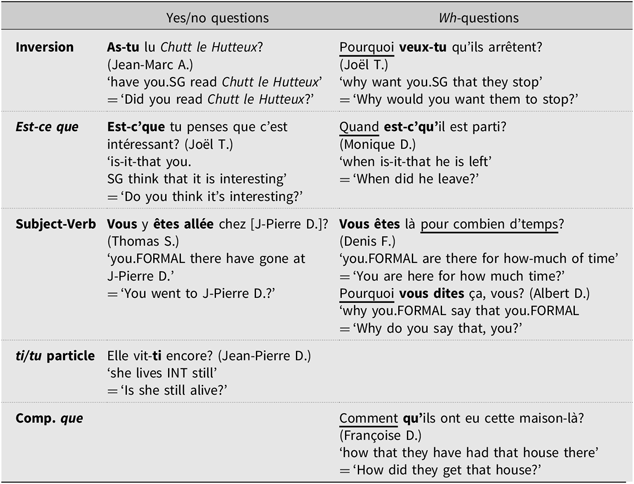
In French, both yes/no and wh-questions comprise a number of variants: subject-verb inversion, est-ce que Footnote 3 ‘is it that’, use of declarative word order often with rising intonation, a number of forms involving uses of complementizer que in wh-questions, and interrogative particle ti in yes/no questions.Footnote 4 Table 2 illustrates this variation with examples from Villeneuve’s (Reference Villeneuve2011) Vimeu French corpus. As in most French corpora from the twentieth or twenty-first century where interrogatives have been studied, the ti interrogative particle is unattested in Wh-questions in our Vimeu French corpus.
Interrogative structures in French

Ashby (Reference Ashby1977), Coveney (Reference Coveney, Green and Ayres-Bennett1990; Reference Coveney1997), Myers (Reference Myers2007) and Farmer (Reference Farmer2013; Reference Farmer2015), among many others, have conducted empirical analyses that show a clear dominance of intonation coupled with a Subject-Verb sentence structure (henceforth SV) in Hexagonal French, followed at some distance by est-ce que as a second option. In most corpora of contemporary Hexagonal French, ti is unattested and subject-verb inversion is virtually absent. Coveney’s (Reference Coveney1996/2002) survey of French grammars also reveals that the various forms of both yes/no questions and wh-questions elicit different sociolinguistic judgements. For instance, subject-verb inversion is generally evaluated as characteristic of a more careful style that may also be used in writing, SV order is viewed as ‘colloquial’, and interrogative ti as ‘rural, working class, uneducated’.
The overwhelming dominance of SV questions and virtual absence of subject-verb inversion that characterizes Hexagonal French does not extend to North American varieties of French. Indeed, Fox (Reference Fox1989), Elsig and Poplack (Reference Elsig and Poplack2006), Elsig (Reference Elsig2009) and Comeau (Reference Comeau2016) reveal that forms that have virtually disappeared from Hexagonal French, namely subject–verb inversion and interrogative ti/tu, are still solidly attested in Canadian French. Fox (Reference Fox1989: 192) reports that, in Québec City French, SV, interrogative tu and inversion occur with very similar frequencies in yes/no questions (35.6%, 33.8% and 29.0%, respectively).
3.2. Picard interrogatives
The studies briefly reviewed above paint a detailed picture of the actual usage of the interrogative structures in varieties of French. Not surprisingly, no comparable studies exist for Picard. Monographs that focus on specific varieties of Picard and volumes that aim to teach Picard do not provide sufficient elements to gain a full understanding of the interrogative system in Picard. Furthermore, some of the information found in different monographs appears contradictory and/or points to possible dialectal differences. For example, Haigneré’s (Reference Haigneré1901: 333) grammar of the Picard variety of Boulogne-sur-Mer claims that subject-verb inversion is observed with all persons except for 1sg, whereas the Chés diseux website, which is created by a speaker of Amiénois Picard, considers that, apart from a few rare exceptions, there is no such inversion. The only study devoted to interrogative structures in Picard, Dagnac (Reference Dagnac, Casanova Herrero and Calvo Rigual2013), relies on a wide range of data: the Atlas linguistique de France, the only map that targets an interrogative structure in the Atlas linguistique et ethnographique picard, brief comments on interrogative structures in a few monographs about Picard varieties and the Chés diseux website, judgements from two speakers and some contemporary texts. Dagnac’s study reveals that Picard makes use of many of the structures described above for French, as seen in the Picard examples provided in (4) for yes/no questions and in (5) for wh-questions. One structure that is unique to Picard and is attested in both in yes/no and wh- questions is the interrogative particle jou (cf. 6), which stems from the generalization of 1s subject pronoun jo (for instance, peux-jou? ‘may I?’) to other persons (Hrkal, Reference Hrkal1910: 262).
(4)

(5)

(6)

The shared use of the same interrogative structures by Picard and French appears to support the claim made by Carton (Reference Carton and Holtus1990) and Éloy (Reference Éloy1997) that the syntax of Picard does not really differ from that of French.
A less neutral evaluation of the complexity of forms observed in Picard is found in Foulet (Reference Foulet1921). This comprehensive article, which builds on a rich corpus of data and provides a very detailed analysis of French interrogatives, includes a relatively short section in which the author discusses the interrogative structures documented for Gallo-Romance varieties in the Atlas linguistique de France. This analysis, based on the few maps that illustrate interrogative constructions, led Foulet to conclude: ‘Ce que nous avons dit suffit à montrer dans quel désarroi se trouvent ici les patois. Emportés par le grand courant de la langue, mais incapables de gouverner, ils s’en vont à la dérive, et le moindre remous leur est un puissant obstacle. Sans idée directrice, sans tradition stable, ils sont prêts, et résignés d’avance, à toutes les aventures’.Footnote 5 (Foulet, Reference Foulet1921: 342).
4. METHODOLOGY
In order to expand on our previous work on Picard and French morphosyntactic contrasts and to determine whether Picard interrogatives really are in such a state of disarray, we collected all instances of yes/no and wh-questions in our Picard and French corpora. We first examined our oral corpus of sociolinguistic interviews, described in Table 1 (for a detailed description, see Villeneuve and Auger, Reference Villeneuve and Auger2013), but soon realized that ascertaining change in the Picard interrogative system would require an analysis of diachronic data. Due to the rarity of older recordings in Picard, we were forced to turn to written data, which exist in sufficient quantity for the Vimeu region. While relying on texts can raise serious methodological concerns given that Picard is strongly associated with orality and that written data may imperfectly capture everyday spoken usage, carefully selected texts can provide valuable data for the diachronic study of language variation and change (Martineau and Mougeon, Reference Martineau and Mougeon2003; King, Martineau, and Mougeon, Reference King, Martineau and Mougeon2011). Indeed, the fact that Auger (Reference Auger, Pusch and Raible2002, Reference Auger, Landrecies and Petit2003) established the faithfulness of written Picard to the spoken language reaffirmed our confidence in adopting this approach to determine whether the Picard interrogative system is changing and, if so, whether it is converging toward French.
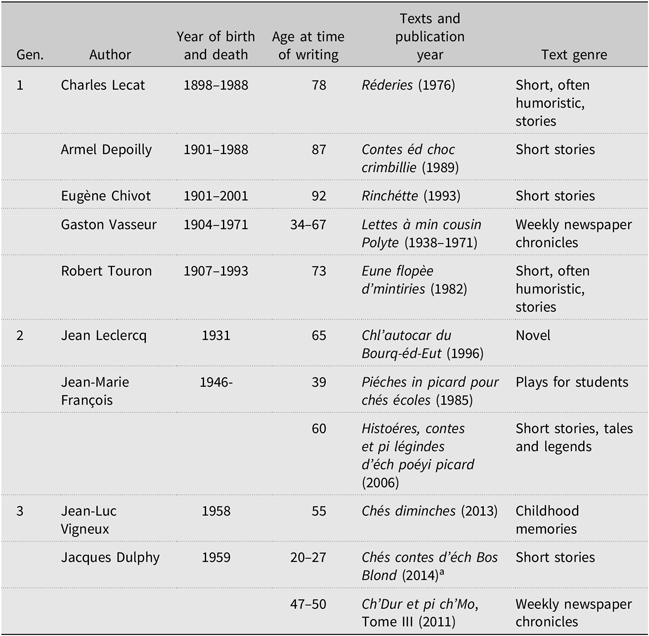
As we see in Table 3, our written corpus contains texts from nine different authors born between 1898 and 1959. In order to facilitate comparisons over time, we have divided our authors into three generations: (i) Generation 1 (born before World War I: between 1898 and 1907), (ii) Generation 2 (born in 1931 and 1946) and (iii) Generation 3 (born in 1958 and 1959). Generation 1 is represented by five men who grew up in homes and communities in which Picard was the dominant language of communication. Generations 2 and 3 are represented by two speakers each. All four authors grew up in communities in which Picard was still in use but in which French played an important role. One member from each generation, Leclercq and Dulphy, grew up with Picard as their native language. The other two, François and Vigneux, had significant exposure to Picard while growing up but did not start actively speaking the language until they reached their late teenage years or early adulthood. While these similarities might suggest grouping these four speakers as a single generation, doing so would obscure noteworthy differences in their linguistic usage (see below).
Written Vimeu Picard corpus divided over three generations of authors

a This book was written in the early 1980s and published later.
Two characteristics are shared by authors from all three generations. First, all nine authors are male. While there are female authors who write in Picard, the literary production of any of them is far less voluminous than that of any male author, thus making it impossible for us to collect sufficient numbers of tokens. Such a state of affairs is very unfortunate for a diachronic analysis of interrogative structures, as it is well established that women are more innovative than men in instances of change in progress (Labov, Reference Labov1990). In order to determine whether the absence of data from female authors might obscure current trends, we have supplemented our main corpus with data from five female authors. We will see below that even though the number of tokens collected from their texts is quite small, their use of interrogative structures clearly is in line with the patterns observed in their male counterparts’ data.
The second characteristic shared by all nine authors is the fact that they were or are all taking an active part in the promotion and recognition of the Picard language. This is particularly true for Gaston Vasseur, who published a weekly chronicle in Picard for 33 years and founded the Picardisants du Ponthieu et du Vimeu, a group that has met on a monthly basis for 50 years to read and hear texts written in Picard. It is also true for members of the last two generations since three of them, Jean-Marie François, Jean-Luc Vigneux and Jacques Dulphy, play central roles in many activities and associations that centre around Picard culture. In the context of a revitalization movement of a regional language that is closely related to the national language, it is plausible that authors involved in promoting Picard might seek to increase the distance between Picard and French by inserting into their texts features perceived to be more Picard-like or by overgeneralizing use of such features. As a matter of fact, Auger’s (Reference Auger, Landrecies and Petit2003) comparison of oral and written usage has revealed such instances. This is precisely the reason why we have chosen to focus our research on morphosyntactic structures that are subject to complex linguistic conditioning. For example, if our analysis of interrogative structures reveals that the distribution of variants is governed by such factors as interrogative type, sentential polarity and subject person, and if it is constant across generations, we will argue that such a distribution truly reflects the grammatical competence of their authors.Footnote 6
In these two corpora, we have collected all instances of yes/no and wh-questions for which variation is possible. Because the two types of questions allow for different interrogative constructions, such that interrogative ti is only possible in yes/no questions and que-insertion only occurs in wh-questions, the two types are analysed separately. An additional reason for the separate treatment comes from Dagnac’s (Reference Dagnac, Casanova Herrero and Calvo Rigual2013) observation that the wh-questions that she collected are very homogeneous in structure, whereas yes/no questions are much more diverse. Our data collection excluded (i) questions in which no variation is possible, which includes questions that do not contain a tensed verb, as illustrated in (7), those that include a tag, as in (8), as well as (ii) interrogative structures that express doubt or surprise but that do not seek a response from the addressee, as in (9).
(7)

(8)

(9)

5. ANALYSIS
5.1. Wh-questions
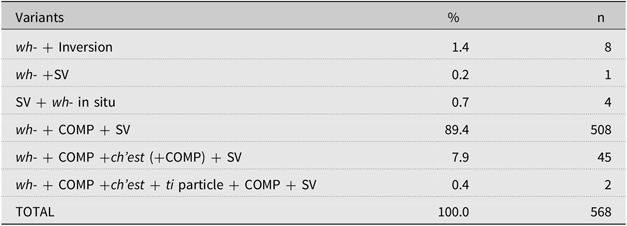
As shown in Table 4, our data confirm Dagnac’s (Reference Dagnac, Casanova Herrero and Calvo Rigual2013) observation that the structure of Picard wh-questions is very homogeneous: a wh-word followed by the complementizer qu — or its complex variant qu’ch’est que — and a declarative SV sentence structure is observed nearly categorically. If we add the cases of wh- + qu + SV (89.4%), as illustrated in (10a-c) and those that involve a complex variant of the complementizer (7.9%), as in (10d), this represents 97.3 per cent of our 568 wh-questions. Only eight cases of inversion-like constructions occur in our corpus, and they all involve cmint veux-tu ‘how do you want’; see (11a). The fact that these apparent cases of inversion are so restricted and that the cmint veux-tu structure is only found in the writing of two authors (seven tokens in Vasseur’s text and one in Leclercq’s)Footnote 7 suggests that these are cases of lexicalization rather than the product of syntactic inversion. As for the four tokens of quand est-che/èch que, we interpret these as cases of the lexicalized wh-word quantéche (cf. 11b for use of this spelling) rather than as instances of inversion, which we also do for the 57 tokens of tchéche/tchèche—a wh-word that means ‘who’ and results from the lexicalization of qui est-ce (Vasseur Reference Vasseur1996: 77); see (11c). Consequently, we count these tokens as instances of the dominant wh- + COMP + SV structure.Footnote 8 Finally, the other constructions attested are represented by so few examples that we do not comment on them any further.
Wh-questions in written Vimeu Picard

(10)

(11)

The overwhelming dominance of wh- + COMP + SV in Vimeu Picard wh-questions contrasts with what is seen in the French wh-questions that we have collected in our oral corpus, where the dominant complementizer strategy that characterizes Picard is unattested.Footnote 9 Rather, we find in-situ as the most frequent construction, followed by some examples of fronting, est-ce que and subject-verb inversion. While these data provide clear evidence that Picard and French resort to different structures in wh-questions, the lack of variation observed in both our written and oral Picard data does not call for a detailed analysis. For this reason, we focus on yes/no questions from this point forward.
5.2. Yes/no questions
While sociolinguistic interviews are a great tool for collecting large quantities of naturalistic speech, one of their limitations is the rarity of some constructions. Because interviews typically feature questions from interviewers and answers from interviewees, interrogative structures tend to be rare in this type of recording. This is unfortunately the case in our oral corpus. Indeed, we have collected only 20 tokens of yes/no questions in Picard and 14 in French; examples are provided in (12) for PicardFootnote 10 and (13) for French. As expected, all 14 French questions are of the SV type. In spoken Picard, SV also constitutes the dominant construction, with 17 tokens (85%), but the use of inversion in three tokens (15%) suggests that use of this structure is far from marginal.
(12)

(13)

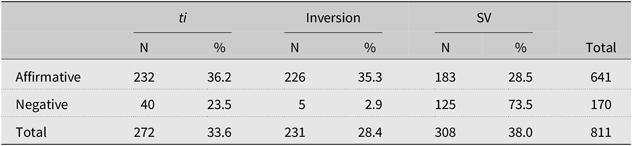
The small number of questions in our oral corpus prevents us from pursuing our comparison of Picard and French much further. For this reason, we now turn to our written Picard data, for which we have collected 811 yes/no questions. As we see in Table 5, Picard yes/no questions make relatively equal use of three different constructions: ti, inversion, and SV.
Yes/no questions in written Vimeu Picard

χ2 = 127.0; p < .001
Yet, a preliminary examination of our data prompted us to investigate the effect of sentential polarity, as negative polarity appeared to disfavour subject-verb inversion. Indeed, once polarity is taken into account, markedly different patterns of use reveal themselves for affirmative and negative questions. In affirmative questions, the relatively equal use of the three constructions that we observed above still obtains. However, in negative questions, inversion is marginal, with only 2.9% of use, and SV dominates with 73.5%. The difference between affirmative and negative questions is illustrated in (14), where we see use of inversion in the affirmative question, but SV in its negative counterpart.
(14)

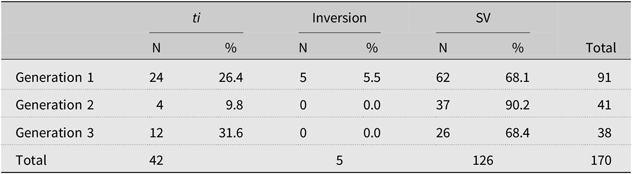
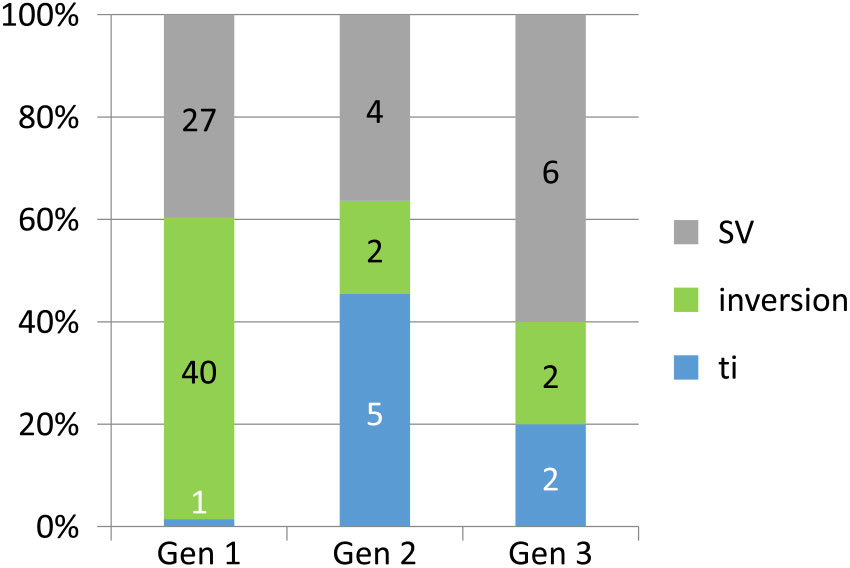
The high frequency of the SV construction in negative questions suggests a possible convergence toward French. In order to determine whether this is the case, Table 6 reports the data by generation of authors. This breakdown reveals that use of inversion was marginal in Generation 1 and that it has completely disappeared in Generations 2 and 3. As for SV, which was already the dominant structure in the written data from authors from Generation 1, its use greatly increases among Generation 2 authors, where it reaches 90.2% (Generation 1 vs. 2: χ2 = 7.78; p = .020). Interestingly, however, Generation 3 returns to a pattern that, with the exception of the disappearance of inversion, closely mirrors that of Generation 1, with interrogative ti being used in 26.4 and 31.6 per cent of interrogatives, respectively, and is significantly different from that of Generation 2 (Generation 1 vs. 3: χ2 = 2.35; p = .309; Generation 2 vs. 3 [without inversion]: χ2 = 5.82; p = .016). This suggests that the possible convergence toward French observed in Generation 2 has been reversed in the youngest generation, a pattern that has been reported in other communities where an endangered linguistic variety is undergoing revitalization (e.g., Dubois and Horvath, Reference Dubois and Horvath1999) and that is compatible with the tendency documented in Auger’s (Reference Auger, Landrecies and Petit2003) analysis of Picard’s emerging literary norm, which favours linguistic variants that contribute to differentiate Picard from French.
Negative yes/no questions in written Vimeu Picard, by author generation

χ2 = 11.1; p = .026
While the quantitative analysis above provides some evidence for overall stability in negative interrogatives across generations, there remains the possibility that the three generations might differ qualitatively. One possible difference concerns the choice of interrogative construction in connection with the two main sentential negation adverbs, mie and point. Even though both negations occur in similar clauses, as can be seen in (15), Burnett and Auger (Reference Burnett and Auger2016) argue that point constitutes the neutral negative marker while mie is used in more limited contexts as it serves to contradict or express annoyance or anger at an interlocutor. Given this difference in meaning, we would expect the two negations to favour different interrogative structures. According to Debrie (Reference Debrie1983: 40) and one of our consultants, this is the case: only point is compatible with interrogative ti.
(15)

As expected given the neutral nature of point, this negation dominates in our corpus of written questions. Indeed, 146 out of 170 negative questions contain point (85.9%), eight contain mie (4.7%), and the rest contain other secondary negations: janmoais ‘never’, pus ‘anymore’, personne ‘nobody’ and rien ‘nothing’. More interestingly, whereas all three interrogative structures are attested with point (SV = 70.5%; inversion = 3.4%; ti = 26.0%), none of the eight tokens of mie occur with either ti or inversion. While this difference does not reach statistical significance (Fisher Exact p = .188) due to the small number of tokens, making it difficult to rule out the possibility that a larger corpus might yield examples of the missing structures, we interpret the uniform cross-generational patterns as evidence that the constraint against the combination of mie and ti is stable across generations. Additional support for this claim comes from grammaticality judgments elicited by Burnett and Auger (Reference Burnett and Auger2016): while all seven of their consultants from Generations 2 and 3 accept (16a), only one of them marginally accepts its counterpart in (16b).
(16)

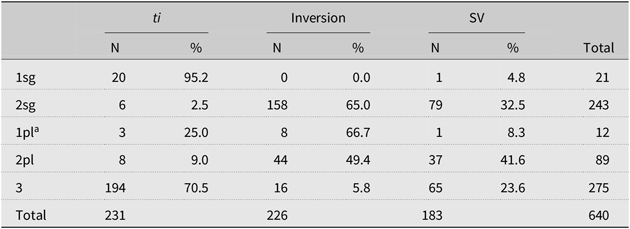
We now turn our attention to affirmative questions. We saw in Table 4 that the three different interrogative variants are used with relatively similar frequencies in affirmative questions. However, these numbers conceal the strong effect of subject person. As Table 7 shows, inversion is the dominant construction for only one person: 2sg subjects. In contrast, ti is observed almost categorically with 1sg subjects and clearly dominates with third person subjects. Even though the numbers of tokens involving 1sg and 1pl subjects are small, they reveal interesting patterns. The simplest one is observed with 1sg subjects, for which ti is used almost categorically and inversion is unattested (cf. Haigneré Reference Haigneré1901: 333). However, the high frequency of inversion with 1pl is very surprising to us as speakers of Québec French. Indeed, we would have expected the ti construction, illustrated in (17), to be the most frequently used strategy. Consultation with two speakers from the Vimeu region reveals that inversion with nous is quite acceptable in this variety of Picard. The reaction from an Amiénois Picard speaker, who rejects inversion with nous and expresses a strong preference for the use of ti in this person, suggests that the former may be specific to Vimeu Picard. Furthermore, there are indications that use of ti with 1pl subjects may be increasing: (i) while one token of ti comes from a Generation 1 author, the other two were produced by Dulphy; (ii) data from our female speakers reveal use of ti in 1pl yes/no questions. Finally, 2pl subjects differ from all other persons: ti is used infrequently with this person, whereas inversion and SV are used with relatively similar frequencies. This pattern warrants a closer examination of the three generations separately.
Affirmative yes/no questions in written Vimeu Picard, by subject person

a Only verbs marked for 1pl, such as (i), are coded as such. Forms that correspond to French on, as (ii), were coded as third person. The use of inversion is only observed with 1pl verbs.

(17)

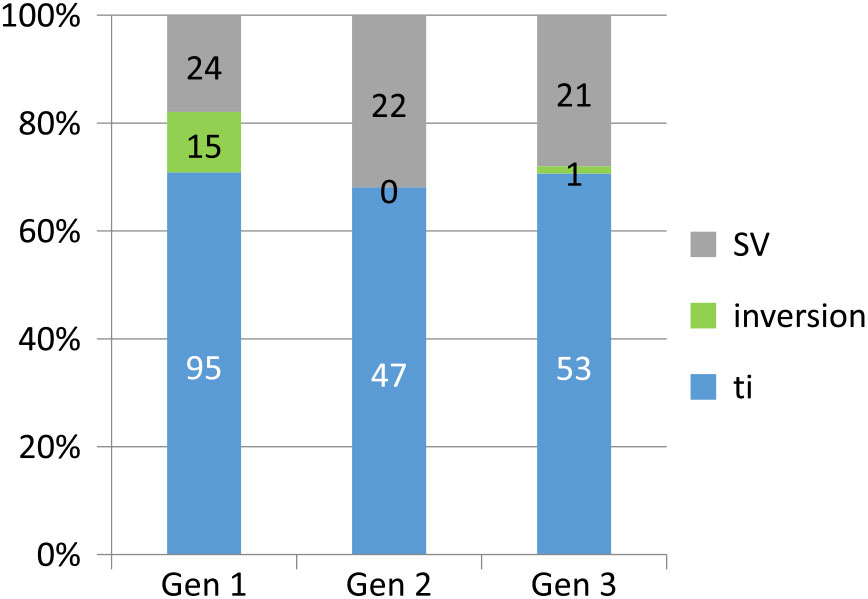
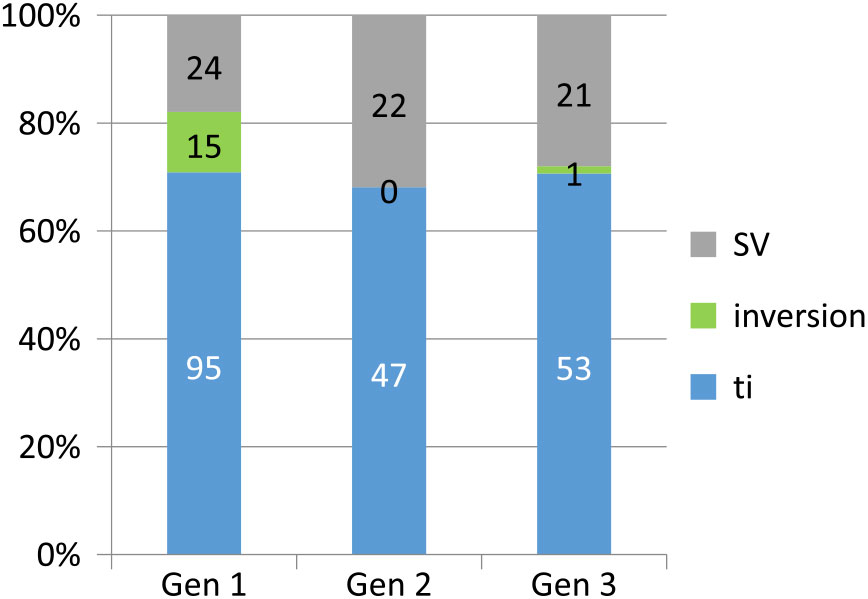
Since interrogatives featuring third person singular and plural subjects behave very similarly, we consider them together. As seen in Figure 1, ti is the dominant strategy across all three generations as it is found in approximately 70 % of tokens. The second most frequent construction is SV. Inversion is the only structure that changes across generations: from a frequency of 11.2 % in Generation 1, it completely disappears in Generation 2 and represents 1.3 % of tokens in Generation 3, with only 1 token. The difference between Generation 1 on the one hand and Generations 2 and 3 on the other is significant (χ2 = 17.4; p < 001). It appears that what was a relatively marginal construction in the oldest generation has virtually disappeared in the younger generations and has been replaced by SV.Footnote 11 Thus, while use of ti remains strong in questions that feature third person subjects, a possible effect of convergence toward French can be seen in the replacement of inversion by SV.
Affirmative yes/no questions with third person subjects, by author generation (N = 278).
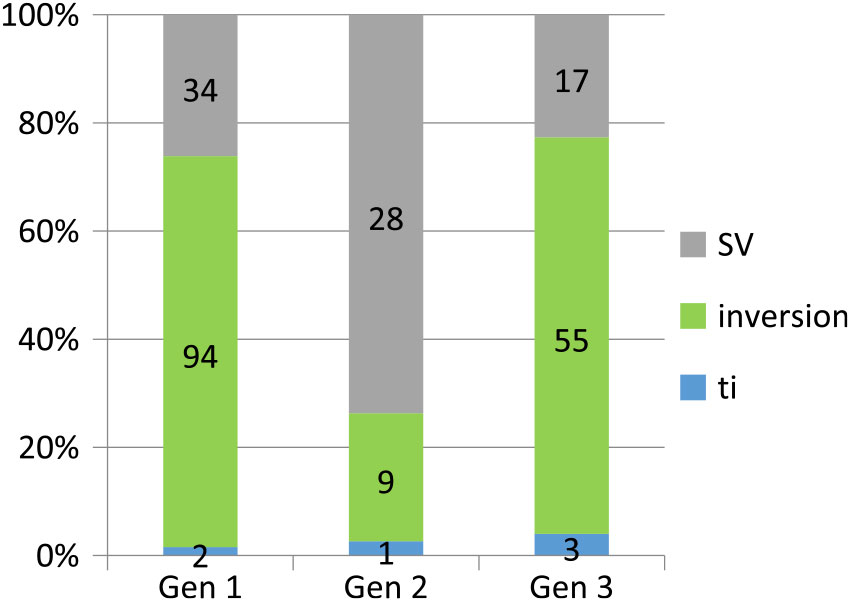
A very different pattern characterizes interrogatives whose subject is a 2sg pronoun, as seen in Figure 2. Across all generations, ti constitutes a marginal strategy. Generations 1 and 3 exhibit the same pattern in which inversion clearly is the preferred construction, with SV taking a distant second position (χ2 = 1.42; p = .491). Generation 2, which is significantly different from the other two generations (χ2 = 17.4; p < .001), reverses the frequencies for inversion and SV, with SV being the favoured option in roughly 75 % of tokens. This pattern mirrors that observed for negative questions and provides another example of a younger generation reverting to a pattern characteristic of an older generation.
Affirmative yes/no questions with 2sg subjects, by author generation (N = 243).
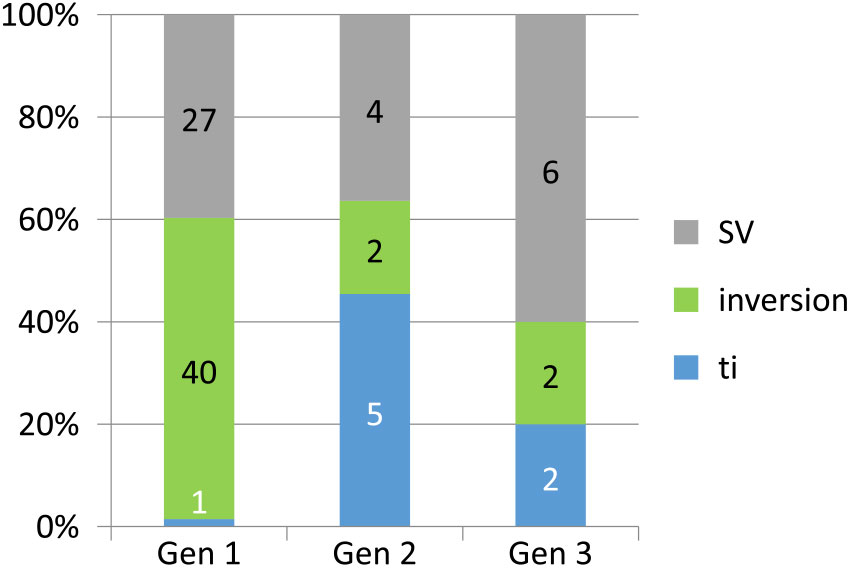
We now turn to yes/no questions that feature a 2pl subject. Given that, in Québec French, 2sg and 2pl questions both allow inversion in yes/no questions (Elsig, Reference Elsig2009: 77), we would have expected this strategy in Picard as well. However, as seen in Figure 3, our data show that this is the case only in Generation 1. In this generation, ti is used very marginally, and SV is the second choice. Generation 2 authors depart from their elders by making interrogative ti their preferred strategy and relegating inversion to last position. As for Generation 3, they show a preference for SV, relegating both inversion and ti to second choice. Once again, the difference between Generation 1 and the two younger generations is significant (χ2 = 23.5; p < 001), but that between Generations 2 and 3 is not (χ2 = 0.712; p = .701). While we take these results with caution given the small numbers of tokens for the two younger generations (11 and 10, respectively), they suggest that use of inversion with 2pl subjects decreases in younger generations. What is less clear is which structure is replacing inversion, as Generation 2 authors appear to favor ti, while those from Generation 3 prefer SV. These results also suggest that 2sg and 2pl are autonomous from each other in Vimeu Picard, as inversion remains the dominant structure for 2sg and the spread of ti currently only affects 2pl pronouns.Footnote 12
Affirmative yes/no questions with 2pl subjects, by author generation (N = 89).
6. CONCLUSION
Having analysed a diverse set of Vimeu Picard data, we now return to our main research question: Do Picard interrogative constructions differ from those found in French? Given that the structures used in Picard have counterparts in formal and informal French, one could argue, like Carton (Reference Carton and Holtus1990) and Éloy (Reference Éloy1997), that the two languages share the same grammar. However, our oral data show that the distribution of variants differs considerably across the two languages. For instance, while it is possible to find tokens of wh-words followed by a complementizer in Vimeu French, this structure is unattested in our oral corpus. Yet, this very structure is the only one attested in our Picard oral data and is used almost categorically in our written data. Similarly, Picard and French exhibit important differences in yes/no questions. Even though, in principle, the various constructions described in the literature are shared by the two languages, their actual distributions differ markedly. In our oral French data, SV is the only structure attested; in Picard, however, both inversion and SV are attested. While this generalization is based on an insufficient number of tokens to provide conclusive evidence that the trends observed are representative of the two varieties, our French data are compatible with the results from studies based on much more extensive corpora (e.g., Coveney, Reference Coveney1996/2001; Farmer, Reference Farmer2015).
Contrary to what Foulet (Reference Foulet1921) claimed, the interrogative system of Vimeu Picard is not in a state of disarray. Our analysis of yes/no questions in written Picard reveals a complex system in which the distribution of three different structures is influenced by two important linguistic constraints: polarity and subject person. Our comparison of three generations of authors shows a high degree of stability in this system while uncovering evidence of change in progress as well as some resistance to convergence toward French. For instance, subject-verb inversion is the most frequent structure used for second person subjects in yes/no questions in our older written texts. While a decline in inversion and an increase of SV order is observed in the intermediate generation, our data for the youngest generation of authors – those born in the late 1950s – reveal a distribution virtually identical to that of the first generation. With 1sg and third person subjects, use of the interrogative particle ti is most frequent. Although SV questions are attested, they are quantitatively marginal and mostly limited to questions in which confirmation is sought or disbelief is expressed. In wh-questions, doubly-filled COMP is used quasi-categorically, as shown in Table 4. Thus a clear difference emerges between Picard and French whether in its formal or informal form.
What makes interrogative structures particularly interesting is that recent written and oral Picard data fail to provide evidence for widespread convergence. Indeed, interrogative ti remains a dominant interrogative strategy in yes/no questions with 1sg and third person subjects, and our preliminary analyses had revealed examples of its use with second person subjects as shown in (18) (Auger and Villeneuve, Reference Auger and Villeneuve2017). While this article provides additional examples of ti with 2sg and 2pl subjects, it fails to demonstrate that Vimeu Picard is moving in the direction of Amiénois Picard, where ti is used with all persons (Hrkal, Reference Hrkal1910; Debrie, Reference Debrie1983; Chés diseux). We contrast the persistence of this marginal structure across all three generations with the disappearance of another marginal structure, namely inversion with third person subjects, and interpret this as evidence of one more instance of divergence from French.
In contexts of revitalization, one real danger involves rule overgeneralization and the creation of hypercorrect forms by speakers who do not fully master the endangered language (cf., e.g., Dawson, Reference Dawson and Antoine2004 and Landrecies, Reference Landrecies2006). The interrogative data analysed in this article provide no such evidence. For instance, the fact that subject-verb inversion and interrogative ti are possible but mutually exclusive in yes/no questions, as seen in (19), can be attributed to the fact that they both realize the same [+interrogative] feature and that this feature cannot be associated with more than one element. This can be interpreted as evidence that these structures are conditioned by the grammar of the language. Similarly, the absence of generalization of ti to wh-questions (cf. 20) provides further evidence that younger generations of speakers and authors are not blindly adopting Picard features but are aware of the constraints that govern their usage.Footnote 13
(18)

(19)

(20)

Another danger of the revitalization movement arises from the possibility that the speakers’ militant involvement might cause them, whether consciously or not, to prefer forms that distinguish Picard from French more sharply. Given that the simple fact of writing in Picard constitutes, in this day and age, a form of militant activity, we recognize that all of our written data were produced by actors who promote the Picard language. Furthermore, all authors in our corpus are males who completed considerable schooling and pursued liberal careers (teachers, accountant, press correspondent, pharmacist), a socioeconomic profile which contrasts with that of most picardisants du cru, i.e., traditional speakers of Picard. Consequently, we must wonder what our data would look like if we expanded our dataset to cover authors with different backgrounds. In order to test the possible role played by the militant process, we collected interrogatives in the texts written by Léopold Devismes, a picardisant du cru and retired peasant born in 1912 who had spoken Picard all of his life. Devismes’ texts are especially interesting as his writings aim at documenting lost rural practices and not at producing literary texts, thus opening a window on a form of Picard closer to its traditional forms. Unfortunately, Devismes’ texts contain only 10 tokens of yes/no questions. Crucially, however, his usage once again mirrors that observed in our written corpus: inversion with 2sg, dominance of ti with third person subjects and SV in his only negative question.
One last word of caution pertains to the fact that our data may obscure potential gender-differentiated patterns. With the exception of 1pl subjects, we have not discussed the data collected in texts written by female authors. The five female authors in our broader corpus span the three generations that we have worked with, with one author born in 1915, two born in the 1940s and two born in the late 1950s. From their texts, we collected 74 tokens of yes/no questions. While such a corpus clearly is too small to warrant firm conclusions, the pattern it reveals mirrors that described for male authors: (i) inversion dominates for 2sg, is attested for 2pl, but unattested with any other person; (ii) ti dominates for 1sg and third person and is attested for 1pl and 2pl, but not for 2sg; and (iii) negative questions favor SV.
The next step in our research on Picard interrogative structures will investigate an important element left unaddressed in this article: the association between specific interrogative variants and pragmatic function. Indeed, previous research has shown that interrogatives can serve several functions and that the likelihood of using one linguistic variant or another is strongly connected to this function (Saint-Pierre, Reference Saint-Pierre1977; Fox, Reference Fox1989; Coveney, Reference Coveney1996/2002, Reference Coveney1997 and Farmer, Reference Farmer2015, among others). For instance, questions that constitute genuine requests for information differ from those that seek confirmation (or disconfirmation) of information that a speaker thinks they hold. In addition, some interrogatives are invitations to perform some action rather than requests for information. The extent to which the effect of polarity and person on interrogative variant selection can be attributed to the pragmatic function associated with a negative question or the difference between 1sg and 2sg subjects can be explained by the kind of questions asked remains to be determined. We are convinced that adding this factor to our future analyses will help us better understand the complex though systematic patterns that the present analysis has revealed.