I
‘These colored men of the East’, declared the June 1860 Weekly Anglo-African about the visiting Japanese embassy, ‘are paving the way for a new state of things much needed in our country’.Footnote 1 African American and abolitionist newspapers embraced the 1860 Japanese embassy to the United States as ‘negroes from Japan’,Footnote 2 using race to create an imagined solidarity that subverted and transcended state hierarchies of ‘civilization’ and race.Footnote 3 The African American and abolitionist press, reimagining Japan and the Japanese, reframed racial prejudice as an experience in solidarity, to prove further the equality of all men, and assert African American membership to the worlds of civility and ‘civilization’. The acceptance of the Japanese gave politically and socially ostracized African Americans a new lens through which to present their quest for racial equality and recognition as citizens of American ‘civilization’. This imagined transnational solidarity reveals Japan's influence in the United States outside the American state's vision of how white and non-white powers should interact. Public representations of the Japanese have never been used as a lens on African American identity formation, historical production, or intellectual history in the antebellum era. Similarly, the cultural influence of Tokugawa Japan has not been studied using the writings of antebellum African American and abolitionist newspapers. Examining the writings of non-state actors traditionally excluded from early historical narratives of US–Japan diplomacy reveals an imagined transnational solidarity occurring within and because of an oppressive racial hierarchy, as well as a Japanese influence on antebellum African American intellectual history and cultural production.
The seventy-seven samurai embassy left Yokohama aboard the USS Powhatan in February 1860.Footnote 4 The singular diplomatic objective of the embassy was the ratification of the Treaty of Amity and Commerce, which, among other conditions, granted American access to certain Japanese ports. Unlike the Iwakura embassy of 1871, the sole purpose of the 1860 Japanese embassy was treaty ratification, not treaty negotiation or targeted information-gathering. As such, the men selected for this mission were not necessarily those who most wanted to learn about America and its people.Footnote 5 After refuelling in Hawaii and California, the USS Powhatan sailed to Panama. The embassy crossed Panama by train, boarded the USS Roanoke, and, after some minor confusion, arrived in Washington, DC, on 14 May 1860. After the treaty ratification on 17 May, the embassy experienced a whirlwind of technological and cultural demonstrations, celebrations, and shopping. The embassy spent nearly four weeks in DC, one night in Baltimore, Maryland, seven nights in Philadelphia, Pennsylvania, and two full weeks in New York before leaving the US for Japan on 30 June 1860.
Despite the significant cultural and racial discourse inspired by the presence of the Japanese in America in 1860, neither the embassy nor the racial implications of their visit have received serious scrutiny since Masao Miyoshi in 1979. English-language scholarship often leaps from Perry to Meiji, as if no US–Japan encounters of importance occurred between those fifteen years.Footnote 6 This gap is, in part, because of a reliance on state relations as the definitive lens through which to view this interracial, intercultural encounter.Footnote 7 Consequently, the interpretation first promoted by antebellum American publications of the 1860 Japanese embassy as a meeting of ‘East learning from West’ remains largely unaltered over 150 years later. The 1860 Japanese embassy has been mentioned in the past as a diplomatic anecdote in the Japanese journey towards ‘civilization and enlightenment’, partnered with a mistaken, though perhaps comforting, narrative of nations developing friendship through cultural exchange. Employing non-state sources to examine US–Japan encounters expands our understanding of the production of culture between minority groups and within nineteenth-century intellectual history, revealing a rich history of interracial encounters and their transnational influence.Footnote 8
The importance of the 1860 Japanese embassy was one of the few political issues upon which most antebellum Americans, regardless of race, gender, or region, could agree. Commercial interest in Japan transcended regional loyalties, and both Northerners and Southerners were inclined to think the best of ‘this wonderful people’,Footnote 9 their potential trade partners. The diplomatic mission was the ‘great event of the age’,Footnote 10 with some newspapers printing up to seven articles about Japan and the embassy per issue.Footnote 11 The America the Japanese explored demonstrated extravagant overtures of hospitality designed to inspire awe and a desire for commerce. The samurai, immediately upon their arrival, initiated a deluge of discourse that attempted to reconcile America's endemic racial hierarchies and understandings of ‘civilization’ with the nation's economic ambitions regarding Japan. The Japanese ambassadors – non-white men of conspicuous wealth and power – jumbled the usual metrics of American hierarchy-building. From the moment the embassy's visit was announced, and for the duration of the embassy's stay, the American metropolitan press struggled to define the Japanese while welcoming them into public and private American life.Footnote 12 Newspapers publicized ‘the fine heads, intellectual countenances and dignified bearing’Footnote 13 of the embassy members. Metropolitan publications struggled to reconcile the burgeoning link between ‘civilization’ and race with the commercial promise of the non-white embassy.Footnote 14 Newspapers depicted the Japanese as ‘a highly civilized people’,Footnote 15 even ‘the British of Asia’,Footnote 16 as early racial demarcations of ‘civilization’ splintered upon the presence of the Japanese in America. The male bodies of the Japanese ambassadors, physically incongruous with American understandings of non-white masculinity, became a centre of cultural contention.Footnote 17 The metropolitan press initially praised the Japanese as refined gentlemen, then later ridiculed the embassy as non-white inferiors. This shift in the metropolitan press's representation of the Japanese occurred within the fifteen weeks between the escort group's arrival in California on 17 March 1860 and the embassy's final departure from New York on 30 June 1860 – a time made more tumultuous considering the embassy spent nearly half that time at sea, physically out of reach of most Americans.
Acknowledging the later mistreatment of the embassy members was an opportunity for the African American press to demand an improved treatment of all non-white people: ‘Learn to respect the colored people in our midst, and we will know how to respect those from abroad.’Footnote 18 African Americans were politically and socially barred from the mechanics of American policy-making and ‘civilization’, a loosely defined hierarchy of power cobbled together as the United States geographically extended into the wider world. The Japanese presence and performance as powerful, sophisticated, men of colour on American soil challenged the validity of hierarchies of race and ‘civilization’ to create an imagined transnational solidarity between African American and Japanese people. Antebellum African American and abolitionist publications viewed the Japanese and the embassy's reception as a reflection of African American experiences of state hypocrisy and denigration as non-whites in a society ruled by a racial hierarchy. The vehicle for this imagined solidarity and interpretation of racial hierarchies was the African American and abolitionist press, a non-state source heretofore unexamined in the studies of the cultural influence of Tokugawa Japan.
Newspapers were a primary source of information and entertainment for nineteenth-century Americans. The African American middle class viewed newspapers and regular, quality reading material as a vehicle for personal improvement and respectability. African American newspapers reported national and international affairs, discerning the influence of world events on their community and quest for human rights. Political news and calls for racial equality occupied the majority of print space. There were also poems, stories, and brief amusements meant to entertain and inform the newspaper's middle-class audience. These newspapers, like many publications of the day, often featured a religious element.Footnote 19 Though, in the words of Erica L. Ball, ‘few free blacks had the financial means generally associated with middle class status’,Footnote 20 they were, on the whole, ‘aspiring men and women looking for more ways to ensure their behavior matched their sense of themselves as virtuous and respectable’.Footnote 21
This study examines the surviving discussion and interpretation of the Japanese generated by the African American press during the period of most volatile discussion of the embassy.Footnote 22 Every extant African American and abolitionist newspaper and periodical published between April and August 1860 was consulted for the purposes of this study.Footnote 23 The exact circulation figures of the African American press are unknown, but ‘based on scant commentary from the editors’, writes Frankie Hutton, ‘circulations ranged from 1,500 to 3,000’.Footnote 24 Newspapers were often shared orally in family parlours, schools, and literature circles, but free African Americans without access to these groups or the necessary funds to procure copies for themselves makes it unclear as to the extent of the press's reach.Footnote 25 African American publications were inaccessible to most residents of the American South due to the distribution censorship of anti-slavery literature.Footnote 26 Low literacy rates and lack of funds among both free Southern blacks and slaves would have made accessing these publications even more difficult. Any African American publication's immediate audience was therefore circumscribed to sympathetic Northerners and literate, most likely free, African Americans. Due to a dearth of data regarding the reading patterns of the urban poor or African American populations in the South, this study focuses on the reception of the Japanese by the free, middle-class African American population assumed to be the target audience of these newspapers.Footnote 27
II
Discussion of the Japanese commanded print space amidst calls for abolition, political debates, and horror stories of slavery and kidnapping. The Japanese embassy was one of the most important political events of the summer of 1860, and discussion of the Japanese pervaded all levels of society. The Japanese arrived at an already turbulent time in the United States and provided, with a state-supported whirlwind of exoticism and festivities, both a celebratory and contentious outlet for the political and social tensions facing the nation. America's volatile welcome and later rejection of the embassy reflected the threat the embassy members posed as non-white men of ‘civilization’ and power to America's tenuous hierarchies of race and ‘civilization’. News of ‘Prejudice against color manifested toward the Japanese embassy’ was important enough to include alongside Charles Sumner's rousing speech on the criminal nature of slavery, which directly challenged the ‘alleged inferiority of the African race, an argument which … leaves it uncertain whether the same principle may not be applied to other races, as to the polished Japanese, who are now the guests of the [nation]’.Footnote 28 A disclaimer in the same July issue of Douglass’ Monthly noted that ‘there are many topics which we would have gladly made room for in this our July number – some of them quite important and interesting; and yet we think that … our space could hardly be more worthily occupied’.Footnote 29 Despite the interest in Japan-related news, without any scheduled interactions with the Japanese, African American newspapers relied on circulated metropolitan coverage – even from publications that regularly belittled African Americans – from which to base their commentary.Footnote 30 Many of the African American publications that discussed the embassy did not introduce the Japanese or the purpose of their visit, implying that their readers were already familiar with the embassy from other sources.
Upon the arrival of the Japanese, some abolitionist newspapers joined in the celebration of Japanese exoticism, but reports of the extravagant pageantry surrounding the Japanese were largely absent from the African American press. This omission reflects, besides the prioritization of news regarding racial equality, a possible conflict between the editors’ visions of practical sensibility and the manner in which the Japanese were celebrated. A line-by-line analysis of fashion and frivolity would hardly have suited the pragmatic aesthetic these newspapers produced amidst urgent appeals for racial equality. Still, the Japanese people themselves were subjects of African American praise. Japan was ‘Arcadia realized’,Footnote 31 a land of no taxes, in which ‘drunkenness and vice are rare’.Footnote 32 ‘Japanese [belles]’Footnote 33 were modest and enjoyed reading, reflecting, and exemplifying the middle-class sensibilities the African American editors wished to promote. The ‘civilized world’Footnote 34 was reported to have ‘followed the example of the Japanese’Footnote 35 in valuing public education. Proper education fostered gentility and ‘civilized’ status, prompting one abolitionist newspaper to comment that ‘it would seem that the Japanese are really as much a reading people as some who are deemed more civilized than they’.Footnote 36 Even the justice system – an institution notorious for its treatment of African Americans – was, in Japan, fair and even co-operative: ‘the rich man [in prison] can have good food if he wants it, but only on one condition, that he shares it with his fellow prisoners’.Footnote 37 The early celebration of Japan and the Japanese reflected the aspirations of education and civility of the readers of the African American press.
While African American periodicals evinced a connection to Japan and the Japanese, the embassy neither sought nor desired interaction with African Americans as a community. Already displeased with the unanticipated extension of their visit, interacting with African Americans was far from the ambassadors’ agenda.Footnote 38 Identifying with a population viewed as lesser by America's ruling powers could potentially have had negative repercussions for the potential racial classification of Japanese people. With few exceptions, references to African Americans in the journals of the Japanese are limited to what are likely parroted repetitions of the racist rhetoric of the day.Footnote 39
The lukewarm detachment of the embassy from African Americans makes the African American perceived solidarity with the Japanese all the more significant. The members of the embassy were an interesting contradiction for many Americans: not white, but not quite ‘coloured’ either. This was not true for the African American press in 1860, which, having established an early identification with Japan, embraced the Japanese wholeheartedly as ‘negroes from Japan’.Footnote 40 African American publications scarcely used the ‘distinguished strangers’ epithet which the metropolitan press frequently used to describe the Japanese.Footnote 41 Instead, the Japanese were ‘distinguished colored foreigners’,Footnote 42 ‘distinguished colored visitors’,Footnote 43 or even ‘our Oriental brethren’.Footnote 44 The Japanese were ‘distinguished’ and ‘brethren’, neither hierarchically above nor below African Americans, but equal to all men, all men being equal. An article in the Weekly Anglo-African represented the Japanese as actually seeking out interaction with African Americans, asserting – only half in jest – that ‘[the Japanese] have inquired for “the stores of the brown-skinned men” [and said] “we want to trade with them”’.Footnote 45 In this fictionalized letter, the Japanese understood the slurs used against them. Despite – or, perhaps, because of – the embassy's experiences of racial intolerance, the Japanese envisioned in this encounter desired to connect with the African American community and offer ‘the brown-skinned men’ the connection most desired by the American state: commerce. Separated from the Japanese by state machinations, linguistic differences, and physical distance, the African American press imagined a perceived closeness between themselves and the Japanese, derived from an assumption of similar experiences of prejudice. Unlike articles attesting early African American contributions to the founding of America as a means of asserting black patriotism and citizenship, these interpretations of Japan transcended the nation to pursue a solidarity in defiance of a state that racially rejected its non-white people. Through imagined solidarity with the Japanese, the African American press expanded membership to non-white ‘civilization’ beyond America's borders.
The language barrier of the embassy and the political intent of their American hosts made it unlikely that the Japanese glimpsed any African American publications during their stay. The embassy's encounters with African Americans were distanced, and it does not appear that any effort was made to ensure otherwise.Footnote 46 It could even be argued – and was – that the separation of the Japanese from any exploited racial minority was a political calculation designed to impede solidarity and the exchange of ‘dangerously contagious’Footnote 47 sentiments. The Anti-Slavery Bugle portrayed potential interactions between the Japanese and enslaved African Americans as disruptive and powerful to all parties involved: the Japanese, for witnessing a more accurate picture of the civilization that longed to ‘enlighten’ them, and for ‘the negroes themselves [who] might draw improper inferences from the unusual attention paid by order of “the authorities” to gentlemen of color’.Footnote 48 As portrayed in the metropolitan press, the samurai ambassadors set a dangerous example, proving that men of colour could possess citizenship as members of ‘civilization’ and its accompanying cultural, economic, and political power. The physical separation of the Japanese from African Americans demonstrated to the African American and abolitionist press that even the leaders of the American government, though claiming slavery as a necessary evil or even a ‘form of civilization’,Footnote 49 intuitively registered slavery as wrong and ‘not, on the whole, calculated to give us much credit as a nation in the eyes of foreigners’.Footnote 50 The Anti-Slavery Bugle and National Anti-Slavery Standard, reprinting an article from the New York Evening Post, spoke to abolitionists and African Americans in one of the few acknowledgements in any American periodical of the insulation of the embassy from exposure to slavery. The article questioned why slavery, if truly the moral and religious imperative that some of its supporters claimed, needed to be hidden from the nation's civilized guests: ‘As slavery is the corner stone of our free institutions, why should it be hid from the gaze of strangers?’Footnote 51 Through analysing the reception of the Japanese, abolitionists and African Americans critiqued the hypocritical nature of American society and challenged the state's barbaric treatment of its non-white people.
III
As early as 1828, African American publications discussed Japan. Early nineteenth-century interpretations of Japan, regardless of their target audience, relied on much of the same material: the geography of the country, its agricultural opportunities, and the anticipation of trade. Apart from reprinted references to Japan's ‘barbarous treatment’Footnote 52 of shipwrecked foreigners, little news was produced or available regarding developments in Japan. Yet even in these early articles, the African American press evinced an interest in Japan for reasons beyond exoticism or commercial opportunity.
Each issue of the African American press served as a moral advance against the theories of innate African degeneracy promulgated by advocates of slavery. Elaborate compositions detailing the historical triumphs of African American people aided the argument against the pervasive rhetoric of black inferiority. These stories inspired readers themselves to ‘cultivate all the social virtues, improve our intellect, and render ourselves worthy of our origin’.Footnote 53 One such article in Freedom's Journal, reprinting from the African Repository and Colonial Journal, attested that, in the early history of mankind, ‘[the negro race] bore sway over almost all Asia, and traveled even to the borders of Japan. Negro settlements are at present, scattered through out [sic] the mountains of that country.’Footnote 54 This narrative, though historically inaccurate, reimagined African American and Japanese history to cast Japan as an early site of African connection. The triumphant reimagining of historical boundaries of state, race, and even geography in connection to the Japanese cultivated an imagined, shared past in the pursuit of a present and future membership to a global citizenship of ‘civilization’.
Japan was represented as a place where dark skin and ‘blackness’ were not laden with negative connotations, where ‘white is the sign of mourning, and black of rejoicing’.Footnote 55 The Japanese registered within the African American imagination decades before diplomatic narratives of ‘opening’ littered American headlines. Early discussions of the tribulations of a virtuous, mixed-race young American described her as of ‘Japanese complexion’.Footnote 56 To a writer wishing to solicit sympathy on behalf of mixed-race women, the Japanese were neither black nor white, but somewhere in between, yet still physically similar to many members of America's ‘coloured’ population. This shared physicality envisioned a relationship between African Americans and the Japanese that existed without hierarchy, diplomacy, or even the state.
The 1850s and the Perry Expedition sparked a surge in American curiosity about the nation's interests and doings in the Pacific. From the beginning of the African American press's relationship with Japan, the Japanese were a lens through which to critique American society. African American publications did not employ racism or narratives of barbarism to demean Japan.Footnote 57 Negative depictions of the Japanese were used, not to assert a disparity between Japan and the ‘civilized’ West, but to emphasize by comparison the inhumanity of Southern plantation owners. If Japan was barbaric for its treatment of non-Japanese, then Southerners were equally or more barbaric for mistreating those ‘of a different complexion’.Footnote 58
The American state interest in converting, trading, and communicating with Japan perturbed the African American press, distressed by the desperate needs of America's enslaved peoples: ‘Have you faith to believe that you can save your brother in Japan … and have you none in the cause of your brother here?’Footnote 59 Nevertheless, the African American affinity for Japan and the Japanese developed throughout the 1850s as the United States heightened its diplomatic ambitions. Beyond religious interests, the recognition of the sovereignty of non-white governments was paramount to African Americans eager to assert their own right to participate in the intercourse of the world and to promote the success and independence of non-white nations. African American newspapers saw the American government's refusal to recognize Haiti diplomatically, a country both geographically and culturally closer to the United States, to pursue instead commercial ‘favors which we now propose to force on Japan’Footnote 60 as a state denial of the value of non-white nations and, accordingly, non-white peoples.Footnote 61
A government that rejected commerce with a non-white country denied the legitimate claim of people of colour to participate in world ‘civilization’. For most nineteenth-century Americans, ‘civilization’ was a hazily defined arena of state recognition in which ‘civilized’ behaviour and some amalgamation of economic and/or cultural might, along with a certain racial classification, remained the criterion for entry. African Americans were, in many parts of the nation, considered undeserving of human rights, let alone citizenship. Many abolitionists encouraged the ‘return’ of African Americans to Africa, rather than an eventual integration into white society.Footnote 62 Many free African Americans laid their claim to equal membership in the world of opportunity, ‘civilization’, and power through their pursuit of education and a refined respectability. Civility as an indicator of ‘civilization’ also operated in reverse. Recognition from the powers of ‘world civilization’ conferred assumptions, if not of equality, then at least of the elevated human faculties, and thus the humanity, that civility entailed. Douglass’ Paper astutely ascribed the reason for the American government's refusal to recognize the sovereignty of Haiti as ‘because that sovereign happens to be a colored man, and would be likely to send a person of a somewhat darker hue … as his diplomatic representative to the United [States]’.Footnote 63 Unexpectedly, this ‘darker’ diplomacy and the complication of American understandings of non-white sovereignty and ‘civilization’ would be achieved through the interpretation of the 1860 Japanese embassy.
African American editors used their interpretation of the Japanese diplomats to imagine a border-transcending, hierarchy-less comradery with the people these state officials represented. This imagined solidarity extended to unite two groups – African Americans and the Japanese people – separated by barriers of geography and language, on the basis of race, gentility, and experiences of prejudice. This was not cultural diplomacy; this was diplomacy inadvertently creating culture. The Tokugawa state did not predict or promote this imagined solidarity, and the African American interpretation of the Japanese was neither controlled nor directed by powers from either state. Over the course of the 1860 Japanese embassy, African American and abolitionist newspapers employed representations of diplomatic and racial exclusion to imagine a transnational solidarity with the Japanese.Footnote 64 An imagined solidarity enabled by state diplomacy subverted the same national authority that attempted to deny African American and Japanese interaction, yet strove towards the spirit of co-operation that was supposedly the goal of state relations.
IV
‘Jap’, like ‘No-Kamis’ or ‘Niphonese’, was one of many words used, often complimentarily, by the American press to describe their foreign guests. In 1860, the term ‘Jap’ was considered a neutral abbreviation made negative only through offensive context targeting ‘personal appearance and intelligent bearing’.Footnote 65 Japanese masculinity and bodies were demeaned in metropolitan publications, often in odd combinations – ‘“Japan-knees” … “small potatoes” … “good-looking boys”’Footnote 66 – but not the concept of the Japanese as a race. Instead, publications seeking to use race to denigrate the Japanese emphasized similarities to the Chinese or equated Japanese-ness with blackness.Footnote 67 This comparison further solidified the African American press's identification with the Japanese. In a time when free African Americans endured daily struggles against prejudice and exclusion, these Japanese gentlemen dined alongside the niece of the American president. The continued representation of the Japanese as civilized gentlemen further confirmed to the abolitionist and African American press that different shades of people could be ‘intelligent, refined, and talented gentlemen’Footnote 68 and equal participants in the civilized diplomacy of world affairs.
After twenty-five days in Washington, DC, and a brief visit to Baltimore, Maryland, the embassy arrived in Philadelphia, Pennsylvania, on 9 June 1860. The ‘City of Brotherly Love’ welcomed the Japanese with a military display and crowds of onlookers, ‘among which the colored race, the females and small boys largely predominate[d]’.Footnote 69 Metropolitan newspapers reported, however, that uncouth Philadelphians shouted racial slurs at the embassy.Footnote 70 The presence and performance of the Japanese as civilized gentlemen threatened America's internal racial hierarchies, and as this threat escalated, the metropolitan press – and, according to its articles, the American people – merged the neutral term ‘Jap’ with slurs related to blackness, such as ‘nayger Jap’.Footnote 71 Racial slurs reportedly used upon the reception of the Japanese in Philadelphia attempted to demean the Japanese men once seen as equal members of ‘civilization’. The public abuse of the Japanese and their reclassified racial status – now as non-whites, rather than ‘[possessing] so many elements of the Anglo Saxon mind’Footnote 72 – intensified the sympathy and impact of the Japanese visit within the African American press. Outraged that the Japanese, or any men, could be attacked with such vehemence, the African American press reported that ‘intelligent American[s]’Footnote 73 shared a condemnation of this rudeness. This criticism of American vulgarity asserted black membership to two conditions deemed essential to partaking in ‘world civilization’ and denied to many African Americans: recognition as both an intelligent, capable being, and as a citizen.
Metropolitan publications across the country admonished the ‘hooting and insults’Footnote 74 used to harass the Japanese for their offensive nature and potential consequences for America's commercial ambitions, and at the same time reprinted the abuse in detail. The metropolitan press no longer mentioned the probationary ‘white’, or at least non-black, status of the Japanese. When the Japanese were ‘white’, they were ‘white niggers’.Footnote 75 When they were ‘yellow’, they were ‘yallow nagurs’.Footnote 76 Racist remarks towards the Japanese relied on slurs invoking blackness. Douglass’ Monthly condemned these ‘insults on account of color’Footnote 77 and bitterly remarked that ‘we have, perhaps, on the ground that misery loves company, a little satisfaction in seeing the epithet always insultingly applied to us, extended to persons of such distinction as those who make up this famous Embassy’.Footnote 78 The racial harassment of the Japanese was deemed inappropriate by metropolitan American publications as well, not for its derogatory nature, but for its potential implications for US–Japan commerce and breach of the laws of civilized hospitality. Some articles in the metropolitan press represented those who harassed the Japanese as ‘negroes, rowdies, boys and dirty women’Footnote 79 – all non-members of ‘civilization’.
This failure of white civility emerged as a triumph of respectability for all people of colour as the Japanese, ‘intelligent, refined, and talented gentlemen, from a proud and high-minded people’,Footnote 80 comported themselves as superior to the ‘vulgar [roars] of laughter’.Footnote 81 A Japanese gentleman described in the Weekly Anglo-African, despite the mob's catcalls, ‘sat upright in the carriage … [his eyes glistening] with intelligent inquiry’.Footnote 82 The embassy member, conscious of his worth as a human being, maintained his dignity under duress and thus exhibited his civilized superiority to the uncivilized masses. The harassment of the Japanese may have resonated with many African Americans, physically and psychologically assaulted for attempts at self-betterment and claims to respectability, yet also, to quote Ira Berlin, ‘condemned [as] hopelessly depraved, indolent, and [criminal]’.Footnote 83 In the eyes of the African American press, the Japanese were able to achieve a superior civility – however bittersweet – through the recognition of the fundamental wrongness of those who perpetuated racial prejudice. In criticizing the denigration of the Japanese, African Americans reimagined state encounters to assert their claim to status as equal members of ‘civilization’.
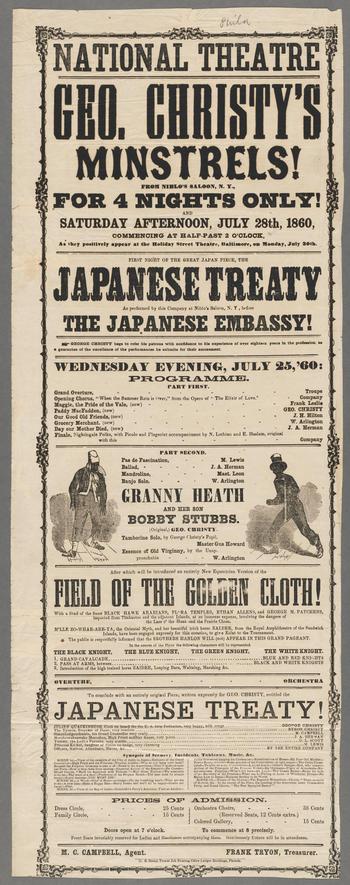
Minstrel productions afforded many urban Americans a ‘Japanese’ experience expunged of threats to societal order.Footnote 84 Performances of men pretending to be Japanese were a commercial confrontation with an increasingly convoluted racial ideology. In his study of blackface minstrelsy, Eric Lott writes that ‘the black mask offered a way to play with collective fears of a degraded and threatening – and male – Other while at the same time maintaining some symbolic control over them’.Footnote 85 The racial implications of the minstrel setting implied that the Japanese, like African Americans, were appropriate objects of ridicule. Public advertisements intimated that the Japanese themselves would attend some of these productions.Footnote 86 These Japanese diplomats were ‘civilized’ enough to merit welcome into the cultural space of the theatre – in a time when some establishments banned African American guestsFootnote 87 – but not enough to warrant preservation from the cruel eye of the stage (Figure 1). The Japanese did not attend ‘The Japanese Treaty’ and were perhaps even unaware of its existence.Footnote 88 The incorrect affirmation of the presence of the Japanese at this racial spectacle served as a publicity stunt that solidified the embassy as willing participants of their own derision. Unlike the street harassment of the Japanese, these minstrel shows received no criticism in the metropolitan press. Embassy-themed entertainments achieved such success that the show ‘The Japanese Treaty’ continued years after the embassy's return to Japan, well into the middle of the American Civil War.Footnote 89 African American newspapers did not comment directly on these performances; their opinions on minstrelsy, ‘that pestiferous nuisance’,Footnote 90 required little elaboration.
The minstrel show ‘The Japanese Treaty’ ridiculed dark-skinned people and the Japanese embassy members at the same time that it asserted the embassy's presence at an earlier performance of this production. Christy Minstrels in Philadelphia, ‘The Japanese Treaty’, 25 July 1860, MS Thr 556 (322), Houghton Library, Harvard University, Cambridge, MA. Reproduced with the permission of Houghton Library, Harvard University, Cambridge, MA.

In writing about Japan and the Japanese, African American newspapers were really writing about American prejudice, American hypocrisy, and American people. By claiming the Japanese as ‘negroes from Japan’, the African American press highlighted the duplicity of the American government and the absurdity of racial prejudice. The deprecation of the Japanese in the metropolitan press reaffirmed to African American and abolitionist editors the injustice of America's racial intolerance. Newspapers across the country linked negative representations of the Japanese with African Americans by ‘reporting’ the criticism of uneducated African Americans in the form of a joke. These racial jokes followed a similar pattern, invoking images of blackness, connections to slavery, and the condescension of crude African Americans to lower the public's opinion of the Japanese: ‘Why, dey ain't nothin’ more'n colored folks, wid their heads shaved … Go to foolin’ round too much, somebody shake ‘em off and sell to Orleans.’Footnote 91 Metropolitan publications depicted the Japanese as both ‘colored folks’ undeserving of the state's elaborate attentions and ‘strangers’Footnote 92 deserving of African American contempt. Some newspapers reprinted ‘A negro's notion about the color of a Japanese’, mocking the treatment of the Japanese as white equivalents: ‘“If de white folks is as dark as dat out dare, I wonder what's de color ob de niggers.”’Footnote 93 The civilized behaviour and commercial appeal of the Japanese may have enabled a temporary access to white ‘civilization’, but the embassy members were represented as neither white, nor black, nor in solidarity with any racial minority. The African American press reprinted these racist jokes to demonstrate both the injustice of these remarks and the legitimate threat of potential solidarity perceived by the metropolitan press.
Through this tactic of double denigration, the metropolitan press belittled all racial minorities. ‘John Chinaman's’ opinion of the Japanese received extensive reprinting even before the embassy reached Washington, DC.Footnote 94 ‘Chinese merchants’ in San Francisco were reported as having ridiculed Americans entranced by the Japanese, which allowed the joke's author to reject the idea that the Japanese could alter America's racial order: ‘“Japanese great men now – Americans want more Treaty – by'n'by Treaty be signed, Japanese like anybody – just like Chinese – just like dam [sic] nigger.”’Footnote 95 Though the metropolitan press was, on the whole, excited to receive the embassy, snide racial criticism increased as the presence of the Japanese became more of a threat to the established racial hierarchy. Racist humour reassured white audiences of the impossibility of solidarity between America's ostracized and the Japanese, and that the normal racial order would soon return.Footnote 96 In the African American press, reprinted racist jokes targeting the Japanese served a similar purpose as slave auction advertisements and reports of horrendous crimes against African Americans. These unsavoury stories showcased American barbarism further to elicit horror at racial prejudice and the state's mistreatment of its fellow men. The same metropolitan presses that fuelled the frenzy for the Japanese with early descriptions of Japanese gentility and potent masculinity later rejected the ‘distinguished strangers’. The political machinations of the metropolitan press pulled the African American and abolitionist press closer to the ‘celestial gentlemen’Footnote 97 as the America portrayed in the metropolitan press pushed the Japanese away. This perceived closeness between the African American press and the embassy is evident in the increased frequency of articles about the Japanese, as well as the questioning displayed within the articles themselves:
What other country in the civilized world but this would make the color of the skin the basis of all manner of insult and wrong? What other people than the American people would make the color of a man's skin the subject of contumely and coarse ridicule, no matter what his rank, station, intelligence, or high moral worth?Footnote 98
The Japanese were a lens through which African American editors interpreted their own experiences of racial prejudice and quest for recognition as equal members in the ‘civilized’ world. African American newspapers saw the demeaning of the Japanese as additional proof that America's perpetuation of slavery and prejudice had plunged the nation further into barbarity. African American newspapers, through their creation of an imagined, transnational relationship of brotherhood, challenged the authority and ideology of the state, ironically with as hierarchical and state-entrenched a group as Tokugawa diplomats.
African American and abolitionist publications employed sarcasm to criticize America's double-standard of who and when someone was allowed access to ‘whiteness’ and its accompanying privileges of inclusion and power. A correspondent for the Anti-Slavery Bugle wrote: ‘Our surprise was greatly increased by seeing with what distinguished consideration the official representatives of the U.S. Government treated these niggers … hob-nobbing with men, whose complexion, in any Southern State would be prima facie evidence they were chattels personal!’Footnote 99
These articles feigned outrage at the American government's welcome and festivities for the ‘swarthy hued individuals whose complexion would have barred against them every entrance into respectable society in the North’.Footnote 100 The article claimed the Japanese as African American equivalents, as ‘colored people’,Footnote 101 and, perhaps sarcastically imitating the racial humour of the metropolitan press, appraised the Japanese as if for the slave market, surmising that certain popular samurai ‘would undoubtedly command a high cash price’.Footnote 102 The article then named the illustrious members of ‘civilized’ American society who, despite an assumed prejudice, ‘[solicited] the pleasure of the company of the colored people’.Footnote 103 The Weekly Anglo-African reprinted a story about a ‘young lady who was desirous of making the Japanese Prince a present’,Footnote 104 but mistakenly presented her bouquet to the wrong embassy member, a man depicted as of less importance than ‘the darkey who washes the pavement in front of her father's mansion’.Footnote 105 Though meant as a humorous anecdote in its original printing, for the Weekly Anglo-African, the girl's inability to recognize a perceived inferior, combined with either her ignorance of or disregard for rules of racial distance, illustrated the unsubstantiated nature of racial prejudice. Whereas hostile depictions of the embassy attempted to place the Japanese racially, the Weekly Anglo-African reprinting mocked the entire hierarchical system, conflating servants and princes, black and Japanese. This Weekly Anglo-African writer questioned the civility of ‘some of our white-faced civilized (?) men’,Footnote 106 and through them, the legitimacy of a state composed of such fallible frameworks. The reimagining of racist humour targeting the Japanese criticized the state's hypocrisy and imagined a future of racial equality.
The 1860 Japanese embassy did not directly influence racial discourse in Japan, but the Anti-Slavery Bugle’s premonition that ‘when [the Japanese] go away they will take with them … our equally warm prejudices against the colored people’Footnote 107 would manifest itself in the early twentieth century. Yukiko Koshiro writes that ‘in an attempt to restore the Japanese power status side by side with the Western (white and capitalistic) nations, the postwar Japanese government quickly restored its dualistic racial identity of being an honorary white nation standing above other people of color’.Footnote 108 At the same time, early twentieth-century African Americans celebrated Japan's achievements and sympathized with their struggles.Footnote 109
Before the embassy's arrival, African American publications equated the foreign policy of Japan – regularly condemned in the metropolitan press as ‘barbarous and intolerable’Footnote 110 – to the ‘seclusion’ of the American South. Pre-Perry, metropolitan publications often portrayed Japan as barbaric and in desperate need of Western influence. African American publications, though less hyperbolic in their initial treatment of the Japanese, did not reject or slander the Japanese people. In the African American and abolitionist press, the ‘tyrannical acts’Footnote 111 of Japan served to emphasize the ‘unmitigated despotism’Footnote 112 of the American South. Japan's state policies may have been compared to those of the barbaric South, but the Japanese themselves were firmly claimed as gentlemen in their interactions – however imagined – with American people throughout the embassy's travels. Discussing early nineteenth-century American views of East Asia, Akira Iriye writes that ‘most Americans may never have seen an Asian, much less visited Asia, but they had an image of Asia because they had an image of America’.Footnote 113 Rather than tout American ‘civilization’ as the example for the Japanese to follow, articles in the African American press explored their government's instinctive recognition of the diplomatic shame of slavery. Abolitionist papers equated the Southern masking of African American slavery to the embassy with Japan's oft-condemned foreign policy: ‘In this respect the policy pursued by the Tycoon has been reversed by our own President. At the moment when the Japanese propose to abandon their exclusiveness and open their country to the world, we as carefully shroud the most interesting part of ours in an impenetrable seclusion.’Footnote 114 The ‘seclusion’Footnote 115 of sites of slavery from the Japanese gaze was represented by the African American press as a bittersweet triumph – proof of the uncivilized nature of slavery and the moral depravity of the American state.
The early celebration of the Japanese by white America exemplified a belief often expressed in the African American press, that what white America despised was not the black man, but the black man's condition.Footnote 116 The rudeness of Irish immigrants towards the Japanese served as evidence to these publications that the poor treatment of the Japanese was a matter of class, not race, mocking the Irish, those ‘miserable wretches’,Footnote 117 much in the same way the metropolitan press manufactured ‘negro dialogue’ for comic effect.Footnote 118 The African American press blamed not the ‘corrupted hearts’Footnote 119 of the Irish for the verbal abuse of the Japanese, but America's wealthy and powerful. The same ‘better classes’Footnote 120 now decorating their homes with Japanese flags had previously, by their own example, instructed new immigrants to the United States in racial prejudice.Footnote 121
The African American press, though critical of the nation-wide hypocrisy that valued commerce over colour, also welcomed this potentially liberating flexibility: ‘the bringing of [the Japanese] will … teach poor white men that all this clamor about color is all moonshine – that their rulers associate as freely with colored men as with men of a lighter complexion, provided they have money to spend’.Footnote 122 Wealth and gentility, then, would ultimately overcome colour prejudice: ‘Give [the USA] money, and the roughest of his edges wear off; show him where he can push his trade, and the bitterest of his prejudices vanish in the air – Japan, Soudan, or Dahomey will be all the same to him.’Footnote 123
V
The members of the 1860 Japanese embassy, without intent or inclination, inspired in the African American and abolitionist press an alternate interpretation of the experience of racial exclusion and oppression within America's antebellum racial hierarchy. By manifesting non-white membership to the worlds of civilization and respectability that America most sought to deny in its African American citizens, the Japanese, in the eyes of the antebellum African American press, had already triumphed on American soil. The race and dignity of the ambassadors made the Japanese symbols of the human solidarity and respectability to which many diplomatically peripherized African Americans aspired. The African American press rejected the ideology of the white state to promote an imagined brotherhood between minorities whose identities were in part defined by their mutual experience of racial prejudice. Instead of a rivalry between minorities jockeying for a higher position on the state's hierarchy of whiteness, as perhaps the metropolitan press encouraged through its doubly denigrating racial jokes, the African American press navigated outside the power and interests of the state to define its own relationship with the Japanese.
African American newspapers used the status of the Japanese as gentlemen and equal participants in ‘civilization’ to criticize the American state as corrupt and concerned more with commercial gain than the ideals of civility and civilization the United States claimed to promote. Public accounts and discussions of the Japanese within the African American press reveal a relationship between those operating both within and outside American hierarchies of race and ‘civilization’, generating a perceived non-state solidarity ironically enabled by state diplomacy. The 1860 Japanese embassy expands our current understanding of the transnational production of history, culture, and identity, as well as of interracial relations within and across state hierarchies, by giving witness to an imagined solidarity of culture and race occurring outside the framework of diplomacy. This imagined solidarity and production of culture occurred within select factions of the American population and Japanese agents of ‘civilization’ – educated and ‘civilized’ state ambassadors – long before initiatives of ‘civilization and enlightenment’ appeared on Japan's diplomatic agenda, before a Japanese military victory over a white power, and before the diffusion of Western racial hierarchies in Japan.
This new information about the antebellum influence of the Japanese on American cultural discourse presents a new historical framework for exploring the interconnected role of culture, identity, and resistance in the context of state and transnational activity, as well as African American intellectual history and historical production. Further studies of the interpretations and exchanges of and between minority groups would contribute to a greater understanding of the transnational production of culture and identity, especially as a mechanism to subvert state authority. Over the course of the 1860 Japanese embassy, people considered on the outskirts of American diplomacy generated an imagined solidarity that inspired intellectual inquiry, sympathy, and a perceived brotherhood surpassing seemingly insurmountable borders of language, geography, and culture.