INTRODUCTION
The ability to monopolize resources by an individual is an important feature that influences population distribution, and such ability can determine reproductive success within the population (Wilson, Reference Wilson1975; Emlen & Oring, Reference Emlen and Oring1977; Baeza & Thiel, Reference Baeza, Thiel, Duffy and Thiel2007). Some individuals make use of territorial or guarding behaviour against competitors belonging to the same species or not in order to monopolize shelter, food and sexual partners (Foster, Reference Foster1985; Huber, Reference Huber1987). Such behaviour directed toward any resource is expected whenever the monopolization of these resources is ‘economic’ – that is, whenever the benefits acquired in this behaviour exceed the costs of it (Brown, Reference Brown1964; Emlen & Oring, Reference Emlen and Oring1977; Thiel et al., Reference Thiel, Zander and Baeza2003a, Reference Thiel, Zander, Valdivia, Baeza and Ruefflerb). According to Baeza & Thiel (Reference Baeza and Thiel2003), the probability of success in the monopolization of a resource, such as a host (refuge), decreases with increases in abundance, complexity and relative size due to the increase in the energy cost. Baeza & Thiel (Reference Baeza, Thiel, Duffy and Thiel2007) proposed a model for crustaceans living in symbiosis, in which the host is commonly used as a refuge (often discrete and discontinuous). This model considers that ecological (abundance and distribution) and morphological (relative size and structural complexity) characteristics of the host (refuge), associated with the risk of predation (of the guests outside their refuges) are jointly able to predict the host use pattern (refuge), as well as the adoption of different reproductive strategies. In this way, variations in such predictive characteristics affect the monopolization capacity of the refuge by its guests, as well as the adoption of different mating systems (Pfaller et al., Reference Pfaller, Alfaro-Shigueto, Giffoni, Ishihara, Mangel, Peckham, Bjoorndal and Baeza2014).
Mating systems can be extremely diverse (Wilson & Pianka, Reference Wilson and Pianka1963; Emlen & Oring, Reference Emlen and Oring1977; Arnold & Duvall, Reference Arnold and Duvall1994; Bauer & Abdalla, Reference Bauer and Abdalla2001; Baeza & Thiel, Reference Baeza, Thiel, Duffy and Thiel2007). In many species, monogamy is the mating strategy (Baeza, Reference Baeza2008, Reference Baeza2010; Baeza et al., Reference Baeza, Simpson, Ambrosio, Guéron and Mora2016a), while many others are polygamous (Shuster & Wade, Reference Shuster and Wade2003). Also, it is possible to find promiscuous species in which the males are constantly roaming in search of receptive females (Bauer & Abdalla, Reference Bauer and Abdalla2001). Although knowledge about reproductive biology and mating strategies has grown considerably (Parker, Reference Parker1970; Bradbury & Vehrencamp, Reference Bradbury and Vehrencamp1976; Wickler & Seibt, Reference Wickler and Seibt1981; Grafen & Ridley, Reference Grafen and Ridley1983; Shuster & Wade, Reference Shuster and Wade2003), the mating systems of many invertebrates remain unknown (Baeza et al., Reference Baeza, Guéron, Simpson and Ambrosio2016b).
Crustaceans display wide diversity, in terms of morphology, behaviour, lifestyle and mating systems in marine habitats (Christy, Reference Christy1987; Jormalainen, Reference Jormalainen1998; Correa & Thiel, Reference Correa and Thiel2003; Bruyn et al., Reference Diesel2009; Peiró et al., Reference Peiró, Baeza and Mantelatto2013). During the last decade, some studies have proposed explanations for the variety of refuge-use patterns and mating systems in organisms adapted to live in discrete habitats (Baeza & Thiel, Reference Baeza and Thiel2003, Reference Baeza, Thiel, Duffy and Thiel2007; Thiel et al., Reference Thiel, Zander and Baeza2003a, Reference Thiel, Zander, Valdivia, Baeza and Ruefflerb; Baeza, Reference Baeza2008; Baeza & Piantoni, Reference Baeza and Piantoni2010). Taking into account the theoretical assumptions mentioned above, it is expected, for example, that symbiotic crustaceans are monogamous when the predation risk away from hosts is high and when their hosts are relatively rare in the environment and large enough to house a few (e.g. two) co-specific individuals (Baeza & Thiel, Reference Baeza, Thiel, Duffy and Thiel2007; Baeza, Reference Baeza2008). In addition, it is expected to find little or no sexual dimorphism in body size and weaponry (e.g. chelipeds used for intra-sexual aggression) due to the low intensity of sexual selection (Shuster & Wade, Reference Shuster and Wade2003; Baeza & Thiel, Reference Baeza, Thiel, Duffy and Thiel2007; Baeza, Reference Baeza2008). Although the model has been proposed for symbiotic species, it is based on the use of discontinuous habitats (hosts) and can therefore be applied to other aquatic or terrestrial organisms that live in discrete and discontinuous refuges (Baeza & Thiel, Reference Baeza, Thiel, Duffy and Thiel2007). Studies concerning the mating system of crustacean symbionts have confirmed the theoretical premises of this model (Baeza & Thiel, Reference Baeza and Thiel2003, 2007, 2008; Baeza, Reference Baeza2008); however, more studies are necessary to test the generalities and the consistency of these theoretical considerations.
Among the Caridea, Alpheidae forms a group with more than 600 species known as snapping shrimp, found in waters of tropical and subtropical regions. In addition to being found in association with several other organisms (Castro, Reference Castro1971; Criales, Reference Criales1984; Silliman et al., Reference Silliman, Layman and Altieri2003; Anker et al., Reference Anker, Hurt and Knowltom2008), a characteristic of many species of this family is the formation of monogamous pairs which share and maintain the same refuge for a period longer than their reproductive cycles (Mathews, Reference Mathews2002a, Reference Mathewsb; Correa & Thiel, Reference Correa and Thiel2003). Alpheid shrimps can also be territorial, with males and females able to share the defence of a territory or occupied burrow (Mathews, Reference Mathews2002b). Alpheus estuariensis Christoffersen, 1984 is commonly found in estuarine environments in the mud, in burrows or under rocks between herbaceous vegetation or Rhizophora roots, from the intertidal region down to a depth of 22 m (Almeida et al., Reference Almeida, Boehs, Araújo-Silva and Bezerra2012). They occur in the Western Atlantic from Florida to the State of Santa Catarina, southern Brazil (Almeida & Mantelatto, Reference Almeida and Mantelatto2013). Taking into account the aforementioned, the present study has two objectives, using the shrimp A. estuariensis as a model: (1) to test whether or not shrimp monopolize their refuges; and (2) to test the hypothesis of monogamy in two populations from north-east Brazil. We expected that species displaying resource monopolization would show a uniform distribution pattern and there would be a limited supply of a given resource that is not complex from a structural point of view. Also, if A. estuariensis is monogamous, we expect that (1) the population distribution of this species is non-random with paired shrimps found more often than expected by chance alone; (2) the sex distribution of shrimps in pairs is non-random with male-female pairs being found more often than expected by chance alone; (3) males pair with females regardless of their reproductive state; (4) male-female pairs display size assortative pairing; and lastly, (5) shrimps should display little or no sexual dimorphism in terms of body size and weaponry.
MATERIALS AND METHODS
Shrimp collection
The shrimps were collected in two muddy flat areas named A1 (11°05′47″S 37°09′30″W) and A2 (11°07′32.08″S 37°09′22″W), both located in one of the mean estuarine systems of Sergipe State, Brazil, the estuary of the Vaza-Barris River, during August to November 2016. The region is characterized by a quasi-uniform seasonal thermal regime, in which rainfall constitutes one of the main elements of climate (Amâncio-Martinelli et al., Reference Amâncio-Martinelli, Santana and Guimarães2013). In this mixohaline ecosystem, mangroves occur in a low tide plain environment occupying an area of 59.37 km2 (Carvalho & Fontes, Reference Carvalho and Fontes2007). In each sample area, 30 replicates were performed, in which the numbers of refuges present within the delimited area were counted. In addition, in each area, during the daytime tidal period, 100 randomly selected burrows were investigated. The collection was done manually with the aid of a tube (PVC tube) of 230 mm in diameter and 400 mm in length, which was buried in the sediment so as to isolate a burrow from the others. All the burrow openings contained in the PVC tube were considered to belong to the same burrow. The sediment contained within the PVC tube was manually excavated until there were no further shrimp to be collected. The captured individuals were packed in plastic bags, transported to the laboratory, and the occurrence and occupation rates of refuge were counted. Additionally, the average abundance of refuges was determined by the counting of shrimp burrows openings by the square method, using a square frame of 1.20 m, totalling 1.44 m2 of the sample area.
In the laboratory, identification of Alpheus estuariensis was performed according to Soledade & Almeida (Reference Soledade and Almeida2013). The males were identified according to the presence of the male appendix located in the second pleopod and the females according to the absence of this structure or according to the presence of eggs adhered to the pleopods in the abdomen chamber and classified in two categories: ovigerous and non-ovigerous, according to the presence or absence of eggs. The eggs of the ovigerous females were classified according to the stage of development of the embryos, with the following characteristics: stage I (embryos containing well-distributed yolk and absence of eyes), stage II (embryos containing agglomerated yolk and visible eyes, but not well developed) and stage III (embryos with well-developed eyes, free abdomen and thoracic appendages) (Wehrtmann, Reference Wehrtmann1990). In both sexes of A. estuariensis, morphometric measurements of the following body structures were taken with the aid of a digital calliper to the nearest 0.01 mm: carapace length (CL), which comprises the length along the mid-dorsal line from the tip of the rostrum to the posterior margin of the carapace; propodus cheliped length (PL), which refers to the length of the largest cheliped from the top of the fixed finger to the distal end of this structure; and pleuron width (PW) of the second abdominal segment (maximum lateral width of the right pleuron).
Determination of size at onset of maturity (SOM)
Taking into consideration that only adult individuals participate in the mating process in a population, the size at the onset of sexual maturity was determined with the purpose of excluding juvenile individuals from the analyses used to determine the mating system of Alpheus estuariensis. The structures used for the determination of SOM were propodus cheliped length (PL) and pleura width (PW) for males and females, respectively. Once these structures were determined, a ‘K-means clustering’ analysis was used on the logarithmic data matrix. This analysis was used to separate age groups (juvenile and adult) to minimize variances within groups and to maximize variances between groups. The result of the classification of the K-means analysis was refined using a discriminant analysis (AD) for a reclassification of the age groups. This statistical methodology was based on the work of Sampedro et al. (Reference Sampedro, González-Gurriarán, Freire and Muiño1999) and Corgos & Freire (Reference Corgos and Freire2006). After separation of age groups, individuals were divided into 0.5-mm size classes and the proportions of juveniles and adults in each class were calculated. The data obtained was adjusted to a logistic equation (y = a/(1 + be−cx)) allowing the calculation of SOM, the size in which 50% (CL50%) of the specimens exhibited morphometric relationships that characterize the adult condition.
Burrowing experiment
In order to investigate the structural complexity of refuges of A. estuariensis, we designed an experiment. We placed 30 shrimps (7.83 ± 0.53 mm), of which 16 were male and 14 were female (7 ovigerous), in 1.5-L plastic containers containing 1 kg of sediment and 0.5 L of water from the collection site. For a period of 24 h, the shrimp were allowed to excavate the sediment and construct their refuges. Following this period, we counted the number of openings in the sediment and used this as an estimate of the complexity of the refuges of A. estuariensis. The greater the number of burrow openings, the greater the structural complexity of the refuge and, consequently, the lower monopolization potential of this resource. We performed a Mann–Whitney test (α = 0.05) to verify if the number of openings produced varied between the sexes.
Refuge-use pattern of Alpheus estuariensis
To examine the presence or intensity of refuge-resource monopolization as well as to test for monogamy, we examined the refuge-use pattern by shrimp, which includes the description of its population distribution as well as the pattern of association between males and females. Initially, it was determined whether the shrimps live alone, form aggregations, or live in pairs within their refuges. For this, the observed frequencies of occurrence of refuges with or without different numbers of shrimp were compared with the frequencies expected from a random Poisson distribution (Elliot, Reference Elliot1983). A Chi-square test was used to inspect for significant differences between the observed and expected distributions (Sokal & Rohlf, Reference Sokal and Rohlf2012). Once these differences were found, specific frequencies between both distributions were compared by subdividing the Chi-square test, using a Bonferroni sequential correction (Rice, Reference Rice1989; Sokal & Rohlf, Reference Sokal and Rohlf2012). When found in pairs in the same refuge, it was determined whether the sexes were randomly distributed by comparing the observed distribution with a binomial distribution.
A linear regression analysis was used to examine if there is a significant relationship between the size of males and females found in heterosexual pairs in the same refuge. We examined whether the presence of eggs and their stage of development affected the frequency of male presence. A Chi-square test was used to inspect for significant differences between the frequency of occurrence of males and the presence of ovigerous females as well as between the frequency of males and the presence of females carrying eggs at different stages of development (Sokal & Rohlf, Reference Sokal and Rohlf2012). Finally, a binomial test was used to test for statistical differences in the expected proportion (1:1) between the sexes in both areas.
Sexual dimorphism in Alpheus estuariensis
To examine the existence of significant differences between the body size of males and females of both populations studied, a Student's t-test (α = 0.05) was used. In addition, we analysed whether the size of the cheliped grows linearly in relation to the body size in males and females of A. estuariensis. These structures function as weapons during intra-sexual interactions or are used for communication between the sexes (Hartnoll, Reference Hartnoll1978). The relationship between cheliped length (PL) and carapace length (CL) was verified using the allometric model y = axb (Hartnoll, Reference Hartnoll1978). The slope b of the linear regression represents the rate of increase (b > 1) or decrease (b < 1) of the cheliped, with an increase unit in the body size of the shrimp (Huxley, Reference Huxley1950). To verify if the relation deviates from linearity, the value of b was subjected to a t-test. If the cheliped grows more or less relative to a unit in body size, the value of b should be greater or less than 1, respectively (Hartnoll, Reference Hartnoll1978). To test the equality of slopes and line intercepts for each morphometric variable studied among sex, an analysis of covariance was performed (ANCOVA) (Zar, Reference Zar2010).
RESULTS
Determination of size at onset of maturity (SOM)
A total of 97 shrimps (45 males, 51 females, 33 of which were ovigerous and 1 unidentified) and 168 shrimps (84 males, 83 females, 48 of which were ovigerous) were sampled at A1 and A2, respectively. The individuals ranged from 3.00 to 9.23 mm (6.52 ± 1.50) in A1 and from 3.40 to 10.23 mm of CL (7.01 ± 1.56) in A2. Alpheus estuariensis was found in 74 and 79% of the burrows from A1 and A2, respectively. The number of burrows ranged from 73 to 193 (133.33 ± 32.35) and from 204 to 368 (291 ± 39.35) at A1 and A2 areas; the differences were statistically significant (t = −16.99, df = 58, P < 0.05). The estimated size at the onset of maturity was 6.25 and 6.43 mm (A1 and A2, respectively) for males and 6.0 and 6.64 mm (A1 and A2, respectively) for females.
Burrowing experiment
After 24 h, 14 of the 30 shrimps used in this experiment built burrows. Of these, one built a burrow with two openings, three built burrows with three openings, eight built burrows with four openings, and two other shrimps built burrows with five openings. The remaining 16 shrimps remained on the surface of the sediment without performing any excavation activity. There was no statistical difference in the number of openings produced between males and females (Mann–Whitney test, U = 31.00; P > 0.05).
Refuge-use pattern of A. estuariensis
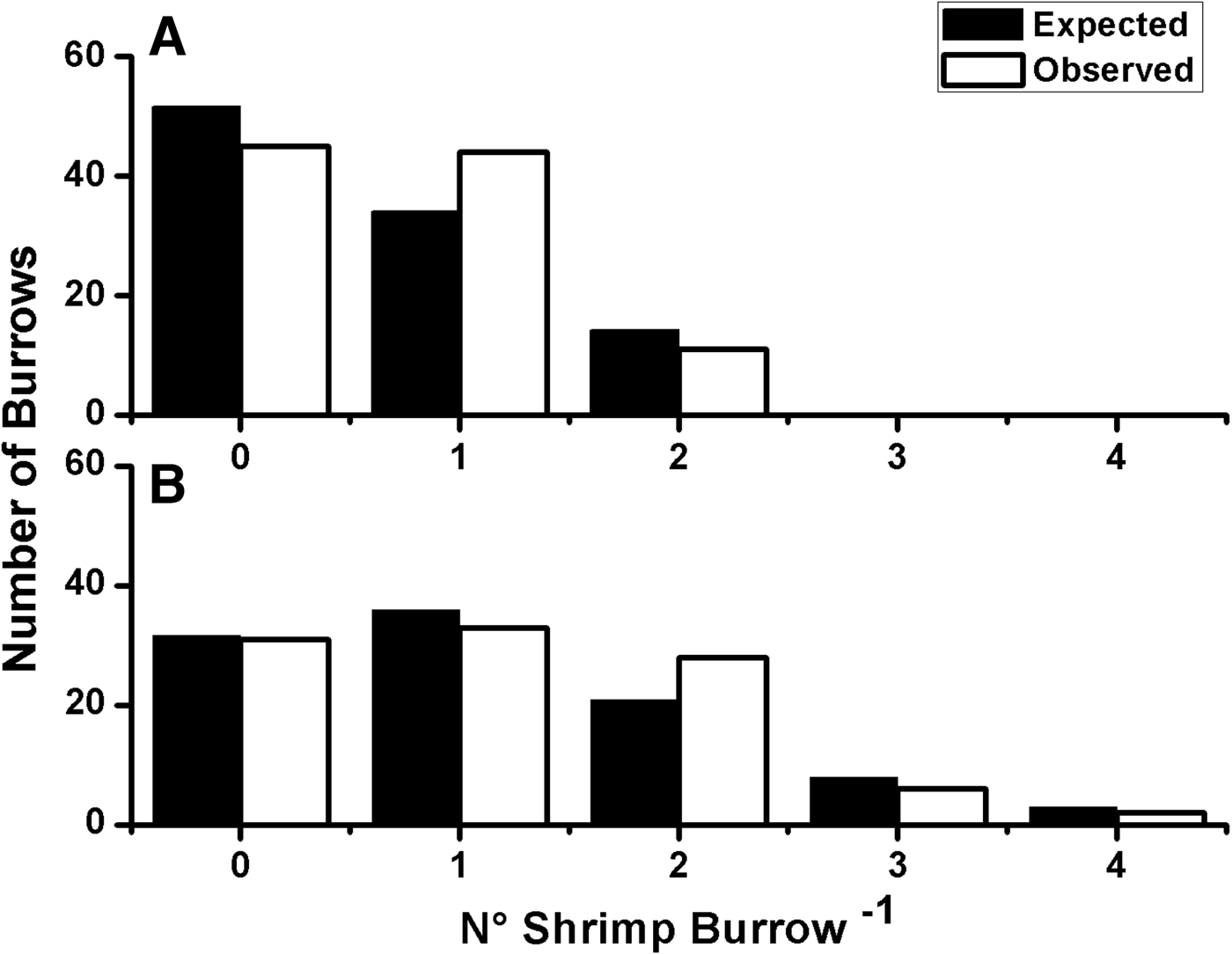
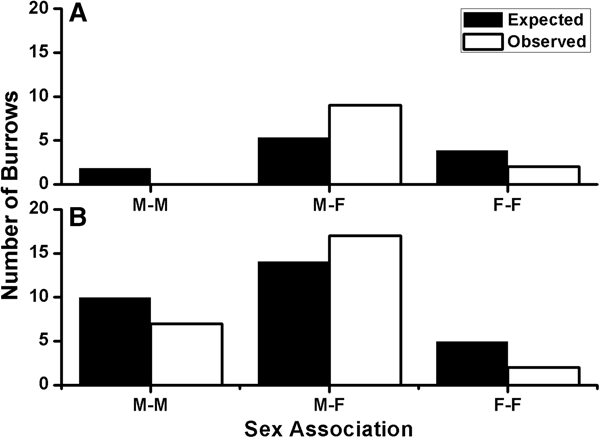
The number of shrimps found per burrow ranged from 0 to 2 (0.97 ± 0.70) and from 0 to 4 (1.15 ± 0.99) at A1 and A2, respectively. Taking into account only adult individuals, that is, those with sizes equal to or greater than the estimated value of sexual maturity, 45% and 28% of the burrows did not contain any shrimp. A total of 44% and 31% of the burrows contained a single shrimp (21 and 12 males, 23 and 19 females, of which 18 and 18 had eggs at different stages of development) at A1 and A2, respectively. A total of 11% and 29% burrows contained two shrimps. The pairs of shrimps found consisted of associations between males and males, females and females, and males and females (8 males-males (A2 only), 2 and 3 females-females, and 9 and 18 males-females in A1 and A2, respectively). At A2 alone, a total of 10 and 2 burrows housed 3 and 4 shrimps, respectively. Of these 10 burrows, a trio was formed by 2 males and 1 ovigerous female and another one by 3 males. Three trios were formed by 2 males and 1 female and another three trios by 1 male, 1 female and 1 ovigerous female. Finally, two trios were composed of 1 male and 2 ovigerous females. Of the two burrows containing 4 shrimps, both were formed by 2 males and 2 ovigerous females.
The population distribution of Alpheus estuariensis did not present a random pattern in A1 (χ2 = 4.45, df = 1, P < 0.05). However, after the sequential Bonferroni correction, in which the P value was adjusted, no statistical difference was observed between the expected and observed frequencies (P > 0.05), which was a random distribution. Concerning A2, the population distribution also presented a random pattern (χ2 = 3.52, df = 2, P > 0.05). In general, the frequency of individuals present in the burrows was similar to that expected by chance alone (Figure 1A and B). Taking into account the binomial distribution, the number of burrows housing heterosexual couples at random should be 5.31 and 14.06 for A1 and A2. Therefore, the number of shrimp found to form heterosexual pairs was higher than expected by chance alone in both areas (Figure 2A and B). The number of heterosexual pairs found was 9 and 18 in the areas A1 and A2, respectively.
Population distribution of the shrimp Alpheus estuariensis in study areas A1 and A2 (A and B, respectively). No statistical differences were observed between the expected and observed frequencies in both areas.

Patterns of association between males and females of A. estuariensis found in pairs in study areas A1 and A2 (A and B, respectively).

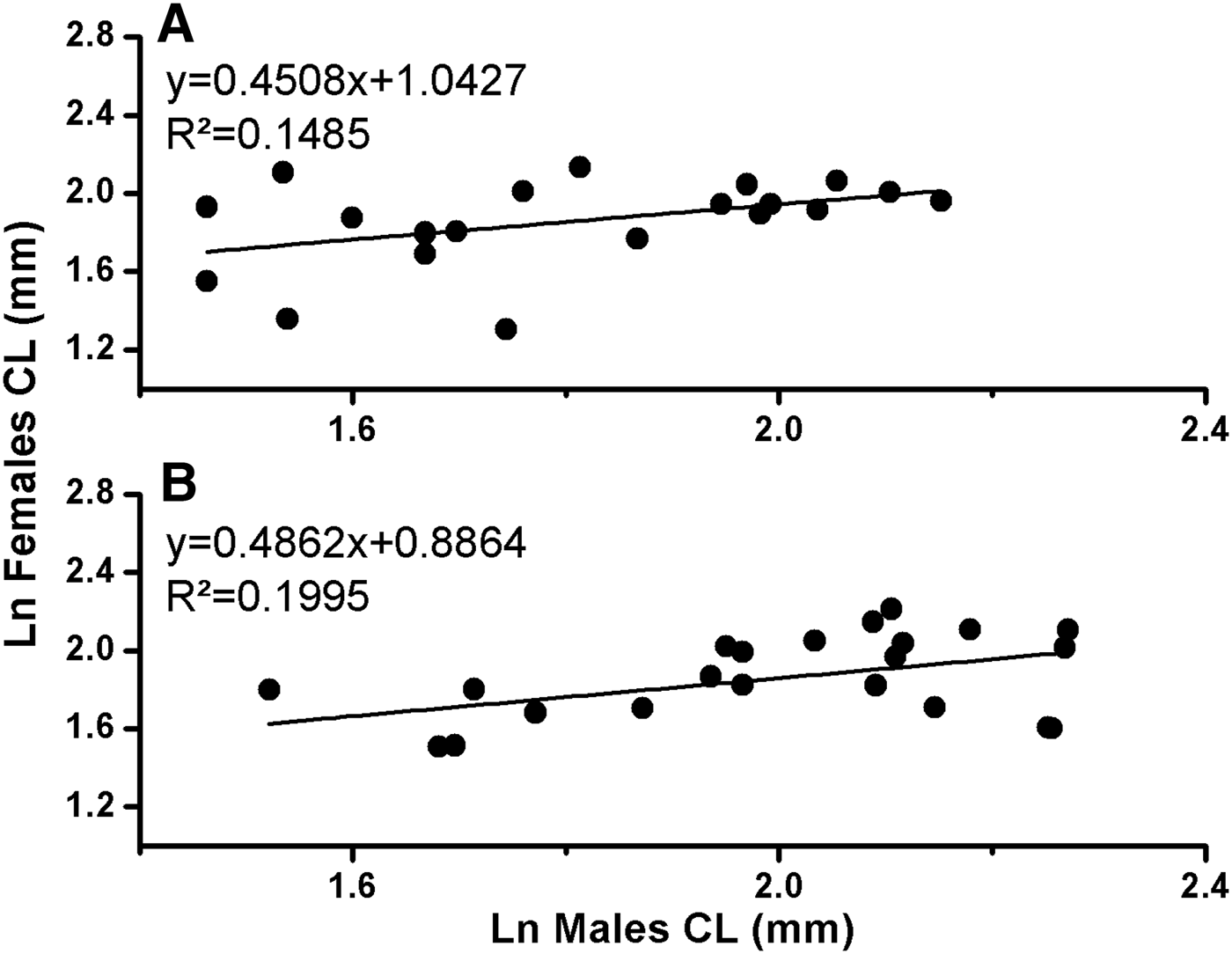
During the study period, a low, but positive relationship was observed between body size (CL) of males and females found in pairs (F = 4.48, df = 1, P < 0.05; F = 6.48, df = 1, P < 0.05, for A1 and A2 respectively): only 14.85% and 19.95% of the variation in the CL of the females was explained by the CL of the males (R 2 = 0.1485; R 2 = 0.1995; Figure 3A and B). In relation to females found in the same burrow with a male, 100% (N = 9) and 77.77% (N = 14) were ovigerous in areas A1 and A2. Of these, 7, 1 and 1 carried eggs in stage I, II and III, respectively, in A1 and 7, 3 and 4 in stages I, II and III, respectively, in A2. Males were preferentially associated with females in ovigerous condition in both areas (χ2 = 9.00, df = 1, P < 0.05; χ2 = 7.11, df = 1, P < 0.05, for A1 and A2, respectively). The proportion of females with embryos at different stages of development showed a significant difference in A1 (χ2 = 8.00, df = 2, P < 0.05), but the same difference was not found in A2 (χ2 = 1.85, df = 2, P > 0.05). Thus, males of A1 are preferentially associated with females harbouring eggs at stage I, while in A2, although a larger number of males were observed together with females harbouring eggs at stage I, apparently the association of males with females is independent of the egg developmental stage. The sex ratio did not differ from the theoretical ratio predicted (1:1) in both areas (binomial test, P > 0.05).
Relationship between carapace length (CL) of heterosexual pairs of Alpheus estuariensis found in the same burrow in the two studied areas A1 (A) and A2 (B).

Sexual dimorphism in Alpheus estuariensis
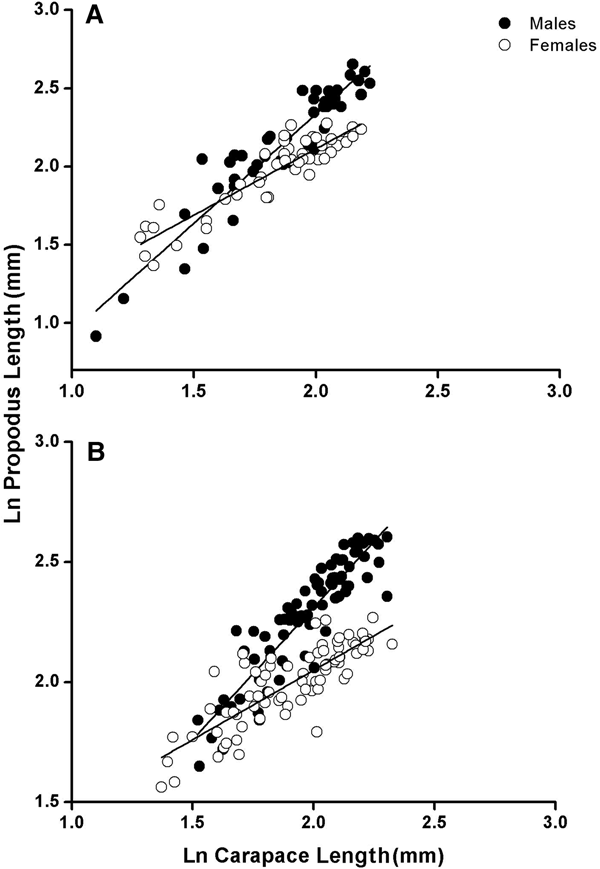
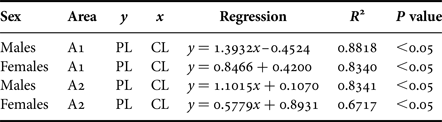
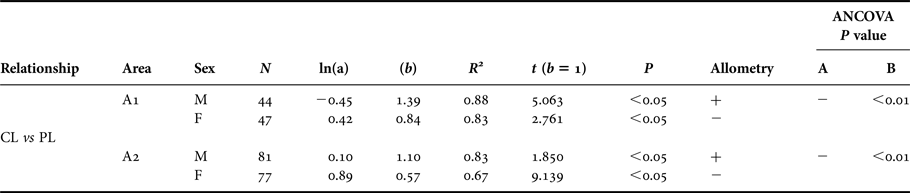
The mean CL of males was statistically larger than that of females in both areas (t = 2.25, df = 150, P < 0.05; t = 2.14, df = 165, P < 0.05, A1 and A2, respectively), indicating sexual dimorphism in A. estuariensis (males > females) in relation to body size. A positive relationship was also observed between CL and the PL of the largest cheliped in both sexes in both areas (Figure 4A and B) (Table 1). In males, the slope (b) of the relation CL vs PL was significantly higher than 1 (b = 1.39, P < 0.05; b = 1.10, P < 0.05, for A1 and A2, respectively), characterizing the growth of the cheliped as a positive allometry in relation to the body size. In females, the value of b for the same relation was significantly lower than 1 (b = 0.84, P < 0.05; b = 0.57, P < 0.05, for A1 and A2, respectively), characterizing the growth of the cheliped as negative allometric. An analysis of covariance (ANCOVA) indicated a significant effect of sex (F = 24.35, df = 1, P < 0.01; F = 38.21, df = 1, P < 0.01, A1 and A2 respectively) and CL (F = 559.32, df = 1, P < 0.01; F = 576.48, df = 1, P < 0.01, A1 and A2 respectively) in propodus length (Table 2).
Relative growth of the cheliped as a function of carapace length in males and females of Alpheus estuariensis in the studied areas A1 and A2 (A and B, respectively).

Relationship between carapace length (CL) and propodus cheliped length (PL) of males and female Alpheus estuariensis in both studied areas.

Allometric analysis using carapace length as independent variable and analysis of covariance (ANCOVA) between male and female Alpheus estuariensis for the relationship between carapace length and the length of the propodus.

CL, carapace length; PL, propodus length; A1, Area 1; A2, Area 2; +, positive allometry; −, negative.
DISCUSSION
The results of the present study do not support the idea that Alpheus estuariensis monopolizes its refuge. Initially, a random distribution pattern was verified for this species in both studied areas. This result contrasts with theoretical predictions in which species that monopolize their refuges should have a uniform distribution pattern over an aggregate or random distribution (Baeza & Thiel, Reference Baeza and Thiel2003). One of the main selective pressures responsible for the development of a guard resource behaviour, including territoriality, is the limitation of a resource in the environment, as already verified for different vertebrate and invertebrate taxa (Wilson, Reference Wilson1975; Barash, Reference Barash1982; Grant, Reference Grant1993; Chapman & Kramer, Reference Chapman and Kramer1996; Duffy et al., Reference Duffy, Morrison and Ríos2000). In this sense, the refuge used by A. estuariensis does not seem to be a limiting resource in the environment and, therefore, it is not expected to display monopolization behaviour. Similar results have already been found for other species of crustaceans, such as Liopetrolisthes mitra (Baeza & Thiel, Reference Baeza and Thiel2003). These results are also in contrast with the hypothesis of monogamy. If A. estuariensis were a monogamous species, we would expect a non-random population distribution – essentially, pairs of individuals would cohabit the same refuge more often than expected by chance alone, and that, among these pairs, the number of heterosexual couples would also be greater than expected by chance alone, as already evidenced in other crustaceans that present monogamy as mating system (Baeza, Reference Baeza2008; Baeza et al., Reference Baeza, Bolaños, Hernandez, Lira and López2011, Reference Baeza, Ritson-Williams and Fuentes2013, Reference Baeza, Simpson, Ambrosio, Guéron and Mora2016a). Although the number of pairs formed by heterosexual couples was greater than expected, the distribution of the populations as a whole did not differ from a random distribution, and the number of shrimp inhabiting the burrows in pairs did not differ from that expected at random. Similar results have already been found in other species of non-monogamous crustaceans (Baeza et al., Reference Baeza, Hemphill and Ritson-Williams2015, Reference Baeza, Guéron, Simpson and Ambrosio2016b; Baeza & Hernáez, Reference Baeza and Hernáez2015).
Another line of evidence that suggests the absence of refuge-guarding behaviour in A. estuariensis is the structural complexity of its refuges, which may, according to the results of the burrowing experiment, present up to five openings. According to Thiel & Baeza (Reference Thiel and Baeza2001), a high structural complexity in hosts harbouring symbiotic crustaceans makes it inefficient to supervise (guard) the entire host by the symbiont. Consequently, symbionts can migrate freely between hosts without any impediment on the part of their co-species. The same principle can be applied to A. estuariensis and its refuges. Other studies show that burrows of other species belonging to the genus, such as A. heterochaelis, A. floridanus and A. migrans among others, are highly complex and formed by U-shaped tunnels with up to eight surface openings (Dworschak & Ott, Reference Dworschak and OTT1993; Stieglitz et al., Reference Stieglitz, Ridd and Müller2000; Dworschak & Pervesler, Reference Dworschak and Pervesler2002). Overall, the characteristics of the refuge restrict the development of guarding the resource due to the high energy expenditure, in terms of both time and energy, in relation to the alternative activities by a single or a small group (pairs) of shrimps (Baeza & Thiel, Reference Baeza and Thiel2003).
If A. estuariensis lived in heterosexual pairs in their refuges (hosts) for a period longer than a reproductive cycle, a tight correlation between the sizes of males and females would be expected (Adams et al., Reference Adams, Edwards and Emberton1985; Baeza, Reference Baeza1999; Mathews, Reference Mathews2002b), due to the growth restrictions imposed by the host they are associated with (Adams et al., Reference Adams, Edwards and Emberton1985; Baeza, Reference Baeza1999, Reference Baeza2008). In the case of A. estuariensis, growth restriction of associated males and females would be imposed by the size of the burrow in which they live. Although a significant relationship was found between associated males and females of A. estuariensis, this relationship does not suggest that the pairing between them is long-lasting. In other species of monogamous symbiotic crustaceans, such as Pinnixa transversalis and Pontonia margarita, male body size explains 77.65 and 63.8% of the variation in female body size, respectively (Baeza, Reference Baeza1999, Reference Baeza2008). In the present study, less than 20% of the variation in male body size explained the variation of the size of the females in both areas. This weak relationship between males and females found together does not support the idea of monogamy.
The pattern of sexual dimorphism found in A. estuariensis argues in favour of territoriality in males (but not females) due to the positive allometry in cheliped size. This pattern has already been reported in the porcelain crab Allopetrolisthes spinifrons (Baeza et al., Reference Baeza, Thiel and Stotz2001; Baeza et al., Reference Baeza, Stotz and Thiel2002). Moreover, sexual dimorphism in relation to the size of the chelipeds does not support the notion of monogamy. Theory suggests that monogamous species should exhibit low or no sexual dimorphism in structures that function as weapons (Baeza & Thiel, Reference Baeza, Thiel, Duffy and Thiel2007). In contrast, the higher relative growth of chelipeds in males compared with those in females suggests that sexual selection may be an important factor for A. estuariensis. In addition, the presence of dimorphism in relation to this structure indicates that both intra-sexual competition and sexual selection are more intense among males than among females of this species (Shuster & Wade, Reference Shuster and Wade2003). Males of polygamous shrimp invest more energy resources in this structure to compete with other males through agonistic interactions when in search of receptive females (Bauer, Reference Bauer2004; Baeza & Thiel, Reference Baeza, Thiel, Duffy and Thiel2007), and this pattern has already been verified for other crustaceans (Bauer, Reference Bauer2004; Biagi & Mantelatto, Reference Biagi and Mantelatto2006; Baeza & Thiel, Reference Baeza, Thiel, Duffy and Thiel2007; Peiró et al., Reference Peiró, Baeza and Mantelatto2013; Baeza et al., Reference Baeza, Hemphill and Ritson-Williams2015). Thus, if the males of A. estuariensis change their burrows in search of females, the size of the cheliped possibly determines the winner of the agonistic interaction and access to the female. Furthermore, reverse sexual dimorphism (in relation to body size) is expected in monogamous species, in which males present lower sizes in relation to females due to the low intensity of intra-sexual competition present in this type of mating system (Thiel & Baeza, Reference Thiel and Baeza2001; Shuster & Wade, Reference Shuster and Wade2003), as already verified in other species of monogamous Caridean shrimps, such as Pontonia manningi (Baeza et al., Reference Baeza, Simpson, Ambrosio, Guéron and Mora2016a) and P. margarita (Baeza, Reference Baeza2008).
Implications for the mating system of A. estuariensis
Mating systems can be characterized by the mating strategies used by males in the population (Shuster & Wade, Reference Shuster and Wade2003). In turn, male mating strategies strongly depend on the environmental potential for monopolization of females and/or resources (refuge) to attract them (Shuster & Wade, Reference Shuster and Wade2003; Baeza & Thiel, Reference Baeza, Thiel, Duffy and Thiel2007). In this study, refuge abundance and structural complexity were expected to favour group living and constrain territoriality and monogamy in A. estuariensis. Given the low potential of refuge monopolization, according to the theoretical expectations, males would increase their mating opportunities by using pure-searching rather than territorial mating tactics (Bauer & Abdalla, Reference Bauer and Abdalla2001; Bauer, Reference Bauer2004; Baeza & Thiel, Reference Baeza, Thiel, Duffy and Thiel2007). Other results, in addition to those presented above, agree with the idea that A. estuariensis features a pure-search mating system.
Although males were found preferentially with ovigerous females at stage I at A1 and independent of the stage of development at A2, the presence of solitary ovigerous females carrying eggs at different developmental stages reinforces the idea that this species is not monogamous. Caridean shrimp females do not have the capacity to store sperm and, therefore, need to be inseminated by males shortly after moulting for new eggs to be fertilized (Bauer, Reference Bauer2004). In this way, the presence of solitary ovigerous females in the burrows indicates that the males transit between the burrows in search of receptive females. This result is not in agreement with what has already been recorded for other species of monogamous carideans in which solitary females do not harbour eggs, such as Paranchistus pycnodontae (Baeza et al., Reference Baeza, Ritson-Williams and Fuentes2013), and agrees with what has already been verified for non-monogamous carideans, such as Odontonia katoi (Baeza et al., Reference Baeza, Hemphill and Ritson-Williams2015). In symbiotic species as well as free-living crustaceans, in which males often transit between their hosts or refuges in search of females, it is common to find a deviant sex ratio toward females (Nakashima, Reference Nakashima1987; Baeza & Díaz-Valdés, Reference Baeza and Díaz-Valdés2011). However, we hypothesize that the great availability of refuges in the environment allows males of A. estuariensis to migrate frequently with low risks associated with this movement; therefore, they do not suffer changes in the sexual ratio of the population.
CONCLUSION
The results of the present study are in agreement with the hypothesis of refuge-guarding behaviour and monogamy in A. estuariensis. The establishment of guarding of the refuge as well as long-lasting heterosexual couples does not seem to be an adaptive strategy, given the environmental conditions in which the species is found in the studied areas: abundant and complex refuges from the structural point of view where the predation risk becomes low. The importance of the characteristics of the refuge, such as abundance and distribution, in the determination of the social behaviour of terrestrial and marine organisms is already well established in the literature (Emlen & Oring, Reference Emlen and Oring1977; Shuster & Wade, Reference Shuster and Wade2003; Baeza & Thiel, Reference Baeza, Thiel, Duffy and Thiel2007, Reference Baeza and Thiel2003). The guarding behaviours as well as the mating system verified for A. estuariensis go against other species belonging to the same family, the same genus (Mathews, Reference Mathews2002a, Reference Mathewsb; Correa & Thiel, Reference Correa and Thiel2003), and even the same species in another area of Brazil (Costa-Souza et al., Reference Costa-Souza, Rocha, Bezerra and Almeida2014). This result reinforces the idea that Alpheidae can be used as an excellent model in the study of the effect of environmental conditions in determining the social behaviour of a species.
ACKNOWLEDGEMENTS
We would like to thank all of our colleagues at the Laboratory of Carcinology of the Federal University of Sergipe for all of the help provided during the study period.
COMPLIANCE WITH ETHICAL STANDARDS
There are no conflicts of interest. All applicable national guidelines for the care and use of animals were followed (SISBIO license #24097-1).