

I. Introduction
A. Research Question
Decades of politics, legislation, and effort have gone into creating, organizing, and marketing Napa Valley and its Sub-AVAs. As the preeminent wine lawyer at the forefront of Napa Valley's Sub-AVA creation, Richard Mendelson (Reference Mendelson2016, p. 100) wrote that “Wine appellations, or at least the best of them, offer producers a collective value added, in the form of a price premium, because consumers regard these wines as ‘a cut above’ the norm, with special character and quality.” At their core, as wine economist Orley Ashenfelter puts it, “AVAs should maximize valuation based on fundamentals.” Napa Valley, as an AVA, has served that role, with many studies showing the positive effect the Napa brand name carries. This paper evaluates the question of whether Napa Valley's Sub-AVAs also effectively create a positive impact on pricing. I will use a hedonic pricing model coupled with a unique dataset discussed in Section III, which is exclusively Napa Valley wines, to isolate the effect of Napa Valley's Sub-AVAs and examine whether they are effective as a cumulative group and also examine the individual price effect of each sub-region.
B. The AVA System
As the 1976 Judgement of Paris brought international attention to Napa Valley and American wines, the American wine industry needed to create a modern labeling system that would ensure accuracy and emphasize origin. The task of regulating the American wine industry fell to the hands of the Bureau of Alcohol, Tobacco, Firearms and Explosives (ATF), a subset of the Treasury Department. The ATF was well equipped to deal with the issue as the Treasury Department “had regulated the domestic alcoholic beverage industry since the first excise tax – the Whiskey Tax – was assessed in 1791,” and more recently “in addition to taxing the industry, the ATF had extensive experience with wine labeling because… each and every label of wine, imported and domestic, must be pre-approved by the ATF” (Mendelson, Reference Mendelson2016, p. 35). To create a new system, the ATF sought advice from vintners, growers, and state governments, but most of all, the agency drew its design from Old World designations, specifically the French system of classification—appellation d'origine contrôlée (AOC). The French system is built on the emphasis of terroir, which loosely comprises all the natural factors that would influence a crop. The AOC system (replaced in 2012 by Appellation d'origine protégée or AOP) is exceptionally strict, mandating rules that apply to nearly all aspects of wine production, such as allowed grape varieties, yields, alcohol levels, aging requirements, and vineyard planting density. While the AOC system delivers information to consumers, during public ATF hearings, American vintners and growers argued that the AOC system was far too restrictive, and would prevent innovation (Mendelson, Reference Mendelson2016).
Thus, in 1978 the ATF issued its official system of classification based on appellations of origin. The ATF “defines an ‘American appellation of origin’ as (1) The United States, (2) a State, (3) two to three contiguous States, (4) a county, (5) two to three counties in the same State, or (6) a viticultural area” (Connell, Reference Connell2014, p. 1). AVA, also loosely called an appellation by many in the wine community, is strictly defined by the ATF as “a delimited grape-growing region having distinguishing features and a name and delineated boundary” (Mendelson, Reference Mendelson2016, p. 37). AVAs are created once an AVA petition is submitted to the ATF and approved as fully meeting the agency's criteria, which include natural factors similar to terroir, current or historical name recognition, and current or historical evidence relating the boundaries of an AVA to its name and boundaries on a topographic map (Mendelson, Reference Mendelson2016). Sub-AVAs are AVAs that are approved within the boundaries of an existing AVA and are subject to the same criteria.
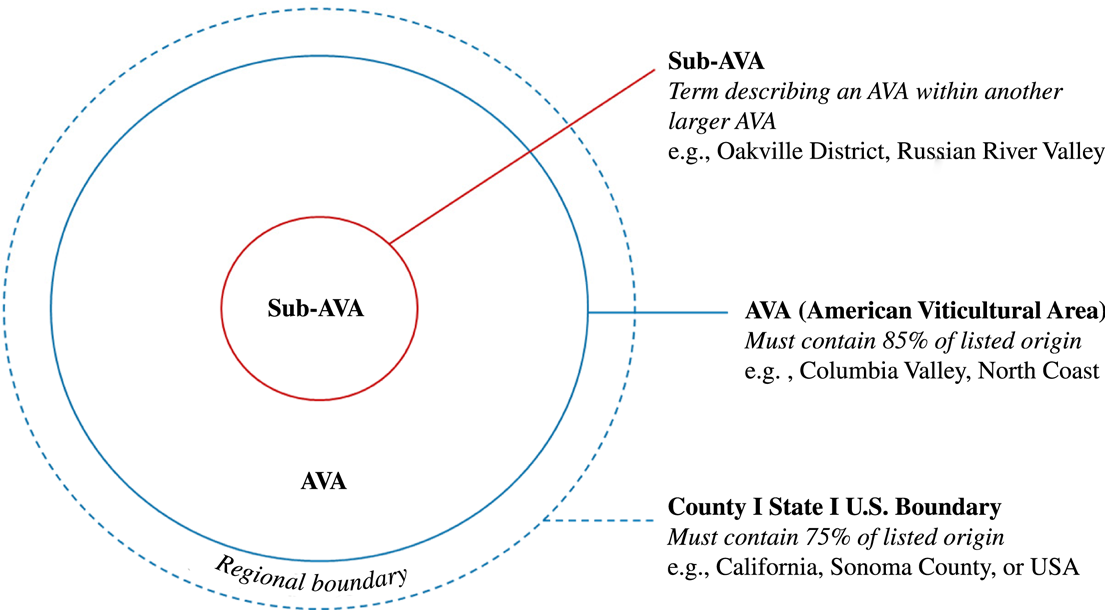
To ensure the authenticity of the system and accuracy of labels, the ATF requires that the following standards be met in order to be used on a wine label.
1. A single varietal wine must contain at least 75% of the varietal's grape.
2. Country, state, and county appellations must contain at least 75% of grapes grown inside the country, state, or county.
3. An AVA or Sub-AVA label must contain at least 85% of grapes grown in said AVA or Sub-AVA.
4. A specific vineyard label must contain at least 95% of grapes grown on the named vineyard (TTB, 2018).
Figure 1 provides a visualization of the American classification systems.
American Classification Systems

C. Napa Valley Sub-AVAs
In addition to the standards imposed by the ATF, Napa Valley wines are subject to strict state legislation. A specific California wine law requires that in order to use California on the label, “100 percent of the grapes in that wine must have been grown in California” (Mendelson, Reference Mendelson2016, p. 105). Even more important to the subject of this research paper is a specific 1990 Napa Valley law on how to treat the labeling of Sub-AVAs. The so-called conjunctive labeling law requires “any wine label that mentions a Sub-AVA located wholly inside Napa Valley to also state the name Napa Valley, such as Howell Mountain-Napa Valley. The two names must appear together” (Mendelson, Reference Mendelson2016, p. 105). This state law was lobbied for by the Napa Valley Vintners and passed by the California legislature with the purpose of promoting all of Napa Valley, instead of focusing on smaller areas. The reason for this law was the rapid rise of Sub-AVAs in the Valley.
Napa Valley was officially established as an AVA in 1981 by the ATF after a lengthy and contentious review process, a full two years after the Napa Valley Vintners and Napa Valley Growers associations submitted a petition to create the AVA in 1979 (Mendelson, Reference Mendelson2016). The review featured debates stemming over how large to make the AVA, specifically whether to include the Eastern Valley of Napa and featured expert testimony, public hearings about economic consequences as many respected Napa Valley producers sourced grapes from the Eastern Valley. Excluding the Eastern Valley from Napa Valley could substantially reduce the demand for their grapes and negatively affect prices. The weight of the decision was lost on no one in the wine community, and on the days of the public hearings in Napa, a veritable “who's who of the wine world” (Mendelson, Reference Mendelson2016, p. 45) came together to make their opinions heard. Arguments on what areas to include fixated on geographic features, the altitude, weather patterns, and especially on the watershed level. In the end, two main arguments turned the tide of the debate to include the Eastern Valley, the first being its inclusion in the Napa Valley phone book, and the second being Robert Mondavi stating that in all the areas of Napa County “I have found that there was a common underlying thread which resulted in a wine that was different from that of Sonoma County, Mendocino County, Monterey County as well as all other counties” (Mendelson, Reference Mendelson2016, p. 49). The ATF listened to these points and included the Eastern Valley in the official Napa Valley AVA, extending the area of the AVA to include more land, grapes, and tastes, but also leaving the AVA ripe for further division.
Since Napa Valley became an official AVA, 16 separate Sub-AVAs have been created within its borders. All went through similar applications and reviews by the ATF, with some being straightforward and others long fought battles. Some owners wanted to create Sub-AVAs for political reasons, to differentiate themselves, or to limit who could use a specific region on a label. For others, the driver was economic, to capture a specific area of the market that drew value. For example, the Stags Leap area drew a significant amount of attention due to Stag's Leap Wine Cellars’ victory in the Judgement of Paris, and the subsequent Stags Leap District AVA could help capture that economic value. However, the creation of an AVA that shared the name of a well-known winery was controversial. In fact, in this case, two wineries were already battling over the name Stag's Leap! Warren Winiarski owned Stag's Leap Wine Cellars, while a neighbor of his, Carl Doumani, owned Stags’ Leap Winery and had “registered Stags’ Leap Vineyard as a word mark” (Mendelson, Reference Mendelson2016, p. 88). The two were locked in a long legal battle over the brands as the Sub-AVA petition for the area began to gain steam, and eventually, Warren Winiarski only agreed to back the Sub-AVA if the appellation name was modified to Stags Leap District, with no apostrophe and the word district to distinguish the region from the brands (Mendelson, Reference Mendelson2016). Names may be important, and parties with vested interests are willing to fight long and hard, even over matters as small as an apostrophe.
Other areas within Napa Valley, which could qualify, may never even become Sub-AVAs for a variety of reasons. The most powerful example is Pritchard Hill, an area sometimes referred to colloquially as “The Rodeo Drive” of Napa Valley. This elusive area, elevated to the East of Oakville, features unique soil, temperature, and weather conditions, sitting just above the main fog line in the valley. Pritchard Hill includes renowned vineyards such as Continuum, Ovid, and, most importantly, Chappellet. The Chappellets were the first family to truly put Pritchard Hill on the map, opening and operating a state of the art vineyard on the hill. Donn Chappellet trademarked the name Pritchard Hill in 1971, and thus controls its rights, even in the case of use as a Sub-AVA (Heimoff, Reference Heimoff2012). In an interview with Wine Enthusiast, Donn Chappellet was adamant that Pritchard Hill would never become a Sub-AVA for fear that the process would include too many neighboring estates.
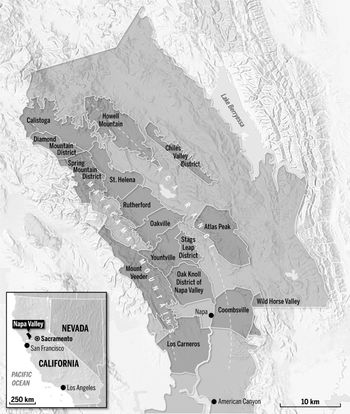
Figure 2 shows the existing Sub-AVA system of Napa Valley (Napa Valley Vintners).
Napa Valley's Sub-AVA System (Napa Valley Vintners)
Source: Courtesy of Ralf Powierski, Info-Graphic Hamburg, info-graphic.de.

II. Literature Review
A. Sub-AVAs
The impact of terroir, the oldest construct for the impact of physical features, has been debated in many papers (Ashenfelter, Reference Ashenfelter2017; Ashenfelter and Storchmann, Reference Ashenfelter and Storchmann2010; Cross, Plantinga and Stavins, Reference Cross, Plantinga and Stavins2017; Gergaud and Ginsburgh, Reference Gergaud and Ginsburgh2008). In their 2003 paper, Bombrun and Sumner begin to delve into the most contentious aspect of regional effects—Sub-AVAs, fueled by their physical features and boundaries. Opinion on Sub-AVAs is divided both in academic literature and among the wine community in Napa Valley. Some believe that the Sub-AVA system is a blight on the wine world, detracting value. Johnson and Bruwer (Reference Johnson and Bruwer2007, p. 167) note that “Schorske (2004) points to the broken nature of the AVA system in the 21st century and the chorus of industry complaints. Many feel that there are too many AVAs and that they are confusing to consumers.” During a research trip to Napa Valley, several producers echoed this sentiment, stating that they concentrated on creating a brand for their winery first and foremost, and did not use Sub-AVA labels even on wines that met the qualifications. Johnson and Bruwer (Reference Johnson and Bruwer2007, p. 168) cite an example of this phenomena, “Jayson Woodbridge has been given 94 + points by Robert Parker and has no difficulty selling his wine. Whereas he is within the Howell Mountain AVA he's only interested in putting Napa on his label”. These pieces of anecdotal evidence suggest that the Sub-AVA system may not add substantial value.
However, other papers refute this notion. Bombrun and Sumner's data show that certain Sub-AVAs earn even higher premiums over California wine than Napa Valley itself. They find that “Appellations with the highest premiums are mainly located within the Napa Valley appellation. For example, Oakville and Howell Mountain appellations earn a premium of 91 percent over wines with the California appellation” (Bombrun and Sumner, Reference Bombrun and Sumner2003). Gokcekus and Finnegan examine the creation of six new Oregon Sub-AVAs since 2005. Referring to Wine Spectator data from 1984 to 2008, they use the price-quality ratio as their dependent variable and run a before–after regression around the time of the creation of the new Sub-AVAs. Their results show that “after reclassification, the price-quality ratio for all portions of Willamette (sub-AVAs and the greater AVA) increased; most importantly, however, the gap between sub-AVAs and the ‘others’ widened” (Gokcekus and Finnegan, Reference Gokcekus and Finnegan2017, p. 347). These findings contradict the work of Johnson and Bruwer, among others, and indicate that Sub-AVAs may add value.
During interviews and discussions with Napa Valley growers and producers, a third hypothesis was suggested numerous times. Several experts believed that a select few of the very best Sub-AVAs, such as Oakville, Rutherford, Stags Leap District, and Howell Mountain, might create value in Napa Valley, while the others would have almost no effect. One or two producers even suggested that the worst regarded Sub-AVAs could even have a negative price effect.
III. Data
A. Data Description
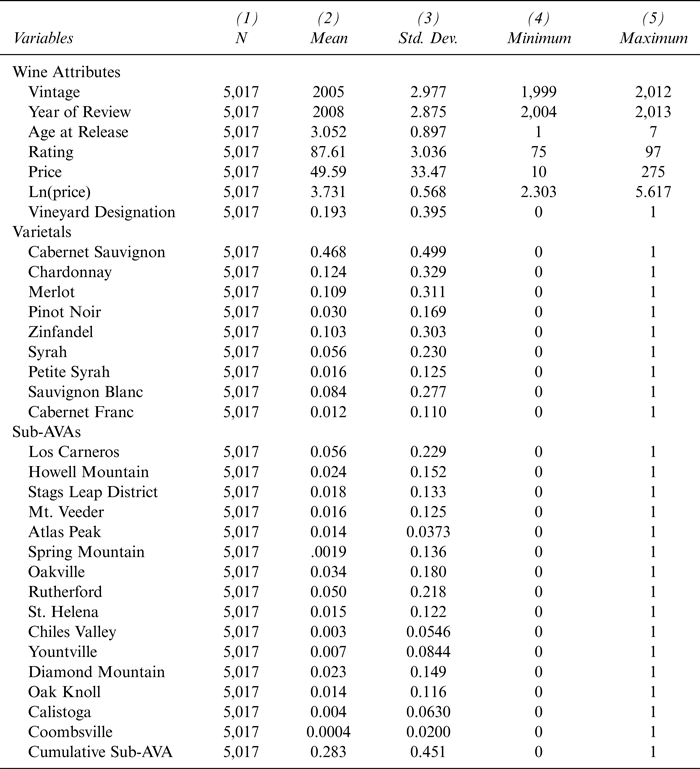
This paper utilizes a dataset of every Napa Valley wine listed in the Connoisseurs’ Guide to California Wine (CGCW) for the 10-year period from 2004–2013.Footnote 1 This dataset focuses on 2004–2013, as prior to 2004, only select wines in each catalog were reviewed, which could introduce selection bias to the data, and prior to 2001, CGCW used a star rating system instead of the modern standard 100-point system. The dataset consists of 5,017 individual wines, recording each wine's vintage, varietal, price, rating, release year, and age at release, as well as Sub-AVA designation or vineyard designation if applicable. I exclude any Napa Valley Blends as they would not qualify for the AVA designation and non-vintage wines. I also exclude wines that are designated Los Carneros but did not specify Napa Valley as the Conjunctive Labeling Law would require since they could have been from the Sonoma side of Los Carneros. The summary statistics for the dataset are shown in Table 1.
Summary Statistics

As one would expect for a Napa Valley dataset, Cabernet Sauvignon dominates the reviews, with 46.80% of all wines containing Cabernet Sauvignon. Chardonnay holds the next highest portion, with 12.36%, followed by Merlot and Zinfandel. The scarcer Petite Syrah and Cabernet Franc grapes are the least represented, with 1.57% and 1.22% shares, respectively.
Sub-AVAs are very well represented in the dataset, with a total of 1,421 wines using a Sub-AVA designation, or 28.3% of the entire dataset. Sub-AVA usage is more common than vineyard designation, which is featured on 970 wines or 19.33% of the dataset. Every Sub-AVA is featured except for Wild Horse Valley, which had no data points and was thus omitted from the model. Coombsville and Atlas Peak both appear less than 10 times in the dataset, and subsequently may not produce statistically significant results. Likewise, Chiles Valley and Calistoga each appear 20 times or less, and also may not have enough data to produce significant results. Even ensuring only Napa Valley wines are recorded, somewhat surprisingly, Los Carneros is the most frequently utilized Sub-AVA, with 279 wines. Rutherford is a close second with 250 wines, followed by Oakville, 168 wines, and Howell Mountain, 119 wines.
Recommended retail price is heavily skewed, ranging from $10 a bottle to $275 a bottle, with a mean of $49.59 and a standard deviation over $33. Because prices are clustered with a large percentage below $50, but with a significant number extending into the $100 plus range, I reshaped the pricing data to a more normal distribution by taking the natural log of the prices. As a result, Ln(price) serves as a better dependent variable for a hedonic pricing model than pure prices would have.
Ratings are fairly normally distributed, with a mean of 87.61 points, a low of 75 points, a high of 97 points, and a standard deviation of 3.
B. Limitations
While the CGCW does blind its tasting sessions and purchases its wine from independent retailers as opposed to being sent bottles by producers, it is important to remember that any single source rating dataset can be influenced by the personal preferences of the tasting panel. The normal distribution of the ratings suggests that any bias would be small, but it could still have an impact on the pricing model's results.
Additionally, the dataset is limited by three principal factors. First, Los Carneros is unique as a Sub-AVA as it is split between both the Napa Valley and Sonoma AVAs, with a larger portion residing in Napa Valley. Because of this unique attribute, I only included wines that the CGCW specified were from Carneros Napa Valley to protect the integrity and clarity of the dataset on Napa Valley wines. With the highest use of any Sub-AVA, it does not seem this decision greatly restricted Los Carneros’ inclusion in the dataset, but its usage may have been even more pronounced than reflected.
Second, the dataset that I created only stretches from 2004–2013. The reason for this is because prior to 2004, CGCW only included rating data for a selection of the wines reviewed. Additionally, prior to 2001, CGCW had used a 1–3-star rating system instead of the more detailed 100-point system in their reviews. As a result, I used the most recent and complete 10-year period that I had available. I would have preferred to include more years of data in the dataset to help capture the effect of Sub-AVAs over a longer period of time, but could not capture the necessary variables continuously.
Third, a limitation to any Sub-AVA research is wineries that are grandfathered into the AVA system, and feature the AVA or Sub-AVA title in their name. Returning to the example of Stag's Leap in the introduction, older wineries that pre-date AVA legislation often have names that evoke a Sub-AVA without actually being designated to that Sub-AVA. A particular bottle from that winery could be from a different region, or from the same Sub-AVA the name evokes, but not designated as such since the winery does not feel the need to apply the more stringent restrictions of Sub-AVA labeling. As such, wines from these select wineries complicate the effect of a Sub-AVA, as the winery may contribute to or receive a price effect from the particular Sub-AVA. Any effects of grandfathered wineries that include Sub-AVA names are not captured in the model I will use.
IV. Methodology
A. Hedonic Pricing Model
This paper primarily uses a hedonic pricing model to study the effect of Sub-AVA designations on wine pricing while controlling for other key characteristics. Drawing on the work of Bombrun and Sumner (Reference Bombrun and Sumner2003), I design a hedonic pricing model that considers the major characteristics of any wine in my dataset as well as location. I also run a second modified regression, which uses a cumulative Sub-AVA dummy variable to study the total effect of Sub-AVAs regardless of which specific Sub-AVA is on the label. This dummy variable equals 1 if a Sub-AVA is designated on the label and 0 otherwise.
B. Reduced Form Pricing Model
To complement my primary regression, I ran two more regressions, each with two parts to capture the individual effects of each Sub-AVA and the cumulative effect as described earlier. The first regression is a reduced form regression, which is identical to my primary regression but without controlling for a wine's rating. The results for this regression will include a pure Sub-AVA effect as well as the implied effect that the Sub-AVA creates through a critic's rating. As critics’ ratings are an imperfect scale, no matter how talented the critic may be, it is interesting to look at this reduced form and compare it to the primary regression's results, which show the effect of a Sub-AVA above and beyond the effect of critics’ rating.
C. Ratings Based Model
The second complementary regression uses rating as the dependent variable instead of as an explanatory variable. This regression studies the effect that Sub-AVAs have on ratings, and in conjunction with the primary regression, helps show if Sub-AVAs affect price through higher ratings or through another means. Logically, if Sub-AVAs significantly increase ratings, this could be a large driver of the value they add. However, if Sub-AVAs do not increase ratings, yet still positively affect price, or vice-versa, the results would demonstrate a Sub-AVA reputational effect that outweighs the indirect effect of rating on price.
V. Results
A. Reduced Form Results
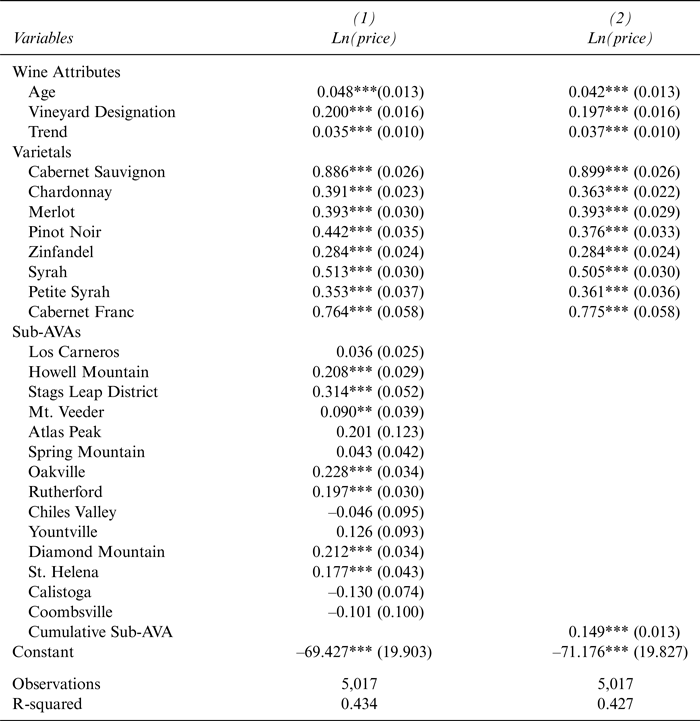
Looking first at the reduced form results provides the basic groundwork to see the extent to which Sub-AVAs affect prices. The results of the reduced form regression are reported in Table 2.
Reduced Form Results

Robust standard errors in parentheses; *** p < 0.01, ** p < 0.05, * p < 0.1
Consistent with expectations and the results of previous studies (Ashenfelter, Ashmore, and Lalonde, Reference Ashenfelter, Ashmore and Lalonde1995; Bombrun and Sumner, Reference Bombrun and Sumner2003; Haeger and Storchmann, Reference Haeger and Storchmann2006; Jones and Storchmann, Reference Jones and Storchmann2001; Zhao, Reference Zhao2008), holding all else constant, age, vineyard designation, a trend variable for year and each varietal predict positive price effects significant at the 1% level. Of these, vineyard designation has the largest effect, with a vineyard usage on the label resulting in a predicted 20.0% increase in price holding all else constant when controlling for each Sub-AVA. Age and the trend variable have positive price effects of 4.8% and 3.5%, respectively, for a one-unit increase holding all else constant.
Critically, for this analysis, of the 14 Sub-AVAs included in the results, six predict positive price effects significant at the 1% level, while one predicts positive price effects at the 5% level. Stags Leap District has the largest effect, with the usage of a Stags Leap District designation predicting a 31.4% price increase, holding all else constant significant at the 1% level. Oakville predicts a 22.8% price increase, Diamond Mountain District a 21.2% price increase, Howell Mountain a 20.8% price increase, Rutherford a 19.7% price increase, and St. Helena a 17.7% price increase holding all else constant, each significant to the 1% level. Mt. Veeder has a positive price effect, predicting a 9% increase holding all else constant significant at the 5% level. Chiles Valley, Calistoga, and Coombsville each have a negative price effect but were not statistically significant. Finally, in the second regression, the cumulative Sub-AVA effect, capturing the effect of every Sub-AVA designated wine, has a predicted positive price effect of 14.9% if a wine used a Sub-AVA designation holding all else constant, significant at the 1% level.
Overall, over half of the individual Sub-AVAs demonstrate a statistically significant positive price effect, and the total Sub-AVA effect is also significantly positive at the 1% level.
B. Primary Hedonic Pricing Results
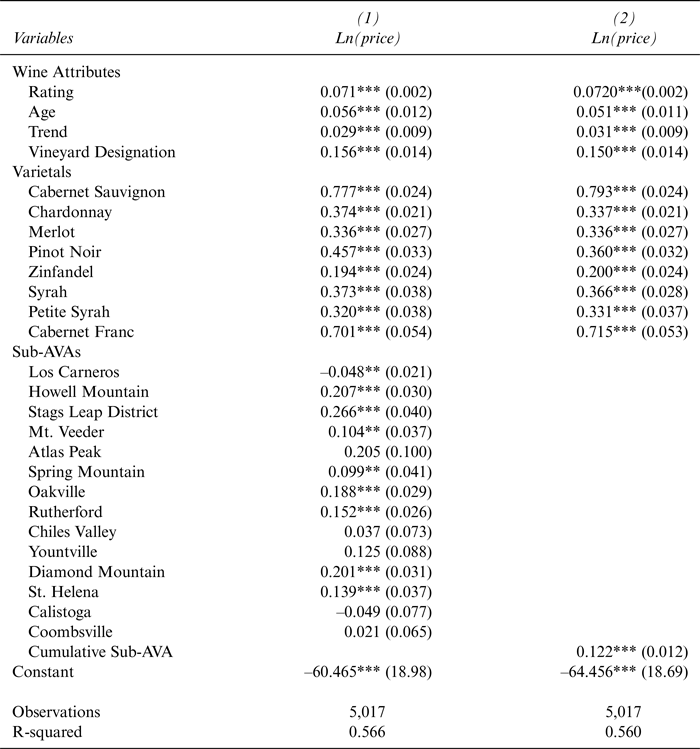
The results of the Primary Hedonic model are shown in Table 3.
Primary Hedonic Results

Robust standard errors in parentheses; *** p < 0.01, ** p < 0.05, * p < 0.1
As discussed in Section IV, in the reduced form regression shown previously, the effects of Sub-AVAs includes both a pure Sub-AVA effect as well as an indirect Sub-AVA effect introduced through critic ratings. A critic might prefer the qualities of a certain Sub-AVA or be able to deduce its origin even in a blind tasting. Hypothetically, if a critic's rating perfectly captured all the characteristics of the quality of a wine and what the consumer valued, then rating would be the only significant variable, and all other characteristics would be insignificant. However, we know that this is not the case, and so further controlling for a wine's rating distinguishes the direct effects of characteristics and those characteristics’ effects through critics’ ratings, and the coefficient for a Sub-AVA in the primary hedonic model will assist in demonstrating a pure Sub-AVA effect.
As shown in Table 3, a rating has a predicted positive price effect of 7.1% per point increase in score significant at the 1% level. Consistent with previous results, age, vineyard designation, and the trend variable remain statistically significant to the 1% level. The predicted impact of the trend decreases slightly while the impact of age increases slightly. Notably, the predicted positive price effect of a vineyard designation drops from 20.0% to 15.6%, showing that almost one-quarter of a vineyard designation's predicted impact is attributable to the critics’ ratings. This substantial difference suggests some critic preference for vineyard designated wines.
Sub-AVAs paint a more mixed picture, with several areas increasing both in significance and in price effect, while others display a lower price effect when controlling for rating. The same six Sub-AVAs of Howell Mountain, Stags Leap District, Oakville, Rutherford, Diamond Mountain, and St. Helena all predict statistically significant positive price effects. Howell Mountain predicts the same positive price effect of 21% as in the prior results, but the other five areas have slightly lower effects. Stags Leap District now predicts a 26.6% price increase compared to 31.4% in the reduced form model in Table 2. Likewise, other Sub-AVA's suggested price effects compared to the reduced form in Table 2 are: Oakville 18.8% (22.8%), Rutherford 15.2% (19.7%), Diamond Mountain 20.1% (21.2%), and St. Helena a 13.9% (17.7%). Notably, three of the most classically lauded Sub-AVAs of Stags Leap District, Oakville and Rutherford show the largest declines in impact when controlling for critics’ ratings, but still provided some of the largest price effects.
Mt. Veeder had previously shown a 9% positive price effect at the 5% significance level, but now predicts a 10.4% positive price effect significant at the 5% level. Additionally, Spring Mountain District, which previously predicted an insignificant positive price effect of 4.3%, predicts a positive price effect of 9.9% significant at the 5% level. These two Sub-AVAs gain in significance, price effect, or both when controlling for critics’ ratings, demonstrating a higher pure Sub-AVA effect.
On the other hand, Los Carneros switches from an insignificant positive price effect to a significantly negative price effect when controlling for critical ratings. Los Carneros predicts a negative 4.8% price effect. Los Carneros’ wines actually, price lower than their ratings and other characteristics would have otherwise predicted. Calistoga also still predicts negative price effects, although at an insignificant level and to a lesser extent than when not accounting for ratings. Chiles Valley and Coombsville both switch to a positive predicted price effect, although, again, not at a significant level.
The cumulative Sub-AVA price effect decreases from 14.9% to 12.2% when including critical ratings. This suggests that of the total Sub-AVA effect, roughly 80% (12.2/14.9) is attributable to a pure Sub-AVA effect, while roughly 20% (2.7/14.9) is attributable to the indirect effect of critics’ opinion on quality. This finding is important, as it suggests the Sub-AVAs add a substantial portion of value to wine through a pure Sub-AVA effect, not just through the preference and influence of critics.
C. Ratings Based Effects Results
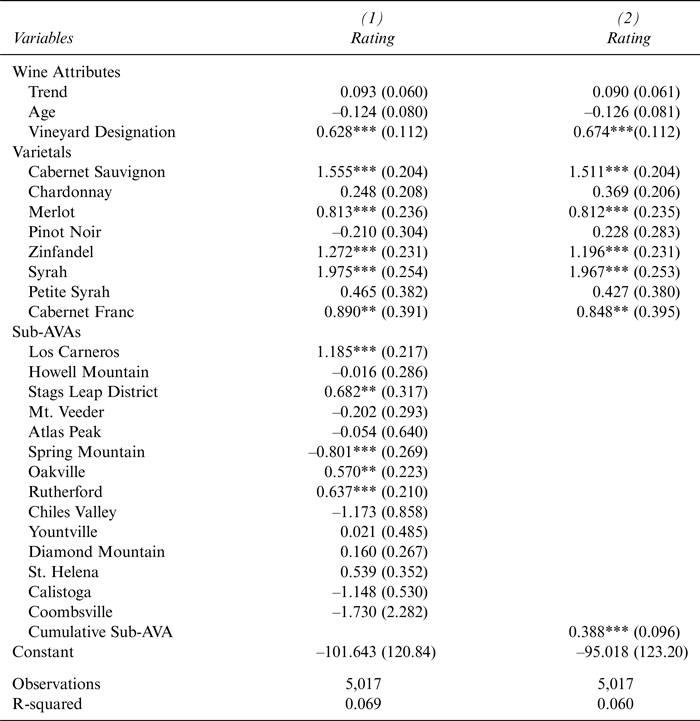
Using ratings as the dependent variable in the ratings-based model also supports this point, as shown in Table 4.
Quality Ratings Based Effects Results

Robust standard errors in parentheses; *** p < 0.01, ** p < 0.05, * p < 0.1
With ratings as the dependent variable, vineyard designation has a significant positive effect at the 1% level. Vineyard designation predicts a 0.628 point increase if a wine uses a vineyard designation holding all else constant. Age has a slightly negative predicted effect on ratings, but significant at no level, and the trend variable a slightly positive predicted effect, again significant at no level. The different varietals have a mix of significant and insignificant results, with most positive and one negative.
The Sub-AVA effects on ratings illustrate the difference between pure Sub-AVA effects and indirect effects through ratings. Of the six Sub-AVAs that predict the largest positive price effects, three also exhibit significantly positive effects on ratings. Holding all else constant, Stags Leap District predicts an increase of .682 points for a wine using its designation, significant to the 5% level, Rutherford .637 points significant to the 1% level, and Oakville .570 points significant to the 5% level. As shown in the primary hedonic model, when controlling for ratings, these Sub-AVAs’ impact falls by the largest amount, although still significantly positive. This change is due to the fact that these Sub-AVAs have a disproportionately positive impact on ratings, whether due to actual quality, historical critical acclaim, or higher-quality producers. While a relatively larger portion of the positive price effect of these regions comes from indirect critic effects, they still deliver large pure Sub-AVA effects. The other three Sub-AVAs that predict positive effects at the 1% level have no significant predicted effect on ratings, and in fact, Howell Mountain even exhibits a negative (although insignificant) effect on ratings. St. Helena, Diamond Mountain, and Howell Mountain impact price almost entirely through a pure Sub-AVA effect, not through indirect rating effects.
Additionally, Mt. Veeder, Atlas Peak, Spring Mountain, Chiles Valley, Calistoga, and Coombsville all suggest negative rating effects, with Spring Mountain significant at the 1% level. Of these Sub-AVAs, Mt. Veeder and Spring Mountain both predict positive price effects in the primary hedonic model, significant to the 5% level. In the case of these Sub-AVAs, the pure Sub-AVA effect actually outweighs a negative indirect effect of critics’ ratings to a statistically significant degree. While these Sub-AVAs may have a predicted negative effect on ratings, their positive price effects demonstrate that consumers value wines from these Sub-AVAs, perhaps due to a peer effect and historical quality of the area.
The reverse of this phenomenon is Los Carneros, which exhibits the largest positive effect on ratings, predicting an increase of 1.185 points for wines using the Los Carneros designation. Because Los Carneros has such a high impact on ratings, in the primary hedonic model, Los Carneros has a negative predicted price effect as a pure Sub-AVA effect. This is an interesting finding, as Los Carneros is the only Sub-AVA to have a negative pure Sub-AVA effect that is statistically significant. This may be caused by Los Carneros’ specialization in Chardonnays, due to its southernmost location in Napa Valley. Napa Valley, as a whole, is rather recognized for Cabernet Sauvignon. Thus, while Los Carneros produces wines that achieve critical acclaim, and has a positive rating effect, it does not resonate with consumers in the same way and fails to create a positive price effect.
VI. Conclusion
To what extent does the creation of Sub-AVAs, by itself, have a causal effect on wine prices? Or are Sub-AVA indicators simply measuring quality differences in the grapes (and wine) produced? In this paper, I attempt to answer this question by controlling for wine ratings that ostensibly indicate a wine's quality to consumers. While there is substantial research that questions the objectiveness of ratings as a measure of quality (Ashenfelter, Reference Ashenfelter2008; Haeger and Storchmann, Reference Haeger and Storchmann2006; Storchmann, Reference Storchmann2012), in controlled studies wine ratings have been shown to influence consumer opinion and demand by providing quality information (Hilger, Rafert, and Villas-Boas, Reference Hilger, Rafert and Villas-Boas2011). However, to the extent there are quality factors unrelated to ratings that are correlated with Sub-AVA indicators and reflected in prices, the hedonic method will overstate the pure effect of AVA labeling, particularly given the lack of pre-post data and producer fixed effects.
Within the limitations of this study, the results of the primary hedonic pricing model are highly compelling for the effectiveness of Sub-AVAs. The primary hedonic pricing model shows that of the 14 included Sub-AVAs, 8 predicted statistically significant positive price effects, with 6 significant at the 1% confidence level and two at the 5% level. Only Los Carneros displays a statistically significant negative price effect. This negative price effect had the lowest significant predicted impact at only 4.8%. Additionally, the cumulative Sub-AVAs in total predicted a positive price effect of 12.2%, significant to the 1% confidence level. Even within the iconic Napa Valley, Sub-AVAs add significant value.
The reduced form and rating-based models also suggest that the majority of the Sub-AVA effect comes from pure Sub-AVA influence as opposed to indirect effects through critics’ ratings. While some of the more critically acclaimed regions receive a boost in critics’ ratings, a majority of the Sub-AVAs maintained positive price effects while having no predicted impact on ratings, and in some cases, even achieved positive price effects despite having a negative predicted impact on ratings. The Sub-AVAs may achieve this effect in the same way AVAs do, through branding, historical quality, reputation, and a peer effect of talented individuals pooling knowledge and skills together on an even smaller microcosm than an AVA. Creating a mountain wine and a valley wine require very different skills, and the Sub-AVAs help each distinct region within Napa Valley to develop a network of talent, create distinctive, high-quality wines and earn positive reputations. These network effects allow wineries within a Sub-AVA to collectively deliver on their goal of achieving recognition in the marketplace for the special qualities and characteristics associated with wines from their Sub-AVA, creating value in the form of a price premium to a greater extent than previously believed or demonstrated empirically in academic literature.
Clearly, further research would be useful. One approach would be to use a longer panel of prices and ratings—unavailable in the data I have—to take advantage of the creation of Sub-AVAs to study this issue. Since quality is not likely to change discretely, a pre-post comparison using fixed effects would be an effective approach. At the same time, data on grape prices grouped by Sub-AVA might also shed light on this issue and may be available over a longer period. Since the creation of Sub-AVAs is costly, political, and time-consuming, determining their true value is of considerable importance for those undertaking to do so, and may prove insightful to the all of the wine community.