Introduction
Trichogaster leeri is a good species choice to serve as a model for biological studies as it generates numerous offspring and reproduces easily. In addition, it is commonly sold in ornamental fish shops (Tonini et al. Reference Tonini, Polese, Abreu, Mattos, Vidal Junior and Andrade2012). Despite the unique characteristics of this species, few studies have been conducted that describe aspects of its early ontogeny. Ontogenetic studies are important for understanding the physiological aspects of the embryo, generating information for conservation of fish populations and improving culture techniques (Godinho et al. Reference Godinho, Santos, Sato, Godinho and Godinho2003).
The description of morphological and physiological aspects of the early stages of embryonic development are extremely important to maximize its survivability rate during the early period of its life (Senhorine, Reference Senhorine1993; Nakatani et al. Reference Nakatani, Agostinho, Baumgartner, Bialetzki, Sanches, Makrakis and Pavanelli2001). Ontogenetic studies can be used as a tool to improve information on fish culture, especially when associated with water quality parameters that interfere directly on fish life stage.
Temperature is one of the main parameters measured in general during fish culture. Fish are classified as poikilothermic and changes in water temperature can significantly affect fish feeding, growth, survival and metabolism (Bustos et al. Reference Bustos, Landaeta, Bay-Schmith, Lewis and Moraga2007). Increased temperature accelerates food intake, metabolism and ontogenetic development, and may disturb the balance between intake and energy expenditure, leading to mortality of the fish. In addition, yolk absorption is faster at higher temperatures, reducing the duration of endogenous supply (Fukuhara, Reference Fukuhara1990; Aritaki & Seikai, Reference Aritaki and Seikai2004; Dou et al. Reference Dou, Masuda, Tanaka and Tsukamoto2005; Fielder et al. Reference Fielder, Bardsley, Allan and Pankhurst2005; Bustos et al. Reference Bustos, Landaeta, Bay-Schmith, Lewis and Moraga2007).
Some studies have investigated the effects on hatching of factors such as yolk sac absorption (slower yolk consumption at lower temperatures for tropical fish) and animal development (accelerated at higher temperatures within the thermally comfortable range), plus the ability to interfere with swimming capabilities of larvae, making them more susceptible to predation and limiting their ability to obtain food (Howell & Caldwell, Reference Howell and Caldwell1984; Berlinsky et al. Reference Berlinsky, Taylor, Howell and Bradley2004). Thus the aim of this study was to determine the effect of temperature throughout embryonic and larval development up to the period of first larval feeding.
Material and methods
The eggs used to describe embryonic development were obtained from the natural spawning of a pair of T. leeri. The pair was kept in the aquaculture sector of the Laboratory of Animal Science and Animal Nutrition (LZNA) of Science Center and Agricultural Technologies (CCTA) from State University of North Fluminense Darcy Ribeiro (UENF), Campos dos Goytacazes, Rio de Janeiro, Brazil.
The pair was kept in a tank with a 20 l capacity, consisting of a re-circulating water system, and equipped with a mechanical and biological filter. After the separation of the pair, the female was kept locked in a transparent container with an opening above the water surface to avoid fighting with other animals. The male built a bubble nest around the female in a floating substrate of expanded polystyrene (EPS), and then the female and the male were released to perform courting, then breeding and until spawning.
After the start of spawning, about 20 eggs were examined under an optical microscope (×25 magnification) to evaluate the embryonic spawning stage. After the first observation, 30 eggs were inserted using a floating sieve into five tanks with a capacity of 18 l, with six sieves per incubator. Each tank possessed a heater coupled to a thermostat, keeping the temperature constant during the whole experimental period. Temperatures in the incubators were set at 24, 26, 28, 30 or 32°C. Each tank had an oxygenation system for water, connected to an air blower, hose and porous stone.
Observations were performed frequently from fertilization until the time that the first feeding of brine shrimp (Artemia spp.) occurred. Observation intervals varied according to the ontogenetic phase, e.g. 30 min intervals during the incubation period (0–24 h), every 2 h (24–48 h), and every 4 h until the first feeding of the animals was observed.
At each observation, a sample of 10 eggs was taken from the total number of eggs from three sieves at random and placed on a glass slide for evaluation under an optical microscope (×25 or ×100 magnification). The images were obtained using an optical microscope with an attached camera.
The embryonic development stages were described only when 50% of the eggs observed in the sample reached the same stage. The values of temperature, pH and dissolved oxygen were measured every 2 h with the aid of a digital thermometer, pH meter and a digital oximeter, respectively. Event classification is based on morphologic characteristics according to the methodology used by Fujimoto et al. (Reference Fujimoto, Kataoka, Sakao, Saito, Yamaha and Arai2006) for the loach (Misgurnus anguillicaudatus). Hours post fertilization (hpf) were used to correlate morphophysiological events. The hpf corresponded to the time spent after fertilization from time 0 (H0 – initial). Upon completion of the embryonic and larval development stages, another spawning was performed from the same family to obtain the hatching rate and larval survival rate as described by Omitogun et al. (Reference Omitogun, Ilori, Olaniyan, Amupitan, Oresanya, Aladele, Odofin and Katkov2012) and the efficiency index calculated using the following equations:
 {\fontsize{8}{10}\selectfont{$$\begin{eqnarray*}
&&{\rm{\% \ Hatchability}}\\
&&\quad = \frac{{{\rm{Total\ no}}.{\rm{\ of\ fertilized\ eggs}} - {\rm{No}}.{\rm{\ of\ unhatcched\ eggs}}}}{{{\rm{Total\ no}}.{\rm{\ of\ fertilized\ eggs}}}}{\rm{\ }}\times 100{\rm{\% }}
\end{eqnarray*}$$}}
 {\fontsize{8}{10}\selectfont{$$\begin{equation*}
{\rm{\% \ Survivability}} = \frac{{{\rm{Total\ no}}.{\rm{\ of\ larvae}} - {\rm{No}}.{\rm{\ of\ dead\ larvae}}}}{{{\rm{Total\ no}}.{\rm{\ of\ larvae}}}}{\rm{\ }}\times 100{\rm{\% }}
\end{equation*}$$}}
 {\fontsize{8}{10}\selectfont{ $$\begin{eqnarray*}
&&\% \ {\rm{Spawning\ efficiency\ index}}\\
&&\quad = {\rm{Hatchability }} \times {\rm{ Survivability }} \div {\rm{ }}100
\end{eqnarray*}$$}}
The results obtained during the experimental period were subjected to statistical analysis, used Pearson's correlation to determine the correlation between variables and polynomial regression to specify a better time of occurrence for the variables studied.
Results
The physicochemical parameters of the aquarium water are shown in Table 1. There were no major changes in temperature during all treatments, the temperature remained near the set value, showing a thermal equilibrium during the experimental period. Oxygen levels and pH of the water were recorded. pH and dissolved oxygen showed acceptable values for culture of this fish species. The average diameter of Trichogaster eggs at different temperatures was 0.863 ± 0.2603 mm.
Average values of temperature (°C). Dissolved oxygen (DO) and pH of water used in the incubators during the experimental period

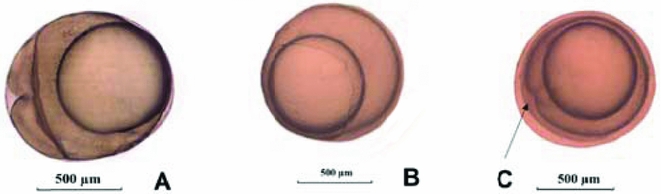
The fertilized T. leeri eggs had a spherical shape, with the chorion and the yolk sac translucent (Fig. 1 A). The chorion was described as somewhat hard and its texture was similar to that of small ‘gelatinous spheres’.
Stages from early cleavage to blastopore closure. (A) Visualization of the beginning of cleavage (two blastomeres). (B) Visualization of the egg in gastrulation. (C) Blastopore closure.
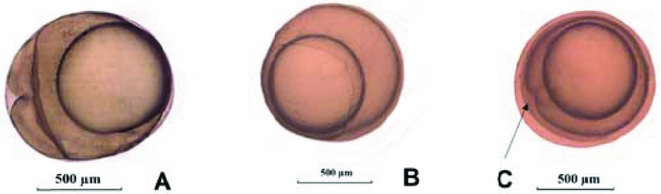
The cleavage pattern observed in the embryos studied, as well as in other teleosts, was meroblastic. The initial division of blastomeres was very rapid and intense, making it difficult to see and preventing any count of blastomere numbers, marking the start time of cleavage from the moment when the eggs had two blastomeres until the moment when the eggs had a spherical-shaped blastodisc, marking the beginning of gastrulation.
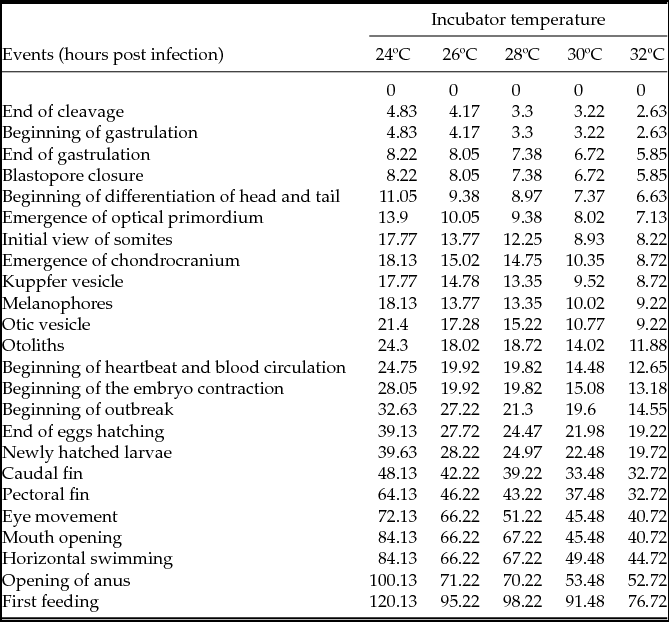
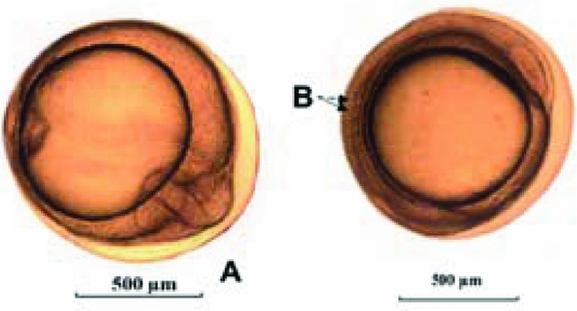
Hpf values for each temperature for all the events are listed in Table 2. Steps such as cleavage, gastrulation and blastopore closure occurred rapidly at all the evaluated temperatures (Fig. 1 A, B). The end of gastrulation was taken to be at blastopore closure in T. leeri eggs (Fig. 1 C). At the end of the gastrula period, organogenesis began, at which time the tissues and organs differentiated. The beginning of differentiation of the head and tail was observed at 6.63, 7.37, 8.97, 9.38, or 11.05 hpf at temperatures of 32, 30, 28, 26 or 24°C, respectively. It can be seen that shortly after visualization of the head and tail of the embryo, the emergence of the optical primordium occurred, which showed a positive correlation of 97.96% with the beginning of visualization of the somites (Fig. 2 A, B).
Events reported during embryonic development of Trichogaster leeri and characteristics of larvae up to first feeding

Beginning of differentiation of structures during organogenesis. (A) Optical primordium. (B) Visualization of somites in the embryonic axis.
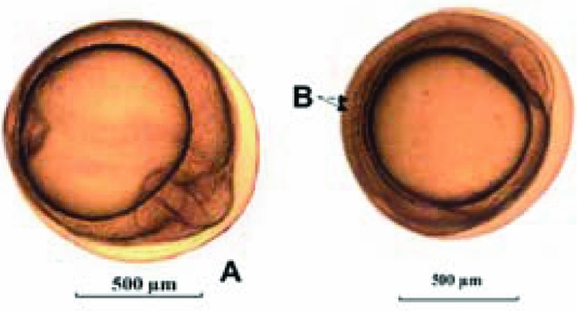
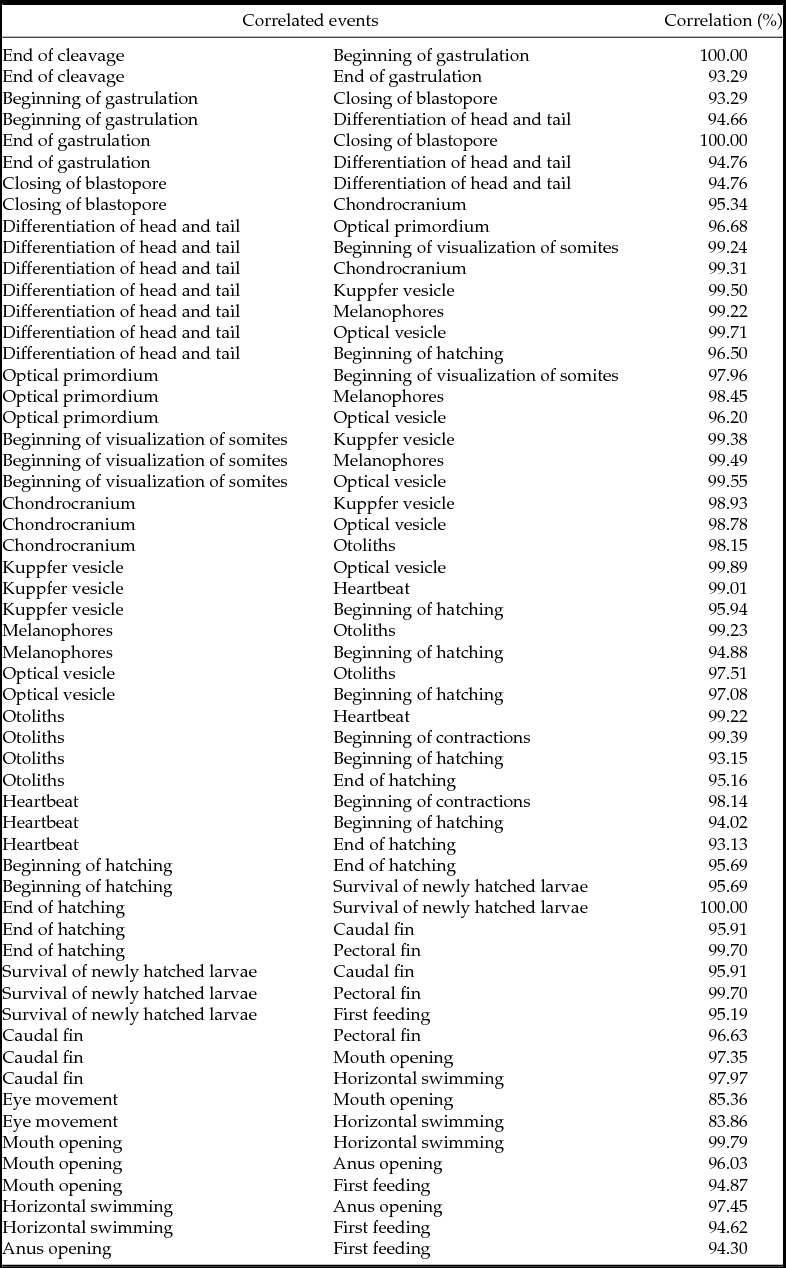
During organogenesis, the start of visualization of the somites was positively correlated (97.53%) with development of the chondrocranium. Another correlation is listed in Table 3. At this stage it was possible to see the emergence of the chondrocranium, a cartilaginous cranial structure of the embryo in the cephalic region, which gives rise to the skull base that sustains the brain. An even higher positive correlation than that of the chondrocranium was observed with the emergence of the Kuppfer vesicle (98.93%).
Correlation between events observed during embryonic and larval development of Trichogaster leeri

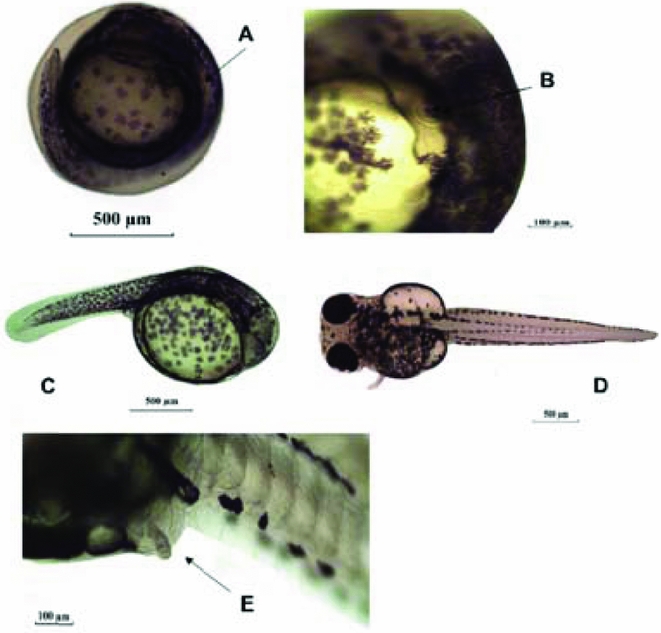
In the present study the emergence of melanophores occurred before the rise of the chondrocranium, except at 32°C. It was possible to observe the beginning of the emergence of the otic vesicle, in the posterior region of the optic vesicle, and then the emergence of the otolith, seen just a couple until moments before hatching. The correlation between the otic vesicle and the otolith was 97.51%. (Fig. 3 A, B).
Photomicrographs of the embryo during pre/post-hatching. (A) Optic vesicle of pre-hatching embryo. (B) Optic vesicle with higher magnification of the image. (C) Trichogaster leeri larva newly hatched. (D) Larvae with mouth opening, developed fins and exhausted calf. (E) Anus opening.
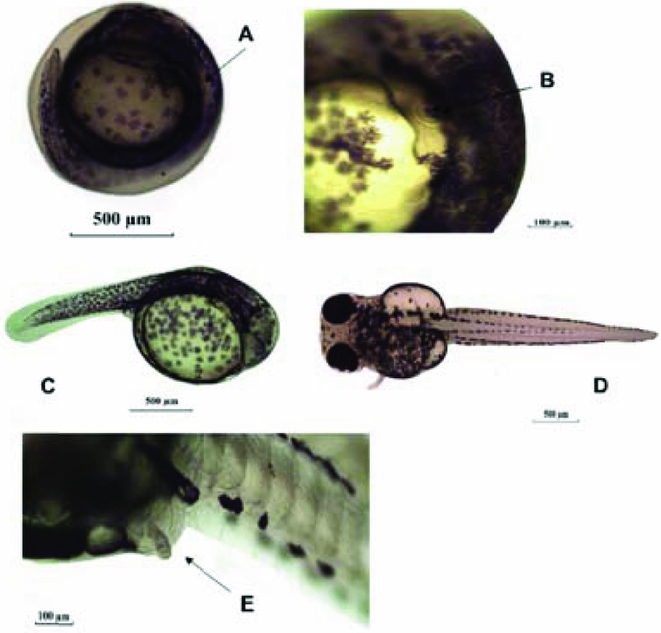
When the animals began contractions, usually near the hatching period, large amounts of dendritic melanophores were observed throughout the embryonic axis (Fig. 3), muscle contraction began to occur during the embryo's preparation to hatch, in order to assist chorion breakage.
The beginning of the heartbeat showed a positive correlation (98.14%) with the beginning of embryo contractions, followed by the beginning of hatching at hpf of 14.55; 19.60; 21.30; 27.22 or 32.63 at temperatures of 32, 30, 28, 26 or 24°C, respectively. The end of hatching occurred over a large time interval between 32 and 24°C, recorded at 19.22 and 39.13 hpf, respectively.
The caudal fin was viewed in the larvae at 32.72, 33.48. 39.22, 42.22 or 48.13 hpf at temperatures of 32, 30, 28, 26 or 24°C, respectively. Eye movement was viewed only after the development of pigmentation of the lens and of retinal pigmentation.
The time of first feeding was described as the time at which the T. leeri larvae began to capture the nauplii. Larvae that were capturing nauplii generally had an orange pigmentation throughout the region of the digestive tract, even in formation. To prove that the animals were feeding, they were removed from the floating sieves and observed under an optical microscope.
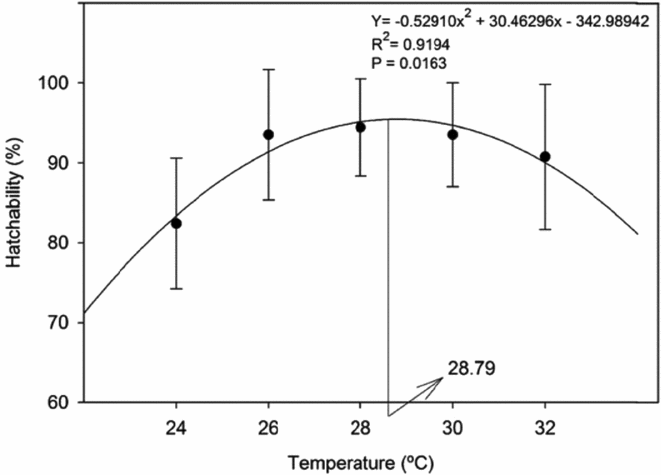
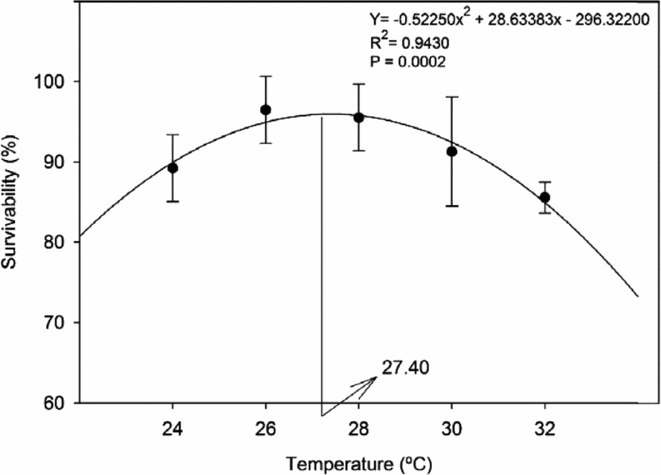
Hatching rate was best from 26 to 30°C, with a maximum at 28.79ºC (Fig. 4). The mean survival values for the larvae were observed at 26 and 28ºC, with maximum at 27.40°C (Fig. 5).
Effect of temperature on hatchability of Trichogaster leeri eggs. Arrow indicates the maximum point obtained by the equation.

Effect of temperature on survivability of Trichogaster leeri larvae. Arrow indicates the maximum point obtained by the equation.

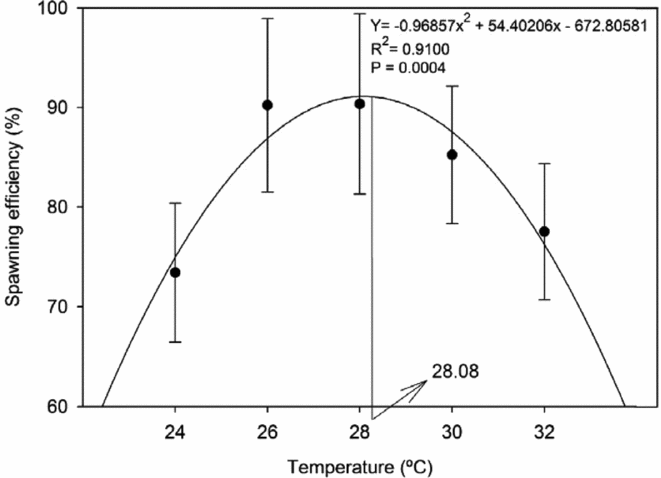
In relation to the efficiency of spawning, obtained through the correlation between the hatching rate and larvae survival, it was possible to observe the best results at temperatures of 26 and 28°C, with the maximum at 28.15°C (Fig. 6).
Efficiency of spawning at different temperatures. Arrow indicates the maximum point obtained by the equation.

Discussion
At the time of spawning, the male T. leeri puts the eggs into a bubble nest, showing parental care, as seen in Betta splendens and Hoplosternum littorale species (Nakatani et al. Reference Nakatani, Agostinho, Baumgartner, Bialetzki, Sanches, Makrakis and Pavanelli2001; Duarte et al. Reference Duarte, Vasconcellos, Vidal, Ferreira, Mattos and Branco2012).
Embryonic development time in this study showed a difference in function at the experimental temperatures used in all treatments. In general, the time to occurrence to events was faster than that observed in other tropical fish (Ferreira, Reference Ferreira2007; Radael et al. Reference Radael, Cardoso, Andrade, Mattos, Motta, Manhães and Vidal2013; Mattos et al. Reference Mattos, Cardoso, Fosse, Radael, Fosse Filho, Manhães, Andrade and Vidal2015).
Cleavage period was characterized by blastodisc successive cell divisions and began soon after the oocyte fertilization. Cell divisions occurring during cleavage continued up to the beginning of gastrulation, a step in which by epibolic movements the blastodermal cells overly the vitelline mass and migration occurs over most internal cells of the blastoderm, moving back and convergently to form the embryonic axis. The embryo axis of T. leeri could be observed when the gastrula was 60%, this result differed from that of Humphrey et al. (Reference Humphrey, Klumpp and Pearson2003), who reported that Melanotaenia splendida differentiation of the embryonic axis occurred during the period when the gastrula was 70%. The end of gastrulation was deemed to be at blastopore closure (Olaniyi & Omitogun, Reference Olaniyi and Omitogun2014)
This phase has been described by other authors such as Puvaneswari et al. (Reference Puvaneswari, Marimuthu, Karuppasamy and Haniffa2009) in Heteropneustes fossilis at 7 hpf and by Reynalte-Tataje et al. (Reference Reynalte-Tataje, Zaniboni-Filho and Esquivel2004) in Brycon orbignyanus at 6.5 hpf to blastopore closure. This step in embryonic development is an important event and it is considered the period at which oocyte fertilization can be confirmed (Woynarovich & Horváth, Reference Woynarovich and Horváth1983).
These events occurred faster at all temperatures when compared with the study of Duarte et al. (Reference Duarte, Vasconcellos, Vidal, Ferreira, Mattos and Branco2012), who observed time until the end of cleavage and end of gastrulation to be 7.5 and 14.5 hpf respectively for B. splendens. In eggs of surubin hybrids (Pseudoplatystoma corruscans × Pseudoplatystoma fasciatum) observed by Faustino et al. (Reference Faustino, Nakaghi, Marques, Makino and Senhorini2007), it was possible to observe faster occurrence in relation to that observed at all temperatures in this experiment. However, this same author pointed out that the time of occurrence of the events in his experiment varied depending on the water temperature.
The differentiation of head and tail in embryonic development, and the appearance of the optic primordium and the somites had lower hpf values at all temperatures when compared with results obtained by Marimuthu & Haniffa (Reference Marimuthu and Haniffa2007), Radael (Reference Radael2009) and Mattos et al. (Reference Mattos, Cardoso, Fosse, Radael, Fosse Filho, Manhães, Andrade and Vidal2015). This difference is probably related to the characteristics of the studied species and larval development level at the time of hatching. T. leeri larvae are altricial and therefore not fully differentiated at the time of hatching, therefore hatching time was shorter than that of the species used by these authors.
It is noteworthy that structures such as somites, resulting in the formation of vertebrae, ribs and axial muscles, develop before emergence of structures such as Kuppfer vesicles that have an excretory function (Alves & Moura, Reference Alves and Moura1992), the optic vesicle and the otolith. This behaviour can be observed in this present study, as well as observed in kinguios ‘var. comet’, by Mahmud et al. (Reference Mahmud, Ahmed, Ghosh, Azad, Bir and Rahaman2011), in Carassius auratus by Tsai et al. (Reference Tsai, Chang, Liu, Abe and Ota2013) and in discus fish, described by Mattos et al. (Reference Mattos, Cardoso, Fosse, Radael, Fosse Filho, Manhães, Andrade and Vidal2015).
The pigmentation that is clearly visible before hatching is a form of protection after hatching, as it camouflages the animal from predators (Bemvenuti & Fischer, Reference Bemvenuti and Fischer2010; Olaniyi & Omitogun, Reference Olaniyi and Omitogun2013). Furthermore, Olaniyi & Omitogun (Reference Olaniyi and Omitogun2014) described that this pigmentation is essential for taxonomic identification of species.
Events at the beginning and end of hatching happened quickly at 26°C. It is possible that this result is associated with proximity to the optimum temperature for larval survival and spawning efficiency. Despite the lack of higher absolute values for hatching rate in 26°C, larvae survival and spawning efficiency was better at this temperature.
In this study, the T. leeri larvae after hatching developed a large area of pigmentation in the yolk and in the embryonic axis, had a large reserve of yolk and exhibited little movement. The T. leeri larvae showed little morphological development at hatching, low swimming motility and little yolk reserve, besides having incomplete digestive tract morphology at the first feeding that may impair the development of animals during and after hatching (Portella, Reference Portella2004; Mattos et al. Reference Mattos, Cardoso, Fosse, Radael, Fosse Filho, Manhães, Andrade and Vidal2015). Until the digestive tract is fully developed, the animal is still dependent on endogenous feed. Digestive tract development corresponds with the necessity for exogenous food, and other changes such as development of the mouth opening, vision and improved swimming, which are all necessary for obtaining a food source (Santin et al. Reference Santin, Bialetzki and Nakatani2004).
At all temperatures, T. leeri larvae exhibited mouth opening shortly after eye movement, indicating that the larvae would be able to search for food. However, although the larvae exhibited mouth opening, first feeding was observed only after a long period, and this behaviour indicated that the larvae required food smaller than the brine shrimp nauplii used as the initial food in this study (Guevara & Guevara, Reference Guevara and Guevara2008).
Temperature influenced embryonic development in T. leeri, best results were at the thermally comfortable range of 26 to 29°C. In studies performed with species from other fish families the effect of temperature on incubation has also been measured. As noted by Dionısio et al. (Reference Dionısio, Campos, Valente, Conceição, Cancela and Gavaia2012), for the effect of incubation temperature on Solea senegalensis eggs, generally grown at 18–22°C and in accordance with Engrola et al. (Reference Engrola, Conceição, Gavaia, Cancela and Dinis2005, Reference Engrola, Figueira, Conceição, Gavaia, Ribeiro and Dinis2009), Fernandez et al. (Reference Fernandez, Pimentel, Ortiz-Delgado, Hontoria, Sarasquete, Estevez, Zambonino-Infante and Gisbert2009), Blanco-Vives et al. (Reference Blanco-Vives, Villamizar, Ramos, Bayarri, Chereguini and Sánchez-Vázquez2010), egg incubation temperature had a significant effect on the occurrence of abnormalities in S. senegalensis larvae.
Although these are different species, water temperature influenced the time of occurrence of events, and may even have affected hatching rate and larval survival, as observed in this study. In addition, for effects on larval performance, temperature may play an important role in the incidence of defects, resulting in lower quality larvae, as observed by Dionısio et al. (Reference Dionısio, Campos, Valente, Conceição, Cancela and Gavaia2012).
Water temperature is one of the most important factors that should be monitored in fish hatcheries because it can change the physiological characteristics of animals, decrease activities such as swimming in some species, provide high mortality rates with stringent changes in temperatures, or be out of the thermally comfortable range of the species of interest (Sfakianakis et al. Reference Sfakianakis, Leris and Kentouri2011).
In conclusion, water temperature influenced embryonic and larval development of T. leeri, events occurred sooner at higher temperatures and were delayed at lower temperatures. Despite the effect that temperature had on the timing of occurrence of events, the best results for hatching rate, larval survival and efficiency of spawning were observed at 28°C, which is the temperature recommended for incubation of T. leeri larvae eggs.
Acknowledgements
The authors acknowledge CNPq for encouraging, and UENF for providing, the conditions for these experiments.