The Industrial Revolution was summarized by T. S. Ashton in the words of the famous schoolboy: “About 1760 a wave of gadgets swept over England.”Footnote 1 Some gadgets are well known (the spinning jenny, the water frame, the steam engine), and others less so (devices to lay out and cut the gears of watches, foot-powered trip hammers to stamp the heads on nails). Much has been learned about these inventions, but central questions remain: Why did the gadgets sweep over England rather than the Netherlands or France or, for that matter, China or India? And why were these technologies invented in England rather than elsewhere? Why, in other words, was the Industrial Revolution British?
This article approaches these questions through a case study of the spinning jenny, the machine that kicked off the Industrial Revolution in cotton. It was invented by James Hargreaves in Lancashire in the mid-1760s, about the same time that Richard Arkwright was inventing his water frame. The spinning jenny, however, was the first to be used on a large scale. It quickly displaced spinning wheels in Britain. France was the other major European cotton producer, but adoption across the channel was very slow. These industries were small compared to the major Asian producers. In Britain and France, several million pounds of cotton were spun annually in the middle of the eighteenth century.Footnote 2 Bengal, which was a major exporter to Europe and Africa and the main competitor of British and French manufacturers, produced about 85 million pounds per year.Footnote 3 This was accomplished without any mechanization, and, indeed, explaining “the absence of any technological innovation in the textile industry” is an important problem for Indian historians.Footnote 4 In the nineteenth century, British producers outcompeted all others in the world, and they did it with machines like Crompton's mule that were descendants of Hargreave's jenny. Why did the British start on this propitious line of development, while the French, the Indians, and everyone else failed to take the first step?
Explaining the Industrial Revolution is a longstanding question, and many social scientists have offered answers.Footnote 5 A current favorite is political structure, i.e., parliamentary checks on the executive, the security of property rights, and the flexibility of the legal system. According to this view, the dramatic changes of the late eighteenth century can be traced back to the Glorious Revolution of 1688 that consolidated parliamentary ascendancy, minimal government, and secure property rights. Supposedly, these legal changes created a favorable climate for investment that made the Industrial Revolution possible.Footnote 6 Another approach is to trace inventiveness back to culture. The oldest variant is Max Weber's theory that Calvinism made Protestants particularly rational and oriented towards economic achievement. This view lives on in David Landes' thesis that the French were poor entrepreneurs who failed to adopt British technology, even though it would have paid and in Greg Clark's claim that the British worked harder than other people because of genetic selection.Footnote 7 Another tack attributes Europe's lead over India (if not Britain's lead over France) to the Scientific Revolution of the seventeenth century, especially as it acted through the Industrial Enlightenment.Footnote 8
Good law and good culture may have been necessary conditions for the Industrial Revolution, but they were not sufficient. Getting the institutions right, increasing knowledge of the natural world, and focusing people's minds on an empirical approach to production may have increased the supply of technology, but they would have had little impact on invention without a demand for new techniques. This article argues that Britain had a high-wage economy that increased the demand for technology that substituted capital for labor. Machines like the spinning jenny did just that. The famous inventions of the Industrial Revolution were adopted in Britain rather than elsewhere because they were profitable to use in Britain, but generated losses elsewhere. A further implication is that the famous inventions of the Industrial Revolution were invented in Britain because they generated enough profit to make the cost of developing and perfecting them worthwhile. They were not invented elsewhere because they were not used even when they were freely available. Hence, there was no point in inventing them. Or, to put the argument in economic terms: In France and India, the rate of return to inventing British technology was too low to justify the necessary Research & Development (R&D).
In this article, I develop this view by investigating a sequence of problems in the history of the spinning jenny. The first is what did it mean to invent the jenny? We must avoid the appealing—but false—proposition that new technologies with big economic effects must have been the products of big ideas. On the contrary, inventions like the spinning jenny are examples of Edison's dictum that “invention is 1 percent inspiration and 99 percent perspiration.” We can understand why they were made by focusing on the incentives to do the hard work of development rather than concentrating on the sources of inspiration. Second, how did the inventions affect the input requirements of production? If they were neutral technical changes, they would have created the same proportional cost decline whatever the factor price configuration, and so the incentives to adopt them would have been the same in England, France, and India. I argue instead that techniques like the spinning jenny were biased and increased capital requirements while reducing labor requirements. This meant that the incentive to adopt the new techniques was greatest where wages were highest relative to capital costs. Third, England stood apart from the rest of the world in having high relative wages. That is why British technology was adopted initially in Britain and not elsewhere. Fourth, since invention was basically research and development, it generated expenses. Modern problems of venture capital and benefit recovery emerged. It was only in Britain, which was the only place where the new technologies generated profits, that it was worthwhile to incur the R&D expenses needed to invent them. That is why the Industrial Revolution was British.
HOW THE SPINNING JENNY WAS INVENTED
To understand what was involved in inventing the jenny, first consider the spinning wheel, which it replaced. The spinning wheel consisted of a vertical wheel, a horizontal spindle that was parallel to the axle of the wheel, and a string that acted as a belt so the turning wheel rotated the spindle. Sometimes a treadle was used to turn the wheel; otherwise, the spinner did it with her right hand. In either case, the spindle spun as the wheel turned, and the inertia of the wheel stabilized the speed.
Before the cotton was spun, it was cleaned and then carded to produce a loose strand called a roving. The spinner faced the spinning wheel, so the spindle was in front of her and the wheel was to its right. One end of the roving was attached to the spindle, and she held the rest of it in her left hand. The two fundamental operations in spinning were drawing and twisting. First, she drew her left hand away from the spindle. This lengthened the roving and made it thinner. Second, she moved her left hand to the left and beyond the end of the spindle. As the spindle turned, the cotton slipped off its end once every revolution and was twisted. This made the yarn strong. When it was twisted enough, the spinner moved her left hand back between her body and the spindle, at which point, the yarn was wound onto the spindle. This sequence was repeated until the entire roving was drawn, twisted, and wound.
Some inventions required strokes of genius, flashes of insight, or newly discovered scientific knowledge. The spinning jenny was not one of them. Instead, it looks like an example of the sort of “local learning” whose importance has been analyzed by Anthony B. Atkinson and Joseph E. Stiglitz and Paul David.Footnote 9
Local learning involves studying existing practice in an effort to modify it in order to reduce costs. This is what Hargreaves did. Many people had thought of devising an engine to spin fiber. Indeed, Eric Kerridge claims to have discovered examples of spinning machines in use in Norwich early in the eighteenth century.Footnote 10 None, however, was widely used before Hargreaves' invention in 1764. The story, which is perhaps apocryphal, is that he was inspired by seeing how a spinning wheel, which had toppled over on its side, continued to rotate and spin automatically. Previously, Hargreaves had tried to operate several wheels simultaneously by holding all of the threads from each in his left hand, but that proved impossible with horizontal spindles. When the wheel was on its side, its spindle was vertical, however, and that made it feasible to draw and twist on many spindles. Vertical spindles became a fundamental feature of the jenny.Footnote 11
The spinning jenny had a row of spindles on one side and, on the other side, a parallel row of pins. The rovings were wound on these pins, and each roving extended across the jenny to the opposite spindle. The spindles were spun by belts from a single wheel. Between the spindles and the pins was a sliding bar with clamps that could grasp the rovings and draw them out. Twist was then imparted by turning the spindles, and finally, the yarn was wound onto the spindles as the sliding bar was pushed towards them. At the same time, the sliding bar pulled out more roving, and the sequence was repeated.
The spinning jenny was not rocket science: The apparatus clearly mimicked the actions of a spinner and wheel, but on an expanded scale. It may have required more sweat and less thought than Edison imagined. The trick was clearly to get it all to work. The dimensions had to be established and the linkages and the sequences perfected. An important feature was the deflection wire that ensured the yarn was wound evenly on the spindle rather than bunching at one end. Invention in the eighteenth century should not be thought of as an exercise of genius. Instead, R&D is the appropriate gloss.
Indeed, it took Hargreaves several years to perfect the jenny, which may account for Arkwright's saying that it was invented in 1767. At first, Hargreaves was supplied with accommodation in Ramsclough, a remote village in Lancashire, and support by Robert Peel, who was acting as his “venture capitalist.” Peel sired a line of Sir Robert Peels including the prime minster, but Hargreave's backer had no title and was not a cultivated man of the Enlightenment; rather, he was a small- scale farmer and putting out merchant known as “Parsley” Peel after the sketch of a parsley sprig he used as a trademark. When word got out that Hargreaves had made a spinning machine, neighbors broke into his house and destroyed the jenny and much of his furniture. In 1768 Hargreaves moved to Brookside, where Peel paid for manufacturing premises. They were attacked by a mob and jennies were again destroyed. Hargreaves then moved to Nottingham, where he first worked with a man named Shipley and then erected a mill with Thomas James, a joiner, who became his new financier. Hargreaves patented the jenny, but, when he tried to enforce his rights in 1770, was advised by his attorney that he would not succeed in court since he had earlier sold jennies in Lancashire.Footnote 12
Improvements in the jenny were rapid in the 1770s. The wheel was changed from a horizontal to a vertical orientation, and the treadle that turned it was replaced by a simpler hand-operated device. A roller was introduced that allowed the number of spindles to be increased to as many as the operator could turn. The first jennies had 12 spindles, but quickly 24 spindles became a standard design. The earliest picture of a jenny is of a 24-spindle model introduced into the United States in 1775.Footnote 13 These jennies were used in people's houses. By 1780 a 120- spindle jenny was built, although 80 spindles became a standard. These jennies were located in workshops. This mode of production was cheaper than small jennies in cottages, and large workshop jennies had displaced smaller cottage jennies by 1790.Footnote 14 These improvements in the jenny were accomplished without patenting and were affected by collective invention.Footnote 15
What is striking about the history of the jenny is how ordinary everything was. Despite its revolutionary effects, the jenny was a simple machine that did little more than run a lot of spindles off a single spinning wheel. It was hardly a conceptual breakthrough. And James Hargreaves, the inventor, was a very ordinary man. He was born in 1721 in a poor and semi-moorland district of Lancashire where the cotton trade was the main source of employment. He was illiterate and supported himself as a handloom weaver for most of his life. The jenny was not his first invention: he was responsible for several simple machines to increase the productivity of labor in carding. One was described thus:
“A plain surface of wood was standing upright and was covered with wire cards which received the cotton, and the hand card which was applied to comb … was moved up and down against the cotton by means of a treddle on the floor … A wood board acting as a spring was affixed to the ceiling, being tied to the card in hand.”Footnote 16
Many machines of this sort were being invented in England at this time. Joel Mokyr sees the Industrial Revolution as the consequence of the Industrial Enlightenment.Footnote 17 This movement involved the collection and dissemination of descriptions of technical processes through publications like the Encylopédie. It also involved professional meetings and informal discussions involving leading manufacturers and scientists in provincial associations, universities, and the Royal Society. Mokyr believes this vanguard of industrial progress was limited to a few thousand people. They were mainly from the upper classes.
Hargreaves does not fit this model. He was not from a high social class, nor did he ever hobnob with the great and the good. One exception does not, of course, invalidate the Industrial Enlightenment model, but it does raise the question of its generality. Hargreaves' experience is much more consistent with the democratic view of invention propounded by Zorina Khan and Khan and Ken Sokoloff for the United States.Footnote 18 They believed that inventors were drawn from across the social spectrum, with many coming from humble backgrounds. While England certainly had the upper-class inventors described by Mokyr, Hargreaves's life raises the question of whether England did not also have a broad swath of inventors from humble backgrounds who were doing things like fitting treddles to boards hung from springy sticks on the ceiling. Was this how England developed so many labor-saving techniques in the eighteenth century? Gravenor Henson's History of the Framework-Knitters (1831) describes many people like that inventing improvements to the knitting frame. Only with detailed studies of more industries will we reach a definitive assessment, but Hargreaves' life is a cautionary tale.
THE BIAS OF TECHNOLOGY AND THE INCENTIVES TO INVENT
Since the spinning jenny was initially bought by country women and putting out merchants for home use, there is a tendency to regard it as not being a capital intensive production method. C. Aspin and S. D. Chapman, for instance, contrast “the comparatively inexpensive jenny” to the mule, which was “a costly machine.” “Because it was driven by hand and because it was easier to make or far cheaper to buy than either the mule or the waterframe, the jenny was chosen by many men who set up in business with limited capital.”Footnote 19 While it is true that buying a jenny was cheaper than building an Arkwright-style factory, nonetheless, the jenny had a big impact on input requirements in cotton spinning. Spinning wheels were far cheaper than jennies. Craig Muldrew, for instance, reports that in probate inventories he has examined, “it is rare to find wheels valued at more than a shilling and some were worth considerably less.”Footnote 20 In contrast, the spinning jenny with 24 spindles cost about 70 shillings. Since the wheel and the jenny were each operated by one woman, Hargreave's invention raised the capital-labor ratio seventy-fold.Footnote 21 That was, indeed, a biased technical change.
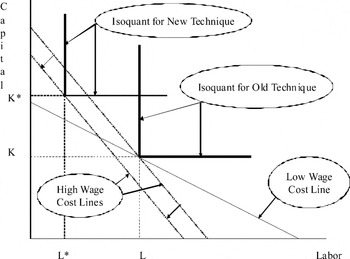
The implications of a biased technical change for adoption and invention are illustrated by the isoquants in Figure 1.Footnote 22 The wheel and the jenny are each represented by a single point corresponding to their input-output coefficients. Isocost lines for a high-wage and a low-wage country are also shown. The important result is that the spinning jenny cuts costs only for the high-wage country: Using the jenny moves the isocost line towards the origin for the high-wage country, while the reverse is true for the low-wage country. Adoption of a known technique depends on factor prices.
If we recognize that invention involves costs, we can also see that invention depends on factor prices. If the R&D costs are amortized over the cumulated output of the jenny and are added to the costs of producing one pound of cotton, then the isocost line is moved upward by R&D cost per pound. Clearly, if it was not worthwhile to use the invention when there were no R&D costs (as in the low wage economy), there is even less incentive when R&D costs would be incurred. Conversely, there are two possibilities in the high-wage economy. In the most
WHEEL AND JENNY ISOQUANTS

favorable case, the isocost line is moved up but remains below the isocost line for the spinning wheel. In this case, the R&D project is worth undertaking: it is profitable to invent the jenny. The difference between this outcome and that in the low-wage economy shows how factor prices can affect invention. A less favorable outcome in the high-wage economy is also possible, however. If the addition of the unit R&D cost raises the isocost line above that running through the spinning wheel point, then it is not worthwhile to invent the spinning jenny even if it was worth using it if it were freely available. Were the market for cotton bigger, then the R&D cost per pound spun would have been smaller, and the invention would have been worth inventing. This possibility shows how market size affects the propensity to invent, a point elegantly developed by Daron Acemoglu.Footnote 23
The effect of factor prices on invention has been debate ever since Sir John Hicks remarked: “The real reason for the predominance of labor- saving inventions is surely that … a change in the relative prices of the factors of production is itself a spur to innovation and to inventions of a particular kind—directed at economizing the use of a factor which has become relatively expensive.”Footnote 24 H. J. Habakkuk's American and British Technology in the Nineteenth Century propelled this thinking into economic history.Footnote 25 The counterargument has always been that businessmen are interested in saving costs in total and do not care about labor costs or capital costs per se, so factor prices should not affect their search for inventions.Footnote 26 Explicitly recognizing that inventions can be biased and that they require R&D expenditures to realize them is one way to show that factor prices mattered for invention. By influencing the profitability of R&D projects, they could affect both the bias and the pace of technical change.Footnote 27
FACTOR PRICES IN EUROPE AND INDIA
To apply this approach to the spinning jenny, we must compare the prices of capital and labor in England, France, and India. There were great differences among the countries. England stands out as the country with expensive labor and cheap capital, and that explains why English producers took up the jenny so enthusiastically. We have the fullest price information for England and France, so I begin with them. Wages in France were lower than wages in England in several senses. The first is comparison at the exchange rate. According to Arthur Young, for instance, a French spinner earned about 9 sous per day in the late 1780s, while an English spinner could earn 6-1/4 pence or 12-1/2 sous.Footnote 28 The low wage earned by workers in France was not matched by low consumer goods prices, so a second sense in which French labor was cheap was that its purchasing power was lower. Young made the point by comparing wage rates to the prices of bread and meat in the two countries. He found that rural workers in France were “76 percent less at their ease; worse fed, worse clothed, and worse supported than
WAGE RELATIVE TO THE PRICE OF CAPITAL

the same classes in England.”Footnote 29 This point holds more generally when more wages are considered and consumer price indices are defined over a wider spectrum of goods.Footnote 30
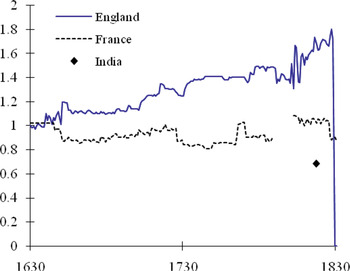
However, for the question at hand, the pertinent sense in which wages were higher in England than elsewhere is the wage rate relative to the price of capital. Figure 2 provides a general indication of how this ratio evolved from 1630 to 1830. Later, when analyzing the jenny in England and France, we will use the prices of jennies and the wages of spinners, but these figures (the price of a jenny, in particular) are not available for years before the jenny was invented. To get an idea of how the wage was changing relative to the price of capital, Figure 2 uses other information to approximate the ratio over a longer time frame. The wage rate used in this figure is that of a building laborer. The price of capital is the user cost of capital (r), that is the purchase price of capital goods (PK) multiplied by the interest rate (i) plus the depreciation rate (d): r = PK (i+d). Long-run interest rates were used to measure i, and d was taken to be 10 percent since the life of a jenny was only a decade.Footnote 31 The price of new capital goods (PK) was represented by a geometric average of the prices of labor and building materials (rather than the price of spinning jennies as such).Footnote 32 This index number presupposes that capital goods were produced with a Cobb-Douglas technology in which materials and labor received equal shares. The price of building materials, in turn, was measured as a simple arithmetic average of the prices of iron, copper, bricks, and soft wood.Footnote 33 In Figure 2, England in 1630 is set equal to one, and the other values for England and all of the values for France are calculated relative to that.Footnote 34
Figure 2 makes several important points. First, in the beginning of the seventeenth century, there was little difference between England and France in the wage relative to the price of capital. Second, after 1630 the series diverged. The wage declined slightly in France relative to the cost of capital, while it rose considerably in England. Third, by the eighteenth century, the wage relative to the cost of capital was two-thirds greater in England than in France. With such a large difference, many projects to mechanize production that were profitable in England proved unprofitable in France.
The data respecting wages and prices in India are much less complete than those for Europe. Wages in Bengal and other parts of India were lower than in England at the exchange rate. When the prices of consumer goods are taken into account, Indian wages were too low to purchase the standard of living enjoyed by English workers.Footnote 35 We do not presently have prices of capital goods that would let us compare India and Europe across the early modern period. The earliestcomparison that can be made for India is for Pune in southwestern India in 1819.Footnote 36 This comparison is represented by a single point in Figure 2. In 1819 the wage in India was even lower relative to the price of capital than it was in France for the seventeenth and eighteenth centuries. This means that the incentive to mechanize production in India was even weaker than on the European continent.
English wages were high relative to both consumer and producers goods prices because England had a more advanced economy than France or India in the mid-eighteenth century. England's lead had been building for over a century and is manifest in the growing divergence shown in Figure 2. Five factors increased the demand for labor: First, larger firms realized internal economies of scale through the division of labor as emphasized by Adam Smith. Second, England was more urbanized than the other countries, and cities raised productivity through external economies.Footnote 37 Third, the growth of London also lead to the expansion of the coal industry. The result was very cheap energy in northern and western Britain that further raised the demand for labor in manufacturing.Footnote 38 Fourth, agriculture was more productive than on the continent. Fifth, the spinning jenny was not alone. Seventeenth- and early-eighteenth-century increases in the wage led to inventions that increased the capital-labor ratio, as Thomas Bentley remarked in 1780: “Nottingham, Leicester, Birmingham, Sheffield, &c. must long ago have given up all hopes of foreign commerce, if they had not been constantly counteracting the advancing price of manual labor, by adopting every ingenious improvement the human mind could invent.”Footnote 39 We know little about the technology of machine making, but the industry was probably like many others and achieved higher labor productivity in England than elsewhere through mechanization and the realization of scale economies.
Early modern England experienced an ascending spiral of progress in which the rise in the wage induced the invention and use of machines that raised labor productivity. The rise in productivity raised the wage even more and the process continued. The inventions of the industrial revolution were the culmination of a century and a half of economic growth.
WHY THE ENGLISH ADOPTED THE SPINNING JENNY AND THE FRENCH AND INDIANS DID NOT
The jenny was taken up very rapidly in England. Aspin and Chapman reported the use of jennies in many towns across northwestern England in the 1770s and 1780s. A historian in Manchester in 1783 recounted how the first 12 spindle jennies were “thought a great affair.” The spread of jennies, especially large ones in workshops, was punctuated by riots and arson as spinners protested against their use. By 1788 reportedly 20,070 jennies were spinning cotton in Britain.Footnote 40
The situation was very different in India and in France. There is no record that the jenny was ever considered in India. Ignorance may have been one reason, but there are grounds for believing that the cause was more fundamental. China provides a point of contact: A hemp spinning machine was invented there in the thirteenth century, but it was never generally adopted and fell out of use. Does this show a cultural or institutional failure or were there rational economic reasons for continuing with hand processes? I shall argue that it would not have paid to use jennies in eighteenth-century India, even if they had been known. This assessment, if true, is not a definitive solution to the “Needham Problem”—far more would have to be considered—but it supports the view that Asia's not developing machine technology was a rational response to the economic environment and not a “failure.”Footnote 41
The French case is better documented than the Indian, for jennies were a live option south of the channel. In the event, only about 900 jennies were used in France in 1790, and they were confined almost exclusively to state-aided factories.Footnote 42 The jenny was not adopted by cottage producers in the way it had been in Britain.
The French aversion to jennies was not due to lack of knowledge; indeed, the French government actively promoted them. John Holker was the key figure. He was an English Catholic who took part in the Jacobite rebellion. He was imprisoned and escaped in 1745, when he fled to France. In 1750 he was a cotton manufacturer in Rouen and in 1754 he was appointed to the Colbertist post of Inspector General of Foreign Manufactures. In this position, he sought to modernize French industry by enticing English entrepreneurs to France. Holker was well informed about developments in the English cotton industry and in 1771 sent his son to Lancashire to obtain a jenny, which was set up in Normandy and copied. Efforts were taken to popularize the machine, but it was never adopted by domestic producers.Footnote 43
Why were the French unenthusiastic about the jenny? Is this an example of Weber's dismissal of Catholicism, or Landes' critique of French entrepreneurs, or Clark's speculations about genes? These answers assume that the profitability of adopting a jenny in France was just as high as it was in England, but we must doubt that in view of the bias of the technical change and the difference in factor prices.
To pin the matter down, I analyze the rate of return to buying a spinning jenny when it was used in a domestic situation. Technology has a path-dependent character, which means that each technique in the sequence is explained by reference to its immediate predecessor. To explain the chain, one must explain the first step, and that was the decision to buy—or not to buy—a small domestic jenny. The decision makers were domestic producers. They contracted with weavers or cotton merchants to spin cotton that was provided. In both England and France (and, indeed, in India), the domestic producers were paid by the hank (a length of 840 yards) or the pound that they spun, and they bought jennies to increase their production and thus their earnings.Footnote 44 The spinners typically had the option of spinning other fibers on the traditional wheel. The opportunity cost of the labor was the earnings they could have made spinning wool or flax (about 6 pence per day). The question they faced was whether the jenny raised their productivity in cotton spinning enough to cover the cost of buying the machine. The historical question is whether it was equally profitable for French and English spinners to buy jennies.
Profitability is determined by analyzing whether the purchase of a jenny lowered labor costs enough to justify its purchase. The rate of return is found by solving the equation

Here J is the purchase price of a jenny, w is the daily wage of a spinner, ΔL is the number of days of labor saved per year, m is the additional maintenance costs associated with the jenny, t is time, n is the length of life of the jenny in years, and r is the internal rate of return, which is the variable to be computed. The savings in labor per year is computed as

where Y is the number of days the jenny was used in a year, D is the “part-time fraction” (the proportion of a full day that the jenny was actually worked), and P is output per hour worked with the jenny relative to the spinning wheel. Y and D enter the equation since the women who bought jennies were usually only part-time spinners. If a spinner worked 250 days per year but only for half a day each day, then YD = 125 full-time equivalent days of work that are paid at the rate of w.
RATES OF RETURN TO BUYING A SPINNING JENNY IN BRITAIN, FRANCE, AND INDIA

Note:
The relative productivity refers to labor productivity with a jenny relative to a spinning wheel.
Sources:
See the text.
Now if the jenny allowed the spinner to produce three times as much per hour as she could with a wheel, then P = 3, and two-thirds of the labor is saved, i.e., .67 = (1-1/3).
The difficulty in applying equations 1 and 2 is determining the values of the parameters. I assume that the life of a jenny (n) was ten years, that a full working year (Y) was 250 days, but that mothers working in their homes only worked 40 percent of that maximum (D), that the cost of a 24-spindle jenny (J) was 70 shillings in England and 140 livres tournois in France, that a women could earn 6.25 pence per day in England and 9 sous tournois in France, and that the annual maintenance costs of the jenny (m) amounted to 10 percent of its purchase price. These values are based on eighteenth-century accounts and on the experience of domestic spinners in India in the 1960s. At the outset, spinning was organized in the putting-out system, and eighteenth-century commentators estimated how much women could increase their earnings if they bought a jenny rather than a wheel. That increase is a measure of the rise in labor productivity (P), and it about tripled.Footnote 45
Table 1 reports rates of return calculated under various assumptions. For the central and most likely case (a tripling of labor productivity and a work day equal to 40 percent of full time), the rate of return to buying a jenny was 38 percent in England and 2.5 percent in France. With these figures, it is no wonder that the jenny was enthusiastically taken up by women in England but not in France! To see how sensitive the conclusion is to the assumptions, the table reports a series of alternatives with productivity increasing by a factor of 2, 3, or 4, and spinners working 30 percent, 40 percent, or 50 percent of a full day.
The rates of return must be compared to returns in other activities to decide whether the jenny was worthwhile. Other investments yielded 15 percent or more. In his General View of the Agriculture of Bedfordshire, T. Batchelor remarked, “the capital employed in many trades and professions is said to produce fifteen percent.”Footnote 46 Industrial investment yielded about 15 percent when profits are imputed to fixed capital.Footnote 47 Spinners probably expected at least as much. The purchase of a jenny absorbed half a year's earnings in Britain and a year and a half's earnings in France. Purchasing a jenny represented such a large commitment that modest people may have expected an exceptional return.
Several features of Table 1 are striking. First, the rate of return to buying a jenny was always much higher in England than in France. This is true under any set of assumptions and is a consequence of the difference between the countries in the ratio of the price of a jenny to the cost of a day of a spinner's labor. Second, the rates of return in England were very high. The lowest was 12 percent. This is the only case when the jenny was unprofitable in England—and not by much. Otherwise, profitability ranged between 24 percent and 59 percent. Third, the rates of return in France were low. In only one case did the rate of return reach the opportunity cost of capital (15.3 percent). In four cases, the rate of return was negative and in four more it was too low to warrant adoption.
We cannot be certain which set of assumptions corresponds to the historical situation. Indeed, differences in family circumstances probably meant that a range of assumptions applied in all countries. However, the meager data available to us can be reasonably interpreted to mean that buying a jenny for home use was usually profitable in England but not in France. The different adoption rates of the jenny are understandable in view of the differences we have computed in the rate of return on the investment.
What about India? Stephen Broadberry and Bishnupriya Gupta have recently emphasized the wage difference between Britain and India, and the commercial opportunity open to British manufacturers if they could mechanize production and cut their costs.Footnote 48 My analysis complements theirs by showing the importance of relative factor prices in explaining why the British found it profitable to use the jenny. The low wage in India meant that manufacturers there had no incentive to do the same. This claim is supported by the rates of return to buying a jenny in India, as shown in Table 1. It must be emphasized that these must be treated very cautiously since they are conjectured from differences in prices rather than from direct measurement. In the absence of prices paid for jennies, the cost of a jenny in India has been estimated by applying an index of relative capital prices to the price of a jenny in England. The available Indian wage data pertain to men. I have taken the daily earnings of women spinning full time in India to have been half of the male laborers' wage, since that was approximately the proportion in England and France. While these figures might be revised, they do highlight the unprofitability of using jennies in India. For the most likely case of a tripling of labor productivity and a woman working 40 percent of full time, the rate of return to the jenny was −5.2 percent. Under the most favorable circumstance, the rate of return to buying a jenny was only 7.3 percent. In most scenarios, there were losses. With prospective rates of return like this, it is no wonder there was no interest in mechanizing production in India—or, indeed, in Asia generally where prices and wages were similar.
WHY THE SPINNING JENNY WAS INVENTED IN ENGLAND RATHER THAN IN FRANCE OR INDIA
Explaining why the famous inventions of the eighteenth century were made in England rather than elsewhere is one of the great challenges in explaining the Industrial Revolution. Inventions have two aspects: a novel idea and the solution of the technical problems that stand in the way of its commercial application. When the novel ideas are considered to be the crux of the problem, the historian analyzes the development of science or the sources of creativity in order to explain them. The ideas embodied in the spinning jenny, however, were so mundane that its invention cannot be understood in these terms.
Instead, we must focus on the R&D aspect of invention. The question is why anyone would have gone to the expense and trouble of figuring out how to power many spindles with the same wheel and how to manipulate the threads with sliding bars and clamps that imitated the nimble fingers of the spinner. Hargreaves seems to have spent three years perfecting the jenny during which time he was supported by Robert Peel. Since Hargreaves was a handloom weaver, his income could not be rated at more than £50 per year. There were certainly other expenses involved in buying materials for experimental machines. Perhaps sometimes, Hargreaves had assistance. By any reckoning, it is hard to see how the spinning jenny cost more than £500 to develop. This was a significant sum, but it was less than many other textile inventions. John Wyatt and Lewis Paul were said to have spent £50,000-£60,000 in their unsuccessful attempt to develop roller spinning in the 1740s, and Jedediah Strutt, who was one of Arkwright's venture capitalists, claimed in 1774 that £13,000 had been spent on the project.Footnote 49 Nonetheless, why spend £500 on the spinning jenny? In particular, is there any reason why someone would do that in England but not in France or India?
The obvious answer is that the spinning jenny was used in England but not in the other cotton-producing countries. It was used because it was profitable, and that profit is a measure of its social utility. We cannot compute the social rate of return to Hargreave's R&D project without more information about the rate of adoption of the jenny, but it cost so little that it must have been socially profitable. The social utility (total profit) is the product of the number of pounds spun and the profit per pound, so total profit depended on the size of the market as well as the reduction in unit costs. From the middle of the eighteenth century, consumption of cotton was increasing in England and that may have spurred invention by increasing the prospective overall return. By the same token, invention was much more likely to take place in England than in the Dutch Republic, which was the other high-wage economy in Europe, since there was no cotton industry in the Netherlands and, hence, no gains from mechanizing its production.
The profit generated by the jenny is also a measure of the income that Hargreaves could hope to realize by patenting it. Hargreaves did get a patent, but he was not able to defend his rights. Had he been successful, he would certainly have made a lot of money.
Even if high income was not a motive for an inventor, the usefulness of the invention was still a motivating factor. Without use, any invention was pointless.
By this reasoning, there was no point in inventing the jenny in either France or India. It was not used in those countries even when it was available, so the social rate of return to inventing it would have been negative. The French government financed some “high-tech” projects with this characteristic like Vaucanson's numerically controlled loom and Cugnot's steam tractor.Footnote 50 While technically precocious, these inventions were never applied commercially because they were not cost effective at French factor prices. Had the jenny been invented in France as a state industrial initiative, it would have suffered the same fate. Private investors saw no point in pursuing it. But the economic conditions were very different in England, which is why it was invented there.
CONCLUSION
Many explanations have been offered for Britain's leading role in technological innovation in the eighteenth century. The invention of the spinning jenny is a good test of their importance. Hargreaves did not benefit from a state that protected his property rights: His jennies were destroyed by mobs on several occasions, and the patent law was sufficiently convoluted that he failed to meet its requirements and never did secure his intellectual property rights. Neither the seventeenth-century Scientific Revolution nor the Industrial Enlightenment, at least as it was manifest among the English upper classes, played a role in the invention of the spinning jenny. It owed nothing to science, it was invented by an illiterate artisan, and its development was financed by investors from the same social stratum and cultural background. Focusing on the artisans is more promising than focusing on the upper classes in understanding England's ascendancy, since many of the inventions of the Industrial Revolution originated from below. Margaret Jacob has emphasized the role of artisan culture in Britain, and Tapan Raychaudhuri has noted its absence in India: “There was a remarkable lack of preoccupation with things mechanical.”Footnote 51 The question is whether England's distinctiveness should be attributed to a unique trajectory of cultural development uninfluenced by economic incentives or whether it should be seen as an endogenous response to the opportunities presented by the economy.
This article has emphasized the importance of endogenous response. The English economy in the eighteenth century was almost unique in the world by virtue of the high level of its wages with respect to capital goods prices. This price structure created unique incentives to develop machines that substituted capital for labor. They were profitable to use in Britain—and unprofitable elsewhere. As a result, they were used in Britain and “economic benefits” (high incomes) were created that balanced the costs of their invention. The contrast with France and India is striking, for the machines that paid in England were not profitable to use there—so they were not used. As a result, there was no incentive to invent them in France or India.Footnote 52 The “preoccupation with
THE TRAJECTORY OF IMPROVEMENTS AND THE TIPPING POINT

things mechanical,” whose absence Raychaudhuri lamented in India and whose presence in England was noted by Jacob, was a cultural manifestation of the profitability of substituting capital for labor, of which the jenny was a particular example.Footnote 53
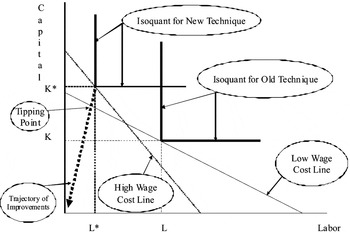
In talking about economic development, it is easy to use the metaphor of the path: “Eighteenth-century England set out on the path to modern industry, while France and India did not.” There is considerable truth in this metaphor, since the development of technology is a path dependent process in which most inventions can only be understood by reference to the technology that preceded them and which they replaced. We can illustrate the path by extending the earlier isoquant diagram. Paul David emphasized that local learning tends to save all inputs equiproportionally since entrepreneurs adopt cost cutting improvements irrespective of capital or labor is saved.Footnote 54Figure 3 shows the resulting path along which the high capital-labor ratio technology evolves as it is improved by local learning. As this is happening, of course, the country using this technology is improving its lead over its competitors, who are seemingly ignoring the possibilities of industrialization. Questions of entrepreneurial performance naturally arise.Footnote 55 An important juncture, however, arises when this path of improvement crosses the isocost line for the low-wage economy. This is the “tipping point,” and, when it is reached, the capital-intensive technology (in its improved form) suddenly becomes profitable in the low-wage economy. At this moment, entrepreneurs in the low-wage economy suddenly adopt the capital-intensive technology in its most advanced form. The industrial revolution spreads to another country in a Gerschenkronian great spurt.
Figure 3 illustrates the history of the cotton industry in the eighteenth and nineteenth centuries. Arkwright perfected roller spinning, and that was a second initial step in the evolution of mechanical spinning. The next great step forward was the invention of the mule by Crompton, who combined Arkwright's rollers with Hargreaves' jenny. The mule could spin much finer yarn than either the jenny or rollers alone. Many inventors improved the mule. A notable advance was Richard Robert's invention of the self-acting mule in the late 1820s. All of these improvements saved labor. By the middle of the nineteenth century, enough labor had been saved so that the mule in its mid-nineteenth century form could be profitably employed even in the lowest-wage economies, including India where cotton spinning mills were being erected in Bombay from the 1850s onwards.Footnote 56 This was only possible since there was a 1850s-style mule, and there would have been no such mule had the jenny not been invented eighty years earlier. That first step on the path could only have occurred in England because that was the only place where the jenny was profitable to use and to invent. While the mule was profitable to install in many places in 1850, the path of development that led to the mule would never have occurred had there not been a country with the economic conditions of eighteenth-century Britain. This was true no matter how progressive were the cultures, nor how supportive of capitalism were the political systems of other countries in the world.
The story of the jenny illustrates another feature of technology and economic development. In the modern world, much technology is developed in rich countries and proves highly profitable there. This technology is much less profitable in poor countries and is consequently much less used. The reason is straightforward. Technology developed in rich countries reflects their factor prices—their high wages in particular—and embodies that influence in a high capital-labor ratio. This factor proportion makes their use uneconomic in low-wage economies. The spinning jenny is an example of the same phenomenon. In the eighteenth century, England was the high-wage economy and consequently technologies with high-capital labor ratios were developed there. These technologies were inappropriate for low-wage economies like France and India, and so they were not used, and the countries fell further and further behind technologically. What is surprising is that this situation was not a consequence of the Industrial Revolution, but obtained at its inception. The unexpected conclusion is that the Industrial Revolution was the consequence of the high-wage economy—not its cause.