

I Introduction
When China joined the WTO in 2001, it declared that the recently launched Doha Development Round negotiations need to put the interests of developing countries centre stage. The Chinese representative speaking at the country’s first full participation of the General Council Meeting of WTO on 19 December 2001, Mr. Long Yongtu, called for WTO negotiations to facilitate ‘the establishment of a new international economic order which is fair, just and reasonable’, which would entail ‘a balance of interests between developed countries and developing countries, especially conducive to the development of developing countries’ (Mfa.gov.cn, 2001). In its 2019 communication on the Chinese reform proposal for the WTO, China reiterated that the ‘[d]evelopment issue is at the centre of WTO work’ (WTO, 2019a, para. 2.4.1). More than twenty years after its accession to the WTO, it is time to (re)assess the role that China has played on development. Has China indeed positioned itself as a development partner in WTO negotiations that sides with the Global South vis-à-vis the Global North, or has its own economic transformation diminished the scope for a shared agenda on development?
Academics that touch upon China’s role in the WTO vis-à-vis the Global South are so far divided in their assessment: those that emphasise ideological South-South ties tend to portray China’s role as a development partner (Bishop and Zhang, Reference Bishop and Zhang2020; Muzaka and Bishop, Reference Muzaka and Bishop2015; Vieira, Reference Muzaka and Bishop2012), while scholars that highlight political economy dynamics either see mixed or even competing interests vis-à-vis other developing countries (Hopewell, Reference Hopewell2021; Vickers, Reference Vickers, Narlikar, Daunton and Stern2014, pp. 268–69). This chapter starts with a brief discussion of these conflicting perspectives on China’s role vis-à-vis the Global South, followed by an examination of China’s negotiating behaviour in the WTO. These patterns in China’s negotiation positions are then compared and contrasted with perceptions of China’s role by other WTO members.
The chapter reveals that while China seeks to align itself politically with the development agenda of the Global South in its bargaining behaviour in Trade Negotiating Committees, perceptions of its role in the WTO are mixed. As the chapter argues, China’s political intention to support a broader development agenda is increasingly undermined by the way in which its larger economic size leads to competition with other developing countries. In particular, China’s distinct economic size increasingly puts it in an ambiguous position when joining other developing country members in their demands to strengthen Special and Differential Treatment (S&D).Footnote 1 The specific conflict lines that arise reflect in part the increasing heterogeneity of the Global South. Three main patterns emerge: First, developing countries that are non-emerging economically are more likely to see China as a competitor for S&D, as compared to other emerging economies or Least Developed Countries (LDCs). Second, developing countries that share the defensive trade policy orientation of the S&D agenda are more likely to perceive China as a development partner as compared to those with a more liberal orientation. Here, conflict lines vary across negotiation issues. Third, the role China plays vis-à-vis the Global South is shaped by the larger context of their specific trade and investment relationship. China thus plays an increasingly contradictory role in the WTO, acting as a development partner for some and as a competitor for other developing countries – dependent on the negotiating issues at stake.
This chapter makes use of the following types of primary sources. First, it relies on official documentation of the WTO’s Trade Negotiations Committee (2001–2019) to assess the negotiation behaviour of China. Second, to reconstruct perceptions of China’s role, the chapter draws on a sample of 33 interviewsFootnote 2 and a survey with 22 officials conducted in Geneva with country representatives at WTO missions, WTO officials, and other trade experts.
II China and the Global South in the WTO: An Overview of the Debate
The existing literature on China’s role in the WTO is primarily interested in its participation in global trade governance, as well as the extent to which it challenges or supports the WTO’s liberal trade order. Questions about China’s relations with the Global South do not take centre stage. The most direct engagement with China’s role vis-à-vis the Global South is part of the literature that analyses bargaining coalitions at the WTO (Hopewell, Reference Hopewell2017; Narlikar, Reference Narlikar2010).
Some scholars emphasise that China has tended to side with developing country coalitions because of its growing self-identification with the so-called Global South. In particular, its shared identity as part of the Global South (Nel, Reference Nel2010) or the ‘power South’ (Acharya, Reference Acharya2014, p. 654) leads to ‘pro-Southern’ negotiating behaviour (Muzaka and Bishop, Reference Muzaka and Bishop2015; Vieira, Reference Muzaka and Bishop2012). The decision in the July 2008 mini-ministerial to side with India rather than the US is, for instance, seen as an expression of South-South solidarity ‘when this has required sacrificing a measure of China’s national interests, to support the cause of this developing country coalition’ (Chin, Reference Chin, Narlikar and Vickers2009, p. 143). Johnson and Urpeleinan (Reference Johnson and Urpelainen2020) find that developing countries – including China – exhibit surprising unity at the WTO, an assessment they base on the statistical analysis of 3.600 paragraphs of negotiation-related text on trade and environmental policy.
Southern unity in bargaining coalitions does not necessarily indicate altruistic motives. Political initiatives in favour of developing countries, and Least Developed Countries in particular, are seen to reflect the country’s intention to build soft power by projecting itself as a responsible and benign developing country (Jain, Reference Jain2014, p. 190). A number of authors mention China’s support for LDCs in the WTO (Bhattacharya and Misha, Reference Bhattacharya, Misha and Luolin2015; Jain, Reference Jain2014), as well as statements of support for the LDCs, the group of African, Caribbean and Pacific countries and the African Group (Jain, Reference Jain2014, p. 189). China has also put forward four proposals designed to protect and promote the interest of developing countries in WTO dispute settlement (Liu, Reference Liu2014, p. 127). At the same time, political considerations at times make it difficult for China to demand better market access in developing rather than developed countries, even if economic benefits are involved (Gao, Reference Gao and Deere-Birkbeck2011, p. 166).
Yet, other scholars offer a more cautious assessment of China’s role as a partner of developing countries in WTO negotiations – regardless of the motives. While they acknowledge ideological South-South ties, they claim that China’s economic interests as a major exporter and importer increasingly tend to converge with those of developed countries (Bishop and Zhang, Reference Bishop and Zhang2020, p. 7; Lim and Wang, Reference Lim and Wang2010, p. 1314). This explains why China has not proactively promoted the interests of developing countries in the bargaining coalitions it joined (Lawrence, Reference Lawrence, Eichengreen, Wyplosz and Park2008, pp. 152–153) and remains a reluctant leader in the WTO (Bishop and Zhang, Reference Bishop and Zhang2020). As noted by Vickers, ‘China’s supportive, yet backseat, role in Southern coalitions partly reflects the fact that Beijing actually shared an interest with the US and the EU in seeking greater access to large developing country markets – including Brazil and India – for its manufactured exports’ (Vickers, Reference Vickers, Narlikar, Daunton and Stern2014, pp. 268–269). With regard to the G-20 coalition of developing countries, China, for instance, took a backseat to Brazil and India which exerted much stronger leadership (Lim and Wang, Reference Lim and Wang2010, p. 1316). In other cases, China did not even join developing country coalitions. While China endorsed many of the positions of the NAMA-11 coalition, which includes India and Brazil, it did not join the group to champion its concerns (Vickers, Reference Vickers, Narlikar, Daunton and Stern2014, p. 267). Tu (Reference Tu, Zeng and Liang2013, p. 175) similarly concludes that even if China repeatedly claims that development should be at the heart of the Doha round, it is seen as ‘not … very active in advocating special and differential treatment’ (Tu, Reference Tu, Zeng and Liang2013, p. 175).
More recently, some scholars argue that China even acts as a competitor to the Global South, given its economic interest has become too far apart from those of the majority of (small) developing countries. Hopewell (Reference Hopewell2022) prominently claims that in the case of agricultural negotiations, China’s insistence on maintaining high levels of domestic support is harmful to other developing countries that seek access to agricultural markets. What matters here is China’s tremendous economic growth, which allowed it to become the world’s leading provider of agricultural subsidies – estimated at $212 billion in 2016 (Footnote Ibid., p. 11). Weinhardt (Reference Weinhardt2020) also finds that, inadvertently, China’s contested claims to maintain its developing country status has undermined the principle of special and differential treatment that grants exemptions and flexibilities to developing countries.
There is, however, also a growing recognition of the ambiguous position that China finds itself in between developed and developing countries. China stands out among developing country members of the WTO because of its enormous market size, continuously high growth rates and its role in driving global growth. Despite its tremendous growth trajectory, however, developmental challenges continue to exist, especially in rural China. As a result, Bishop and Zhang’s (Reference Bishop and Zhang2020, p. 7) claim that China is caught between its roles as a developing country and a country in the transformation to a ‘developed’ one. This explains why Chinese policymakers still adhere to ‘a discourse of developmental unity’ (Bishop and Zhang, Reference Bishop and Zhang2020, p. 7) – even if it pursues ‘selfish’ interests that increasingly cut across North-South lines (Gao, Reference Gao, Toohey, Picker and Greenacre2015, p. 92). More generally, China’s emphasis on its developing country identity is not only an expression of historically grown South-South solidarity, but also considered as important to help forge and maintain relations with the Global South that forms ‘the political basis of China’s international support’ (Pu, Reference Pu2019, p. 46). These more recent assessments suggest that China’s role vis-à-vis the Global South is unlikely to easily fit the binary categories of development partner or competitor. What is missing, however, is a systematic assessment that goes beyond specific negotiating issues and contrasts China’s negotiation behaviour with perceptions of others.
III China in WTO Negotiations: Eager to Position Itself as a Development Partner
China itself has been eager to position itself as a development partner in WTO negotiations. This becomes apparent both in its political support for the development orientation of the WTO’s ongoing negotiating round as well as in the pattern of its submissions to the WTO’s Trade Negotiation Committees.
(i) China’s Political Support for the Doha Development Agenda
When Doha Development round negotiations were launched in 2001, there was a clear sentiment that development needs to be central for the WTO to succeed. The Doha Ministerial Declaration (WTO, 2001) explicitly stated that ‘[t]he majority of WTO members are developing countries. We seek to place their needs and interests at the heart of the Work Programme adopted in this Declaration’. It soon became clear, however, that the political will to deliver on this promise was rather limited. Agriculture became the major issue of the Doha Development round. Initially, China took a back seat in developing country coalitions pushing for the conclusion of a development-oriented round. For instance, at the 2003 Ministerial conference in Cancún, India and Brazil were central to the creation of the G-20 coalition that focused on agricultural negotiations. As China became more active in WTO negotiations and joined its core decision-making group in 2008 (Gao, Reference Gao, Toohey, Picker and Greenacre2015, Reference Gao and Shaffer2021), it also became more vocal in lending political support to the demands of developing countries in WTO negotiations.
China’s support for a ‘developmental orientation’ of the organisation could be witnessed prominently at the WTO’s 10th Ministerial Conference (MC10), held in December 2015 in Nairobi in Kenya. The MC10 stood out as it thought to resolve the deadlock over the continued viability of the Doha Development Agenda as a mandate for the ongoing negotiation round (Wilkinson et al., Reference Wilkinson, Hannah and Scott2016, p. 247). Major developed country members, and in particular the United States, intended to use the occasion of the MC10 to officially move beyond the Doha Development Round’s original mandate, including the Single Undertaking rule.Footnote 3 Faced with a deadlock situation since 2008, they emphasised that it was time to move on to negotiate new issues – such as e-commerce (compare Liang and Zeng, 2022, this volume) – relying on new negotiating approaches that were more flexible in excluding highly contested issues from the agenda. However, developing country members fiercely opposed this demand, as they feared that adopting a more flexible negotiating approach would effectively imply dropping those negotiating issues of particular concern to them, especially agriculture. China positioned itself as part of a developing country camp in this conflict. In a joint proposal for the conference’s final Ministerial Declaration together with Ecuador, India, Indonesia, South Africa and Venezuela, China clearly reaffirmed the original Doha mandate.Footnote 4 As acknowledged by a developed country trade official: ‘[China] has been pretty clear in all their statements that they want to complete the Doha agenda … they have been pushing hard for commitment to complete the Doha agenda. Many of us are weary of such statements’.Footnote 5 The rift between both camps was so substantial that, in a historically unprecedented way, WTO members in the end agreed to disagree.
China’s support for the Doha Development Agenda tends to reflect the importance of political ties with the Global South in Chinese foreign policy, rather than shared economic interests. China has always been keen to emphasise that it stands with the developing world, in part because close economic relations with the Global South have helped China to increase its political influence (Pu, Reference Pu2019, p. 46). Positioning China as a developing country member in WTO negotiations has thus not only been used to claim continued access to flexibilities under Special and Differential Treatment (Hopewell, Reference Hopewell2021; Weinhardt, Reference Weinhardt2020), but also to consolidate support from other developing countries (compare Pu, Reference Pu2019, p. 47). Conversely, China’s decision to side with developing countries that defend the original Doha Development Round’s mandate does not necessarily reflect its own economic interests. For instance, China has in the meantime joined the WTO negotiations for an e-commerce agreement. Launching these negotiations in January 2019 while the Doha Round had not been concluded yet has been interpreted to go against the original Doha mandate (Abendin and Duan, Reference Abendin and Duan2021). Many developing countries that are less competitive than China in the e-commerce sector, for instance in Africa, had criticised the plan to launch these negotiations (Liang and Zeng, Reference Liang, Zeng, Gao, Raess and Zeng2023, this volume; SAIIA, 2021).
China’s attempts to position itself as a development partner extends beyond lending support to the development orientation of WTO talks, and includes political initiatives geared towards capacity-building in the Global South. In 2011, China, for instance, launched the Least-Developed Countries (LDCs) and Accessions Programme. It comprises several round tables, workshops, and South-South dialogue forums, as well as an internship programme for countries that seek to accede to the WTO.Footnote 6 China has, moreover, sought to support LDCs that seek to accede to the WTO informally. For instance, when the accession negotiations with Laos ran into difficulties, the Chinese chairperson of the Accession Working Group at the time, Zhang Xiangchen, was reported to have been instrumental in facilitating a mediation process.Footnote 7 Moreover, the Chinese Deputy Director-General at the time supported Laos’ accession.Footnote 8 Drawing on its own experiences of the recent accession negotiations, China has thus been eager to position itself as a development partner of LDCs. Beyond its support for LDCs, China has also put forward four proposals designed to protect and promote the interest of developing countries more generally in WTO dispute settlement (Liu, Reference Liu2014, p. 127).
(ii) Chinese Submissions to the WTO’s Trade Negotiating Committee: Siding with Developing Countries
China’s preference to portray itself as a champion of developing country concerns in the WTO also becomes apparent when analysing the pattern in its submissions to the WTO’s Trade Negotiating Committees (TNCs).Footnote 9 China prefers submissions with other developing countries, rather than with developed countries. In case of conflicting economic interests, China tends to opt for unilateral submission.
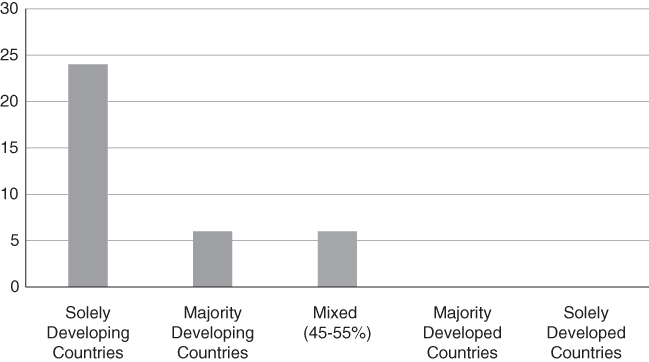
The analysis of China’s negotiating behaviour in the WTO’s TNCs reveals that if China makes joint submissions, it has a clear preference for submissions together with other developing countries (see Figure 9.1). Out of 36 submissions that China made together with other WTO members, none was made with a group comprised primarily of developed countries or comprised of developed countries only. On the contrary, 30 were submitted with other developing countries only or with groups comprising developing countries as the majority. China only rarely made submissions as part of ‘mixed’ country groups (6 submissions).
Patterns of coalition partners in Chinese submissions in the WTO Trade Negotiating Committee and its sub-groups (2001–2019)
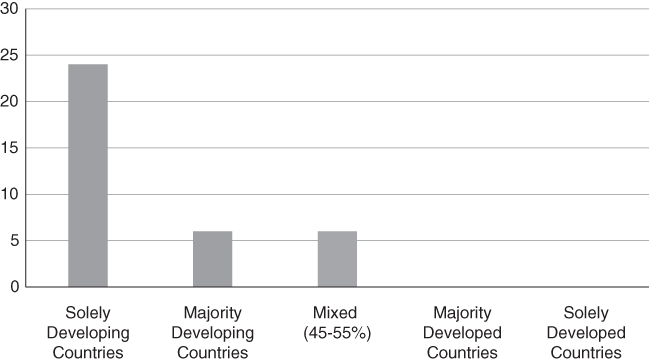
This pattern holds across all ten TNCs (see Table 9.1), and includes committees in which China’s economic interests are arguably closer to those of the developed rather than the developing world. This can be for instance seen in the market access negotiations, an area in which its offensive interests in improved market access for non-agricultural goods tend to converge with those of developed country members. However, China only made one related submission to the market access committee as part of the Asia-Pacific Economic Cooperation coalition that includes the United States, Canada, and Japan, which reflected a shared interest in better market access for IT products. This contrasts with the behavior of other emerging economies that more frequently joined developed country members for joint submissions regarding market access for non-agricultural goods.Footnote 10
| Composition of WTO members in joint submissions including China | |||||
|---|---|---|---|---|---|
| Solely developing countries | Majority developing countries | Mixed (45–55%) | Majority developed countries | Solely developed countries | |
| WTO rules | 4 | 2 | 0 | 0 | 0 |
| Services | 3 | 0 | 1 | 0 | 0 |
| Development | 0 | 0 | 0 | 0 | 0 |
| TRIPS | 0 | 0 | 0 | 0 | 0 |
| General | 4 | 3 | 0 | 0 | 0 |
| Dispute settlement | 0 | 0 | 0 | 0 | 0 |
| Trade facilitation | 4 | 0 | 2 | 0 | 0 |
| Market access | 1 | 1 | 1 | 0 | 0 |
| Agriculture | 7 | 0 | 2 | 0 | 0 |
| Trade and environment | 1 | 0 | 0 | 0 | 0 |
What is notable, however, is that a considerable number of Chinese submissions to the WTO’S TNC did not include other WTO members: 34% of its submissions were unilateral, while 64% were submitted together with other countries. This suggests that China prefers to side with developing countries whenever it is able to find partners on given negotiating issues but does not shy away from defending its own interests unilaterally if necessary.
IV Perceptions of China’s Role vis-à-vis the Global South: Mixed Assessments
Despite China’s attempts to position itself as a development partner, its role vis-à-vis the Global South has become increasingly ambiguous in the past decade of WTO negotiations. Both its market size and its state-led economy set it apart from other developing country members of the WTO. In terms of its Gross Domestic Product, China has overtaken the United States as the largest economy worldwide in 2017, measured in terms of purchasing power parity. While China’s National Bureau of Statistics has been quick to point out that this does not change that China remains ‘the world’s largest developing country’ (SCMP, 2020), its rapidly increasing share in world trade puts the country in a central position in the world economy. In particular, with regard to trade in goods, China has become a leading exporter (16.1% of world exports) and the third largest importer (13.1% of world imports).Footnote 11 In contrast to many other developing countries that primarily trade raw materials, 43% of China’s global goods trade is in the more valuable category of high-value-added machines and electrical goods.Footnote 12 While this does not imply that China does not face development challenges anymore, the tremendous economic transformation of the country in a relatively short period of time sets it apart from other developing country members in the WTO.
While China clearly seeks to position itself as a development partner, its increasingly divergent economic position from other developing country members leads to mixed perceptions of its role. Trade representatives acknowledge both China’s desire to position itself as a partner of the developing world, as well as the way in which it may pursue self-interested economic motives. One representative claimed, for instance, that China is ‘devoting its attention to the development aspect of the WTO and ensuring that there is special differential treatment for developing countries in the negotiating functions of the WTO’ and that ‘they are very serious about being seen as a leader among developing countries in WTO’.Footnote 13 There was, however, also the perception that China defends its own economic interests against the Global South. For instance, regarding the Government Procurement Agreement (GPA), China was allegedly reluctant to grant preferences negotiated as part of GPA to India as a non-participating country.Footnote 14 Another trade official complained in an interview that ‘China has put its hand where its mouth is’.Footnote 15 In particular, regarding negotiations on agriculture, where China has become a major subsidiser itself, developing country officials increasingly perceive conflicts of interest.Footnote 16
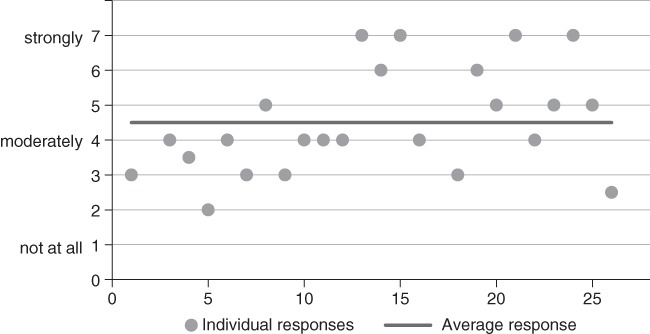
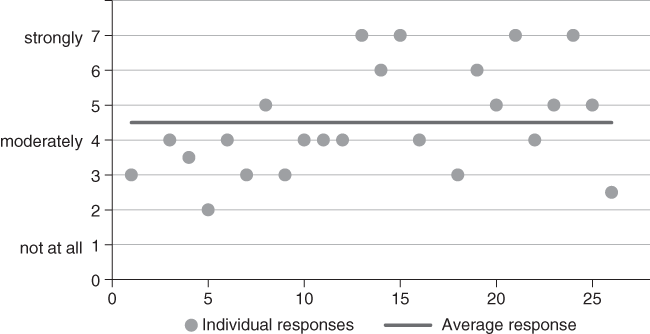
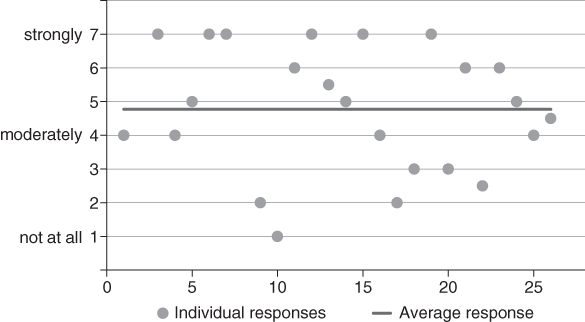
The ambiguity that exists about China’s role vis-à-vis the Global South also comes across in the result of the survey conducted among trade officials from developed and developing countries based in Geneva. When asked whether trade officials feel that China’s negotiating positions in the WTO overlap with the interests of developing countries, the average answer is 4.5 on a scale from 1 to 7, suggesting a slightly positive answer (see Figure 9.2). Yet, variation is rather strong, with answers ranging from 2 to 7. A similar pattern emerges when interviewees were asked whether they feel that Chinese negotiating positions during the Doha round were informed by historical roles that reaffirm the importance of South-South cooperation (see Figure 9.3), with answers varying from 1 to 7, and the average answer being 4.8. In these surveys, developed country representatives tended to have a slightly more favourable view of China’s role as a development partner than developing country representatives.
To what extent do you feel that China’s negotiating positions in the WTO overlap with the interests of developing countries?
To what extent do you feel that Chinese negotiating positions during the Doha round were informed by historical roles that reaffirm the importance of South-South cooperation?
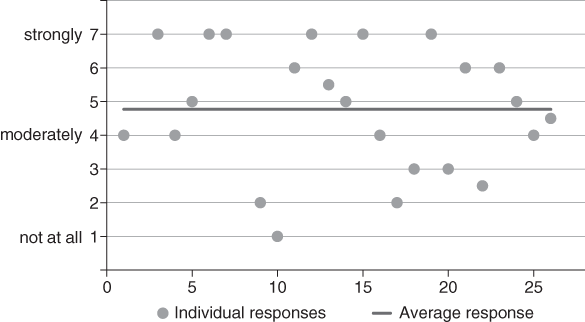
While the sample size (n = 22) is too small to be representative, these findings suggest that there is no uniform perception of China’s role vis-à-vis the Global South in the WTO. Some perceive China to act in pro-Southern ways, while others remain sceptical regarding the extent to which Chinese interests overlap with those of other countries in the Global South.
Notably, developed country representatives tended to share these mixed assessments of China’s role vis-à-vis the Global South. The semi-structured interviews and the survey revealed that, on the one hand, they tended to perceive China as more clearly in line with the agenda of developing countries. On the other hand, however, some of these officials acknowledged that regarding particular negotiation outcomes, China also defends its own economic interests against the Global South. Examples included China’s tough negotiations with South Korea that were crucial for reaching an agreement on the Expansion of the Information Technology Agreement,Footnote 17 or China’s alleged reluctance to grant preferences negotiated as part of the Government Procurement Agreement to India as a non-participating country.Footnote 18 The following section further unpacks the patterns that emerge amongst those countries that China seeks to partner with on development issues – the Global South.
V Unpacking Mixed Perceptions across the Global South: The Emergence of New Conflict Lines Linked to Special and Differential Treatment
Why do some developing countries perceive China to act as a development partner, while others do not? The explanatory patterns that emerge are linked to the political agenda of S&D for developing countries in the WTO. Three main patterns emerge: First, whether or not China is seen as a partner or competitor in S&D is shaped in part by the political status that developing countries have. In particular, non-emerging developing countries tend to see China as a competitor for these special rights. Conversely, LDCs and other emerging developing country members are more likely to continue to see China as a development partner. Second, however, issue-specific conflict lines are influenced by the extent to which other developing country members share the defensive trade policy orientation of the S&D agenda. Third, political South-South ties – and variation therein – further shape perceptions of China’s role vis-à-vis developing countries within the WTO.
(i) China as a Competitor for Special and Differential Treatment: Emergent vs. Non-Emerging Developing Countries
S&D was introduced into the world trading system to counterbalance the demands for trade liberalisation with those for ‘equitable socio-economic development’ (Lichtenbaum, Reference Lichtenbaum2001, 1008). The principle grants special rights such as exemptions from liberalisation commitments or longer transition periods to developing countries, given that they are perceived to be in a disadvantaged position versus developed countries. Whether or not, and how, such a defensive S&D agenda serves the interests of developing countries in the WTO has been and remains hotly contested. Divergent viewpoints reflect different assessments of the causal link between the depths of trade liberalisation commitments and economic development (compare Low, Reference Low, Hoekman, Tu and Wand2021).
Another highly controversial aspect of S&D in the WTO is that regime members can self-declare the status they have. This creates incentives for emerging economies such as China to maintain their political status as developing countries, given the special rights that this status is associated with. For the same reason, the US and other developed countries contest China’s political status as a developing country in the WTO, given that they perceive China increasingly as an economic competitor. As a result, the status of emerging economies such as China has become a central issue of conflict and contestation in the WTO (Hopewell, Reference Hopewell2020; Weinhardt, Reference Weinhardt2020; Weinhardt and Schöfer, Reference Weinhardt and Schöfer2022).
What has received less attention, however, is that other developing country members may also increasingly perceive China as a competitor. Perception is different, however, depending on whether developing countries are themselves considered to be emerging. While China’s self-declared status has been at the centre of US calls for reforming S&D, the proposed changes affect other larger developing countries as well. In 2019, the US proposed a set of criteriaFootnote 19 in the WTO General Council to define and delimit who should have access to S&D (WTO, 2019c). According to this definition, 34 self-declared developing country members of the WTO were to graduate from developing country rights. Larger developing countries that are also considered to be emerging are thus more likely to side with China, as they fear that greater differentiation would also reduce their own access to S&D. Indeed, in response to the US proposal, China, India, South Africa and Venezuela submitted a joint communication at the General Council to defend the existing system of S&D that allows all WTO members to self-declare their status as developing countries (WTO, 2019d).Footnote 20 For these countries, China acted as a development partner.
Conversely, developing country members that are not commonly considered to be emerging economically are more likely to see China (and other emerging economies) as unfair competitors for these special rights. The benefits derived from S&D may become smaller for them if they have to be shared with emerging economies such as China. One representative from the Global South for instance complained that: ‘Amongst developing countries, there is China, there is India, Brazil, but if they are allowed the sorts of flexibilities that are usually carved out for developing countries, it will put them in stronger economic position than us the developing countries who are their direct competitors in the market’ (quoted in Weinhardt, Reference Weinhardt2020, p. 405). This concern was shared by other representatives from non-emerging countries in the Global South,Footnote 21 with one official claiming that among the negotiation group comprised entirely of developing countries that he was working for, there is ‘the sentiment that they do the competition with them [emerging economies such as China] for S&D but are not at the same level of development’.Footnote 22
Lastly, China’s support for S&D in its negotiation positions is least controversial when it seeks to strengthen these special rights for the narrow group of LDCs – rather than for itself.Footnote 23 An example is China’s support for the LDC countries’ repeated requests for a prolongation of the TRIPS waiver, which developed countries tended to question. Here, flexibilities are reserved for a clearly defined and narrow group of WTO members – which excludes most developing countries, and most certainly those that are emerging economies.Footnote 24 Evidence from the semi-structured interviews suggests that LDC representatives also assess China’s political support within the WTO positively. One representative, for instance, mentioned that China urges other developed countries to be more flexible when LDCs negotiate accession to the WTO compared to other countries.Footnote 25 The trade official also positively referred to the South-South Dialogue on LDCs and development than China initiated, and that China is granting duty-free and quota-free market access to all LDCs.Footnote 26 This indicates that China most unambiguously acts and is perceived as a development partner in negotiating issues where its distinct economic size is less pertinent, such as support for LDCs.
(ii) Issue-Specific Conflict Lines: Defensive or Offensive Trade Policy Orientation?
Perceptions of China’s role are, however, not only shaped by the political status of countries from the Global South. Issue-specific conflict lines are central in shaping whether or not China is perceived as a development partner. Given the inherently defensive nature of the S&D agenda on development, developing countries that pursue a liberal, and more offensive, trade policy orientation are more likely to see China as a competitor rather than a development partner. Notably, these conflict lines can vary across negotiating issues, and partly cut across the political conflict lines (see Section V(i)).
An insightful example of how these issue-specific conflict lines play out is WTO negotiations on agriculture, a key aspect of the Doha Development Agenda. The issue of agricultural subsidies has traditionally split WTO members along North-South lines, pitting developing country members that do not have the capacity to subsidies their own agricultural sectors against developed country members as heavy users of domestic support. However, these conflict lines have recently shifted since China itself – facilitated by its economic rise – has become one of the major providers of agricultural subsidies (Hopewell, Reference Hopewell2021). With the Nairobi Ministerial Conference in 2015, attention in agricultural negotiations shifted away from questions of market access to a primary focus on domestic support. This brought to the forefront China’s support measures for domestic farmers, which China justifies with reference to its status as a developing country and as support to the subsistence of farmers – in contrast to subsidies in the US, the EU, and other developed countries paid to agribusinesses.Footnote 27 WTO rules indeed grant China more flexibility regarding specific domestic support levels as compared to developed countries. It holds a so-called de minimis threshold that allows for subsidies of up to 8.5% of the value of production, while this level of subsidies for developed country members is 5%.
Whether or not other developing country members of the WTO perceive China’s defensive position on domestic support is shaped by the specific constellations of interests at stake. China has consistently been a net importer of foodstuffs over the past two decades. Strong state-permeation continues to characterise the agricultural sector which is deemed largely uncompetitive despite substantial reforms since the 1980s (Weinhardt and ten Brink, Reference Weinhardt and ten Brink2020, pp. 268–269). Moreover, since the 2008 world food price crisis, the provision of subsidies in agriculture is seen as necessary not only for stability, employment, poverty alleviation, and development (Liang, Reference Liang, Zeng and Liang2013, p. 213) but also for food security. Together, these features in China’s trade profile lead to a defensive stance that China has adopted on international agricultural policy since WTO accession in 2001.
Whether or not other (emerging) developing countries see China as a development partner in these negotiations depends in part on their specific trade policy orientation. China’s defensive stance on domestic support is, for instance, shared by India. The continued prevalence of large-scale subsistence farming in its economy, that is, of small, peasant-based production for domestic, and the need to safeguard rural employment and the livelihoods of peasant farmers lead to a defensive position in agricultural trade. This convergence of defensive interests, as well as their reluctance to graduate from the developing country status, made them development partners in agriculture. In 2017, India and China, for instance, submitted a joint reform proposal on agriculture at the WTO Ministerial Conference in Buenos Aires. Conversely, Brazil – even though also an emerging developing country member – sided with the European Union and tabled a reform proposal that also entailed subsidy cuts by developing country members. This difference in position reflected Brazil’s highly liberal trade policy orientation in agriculture, which conflicted with China’s defensive stance adopted on domestic support.
Non-emerging developing countries were likely to perceive China’s position on domestic support as unfair competition if they were net-agricultural exporters, and hence offensive in policy orientation. More precisely, the trade-distorting effects of Chinese subsidies are of particular concern to developing countries that export agricultural products that receive domestic support. These products include cotton in the case of African countries, soybean in the case of Brazil and other Latin American countries, and rice in the case of Laos, Bangladesh and Vietnam.Footnote 28 An official from a non-emerging developing country, for instance, complained that Chinese subsidies negatively affect other developing countries because of the size of its domestic market: ‘China says it is using its domestic support only for farmers that produce for the domestic market, but even this affects others. There will be fewer imports.’Footnote 29 China’s domestic economic policies on agriculture indeed have a crucial effect on the growing South-South flows of agricultural trade (Belesky and Lawrence, Reference Belesky and Lawrence2019, p. 1123). That China has become the world’s largest agricultural import market in 2020 (United States Department of Agriculture, 2020) magnifies the trade-distorting effects of its subsidies.
The example of WTO negotiations thus illustrates that China has become a competitor for some developing countries, and remains a development partner for others. Developing countries that do not share the defensive trade policy orientation of the S&D agenda are likely to hold conflicting interests with China, as it seeks to promote special rights for developing countries – including itself. These conflict lines may partly cut across the political differentiation between emerging and non-emerging developing countries.
(iii) Perceptions of China’s Role Are Shaped by Larger Context of South-South Ties
Mixed perceptions of China’s role via-a-vis the Global South in part also reflect the ambiguous role that South-South ties play in the WTO context. China’s paradoxical situation (see Hopewell, Reference Hopewell2022, this volume) – a major economic power, but politically part of the developing country group – may lead to ambiguous assessments. The difficulty of assessing its role stems from weighing the economic implications of individual Chinese negotiating positions that may be detrimental for some developing country members against the broader political support for a ‘Southern’ agenda that they may stand for, a theme that emerged in several interviews.Footnote 30 Developing country officials are, moreover, cautious not to side with the Western trading nations in the conflict over agriculture. While they may share in interest in China reducing its domestic support, conflict lines are more complex: Developed countries are also perceived to be part of the problem. Regarding agricultural subsidies, a developing country official for instance remarked: ‘Because if we say, let’s support the US in terms of pressing China to reduce its subsidies, the danger is that the US takes advantage of China not doing it and turn around and say, “because they are not willing, we are not willing”’.Footnote 31
Moreover, few developing countries openly portray China as a competitor for S&D. This lack of open criticism of China should not be mistaken for reaffirmation of China’s position. The interviews revealed that developing country members often do not dare to speak up against China given its importance as a development partner outside of the WTO context (compare Shaffer and Gao, Reference Shaffer and Gao2020). One developing country trade representative stated that there is a sentiment that China is not a developing country and therefore should not receive the same treatment as other developing countries under S&D – a call for greater differentiation within the developing country group. Yet, the negotiating group the interviewee worked for would never openly make such as claim, mainly because ‘it is political.’Footnote 32 A former trade official from Africa similarly argued that: ‘The economic relations with China are so that any African country cannot dare to stand up against China. China is the largest export destination of African commodities, China is the biggest donor…. this means that you cannot open your mouth to speak up on differentiation.’Footnote 33 The role that China plays vis-à-vis the Global South is thus in part shaped by the larger trade and investment relations it has with other developing countries – and how the rise of China has affected them.
VI Conclusion
Since joining the WTO in 2001, China has become a major economic player in global politics. This chapter has revisited its role vis-à-vis the Global South in multilateral trade policymaking. The scholarly literature tends to portray China either as a development partner, given ideological South-South ties, or as a competitor whose economic interests as a major trading nation increasingly overlap with those of developed country members. This chapter shows that as China transforms economically but continues to seek political alliances with the Global South, its role cuts across that of either a development partner or a competitor.
The chapter has shown that China plays an ambiguous role in the WTO. On the one hand, China continues to lend its support to the broad development agenda of the WTO’s ongoing Doha Development Round. Similarly, China’s submissions to the WTO’s Trade Negotiation Committee are primarily together with other developing country members. On the other hand, the analysis of perceptions of other WTO members reveals that China’s attempts to portray itself as a development partner do not always succeed. First, there is no uniform assessment of China’s position towards the Global South. Trade representatives disagreed substantively on the importance of South-South ties and the overlap between China’s economic interests and those of other developing country members. Second, China’s political claims to the developing country status are increasingly seen as a source of competition, especially by other non-emerging developing country members. In this regard, China’s role vis-à-vis the Global South is similar to those of other emerging economies such as India that are reluctant to graduate from the developing country status. Third, developing countries that share the defensive orientation of the S&D agenda on a given negotiating issue are more likely to see China as a development partner than those with a more offensive, or liberal, policy orientation. This point illustrates that what counts as ‘development-oriented’ is in part shaped by ideological beliefs about what depths of liberalisation commitments are conducive for economic development. Lastly, China’s role is interpreted against the context of China’s role as a development partner outside of the WTO, which also differs across countries and regions.
Taken together these findings illustrate how the paradoxical situation of China (Hopewell, Reference Hopewell2022, this volume) – as a major economic player that self-identifies as a developing country – leads to ambiguity in its role vis-à-vis the Global South. This finding contrast with one-sided assessments as either ‘pro-Southern’ or detrimental for other developing countries, and contradict, for instance, Johnson and Urpelainen’s (Reference Johnson and Urpelainen2020, p. 468) conclusion that ‘major developing countries do not seem to be abandoning their less prosperous Southern brethren’, and in turn ‘receiv[e] Southern backing’. Considering the broader context of WTO negotiations, moreover, helps us to contextualise findings about China’s role as a competitor for developing countries in specific issues such as agricultural negotiations (Hopewell, Reference Hopewell2021): While China’s rise does not translate into a strengthened development agenda across the board, old North-South dividing lines do not necessarily disappear. Instead, coalitions within the Global South become more fragmented and complex. The relation between China and the Global South thus develops in parallel to the broader conflict over the future of the WTO (Hoekman et al. Reference Hoekman, Tu, Wolfe, Gao, Raess and Zeng2023 this volume; Hopewell Reference Hopewell2020; Muzaka and Bishop, Reference Muzaka and Bishop2015).

 Open access