Introduction
English is the first language in the history of human kind that has expanded as a truly global language. English speaker numbers are difficult to nail down, yet some rough estimates yield the following picture. English is spoken as a first language by some 329,140,800 people and as a second language by a further 430,614,500. In addition, over a billion language users have adopted English as their major foreign language. When put together, these figures result in a highly impressive number of some 2,236,730,000 English speakers (Jenkins Reference Jenkins2015:2; see also Galloway & Rose Reference Galloway and Rose2015:11–15).
The sociolinguistic contexts underpinning the emergence of World Englishes (WE) are highly diverse and difficult to classify (for an attempt, see Mesthrie & Bhatt Reference Mesthrie and Bhatt2008:3–6). Although a strict division is hard to justify (Davydova Reference Davydova2012), traditionally a broad distinction has been made between ESL (English as a second language) and EFL (English as a foreign language) varieties. ESL varieties are part of the colonial heritage of a country and by this token used in institutionalized national social and political settings such as education or the law as well as a primary means of interethnic communication actively shaped through local linguistic practices and daily interactions. This is the case for many African and South (east) Asian nations. In other nations English is an EFL variety: an important means of international communication and, increasingly, a preferred lingua franca in contexts involving interactions between non-native speakers. EFL varieties have been developing, for example, in Western Europe, Russia, and East Asia. Kachru's influential division of WEs into three concentric circles captured this distinction (Kachru Reference Kachru, Quirk and Widdowson1985, Reference Kachru1992): Inner Circle (L1) varieties include, for example, UK, US, and Australian English, where the majority of the population speak English natively; ESL varieties are considered to be in the Outer Circle; and EFL varieties in the Expanding Circle.Footnote 1
The spread of English has given rise to the emergence of global linguistic variants (Buchstaller Reference Buchstaller2008), a term used for ‘linguistic innovations arising contemporaneously in highly disparate places’ (Sayers Reference Sayers2014:186). One linguistic innovation has attracted researchers’ particular attention.Footnote 2
- (1)
a. and he told me “I love you” (pause and making a face) Ø “I don't know you!” and then I said “no!” but he was really sad (MaCGE:GE188)
b. he said like “yeah, you could be my perfect wife!” and I (with emphasis) Ø “I don't know you! Why?” (MaCGE:GE188)
c. so like everything fell down, so it was like “how could that happen?” (MaCGE:GE188)
Quotative be like in (1c), and the variable quotative system of which be like is part and which includes other variants such as the bolded forms in (1a) and (1b), has become a ‘veritable cottage industry for sociolinguistics’ (Tagliamonte, D'Arcy, & Rodrígez Louro Reference Tagliamonte, D'Arcy; and Louro2016:825). The main reason underlying such an unfailing interest is the rapid and vigorous spread of be like in noncontiguous geographic locales across the globe (Tagliamonte & D'Arcy Reference Tagliamonte and D'Arcy2004:493). Quotative be like has been described as a linguistic change that is ‘salient, frequent in everyday conversation and … dominant in every part of the [L1] English-speaking world that has been investigated’ (Labov Reference Labov2018:2). Crucially, be like has been reported to be ‘highly productive across all national varieties of native-speaker English (i.e. in the Inner (L1) Circle; see Kachru Reference Kachru, Quirk and Widdowson1985, Reference Kachru1992) and appears to be used with analogous and highly constrained patterns’ (Tagliamonte, D'Arcy, & Rodrígez Louro Reference Tagliamonte, D'Arcy; and Louro2016:825). Against this backdrop, a variationist concerned with the study of non-native Englishes may wonder whether and to what extent this global feature has been appropriated by ESL and EFL learners and, crucially, whether the system-internal mechanism underlying the variable realisation of be like is analogous to that reported for L1 Englishes.
From a more general theoretical perspective, English, together with its innovative linguistic variants, has been contributing to linguistic diversity in various speech communities world-wide, ‘broadening [their] vernacular base’ (Meyerhoff & Niedzielski Reference Meyerhoff and Niedzielski2003:534). Such unprecedented rise of English is a valuable cross-cultural development not simply because of pure practical necessity. Crucially, the status of English as a truly global language has produced a plethora of ESL and EFL users, who, in turn, have the potential to contribute to our understanding of the mechanism(s) underlying (group) second language acquisition and, by this token, inform existing models of language change.
The article has been envisaged with this major goal in mind. Here, I explore appropriation of a globally available variable linguistic feature (quotative be like, as in and I'm like ‘What are you doing here?’) by two learner groups from distinctive sociolinguistic ecologies, India and Germany. The former serves as a classic example of the ESL setting. The latter, in turn, is representative of the EFL context. In so doing, I take the Labovian model of linguistic transmission and diffusion as a starting point for discussion and explain how the insights gained from newly emerging forms of non-native English can expand our knowledge about linguistic evolution.
Transmission, diffusion, and acquisition of structured variation
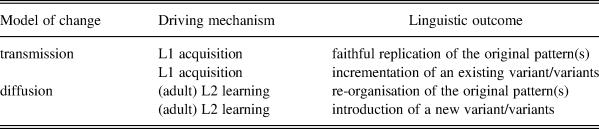
Developed by Labov (Reference Labov2007), the model of linguistic diffusion is now a classic account of linguistic change underpinning much variationist work. Taking the traditional family tree and wave models of change as a starting point for discussion,Footnote 3 Labov builds an argument explaining the mechanisms that ensure the preservation of linguistic structures and continuity in language on the one hand, and the gradual erosion of initial patterns and loss of structural features on the other. Within this theoretical framework, a distinction is drawn between transmission and diffusion. The former is defined as the ‘unbroken sequence of native-language acquisition by children’ (Labov Reference Labov2007:346). It is this process that ensures the continuity of dialects and languages across time. While acquiring ambient language from their caretakers and the surrounding speech community, children do an excellent job replicating the variable forms encountered in the input in all of their structural detail (Labov Reference Labov2007:346). They then advance these variable elements beyond the level of their caretakers and role models through consistent incrementation of the original linguistic pattern in ‘the direction indicated by the original age vector’ (Labov Reference Labov2007:346).Footnote 4
Diffusion, in contrast, is the product of second language/dialect acquisition by adults, necessarily resulting in the weakening and re-ordering of the original rule or pattern (Labov Reference Labov2007:349). Adult learners routinely produce a different version of the variable grammar by not adopting various linguistic items, re-organising existing constraints to which they are exposed or by creating new constraints nonexistent in the speech of native speakers (see also Schleef, Meyerhoff, & Clark Reference Schleef, Meyerhoff and Clark2011:142). While learning a new linguistic variety, adults may further introduce new linguistic features stemming from their first language or dialect or from the universal principles guiding second language/dialect acquisition (Winford Reference Winford2003:217–31).Footnote 5 The difference between transmission and diffusion is ultimately explained by differences in the language-learning abilities of children and adults (see also Meisel, Elsig, & Rinke Reference Meisel, Elsig; and Rinke2013).
The reason why children are such powerful language acquirers is the neural plasticity of the newly born brain (Mundkur Reference Mundkur2005) and the rich linguistic diet of the surrounding environment that early language acquirers are exposed to (Schleef, Meyerhoff, & Clark Reference Schleef, Meyerhoff and Clark2011). Advances in neuroscience and technology have sharpened our understanding of the workings of the human brain and its early development. We thus know that each individual is born with 100 billion neuro cells, each cell exhibiting about 10,000 synaptic (between-the-cells) connections (Sapolsky Reference Sapolsky2018:686–87). These begin to grow at a fast rate ensuring that the mechanisms of motor, sensory, and language development are set in motion. By age three, the brain of a child has twice as many connections as the brain of an adult. This is arguably why exposure to ambient language plays a crucial role in early child development. The building of new synaptic connections is gradually arrested throughout childhood and adulthood through the process of synaptic pruning. Linguistic abilities and the resulting linguistic competence of a newly born child is ultimately affected by early neurobiological experience (Lakoff Reference Lakoff2013).
The Labovian argument is further bolstered by a substantial amount of research into the (individual) acquisition of a second language. This strand of research informs us that capacity for the faithful reproduction of linguistic patterns (and native-like ultimate attainment that goes along with it) declines roughly between nine and seventeen years of age (Johnson & Newport Reference Johnson and Newport1989; Birdsong & Molis Reference Birdsong and Molis2001; Abrahamsson & Hyltenstam Reference Abrahamsson and Hyltenstam2009; Abrahamsson Reference Abrahamsson2012). Beyond this critical period (Penfield & Roberts Reference Penfield and Roberts1959; Lenneberg Reference Lenneberg1967), highly successful acquisition of a second language or dialect appears to be possible but extremely rare (Selinker Reference Selinker1972; Seliger, Krashen, & Ladefoged Reference Seliger, Krashen; and Ladefoged1975; Birdsong Reference Birdsong and Birdsong1999, Reference Birdsong, Kroll and Groot2005). With this said, research has also highlighted the role of motivation and social factors as crucial determinants guiding adult language learning (Spolsky Reference Spolsky1989).
Moreover, sociolinguistic studies on the acquisition of structured variation report nonadoption, partial replication, or reallocation of the original L1 pattern in adult learners’ speech (Wolfram Reference Wolfram1985; Adamson & Regan Reference Adamson and Regan1991; Young Reference Young1991; Regan Reference Regan, Bayley and Preston1996; Schleef, Meyerhoff, & Clark Reference Schleef, Meyerhoff and Clark2011; Davydova Reference Davydova, Duarte and Gogolin2013; Schleef Reference Schleef, Vogelaer and Katerbow2017). In other words, language learners ‘either produce a different version of the native speakers’ variable grammar by re-ordering the internal hierarchies of existing constraints’ or they create novel constraints that are not attested in the speech of native speakers (Schleef, Meyerhoff, & Clark Reference Schleef, Meyerhoff and Clark2011:219).
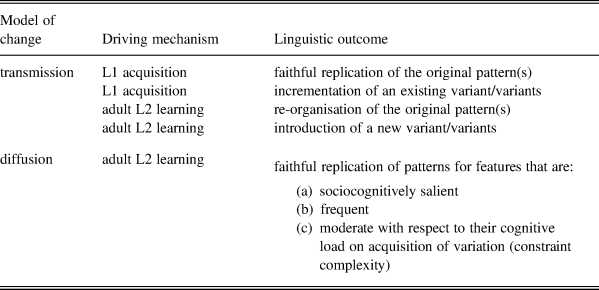
It follows then that transmission and diffusion are two fundamentally distinct processes driven by two different mechanisms. These differences are summarised in Table 1 for convenience.
Transmission and diffusion (extrapolated from Labov Reference Labov2007).

The Labovian model allows for the prediction that the results of linguistic diffusion (i.e. second language/dialect learning) will be less regular and less governed by structural constraints (Labov Reference Labov2007:383) than the internal changes promoted by the mechanism of intergenerational change, that is, transmission. In this contribution, I build on the theoretical construct outlined above and demonstrate that surprisingly, and at least in some cases, the process of linguistic diffusion may result in a generally accurate reconstruction of patterns underlying the variable use of a linguistic feature. I argue that the largely wholesale replication of constraints on variation is due to the high levels of sociocognitive salience exhibited by a variable linguistic feature that is also abundant in the input and moderate with respect to the cognitive load it exerts on the L2 acquisition of structured variation. I elaborate below on the notions of sociocognitive salience in order to illustrate how this is the case.
The discussion is organised as follows. First, I provide a description of the variable linguistic feature and the system-internal constraints underlying its use. I then introduce the data and elaborate on the methods of analysis, followed by the presentation of the results. I situate the findings within the theoretical framework of linguistic diffusion while incorporating the notion of sociocognitive salience as a theory-building component in the model, refining our understanding of the mechanisms shaping language change and governing the evolution of English world-wide.
The linguistic variable
Originating in the 1980s, quotative be like has been making vigorous advances in L1 English speech communities world-wide. Nowadays, it is attested in the speech of young adults speaking British and American English at rates varying between 43.3% and 72.7% (Buchstaller Reference Buchstaller2014:119). Speakers of Canadian and Australian English born in the 1980s and 1990s use this feature with a frequency of 60% to 80% (Tagliamonte, D'Arcy, & Rodrígez Louro Reference Tagliamonte, D'Arcy; and Louro2016:831). Crucially, be like is not a mere lexical innovation, an ‘off-the-shelf change’ (Eckert Reference Eckert2003:186). Embedded within a larger context of direct quotation in spoken narrative, it is a variable linguistic feature exhibiting a complex triggering mechanism (Sayers Reference Sayers2014:187). More specifically, be like has been linked to four major aspects of language-internal organisation in L1 English. Systemic constraints underlying its use include mimesis, quote type, grammatical subject, and tense. The first two are pragmatic constraints, the last two are grammatical ones.
Mimesis is a classic factor underlying the occurrence of be like with quotes performed with a ‘voice’ (Bakhtin Reference Bakhtin1979/1986), as if they were a piece of theatre (Wierzbicka Reference Wierzbicka1974) or a radio play (Buchstaller Reference Buchstaller2003), and favouring the innovative feature, as shown in (2a), (2b), and (2c).
- (2)
a. and I was like “(making a face)” (MaCGE:GE121)
b. he was a bit like “(a huge sigh!)” (MaCGE:GE122)
c. and I was like (frustrated) “yeah, whatever” (MaCGE:GE112)
Quote type is a further potent predictor triggering the occurrence of be like. With regards to the nature of the quote, a distinction has been drawn between quotes representing thought and internal dialogue and quotes illustrating direct speech proper including code-switched material, as in (3c). Be like shows a highly robust link to internally realised quoted material in (3a), although it is not exclusively restricted to these contexts as in (3b) and (3c).
- (3)
a. and it was like “oh, my God! That is silly” (MaCGE:GE118)
b. he's like “oh, what? Don't be a frog” (MaCGE:GE117)
c. and I run into them and was like “oh, my God, sorry, es tut mir leid!” (MaCGE:GE98)
Grammatical subject is an aspect of language-internal structure implicated in the variable realisation of the feature studied here. The main generalisation here is that be like is preferred with first over third person grammatical subjects introducing the verb of quotation in (4a) and (4b). When included in the analysis, the neuter pronoun it has a hugely favouring impact on the occurrence of quotative be like in (4c).
- (4)
a. and I was like “okay!” (laughs) (MaCGE:GE007)
b. they are like “oh, Germans are so good in English” (MaCGE:GE022)
c. it's just like “wow!” (MaCGE:GE016)
Tense is the final predictor discussed in the literature. Be like has been reported to be overwhelmingly preferred with the conversational historical present tense (CHP), a narrative device allowing speakers to report past events while using present tense morphology. This study distinguishes between the CHP in (5a), generic present tense morphology in (5b), past tense marking in (5c) and modal auxiliary marking in (5d) and (5e), as these are the variants attested in the data.
- (5)
a. I knew they were talking but I'm like “I don't understand ya!” (MaCGE:GE087)
b. what they do differently is complementing, everybody is like “hey, your shoes are so cute!” and things like that (MaCGE:GE098)
c. I was just like “oh, okay, yeah. Oh, blah-blah-blah” (MaCGE:GE091)
d. You can't just be like “hey! Let's go to Australia tomorrow!” (MaCGE:GE131)
e. probably, with some people, they will be like “what is she doing? What's she talking?” (MaCGE:GE015)
The data
Collected in the time period from 2007 to 2015, the data reported here stems from two linguistic corpora containing recordings of 177 young adults (aged eighteen to twenty-six)—eighty from India and ninety-seven from Germany—enrolled in bachelor and master degree programmes at Jawaharlal Nehru University (JNU) in New Delhi and at the University of Mannheim (UM). Both are top-notch universities in the field of social sciences representing India and Germany respectively.
The Indian data forms part of the Hamburg Corpus of Non-Native English (HCNVE) and represents ESL forms spoken in India. The data for this corpus was collected during three fieldwork trips to Jawaharlal Nehru University, New Delhi, in 2007, 2011, and 2014. The Mannheim Corpus of German English (MaCGE) supplies the data from Germany and, in so doing, serves as a representative of EFL. The data for this corpus was collected from 2014 to 2016. The data was elicited from sociolinguistic interviews, as used in variationist linguistics (Labov Reference Labov, Eckert and Rickford2001). Each interview lasted for about an hour and included topics aiming to elicit stories from participants.
My focus here is on these young adults, as they are socially motivated individuals with high academic aspirations and ambitious goals in life for whom English is an everyday reality. English is an integral part of their inner and social life. Both speaker groups routinely use English for various academic purposes. In addition, they write English in their e-mail correspondence, read English books, watch English films, TV series, and various YouTube programmes, although, admittedly, the extent to which students engage in these activities varies from individual to individual. Crucially, these young adults have embraced English as an (additional) language in which they can sustain prolonged linguistic interactions. The contexts in which this happens differ, however, from speech community to speech community. In JNU, English is part of in-group communication for a conspicuous majority of students.Footnote 6 For UM students, English is an important means of communication with outsiders, both native and non-native speakers. All of the informants were born in the mid 1980s to mid 1990s at the time when be like was beginning to blossom in L1 English (Tagliamonte, D'Arcy, & Rodrígez Louro Reference Tagliamonte, D'Arcy; and Louro2016:831–32). These ESL and EFL speakers are therefore the most likely early L2 adopters of the global linguistic innovation. Given that the primary mechanism of linguistic diffusion is adoption of linguistic features by adult speakers, we should expect ‘some degree of breakdown in the replication of linguistic forms, rules, and constraints as it spreads across communities’ (Tagliamonte, D'Arcy, & Rodrígez Louro Reference Tagliamonte, D'Arcy; and Louro2016:830). In what follows, I subject this hypothesis to empirical testing, drawing on traditional variationist methods.
Method
The variable context
The classic principle of accountability (Labov Reference Labov1972) requires that the analyst account for all the variants used to introduce direct quotation in constructed dialogue during the subsequent statistical modelling of data. Following well-established variationist practice, I determined the variable context functionally, extracting all instances of re-enactment (Buchstaller Reference Buchstaller2014), that is, ‘the reformation of thought, speech, action, nonlexicalized sounds, and gestures in the voice of oneself or of another’ (Tagliamonte, D'Arcy, & Rodrígez Louro Reference Tagliamonte, D'Arcy; and Louro2016:828). Direct quotation may be introduced by a variety of verbs such as say, think, and be like, the focal point of attention. Other verbs of speech (tell, ask, etc.) and perception (feel, realise, etc.) are fairly ubiquitous, as are the null forms, zero quotatives (see (1a) and (1b)). Delineating the variable context in this way yielded 3,530 quotative markers—2,118 from New Delhi and 1,412 from Mannheim—of which 830 were instances of quotative be like. Of these, 479 occurred in New Delhi and 351 in Mannheim. The data is robust enough (i) to capture the extent to which ESL and EFL learners have appropriated the global innovative feature, and (ii) to ascertain the degree to which young non-native speakers from both academic communities have been able to reconstruct the systematic patterns of variability of quotative be like characterising L1 English. With this said, I now present the methods of analyses employed in this study.
Analytical tools
Given that this study is grounded within the framework of variationist sociolinguistics, I appeal to those types of data modelling that allow me to conceive of direct quotation as a system of grammar. In the first step, I thus explore the extent to which be like has been attested in ESL English, as represented by the HCNVE, and in EFL English, as reflected by the MaCGE data. To this end, I ascertain the rate at which be like is used in each data set in comparison to all the other quotative options extracted from the data.
In the next step, I construct statistical models of the data in order to test for the simultaneous effects of the four predictors, that is, mimesis, quote type, grammatical subject, and tense. In so doing, I carry out fixed-effects logistic regression analyses in Goldvarb X (Sankoff, Tagliamonte, & Smith Reference Sankoff, Tagliamonte and Smith2005). Since most variationist studies of be like have used this statistical procedure, this analysis maximises the comparability of the obtained results with previous findings. I then subject the data to mixed-effects modelling using the Rbrul statistical package (Johnson Reference Johnson2009). This analysis tests the effects found to be significant in the fixed-effects modelling as well as a random intercept for individuals and a fixed effect for location. Probing main language-internal effects with speaker as a random variable allows us to capture those systemic predictors the effects of which are robust enough to rise above the variability caused by nonreplicable factors such as individual linguistic behaviour. Running location as a fixed effect allows us to ascertain whether speaker groups have the same system governing the use of be like. If the effect of this factor group is significant, this indicates that the linguistic behaviour of be like is different between the two speaker groups. If, however, the effect of location cannot be attested and the systemic constraints remain intact, I can interpret this to mean that the two cohorts of young speakers are largely undifferentiated with respect to the use of be like.
The global linguistic variant in ESL and EFL English
Distributional analyses
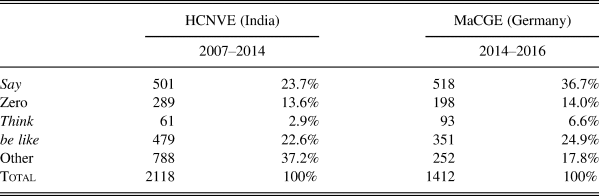
I first ascertain the extent to which the ESL and EFL students have adopted quotative be like in their speech. To this end, I compare the percentages with which the innovative form is employed relative to all the other quotative variants recruited by the L2 populations during sociolinguistic interviews. Following the practice established in previous variationist studies, I report percentages of the main quotatives analysed in research on L1 varieties of English, namely say, think, zero quotatives, and quotative be like. All of the remaining variants were merged into the category ‘other’.Footnote 7 The distributional analyses of data yield the results reported in Table 2.
Overall distribution of quotative markers in HCNVE and MaCGE data.
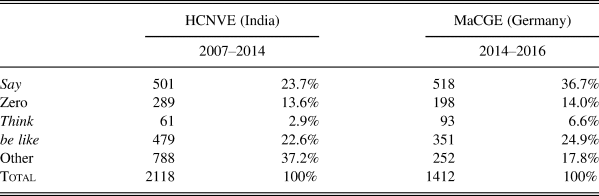
Table 2 shows that in contrast to their L1 peers who, as mentioned earlier, use innovative be like with rates ranging between 40% and 80% (Buchstaller Reference Buchstaller2014:119; Tagliamonte, D'Arcy, & Rodrígez Louro Reference Tagliamonte, D'Arcy; and Louro2016:831), young individuals from India and Germany have adopted this variant at a much more modest rate of 22.6% and 24.9% respectively. For them, be like stands in clear competition with say, zero, and other quotative markers. The fact that quotative be like has been adopted at comparable but nonelevated rates by two L2 groups may be explained in terms of ESL and EFL learners’ perceptions of the new feature. A study reported in Davydova (Reference Davydova2019) indicates that young speakers of Indian English have developed a series of tacit and explicit associations indicative of both positive and negative attitudes harboured towards be like. A similar investigation yielded comparable results for German learners of English (Davydova, Tytus, & Schleef Reference Davydova and Buchstaller2017). On the one hand, both ESL and EFL speakers seem to realise that be like is a ‘trendy’ feature characteristic of an informal style that makes them sound hip and socially attractive. On the other hand, they believe that the use of this feature comes with the price of sounding less cultivated. Overall, it seems possible that being acutely aware about (highly) stigmatised connotations attached to quotative be like in L1 English (see also Buchstaller Reference Buchstaller2014:198–244), ESL and EFL learners have appropriated this variant in their speech only to a moderate degree.
Logistic regression analyses
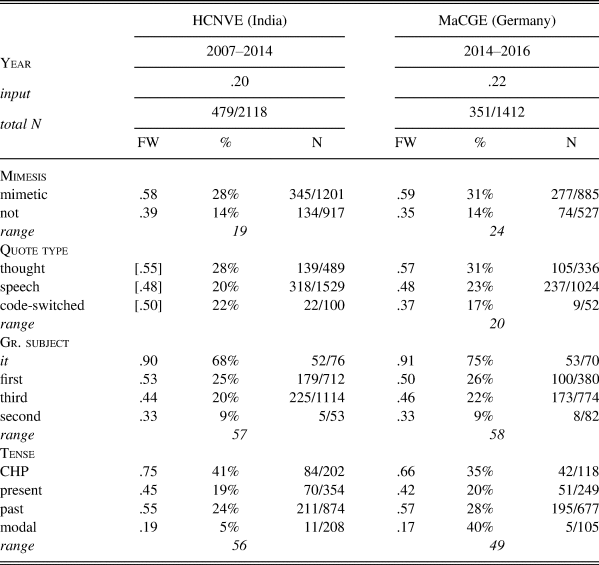
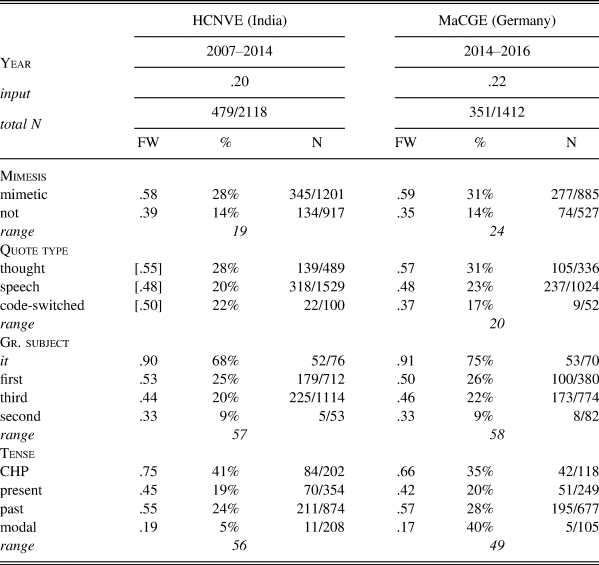
Let us now turn to the exploration of the variable grammar underpinning the use of be like in the HCNVE and MaCGE data. When interpreting the results of statistical modelling, I draw on two lines of evidence in order to ascertain the extent to which the variable grammar has been appropriated by adult L2 English speakers: (i) statistical significance of individual factor groups at a level of probability of p < 0.05, and (ii) ordering of individual (statistically relevant) constraints (Clark & Schleef Reference Clark and Schleef2010:299). Factor weights (FW), reported in Tables 3 and 4, are weighted probabilities of individual factors. Those above .50 are interpreted as favouring the occurrence of be like. Those below .50 indicate a disfavouring linguistic context for the innovative variant.
Language-internal predictors constraining be like in HCNVE and MaCGE data; fixed-effect modelling (Goldvarb).
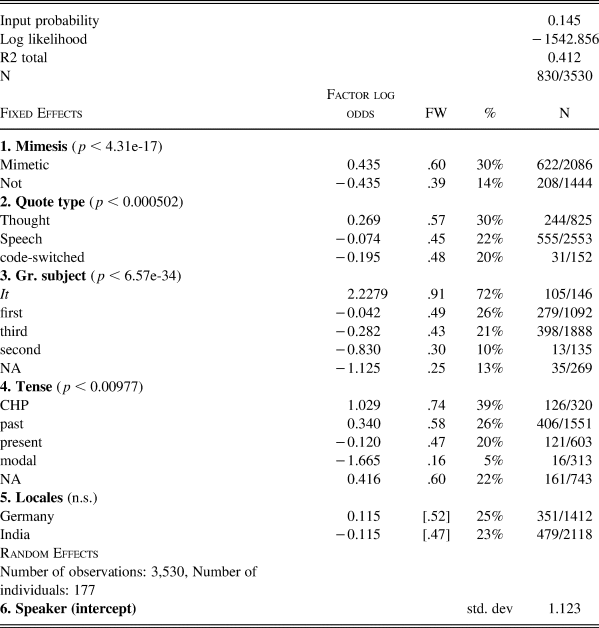
Mixed-effects model for be like; HCNVE and MaCGE data combined (Rbrul).
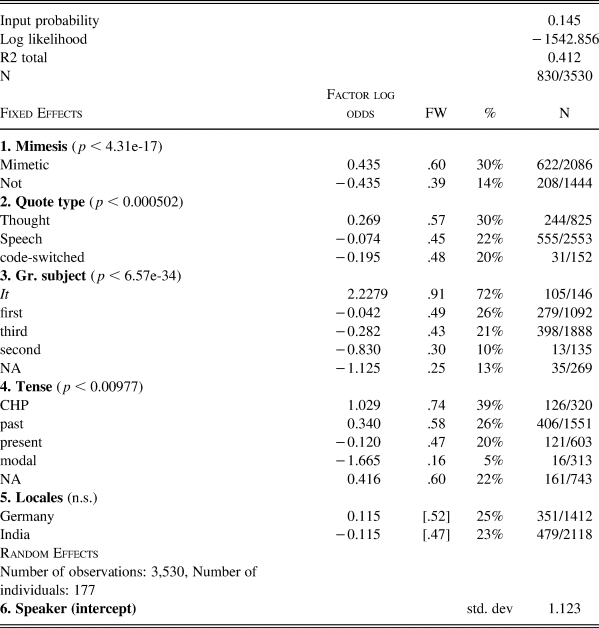
Before turning to the presentation of the fixed-effects results, a few methodological observations are in order. First, the square brackets, in Table 3, indicate statistically nonsignificant factors. Second, nonapplicable environments, that is, contexts that are not marked for grammatical subject (n = 163) and tense (n = 480) in HCNVE and grammatical subject (n = 106) and tense (n = 263) in MaCGE, have been excluded from the respective factor group analyses in Goldvarb. Third, there is no consensus amongst variationists on how to treat neuter it (e.g. It's like, ‘Wow!’, MaCGE:GE16). Some researchers (e.g. Tagliamonte, D'Arcy, & Rodrígez Louro Reference Tagliamonte, D'Arcy; and Louro2016) exclude it from the analysis, whereas others account for the context in their models of language variation (e.g. Buchstaller Reference Buchstaller2014). In this study, I ran the factor group analysis in Goldvarb both with and without neuter it, for both datasets. Goldvarb returns ‘grammatical subject’ as a statistically significant predictor in both cases, thereby justifying the inclusion of the neuter form in the analysis since the overall effect of the factor group is not attributable to this constraint alone.
Fixed-effects modelling, presented in Table 3, indicates that the language-internal variables reported as significant constraints in L1 English are largely at work in ESL and EFL English. Similar to their L1 peers, both Indian and German speakers of English prefer be like with mimetic quotes (FW .58 for HCNVE and FW .59 for MaCGE), first over third person subjects (FW .53 vs .44 for HCNVE and FW .50 vs .46 for MaCGE) and the CHP (FW .75 for HCNVE and FW .66 for MaCGE). Quote type, also known as content of the quote, is a working constraint in the MaCGE data with reported inner dialogue favouring the occurrence of be like at FW .57. Whereas quote type fails to reach the significance threshold in the HCNVE data, the distributional pattern nevertheless indicates that be like is more frequent with reported thought (28%) than with reported speech (20%).
So far it has been determined that largely the same constraints are significant and operate uniformly across two speaker groups, located 3,813 miles apart from each other. As a next step, I subject the data to a mixed-effects analysis run in Rbrul (Johnson Reference Johnson2009) in order to ascertain whether be like is doing the same linguistic work globally and to assess the effect of the locale itself. To that end, I combine the data from both student communities and include geographical setting as an independent predictor (fixed effect) in the analysis. Furthermore, I include individual as a random effect in order to establish whether the effects reported here are robust enough to rise above intra-speaker variability. Table 4 delivers several important findings.
First, mimesis, quote type, grammatical subject, and tense are genuine predictors of be like occurrence, overriding the idiosyncratic linguistic behaviour of individual speakers. Second, the overall direction of constraints remains invariable in the combined data: Be like is favoured with reported thought rather than reported speech, and with first person rather than third person grammatical subjects. Furthermore, it is linked to the CHP and mimetic quotes. Crucially, when factored into the analysis, the effect of locale itself is nonexistent. I interpret both findings as evidence supporting the view that the two speaker groups are essentially alike with respect to the systemic use of quotative be like.
The findings reported here thus indicate that, surprisingly and contrary to the expectation predicted by the model of linguistic diffusion, ESL/EFL speakers have adopted the variable grammar governing the use of be like in native English with a remarkable degree of precision. These results are even more astounding against the backdrop of previously mentioned studies reporting less than perfect appropriation of patterns of structured variation by adult language learners. How could this have happened? Which mechanism(s) may have been responsible for this outcome?
Sociocognitive salience
In order to address this question, I appeal to and elaborate on sociocognitive salience, a notion that has gained currency well beyond the field of language study. The construct of salience has been recruited by physiologists, cognitive scientists, and social psychologists in order to explain the functioning of the human brain and human behaviour (Rosch Reference Rosch1973; Taylor & Fiske Reference Taylor and Fiske1978; Treisman & Gelade Reference Treisman and Gelade1980). In linguistics, the notion has attracted attention from dialectologists, sociolinguists, and psycholinguists, some of whom are also experts in first and second language acquisition (Naro Reference Naro1981; Kerswill Reference Kerswill1985; Slobin Reference Slobin and Slobin1985; Trudgill Reference Trudgill1986; Bardovi-Harlig Reference Bardovi-Harlig1987; Mufwene Reference Mufwene, Byrne and Huebner1991).
Salience is generally understood as a complex explanatory variable resulting from multiple factors (Kerswill & Williams Reference Kerswill, Williams, Jones and Esch2002). Against this backdrop, recent accounts have sought to establish rigorous criteria for defining salience as a theoretical building block (Rácz Reference Rácz2013; Levon & Fox Reference Levon and Fox2014; Levon & Buchstaller Reference Levon and Buchstaller2015; Buchstaller Reference Buchstaller2016; Cintrón-Valentín & Ellis Reference Cintrón-Valentín and Ellis2016; Ellis Reference Ellis2016b). What these studies suggest is that there are generally two major (albeit complementary) ways in which salience can be construed as a linguistically viable concept.
On the one hand, salience can be understood as a general and, at least to some degree, objective property of a linguistic feature or construction (see also Naro Reference Naro1981:97). This type of salience is referred to as cognitive salience. A cognitively salient feature ‘bulges out of its [linguistic] surroundings’ (Rácz Reference Rácz2013:31), ‘stands out from the rest’ (Ellis Reference Ellis2016b:342; see also Fiske & Morling Reference Fiske, Morling, Manstead and Hewstone1996:489) and, therefore, has increased chances of coming to the fore of learners’ attention, the major prerequisite for learning (Schmidt Reference Schmidt and Robinson2001). On the other hand, salience can be construed as a subjective property of the speaker's mind revealing the degree to which speakers are aware of an existing variant (Levon & Fox 2014:185). This type of salience is termed sociolinguistic salience here.
However you look at the phenomenon, salience, by its very nature, always increases attention, resulting in L2 speakers ‘becoming conscious of some material… [which] seems to be the sovereign remedy for learning anything, applicable to many very different kinds of information’ (Baars Reference Baars1997, cited in Ellis Reference Ellis, Hundt, Mollin and Pfenninger2017:79). With this in mind, I developed a catalogue of language-specific and sociolinguistic criteria allowing us to describe the degree to which a given linguistic feature or construction is sociocognitively salient, that is, attention-fostering (Davydova Reference Davydova2019:197–98).
(i) Phonetic/phonological level: whether it expresses phonetically different (discrete) contrasts (Kerswill Reference Kerswill1985:7; Trudgill Reference Trudgill1986:11); and whether it is involved in the maintenance of phonological contrasts (see Trudgill Reference Trudgill1986 for a full discussion);
(ii) Suprasegmental level: whether a feature is used as suprasegmentally emphasised material (Mufwene Reference Mufwene, Byrne and Huebner1991:139);
(iii) Morphosyntactic level: the extent to which a feature can be individuated on the morphosyntactic level of the organisation of linguistic structure … (Mufwene Reference Mufwene, Byrne and Huebner1991:127–28);
(iv) Semantic level: whether a feature can be described as possessing a ‘specific meaning’ (Mufwene Reference Mufwene, Byrne and Huebner1991:139) or ‘particular semantics’ (Buchstaller Reference Buchstaller2014:14) clearly mapped onto a linguistic construction; in other words, whether it is transparent in terms of form-meaning correspondences (Chapman Reference Chapman1995:2; Kerswill & Williams Reference Kerswill, Williams, Jones and Esch2002:87);
(v) Discourse-pragmatic level: whether a feature is an ‘interactionally prominent’ element (Cheshire Reference Cheshire, Klemola, Kytö and Rissanen1996:6) introducing (a) a ‘conceptual contrast’ (Talmy Reference Talmy, Robinson and Ellis2008:30) and/or (b) ‘emotionally-heightened material’ (Buchstaller Reference Buchstaller2003:9);
(vi) ‘Explicit meta-discourse’: whether a feature is a subject of overt commentaries in the public discourse, including interactions in a classroom (Levon and Fox 2014:187).
Importantly, sociocognitive salience is a gradient rather than a categorical construct. ‘Classifying variable features into sociocognitively salient, less salient or least salient’, Davydova (Reference Davydova2019:198) argues, ‘allows us to make more finetuned predictions regarding the extent to which these features [and] their conditioning systems … can be acquired by non-native speakers and, in so doing, promoted from one linguistic variety into another’. In what follows, I explore the extent to which innovative be like (and the quotative frame underlying it; see Figure 1) can be construed as a sociocognitively salient construction. Given that be like is a discourse-pragmatic feature with relatively fixed morphosyntactic embedding (Buchstaller Reference Buchstaller2014), criterion (i), which treats salience at the phonetic/phonological level, does not apply.
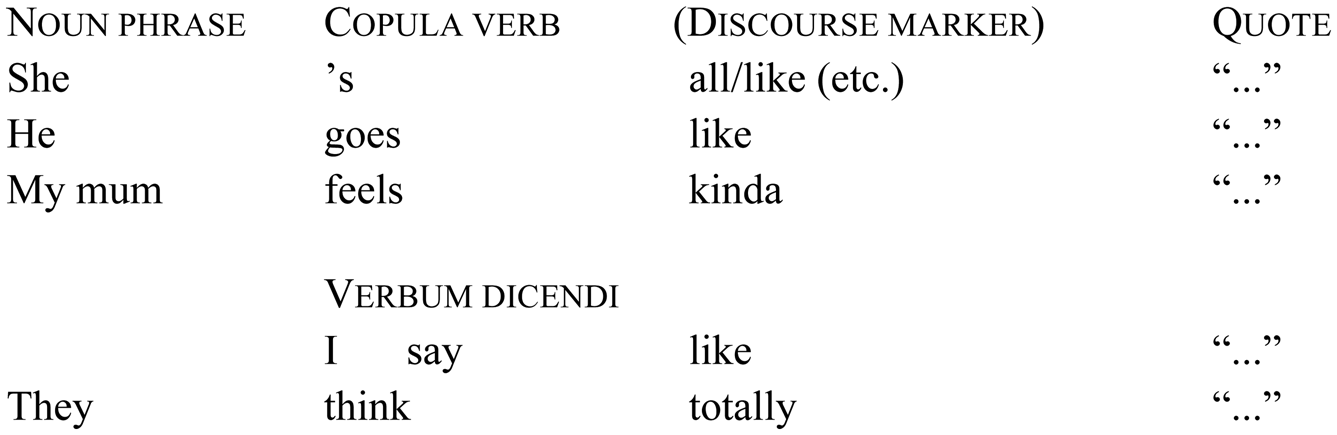
Quotative template (revised from Davydova & Buchstaller Reference Davydova and Buchstaller2015:452)

Serving the purpose of re-enactment, quoted material contrasts with surrounding speech by altered pitch variations and intonation contours at the suprasegmental level. Since quotation is recruited for demonstration of an event or a speech act and, therefore, for depicting rather than describing something (Clark & Gerrig Reference Clark and Gerrig1990:765–66), speakers often seek to produce a quote in a different ‘voice’ (Bakhtin Reference Bakhtin1976/1986). Crucially, current research indicates that be like is linked to mimetic, that is, prosodically marked quotes, more closely than any other quotative marker (see, for instance, Buchstaller Reference Buchstaller2014). It is this association with prosodically emphasised material that renders the innovative variant salient at the suprasegmental level of linguistic structure.
As Figure 1 shows, at the morphosyntactic level the quotative template is composed of four relatively autonomous elements, that is, noun phrase + copula verb/verbum dicendi + (discourse marker) + quote. The template is quite similar to analytical or periphrastic constructions featuring two or more free-standing words, which have been argued to be salient (Hopper & Traugott Reference Hopper and Traugott2003; Ellis Reference Ellis, Hundt, Mollin and Pfenninger2017:83). With the exception of pronouns and following copula verbs (e.g. she's), the structural elements of the quotative frame are not merged either with each other or with any other elements in a clause and can, by this token, be relatively easily attended to in the discourse.Footnote 8 The individuated nature of the quotative template, illustrated in Figure 1, facilitates the allocation of cognitive resources towards the construction at hand, which, in turn, is a prerequisite for turning input into intake, that is, learning. This is in contrast to low schematicity bound morphemes—of which the variable (velar vs. alveolar) realisation of the -ing morpheme is one much discussed example (see Schleef, Meyerhoff, & Clark Reference Schleef, Meyerhoff and Clark2011)—which are less available for processing by the human brain in a speech stream and thus less likely to come to the fore of L2 speakers’ attention during spontaneous interactions.
Semantically, a linguistic feature or construction can be construed as cognitively salient if it exhibits a high level of one form/one meaning correspondence (Mayerthaler Reference Mayerthaler1981). There is evidence suggesting that such items become more readily available to our senses for further processing than multiple meaning items where a connection between a surface form and its meaning is weaker, less salient, and thus poorly learned (see also Ellis Reference Ellis, Hundt, Mollin and Pfenninger2017:73, 85–86). At this level of linguistic structure, a salient variant is also the one exhibiting ‘particular semantics’ (Buchstaller Reference Buchstaller2014:15) or a ‘specific meaning’ (Mufwene Reference Mufwene, Byrne and Huebner1991). This is because a more specific referent tends to attract greater attention than a more general referent (Talmy Reference Talmy, Robinson and Ellis2008:32).
From this perspective, the quotative template is a linguistic construction (Tomasello Reference Tomasello2003, Reference Tomasello, Damon and Lerner2006; Traugott & Trousdale Reference Traugott and Trousdale2013) exhibiting the function of producing ‘a piece of theatre’ (Wierzbicka Reference Wierzbicka1974) or a ‘radio play’ (Buchstaller Reference Buchstaller2003). In other words, speakers seem to be aware that the use of a quotative marker obliges them to portray, and in so doing, to perform the event or the internal state referred to, not merely narrate it (Clark & Gerrig Reference Clark and Gerrig1990:802). The quotative template therefore fits with the one form/one function criterion characterising salient linguistic constructions. Furthermore, it is quotative be like that is frequently accompanied by gestures and mimesis, which increases its noticeability in the discourse and helps the speaker/learner reconstruct the basic function attached to it.
At the discourse-pragmatic level of linguistic structure, the quotative marker functions as a pivot introducing a shift in vantage point from the narrator to the characters. The shift in perspective also applies to those cases featuring the first person grammatical subject where the referent remains unchanged. It is in this sense that the quotative template can be considered an ‘interactionally prominent’, and therefore attention fostering, element in the discourse (Cheshire Reference Cheshire, Klemola, Kytö and Rissanen1996). While being stylistically marked, quotative be like serves the introduction of emotionally relevant material (Buchstaller Reference Buchstaller2003:9), thereby creating a dramatising effect between contrastively focused and nonfocused narrated events (Wolfson Reference Wolfson1978; Romaine & Lange Reference Romaine and Lange1991). Such a ‘conceptual contrast’ (Talmy Reference Talmy, Robinson and Ellis2008:30), in turn, renders quotative be like cognitively salient.
On the level of social awareness, be like has been described as an ‘ultra-salient’ (Jensen Reference Jensen2013) or ‘maximally’ salient (Buchstaller Reference Buchstaller2016) feature subject to extensive commentary, both positive and negative, in globally available public discourse. On the one hand, the use of (be) like has been criticised severely by US educationalists, who frequently equate the use of this variant with being inappropriate, inadequate, and even stupid (see discussion in Buchstaller Reference Buchstaller2014:199–202). This policy has been embraced by some (although by no means all) non-native English teachers who explicitly condemn be like users in the classroom (Davydova Reference Davydova2019:204). It is important to note that irrespective of their attitudes towards the innovative variant, teachers do not engage in discussion of the major functions underlying the variable use of be like. Similar to other features of vernacular grammar, be like is acquired in naturalistic contexts, while being traditionally banned from explicit instruction in a classroom context (see also Davydova & Buchstaller Reference Davydova and Buchstaller2015). The negative comments accompanying the spread of be like may explain why this variant has been adopted only to a modest degree by the two L2 populations studied here. That ESL and EFL learners are generally aware of the negative connotations attached to quotative be like has been reported in Davydova (Reference Davydova2019) and Davydova, Tytus, & Schleef (Reference Davydova, Tytus; and Schleef2017).
At the same time, be like has been recently discussed in blogs (Bierma Reference Bierma2005; Zwicky Reference Zwicky2006; Carey Reference Carey2013; Rundell Reference Rundell2013) and mainstream journals (Peterson Reference Peterson2015). These project a friendly image for be like aiming at fostering readers’ curiosity about the new variant, while also commenting on its provenance and major sociolinguistic functions. In a similar vein, be like has been featured in A Webcomic of Romance, Sarcasm, Math, and LanguageFootnote 9 (also promoted through Facebook) and discussed by amateur video bloggers on YouTube (see Davydova Reference Davydova2019:202–203). Given this kind of attention accompanying the spread of be like worldwide, it is not unreasonable to suggest that both ESL and EFL learners are presented with ample opportunities allowing them to ‘take notice’ (Schmidt Reference Schmidt1990) of this feature.
In sum, the quotative template is characterised by a high level of suprasegmental prominence and morphosyntactic schematicity coupled with a transparent form-function relationship (i.e. performing ‘a piece of theatre’; Wierzbicka Reference Wierzbicka1974) and a vital textual function (i.e. steering listeners’ attention towards emotionally highlighted material). It is a sufficiently salient linguistic construction featuring a variant frequently discussed in the media—quotative be like. Various aspects of sociocognitive salience attached to innovative be like are thus at work guiding L2 speakers’ acquisition of probabilistic patterns of structured variation.
Rare success in linguistic diffusion: Sociocognitive salience and other supporting factors
The Labovian model of linguistic diffusion explains continuity in language, that is, retention of initial linguistic forms and their patterns, through ‘unbroken sequences’ of generational L1 acquisition or parent-to-child transmission (Labov Reference Labov2007:383). In contrast, it attributes linguistic diversification and reorganisation of original constraints to linguistic diffusion and its major driving force, (adult) L2 language learning. In his seminal paper, Labov (Reference Labov2007:383) concludes, however, that ‘it would be helpful to know more about the limitations on children's ability to learn new dialects and on adults’ inability to learn them’. This investigation has been concerned with the latter and, in so doing, has presented a scenario leading to a successful appropriation of structured variability.
The evidence presented in this study urges the analyst to recognise the possibility of a generally accurate replication of the original patterns at least in some cases of linguistic diffusion and, in so doing, to expand the existing model of linguistic change (see Table 5). Even though be like was not adopted by ESL/EFL learners to the same degree attested in the L1/source varieties, thereby substantiating a sociolinguistic postulate that adults, in fact, do participate in an ongoing change to a lesser degree (Baxter & Croft Reference Baxter and Croft2016:136), the extent to which they appropriate the patterns of L1 variation irrespective of their local sociolinguistic ecology (ESL vs. EFL) is remarkable. Even more so against the backdrop of an observation that ‘structural borrowing is rare [in situations of language contact]: the adults who are the borrowing agents do not faithfully reproduce the structural patterns of the system they are borrowing from’ (Labov Reference Labov2007:383).
Transmission and diffusion (Labov Reference Labov2007): The expanded model.
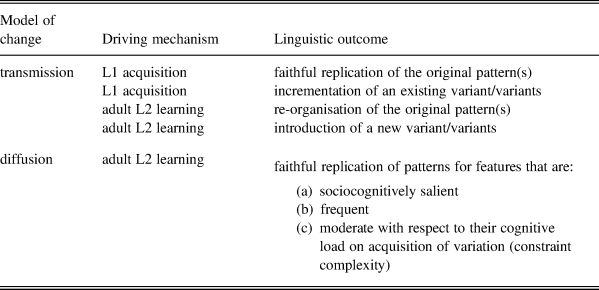
It has been argued here that the mechanism guiding and ultimately ensuring the wholesale adoption of patterns of structured variation is the high level of sociocognitive salience attached to a linguistic construction. Consistent with theories of second language acquisition highlighting the role of attention as a precondition to learning (Schmidt Reference Schmidt1990, Reference Schmidt and Robinson2001; Ellis Reference Ellis and Rebuschat2015), the theoretical construct of sociocognitive salience holds the key to understanding successful L2 learning of structured vernacular variation and, by this token, its potentially successful linguistic diffusion. Essentially, the theories mentioned postulate that we learn about phenomena that we pay attention to and do not learn those that go unnoticed. They predict that paying attention to a variable feature in ambient language sets the mechanism of exemplar-based learning (Ellis Reference Ellis and Rebuschat2015) in motion, whereby the act of noticing a linguistic variant starts activating the building of associative language-internal patterns attached to that variant through the gradual strengthening of synaptic connections, the neurobiological substrate of learning. Coupled with adult neurogenesis, neuroplasticity of the adult human brain reportedly ensures the proper functioning of exemplar-based learning in fully grown individuals (Sapolsky Reference Sapolsky2018:147–50, 679–706).Footnote 10
To be sure, sociocognitive salience is not the only phenomenon fostering successful results in L2 learning and linguistic diffusion. Several factors need to conspire in order to help L2 speakers master a cognitively demanding task—the acquisition of probabilistic constraints triggering the occurrence of one variant over another. There are, as far as I can see, two other factors that favour the adoption of structured variation—frequency and constraint complexity.
L2 research has accrued significant evidence that frequency is a factor supporting L2 success (Ellis & Collins Reference Ellis and Collins2009; Ellis Reference Ellis2002, Reference Ellis, Behrens and Pfänder2016a, to mention a few). From the variationist perspective, frequency allows L2 speakers to accumulate ‘context-rich exemplars and extract information out of the regularity of occurrence between certain linguistic features (sound sequences, morphosyntactic patterns, lexical material, and so on) with other types of factors (the linguistic context as well as situational, interactional or social factors)’ (Davydova & Buchstaller Reference Davydova and Buchstaller2015:462).
With this said, let us consider our linguistic variable with respect to the parameter ‘frequency’. The quotative template is a construction type that exhibits high levels of type and token frequency. The former refers to the number of distinct items that can be substituted for each other in a linguistic pattern and has been demonstrated to promote learning of linguistic patterns via analogical category building (McDonough & Kim Reference McDonough and Kim2009; see also Tomasello Reference Tomasello2003:145; Bybee Reference Bybee, Robinson and Ellis2008:221). Representing the number of occurrences of a linguistic item in the input, a high token frequency boosts the individual representation of a linguistic item (Croft Reference Croft2001:149). Crucially, both type frequency and token frequency play an important role in construction learning (Casenhiser & Goldberg Reference Casenhiser and Goldberg2005).
Regarding type frequency, the quotative template is a productive construction type in L1 English continuously attracting new linguistic material into the discourse marker slot, illustrated in Figure 1 (see also Buchstaller Reference Buchstaller2014:16–18). The productivity of the quotative template is further supported by cross-linguistic data (Buchstaller Reference Buchstaller2014:20–23). Experiencing the quotation schema with different lexical items in speech instigates the parsing mechanism and in so doing, prompts active pattern learning. The high type frequency of the quotative frame is complemented by a high token frequency of the quotative schema on the one hand and quotative be like on the other. English quotatives have been reported to occur with a frequency amounting in some cases to 228.8 productive usages per hour in the speech of young adults from US and Canada (Tagliamonte & D'Arcy Reference Tagliamonte and D'Arcy2007:200). We have also seen that quotative be like has a share in the L1 English quotative system ranging between 60% and 80% of all instances of quotation. The relative frequency with which be like occurs in the input makes it a prototypical member of the category and the type that language learners have the greatest chance of encountering. Supported by the general productivity of the quotative template, the distributional frequencies of be like in the donor varieties ‘provide L2 learners with ideal circumstances for a cognitively challenging task—the acquisition of a constraint system’ (Davydova Reference Davydova2019:186).
Whereas the high level of sociocognitive salience may initiate the process of synaptic building, it is the productivity of a linguistic construction and the frequency with which a variant of that construction occurs that invariably supports and ultimately results in a strong mental representation of a variable linguistic item and its hierarchically organised conditionings of occurrence (Bybee Reference Bybee2002). Note, however, that a high degree of salience is viewed here as the overriding factor and a crucial prerequisite for successful L2 outcomes; low-salience constructions may not be learned even after years of (frequent) exposure (Wulff & Ellis Reference Wulff, Ellis, Miller, Bayram, Rothman and Serratrice2018:37).
Another factor implicated in L2 acquisition of the variable grammar is constraint complexity. The term constraint complexity has been coined by variationist sociolinguists in order to describe ‘the amount of cognitive load that a learner will need to handle while extracting and processing probabilistic constraints from the variable input’ (Davydova Reference Davydova2019:205; see also Meyerhoff & Schleef Reference Meyerhoff and Schleef2012; Ender Reference Ender, Vogelaer and Katerbow2017). Whereas phonological variables tend to be conditioned by excessively elaborate, often lexically conditioned rules (see Labov Reference Labov2007; Schleef, Meyerhoff, & Clark Reference Schleef, Meyerhoff and Clark2011; Schleef Reference Schleef, Vogelaer and Katerbow2017), the rules conditioning the variable occurrence of be like are perhaps best described as moderate with respect to the cognitive load they exert on a speaker acquiring structured variation in a second or foreign language. While acquiring quotative be like, a learner is confronted with two pragmatic and two grammatical parameters in total and the number of individual constraints varies between two (yes or no in the case of mimesis) and four (CHP, etc. in the case of tense). In contrast to that is the cognitive load involved in the acquisition of perhaps the most well-studied phonological variable, (ing): the velar vs. alveolar realisation of the suffix -ing. Research on L1 (ing) variation reports up to seven language-internal predictors of variation including strenuous lexical conditioning (see Hazen Reference Hazen and Brown2006; Schleef, Meyerhoff, & Clark Reference Schleef, Meyerhoff and Clark2011 for overviews). Furthermore, the individual constraints within factor groups may comprise as many as eight discrete values. A similar picture emerges from the examination of patterns underlying the variable realisation of the tense and lax short-ɑ reported for New York City and Mid-Atlantic states (Labov Reference Labov2007). Labov documents one basic and seven specific conditions on the variable occurrence of the lax short-ɑ including phonological and grammatical conditions as well as lexical exceptions and late learned words (Labov Reference Labov2007:354–55). Such constraint hierarchies are overwhelmingly elaborate. In contrast to many of the phonological systems of variation reported in the literature, the variable grammar of be like appears to represent a manageable system of language-internal conditioning. With its tolerable cognitive load, be like seems to be within the reach of L2 speakers acquiring patterns of structured variation.
Conclusion and outlook
This article has presented a case of linguistic diffusion resulting in a generally wholesale replication of patterns of variation. I have singled out three phenomena—sociocognitive salience, frequency, and constraint complexity—as factors promoting success in L2 appropriation of structured variation and, by the same token, in linguistic diffusion. Within the framework adopted here, sociocognitive salience is viewed as a triggering event drawing speakers’ attention towards a linguistic variant and guiding them into L2 success supported by sufficiently high levels of type and token frequency and a moderate cognitive load on L2 acquisition exerted by constraint hierarchies.
The value of any theory lies in its ability to generate testable predictions that could be subjected to further empirical investigation. With this said, we may want to hypothesise that if ongoing changes in progress spreading through a linguistic diffusion/L2 acquisition pathway are represented by a feature that is maximally salient from a sociocognitive perspective, such change is likely to result in a successful adoption of the original pattern if and only if the variable feature exhibits high levels of type and token frequency and a moderate degree of constraint complexity. Variable features that are high in type and token frequency but low in salience will not be acquired. Similarly, excessively complex constraint hierarchies may not be acquired by L2 speakers, no matter how salient a variable linguistic feature is. Acquisition of structured variation is a highly challenging task to the extent that a constellation of factors need to conspire in order for adults ‘to reproduce linguistic forms, rules, and constraints with accuracy and speed [approaching those of children]’ (Labov Reference Labov2007:349).