One of the most influential relationships studied in the field of political participation is that between citizenship and public policy. For years, scholars explored this relationship unidirectionally; that is, they were concerned with how various inputs such as contextual circumstances and interest group pressures shape the formation of public policy.1
It was only later that research began to flow in the opposite direction by focusing on the ways in which policies transform citizens with respect to their level, intensity, and form of political participation.2 Foremost among these emergent ideas was the notion that the social construction of target populations could serve as a critical driver of political participation.3 In brief, social construction theory argues that public policy plays a fundamental role in sending different groups of citizens highly tailored messages about their worth in the political system and what they can expect from the government in terms of responsiveness. These messages then lead to a hierarchy of citizenship and ultimately, disparate levels of political participation.Recent research on this political participation effect has most often focused on how the social construction of deserving versus undeserving target populations impacts voting behavior and notions of political efficacy.4
More specifically, those who are viewed as deserving will be more likely to vote and engage with political issues than those who are viewed as undeserving. Yet there is a more proximate and, as of yet, underexplored type of spillover effect which may be even more critical. This is the capacity of groups to advocate on behalf of their own interests when they experience problems as a direct result of their participation, either voluntarily or involuntarily, in the governmental programs that are shaped by these social constructions. This is important because in a democratic system, the ability to effectively articulate programmatic problems is the first necessary step to promoting policy change by elected officials. The key question thus becomes, how do social constructions as signaled through public policies impact the ways in which groups articulate their specific complaints about a program's operation?Scholarship on language use has in the past primarily focused on how elites create and reinforce social constructions, rather than on how target groups react to these social constructions in communicating their problems with governmental programs to others.5
Importantly, then, critical discourse analysis represents one innovative way to unpack the connection among social constructions, public policy, language, and political participation on behalf of these target groups. As part of the linguistics disciplinary field, the critical discourse approach distinguishes itself by its focus not only on language, but on the social contexts under which this language is produced.6 Central to research generated in this tradition is the notion of power. According to Ruth Wodak, “language indexes power, expresses power, is involved where there is contention over and a challenge to power.”7Wodak 2001, 11.
The critical discourse approach represents a means of understanding social problems that is open to a vast breadth of theoretical lenses in a multidisciplinary context, from all-encompassing explanations of societal organization, to micro-level examinations of one-on-one, interpersonal interactions.8
Sarangi and Coulthard 2000.
Meyer 2001.
Fairclough 1992.
In this paper, we focus specifically on how political science and policy studies can benefit from the careful study of vocabulary using standard qualitative analysis methods in understanding complex social dynamics. In particular, we argue that the social construction of target populations in governmental programs creates, elaborates upon, and reinforces a language of inequality, which ultimately produces fundamentally negative outcomes for political participation. On one hand, socially-constructed deserving groups learn through policy that their voices are more valuable in the political process. Through their privileged position in society, they understand how the political game works, and, although they might be experiencing difficulties with a subset of public policies currently in operation, they remain highly connected to the political system overall. In other words, although they disagree with the rules governing the program, they tend to challenge the rules within an overall framework of compliance and pro-social behavior. Their words and actions, therefore, are much more likely to be considered by policymakers, thus creating a positive feedback cycle of participation.
On the other hand, socially-constructed undeserving groups learn from all phases of the policy process that they are marginalized actors in the game of politics. Their concerns, their voices, and their perspectives do not matter to those in power. When they speak about problems that they are experiencing as participants in governmental programs, their language patterns reflect this disconnection. The policies with which they must comply in no way match the realities of their lives. Therefore, in many cases, they choose to disengage from the formal, programmatic rules that govern their lives as much as possible. More specifically, they suggest evasive and even illegal means of coping with the program at issue. Policymakers subsequently hear this language of disconnection and disengagement, and are likely to choose to be less receptive to these groups in response. The cycle of alienation from the political world for these groups, then, only worsens. Figure 1 lays out these processes.

The impact of social constructions on the creation of target populations, political language, and policy response by elected officials
This analysis empirically assesses these relationships by comparing the discourse of two sets of fathers towards the child support enforcement system: middle class fathers organized into fathers' rights groups—which are grassroots organizations located all over the country that provide personal case management services to men undergoing family dissolution, offer emotional support, and advocate on behalf of child support reform—and fathers with children receiving welfare. Social constructions create policies that serve to classify middle class fathers represented by fathers' rights groups as relatively more deserving of assistance, while conceptualizing fathers with children on welfare as relatively undeserving of assistance in meeting the obligations of helping their families. The policies that emerge from these constructions, in turn, define the ways in which these two sets of fathers talk about the problems that they are experiencing in the child support enforcement program. Fathers' rights members, on one hand, reflect a remarkable connection to the policies to which they are, in many ways, opposed, and tend to advocate for change in incremental terms. The use of language in this fashion makes their claims at least potentially actionable by policymakers if their recommendations are persuasive. Fathers with children on welfare, on the other hand, speak about their problems in ways that demonstrate disconnection from these policies, which leads them to suggest questionable ways to disengage from the formal system of support. Not surprisingly, policymakers are unlikely to respond positively to these attitudes and behaviors.
This article proceeds in the first section to present an overview of social construction theory and provides a brief description of the child support enforcement system in the United States. It lays out the differential sets of rules that apply to fathers whose children are not on welfare, whose interests are represented by fathers' rights groups, and compares them to those rules which apply to fathers with children on welfare. The second section details the methodological approach utilized here, and the third section presents the results. Finally, we conclude with the implications of these findings for the health of participatory democracy over the long run.
Social Construction, Child Support Enforcement, and the Differential Treatment of Fathers through Public Policy
According to Anne Schneider and Helen Ingram, social construction theory posits that the rationale, delivery system, and actual substance of public policy tells some groups that they are highly valued in the political system, while informing others that they are relatively unimportant players when goods and services are being allocated by elected officials.11
Schneider and Ingram 2005.
Advantaged groups, who have significant power and a positive political construction, reap the largest rewards in the allocation of goods and services. They receive messages through policy that they are central to the nation's productivity, and that they are justly entitled to the benefits that the political process doles out. Recognizing the power of their unique, “deserving” status, they are quick to organize into formidable lobbying groups, such as older Americans into the AARP (formerly known as the American Association of Retired Persons) and business interests into the United States Chamber of Commerce Federation. Contenders, such as members of the gun lobby, also have great political power in terms of their propensity to organize into advocacy groups, but do not enjoy as privileged a social construction as advantaged groups. Harmed by their poor public reputation, they learn that politics is a corrupt game that necessitates the use of clever strategies in terms of interest group mobilization in order to achieve their share of policy benefits.
Dependents, such as mothers and children, and deviants, such as drug addicts and criminals, are in the worst position in that both groups lack political power. Neither category is likely to organize into an advocacy organization to fight for their interests. Dependents, however, have a slightly better social construction than deviants, which enables them to secure a modicum of benefits because of their perceived “needy” status. Deviants, on the other hand, rarely receive any benefits. Policymakers design measures intended not only to punish this group because of their delinquent behaviors, but also to discourage them from engaging in further unacceptable activities in the future. Through all of the above-mentioned categorization schemes, policies come to differentially shape the everyday lives of ordinary citizens, including those suffering from AIDS,12
veterans returning from wartime service,13Jensen 2005.
Gonzalez Baker 1993.
Schriner 2005.
While this approach has been criticized for being overly simplistic in terms of its categorization schemes,16
it is nonetheless useful as a starting point to understand the impact of social constructions interacting with policy design in the American child support enforcement program. Today, the child support program engages in a variety of tasks related to securing support for the approximately 15.8 million cases in the system, including establishing paternity, setting orders, and enforcing these orders;17OCSE 2005.
Mothers paying fathers is a much less frequent occurrence. In 2002, approximately 84 perscent of all custodial parents were mothers; see Grall 2003. This paper will thus treat fathers as the central obligors in the system.
OCSE 2005.
When the program first began in 1975, lawmakers were primarily interested in reducing welfare, or Aid to Families with Dependent Children (AFDC) expenditures, the precursor to the current Temporary Assistance for Needy Families (TANF) program which was instituted in 1996.20
Lawmakers viewed child support enforcement as a way to decrease these costs by substituting private dollars for public dollars, and the program focused its initial efforts on these families. With the Child Support Enforcement Amendments of 1984, however, the priorities of the program fundamentally changed.21Crowley 2003a.
OCSE 1989.
OCSE 2005.
While both sets of fathers are enrolled in the same program, their social constructions are very different. On one hand, policymakers have viewed fathers whose children are not on welfare with cautious skepticism. In the Schneider-Ingram framework, these fathers are political contenders. For the most part, they work in the market economy and are engaged in positive social behavior. However, a subset of this group consistently flouts the law, creating and sustaining the notorious “deadbeat dad” public imagery, as evidenced by the bipartisan testimony of numerous Congresswomen, such as Patricia Schroeder (D-CO), Marge Roukema (R-NJ), and Barbara Kennelly (D-CT) as they attempted to reform the child support law during the 1980s.24
Crowley 2003b, 138–140.
Crowley 2003b, 95.
These different social constructions translate into different programmatic rules for each group, as table 1 indicates. The first major difference relates to participation in the program. Fathers whose children do not receive welfare do not necessarily need to make their financial transactions through the child support system. If there have been no problems regarding the transfer of these monies (such as regular delinquencies), then the parents can, at times, arrange to make payments between each other privately.26
Note that about 40 percent of fathers whose children are not on welfare pay child support privately to their former partners; that is, they agree to pay the usually court-ordered amount of child support to their former partners without becoming involved in the child support enforcement system at all. See Mellgren et al. 2004.
For a more thorough discussion of Medicaid reimbursement for pregnancy and childbirth-related expenses, see MCSWG 2000. Also, note that with the passage of the Personal Responsibility and Work Opportunity Reconciliation Act of 1996 (PRWORA)—and after the interview data presented in this paper were collected—the $50 pass-through policy became a state option, and twenty-eight states completely ended the practice. See Roberts and Vinson 2004.
Note that the introduction of PRWORA in 1996 and the Deficit Reduction Act of 2005 ended this flexibility but encouraged states to adopt a “families first” payment strategy after they leave welfare. These guidelines, however, are only voluntary in nature. Note also that in their totality, these three differences are not the only policies that may come into play and affect fathers whose children are not on welfare differently than fathers with children who are on welfare. Certain policies, for example, like paternity establishment procedures for non-marital children that now take place in hospitals at the time of a child's birth, are more likely to impact fathers with children on welfare than fathers who do not have children on welfare. Moreover, many states have sets of policies directed at low-income fathers without conditioning them on whether or not their children are currently receiving welfare benefits. For example, some states disqualify earnings acquired through public assistance programs, such as disability payments, when they calculate child support obligations. Other states impose a minimum child support award obligation on low-income parents. Of course, there is a strong likelihood that many of these low-income fathers will also be those fathers with children on welfare, so these qualifications are important to keep in mind. See OCSE 2002.
Fathers' treatment by program

Even though they are nominally in the same program, then, fathers whose children are not on welfare and fathers with children on welfare receive very different messages about their value as parents through these policy differences. Fathers whose children are not on welfare are told that they are not completely trusted to support their children regularly, so that if they cannot come to a voluntary arrangement with their ex-partners, they must enroll in the program. However, monies paid into the system, including arrearages, return directly to their families, enabling them to witness first hand the impact of their financial support. In contrast, fathers with children on welfare must be “taught a lesson” about having children without the means to support them. This lesson comes in the form of punitive, “payback” policies to taxpayers where their children see little to no direct benefit of their support contributions. Arrearage payments, even after the family leaves welfare, also can be seized by the state. In analyzing both groups' language when they explain their difficulties with the child support system, we therefore lay out the following hypotheses:
Hypothesis 1: In describing their problems with the child support system, fathers whose children are not on welfare are predicted to use language that demonstrates their dissatisfaction with the current system, but nonetheless their connection to it as a legitimate governmental program. As a result of this persistent connection, they are also predicted to use language that exhibits their willingness to engage with the formal system of paying support while hoping to reform it.
Hypothesis 2: In describing their problems with the child support system, fathers with children on welfare are predicted to use language that demonstrates their complete disconnection from these programmatic policies. As a result of this disconnection, they are also predicted to use language that reveals their willingness to engage in evasive and even illegal behavior as a means of coping with their compulsory involvement in the program.
Methodology
This article draws from the primary work that was conducted as part of two larger projects on fathers' rights groups and families with children on welfare. To map out the child support problems of fathers who are organized as political contenders in the Schneider-Ingram framework, we turned to fathers' rights groups, which have about 10,000 members nation-wide.29
Goldberg 1997, 49.
Bertoia and Drakich 1993; Coltrane and Hickman 1992; Fineman 1991; Gavanas 2004; Williams and Williams 1995.
Crowley 2006.
The first task was to collect a sample of fathers' rights respondents to interview. Because no centralized list of “fathers' rights” groups exists, random sampling of groups and their membership was impossible. As a first step, then, we searched the internet and non-profit directories for possible groups to investigate. We established two primary standards for inclusion. First, all selected groups had to be active within their particular jurisdiction on family issues, as defined by holding regularly scheduled activities, such as monthly or quarterly in-person meetings. Second, we were also interested in selecting groups to provide the research project with maximum geographic and thus membership diversity. In the end, we had a potential sampling pool of 50 groups, from which we then attempted to make contact with each group's leader who could provide us with legitimate entrée into the organization. After our initial contact, we secured access to 26 groups.32
From the original 50 groups, four leaders declined participation on behalf of their group, while two leaders refused because their groups were no longer active. Fourteen group leaders did not respond to our request for information, and four group leaders' contact information was no longer in service at the time of our request for access.
In the end, we obtained a total of 158 respondents from these 26 groups who each agreed to a one-hour, unstructured, telephone-based interview for the larger project. For this particular study, we eliminated women (who often join as new wives and girlfriends of fathers experiencing problems) and men who joined for other reasons besides help with their own specific case, which resulted in a final total of 131 respondents. We asked each of these respondents questions in either five or six topical areas, of which their attitudes towards the child support program emerged in our discussion of the second category, “Group Patterns of Recruitment and Goals”: (1) Demographics, (2) Group Patterns of Recruitment and Goals, (3) Relationships with Past Partners, (4) Relationships with Children, (5) Political Behavior, and (6) Challenges Related to Leadership (asked of leaders only). More specifically, to assess their attitudes on the topic of interest here, we asked each respondent in the interview protocol to comment on whether or not he perceived the child support system to be fair, and then to elaborate on problems or issues that he had with the current program.
We also aimed to understand how fathers with children on welfare use language to discuss their problems with the child support enforcement program. These fathers are the deviants in the Schneider-Ingram framework, and were drawn from a larger project that focused on the experiences of low-income, unmarried mothers and fathers living in or near Trenton, New Jersey. Low-income, unmarried fathers have been underrepresented in national surveys, and much of the data available on these men come from interviews with women. Some of these fathers are difficult to sample because they are loosely attached to households, and others do not acknowledge nonmarital children.33
Garfinkel, McLanahan, and Hanson 1998.
Edin and Lein 1997.
In the end, we secured 29 unstructured interviews from these fathers. These interviews focused on the following areas: (1) Neighborhood and Family of Origin, (2) Models of Parenting and Evaluations of Self and Partners, (3) Relationships with Partners and Nonmarital Fertility (4) Paternity and Child Support, and (5) Socioeconomic Barriers and Supports. Discussion of the fourth category included soliciting low-income fathers' views on both the positive and negative aspects of the child support system.
The fathers' rights member interviews were conducted in 2003, while the interviews with fathers with children on welfare were conducted during 1994 and 1995. All of these interviews were taped and then transcribed, and all respondent names as well as other key identifying characteristics were changed to protect their confidentiality. In terms of analysis, first, we categorized the data by the type of problem each father described in his encounters with the child support system. In doing so, we aimed to identify similarities in the concerns experienced by both groups of men as they navigated through the program. Second, as we were chiefly interested in understanding power and powerlessness within governmental programs, we coded each child support text unit as either expressing opposition to the program but within the boundaries of law-abiding behavior, or opposition to the program while exhibiting a tendency to engage in evasive or illegal behavior as a means of coping with the program. Examples of evasive behavior include paying a minimum amount of child support in order to satisfy the child support agencies, quitting a higher paid job for a lower paying job in order to pay less child support, or reporting that the mental duress imposed by the system forced the respondent to stop paying. Examples of illegal behavior include deliberately working in the underground economy to avoid paying child support or selling drugs to meet child support obligations.
Results and Discussion
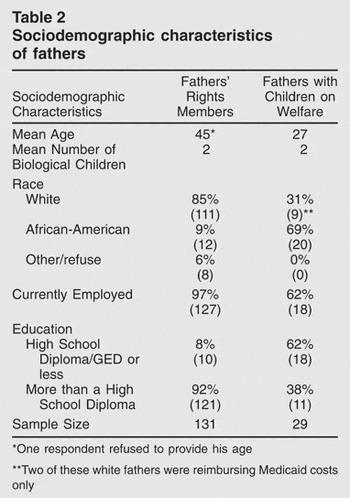
Descriptive statistics demonstrate that fathers' rights members and fathers with children on welfare have vastly different socioeconomic characteristics, as evidenced by table 2. Fathers' rights members were older, with a mean age of 45, compared to a mean age of 27 for fathers with children on welfare. Fathers' rights members were also overwhelmingly white, with 85 percent of these respondents reporting this racial preference, 9 percent reporting that they are African-American, and 6 percent reporting that they are another race. In contrast, of all of the fathers with children on welfare, 69 percent were African-American, with the remainder white. A full 97 percent of all fathers' rights members in this sample were employed, while only 62 percent of the fathers with children on welfare were employed. Not surprisingly, fathers' rights members were also more highly educated, with 92 percent reporting that they had received training beyond high school, in contrast to only 38 percent reporting the same level of educational attainment among fathers with children on welfare. The only commonality was that they shared the mean number of two biological children.
Sociodemographic characteristics of fathers

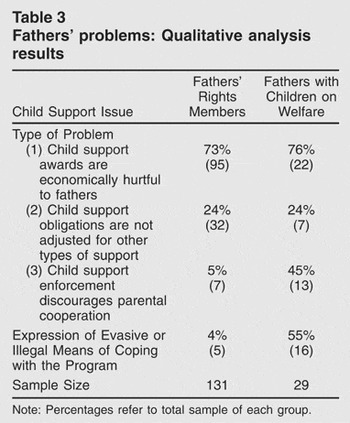
As table 3 indicates, in comparing how fathers' rights members and fathers with children on welfare talk about their disaffection with the child support system, we find that they have three primary areas of concern: child support awards are economically hurtful to fathers, child support obligations are not adjusted for other types of support, and child support enforcement discourages parental cooperation. However, while the fathers express similar areas of discontent with the child support system, fathers' rights members and fathers with children on welfare communicate their concerns in significantly different ways, which echo the influences of the social construction processes at work and ultimately support Hypotheses 1 and 2. Fathers' rights members' language demonstrates their connection to the formal system of collecting support, which makes it easier for policymakers to potentially respond to their concerns with incremental policy change. Indeed, only 4 percent of this sample expressed an intention to engage in evasive or illegal means of coping with the program. Fathers with children on welfare, on the other hand, express their concerns through language that demonstrates their perceived disconnection from child support policies, with a full 55 percent of the sample using evasive or illegal means to cope with the program's requirements. Indeed, in a variety of ways, they argue that this system has no pertinence to their lives, and often, as a result, vocalize a strong preference to completely disengage in a variety of ways from the formal system of transferring money to their children.
Fathers' problems: Qualitative analysis results

Issue 1: Child Support Awards Are Economically Hurtful to Fathers
Both fathers with children on welfare (76 percent) and fathers' rights members (73 percent) share a common belief that child support awards are economically hurtful to them, although each group talks about this issue in an extremely different way. First, fathers' rights members find the child support system to be economically hurtful; however, they still feel connected to the formal system and are able to articulate their concerns in ways that are likely to promote incremental change from policymakers. For fathers' rights group members, having enough income to make steady child support payments is not their main concern. Rather, it is the way that this income is treated that causes them the greatest consternation. For example, one father named Mark took issue with current policy because of how the states calculate award amounts. Currently, states use one of four standardized formulas in assessing child support obligations and apply them to fathers across the board.35
The first guideline is the percentage-of-income standard, which requires that fathers pay a designated percentage of their earnings to their children. The second is the income shares model, which is calculated from the addition of the both parents' earnings, after which an obligation is then pro-rated based on each individual parent's income. The third is the Melson formula, which provides a designated sum for each parent's self-support, and then calculates an obligation based on the child's needs plus a standard of living adjustment. Finally, several states use a hybrid formula, relying on the percentage-of-income standard when a father makes below a certain level of income, and the income shares model when his income exceeds a certain threshold. Deviations from these standards are possible, but not common.
I've been in the position of both paying and receiving child support. I don't believe it costs $230 or $240 a week to raise a small child … It just doesn't … And intact families don't spend that much on the child … I think there should be more flexibility. There should be more of any inquiry as to what …. an intact family is spending.
—Mark
In a similar way, another fathers' rights group member named Ross questioned why the government uses a completely different formula in awarding money to couples who are raising foster children. To him, the laws should be very similar in that the goals of both are to raise children in happy, healthy, and safe environments.
I think the most unfair thing about [child support awards] is [that they are] not based on rational economic information. You can fairly easily figure out how much it costs to raise a child…. That's not rocket science. In [my state], the [government] pays a foster parent $11.00 a day to take care of a child. I was paying my ex $30+ dollars a day for children that were only with her four days a month more than half time … That's not rational.
—Ross
For these fathers, policymakers are unaware of how much it costs to raise a child and the arbitrary award guidelines that are in place only serve to financially harm them. In articulating these concerns, however, Mark and Ross remained connected to the child support system and never suggested neglecting their obligations. Instead, their criticisms are rather narrow in scope—calling for increased flexibility or more refined methods of calculating support—and thus are much more likely to be heeded by elected officials.
Fathers' rights members also argue that the current child support system disadvantages them because there is inadequate accountability concerning how their former partners spend their child support awards. In this sense, fathers claimed that policies are financially hurtful and unjust when their payments finance “extravagant” and unnecessary activities that are completely unrelated to their children's well-being. One father named Jorge expressed his exasperation with the system's lack of accountability for how his former partner spends his child support payments:
There is no accountability involved in any of this … These monies basically disappear into a black hole and whether or not they are going for the child [or] the benefit of the children is something which isn't being supervised at all. I've heard people mention that there is the possibility that this can be done. We live in a very technological society. We've got credit cards, this, that, and the other thing. It is possible that child support could go onto some sort of a child support credit card [or] debit card and only approved types of transactions could come off of this account.
—Jorge
Notably, Jorge did not dispute his responsibility for paying child support through the formal system; he continued to pay on a regular basis. Instead, he questioned whether the formal system holds former partners accountable for how they spend that support. Jorge even took this argument a step further. He identified a precise solution to this problem, a “child support credit card [or] debit card” so that only appropriate, child-oriented transactions can be charged. In this way, fathers' rights group members communicate the legitimacy of the formal system while highlighting specific aspects of the system that they wish policymakers would consider revising.
In contrast to fathers' rights members, fathers with children on welfare find the child support system financially damaging because their current income is too low to meet their ordered payment schedules. Perhaps more importantly, these fathers face many barriers to increasing their income-earning potential over time.36
Environmental factors, such as residing within crime ridden neighborhoods plagued by robbery, drug trafficking, and murder, as well as societal racism, are several of the strong, limiting factors to upward mobility. In addition to these stressors, fathers with children on welfare often have only small reserves of educational and skill-based capital that make it difficult for them to find and retain stable employment. They are also more likely to have a history of incarceration that severely constrains their employment options and are more likely to face serious personal struggles, such as drug and substance addictions, which can impair their ability to demonstrate the type of individual responsibility that is necessary for optimal, on-the-job performance.37Achatz and MacAllum 1994.
The barriers that fathers with children on welfare face to upward mobility can cause them to become discouraged when they try to meet both their own economic needs and their child support obligations through the formal system. Fathers with children on welfare may pursue under-the-table wages, or even resort to stealing, selling drugs, or gambling in order to produce enough income to make up for what the state seizes as child support.38
Murphy 2003.
A lot of fathers are just getting fed up with the situation. They [are] like, boom, if I'm still looking after my kids and I still have to pay the government so much money a week and still support myself, you [aren't going to] do it… How can you, on a simple job out here, how can you support yourself plus pay for your kids that way, plus still have to do for your kids and maintain yourself in this kind of environment?
—Yusef
This father expressed disconnection from the formal system because it seems insensitive to his personal reality—that he is unable to earn enough money to pay for both child support and his daily living expenses. He also disengaged by stating his inclination, like most other fathers in his situation, to evade these duties: “you [aren't going to] do it [pay child support].” Another father named Kareen similarly took his sense of disconnection a step further by suggesting that criminal activity is the only way fathers can afford their child support.
Like I told you before, you know, it's hard to get jobs, you know. But these [child support hearing officers are] still [saying], you [have] children, you [have] to take care of [them], you [have] to bring in such and such much money a week. Where you [going to] get the money from if you [do not have a] job? Then you got to turn around and rob and steal and kill. You know what I'm [saying]? [You have to take] money [to the child support agency] to keep your behind on the street [and out of jail]. You know what I mean? You know what I'm [saying]? That's like squeezing blood from a turnip. You know what I mean? [It is like trying to get] water from a rock. How can you do that?
—Kareen
For fathers like Kareen, participation in the formal system through legal means is simply an impossibility.
In addition to their difficulties in securing steady employment, fathers with children on welfare often have limited knowledge of child support regulations. Many times, they are simply unaware that they can petition the state to lower their payments under conditions of unemployment, reduced income, or imprisonment. In other cases, fathers with limited means struggle with understanding the rationale of a system that imprisons them when they are unable to pay, only to further drive up their arrearages once they are in jail. One father revealed his bafflement with this aspect of the system and his subsequent decision to try to evade his responsibilities to the program by paying only when he senses that the system will catch up to him.
I've paid here and there, um, when the final ball drops, [I] pay or go to jail. I try to stretch [the timing between payments] out as long as possible. And I, I've paid about half of [what I owe for] my own sons, [where] I got pretty far behind … You can never catch up, because of the jail time I did. I was there for like four years. And it … support keeps [going] and you can't pay, you know, so. So, that's how [my child support bill] got to be so high. I think I owe like eight thousand dollars or something; I'm behind.
—Jake
Fathers living in difficult earning circumstances frequently live paycheck to paycheck. Their needs are immediate, and so are the needs of their families. A system that produces arrearages while they are in jail only because they cannot pay in the first place is, in many men's view, deserving both of disdain and ultimately even evasion.
Issue 2: Child Support Obligations Are Not Adjusted for Other Types of Support
In addition to describing child support awards as economically hurtful, both fathers' rights members (24 percent) and fathers with children on welfare (24 percent) are dissatisfied with the child support system because in their view, it fails to account for other types of assistance that men provide for their children. Yet the language that these fathers use to express their dissatisfaction is radically different, leading to highly divergent prospects for political reform.
Fathers' rights members' main concern is that the states do not adjust support awards according to the amount of time that fathers actually look after their children. Yet, instead of refusing to pay through the formal system, fathers' rights members stay engaged in the current system by calling for changes to established policies which would compensate them for their time. More specifically, fathers' rights members argue that current policy is based on the false premise that children spend little to no time with their noncustodial parents and that, when this assumption is built into the child support guidelines, these fathers face the prospect of being “double-billed” for their children's care. One father named Mel explained how the child support system originally failed to make accommodations for children spending substantial time with their noncustodial parents.
[Ideally justice would be to] divide [the support amount] by the amount of days that each parent has and each parent would get that amount of money for that amount of time. For example, I have my child five weeks during the summer. I still continue to pay child support to my ex-wife. I have 100% of the cost and I always maintain a home, [and] I still have a significant cost. There has never been any consideration given to that. So that's where I feel [the laws are] unfair in that context.
—Mel
This father expressed familiarity with his state's current policy and argued that justice was not being carried out when he had to take care of his child financially during the summer months. More significantly, he identified a way to make the system fairer by tightly linking time spent with children to support obligations.
More recently, some states have moved towards passing “shared parenting” laws, which assume that a child may spend a higher than average percentage of his/her time with the noncustodial parent (with under 20 percent, or 73 overnights, defined as traditional or uncompensated visitation). Under these laws, child support awards are adjusted using a variety of different methods, such as personal requests for guideline deviations from the courts, standard formulas that allocate financial responsibility based on the amount of actual time that the child spends with each parent (the cross-credit approach), and per diem reimbursement plans.39
Crowley 2003b.
I think I should get a proportionate deduction based on the time I have [my daughter], but there is a threshold for that, it is 40%. I have 39.17%, so I missed it by 83/100 of a percent… Why don't they say something like … the guy has 60% [of the time with the child], we find the child needs $1000 a month, okay, pops got, okay, pops should pay 60% of that, $600… Why do you have to pay 100% of the time? This is why deadbeat dads, that lousy term, is created.
—Samuel
Both Mel and Samuel were frustrated with the fact that their states' policies do not automatically adjust award amounts according to how much time each parent spends with the children. Through their comments, however, it is clear that these fathers remained engaged in the current system. They did so by arguing for a very specific solution to their problem: that the amount of support received should be directly proportional to the amount of time each parent has the child. This proposed reform is narrow in scope, and is thus amenable to legislative action if elected officials ultimately agree that it has merit.
In contrast, for fathers with children on welfare, their main concern is that the child support system does not recognize any material items that they provide for their children in addition to or in lieu of child support checks. One father named Brian described how he supported his daughter by meeting her material needs informally, only to find that the formal system would not count these contributions toward his support obligation.
It's not [like] I'm [trying] to run from it, you know; I'm here. But [the child support program is making] me run. It's like they give [you] no other opportunity but to say, okay, fine, I'm [going to] go be a criminal… They tell me, everybody's [telling] me, keep your receipts, keep your receipts… Then after I went to court, I said, for what? What am I keeping [them] for? I had everything stapled together, like I had [them] in a big box. And, um, I took the shoe box up to the [judge] and I had all the receipts in it. He said, “That's not a court ordered. I don't care anything about that.” … So I said, well. I don't know. I don't know what to do. I don't know what to do. You know, I'm [trying], but it's not [working].
—Brian
This unfair arrangement, in this respondent's words, makes him want to evade the system, or “make him run … be a criminal.” Another father named Salaam described a similar situation, whereby he had kept his receipts for items that he had bought his children, only to discover that the legal system did not care about this type of support.
At one time … I was saving all [of] my receipts when I … first got locked up for child support. You know, [the judges] don't want hear that. They want the money. They don't want to see those receipts. They don't care whether you take care of your kids or [anything]…. And when I did get the jobs (in the future), they only lasted for two weeks, [because of] the simple fact of them [going] over my application [and] finding out that I was locked up … I mean, shh, how could I keep it?
—Salaam
At another point in the interview, he remarked,
Everybody that's out there on the street doesn't really want to be out there. And everybody [who is out there isn't] bad. You know. But, just by standing out there [for a] long period of time, you get a tendency [of falling] into trouble.
This father was clearly frustrated with the formal child support system for not systematically recording his efforts to support his daughter informally. His language in this case was striking. He was completely overwhelmed by his child support obligations, yet when he received his day in court, the judge did not want to listen to how he consistently provided for his child. Eventually, this treatment led to his incarceration, which ultimately prevented him from obtaining legitimate work in the market economy. These types of barriers made “dropping out” of the system and engaging in illegal behavior seem like his only viable options.
In fact, research indicates that many fathers with children on welfare seek to establish private agreements for cash, goods, and services with their children's mother instead of providing strictly cash through the formal child support system.40
Problems arise for these fathers when the state forces them into the formal child support system. At times these fathers believe that if they document the informal contributions that they have made to their children in the past, the state will decrease the amount of formal child support payments that they must make in the future. However, courts rarely grant this type of reduction. In addition, any arrearages or retroactive support that fathers with children on welfare may face do not take into account whether or not these men supported their offspring informally in the past. Taken in their entirety, the formal system's norms, rules, and procedures only increase their feelings of disconnection from current public policy and their propensity for evasive and even illegal behavior as mechanisms of disengagement.Issue 3: Child Support Enforcement Discourages Parental Cooperation
Finally, fathers from all backgrounds claim that participation in the child support system discourages parental cooperation on issues related to their children's well-being, with 5 percent of fathers' rights members and 45 percent of fathers with children on welfare reporting this concern. First, fathers' rights members argue that the mechanics behind child support award calculations create negative parental behaviors that continue to damage their children's lives long after a family breaks down. In this view, the majority of parents recognize that whoever is successful in “getting” the children also receives the child support. Therefore lawyers, according to these fathers, actively encourage parents—especially mothers—to seek full custody.
[Current child support laws are bad because] they put the children in the middle of a war about money. I agree that children have to be supported; that is the most important thing that should be done. As a person who is going through it, I see my son not permitted around me for close to a year because [of] lawyers on the side and the [fact that the] system is set up that it becomes a money issue. If I have full custody of my son, she pays me. If she has full custody of my son, I pay her. The goal of the person, and it's been told to me by the attorney, [is to] keep the child away from the other party, you keep the child away, whoever draws first blood gets the child.
—Qasim
This father named Qasim maintained that the courts are a complicit party in tearing families apart by linking child support to custody issues. The system, in essence, encourages parents to avoid cooperating with each other and, instead, compete to “draw first blood.” But notably, this father also actively endorsed his commitment to the system overall by stating that children need to be supported and that this financial stability is the most important responsibility that parents have. His primary suggestion for reform was that access and custody issues be delinked from monetary concerns.
Beyond lawyers encouraging hostility between parents, the quest for financial support also blinds parents to their children's most fundamental needs for happiness and security. Whether this is a conscious or unconscious choice, parents end up using their children as pawns to extract more money from each other in child support. One father named Carlos explained how this dynamic plays itself out in the continuous cycle of disputes between custodial and non-custodial parents.
What bothers me is that the current child support system we have now encourages parents to fight for full custody… The calculations [are such] that they do not make any allowance for ordinary parenting time with the children, so a parent who is paying guideline child support and has his children according to the local parenting time rules [suffers]… [In] the county I'm in, [the noncustodial parent gets] every other weekend, one evening a week for 3 hours, and half of the holidays. But when you count up half the holidays and summer and everything, that's about 27% of the time. That parent is actually paying twice, even if they're not incurring any of direct expenses for clothing, and school, and so forth. They're paying twice for housing and all of that, and that, I think, you know, the unfairness bothers me.
—Carlos
As this father indicated, the rules of the game are such that parents are induced to fight each other for custody time in order to increase their child support awards. In the worst case, they can cease cooperating across all decision-making areas, regardless of the developmental, emotional, and physical costs to their children. However, note that Carlos also offered a solution when he remarked that the child support calculations “do not make any allowance for ordinary parenting time with the children.” In his view, the guidelines should do more to compensate non-custodial parents for the money that they are expending on their children. This is a narrow proposal for reform, which raises the likelihood that it will be considered by policymakers.
The program discourages parental cooperation for fathers with children on welfare in a different way. These fathers often resist enrollment in the formal child support system and encourage their ex-partners to avoid it as well. More specifically, research has found that many fathers with children on welfare believe that as long as they continue to provide in-kind contributions to their children and maintain good relationships with their children's mothers, these ex-partners will not “turn them in” to their state's child support agency.41
These mothers hold reciprocal leverage in these relationships by threatening fathers with the possibility of reporting them to the child support agency if they neglect their responsibilities.But this leverage can ultimately produce instability. Research has revealed that many low-income couples with children have tenuous relationships even when they are “together” because of their inadequate preparation for parenthood and their weak personal attachment or commitment to each other.42
Murphy 2003.
Moreover, when these already aggrieved fathers perceive that their former partners are using the law to bring further stress into their lives, they feel even less connected to the system and ultimately make sure that these women do not “get a dime.” In one case, a respondent named Jared remarked that his ex-partner had moved in with a new boyfriend, who paid for all of the expenses in their home. However, she still applied for welfare and “turned him in” to pay child support, which angered him.
[She lied and] told [the child support workers that] she was living on her own, she was paying the rent, and everything, which she wasn't. So, it was like, man, I [am not] paying for you … you know. That's to the point I was, I'm not paying for you. I'm paying, I want to pay for my son, I'd be more than happy to pay for my son. [But] I'm not paying for you. It got to the point where it was like, I'm not paying [any] more, because it's going to you and it's not [going] to my kid. You know what I'm saying?
—Jared
This respondent was clearly upset that while his ex-partner was able to meet all of her financial needs, she nonetheless identified him to the child support agency as a father who needed to support his children. His frustration with her actions made him consider not paying and contemplate evading the system entirely. Another father named Vincent explained how child support fosters a lack of cooperation between parents in the following way:
[When men are forced to pay child support], … they take off, they go on the lam. And effectively, they become fugitive[s]. And … you know, [they] escape from their identity. But they also lose any sort of contact with their children; unless their former spouses [are] kind [of] counter-cultural and [believe that they are all united together] against the government all along. [Only if they are counter-cultural will] they still let [them] see their kids … without turning [them] in [to the child support agency].
—Vincent
In this case, this father remarked that the aggressive nature of the program creates hostility and tension between parents. With the state simply ordering fathers to pay, men never become invested in the system as a whole; instead, they simply leave or “escape from their identity” by evading the authorities.
Other Influences on Policy Language?
As evidenced by their own words, fathers' rights members and fathers with children on welfare, while sharing broad categories of concern, speak about the child support system in very different ways. We argue that the social construction of fathers' rights members as contenders and fathers with children on welfare as deviants is the primary engine driving this language difference. However, there are other possible reasons for this divergence that must be considered as well. First, even though their status in terms of personally receiving public assistance is unknown, the fathers with children on welfare included in this study may have had other types of encounters with social programs in their lives, such as Food Stamps and General Assistance. Some scholars have argued that the receipt of public assistance discourages political involvement by cultivating traits of dependency on government and softening fathers' desires to make political demands.44
In other words, participation in other programs could have negative spillover effects on the ways in which these fathers interact with and speak about the child support system.However, there is some evidence that particularized interactions with specific programs can have independent effects on political participation. In his regression analysis using National Election Studies (NES) data, Joe Soss found differences in citizens' propensity to vote based on whether they were participating in the AFDC program versus the Social Security Disability Insurance [SSDI] program.45
Soss 1999.
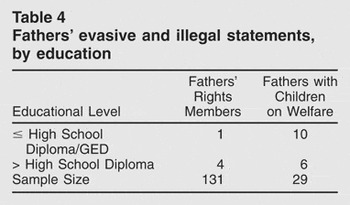
A second possible reason for the disconnection and disengagement among fathers with children on welfare as compared with fathers' rights members might be their lower socioeconomic status (SES). This explanation asserts that individuals with lower levels of resources and skills—a lower SES—will not participate as extensively in the political process as those with a higher SES.46
Verba, Schlozman, and Brady 1995.
Fathers' evasive and illegal statements, by education

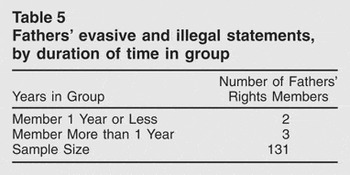
A final consideration is that fathers' rights group members have simply learned or been socialized through their affiliation with the group over time how to speak about reform without using evasive and illegal methods in order to be more politically effective.47
See Dodson 1990. Fathers with children on welfare do not physically meet on a regular basis, so the political learning hypothesis through socialization is not relevant to them.
Crowley 2006.
Fathers' evasive and illegal statements, by duration of time in group

Conclusions
Understanding how social constructions create, redefine, and reshape public policies is unquestionably a critical mission for contemporary political science and policy studies research. Scholars have begun work in this area by noting the important ways in which implemented policies can have wide-ranging, political effects. Through the process of policy feedback, current policies can alter the ways in which groups view their prospects for organizing and becoming a vibrant, energetic part of the polity.49
More specifically, policies can signal to certain group members that they are important to the political process by underwriting the institutions, outreach efforts, and administrative capacities necessary for them to reach their full potential as active citizens. Alternatively, policies can weigh citizens down by constructing uninviting, unintelligible bureaucratic systems that offer them only insufficient services of last resort.The analysis presented here has added a fundamental insight into the ways in which social constructions as conveyed through public policies can impact political participation: language. Scholars have already explored the role of political language in select contexts, including the use of language in producing power and participation differences according to gender and race in legislative and “every day” settings,50
the structuring of language to promote/thwart international cooperation,51Duffy, Frederking, and Tucker 1998.
Schlesinger and Lau 2000.
In this case, we have not discussed the merits of these groups' claims; instead, we have argued that social constructions define policies that affect targeted populations in highly differentiated ways. These distinctly tailored policies then influence the ways in which these groups talk about their problems in governmentally-sponsored programs. Groups that are favorably received learn through policies that they are positively valued citizens whose opinions matter in the public arena. When they critique governmental programs, they use language that demonstrates both that they remain inextricably connected to the policies which serve them and engaged in the process that they hope to reform. They also tend to suggest incremental changes in policy, which meshes with the historically-preferred method of response by elected officials.
Groups that are not favorably received, on the other hand, face an entirely different fate. Through their social constructions, they receive messages through policies that they are only marginal to the political process. As a result, when they are asked to describe the problems they may be experiencing in receiving governmental services, they use language that demonstrates their disconnection from the policy solutions which are targeted to them. Perhaps even more importantly, they express disengagement with the process as whole, often choosing to drop out of programs in which they might be required by law to participate. Elected officials then witness this evasive or even illegal behavior, and frequently favor imposing further sanctions upon this “anti-social” group. In contrast, then, to the more positively-constructed groups whose actions push the cycle of political participation forward, for these more negatively-constructed groups, the opportunities for political participation are only further stymied.
The findings presented here aim to open political science and policy scholarship to an entirely new and expansive breeding ground of data analysis: that involving policy language. More precisely, how citizens talk about their experiences in public programs might not only be indicative of the differential impact of social constructions, but also potentially predictive of their levels of political participation. Data for language analysis might include texts in both written and oral forms, as well as be drawn from a multitude of sources, including speeches, interviews, and focus groups, to name a few. Also, while this study focused on examining words and word meaning, the toolbox of the critical discourse approach is rich with many other ways of mapping out power within dialogue, including attention to the ways in which texts are produced and exchanged, as well as how texts contribute to, maintain, and reproduce the social order.
Given the state of American politics today, we might expect to discover consistent patterns of power and powerlessness within most texts under investigation, whatever their source. But this begs the question as to what a democratic language of program participation ultimately would look like, if it were achievable. Elaborating and extending the work of Norman Fairclough,54
Fairclough 2000.
First, democratic language would demonstrate that the speaker maintains faith in democratic institutions, such as the courts, legislative bodies, and executive agencies. In recent years, Americans have grown increasingly skeptical about the capacity of government to respond to their needs. This trend has been evidenced by declining measures of political participation such as voter turnout, party identification, and campaign activism. A renewed commitment to democratic speech regarding program participation would help stem this tide of rapidly deteriorating political alienation. This means that, as this article has laid out, we would expect to find language that reflects connectedness to public programs, regardless of their flaws, and language that expresses the speaker's desire to fix perceived problems and faulty processes by interacting with elected officials.
A second marker of democratic language would be speech that adequately conveys the speaker's personal experiences in public programs while relating those experiences to democratic principles, such as equality, fairness, and justice. These are not just abstract ideals that have no relevance to people's lives in the twentieth-first century. Rather, they are the hallmarks of a fully-developed conceptualization of true citizenship, and to the extent that they are more fully realized, more people become invested in the health and well-being of the government and its representatives overall. In the end, the ability to articulate real and specific programmatic concerns that appeal to widely-accepted democratic ideals will thus increase the likelihood that officials will understand and respond to the speaker's concerns on a consistent basis.
Finally, democratic language would facilitate the formation of political coalitions. Language would be expressed in forms that could easily transfer among groups and through all levels and branches of government. This language would construct strong prospects for citizens to compare commonalities and construct alliances among themselves. In building these coalitions, democratic language would be able to be covered by all forms of media without being dismissed as irrelevant or silenced by a dominant discourse, thus increasing the opportunity for public participation across races, classes, and other collective identities. In these ways, political talk would not just be a means of transmitting information, but a means of guaranteeing a fully democratic form of participation in the public at large.