Recently, disasters have occurred frequently because of climate change in many countries worldwide. According to the United Nations Office for Disaster Risk Reduction (UNDDR), the number of disasters in the world increased from 4212 between 1980 and 1990 to 7348 between 2000 and 2019, the number of deaths increased from 1.19 million to 1.23 million, the number of affected people increased from 3.25 billion to 4.03 billion, and total economic losses increased from 1.63 trillion to 2.97 trillion (USD).1 In terms of the absolute number of people affected, China ranked first with 1792 million, India ranked second with 1,083 million, and the Philippines ranked third with 149 million, from 2000 to 2019. For a total number of people affected in a population of 100,000, Eswatini ranked first with 11,380 people, Mauritania ranked second with 9,279 people, and Cuba ranked third with 9,051 people.1 Thus, disasters affect huge numbers of people and objects. For example, disaster damage worldwide is calculated based on income and divided into 4 groups. The rate of economic losses in the low and low-middle income groups was 1+8 = 9%, and in the upper-middle and high-income groups was 24+67 = 91%. Regarding total deaths, the low and low-middle income groups accounted for 23+44 = 67%, and the upper-middle and high-income groups accounted for 22+10 = 32%. Furthermore, the average number of deaths per disaster and the number of affected people in the low and low-middle income groups were 284+255 = 539, and in the upper-middle and high-income groups, 119+67 = 186.1 Therefore, low-income individuals were more likely to be affected.
Globally, for persons with disabilities, income, academic background, and employment are low, and the human rights situation is poor. A study on living conditions of persons with disabilities in Mozambique compared persons with and without disabilities aged 15 years or older. Among people who had never attended school, 38.0% had disabilities and 27.4% had no disabilities. Among those who left school, 55.2% had disabilities and 51.9% had no disabilities. The rate of people (aged 15 to 65) currently working or returning to work among persons with disabilities was 10.8% and that of persons without disabilities was 25.8%. Persons with disabilities accounted for 89.2% of those not currently working, while persons without disabilities accounted for 74.3%.Reference Eide and Kamaleri2 Moreover, in a British study, the risk of human rights violations was 3 times higher for persons with disabilities than persons without disabilities.Reference Khalifeh, Howard and Osborn3 According to these studies, in both developed and developing countries, persons with disabilities are not only exposed to poverty risk but also to violations of human rights.
Persons with disabilities are vulnerable to disasters. For example, in the 2011 Tohoku Earthquake off the Pacific coast, 36 of 525 deaths in Miyako City, Iwate Prefecture were of persons with disabilities, 1,028 of 9,471 deaths in Miyagi prefecture were of persons with disabilities, and 125 of 798 deaths in Miyagi prefecture, Minami Sanriku town, were of persons with disabilities.4 The rate of deaths in municipalities with 10 or more deaths among all residents was 0.78%, while it was 1.43% for persons with disabilities, based on the Japan Broadcasting Corporation data for the abovementioned disaster in Iwate, Miyagi, and Fukushima prefectures.5 Therefore, persons with disabilities experienced greater disaster damage than those without disabilities.
The Philippines ranked third in the list of the 10 most disaster-prone countries from 2005 to 2014.1 Disasters in the Philippines include storms, floods, earthquakes, volcanic activity, and fires. The Philippines has experienced 304 disasters in the past 20 years, which is the fourth highest in the world. The number of affected people per 100,000 people in the Philippines was 7,796, the seventh highest worldwide.1 Therefore, persons with disabilities in the Philippines are expected to suffer significant damage during disasters.
International communities are working together to improve this situation by establishing treaties and actions for persons with disabilities. The Convention on the Rights of Persons with Disabilities (CRPD) in 2006 employed concept of social model of disabilities.6 The social model of disabilities posits that disabilities are created by social conditions. Furthermore, regarding disaster prevention, the Sendai Framework for Disaster Risk Reduction (hereafter, Sendai Framework) in 2015 was summarized as a priority action to determine the target as a global disaster guideline by 2030.7 Sustainable Development Goals (SDGs) include tackling global issues to determine 17 goals related to human rights and living environment, and disaster risk reduction, with particular consideration to marginalized populations, including persons with disabilities.8 Regarding each treaty and action for rights of persons with disabilities, CRPD is a legally binding document stating that necessary action must be taken during disasters and other dangerous situations to ensure the safety and protection of persons with disabilities.6 The Sendai Framework states that the dissemination of detailed data and science-based latest information is necessary for disaster mitigation.7
When a disaster occurs, it is time-consuming to provide administrative services to residents and these services are limited. Persons with disabilities suffer great damage because it is more difficult for them to sense danger and escape disasters than for persons without disabilities. Therefore, the damage can be limited by preparing for disasters in advance, analyzing and assessing the disaster situation, and forming relationships that enable residents to help each other smoothly. According to a study involving Chinese students living in Japan, the greater the preparedness for disasters, the better their mental health. Therefore, people with vulnerability are at higher risk when disasters occur.Reference Hu and Umeda9
Another study on families having children with special medical needs in rural areas demonstrated that they were not well-prepared for disasters for all 4 categories, including overall, supply, discussion/practice, and emergency plan.Reference Hamann, Mello and Wu10 However, this study did not compare persons with and persons without disabilities; therefore, disaster preparedness among persons with and without disabilities is unclear. In a study on disaster preparedness of persons with disabilities in Tuvalu, it was important to understand and deal with the lack of participation in evacuation drills, participation in disaster policy decision-making, information accessibility, and disaster preparedness as factors related to disaster preparation.Reference Elisala, Turagabeci and Mohammadnezhad11 However, this was a qualitative study; quantitative perspectives are required to comprehensively examine disaster preparedness. Although a few studies have explored advanced disaster preparation and disabilities, there is scarce research comparing disaster preparedness among persons with disabilities and persons without disabilities. Therefore, it is necessary to clarify the relationship between disabilities and disaster preparedness.
This study aimed to quantitatively clarify the differences in disaster preparedness between registered persons with disabilities and persons without disabilities and clarify the differences in disaster preparedness by disability type. Furthermore, factors contributing to disaster preparedness were examined.
Methods
Participants
This study was conducted between January 2019 and January 2020 in the city of Muntinlupa, located in the southernmost part of Metro Manila, the capital region of the Philippines. As of 2015, the population of the city was 504,509.12
Health workers officially employed in Muntinlupa gathered data separately from registered persons with disabilities and persons without disabilities. They received the necessary training on ethical considerations and the process of data collection; 50 and 15 health workers were involved in data collection for registered persons with disabilities and persons without disabilities, respectively.
As of May 11, 2021, there were 11, 586 individuals registered as persons with disabilities, according to the Government of the City of Muntinlupa. We randomly approached 3,000 individuals with disabilities registered in the city statistics (25.90% out of all persons with disabilities). In Muntinlupa, there are 6 types of disabilities according to official statistics: (1) mental or psychosocial, (2) communication, (3) learning, (4) intellectual, (5) orthopedic, and (6) visual. If an individual has more than 1 type of disability, that individual is registered with the leading type of disability. The registration of persons with disabilities is based on the judgment of clinicians, such as medical doctors.
A total of 1,025 individuals with disabilities participated in this study. 50 health workers visited the participants’ homes to collect data. Considering the literacy rate in the Philippines, the questionnaire was read aloud by the health workers, and participants’ answers were recorded. Participants with hearing disabilities read the questionnaire with the support of the health workers and answered it. This study aimed to examine the participants’ current level of disaster preparedness; therefore, all participants were requested to answer the questions to the best of their knowledge. No additional information or support was provided to the participants regardless of their understanding of the questions. It approximately took 15 minutes to complete the questionnaire. No compensation was provided to participants. Data were collected between January 2019 and January 2020.
Participants without disabilities were also recruited from Muntinlupa. The city government randomly selected 800 people (0.16% of the total city population) from 8 districts based on a resident registry to participate in health promotion events. The selection criterion was age >18 years. Of 800 people, 405 participated in this study. The participants were compensated with 300 pesos for attending the health promotion events. Data were collected in December 2019. Participants completed the questionnaires themselves, even if they had difficulties. It took approximately 10 minutes to complete the questionnaire.
Instruments
This study employed a cross-sectional design. A structured questionnaire was distributed to gather data on sociodemographic characteristics, disaster preparedness, and mental health status.
Sociodemographic characteristics included gender, age, religion, job status, family income, and years of education. Regarding gender, participants were asked about their gender identity, and gender diversity was set as an option. Additionally, the Washington Group Short Set on Functioning (WG-SS) was used to assess the participants’ visual, hearing, mobility, cognitive, and self-care disabilities.13 The WG-SS was developed to identify persons with disabilities based on functional limitations. Self-care disabilities are assessed with a question about difficulties in conducting self-care, such as washing one’s entire body or dressing.
The types of registered disabilities for persons with disabilities were confirmed by registration in a city government document.
The Disaster Preparedness for Resilience Checklist (DPRC) was used to examine preparedness for resilience in emergency settings. The DPRC (Cronbach’s α = 0.83) was developed based on the Inter-Agency Standing Committee’s guidelines for mental health and psychosocial support in emergency settings.14 The DPRC comprises 23 items, with a 0-3 response set. Higher scores indicate higher preparedness for resilience.
To examine mental health status, the Kessler 6-item Psychological Distress Scale (K6) (Area Under the Curve Index = 0.94) was employed.Reference Kessler, Andrews and Colpe15, Reference Sunagozaka, Izutsu, Tanaka, Echavez, Benavidez and Tsutsumi16 The K6 is a standardized scale comprising six items with a 0-4 response set. It is used in different settings worldwide to examine the degree of several mental health problems, including psychological stress. Higher scores indicate worse mental health status.
Ethical Considerations
All participants voluntarily participated in the study. In the recruitment procedure, the voluntariness of participation, objective and methods of the study, and the right to withdraw at any time were explained to the participants verbally and in writing. Written informed consent was obtained from all participants, except those who were not literate; they provided verbal consent.
This study was approved by the Ethics Committee of Kanazawa University (approval number: KINDAIKOKUKI-001GO). The Muntinlupa City Health Office approved the study protocol.
Data Analysis
Sociodemographic data were compared between registered persons with disabilities and persons without disabilities using the chi-square test for gender, religion, and job status, and the unpaired t-test for family income, number of family members, and years of education. The DPRC scores were compared between the two groups and gender in two groups using an unpaired t-test respectively. Furthermore, an unpaired t-test was conducted to compare the scores of individuals with mental or psychosocial disabilities and those with other types of disabilities. Multiple regression analyses were conducted to examine factors associated with the DPRC scores. Registration of persons with disabilities by city, age, gender, K6 score, years of education, and visual, hearing, mobility, cognitive, self-care, and communication disabilities assessed by the WG-SS were set as independent variables. IBM SPSS Statistics (version 27) was used for the analyses, and statistical significance was set at p < 0.05.
Results
Table 1 shows the participants’ sociodemographic characteristics. In total, 31 (1,024 registered persons with disabilities and 407 persons without disabilities) individuals participated in the study. Between registered persons with disabilities and persons without disabilities, religion, disability status assessed by the WG-SS, number of family members, age, years of education, and K6 scores were significantly different (p < 0.01). No significant differences were observed for job status and gender. The mean age of persons with disabilities was 39.70 (SD = 13.96) years, higher than that of persons without disabilities (35.68 [SD = 12.6]). Regarding religion, 840 (82.00%) registered persons with disabilities were Roman Catholics, 18 (1.80%) were Protestants, 155 (15.10%) believed in Iglesia ni Cristo, and 11 (1.10%) followed other Christianity. Whereas 401 (99.00%) persons without disabilities were Roman Catholics (99%), 1 (0.2%) was Protestant, and 3 (0.7%) believed in Iglesia ni Cristo. The number of persons with disabilities was significantly higher in the disabilities assessment by the WG-SS; however, the rate of disabilities assessed by the WG-SS among persons without disabilities was high. Among persons without disabilities, 22 (5.40%), 6 (1.50%), 17 (4.20%), 8 (2.00%), 8 (2.00%), and 14 (3.50%) people had visual, hearing, mobility, self-care, communication, and cognitive disabilities, respectively.
Sociodemographic data

a = Mean, SD or t, b = Frequency, % or χ **p < 0.01
The mean years of education for persons with disabilities was 9.85 (SD = 4.08) and it was 11.02 (SD = 2.32) for persons without disabilities.
On the K6, persons with disabilities scored 6.24 (SD = 6.78) and persons without disabilities scored 4.53 (SD = 4.74).
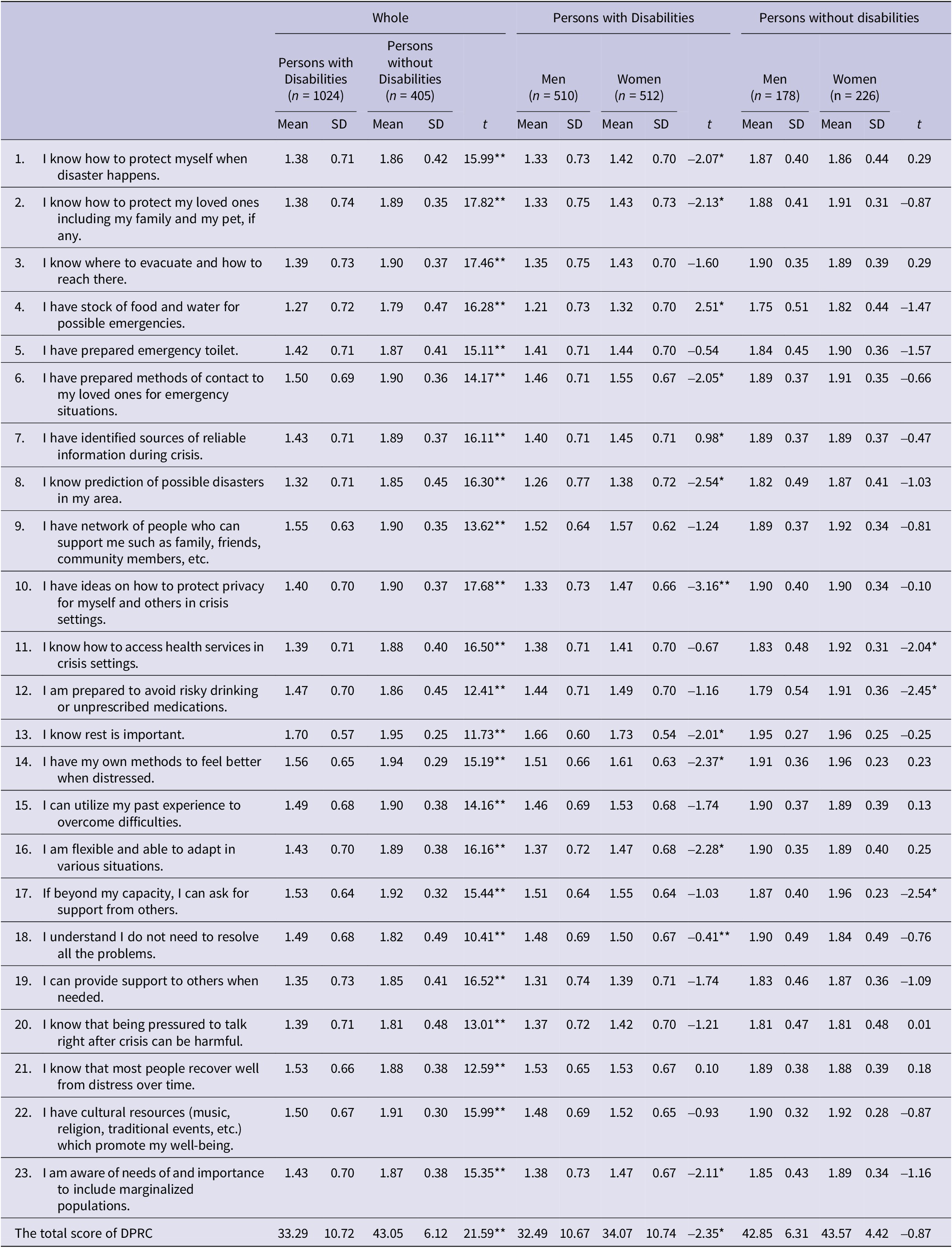
Table 2 shows the comparison between DPRC scores of registered persons with disabilities and persons without disabilities, as well as men and women among persons with disabilities and those without disabilities. Among persons with and without disabilities, significant differences were found for each of the 23 items and the total score (p < 0.01). Persons with disabilities had a significantly lower total DPRC score (mean: 33.29, SD: 10.72) than persons without disabilities (mean: 43.05, SD: 6.12). Moreover, among registered persons with disabilities, women had a significantly higher score (mean: 34.07, SD: 10.74) than men (mean: 32.49, SD: 10.67) (p < 0.05). Whereas among persons without disabilities, there was no significant difference in total score by gender, but a significant difference was observed in questions 11, 12, and 17 (p < 0.05).
DPRC scores of all participants and comparison of them based on gender

Unpaired t test *p < 0.05, **p < 0.01.
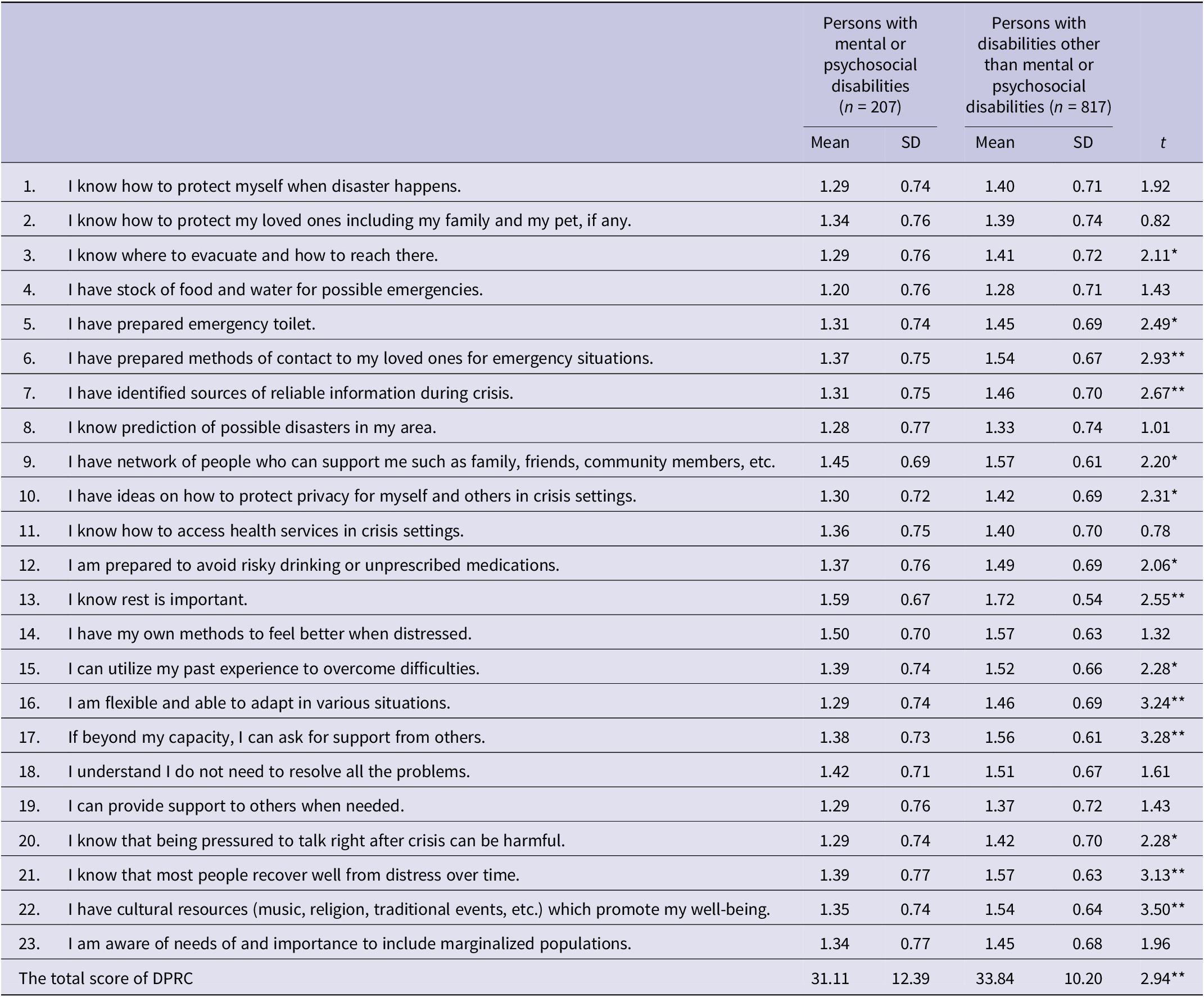
Table 3 shows the comparison of DPRC scores divided into two groups: registered persons with mental or psychosocial disabilities and registered persons with disabilities other than mental or psychosocial disabilities. Significant differences were found between the two groups for questions 3, 5, 9, 10, 12, 15, and 20 (p < 0.05) and questions 6, 7, 13, 16, 17, 21, and 22 (p < 0.01).
DPRC scores of persons with mental or psychosocial disabilities and persons with disabilities other than mental or psychosocial disabilities

Unpaired t test *p < 0.05, **p < 0.01.
The mean total DPRC score for persons with mental or psychosocial disabilities was 31.11 (SD = 12.39) and that for persons with other disabilities was 33.84 (SD = 10.20), showing a significant difference (p < 0.01).
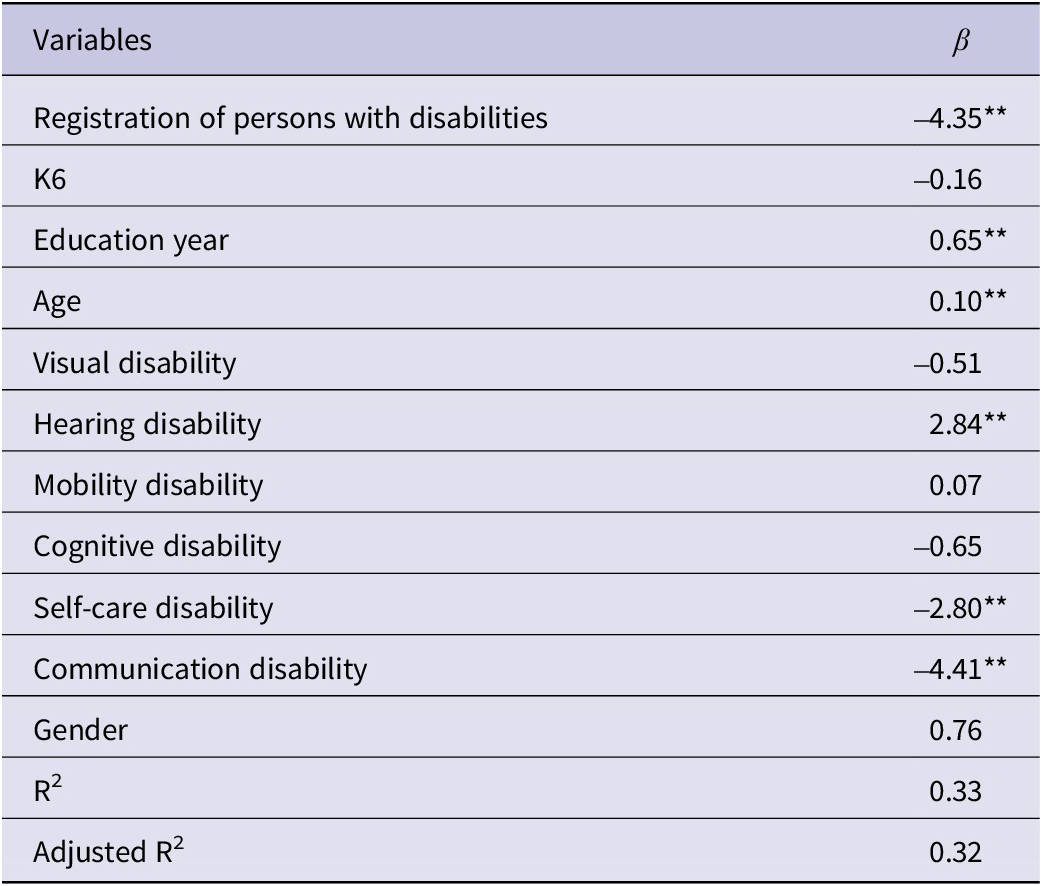
Table 4 presents the multiple regression analysis of the DPRC scores. Significant differences were found between registration status of disabilities by city, age, and self-care, communication, and hearing disabilities assessed by the WG-SS (p < 0.01). Being a registered person with disabilities, younger age, and having self-care and communication disabilities were significantly associated with lower scores on the DPRC while having hearing disabilities was significantly associated with higher scores on the DPRC. There were no significant differences in gender, K6 scores, and visual, mobility, and cognitive disabilities.
Multiple regression analysis of DPRC scores

Standard multiple regression analysis. **p < 0.01.
Registration of persons with disabilities by city (0 = persons without disabilities, 1 = persons with disabilities). Visual, Hearing, Mobility, Cognitive, Self-care and Communication disability (0 = without disability, 1 = with disability), Gender (1 = male, 2 = female, 3 = gender diverse).
Discussion
This study compared disaster preparedness in persons with and without disabilities. The findings indicate that persons with disabilities are less prepared for disasters than persons without disabilities. Sociodemographic characteristics, years of education, and the K6 score differed between persons with and without disabilities (Table 1). Furthermore, religion, age, and number of family members were significantly different between the groups. Mental health of persons with disabilities was lower compared with persons without disabilities. This vulnerability could be a negative effect of the disaster; disaster prevention for persons with disabilities is important.Reference Wolf-Fordham, Morrow-Gorton, Morrow-Gorton, Wolf-Fordham and Snyder17
The DPRC scores for all items for the comparison between all participants and by gender were significantly lower for persons with disabilities compared with those without disabilities (Table 2). The total score was also significantly different. The UNDRR emphasizes the importance of gender-responsive disaster risk reduction, including increasing the gender-specific and disaggregated data.18 This study found that, among registered persons with disabilities, women had higher scores on the DPRC, while no significant difference was observed among persons without disabilities. These results indicate that among persons with disabilities, women had significantly higher disaster preparedness and resilience.
There are several reasons for this finding. First, persons with disabilities find it difficult to access information, as shown by questions 6, 7, 9, and 11 in Table 2. Therefore, they do not know how to act in emergencies. Disaster preparedness is gaining more attention in the world. However, the idea of disaster preparation for persons with disabilities may not be widespread; therefore, information on this topic is lacking. For instance, in a study on the accessibility in CRPD, 50% of countries did not have laws and regulations regarding the definition of accessibility.Reference Gould, Leblois and Bianchi19 In a study on disaster vulnerability, it was recommended that persons with disabilities be involved in every step related to the disaster.Reference Smith, Jolley and Schmidt20 This may be why they find it difficult to get information regarding disaster preparation.
Second, there is insufficient planning and support for persons with disabilities in the event of a disaster. There were significant differences in questions 1, 3, 9, and 11 in Table 2, indicating that they do not receive adequate support for disaster preparation. There have been attempts to address disaster risks in Muntinlupa. Local weather monitoring and flood warning systems use machines to measure the parameters of precipitation, wind speed, air pressure, humidity, temperature, and flooding conditions and constantly observe these situations.21 Early warning systems use sirens to prompt evacuation of citizens when emergency situations occur, such as fires, earthquakes, typhoons, and volcanic ash descent.22 While these are appropriate for other citizens, they may not be adequate for persons with disabilities. Moreover, hospitals and other facilities are not numerous in rural areas; therefore, support is not widely available in times of emergency. There have been a few nationwide attempts and organizations to support persons with disabilities to prepare for disasters. However, attempts by the local government are limited. In addition, several laws have been established for persons with disabilities. For instance, an Act approved in the House of Representatives in the Philippines recognized the importance of developing the capacity of marginalized groups, including persons with disabilities, to respond to and recover from the effects of a disaster.23
Third, persons with disabilities lack the financial margin to stock food and water because they have an insufficient income, as indicated by item 4 in Table 2. The mean of that item was the lowest among all items in the DPRC. Food items need to be purchased and stocked depending on the expiration date. Persons with disabilities have a low income, making it difficult to buy food and water during emergencies. Stockpiling and emergency items, such as emergency toiletries, may be expensive and not available in supermarkets.
Differences in disaster preparedness and resilience by gender were observed among persons with disabilities. This study examined not only preparedness but also resilience toward disaster. A previous study involving persons with mental health conditions or psychosocial disabilities in the Philippines indicated that women had worse human rights and well-being than men.Reference Hashimoto, Izutsu and Sunagozaka24 Women may have more awareness and ability to deal with various situations, including crises, both physically and psychologically. Gender differences in disaster preparedness among persons with disabilities are widely discussed. For instance, a study on preparedness and response behavior toward flood risk in Serbia revealed that women had more understanding of the health consequences of floods while men had higher self-confidence regarding preparation for floods.Reference Cvetković, Roder and Öcal25 Another study examining emergency response and crisis management among Chinese university students found no significant differences by gender for most of the indicators.Reference Yu, Amin and Olga26 In the event of a disaster, in addition to the protection of lives, psychological awareness and post-disaster care are important.
In Table 3, the total DPRC score of registered individuals with mental or psychosocial disabilities was significantly different from persons with other disabilities. Moreover, there were significant differences in several items of the DPRC between persons with mental or psychosocial disabilities and persons with disabilities other than mental or psychosocial disabilities. This shows that persons with mental or psychosocial disabilities do not have sufficient knowledge regarding disaster preparation; therefore, when a disaster occurs, they do not know how to act. The fact that community networks are not well-established in daily life is related to the lack of disaster preparedness. Persons with mental or psychosocial disabilities cannot perceive information as reliable, as indicated by question 7; thus, they may not know what they need to prepare for a disaster. A study on risk perception found that participation to participatory exercise was effective in raising awareness of disasters and encouraging citizens to take more personal responsibility.Reference Wachinger, Renn and Begg27 Furthermore, persons with disabilities may not be ready for life after a disaster. For instance, in this study, participants were not ready to contact family and friends, obtain information, or protect privacy, as observed in the significant differences in questions 6, 7, and 10. In a study on education and experience in the Philippines and Thailand, people who experienced disasters in the past three years were 2.8 and 2.7 times more likely, respectively, to prepare for disasters.Reference Hoffmann and Muttarak28 Thus, it is important to pay attention to life after a disaster for persons with mental or psychosocial disabilities in disaster preparation.
Furthermore, disaster preparedness and resilience are not necessarily difficult to understand regardless of disabilities if reasonable accommodation or effort to reduce social barriers is made; for instance, facilitating communication support for persons with mental or psychosocial disabilities to deal with various situations.Reference McDowell and Fossey29 It is also indicated that social and organizational environments are important for universal design for persons with disabilities in addition to action to eliminate physical barrier.Reference Nielsen30 Efforts by the government and support from people close to them may be effective in improving disaster preparedness and resilience.
In the multiple regression analysis, there were significant differences in age and hearing, self-care, and communication disabilities between persons with and without disabilities. Regarding age, young people may lack previous experience of a disaster, and this may result in a lower score on the DPRC. Therefore, further specialized studies are necessary. This study focuses not on the actual manner of evacuation during a disaster but on disaster preparedness, including the appropriate evacuation process, based on daily community-building. Thus, having communication and self-care disabilities may have influenced a lower score on the DPRC. Studies on the perception of risk of disasters indicate that communication plays a significant role in understanding natural hazards.Reference Wachinger, Renn and Bianchizza31
The Sendai Framework adopted an “all of society” approach. This approach incorporates the concept of inclusion and universal design, where persons with disabilities are important stakeholders in policy-making on disaster risk reduction and preparedness and are important for inclusion and universal designs.7 Individual differences can be utilized for everyone regardless of registration of disabilities; as this study indicated, numerous persons without disabilities also have various needs, as revealed by the WG-SS assessment.
This study has several limitations. First, data collection was conducted in Muntinlupa City; therefore, it may have limited applicability to the entire Philippines. In addition, because of the registration system for persons with disabilities in the city of Muntinlupa, they are not necessarily registered as having all types of disabilities if they have multiple disabilities based on clinical judgment. This study included questions regarding knowledge of disaster preparedness. Functional disabilities may affect the result, depending on the type of disability. Additionally, this was a comparative study using a cross-sectional design. Further longitudinal studies examining the effect of disabilities on disaster preparedness and recovery after a disaster are needed.
Conclusions
This study clarified that persons with disabilities are less prepared for disasters than persons without disabilities. Furthermore, persons with mental or psychosocial disabilities are often unprepared. Therefore, it is necessary to focus more on individuals with mental and psychosocial disabilities. Planning, support, and suggestions regarding disaster preparedness should be conducted in view of the present situation for persons with disabilities, especially for those with mental or psychosocial disabilities.
Acknowledgments
This work was supported by the Japan Agency for Medical Research and Development (AMED) [Grant Number: JP18jk0110015]; the Japan Society for the Promotion of Science (JSPS) [KAKENHI Grant Numbers: 19K02235, 22K02060, 22H00925, and 25K00718]; and the Japan Science and Technology Agency (JST) SPRING [Grant Number: JPMJSP2135]. The funders had no role in study design, data collection and analysis, decision to publish, or preparation of the manuscript.
Author contribution
Conceptualization, A.T., T.I. and S.S.; methodology, T.I., A.T. and S.S.; software, S.S., T.I. and A.T.; validation, S.S., A.T. and T.I.; formal analysis, S.S. and A.T; investigation, S.S. and A.T.; resources, T.I., A.T. and S.S.; data curation, S.S. and A.T.; writing—original draft preparation, M.M.; writing—review and editing, S.S. and A.T.; visualization, M.M. and S.S.; supervision, A.T., T.I. and S.S.; project administration, A.T. and T.I.; funding acquisition, A.T., and T.I.
Competing interests
The authors declare none.