1. Introduction
Most recent investigations on the Precambrian basement of the North China Craton (NCC) have identified three Palaeoproterozoic mobile belts, namely the Trans-North China Orogen (TNCO), the Khondalite Belt and the Jiao-Liao-Ji Belt (JLJB) (e.g. Zhao et al. Reference Zhao, Wilde, Cawood and Sun2001, Reference Zhao, Sun, Wilde and Li2005, Reference Zhao, Cawood, Wilde, Sun, Zhang, He and Yin2012; Zhao & Cawood, Reference Zhao and Cawood2012; Fig. 1a). The TNCO subdivides the NCC into the Western and Eastern blocks, whereas the Khondalite Belt separates the Western Block into the Yinshan and Ordos blocks, and the JLJB separates the Eastern Block into the Longgang and Langrim blocks (Zhao et al. Reference Zhao, Wilde, Cawood and Sun2001, Reference Zhao, Sun, Wilde and Li2005; Zhao & Cawood, Reference Zhao and Cawood2012). Most of the basement rocks within the Western and Eastern blocks are characterized by the widespread ~2.5 Ga tectonothermal event with anticlockwise P–T paths (Zhao et al. Reference Zhao, Wilde, Cawood and Lu1998; Geng, Liu & Yang, Reference Geng, Liu and Yang2006; Wu et al. Reference Wu, Zhao, Sun, Yin, Li and Tam2012, Reference Wu, Zhao, Sun, Li, He and Bao2013), whereas the basement rocks within the three mobile belts are characterized by the 1.9–1.8 Ga tectonothermal events with clockwise P–T paths (Zhao et al. Reference Zhao, Sun, Wilde and Li2005; Yin et al. Reference Yin, Zhao, Sun, Xia, Wei, Zhou and Leung2009, Reference Yin, Zhao, Guo, Sun, Xia, Zhou and Liu2011; Tam et al. Reference Tam, Zhao, Liu, Zhou, Sun and Li2011, Reference Tam, Zhao, Sun, Li, Iizuka, Ma, Yin, He and Wu2012a ,Reference Tam, Zhao, Sun, Li, Wu and Yin b ,Reference Tam, Zhao, Zhou, Sun, Guo, Li, Yin, Wu and He c ; Zhang et al. Reference Zhang, Zhao, Li, Sun and Liu2012). Particularly, the basement rocks exposed in the Eastern Shandong Province in the Eastern Block have records of both ~2.5 Ga and 1.9–1.8 Ga tectonothermal events, making this area critical to understanding the relationship between these two events and the Precambrian evolution of the NCC. However, most of the previous studies were focused on the Palaeoproterozoic JLJB with high-pressure (HP) granulite facies metamorphism in the Eastern Shandong Province (Zhou et al. Reference Zhou, Wilde, Zhao, Zheng, Jin, Zhang and Cheng2008a ,Reference Zhou, Zhao, Wei, Geng and Sun b ; Tam et al. Reference Tam, Zhao, Liu, Zhou, Sun and Li2011, Reference Tam, Zhao, Sun, Li, Wu and Yin2012b ,Reference Tam, Zhao, Zhou, Sun, Guo, Li, Yin, Wu and He c ), but less work has been done on the Archaean Jiaodong Terrane that was located within the JLJB. Several models about the Jiaodong Terrane have been proposed, with some suggesting that the Jiaodong Terrane was part of the Archaean Eastern Block in the NCC (Tang et al. Reference Tang, Zheng, Wu, Gong and Liu2007; Jahn et al. Reference Jahn, Liu, Wan, Song and Wu2008; Zhou et al. Reference Zhou, Wilde, Zhao, Zheng, Jin, Zhang and Cheng2008a ), while others argued that the Jiaodong Terrane has affinities to the South China Craton (SCC) (Faure, Lin & Le Breton, Reference Faure, Lin and Le Breton2001; Faure et al. Reference Faure, Lin, Monié, Breton, Poussineau, Panis and Deloule2003; Wu, Zheng & Zhou, Reference Wu, Zheng and Zhou2004). Moreover, some scholars speculate that the Jiaodong Terrane was an exotic terrane that was accreted to the NCC in the Mesozoic (Cai, Reference Cai1989; Shang, Reference Shang1989; Li et al. Reference Li, Yang, Geng and Cao2013). In this paper, we carried out laser ablation inductively coupled plasma mass spectrometry (LA-ICP-MS) U–Pb zircon dating on the major lithologies of the Jiaodong Terrane, and the results will provide important insights into understanding the affinity of the Jiaodong Terrane and the relationship between the Jiaodong Terrane and the Palaeoproterozoic JLJB.
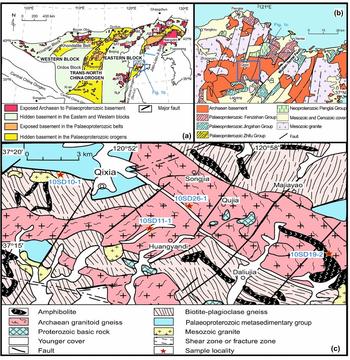
(a) Tectonic subdivision of the North China Craton (revised after Zhao et al. Reference Zhao, Sun, Wilde and Li2005). (b) Geological sketch map of the Eastern Shandong Complex (revised after Tam et al. Reference Tam, Zhao, Liu, Zhou, Sun and Li2011). (c) Geological sketch map of the Jiaodong Terrane (revised after Jahn et al. Reference Jahn, Liu, Wan, Song and Wu2008). Abbreviations: AB – Anshan-Benxi; EH – Eastern Hebei; ES – Eastern Shandong; MY – Miyun; NL – Northern Liaoning; SL – Southern Liaoning; SJ – Southern Jilin; WL – Western Liaoning; WS – Western Shandong; TLF – Tancheng–Lujiang Fault.

2. Regional geology
The Precambrian basement rocks of the Eastern Block are composed mainly of trondhjemitic–tonalitic–granodioritic (TTG) gneisses, granites and minor supracrustal rafts, exposed in the Southern Jilin, Northern Liaoning, Anshan–Benxi, Western Liaoning, Eastern Hebei, Miyun, Southern Liaoning, Eastern Shandong and Western Shandong domains (Fig. 1a; Zhao et al. Reference Zhao, Sun, Wilde and Li2005). Previous geochronological studies show that most basement rocks were formed in the period of 2.55–2.50 Ga (Zhao et al. Reference Zhao, Wilde, Cawood and Lu1998; Geng, Liu & Yang, Reference Geng, Liu and Yang2006; Yang et al. Reference Yang, Wu, Wilde and Zhao2008; Wang et al. Reference Wang, Liu, Santosh, Bai, Li, Yang and Guo2013a ; Peng et al. Reference Peng, Wilde, Fan and Peng2013; Wu et al. Reference Wu, Zhao, Sun, Li, He and Bao2013), with minor Early Neoarchaean rocks of ~2.7 Ga age reported from the Western and Eastern Shandong domains (Tang et al. Reference Tang, Zheng, Wu, Gong and Liu2007; Jahn et al. Reference Jahn, Liu, Wan, Song and Wu2008; Wan et al. Reference Wan, Liu, Wang, Yang, Wang, Dong, Zhou, Du, Yang and Diwu2011; Wang et al. Reference Wang, Liu, Santosh, Bai, Li, Yang and Guo2013 b). All the Archaean basement rocks experienced the strong regional metamorphism at ~2.5 Ga, characterized by anticlockwise P–T paths (Geng, Liu & Yang, Reference Geng, Liu and Yang2006; Yang et al. Reference Yang, Wu, Wilde and Zhao2008; Wu et al. Reference Wu, Zhao, Sun, Yin, Li and Tam2012, Reference Wu, Zhao, Sun, Li, He and Bao2013).
The Precambrian basement exposed in the northeastern part of the Shandong Province is traditionally named the Eastern Shandong Complex, separated from the Western Shandong Complex by the famous Tancheng–Lujiang Fault zone (TLF) (Fig. 1a). It is composed of the Archaean Jiaodong Terrane, the uncomformably overlying Palaeoproterozoic Jingshan, Fenzishan and Zhifu groups and the Neoproterozoic Penglai Group (Fig. 1c). The Archaean Jiaodong Terrane is composed predominately of granitoid gneisses with minor supracrustal rocks, metamorphosed to amphibolite facies and locally granulite facies (Wan et al. Reference Wan, Song, Liu, Wilde, Wu, Shi, Yin and Zhou2006; Tang et al. Reference Tang, Zheng, Wu, Gong and Liu2007; Fig. 1c). The granitoid gneisses mainly include TTG gneisses and minor granitic rocks, while the supracrustal rocks, traditionally named the ‘Jiaodong Group’, consist of amphibolites and biotite-plagioclase gneisses, occurring as enclaves or tectonic lenses enclosed in the granitoid gneisses (Fig. 1c). The overlying Jingshan and Fenzishan groups were metamorphosed from amphibolite facies to granulite facies (Zhai & Liu, Reference Zhai and Liu2003; Zhai, Guo & Liu, Reference Zhai, Guo and Liu2005; Zhao et al. Reference Zhao, Sun, Wilde and Li2005; Wan et al. Reference Wan, Song, Liu, Wilde, Wu, Shi, Yin and Zhou2006; Tang et al. Reference Tang, Zheng, Wu, Gong and Liu2007), while the Zhifu and Penglai groups were metamorphosed from upper greenschist facies to amphibolite facies (SBGMR, 1991; Faure, Lin & Le Breton, Reference Faure, Lin and Le Breton2001; Faure et al. Reference Faure, Lin, Monié, Breton, Poussineau, Panis and Deloule2003).
Available geochronological data show that the protoliths of the granitoid gneisses and supracrustal rocks from the Jiaodong Terrane were formed in the period of 2.9–2.5 Ga (Tang et al. Reference Tang, Zheng, Wu, Gong and Liu2007; Jahn et al. Reference Jahn, Liu, Wan, Song and Wu2008; Zhou et al. Reference Zhou, Wilde, Zhao, Zheng, Jin, Zhang and Cheng2008a ; Liu et al. Reference Liu, Liu, Ding, Liu, Yang, Liu, Wang and Meng2013a ). Available zircon ages obtained for the Fenzishan and Jingshan groups suggest that the two groups were formed coevally at 2.2–1.9 Ga and experienced metamorphism around 1.9–1.8 Ga (Wan et al. Reference Wan, Song, Liu, Wilde, Wu, Shi, Yin and Zhou2006; Zhou et al. Reference Zhou, Wilde, Zhao, Zheng, Jin, Zhang and Cheng2008 b; Tam et al. Reference Tam, Zhao, Liu, Zhou, Sun and Li2011; Zhao et al. Reference Zhao, Cawood, Wilde, Sun, Zhang, He and Yin2012). The dating results of detrital zircons from the Penglai and Zhifu groups indicate two major age populations of 2.45–2.1 Ga and 2.0–1.7 Ga (Zhou et al. Reference Zhou, Wilde, Zhao, Zheng, Jin, Zhang and Cheng2008a ; Liu et al. Reference Liu, Liu, Ding, Liu, Yang, Liu, Wang and Meng2013 b), suggesting that their sources were most likely from the Palaeoproterozoic Jingshan and Fenzishan groups.
3. Sample selection and methodology
Four representative samples of different lithologies from the Jiaodong Terrane were selected for zircon U–Pb dating, including amphibolite (10SD19-2) and biotite-plagioclase gneiss (10SD10-1) from the supracrustal rocks, tonalitic gneiss (10SD11-1) and granodioritic gneiss (10SD26-1).
Zircons were extracted from samples through standard heavy liquid and magnetic separation techniques, and then hand-picked and mounted into epoxy resin and polished to half of their thickness. Cathodoluminescence (CL) imaging and zircon dating were both carried out at the State Key Laboratory of Continental Dynamics, Northwest University (Xi'an), China. Zircon U–Th–Pb isotopes were analysed by a LA-ICP-MS method, of which the laser-ablation system includes an Agilent 7500a ICP-MS instrument equipped with a 193 nm ArF excimer laser. A laser beam of 32 μm in diameter and repetition rate of 7 Hz was adopted during the whole analyses, and the more detailed analytical procedures were similar to those described by Wu et al. (Reference Wu, Zhao, Sun, Li, He and Bao2013). The U–Th–Pb isotopic ratios were calculated using the GLITTER 4.0 program (Macquarie University, Sydney, Australia), and then corrected by using the standard zircon 91500 as an external standard. Concordia plots and weighted mean U–Pb age calculations were made using the ISOPLOT 3 program with a 1σ error and 95% confidence level (Ludwig, Reference Ludwig2003). All zircon U–Th–Pb data are presented in online Supplementary Table S1 available at http://journals.cambridge.org/geo.
4. Results
4.a. Amphibolite
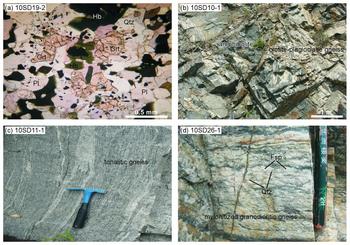
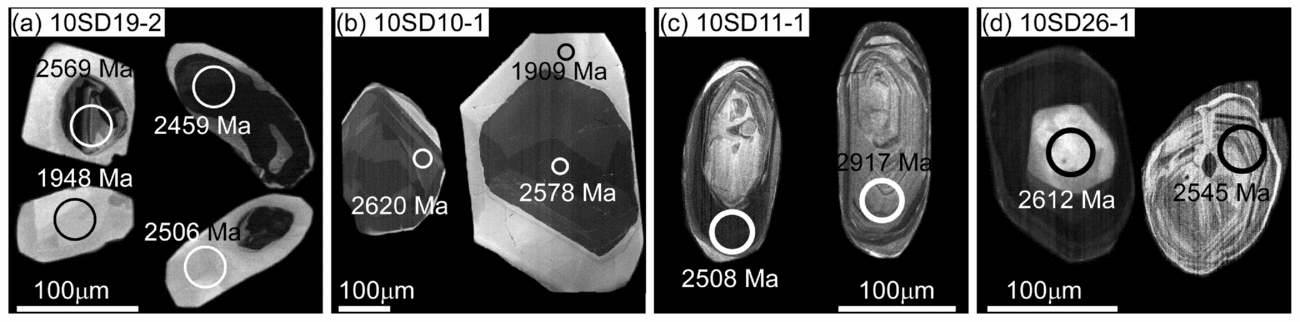
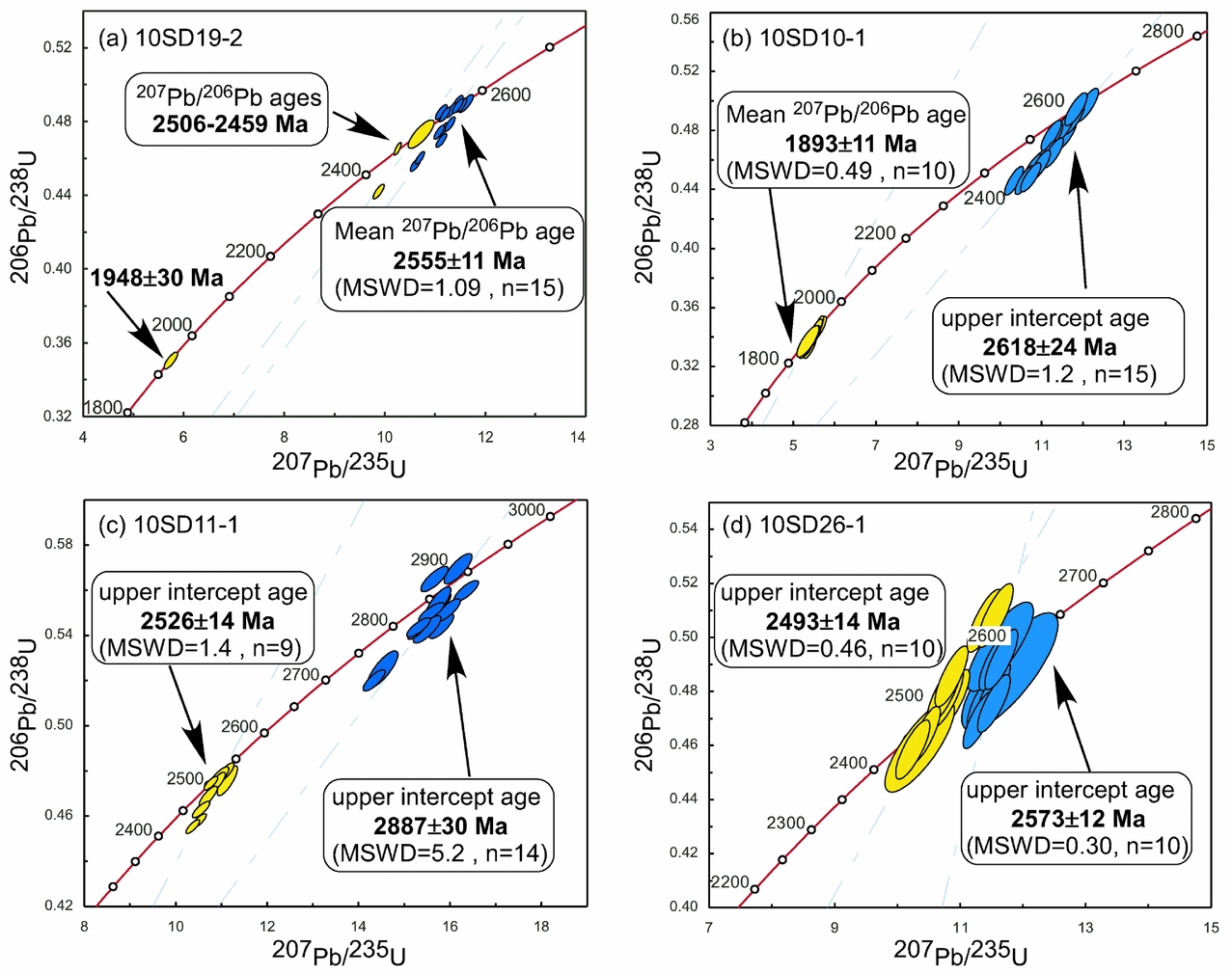
10SD19-2 is a coarse-grained garnet-bearing amphibolite sample collected at a locality 18 km southeast of Qixia City (Fig. 1c), with a mineral assemblage of garnet (~10%) + hornblende (~35%) + plagioclase (~40%) + quartz (~10%) + opaque minerals (~5%) (Fig. 2a). Zircons grains from this sample are subhedral to euhedral stubby and prismatic in shape with their lengths ranging from 30 to 200 μm. The CL imaging shows that most zircon grains have inherited magmatic oscillatory-zoned cores surrounded or truncated by narrow high-luminescent metamorphic overgrowth rims, and some grains have metamorphic structureless cores (Fig. 3a). Nineteen analyses were carried out on magmatic and metamorphic zircons from this sample and the results were plotted in Figure 4a. Of 15 analyses on magmatic zircons, 9 concordant analyses yield a weighted mean average 207Pb–206Pb age of 2555 ± 11 Ma (MSWD = 1.09), interpreted as the age of the magmatic provenance of the amphibolites. Two analyses on metamorphic overgrowth rims and one analysis on a dark structureless core give apparent 207Pb–206Pb ages of 2506–2459 Ma, approximating the timing of metamorphism. In addition, one analysis on a high-luminescent structureless core gives a 207Pb–206Pb age of 1948 ± 30 Ma, which is interpreted as the timing of a second metamorphic event.
Field photographs or microphotographs of (a) amphibolite (10SD19-2), (b) biotite-plagioclase gneiss (10SD10-1), (c) tonalitic gneiss (10SD11-1) and (d) granodioritic gneiss (10SD26-1), collected from the Jiaodong Terrane. The length of the hammer is 30 cm and the width of the pencil is 6 mm. Abbreviations: Grt – garnet; Pl – plagioclase; Hb – hornblende; Qtz – quartz; Fsp – feldspar.

Cathodoluminescence images (CL) of representative zircons from (a) amphibolite (10SD19-2), (b) biotite-plagioclase gneiss (10SD10-1), (c) tonalitic gneiss (10SD11-1) and (d) granodioritic gneiss (10SD26-1), collected from the Jiaodong Terrane. The open circles represent the U–Pb analytical positions and each circle is 32 μm in diameter.

Concordia diagrams of zircon U–Pb data from (a) amphibolite (10SD19-2), (b) biotite-plagioclase gneiss (10SD10-1), (c) tonalitic gneiss (10SD11-1) and (d) granodioritic gneiss (10SD26-1), collected from the Jiaodong Terrane. The blue circles represent magmatic zircon domains. The yellow circles represent metamorphic zircon domains. Analytical errors are depicted at the 1 sigma level.

4.b. Biotite-plagioclase gneiss
10SD10-1 is a biotite-plagioclase gneiss sample collected on an outcrop 3 km northeast of Qixia City (Fig. 1c). The sample shows a moderate gneissic structure, and consists of quartz (~30%), plagioclase (~50%) and biotite (~10%), with minor hornblende and K-feldspar (Fig. 2b). Zircon grains in this sample are mainly subhedral stubby or rounded grains with sizes ranging from 150 to 400 μm, and are characterized by clear core–rim textures (Fig. 3b). Most of the cores show blurred sector zoning, probably suggesting recrystallization (Fig. 3b). The high-luminescent overgrowth rims surrounding the cores (Fig. 3b) are typical of metamorphic origin. Of 25 analyses on zircons from this sample, 15 made on the cores form a discordant line, intercepting the concordia at 2618 ± 24 Ma (MSWD = 1.2; Fig. 4b), interpreted as the crystallization age of the magmatic protoliths. The remaining ten analyses made on overgrowth rims give concordant 207Pb–206Pb apparent ages of 1909–1871 Ma, which yield a weighted mean average age of 1893 ± 11 Ma (MSWD = 0.49), in agreement with the timing of the Palaeoproterozoic metamorphism recorded by the amphibolite.
4.c. Tonalitic gneiss
10SD11-1 is a tonalitic gneiss sample collected from an outcrop 5 km southeast of Qixia City (Fig. 1c). The sample shows a strong gneissosity (Fig. 2c) and a medium- to fine-grained texture, with a mineral assemblage of plagioclase (~60%) + quartz (~15%) + biotite (~15%) ± hornblende ± K-feldspar. Zircons from this sample are mainly prismatic grains with rounded terminations, with sizes ranging from 100 to 250 μm (Fig. 3c). Most zircons show typical magmatic oscillatory zoning with narrow (< 10 μm) highly luminescent rims, which are considered to be of metamorphic origin (Fig. 3c). Some zircons have relatively wide (10–50 μm) low-luminescent rims between the magmatic cores and narrow highly luminescent rims (see the lower left grain in Fig. 3c), which are considered to form by metamorphic recrystallization. Of 23 analyses carried out for this sample, 14 made on magmatic domains give variable apparent 207Pb–206Pb ages from 2917 to 2821 Ma and form a discordant line with an upper intercept age of 2887 ± 30 Ma (MSWD = 5.2; Fig. 4c), which is interpreted as the crystallization age of the tonalite. The remaining nine analyses made on those wide metamorphic rims give variable apparent 207Pb–206Pb ages of 2549–2498 Ma and form a discordant line with an upper intercept age of 2526 ± 14 Ma (MSWD = 1.4; Fig. 4c), which approximates the timing of the end-Neoarchaean regional metamorphism.
4.d. Granodioritic gneiss
10SD26-1 is a fine-grained granodioritic gneiss sample collected from an outcrop 8 km southeast of Qixia City (Fig. 1c). The rock shows a moderate gneissic structure with local mylonitization, where quartz grains are flattened and stretched to form a lineation (Fig. 2d). The major mineral phases of the sample are plagioclase (30%), K-feldspar (25%), quartz (30%), biotite (10%) and minor accessory minerals. Zircons from this sample are subhedral stubby grains with rounded terminations, and their sizes vary from 100 to 150 μm. CL imaging reveals that most zircons have oscillatory-zoned cores surrounded by structureless or patchy-zoned rims (10–60 μm wide; Fig. 3d). The oscillatory-zoned cores are typical of a magmatic origin, whereas the structureless and patchy-zoned rims are considered to be formed during metamorphic recrystallization. Of 20 analyses carried out for this sample, 10 made on magmatic domains form a discordant line with an upper intercept age of 2573 ± 12 Ma (MSWD = 0.30; Fig. 4d), interpreted as the crystallization age of the protolith of the granodioritic gneiss. The remaining ten analyses made on metamorphic domains form a discordant line with an upper intercept age of 2493 ± 14 Ma (MSWD = 0.46; Fig. 4d), interpreted as the timing of the end-Neoarchaean regional metamorphism. Some zircon grains possess outermost thin rims with high-luminescence (Fig. 3d), which are too narrow to be analysed.
5. Discussion
Controversy has surrounded the tectonic affiliation of the Jiaodong Terrane for a long period. Some researchers proposed that the Jiaodong Terrane was an exotic terrane that was accreted to the Western Shandong domain in the NCC owing to the sinistral movement of the Tan-Lu Fault at the end of the Mesozoic (Cai, Reference Cai1989; Shang, Reference Shang1989; Li et al. Reference Li, Yang, Geng and Cao2013). Recently, some scholars have even suggested that the Jiaodong Terrane belonged to the SCC and considered the northern margin of the Jiaodong Terrane as the boundary between the NCC and SCC (Faure, Lin & Le Breton, Reference Faure, Lin and Le Breton2001; Wu, Zheng & Zhou, Reference Wu, Zheng and Zhou2004). However, new results presented in this study and previous geochronological data do not support these two models. Magmatic zircon ages obtained from this study suggest that the protoliths of the metamorphosed supracrustal rocks of the Jiaodong Terrane were formed in the period of 2.62–2.56 Ga, while the protolithic TTG magmas of the granitoid gneisses were emplaced at ~2.89 Ga and ~2.57 Ga. Metamorphic dating results indicate that, like most metamorphic basement complexes in the Eastern Block of the NCC, the Jiaodong Terrane experienced regional metamorphism at ~2.5 Ga, though it encountered widespread reworking at 1.9–1.8 Ga in association with the development of the Palaeoproterozoic JLJB. These data are in good concordance with previous magmatic zircon ages of ~2.9–2.5 Ga and metamorphic ages of ~2.5 Ga and ~1.9–1.8 Ga obtained for different lithologies of the Jiaodong Terrane (Faure et al. Reference Faure, Lin, Monié, Breton, Poussineau, Panis and Deloule2003; Zhang et al. Reference Zhang, Cawood, Wilde, Liu, Song, Li and Snee2003; Tang et al. Reference Tang, Zheng, Wu, Gong and Liu2007; Jahn et al. Reference Jahn, Liu, Wan, Song and Wu2008; Zhou et al. Reference Zhou, Wilde, Zhao, Zheng, Jin, Zhang and Cheng2008a ; Liu et al. Reference Liu, Liu, Ding, Liu, Yang, Liu, Wang and Meng2013a ). All these geochronological data suggest that the Jiaodong Terrane is neither an exotic terrane accreted to the NCC at the end of the Mesozoic nor a part of the SCC where the Neoarchaean magmatism was minor but Neoproterozoic (700–800 Ma) magmatism was dominant (Zhao & Guo, Reference Zhao and Guo2012).
Our results and previous data support models proposing that the Jiaodong Terrane is part of the NCC (Tang et al. Reference Tang, Zheng, Wu, Gong and Liu2007; Jahn et al. Reference Jahn, Liu, Wan, Song and Wu2008; Zhou et al. Reference Zhou, Wilde, Zhao, Zheng, Jin, Zhang and Cheng2008a ). Based on distinct geochronological, geochemical, and Nd and oxygen isotopic data on both sides of the N–S-trending Wulian–Yantai Fault (Fig. 1b), Tang et al. (Reference Tang, Zheng, Wu, Gong and Liu2007) divided the Eastern Shandong domain into the eastern and western parts, of which the former is considered as an extension of the Sulu-Dabie orogen in the SCC, whereas the western part, regarded as the Jiaodong Terrane in this paper, belongs to the NCC. Our data further support this model, as the Neoarchaean magmatism and metamorphism of the Jiaodong Terrane were consistent with those of other Neoarchaean metamorphic terranes in the Eastern Block of the NCC (e.g. Zhao et al. Reference Zhao, Wilde, Cawood and Lu1998, Reference Zhao, Wilde, Cawood and Sun2001; Geng, Liu & Yang, Reference Geng, Liu and Yang2006; Zhao & Cawood, Reference Zhao and Cawood2012; Wu et al. Reference Wu, Zhao, Sun, Li, He and Bao2013).
Previous studies indicate that mafic supracrustal rocks (mainly amphibolites) from the Jiaodong Terrane only preserve 1.9–1.8 Ga metamorphic zircon ages (Tang et al. Reference Tang, Zheng, Wu, Gong and Liu2007; Zhou et al. Reference Zhou, Wilde, Zhao, Zheng, Jin, Zhang and Cheng2008a ; Liu et al. Reference Liu, Liu, Ding, Liu, Yang, Liu, Wang and Meng2013a ), without ~2.5 Ga metamorphic zircon ages, which are only obtained from granitoid gneisses from the Jiaodong Terrane (Faure et al. Reference Faure, Lin, Monié, Breton, Poussineau, Panis and Deloule2003; Tang et al. Reference Tang, Zheng, Wu, Gong and Liu2007; Jahn et al. Reference Jahn, Liu, Wan, Song and Wu2008; Liu et al. Reference Liu, Liu, Ding, Liu, Yang, Liu, Wang and Meng2013a ; this study). In this study, however, we show that one amphibolite sample (10SD19-2) preserves both metamorphic ages of ~2.5 Ga and ~1.9 Ga, suggesting that the Archaean Jiaodong Terrane experienced two discrete metamorphic events at the end of the Neoarchaean and the Palaeoproterozoic. This is further supported by zircon CL images that show some ~2.5 Ga metamorphic zircon domains (rims) surrounded by very thin metamorphic rims (see left grain in Fig. 3c), which are considered to be the products of the ~1.9 Ga metamorphic reworking, although these thin metamorphic rims are too narrow to be analysed. Moreover, the Palaeoproterozoic metamorphic ages of 1.95–1.89 Ga reported from the Jiaodong Terrane are well consistent with the timing of metamorphism reported from the JLJB. Previous geochronological and metamorphic studies on the JLJB have shown that the belt experienced peak HP granulite facies metamorphism at ~1.95 Ga and post-peak medium-pressure granulite facies metamorphism at ~1.85 Ga (Zhou et al. Reference Zhou, Wilde, Zhao, Zheng, Jin, Zhang and Cheng2008a ,Reference Zhou, Zhao, Wei, Geng and Sunb; Wan et al. Reference Wan, Song, Liu, Wilde, Wu, Shi, Yin and Zhou2006; Tam et al. Reference Tam, Zhao, Liu, Zhou, Sun and Li2011; Liu et al. Reference Liu, Liu, Ding, Liu, Yang, Liu, Wang and Meng2013 c), which are interpreted as ages of the continent–continent collision between the Longgang and Langrim blocks to form the Eastern Block and the subsequent exhumation, respectively (Zhou et al. Reference Zhou, Wilde, Zhao, Zheng, Jin, Zhang and Cheng2008a ,Reference Zhou, Zhao, Wei, Geng and Sunb; Tam et al. Reference Tam, Zhao, Liu, Zhou, Sun and Li2011, Reference Tam, Zhao, Sun, Li, Iizuka, Ma, Yin, He and Wu2012a ,Reference Tam, Zhao, Sun, Li, Wu and Yinb,Reference Tam, Zhao, Zhou, Sun, Guo, Li, Yin, Wu and He c ). Considering the close spatial and temporal relationships between the Jiaodong Terrane and the JLJB, we believe that the Archaean Jiaodong Terrane was part of the Neoarchaean basement in the Eastern Block of the NCC, which was involved in the subduction and collision to form the JLJB in the Palaeoproterozoic.
Acknowledgements
This research was funded by Chinese NSFC grants (G. Zhao., grant number 41190075), (Y. He., grant number 41102121), a Dr. Stephen S. F. Hui Trust Fund (G. Zhao., grant number 201103173001) and a Hong Kong RGC GRF Grant (G. Zhao., grant number 7069/12P). We are grateful to Mr Yongfeng Guo, Zhibin Xiao and Lei Li for their help during the zircon U–Pb analyses at Northwest University (Xi'an).