In the closing scene of René-Charles Guilbert de Pixérécourt's melodrama La Tête de mort; ou, Les Ruines de Pompeïa (1827), audiences at Paris's Théâtre de la Gaîté were presented with the spectacular cataclysm of an erupting Mount Vesuvius that invaded the city and engulfed the hapless characters in its fiery embrace. “The theatre,” Pixérécourt writes, “is completely inundated by this sea of bitumen and lava. A shower of blazing and transparent stones and red ash falls on all sides…. The red color with which everything is struck, the terrible noise of the volcano, the screaming, the agitation and despair of the characters … all combine to form this terrible convulsion of nature, a horrible picture, and altogether worthy of being compared to Hell.”Footnote 1 A few years later, in 1830, Daniel Auber's grand opera La Muette de Portici (1828), which yoked a seventeenth-century eruption of Vesuvius with a popular revolt against Spanish rule in Naples, opened at the Théâtre de Monnaie in Brussels. The Belgian spectators, inspired by the opera's revolutionary sentiments, poured out into the streets and seized their country's independence from the Dutch.Footnote 2 These two famous examples, which form part of a long genealogy of representing volcanic eruptions through various artistic means, highlight not only the compelling, immersive spectacle of nature in extremis but also the ability of stage scenery to intervene materially in the narrative action and assimilate affective and political meanings. As these two examples also indicate, however, the body of scholarship in literary studies, art history, and theatre and performance studies that attends to the mechanical strategies and symbolic purchase of volcanic representations has tended to focus mainly on Europe; more research remains to be undertaken into how volcanic spectacles have engaged with non-European topographies and sociopolitical dynamics and how this wider view might illuminate our understanding of theatre's social roles.
This article contributes to an expanded social and scenographic history by analyzing selected portrayals of the Pacific volcano on European, American, and Australasian stages from the 1780s until 1900. Encircled by the world's most vast and most volatile volcanic zone, the Pacific Islands region was undergoing widespread European exploration at the same time as Europe was experiencing a particular interest in volcanism. The Pacific Islands’ exotic geomorphology, flora, and native inhabitants captured the European imagination, and the Pacific volcano played a stage role in new encounter plots. Yet the volcano was soon to symbolize more fraught and complex contestations over territory and ideology as foreign powers increased their colonial presence in the Pacific during the nineteenth century. I discuss the emergence of the Pacific volcano on European and North American stages in the late eighteenth century in La Mort du capitaine Cook/The Death of Captain Cook (1788/9), an ethnographic fantasy that braided the trauma of cross-cultural encounter with the eruption of Hawai‘i's Mauna Loa, and explain how it pioneered theatrical techniques and social themes that would be both echoed and recalibrated in performances of the later nineteenth century. I then focus on two such performances from the 1890s that foregrounded Pacific volcanoes as sites of contest between settler-colonial and indigenous claims: the Cyclorama of Kilauea, a titanic interpretation of Hawai‘i's most famous natural phenomenon, at the World's Columbian Exposition in Chicago and the California Midwinter International Exposition in 1893–4; and the spectacle melodrama The Land of the Moa (1895–6), which featured the eruption of New Zealand's Mount Tarawera and toured widely throughout New Zealand and Australia. In both cases, these engineered volcanoes represented a mélange of coveted terrain, primitive allure, and unruly native energy that colonial governments sought both to capitalize on and control. But even as their theatrical technologies worked to consolidate these power structures, the Native Hawaiian and MāoriFootnote 3 cultural performers who formed components of and adjuncts to the action presented pockets of resistance that turned each volcano into a more brisant political site. Consequently, these performances offer captivating insights into theatrical (counter)strategies and competing representational economies in the colonizing Pacific while broadening our appreciation of the stakes involved in the aesthetic replay of nature's awesome forces.
Big Bang Spectacles: The Rise of the Volcano Show
The artistic depiction of volcanic eruptions in shows, exhibits, and theatrical displays was a highly popular phenomenon from the mid-eighteenth century until the early twentieth century. Volcanic spectacles, as Nicholas Daly explains, had their inception during the Renaissance in early experiments with fireworks that were emblematic of monarchial or aristocratic power,Footnote 4 but interest in the secular volcano show developed during the mid-1700s against a backdrop of new scientific interest in volcanoes and volcanic energy. The awakening of Vesuvius and Etna as active volcanoes in the seventeenth and eighteenth centuries; the excavation of Pompeii beginning in 1748, which encouraged the dissemination of knowledge and material culture; and the concomitant rise of modern vulcanology all led to a craze that gripped a public already fascinated with natural history and neoclassicism.Footnote 5 This developing scientific and sociocultural discourse inspired artistic representations that benefited from and demonstrated new advances in pyrotechnics and mechanical novelties and experiments in lighting and perspective and other stage technologies.
Richard Altick notes that between the late 1700s and the mid-1850s, for European and North American showmen and audiences, “volcanic action was second only to sea-storms in popularity.”Footnote 6 Volcano spectacles were, in Daly's terms, a “polymodal ‘commodity experience’”Footnote 7 that ranged between popular and high culture, synthesized several disciplines, generated a rich (and often contradictory) array of symbolic resonances, and were deployed for multiple purposes. Volcano motifs found their way into intimate objets d'art and personal accoutrements, such as ladies' fans decorated with images of smoldering or erupting volcanoes, which served as metaphors for sexual potential and passion in the interpersonal performances of the fashionable elite.Footnote 8 Exhibits of a more pedagogical nature included indoor volcano shows (sometimes accompanied by lectures) that featured glass transparencies or cork models, some of which involved elaborate multisensory effects. One spectator's account of Richard Dubourg's cork representation of Vesuvius (ca. 1800) recalls the mountain “throwing out fire, red hot stones, smoke and flame, attended with a roaring noise like thunder” and “the odour of burning sulphur.”Footnote 9 Small-scale modeling, clockwork animation, transparencies, scene painting, and concentrated lighting and sound effects were brought into heightened synchrony in Swiss scenographer Philippe Jacques de Loutherbourg's Eidophusikon. Pioneered in London in 1781, the miniature theatre (8 × 6 feet) showed various scenes, including Mount Etna erupting and a Miltonian vista of Satan raising the palace of Pandemonium,Footnote 10 that played into a trend of identifying hell in terms of extreme natural phenomena.Footnote 11 The Eidophusikon presented intricate tableaux that were not yet possible in the full-scale theatre, but it inspired later designers to realize their effects in elaborate scenic spectacles on the nineteenth-century stage.Footnote 12
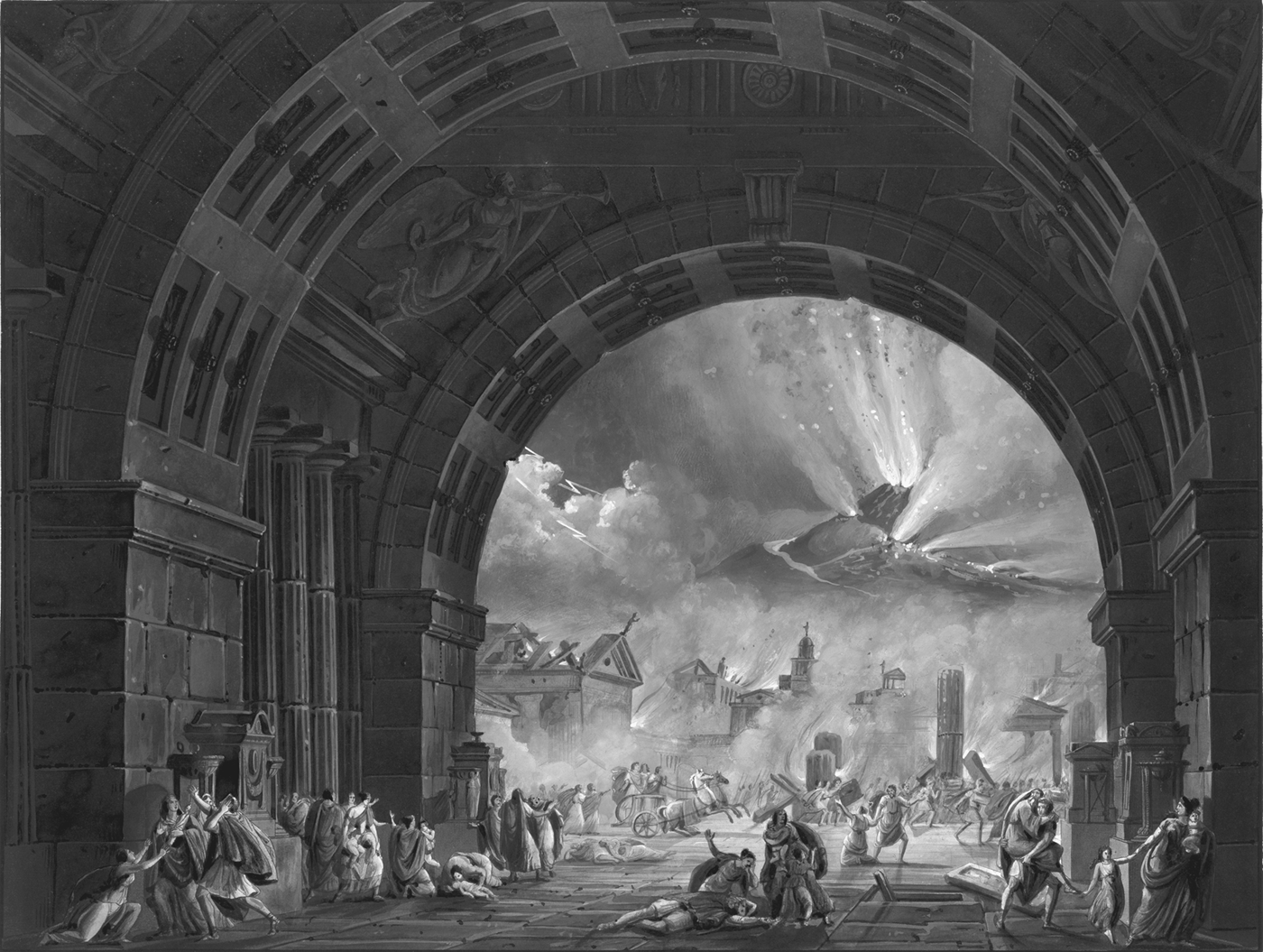
These “sulpher [sic] and blue-fired spectacles” were some of the most frequent and dangerous types of display in European and North American theatres during the early 1800s.Footnote 13 Operas, ballets, and melodramas that integrated the volcano and its special effects into a broader narrative plot (however vacuous) involved a grand illusion of eruptions—thunder, lightning, smoke and flame, explosions, and streaming lava, tephra, and effluvia—that stretched the art of stage managers and involved the labor of dozens of technicians and stagehands (Figure 1).Footnote 14 A respectable alternative to the theatre could be found in the immersive experiences of the panorama, a large-scale 360-degree scenic painting (patented 1787), or the diorama, a flat picture with the illusion of depth and sophisticated lighting effects (patented 1823), both of which featured Vesuvius “in full roar and torrent”Footnote 15 by the 1820s and the 1840s, respectively. Still larger exhibitions were staged outdoors in urban pleasure gardens of the period. An extension of the pictorial realism of volcano paintings (a popular fine arts genre at the time), these “free-standing architectural and topographical models” of canvas and wood, which were over eighty feet high and offered modeled three-dimensional projections, could be admired on their own by day and as elaborate son et lumière spectacles with fireworks at night.Footnote 16
Illustration of Alessandro Sanquirico's set design for the eruption of Vesuvius in the 1827 La Scala production of Giovanni Pacini's L'ultimo giorno di Pompei (The Last Day of Pompeii). In Raccolta di varie decorazioni sceniche inventate ed eseguite per il R. Teatro alla Scala di Milano (Collection of Various Scenic Decorations Designed and Executed for the Royal Theater at La Scala, Milan), ca. 1827–32, by Carlo Sanquirico. Digital image courtesy of the Getty's Open Content Program.

This varied discourse exemplified and traded on tensions between science and art, education and entertainment, and edification and commercial profit, and it engendered a range of meanings from the frivolous to the overtly political.Footnote 17 Beyond their roles as teaching aids, antiquarian curiosities, and virtual tourism, these volcanic representations (primarily of Vesuvius and Etna) often functioned in symbolic and allegorical ways, augmenting the sublime thrill of violent natural phenomena with social messages for audiences. An especially common scheme was the disaster narrative, in which the volcano was activated as a moral intervention or a symbol of natural or divine justice that operated as a tragic or providential repository for the heroine (or monsters in Gothic and Romantic versions), melodramatically immolated villains, or inundated buildings and entire cities. In the last case, full-scale urban annihilation often turned on a semiotic intersection between natural history and modernity, offering historical scenarios whereby contemporary audiences were prompted to reflect critically on a decadent society poised on the brink of cataclysmic destruction.Footnote 18 Correspondingly, as metaphors for radical social and political change, volcanoes spoke to various European revolutionary contexts. They loomed particularly large in the rhetoric of the French Revolution, for example, as symbols of the people who would drastically sweep away the ancien régime and institute a new world order.Footnote 19 Other presentations foregrounded the volcano's atavistic and mythological connotations, depicting Hercules' relationship to Mount Vesuvius or the Cyclops tending the forge of Vulcan at Mount Etna. By extension, certain dramas of the “wild man” genre positioned the volcano (which was often located in a remote and fictional site) and the “savage” in counterpoint, as potentially dangerous symbols of the natural world to be tamed by civilization, thus lending moral rectitude to the benevolent domination of empire.Footnote 20
Volcanic spectacles occupied a varied and mutable set of meanings that—despite their predominantly historical settings—were tied closely to contemporary Euro-American concerns about the character, transformation, or confirmation and dissemination of the existing social order. Given the significant and influential rhetorical and symbolic currencies of the volcano, it is worth investigating artistic depictions of volcanoes from the Pacific region, which was undergoing extensive exploration during this period. How were volcanoes in the Pacific perceived in the ethnographic information that came back to Europe from exploratory voyages? Also, how did Pacific volcanoes compare in the public imagination to European ideas about volcanoes, and what insights might such a comparison engender? In what follows, I explain how Western representations of these newly “discovered” Pacific volcanoes both drew upon and extended the scientific and popular renderings of volcanoes that were already circulating in Europe, introducing new physical environments, aesthetic approaches, ideologies, and sociopolitical conflicts. Whereas stage representations of European volcanoes tended to focus on urban milieus, the foibles of familiar civilizations, and social history, the theatrical treatment of Pacific volcanoes offered contemporary scenarios that treated the exploration and possession of novel territories and examined relations of dominance between Pacific Islanders and foreign visitors, reimagining schemes such as the disaster narrative and the “wild man” trope in new, topical plots.
Like the symbolism of their European counterparts, the symbolism of Pacific volcanoes changed over time in response to developing social circumstances. These artistic representations emerged as revelatory sites for new concerns and struggles in the colonizing Pacific. Just as depictions of European volcanoes channeled some of Europe's most pressing social preoccupations through popular media, we might also read Pacific volcanoes as functioning as signifiers of and agents in debates regarding Euro-American expansion into the Pacific, especially the competing claims and aspirations of indigenous and settler populations. By the final decade of the nineteenth century, which was marked by a scaling up of U.S. imperial ambitions and a consolidation of several British colonies in the region, the volcano and its representational technologies were functioning as a potent expression of the strategies and contradictions of imperial desire and resistance.
Incendiary Encounters: The Volcano in Early European Explorations of the Pacific
The earliest European accounts of volcanoes on islands in the Pacific Ocean emerged in the late sixteenth and early seventeenth centuries, when Spanish, Portuguese, and Dutch explorers recorded eruptions in the Karkar and Manam Islands off the coast of Papua New Guinea and in the Solomon Islands.Footnote 21 The most detailed documentation comes from the eighteenth-century “golden age” of Pacific exploration, especially the three voyages led by British navigator James Cook in the period 1769–80. Johann Reinhold Forster, the German naturalist on Cook's second voyage, was the first to observe volcanoes as a constitutive feature of Pacific geography. He conducted a comparative analysis of the soil and topography of New Zealand, Norfolk Island, Easter Island, the Marquesas Islands, the Society Islands, Tonga, Vanuatu, and New Caledonia and linked their formation to volcanic action.Footnote 22 Most of the empirical descriptions of physical volcanoes and scientific experiments that Cook's men provided reflect a grammar of natural history and incipient ethnography that sought to detail people, culture, and natural phenomena in ways that brought the unknown into the realm of Enlightenment knowledge. One incident, however, situates the Pacific volcano as a mysterious site of contention in a cross-cultural encounter with an exotic Other. Forster's son, ethnologist and travel writer George Forster, recounts how in August 1774 an expeditionary group from the ships wanted to explore the active Mount Yasur on Tanna Island in the Vanuatu archipelago but was opposed by the local community, to whom the volcano was sacred. Forster concluded that it was “an excursion which might, with a little more rashness on our part, have proved fatal not only to the natives, but, in the end, to ourselves. We were forced to give up all hopes of approaching the volcano; but it is surely adviseable to abandon a pursuit where knowledge cannot be obtained without bloodshed and injustice.”Footnote 23 Notwithstanding the younger Forster's performance of Enlightenment humanism, this narrative is notable as an early account in which the arcane features of a volcano are enfolded in a contemporary adventure narrative of exploring and possessing “unknown” lands.
Europeans first encountered Hawaiian volcanoes, which would come to feature so prominently in the scientific, touristic, artistic, and colonial discourse on the Pacific, during Cook's final, fatal voyage in 1779. What impressed the explorers, however, was not fire but ice. The first description of Mauna Loa on the island of Hawai‘i was published in 1781 in an unauthorized account by John Rickman, second lieutenant aboard the Discovery. It depicts the vast volcano (the world's largest) with its seasonal snowcap:
When we first approached the coast of this island we were astonished at the sight of a mountain of a stupendous height, whose head was covered with snow. This was so rare a sight in an island between the tropics, that several of the officers and gentlemen from both ships were desirous of taking a nearer view of it, and for that purpose they requested the king's permission [the ali‘i Kalani‘ōpu‘u], and a guide to attend them, which was readily granted.Footnote 24
Once again, access to the volcano is framed in the context of adventurous exploration of new lands and people and through ceremonial encounters with local Hawaiians. Although the party did not reach the summit (the first ascent by Europeans was achieved by members of the Vancouver Expedition in 1794), the volcano's real significance in these early European narratives is its outlook over Kealakekua Bay, which was to become infamous as the setting for Cook's violent death in February 1779. The arrival of Cook's entourage during the local Hawaiians’ Makahiki festival and Cook's putative ceremonial identification with the fertility deity Lono,Footnote 25 the gradual deterioration of relationships between the visitors and their hosts that led to an aggressive confrontation, and Cook's fate at the hands of Hawaiians during the melee highlighted the indeterminacies of cross-cultural encounter. The event became the basis for a mythologized afterlife whereby the celebrity navigator was detached from his biographical moorings to inhabit a range of figurative and metonymic roles in both Western and Pacific discourses.
The Pacific volcano entered the theatrical stage as part of the multimedia representations of and responses to Cook's death that included posthumous apotheosizing, ethnographic imaging, and European mourning. It made its debut in a popular and enduring performance of the period, La Mort du capitaine Cook, a four-part nonspeaking pantomime that opened at the Théâtre de l'Ambigu-Comique in Paris in 1788. It appeared the following year in a modified three-act English version that was billed as a “Grand Serious-Pantomimic-Ballet,” The Death of Captain Cook, which premiered in London at the Theatre Royal, Covent Garden, and played in various centers throughout England, Ireland, the United States, and Canada for many years. As one of several theatrical works of the time that sought to represent the experiences of the voyages within a scheme of “staged authenticity,”Footnote 26La Mort has been analyzed extensively in terms of its embodied cross-cultural exchanges and its relationships to the explorers' published reports;Footnote 27 so here I concentrate on the imagery and function of the active volcano as a performing object in the drama.
Both the published French and English versions of La Mort tell the same story (in the form of a descriptive summary), although the French text is more detailed and places more emphasis on the volcano's place in the performance's mise-en-scène and symbolic grammar. From the opening scene on the island of Hawai‘i, the “burning mountain” (montagne brûlante)Footnote 28 is clearly visible in the background to the right of the stage, dominating the visual spectacle and determining the performance's key narrative shifts. The opening action concerns the ongoing rivalry between two islanders, Oki (Pareea in the English version) and Étoé (Koah), for the affections of a young woman, Émaï (Emai). The two men fight, but “during the fight the sky darkens by degrees, and a thick smoke emerges from time to time from the top of the mountain; the fight ends, the thunder rumbles, and the natives appear dismayed.”Footnote 29 Although Mauna Loa was quiet during Cook's actual visit, here the stirring volcano advances the action by breaking up the altercation and heralding the arrival of Cook in Kealakekua Bay, indexing Cook's mana (elemental power), and signaling an epistemic transition through the discourse of discovery. After his reciprocal ceremonial encounters with the king (Terreeoboo [Kalani‘ōpu‘u]), the gallant Cook intervenes when the spurned Étoé attempts to carry off Émaï. Several dramatic engagements follow in which Cook enlists his British marines to protect the king and his faction from the schemes of Étoé and his warriors. The British are victorious, and Cook's humanism is further displayed when he prevents the execution of the perpetrators. Tragedy strikes when the villainous Étoé returns once again for a fight and stabs Cook in the back. Although Cook shoots Étoé dead, Cook dies from his wounds.
At this point, “we see the mountain in the distance first discharge a dense smoke; soon we see the flames appear, and finally the lava, which spreads and flows down the mountain. The sound of explosions is heard at intervals.”Footnote 30 The volcano's prodigious eruption, which continues throughout the funeral ceremonies and the exchanges that constitute the final act, reinforces the volcano's symbolic link to the power and significance of Cook. For Parisian audiences poised on the cusp of the French Revolution, it may also have signaled a deeper sense of epochal change. For Christopher Balme, “the suggestion is that the natives will be consumed by this natural calamity” for their part in the death of the foreign hero,Footnote 31 yet the conciliatory ritual engagements between the British and Hawaiians that close the piece erase the edge of violent retribution and replace it with a feeling of mourning from all sides, implying that the volcano operates more as an existential sign that expresses the holistic greatness and tragedy of Cook through nature and the earth.
That Cook's death is attributed to his involvement in a love triangle is typical of several works of the period in which personages from the voyages were imagined according to the plots and conventions of extant theatrical genres, even while new information reworked their scenic and topical aspects.Footnote 32 More than trivial whimsy, works such as La Mort were testament to the contradictory, ambivalent relationship between imagination and “real life,” especially the way in which the deadly drama of Cook's faraway demise and the real-world phenomenon of his posthumous reputation constantly blended fantasy and reality, forging a tension between the “factual” descriptions and artifacts from the voyages and the pervasive, polyvalent mythmaking about Cook that turned the confusions and interstices of cross-cultural encounter into new legendary material. In contrast to theatrical narratives of European volcanoes that emphasized ancient, known civilizations and urban culture, this portrayal of a vexed and lacunar contemporary history loaded the Pacific volcano with different ideological freight and enhances our understanding of how stage technologies of the period absorbed and elaborated Western myths about the Pacific.
This approach did not please everyone. As one reviewer of the London production in 1789 complained, “We have not only lost the opportunity of being ourselves the first to celebrate our immortal countryman, but we have done very little justice to his memory in the imitation, as all who saw it in Paris, will readily allow. Instead of a representation of a burning mountain, it should conclude with Cook's apotheosis.”Footnote 33 Nevertheless, the volcano's role as an active participant in the production lends La Mort further significance as a very early scenic spectacle that narrativized the volcanic eruption. Daly suggests that Giovanni Pacini's opera L'ultimo giorno di Pompei (1825) is “probably the first cultural artifact in which the eruption of a volcano appears as a fully plot-subordinated ‘special effect,’ rather than as the sole attraction of the representation,”Footnote 34 yet La Mort's depiction of Mauna Loa as a moral arbiter and natural sign predates this technique by more than thirty-five years. The production, consequently, possibly constitutes an innovative use of the volcano in the theatre and may have served as technical inspiration for French Revolutionary plays such as Sylvain Maréchal's Le Jugement dernier des rois (1793), in which the pope and monarchs from various European nations are exiled to a remote volcanic island and are ultimately destroyed by the volcano's spectacular explosion.Footnote 35
Although La Mort du capitaine Cook and The Death of Captain Cook depict Cook as a European hero, certain responses to the pantomime took on Cook's British identity in a politicized way. One playbill for a New York production of The Death of Captain Cook in 1797 eschewed the popular advertising gambit used widely for the European shows—that the piece was “to conclude with a representation of a burning mountain”Footnote 36—and instead proclaimed that it was “to conclude with the Assassination of captain cook …”Footnote 37 This maneuver might be linked to a nascent anti-Cook ideology that gained particular momentum in the United States during the 1780s and was based on the notion of Cook as an idolater for accepting the role of Lono; in this version of the story, Cook's death was a righteous punishment from God. This perspective was tied to a developing U.S. nationalism that by the early nineteenth century promoted interests in Hawai‘i that had been spearheaded by U.S. Protestant missionaries who sought to displace British influence and scientific inquiry in favor of American colonialism and Christian faith, both of which were at odds with Hawaiian culture and beliefs.Footnote 38 The Hawaiian volcano was drawn into this ideological battle over territory and religion, shifting semantically from a site for British patriotism and romantic imagination in the late 1700s to an unruly force to be tamed within the ambit of U.S. political aspirations during the nineteenth century.
“Pele-Worshipers of the Future”: Capturing Kīlauea in Chicago and California
For many centuries Kīlauea, a highly active shield volcano adjacent to Mauna Loa, has been a sacred site for kanaka maoli (Native Hawaiians) as the body and home of Pele, the head of a family of fire deities governing the activities of lava flows. Known for her mercurial temper and her power to create and destroy at will, Pele forms part of a complex myth cycle throughout Hawai‘i and other parts of the Pacific and, along with her sister Hi‘iaka, is patron of the hula.Footnote 39 Although members of the Hawaiian aristocracy had formally abolished key aspects of the ancient Hawaiian belief system just before the arrival of American missionaries in the early 1820s, many people continued to recognize Pele, especially because her background was so sophisticated and tied to so many cultural expressions. As Gary Okihiro explains, for the missionaries, Pele and her family were “superstitions to be exposed and purged,” and in this context, “the volcano becomes a site of contest, both literal and metaphorical, between Christianity and truth, idolatry and superstition.”Footnote 40
Notable early missionaries (and anti-Cook ideologues) William Ellis and Hiram Bingham produced influential publications about their careers in the Hawaiian Islands that interleaved accounts of the volcano's rebarbative landscape, idolatrous Hawaiians, and Captain Cook's (idolatrous) death. Ellis, who in 1823 was the first European to provide a description of Kīlauea, augments his account with references to the Bible and Milton's Paradise Lost. He encounters an “immense gulf” filled with a “vast flood of burning matter in a state of terrific ebullition,” along with “pyramids of brilliant flame,” a “boiling cauldron of lava,” “long banks of sulphur” and “dense columns of vapour and smoke,” made deafening by the “constant roaring of the vast furnaces below.”Footnote 41 Evoking the hellish connotations of the volcano within a broader scheme of divine creation, Ellis recalls:
After the first feelings of astonishment had subsided, we remained a considerable time contemplating a scene, which it is impossible to describe, and which filled us with wonder and admiration at the almost overwhelming manifestation it affords of the power of that dread Being who created the world, and who has declared that by fire he will one day destroy it.Footnote 42
Bingham makes no bones about the fact that he is “decidedly opposed to all idolatry, and particularly to the worship of Pele.”Footnote 43 Upon visiting Kīlauea's crater Bingham is clearly impressed by the “vast chasm in the earth, five or six times the depth of Niagara Falls,” which “would take in, entire, the city of Philadelphia or New York, and make their loftiest spires, viewed from the rim, appear small and low.”Footnote 44 Yet he, like Ellis, emphasizes that God, not Pele, is responsible for the volcano. Bingham's book includes several anecdotes about how missionaries and converted Hawaiians have exposed and defied the “Hawaiian Vulcan,”Footnote 45 lending credence to the moral righteousness and inherent progressiveness of Christian belief.
Accounts such as these implicitly blended a missionary agenda with U.S. colonialist efforts, while their sensational descriptions of the volcano's awful sublimity had a profound impact on the production of Kīlauea (and, by extension, the Hawaiian archipelago) in the popular imagination of westerners. After the 1820s, Kīlauea became a trope in romance novels, paintings and murals, music, and travel writing (in addition to being the subject of bona fide scientific investigation), and by the late nineteenth century it was the most commonly recognized international image of Hawai‘i.Footnote 46 By the 1850s, the increasing interest in the volcano as a tourist site and its inevitable commodification were visible to the discerning observer. In an 1851 volume that otherwise recapitulated the material of his missionary colleagues, the Reverend Henry Cheever made this prescient remark:
There might be taken a series of panoramic and particular views of this unique volcano, and exhibited through the diorama, that would doubtless be greatly admired, and bring an independent fortune to the first successful artist. Something of the kind, I have no doubt, will be tried and accomplished ere long; and then we shall have the whole world gazing at Kilauea, and tracks of travel will tend there, and tourists will be filling their books with its wonders, and rail-road, steam-ship, and Daguerreotype will be bringing them so near, and making them so familiar, that Pele will have more idolaters than ever she had in the days of old. Whether Hawaiians will gain by it remains to be proved.Footnote 47
Indeed, it was only a few decades before a paratheatrical spectacle of Kīlauea was created that used novel technologies of the day. This project represented a new manifestation of the moral and philosophical struggle over Pele that attempted to harness her energies in the name of politics, commercial profit, and frontier expansionism. In 1884, French painter and illustrator Jules Tavernier traveled to Hawai‘i and fashioned a circular dioramic model of Kīlauea approximately twenty feet in diameter that he called the Cyclorama of Kilauea; Footnote 48 he exhibited it in Honolulu and on the U.S. mainland.Footnote 49 Honolulu-based missionary descendant, politician, and businessman Lorrin Andrews Thurston was keen to promote Kīlauea as a tourist attraction in order to nurture the concept of Hawai‘i as a locus of desire in the U.S. imagination and—ultimately—to bolster plans for annexing Hawai‘i to the United States. Thurston had already published his own promotional pamphlet about Hawai‘i and its attractions,Footnote 50 and it occurred to him to seize the opportunity to build a large-sized version of Tavernier's cyclorama (22,248 sq. ft.) that could be “used advantageously to advertise Hawaii.”Footnote 51
The genre of cycloramaFootnote 52 that Thurston had in mind was a cylindrical theatre, or rotunda building, that housed a massive 360-degree painting executed in photorealistic detail, augmented with substantial three-dimensional faux terrain, props, dummy and/or live actors, mechanical and lighting effects, and (sometimes) auditory and olfactory impressions. Patrons gathered on a central elevated viewing platform—which in some cycloramas rotated slowly—surrounded by the immersive spectacle. Sealed off hermetically from external visual referents, the image space became a totality that created a complete alternative reality for viewers and maximized the sense that they were physically present at the depicted location.Footnote 53 Cycloramas were a commercial entertainment that appealed to both playgoers and art enthusiasts and offered large audiences an edifying alternative to the theatre.Footnote 54 Although the basic form had been in existence since the late eighteenth century, the advent of electricity took the cyclorama experience to new heights of illusionism and technological wonder, and toward the end of the nineteenth century it was one of the most popular forms of mass entertainment before it was eclipsed by cinema. Because of their enveloping nature and their ability to influence public opinion through suggestive emotional identification, cyclorama subjects had strong links to tourism and imperialism and were often deployed for propagandist purposes.Footnote 55 In 1891, Thurston traveled to Chicago to secure a midway concession at the 1893 World's Columbian Exposition, established the Cyclorama Company, and arranged for scenic artist Walter Wilcox Burridge to come to Hawai‘i to sketch Kīlauea in action.Footnote 56
The representation of Hawai‘i at the World's Columbian Exposition via a theatrical concession marked a paradigmatic shift from Hawai‘i's (increasingly embattled) sovereign self-representation at previous international fairs to its role as a commoditized adjunct of the United States.Footnote 57 In Chicago, amid an event that celebrated America's settler history and emphasized the United States’ uniqueness and its coming of age as an industrial nation, the Hawaiian exhibit was not part of the national displays of manufactory, craft, and agriculture that connoted modernity and capitalist progress in the exposition's White City but was instead positioned on the Midway Plaisance between the Chinese Theatre and the Ferris Wheel.Footnote 58 Versions of the Thurston–Burridge Cyclorama of Kilauea were exhibited across the United States throughout the 1890s—in Chicago in 1893, San Francisco in 1894, Boston and Atlanta in 1895, and Buffalo in 1901—during a turbulent decade in the history of the Hawaiian nation.Footnote 59 Thurston and his colleagues illegally overthrew the Hawaiian monarchy in January 1893, just months before the Chicago exposition; the Republic of Hawaii was established by the new Provisional Government in 1894; the deposed Queen Lili‘uokalani was convicted of misprision of treason in 1895 following a royalist counterrevolution; Hawai‘i was annexed as a U.S. territory in 1898; and the U.S. Congress passed the Hawaiian Organic Act, which extended U.S. citizenship to all members of the former republic, in 1900.Footnote 60
That “the Volcano Building appeared [to be] a microcosm of the struggle for civilization being waged by white Americans in Hawai‘i”Footnote 61 was evident in its conception, design, and execution. Even before the Cyclorama of Kilauea was erected in Chicago, it was anticipated by breathless newspaper reportage that drew on its claims to verisimilitude and emphasized the desired connection between the virtual commodity and the real experience. The very act of rendering the volcano artistically was shown to be fraught with danger: while Burridge and a Chicago correspondent, Mr. Webster, were working at Kīlauea, “the newspaperman undertook to explore the crater and almost lost his life in the attempt.” He was twice “overcome by the sulphurous gas of the crater, and would have fallen into the abyss but for the assistance of his companion.” This foolhardy escapade is valorized in terms of white masculine heroic achievement in the discovery and traversing of new territory: “Until Mr. Webster accomplished the difficult feat no tourist and few guides had ever gone down to the surface of the crater.” The triumphant Webster secures “some specimens of the fiery lava” as proof of his adventure, and all is well.Footnote 62 Such reports probed and exposed Kīlauea's mysteries while holding out to readers the promise of excitement and risk in vicarious or actual encounters and suggesting how the cyclorama might offer a new vision of the American frontier. As Dean Saranillio has also observed, it is notable that Burridge's finished painting included the figure of a geologist observing the crater from within. Although the scientist was dwarfed by his surroundings, his gaze helped represent the competing epistemologies at work in the cyclorama. In contrast to indigenous mythology (and, indeed, to Ellis's and Bingham's creationism), the explanatory paradigms of Western science—buttressed by geological lectures delivered in the cyclorama—presented patrons with a purportedly more accurate and “advanced” knowledge of the volcano and its meanings, reinforcing white settlers’ authority over Kīlauea and their consequent right to it.Footnote 63
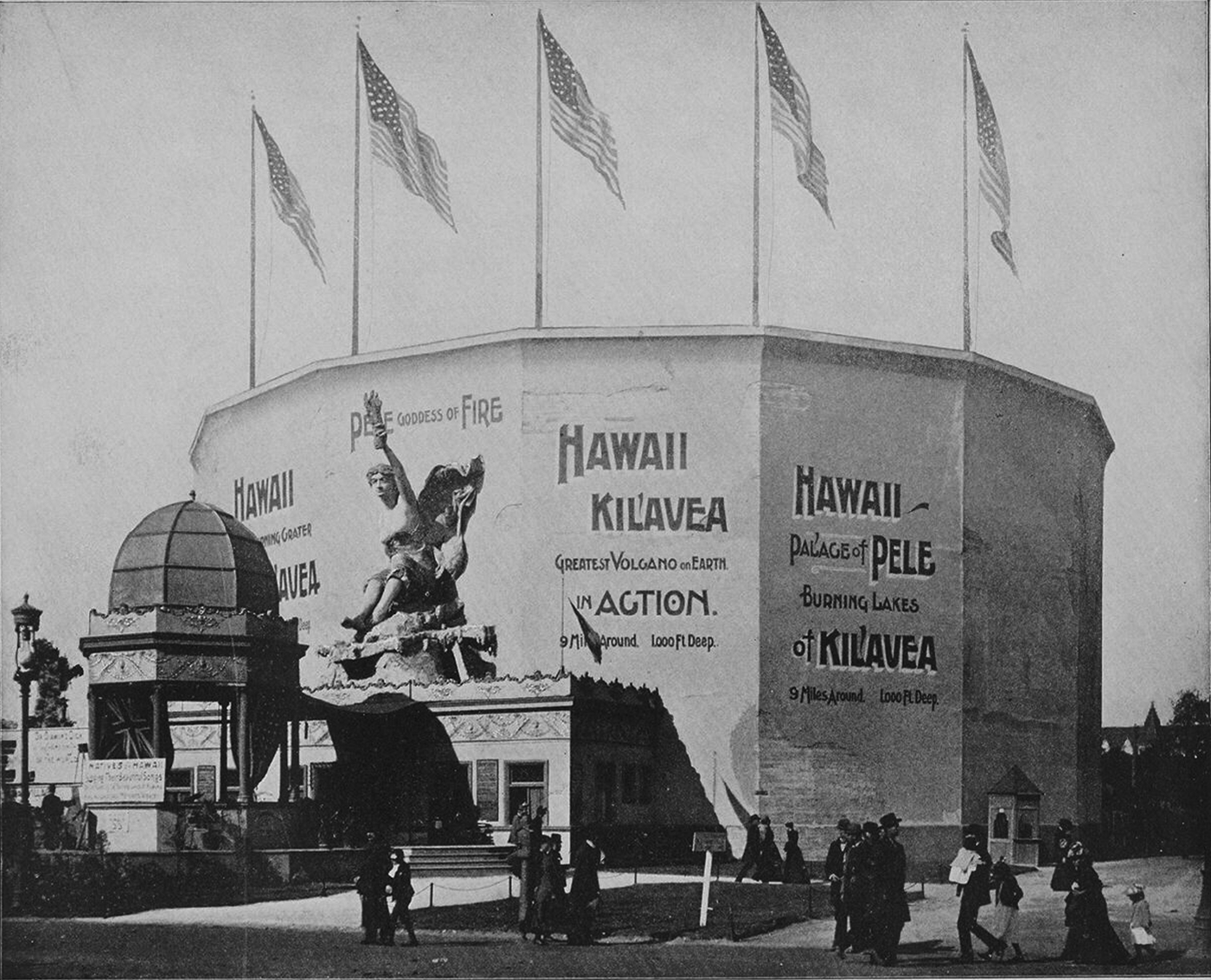
The completed cyclorama, which cost in excess of $82,000 to construct,Footnote 64 was the largest in the country and was designed to make a powerful statement about Hawai‘i's destiny at a time when the legitimacy of the overthrow and the Provisional Government were under critical scrutiny by the U.S. government.Footnote 65 The gargantuan canvas (54 ft. high × 412 ft. long) required several tons of oil paint for its pictorial scenes alone; once hung (itself a considerable feat of engineering technology that required the services of an “expert cyclorama handler”), it took four tons of granite paving blocks just to weight it securely.Footnote 66 An elaborate faux terrain fashioned by C. H. Ritter filled out the interior. The main entrance to the polygonal pavilion (which was 60 ft. high × 140 ft. in diameter) was presided over by a wood-and-plaster statue of Pele by Chicago sculptor Ellen Rankin Copp. Copp's effigy figured and fixed Pele's protean form as a neoclassical goddess in white flowing robes, brandishing a flaming torch in one hand and grasping rocks in the other while seated on a descending wave of molten lava (Figure 2). Exposition guidebooks described the “fair goddess” as “the most beautiful woman that ever lived”Footnote 67 and explained that the statue depicted Pele in an “island legend” in which she is beaten in a race by a “native prince” and pursues him in fury as he escapes into the sea.Footnote 68
The Cyclorama of Kilauea on the Midway Plaisance at the World's Columbian Exposition, Chicago, 1893. In Halsey C. Ives, The Dream City: A Portfolio of Photographic Views of the World's Columbian Exposition (St. Louis, MO: N. D. Thompson Publishing Co., 1893). Image courtesy Paul V. Galvin Library, Illinois Institute of Technology.
This tale was a bastardized version of the Pele–Kahawali story, one of the most famous competition legends (a popular genre in Pele mythology) in which Pele, in the form of an old woman, challenges the ali‘i (ruler) to a hōlua (lava-sled) race but is refused by the arrogant young man. Her retribution—as in most of these narratives—is swift and devastating: pursuing Kahawali down the hill in her fire form, she overwhelms his wife, children, sister, and favorite pet pig with lava. Kahawali only just makes it to a canoe that his brother has fortuitously pulled ashore.Footnote 69 When framed by Western representational paradigms, this exemplar of Pele's authority was ideologically disciplined and subjected to domestic notions of femininity. Yet for informed viewers the very form and source material of Copp's statue actually (inadvertently) incorporated references to Pele's power, pointing to a doubleness characteristic of many colonial representations. In retrospect, it is tempting to read Pele's statue—who is taken by surprise and is dressed in Euro-drag—as a metaphor for the Hawaiian Islands at the time, whose perceived physical and cultural threats would be made safe, even attractive, for foreign consumption.
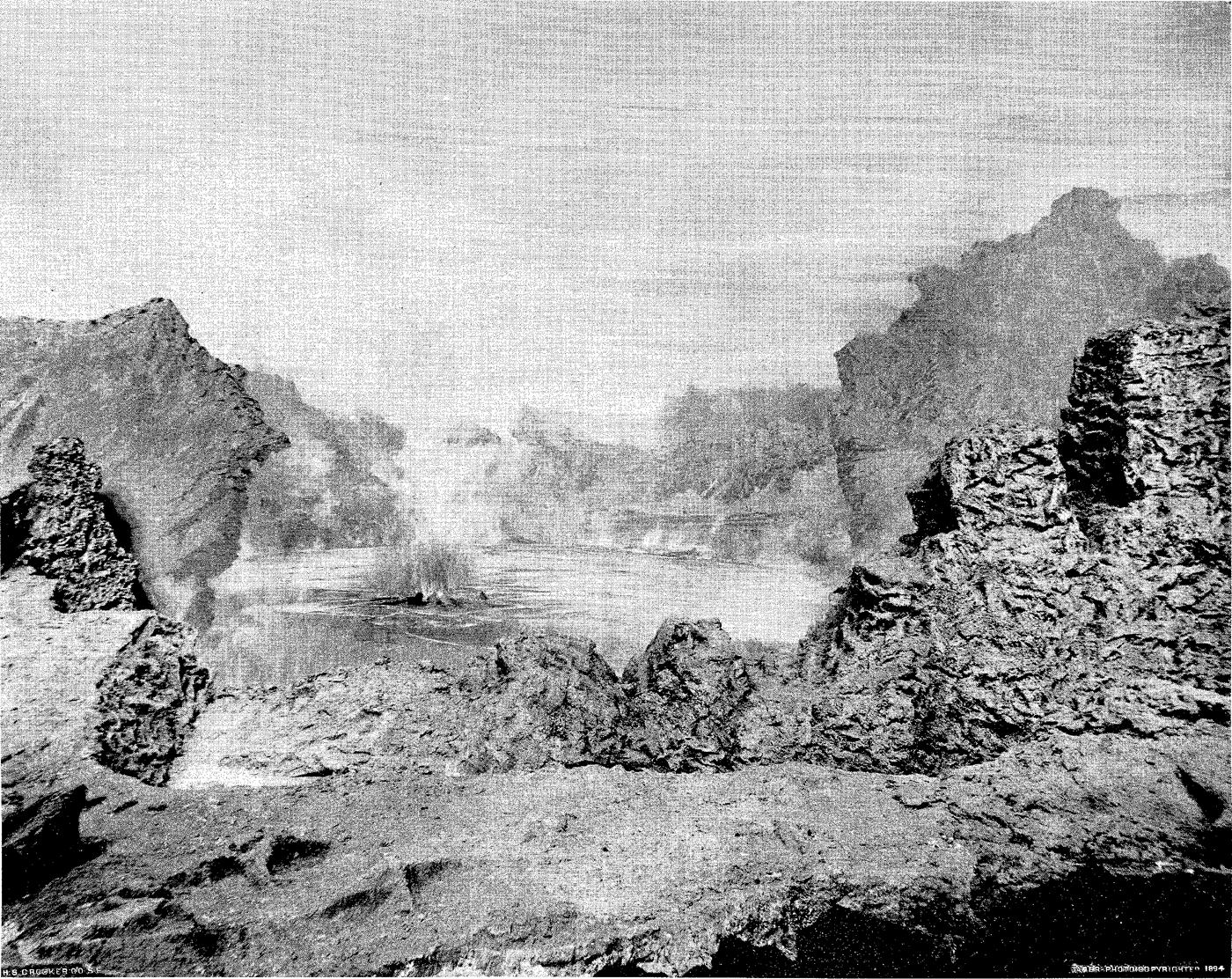
Patrons entered Pele through a lava-tube corridor lined with stalactites. In the womb of the volcano, spectators emerged onto a central ridge of hardened lava that afforded a 360-degree lateral view of the scene as well as views upward and downward into the amphitheatre. Spectators were entranced by the “bubbling and seething pools and lakes of fire,” the “toppling masses of rocks,” “outpourings of lava” and “great fathomless pits,” and the “flames active in their fury, white or golden yellow, tinged with phosphorescent hues of crimson or green,” all enrobed in a “pall of smoke like an infernal curtain” and punctuated by “dull rumblings, as of distant thunder, and an occasional deafening explosion” (Figure 3).Footnote 70 Beyond the fires themselves were “the jagged, illumined walls of the crater, backed by the snow summits of Mauna Kea and Mauna Loa on the one side, and on the north, east, and south, a vast half circle of lower peaks”Footnote 71 represented “the wooded hills of Hilo, which in turn melt[ed] on the broad blue Pacific on the horizon,”Footnote 72 its moonlit “surface glittering like a sheet of silver.”Footnote 73 “The effect is intensified,” a spectator recalled, by “the coming on the scene of a white-robed priest, who pauses on the brink of a boiling lake and hoarsely supplicates the goddess Pele. When the barbaric chant is ended, the priest slowly descends into darkness, and four young Hawaiians take his place and ravish the ear with the entrancing songs of modern Hawaii.”Footnote 74 These combined tactics achieved an isomorphic correlation between “here” and “there” for the audience: “Hearing [the quartet] sing their native songs, and looking upon the great painting of the volcano, made one feel as if they were in reality in far away Hawaii.”Footnote 75
Interior of the Cyclorama of Kilauea at the California Midwinter Fair, San Francisco, 1894. In The “Monarch” Souvenir of Sunset City and Sunset Scenes. Photography by I. W. Taber, text by J. M. Hutchings. (San Francisco: H. S. Crocker, 1894).
The Cyclorama of Kilauea exemplified the imperialist drive that had characterized the form since the late eighteenth century. Bringing painting, perspectival illusionism, haptics, 3-D objects, architecture, sound, smell, steam and heat, mechanical effects, and live performance into complex interplay, the cyclorama presented a Gesamtkunstwerk that reversed the dynamics of Bentham's panopticon to make the observers the object of political control,Footnote 76 strategically soliciting their support of and involvement in the cyclorama's expansionist ideologies. As Denise Blake Oleksijczuk has argued of panorama aesthetics, “The educational side of the experience, coupled with the sheer sense of their physical centrality with regard to the scene, encouraged spectators to see themselves as participants in the countless linkages and networks being established between the metropolis and the wider world.”Footnote 77 What distinguished the Cyclorama of Kilauea from other cycloramas that portrayed battles and landscapes that reinforced the “legitimacy of the actions of the nation-state”Footnote 78 was the fact that the contest over Hawai‘i at the time was not state-sanctioned official history but an ongoing and controversial issue for many people on the mainland and in Hawai‘i. Thurston's spectacle contributed to an event in the making, representing a bold pitch for a new regime that travel and tourism would help engender and that the very process of audience participation would help to achieve. Even if it evoked a primordial atavism, the Cyclorama of Kilauea symbolized the future, enacting a millennial drama in which the ancient forces of the volcano and its acolytes would give way to a new world of capitalist progress—a forward vision that, ironically, would be undergirded by the exoticism associated with the primitive.Footnote 79 Ghosting missionary ideology, as the “barbaric” kahuna entreated Pele and was in turn replaced by the tourist package of “modern Hawaii,”Footnote 80 unruly savagery was tamed and brought into the confines of the national territory. Instead of the volcano destroying civilization with its fiery wrath, civilization would be born out of the volcano.
The cyclorama acquired additional performative dynamics when it opened in January 1894 at the California Midwinter International Exposition in Golden Gate Park, San Francisco. The exposition sought to situate the spirit of California in the intercultural “blending of the East and the West” of a city whose “lights glistened on the waters of the Pacific,”Footnote 81 suggesting the transpacific expansion of the cultural and geographic borders of the United States. In California, the Cyclorama of Kilauea was acclaimed as “a complete success in every particular…. It is not an exact counterpart of the picture presented at the Columbian exposition, but has been improved upon in many ways, and is pronounced a grander scene from every point of view.”Footnote 82 Although a comparison of publicity materials, photographs, and reviews from both exhibitions does not indicate much difference in the interior spectacle of the crater (although later descriptions refer to an additional representation of a tropical storm),Footnote 83 distinct changes were made to the architecture and spatial layout of the exhibit. Unlike in Chicago, where the decontextualized volcano building had been separated from the other Hawaiian performers, who had been clustered in a “collection of South Sea Island villages,”Footnote 84 the now-cylindrical structure (sans the statue of Pele) was set in a Hawaiian Village as a related concession.
If, as the fair's organizers suggested, “its location in the midst of picturesque island surroundings added to the attractiveness of this burning mountain of Kilauea,”Footnote 85 it also created a geographical microcosm of the Hawaiian Islands that extended beyond the volcano to feature the people as commoditized emissaries. As one guidebook for the fair explained, “Recent events have created a desire in the public mind for a more intimate knowledge of the Hawaiian people, and the visitor to the Fair is here given an opportunity to gratify a very natural curiosity.”Footnote 86 Now, in addition to experiencing Pele's flaming envelopment and purchasing lava souvenirs and proannexation pamphlets, the visitor could walk among grass-thatched structures and alongside an artificial lagoon; see hula dancers, pearl divers, and taro pounders; enjoy Hawaiian food; and view agricultural products from the archipelago and—notably—various items from the royal household that had been loaned by the Provisional Government and presented as historical curios. In early 1894, Hawai‘i was still the focus of profound contention within the U.S. government, and Hawai‘i's Provisional Government was lobbying to develop a more permanent administration and prevent the restoration of the monarchy. As with Pele, the Hawaiian exhibit enfolded symbols of sovereignty into a tourist display that diminished Hawaiian authority while showcasing the islands as worthy of U.S. settlement and investment.
Although scholars have long acknowledged the imperialist, hegemonic, and social Darwinist imperatives of world's fairs,Footnote 87 it is important to take a closer look at cross-cultural agency in these performative transactions. As Adria Imada explains, during the early period of American colonization, Hawaiians’ cultural performance—especially at international exhibitions—worked to represent their country, disseminate political discourse before wider audiences, and assert the role of Hawaiians in determining Hawai‘i's future.Footnote 88 In Chicago, while the statue of Pele unwittingly encoded an empowering duality for those who could interpret it, performers deliberately embedded “hidden transcripts of critique and resistance” in hula, chant, music, and convivial interactions, sustaining “a Hawaiian intimacy with land and spiritual patrons that could not be easily overwritten by settler colonialism.”Footnote 89 At the California exposition this role was more overt, especially for the guardians of the royal treasures, who presented themselves as ambassadors working in the kingdom's political interests. The royal accoutrements on display, which “little over a year ago were wrested from the possession of Liliuokalani by the Provisional Government of Honolulu” comprised the royal throne chairs; royal robes, including priceless feather cloaks worn by ancient ali‘i; the Queen's personal couch; draperies, silverware, glassware, and cutlery from the household; kahili (royal standards); court uniforms; and other royal furniture and equipment from the palace. Regarding these appropriated treasures, a fair guidebook noted that
in permitting the transportation of these idle baubles of a deposed dynasty to a foreign land, the new rulers of the Sandwich Islands evidently intended to give notice that these things would never again be needed at home. The native islanders who serve as attendants in the Hawaiian Village at the Midwinter Exposition hold to a different view. They look hopefully to the time when their queen will be re-enthroned on one of these chairs, while the other is occupied by her chosen successor.Footnote 90
Ninetta Eames, a journalist at the fair, witnessed how Mary Piilani Cook, a personal friend of Queen Lili‘uokalani, offered careful explanations of the royal equipment in ways that increased visitors’ understanding of, interest in, and sympathy for the Hawaiian cause.Footnote 91 Consequently, some visitors may have come to comprehend the Hawaiian exhibit (including the volcano) quite differently from the way the exposition framed it. This ambivalence is nicely encapsulated in a behind-the-scenes photograph taken at the exposition. It shows two Hawaiian men seated on either side of the giant, detached head of Copp's Pele statue (which must have accompanied the cyclorama from Chicago), which has been adorned with palm fronds (Figure 4). Whereas the scene may well have caught the eye of the photographer as a quaint instance of superstitious reverence paid to the cast-off remnants of an obsolete concession, one might read it equally as a Hawaiian recognition of akua, an affirmation of the ongoing presence and power of Pele through a dismantling, reincorporation, and reindigenizing of a white depiction and, ultimately, as a telling insight into the complicated politics of representation at the fair.
“The Head of Pele, Goddess of Fire—Hawaiian Decoration.” In The Official History of the California Midwinter International Exposition (San Francisco: H. S. Crocker, 1894). San Francisco History Center, San Francisco Public Library.
Renditions of Hawai‘i's famous volcanoes and volcanoes from elsewhere in Oceania continued to circulate as colonial cultural capital during the 1890s in theatrical genres other than the cyclorama. One example, Sands W. Forman and Noah Brandt's melodramatic opera Captain Cook sutures the thematic concerns of the two case studies discussed so far while gesturing toward the aesthetic techniques of the treatment of the historic Mount Tarawera eruption in The Land of the Moa, discussed below. This bizarre imperial fantasy, which premiered in San Francisco in 1895, echoed several aspects of La Mort du capitaine Cook of a century before, with its first-encounter plot, dancing and other exchange ceremonies, Cook's romantic entanglements, and an impetuous eruption of Mauna Loa to validate foreign presence and quell indigenous resistance. The opera, however, turns tragedy into comedy as Cook resolves matters to his advantage and prepares to sail away happily.Footnote 92 In an overt attempt to capitalize on current events, the show's 1897 remount in New York featured a new ending whereby Cook and his crew are “still in the offing when the United States cruiser New York comes in sight. The white cruiser lands a heavy detail of Uncle Sam's Jack Tars and her commander hoists the American flag and formally annexes Hawaii to the United States.”Footnote 93 This flagrant conflation of claims and chronologies relied on the mechanism of the stage volcano to galvanize a trajectory of U.S. expansionism. Pele is overthrown by the “white God” Cook and then operates in his service to overcome his Hawaiian rivals. Consequently, the “natives[,] being greatly subdued and no longer dangerous,”Footnote 94 are ready for the celebratory cession of British authority in favor of the new American order. (One wonders what Queen Lili‘uokalani made of the performance she attended at Madison Square Garden after visiting Washington to protest officially the Treaty of Annexation.)
The Rebellious Land: Touring Tarawera in New Zealand and Australia
The use of volcanic eruptions as vehicles for naturalizing colonial policy in the Pacific can be found in spectacle melodramas set and staged elsewhere in Polynesia. In Aotearoa New Zealand, Māori cosmology attributes volcanic activity to Rūaumoko, the infant son of the sky deity Ranginui and his wife, Papatūānuku, the earth.Footnote 95 Although Rūaumoko exhibits the same vengeful and capricious temperament as Pele, he occupies lesser mythological importance in Māori oral history (indicating, perhaps, the more minor role of volcanic eruptions in New Zealand up to the nineteenth century),Footnote 96 and during the European era the volcano did not become an anthropomorphized object of ideological contention as in Hawai‘i. Instead, colonial conflicts in New Zealand's comparatively large and temperate islands were arrayed around a different program of appropriating and cultivating the agrarian potential of native land and exploiting the scenic landscape for tourism. By the 1890s, these processes had become central to the spatial project of state making. Volcanism did, however, play a vital role in the developing tourist industry, centered on the dramatic geysers, hot springs, and volcanic terraces of the country's geothermal “Wonderland” located in the central North Island adjacent to Mount Tarawera, a tapu (sacred) lava-dome volcano. Although nineteenth-century Māori and European inhabitants were unaware that Tarawera was active, on 10 June 1886 the volcano exploded in “the biggest and most destructive eruption in New Zealand during the historical (European) period.”Footnote 97 The scoria that the catastrophic basaltic eruption dispersed was similar in extent to that of Vesuvius in 79 c.e. It obliterated the Pink and White Terraces (the nation's premier tourist attraction) and covered hundreds of square miles with pyroclastic surges, poisonous gases, and thick mud and ash. The disaster was profoundly traumatic, especially for Māori, who comprised 101 of the 108 known fatalities. It destroyed vegetation, livestock, villages, and immediate tourism and caused widespread land dispossession (Figure 5).Footnote 98
Charles Blomfield, “Mount Tarawera in Eruption, June 10, 1886.” (From the native village of Waitangi, Lake Tarawera, NZ.) W. Potts, lith. C. Blomfield, del. Wanganui, A. D. Willis [ca. 188–?]. Ref: C-033-002. Alexander Turnbull Library, Wellington, New Zealand. Online at http://natlib.govt.nz/records/22750114. Permission of the Alexander Turnbull Library, Wellington, New Zealand, must be obtained before any reuse of this image.
Themes of tourism, land and landscape, indigeneity, emergent nationalism, and the Tarawera eruption were woven together in New Zealand's largest theatrical event of the nineteenth century: a five-act spectacle melodrama called The Land of the Moa Footnote 99 that toured New Zealand and Australia from July 1895 to March 1896. Written and directed by British actor, playwright, and theatre manager George Leitch, the play's background action begins in the geothermal Māori village of Ōhinemutu during the New Zealand Wars, a prolonged and widespread conflict over land and sovereignty fought between Māori iwi (tribal groups), British forces, and settler militia during the middle third of the nineteenth century. Rewi, an esteemed chief and warrior, entertains an American guest, Captain Eden, who is revealed as a villain. Eden supplies Rewi with useless guns and ammunition, betrays his military positions to the British, and elopes with Rewi's beautiful daughter, Kura (who was already betrothed to Roto of the Ngāpuhi), killing Roto's father and brother as he escapes in his yacht. Over the bodies of the slain, the Māori characters swear an oath of vengeance against Eden (the “Black Angel”) and prophesy his doom at their hands.
Several years later, in early 1886, the Māori protagonists discover that Eden is back in Wellington, New Zealand's capital city, this time in the guise of Capias Marks, a Quaker businessman from Philadelphia. Marks is also being tracked by Kura, whom he married and then abandoned in England, but who still loves him despite his cruelty. Marks sets his sights on a genteel young Englishwoman called Mavis Noble, who has traveled to New Zealand to meet her uncle. Marks tries to abduct Mavis aboard his yacht, but the attempt is foiled, and the vessel is wrecked in Tauranga. Mavis, Kura, and Roto head for Ōhinemutu with Mavis's fiancé and Marks in pursuit. The characters traverse several vistas of natural beauty while Marks tries everything from poison to dynamite to achieve his ends. They eventually enter volcanic territory, where Rewi's warriors apprehend Marks, and Roto's mother, Wangarita, finally dispatches Marks by hurling him into a volcanic blowhole as the Tarawera eruption reaches its apex. A chaotic scene follows in which the characters try to survive the eruption. (During the show's Australian tour, they were led to safety by the area's legendary Māori tourist guide, Sophia Taiawhio, in a cameo role; Figure 6.) After they escape by boat, the final scene takes place in the calm city of New Plymouth, where, in comic melodrama style, lovers, friends, and families are properly reunited.
Guide Sophia at Wairoa Geyser, Whakarewarewa, date unknown. The inscription reads: “Guide Sophia at Wairoa Geyser invoking the spirits of the netherworld to bring the geyser into action.” Māori tourist guide Sophia Hinerangi/Taiawhio reputedly saved the lives of more than sixty people during the Tarawera eruption by sheltering them in her whare (house). She played herself during the Sydney run of The Land of the Moa. Photo: Photographer unknown. Courtesy of Rotorua Museum, Te Whare Taonga o Te Arawa (OP-2166), Rotorua, New Zealand.
With its ten tons of stage scenery, The Land of the Moa was far more concerned with visual appeal than literary logistics. Leitch traced his storyline from Walter Besant's 1881 novella “Over the Sea with a Sailor,”Footnote 100 transferring Besant's U.S. Civil War setting to the aftermath of New Zealand's “civil wars,” the interracial transactions between whites and African Americans to those between Pākehā and Māori, and the villain's watery death in Niagara Falls to his fiery immolation in Tarawera. However, these changes were not without political substance. In generic terms, Leitch's play contributed to the ever-popular volcanic disaster narrative but, as the play's New Zealand reception reveals, it manipulated the common theme of grassroots social upheaval to privilege the goals of settler-nationalism, functioning as an apparatus of the liberal state that entrenched its spatial and racialized logics.
The Land of the Moa was not the first local play to be set in New Zealand, but it was perhaps the first to situate it as a subject. The elaborate “specimen of the stage mechanist and scene-painter's art,”Footnote 101 which trumped anything seen before in the colony, presented a condensed survey of New Zealand's cities, coastline, and interior bushland. It also depicted the “departed glory”Footnote 102 of its pulverized geothermal wonders with a fidelity that “roused the audience to a pitch of enthusiasm,”Footnote 103 soliciting their patriotic sensibilities while exhibiting the trope of white nostalgia for lost landscapes. The climactic eruption of Tarawera, which occupied the entire stage with its rain of fire and ashes, riven craters, pouring lava, bursting steam, and deafening explosions, received the highest acclaim from newspaper critics, one of whom wrote that it evoked “on the stage the most vivid miniature reproduction of all the appalling incidents which occurred on the memorable June night of 1886.”Footnote 104 Yet if the play acknowledged the traumatic past (refracted through a Pākehā prism), it interleaved the natural disaster with bucolic scenes, vanished natural attractions revived by theatre's material technologies, and vistas of modern townships. These, together with the characters’ ultimate journey from one bright colonial city to another, enabled the production to frame the danger and disorder of the country's unique topography (and the indigenous peoples who inhabited and represented it) in a space of order and future progress that conveyed a secure sense of the evolving nation. This nationalistic confidence was confirmed on opening night, when New Zealand premier Richard Seddon attended the production at the Wellington Opera House with several of his ministers and other dignitaries and visited the stage to give the play his imprimatur.Footnote 105
Seddon's endorsement was hardly surprising: The Land of the Moa precisely articulated the strategies and worldviews of Liberal-era governmentality. The government of the Liberal Party (1891–1912), which is widely credited with laying the foundations of New Zealand's economy and welfare state, was preoccupied with land and land settlement issues. It purchased millions of acres of Native land for development in the 1890s while encouraging a national veneration of nature as an integral component of Pākehā civil society and cultural production.Footnote 106 Māori were given little consideration in these processes. They were deemed largely “irrelevant to New Zealand political life” and seen as a population in terminal decline.Footnote 107 Nevertheless, as Margaret Werry astutely remarks, “At the same time as politicians and pundits tolled the death knell for their picturesque indigenes (and pursued policies that many hoped would ensure it), they paired progressive liberalism with Māori culture at the forefront of diplomatic pageantry, nationalist historiography, and artistic production as the coin of national distinction.”Footnote 108 The melodrama's transcendent visual aesthetic, its Māori encounter plot (in which all speaking roles were played by white actors), the Māori performance troupe who presented haka in act IV to great applause, and the narrative that simultaneously valorized and foreclosed indigenous sovereignty offered a spectacular reification of these ideals in what reviewers praised as “the first really great New Zealand play put upon the colonial stage.”Footnote 109
Leitch's play replicates the spatial logic of the Liberal-era “tripartite state,” which segregated the islands into zones of civilization, nature, and savagery as a strategy of racial containment and production.Footnote 110 The European characters move steadily from the bustling urban mise-en-scène into the arcadian realm of nature before entering the uncanny, perilous, primeval heart of “Māoriland” where “Plutonic forces are at work.”Footnote 111 The volcanic landscape itself presents a progressively unsettling spectacle, from the strange grandeur of the Pink Terraces to the Black Crater on Sulphur Island, where Rewi holds court on a throne of sulfur amid bursts of steam and geysers of mud, to the apocalyptic hell of Tarawera, from which the characters must fight for deliverance. Māori action is largely sequestered in this zone of otherness; although Māori characters traverse other sectors of the landscape, they are rendered impotent in “Pākehā” domains. The villain Marks, for instance, can be brought to justice only in Māoriland:
Roto: Here in the town of the Pakehas, our hate must be mute, hands held, Roto waits—
Wangarita: (Contemptuously) Waits!
Roto: That the net may be drawn to bring him to us.Footnote 112
Māoriland, similarly, is demarcated as a territory dangerous to Pākehā, where old vengeances linger and where the unfinished business of the wars is tabulated and carried out. Rewi, for instance, bans the foreign visitors because of grievances over colonial encroachment: “No; no English here. We of the flaming skies and steaming soil trusted their promises and lost our lands…. Still can we hold the spear and club to resist oppression, demand justice.”Footnote 113 In a play that ostensibly upholds fellowship and cooperation between English and Māori, however, the subsequent act bestows a deus ex machina whereby Rewi comes into possession of documents that confirm the return of his ancestral territory: “The English are great, they listen and are just. (Shows parchments) The lands of our Fathers are again as to our Fathers, and to the children's children. From this time England is our friend, to applaud, obey, defend!”Footnote 114 Other commentators on the play have noted this ahistorical turn and its possible effect on colonial audiences and have pondered Leitch's potential sympathy for the Māori cause.Footnote 115 Yet I suggest that this fictive act of British magnanimity, which serves the immediate plot by brokering an alliance between the visitors and Rewi's people, operates in service of a subtler dispossession.
The ensuing volcanic eruption that destroys the surrounding area neatly displaces the Māori characters, making it unnecessary for the British to do so (and ensuring that the Crown suffers no losses). The fact that the tribal territory that the colonial power returns is then taken by the volcano stages a reflexive act whereby the land annihilates the land, presenting a naturalized erasure of tūrangawaewae (one's foundation or home ground; lit. “a place to stand”). The play depicts the destruction not of cities but of Māoriland, as Rewi's throne “sink[s] into a gulf of steam and fire.”Footnote 116 If Māori are here identified with the unpredictable forces of the volcano—as an atavistic, latent energy that could burst forth again at any time with disastrous consequences—then the play's deployment of Tarawera subsumes that threat in its own fires, reassuring colonial audiences of the structures of statehood, a reassurance bolstered by the camaraderie between the English protagonists and the friendly natives and by the overt demise of the American villain (the “true” foreign menace). In the final scene, as the European cosmopolites and Māori characters take fond leave of one another, backed by a rousing chorus of “Rule Britannia,” the play cements Liberal settler ideals by sanctioning British colonial authority under the guise of benevolent managerialism.
Whereas the narrative and visual logic of The Land of the Moa threatened to bury native sovereignty claims beneath an avalanche of volcanic fallout, the melodrama's Māori cultural performances—as with the Hawaiian exhibits discussed above—contained the potential for alternative articulations that pushed it to encompass a richer, more contradictory range of social meanings. In 1895, concerned about the progressive Crown encirclement of their self-governing region, a delegation of Urewera (Tūhoe) chiefs from the eastern North Island visited Wellington for the entire parliamentary season to negotiate an agreement with Seddon that would enable Te Urewera to manage the future of its regional economy on its own terms.Footnote 117 During the Auckland run of The Land of the Moa, newspapers noted that “a number of the Urewera chiefs, who have been interviewing the Governor and Premier in Wellington recently, will take part in the performance,”Footnote 118 and indeed, the revised “troop of Maoris, each one of which bears a name that has become historical in the history of the Maori [New Zealand] War” executed their haka “with a spirit and intensity which at times is electrifying, showing that the old war spirit and the blood of this race is not extinct.”Footnote 119 This incursion of real-world politics into the play's fictional frame indicates how the melodrama's touristic inserts could be co-opted—if only briefly—as a vehicle for a more politicized Māori presence. If, in hindsight, the chiefs' performance seems an ambivalent celebration of the cession of de facto sovereignty in return for short-lived guarantees, it also acknowledged a significant engagement with the Pākehā government that had secured some continuation of Te Urewera's religious, linguistic, and political autonomy and thus served as an assertion of tino rangatiratanga (sovereignty, self-determination) that subverted the monovocality of the settler state.
The stage volcano has long been a feature of the Euro-American representation of the Pacific Islands region. La Mort du capitaine Cook, the Cyclorama of Kilauea, and The Land of the Moa demonstrate how, in the colonizing Pacific, the theatrical volcano formed the volatile epicenter of a turbulent set of competing claims, ambitions, and representational technologies in ways that illuminate settler-indigenous politics of the period. While absorbing and conveying features of extant volcanic imaginaries, these depictions of Mauna Loa, Kīlauea, and Tarawera extended the symbolism of volcanic eruptions from a European focus on urban destruction and domestic social history to new social and scenographic discourses that pursued imperial desires. These eighteenth- and nineteenth-century tropes would continue to reverberate throughout the twentieth and twenty-first centuries, from the unfortunate cross-cultural U.S.–Hawaiian romance that closes with Luana's fiery fate in Richard Walton Tully's The Bird of Paradise (1911) to Gollum's cinematic engulfment in the Mount Doom of Peter Jackson's Euro-Pasifika Middle Earth to the choreographed lava, flaming lagoon, tropical flora, and tribal beats of that staple of the Las Vegas strip, the volcano at the Mirage Hotel. At the same time, however, it must be acknowledged that indigenous resistance to colonial intervention in Oceania has been far more sustained and vigorous than is suggested by the tendentiousness of these volcanic displays. Rather than fleeting responses, the Māori and Hawaiian self-representations that erupted within these partisan projects in the 1890s are indicative of indigenous people's long-term, strategic engagements with treaty-based claims in Aotearoa and U.S. assimilationist ambitions in Hawai‘i. These efforts have become particularly visible since the 1970s, a period that has witnessed indigenous cultural renaissances in both sites.
This narrative of the theatrical representation of Pacific volcanoes contributes to broader discussions of landscape as “a perspective and a method, linking seemingly unrelated theatrical practices in staging, text, scenography, and spectatorship,”Footnote 120 while adding to our understanding of material theatre historiographies in Oceania. Beyond the iconography of the volcano, however, the ways these historical performances activated potent exchanges across cultural and geopolitical boundaries provide insights into the intersections among performance, transnationalism, and economy in the region. These pieces demonstrate, variously, how the transoceanic linkages forged by Cook's exploratory voyages produced new ethnographic and artistic interfaces between Western and Pacific products and ideas, how colonial enterprises commodified and redeployed indigenous products for multiple forms of profit, and how the traffic of indigenous and nonindigenous bodies and practices within and beyond Oceania was managed by the commercial circuitry of touring theatres and world's fairs. Yet other histories of mobility are contained here that underpin much Pacific indigeneity and that offer more proactive alternatives to narratives of colonial co-optation. It is notable that Pele, a quintessential symbol of Hawai‘i—indeed, part of the island's very substance—bears the epithet akua malihini (foreign god), which cites her history as a traveler, traversing the Pacific Ocean from afar before settling at Halema‘uma‘u crater in Kīlauea. This background, along with the broad circulation of Pele-related mythology across a considerable region of the Pacific, speaks to complex interisland connections and processes of transculturation developed by various Pacific communities in the precolonial period—a cosmopolitanism that, despite the isolating tendencies of colonial policies, was manifested in new forms of international engagement during the modern period. The performances discussed here, then, are also testament to the complicated entanglements between competing forms of cosmopolitanism, prompting us to consider more carefully the transnational and cross-cultural dynamics of colonial theatricality in Oceania.