Introduction
Each disaster leaves an imprint or singular signature on the affected population. When forces of harm collide with a vulnerable human population, physical and psychological disaster consequences coalesce and synergize to etch their mark on the affected community. Starting from the Disaster Ecology Model,Reference Shultz, Espinel, Galea, Reissman and Ursano1,Reference Shultz, Espinel, Flynn, Cohen and Hoffmann2 this article describes the interaction between the brute physical forces of the 2010 Haiti earthquake and the widespread psychological impact. This analysis portrays the unique “Trauma Signature” of the 2010 Haiti earthquake.
A critical unmet need in the field of disaster behavioral health is the capability to tailor mental health and psychosocial support (MHPSS) to the psychological risk factors operating within each disaster. Recent high-profile disasters such as the Great East Japan Earthquake (Richter M9.0),Reference Shultz, Kelly, Forbes, Verdeli, Leon, Rosen and Neria3 monsoonal flooding throughout Pakistan, and the Deepwater Horizon oil spill, exemplify the diversity of the human disaster experience. In each instance, the trauma profiles (involving disparate combinations of exposure to hazards, mortality, injury, displacement, and economic losses) create distinct patterns of MHPSS needs. Disaster mental health interventions must be adapted to the circumstances of each traumatic event.
Customizing effective MHPSS responses requires the merger of two types of information: (1) assessment of real-time disaster situation reports to identify salient, event-specific risk factors for psychological impairment; and (2) actionable evidence-based guidance on MHPSS response, matched to the spectrum of identified psychological needs. For this purpose, a “Trauma Signature” (TSIG) assessment is proposed to quickly analyze key features contributing to the psychological footprint of disaster. The 2010 Haiti earthquake was selected as the case example because it was an event in which major risk factors are present simultaneously and at exceptional magnitude. TSIG assessment draws upon data from disaster situation reports, analyzed in the context of the disaster mental health scientific literature, to determine the anticipated magnitude of psychological distress and impairment. While the analysis presented here was conducted post hoc, in future applications, TSIG assessment is designed to incorporate data from early situation reports, thereby informing the selection and preparation of MHPSS assets appropriate for deployment to the scene.Reference Shultz, Kelly, Forbes, Verdeli, Leon, Rosen and Neria3
Event Description
Globally, natural disasters are common, exceeding a frequency of one-per-day.Reference Guha-Sapir, Hargitt and Hoyois4 However, major incidents such as the 2010 Haiti earthquake, which superimposed extensive mortality on expansive devastation, are atypical.
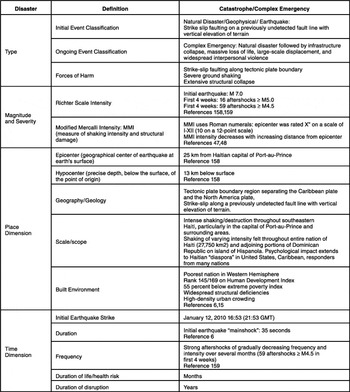
The 7.0-Richter earthquake that struck southern Haiti on 12 January 2010 caused an estimated 222,000 - 300,000 deaths (3% of the national population) and 300,000 injuries, displaced greater than 1.3 million persons to improvised camps in the vicinity of destruction, and an additional 600,000 to remote rural areas of the country (19% of the population), and ransacked the nation’s infrastructure.5–8 Classified as a catastrophe,9,10 this earthquake ranks among those rare events that expose a human population to the most extreme stressors. The hazard profileReference Callahan11,Reference Calais12 for the 2010 Haiti earthquake is presented in Table 1.
Haiti 2010 Earthquake Hazard Profile

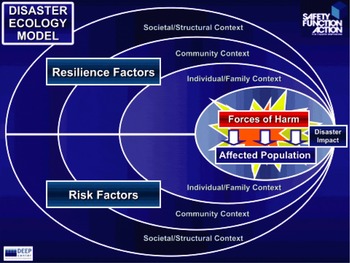
The traumatic nature of the 2010 Haiti earthquake can be modeled according to the Disaster Ecology Model.Reference Shultz, Espinel, Galea, Reissman and Ursano1,Reference Shultz, Espinel, Flynn, Cohen and Hoffmann2 The Disaster Ecology Model extends the “epidemiological triad” of agent, host, and environment into the realm of disaster. Agent is recast as the “forces of harm,” host enlarges to encompass the “human population in harm’s way,” and environment acquires multiple layers as the “ecological context.”
Integral to the Disaster Ecology Model is the definition of disaster provided by the model’s authors: “an encounter between forces of harm and a human population in harm’s way, influenced by the ecological context, creating demands that exceed the coping capacities of the disaster-affected community.”Reference Shultz, Espinel, Galea, Reissman and Ursano1 This definition of disaster is embedded directly into the graphic depiction of the model, displaying the encounter between forces of harm and the vulnerable human population at the moment of impact, surrounded by concentric rings of factors (operating at individual, family, community, and societal levels) comprising the “ecological context” (Figure 1). While some factors may promote resilience, others exacerbate risk. In the case of Haiti, as this paper will demonstrate, risk factors predominated.
Disaster Ecology Model

Germane to the organization of this article is the contribution of one of the developers of the model who recommended expanding the “forces of harm” to include three elements: (1) exposure to hazards during impact; (2) exposure to loss during impact (but primarily experienced in the aftermath); and (3) exposure to profound and enduring change post-impact. This conceptualization emphasizes that the psychological “forces” of disaster persist long after the physical forces have ceased.
During any disaster, the severity of the psychological responses may range from transient fear and distress to chronic and debilitating psychopathology. These responses not only relate to the characteristics of the disaster’s “forces of harm,” but also to the unique vulnerabilities of the trauma-exposed individuals.Reference Norris, Friedman and Watson13,Reference Neria, Nandi and Galea14
As the poorest country in the Western Hemisphere, ranking 145 among 169 nations on the 2010 Human Development Index,15 Haiti was disaster-vulnerable before the earthquake. The average per capita income was US$660, with more than half of residents living on less than US$1.25 per day.6,16 Life expectancy was only 61 years of age, prior to the abrupt, extensive, premature loss of life on 12 January 2010.16
Compounding these indicators of extreme poverty are other salient vulnerability factors. The absence of urban planning, zoning ordinances, construction standards, and enforcement of building codes rendered many structures susceptible to collapse.16 Most concrete structures in Port-au-Prince were built with poor quality cement and without steel reinforcement rods.6 Extreme crowding from uncontrolled urbanization elevated the numbers of injuries and deaths.6 An overarching contributor to national vulnerability was the void of sociopolitical leadership and the corresponding failure to develop coherent mechanisms to mitigate disaster risks.Reference Marcelin17
The vulnerability of Haiti was revealed repeatedly during recent disasters. A succession of tropical cyclones and floods collectively accounted for greater than 6,000 deaths between 2004 and 2008 despite the availability of advance warning.6,18 This “multiplicity” of prior disasters also amplified the psychological impact of the 2010 earthquake, since exposure to a sequence of extreme events has been shown to be more traumatic than exposure to a single disaster.Reference Shultz, Espinel, Galea, Reissman and Ursano1,Reference Shultz, Espinel, Flynn, Cohen and Hoffmann2,Reference Butler, Panzer and Goldfrank19–Reference Shultz, Allen, Neria, Espinel and Bobrowski21
Trauma Signature
Norris and colleagues posit that disasters possessing two or more of the following four characteristics are likely to generate pervasive mental health problems: (1) large numbers of injuries or deaths; (2) widespread destruction and property damage; (3) disruption of social support and ongoing economic problems; and (4) intentional human causation.Reference Norris, Friedman and Watson13 Reviewing these points, the 2010 earthquake produced: (1) mass mortality; (2) extensive physical destruction; and (3) social dislocation, bordering on societal collapse. While the final point, human causation, generally does not apply to disasters caused by natural hazards, the aftermath of the Haiti earthquake was marked by uncommonly widespread interpersonal and organized violence, including sexual assault, violence in the ration lines, and gang violence.Reference Marcelin17
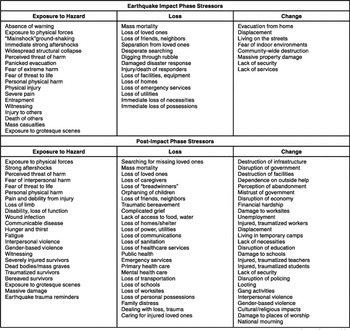
The psychological impact of the 2010 Haiti earthquake becomes starkly apparent when disaster stressors are examined in relation to exposure to hazards, loss, and change during the earthquake and post-impact (Table 2).
Haiti 2010 Earthquake: Disaster Stressors Associated with the Forces of Harm

Disaster mental health research has documented dose-response relationships between the severity of trauma and the magnitude of loss (both in lives and in property) in relation to psychopathological outcomes.Reference Norris, Friedman and Watson13,Reference Neria, Nandi and Galea14,Reference Shultz, Allen, Neria, Espinel and Bobrowski21–Reference Neria, Galea and Norris23 The National Center for Post-Traumatic Stress Disorder (NCPTSD) has enumerated disaster-specific risk factors for psychological consequences in disasters caused by natural hazards that align closely with the portrayal of exposure to hazards, loss, and change in the Disaster Ecology Model.24–26 First, severity of exposure to hazards is the single most important determinant of adverse psychological outcomes. The two strongest predictors of long-term psychological effects are personal injury and perceived life threat, frequently accompanied by experiences of panic or horror during impact. Second, regarding loss, death of a loved one portends traumatic bereavement and complicated grief for surviving family members. Furthermore, separation from family members during or after the disaster is acutely distressing. Loss of home, property, personal possessions, or material resources is a strong predictor of psychological distress. Third, potent markers of destabilizing change include post-impact adversities such as displacement and disruption of social networks. Deficits in social support prior to disaster and deterioration of social support following a disaster place survivors at greater risk for psychosocial impairment. The NCPTSD indicates that as the number of these risk factors increases, so does the likelihood of psychological impairment.24–26
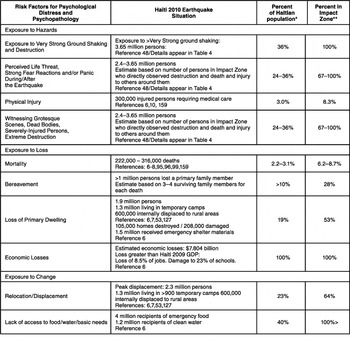
The TSIG analysis presented here is organized around these empirically derived risk factors. For each risk factor, the specifics of the Haiti situation and the estimated percentage of the Haitian population affected both in the impact zone and nationally are presented in Table 3.
Haiti 2010 Earthquake: THE TRAUMA SIGNATURE

*National population: 10 million
**Impact Zone population: Defined for this analysis as the 3.65 million experiencing ground-shaking intensity at Modified Mercalli Intensity (MMI) of VII or greater (see Reference 48 and Table 4).
Exposure to Earthquake Hazards
Severity of Exposure:The extent of damage and injury in an earthquake-impacted community is a function of five factors: (1) local Richter magnitude; (2) distance from the epicenter; (3) vibration-transmitting character of the ground; (4) type of buildings and quality of construction; and (5) timing of the event.Reference Peleg, Reuveni and Stein27 Following the earthquake, all five factors colluded to magnify the degree of harm: (1) a powerful, 7.0-Richter earthquake (2) occurred just below the earth’s surface near the heart of Port-au-Prince’s dense-packed urban center (3) along a highly-stressed tectonic plate boundary that lurched violently, (4) causing disintegration of hundreds of thousands of structurally-fragile buildings and homes (5) on a busy weekday afternoon.10–Reference Calais12
Mental Health Correlates: During a disaster, one of the strongest predictors of the psychological consequences is the severity of exposure to the forces of harm.Reference Shultz, Espinel, Galea, Reissman and Ursano1,Reference Neria, Nandi and Galea14,Reference Shultz, Allen, Neria, Espinel and Bobrowski21,24–26,Reference Green28 The absolute magnitude of the earthquake hazards; including ground-shaking, liquefaction of the earth, abrupt lateral and vertical translocation of the earth’s surface, vibration, and structural collapse; largely determines the extent of damage, destruction, displacement, death, and injury, as well as the degree of stress and trauma experienced by the disaster-affected population.
Distance from the Epicenter: One metric that predicts severity of exposure in an earthquake is the distance from the epicenter.Reference Peleg, Reuveni and Stein27,Reference Neria, Gross, Olfson, Gameroff, Wickramaratne, Das, Pilowsky, Feder, Blanco, Marshall, Lantigua, Shea and Weissman29 Earthquakes are concentric events. Ground-shaking is most intense, destruction is most cataclysmic, and risk for harm and death is most pronounced near the focus of seismic activity. Force dissipates with increasing distance from the center.
Likewise, persons who are geographically closest to the point of disaster impact bear the highest risks for psychiatric outcomes such as PTSD, a finding that generalizes across diverse traumatizing events.Reference Goenjian, Najarian, Pynoos, Steinberg, Manoukian and Tavosian30–Reference Smith, North, McCool and Shea34 However, effective interventions may create the rare exception to this widely supported finding. Researchers following Chinese earthquake survivors discovered that persons from a town closer to the epicenter that sustained irreparable damage to homes reported better quality-of-life than their counterparts in a more distant, less-damaged community.Reference Wang, Gao, Shinfuku, Zhang, Zhao and Shen35,Reference Wang, Gao, Zhang, Zhao, Shen and Shinfuku36 The mediating factor was governmental support; citizens from the severely damaged community received intensive interventions, including new homes built for them by the government. Also, experiencing violent ground movement in an undeveloped area near the earthquake’s origin may be less distressing than less intense shaking farther from the epicenter accompanied by structural collapse and injury.
Fear and Perceived Life Threat during the Earthquake: Large numbers of persons witnessed death firsthand and shared the same life-threatening environment with people around them who were killed. Even during disasters with objectively low mortality rates, belief that one is going to die may be prevalent. During Hurricane Hugo, 46% reported perceived life threat.Reference Norris and Uhl37,Reference Thompson, Norris and Hanacek38 as did 76% of citizens during Hurricane Andrew.Reference Norris, Perilla, Riad, Kaniasty and Lavizzo39
Mental Health Correlates: Belief in life threat consistently predicts psychopathology.Reference Norris, Wind, Neria, Galea and Norris40 Epidemiological analyses of earthquake survivors in Turkey and Greece consistently documented that “fear during the earthquake” and perceived life threat were significant predictors of psychological distress and PTSD.Reference Livanou, Basoglu, Salcioglu and Kalendar41–Reference Sumer, Karanci, Berument and Gunes46
Exposure to Physical Sensations of the Earthquake Mainshock: The moment of “mainshock” was experienced as 15 to 35 seconds of ground-shaking. Persons closest to the epicenter were subjected to the kinesthetics of extreme shaking, compounded by the multi-sensory experience of structural disintegration all around them. In some areas, “liquefaction” occurred as the quivering earth lost its weight-bearing properties, causing structures to sink and crumble. Punctuating the fear-inducing sensations and jouncing vibrations, many persons were physically injured, pinned by falling rubble, or entrapped in collapsed structures. Bodily pain, injury, immobilization, trapped confinement, and perceived life threat are psychological stressors. Survivors engaged in frenetic, bare-handed scramble to find and extricate family members and neighbors who had disappeared seconds earlier amid the heaving earth and caving debris.
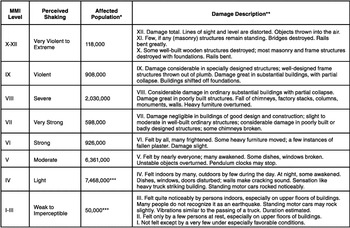
The sophistication of earthquake monitoring offers the unique capacity for quantifying the numbers and distribution of persons exposed to varying intensities of ground-shaking. The Modified Mercalli Intensity Scale (MMI) is a 12-point rating scale of perceived shaking intensity accompanied by structural damage estimates.47 The MMI is well suited for describing subjective human sensations during earthquake impact.47 The United States Geophysical Survey created a “shake-map” displaying the geographic areas, and estimated population numbers, for each of the MMI categories.48 An estimated 3.65 million Haitian citizens, 36% of the national population, experienced ground-shaking at the level of “Very Strong” or higher (MMI Levels VII-XII) (Table 4).48
Haiti 2010 Earthquake: Persons Exposed to Ground-Shaking by Level of Modified Mercalli Intensity Scale

*U.S. Geological Survey. Estimated Population Exposed to Earthquake Shaking. Available at: http://earthquake.usgs.gov/earthquakes/pager/events/us/2010rja6/onepager.pdf Accessed on 13 July 2011. (Reference 48)
**USGS: The Modified Mercalli Available at: http://earthquake.usgs.gov/learn/topics/mercalli.php Accessed on 13 July 2011. (Reference 47)
***Includes persons in Dominican Republic, Cuba, Caribbean islands as well as Haiti
Aftershocks: The first powerful aftershock occurred just seven minutes after the mainshock; a second followed 12 minutes later. Within the first 12 days, Haiti experienced 52 aftershocks of magnitude 4.5 or greater.10
Mental Health Correlates: During exposure to threat or overt forces of harm, survival stress responses are activated. The sequence of initial earthquake mainshock followed by a prolonged series of aftershocks is more stressful than a single event.Reference Shultz, Espinel, Galea, Reissman and Ursano1,Reference Shultz, Espinel, Flynn, Cohen and Hoffmann2,Reference Butler, Panzer and Goldfrank19,Reference Ursano, Fullerton, McGaughey, Ursano, McGaughey and Fullerton49,Reference Neria and Litz50 Aftershocks serve as startling trauma reminders. Investigators have identified fear of aftershocks as a repetitive stressor for earthquake survivors.Reference Basoglu, Kilic, Salcioglu and Livanou44,Reference Kuwabara, Shioiri, Toyabe, Kawamura, Koizumi, Ito-Sawamura, Akazawa and Someya51,Reference Lau, Yu, Zhang, Mak, Choi, Lui, Zhang and Chan52
Exposure to Physical Injury
Haiti situation: An estimated 300,000 survivors (3%) sustained physical injuries requiring medical treatment.6,10 Blunt trauma, fractures, lacerations, and crush injuries from falling structures were treated routinely. Estimates of survivors who lost a limb in the earthquake range from 2,000 to 4,000.Reference Adams53
Mental Health Correlates: The psychological component of physical injury is well-documented. Pain is a psychic stressor. Disaster-related injury increases risks for conconmitant psychiatric impairment, including PTSD and depression.Reference Rundell54,Reference Rundell and Ursano55
Injury-related distress (IRD) is an expected psychological outcome of physical injury.Reference Victorson, Farmer, Burnett, Ouellette and Barocas56 Acute and chronic IRD include symptoms of posttraumatic stress, depression, anxiety, and pain.Reference Geisser, Roth, Bachman and Eckert57,Reference Maes, Mylle, Delmeire and Altamura58 Assessment of IRD is recommended during the early phase of hospitalization for injury in anticipation of psychological after effects.Reference Richmond and Kauder59
During disasters, injured survivors are subjected to physical and psychological trauma, a combination that confers elevated risk for PTSD.Reference Helzer, Robins and McEvoy60–Reference Zatzick and Ursano65 ZatzickReference Zatzick and Ursano65 determined that 10 to 40% of hospitalized injured adolescent and adult survivors develop symptoms compatible with a diagnosis of PTSD.Reference Michaels, Michaels and Moon66–Reference Zatzick, Russo and Grossman73 Diagnoses of depressionReference Zatzick, Jurkovich and Russo72–Reference O’Donnell, Creamer and Pattison75 and medically-unexplained complaintsReference Engel, Liu, McCarthy, Miller and Ursano76–Reference Zatzick, Russo and Katon78 are common co-morbidities.
Exposure to Physical Injury with Limb Loss: The 2010 earthquake left an estimated 2,000 to 4,000 limb-loss victims in urgent need of treatment.Reference Adams53 Limb-loss threatens self-sufficiency, particularly when many Haitians make a living through manual labor. Disability access is lacking, severely limiting mobility. Haiti is challenged to provide rehabilitation, including prostheses, especially for growing children, and to retrain its earthquake-disabled citizens into functional roles in society.Reference Adams53,79
Mental Health Correlates: The need for mental health treatment is particularly compelling for limb-loss victims whose risks for psychological impairment exceed those of other earthquake survivors. Rates of major depression have been assessed at 35% for survivors of traumatic limb loss.Reference Cansever, Uzon, Yuldiz, Ates and Atesalp80 Amputation following accidental injury is associated with increased PTSD prevalence.Reference Cavanagh, Shin, Karamouz and Rauch81 Haitian earthquake amputees included many youth and young adults; limb-loss early in life predicts major depression and other mental disorders in subsequent years.Reference Frank, Kashani, Kashani, Wonderlich, Umlauf and Ashkanazi82,Reference Singh, Ripley, Pentland, Todd, Hunter, Hutton and Philip83 In Haitian culture, limb-loss is highly-stigmatized; a commonly-held belief is that evil spirits can enter the body through amputation sites.Reference Davis84–Reference Smith and Michel86 Achieving optimal reintegration for amputees requires a combination of effective prosthetics and multi-faceted treatment that encompasses physical, psychological and social needs.Reference Horgan and MacLachlan87,Reference Ferguson, Richie and Gomez88
Experience of Entrapment: Disaster medical responders have indentified the conditions that favor survival of persons in earthquake-toppled structures.Reference Macintyre, Barbera and Smith89 Unfortunately, the “built environment” of Haiti exacerbated risks for entrapment while minimizing the likelihood for survival. Many survivors were indoors during the mainshock. With structures collapsing around them, they battled to self-extricate from the fallen rubble. Thousands were pinned in a manner that required valiant rescue efforts on the part of family or neighbors. In the first week, more than 50 international search-and-rescue teams participated in 132 live rescues.Reference Hopmeier, Pape and Paulison90
Mental Health Correlates: Entrapment is severely traumatizing. Entrapped survivors experience both the psychological effects of physical injury and the trauma of immobilized confinement. Entrapment has been associated with high rates of PTSD.Reference Wang, Zhang, Tan, Yin, Chen, Wanga, Zhang, Wang, Guo, Tang and Li91 Physical injury and psychological outcomes of entrapped earthquake survivors relate to the “time period under the rubble”.Reference Sever, Erek, Vanholder, Ozener, Yavuz, Kayacan, Ergin, Apaydin, Cobanoglu, Donmez, Erdem and Lamiere92
Witnessing Injury or Death of Others: Five percent of the population of Haiti was either killed or injured,6 guaranteeing that hundreds of thousands of uninjured survivors witnessed harm to others at the moment of injury, and later, piles of dead bodies decaying in the streets.
Mental Health Correlates: The experience of witnessing grotesque scenes, grievous harm, or death to others is traumatizing and predictive of psychological disorder.Reference Norris, Wind, Neria, Galea and Norris40,Reference Maes, Mylle, Delmeire and Altamura58,Reference Watts93 For example, persons who directly witnessed the calamatous destruction of the World Trade Center had higher rates of PTSD and depression compared with non-witnesses.Reference Galea, Ahern, Resnick, Kilpatrick, Bucuvalas and Gold94
Exposure to Loss
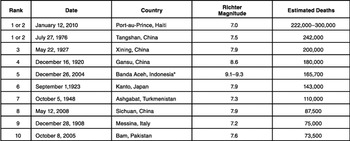
Loss of Loved Ones: Mass Mortality: Sudden, geographically concentrated mass mortality distinguishes the 2010 Haiti earthquake. Two mortality estimates were circulating when this paper was first drafted, 220,000 deaths (in some sources, 222,570)6–8 and 300,000 deaths,95,Reference Crane, Dobbins, Miller, Ries, Chivvis, Haims, Overhaus, Schwartz and Wilke96 equivalent to 2-3% of the Haitian population of approximately 10 million persons.97 Most deaths occurred instantly or within hours of the initial earthquake, while some victims suffered a more protracted death due to the circumstances of injury, entrapment, lack of access to medical care, wound infection, or absence of basic survival needs. The 2010 Haiti earthquake accounted for 13% of the 2,323,000 deaths associated with 1,095 major earthquakes occurring since 1900 (Table 5).98 On the one-year anniversary of the earthquake, January 12, 2011, the Government of Haiti raised the mortality figure to 316,000.99
Haiti 2010 Earthquake: Leading Earthquakes by Mortality, 1900–2010

Source: Centre for Research on the Epidemiology of Disasters (CRED). EM-DAT The International Disaster Database. Disaster Profiles. Available at: http://www.emdat.be/disaster-profiles. Accessed July 16, 2011.
*CRED database lists data by individual country. During the 2004 Southeast Asia tsunami, the highest death toll for a single country occurred in Indonesia. In total, more than 230,000 persons were killed in 14 countries.
Mental Health Correlates: Bereavement and Complicated Grief: Bereavement was a defining feature of this quake.Reference Fullerton, Ursano, Kao and Bharitya100–Reference Shear, Frank, Houck and Reynolds103 “Multiple” bereavement was common.Reference Montazeri, Baradaran, Omidvari, Azin, Ebadi, Garmaroudi, Harirchi and Shariati104 This extreme loss of life places Haitians at high risk for a range of loss-related mental health problems, including enduring bereavement reactions referred to as complicatedReference Neria, Gross, Litz, Insel, Maguen, Seirmarco, Rosenfeld, Suh, Kishon, Cook and R105,Reference Prigerson, Bierhals, Kasl, Reynolds, Shear, Newsom and Jacobs106 or traumaticReference Prigerson, Bierhals, Kasl, Reynolds, Shear, Day, Beery, Newsom and Jacobs107 grief, PTSD,Reference Neria, Olfson, Gameroff, Gross, Pilowsky, Blanco, Manetti-Cusa Wickramaratne, Lantigua, Shea and Weissman22 depression,Reference Neria, Olfson, Gameroff, Gross, Pilowsky, Blanco, Manetti-Cusa Wickramaratne, Lantigua, Shea and Weissman22,Reference Bruce, Kim, Leaf and Jacobs108 generalized anxiety disorder,Reference Neria, Olfson, Gameroff, Gross, Pilowsky, Blanco, Manetti-Cusa Wickramaratne, Lantigua, Shea and Weissman22 alcohol abuse,Reference Glass, Prigerson, Kasl and Leon109 sleep abnormalities,Reference Brown, Reynolds, Monk, Prigerson, Dew, Houck, Mazumdar, Buysse, Hoch and Kupfer110 functional impairment,Reference Neria, Olfson, Gameroff, Gross, Pilowsky, Blanco, Manetti-Cusa Wickramaratne, Lantigua, Shea and Weissman22 suicidality,Reference Latham and Prigerson111 extreme physical pain,Reference Neria, Olfson, Gameroff, Gross, Pilowsky, Blanco, Manetti-Cusa Wickramaratne, Lantigua, Shea and Weissman22 work loss,Reference Neria, Olfson, Gameroff, Gross, Pilowsky, Blanco, Manetti-Cusa Wickramaratne, Lantigua, Shea and Weissman22 hospitalization,Reference Li, Laursen, Precht, Olsen and Mortensen112 and mortality.Reference Li, Precht, Mortensen and Olsen113
Loss of a loved one due to a disaster is a psychologically devastating experience. Complicated (or prolonged) grief disorder (PGD) is a relatively new diagnosis, and different from normal grief in its extended duration and symptom profile.Reference Horowitz, Siegel and Holen114 Correlates of PGD include severe functional impairment, decreased productivity, suicidality, and physical health problems.Reference Neria, Gross, Litz, Insel, Maguen, Seirmarco, Rosenfeld, Suh, Kishon, Cook and R105 The synergism between disaster trauma and loss of a loved one has not been explored.Reference Neria and Litz50 Many survivors of the 2010 Haiti earthquake experienced both. The shortage of mental health care post-earthquake, compounded by the fact that most poor individuals tend to avoid seekingReference Howard, Cornille, Lyons, Vessey, Lueger and Saunders115 or receiving specialty mental health care,Reference Leaf, Bruce, Tischler, Freeman, Weissman and Myers116 predicts that many bereaved Haitians will not benefit from mental health care.
Loss of Resources: Based on the Post-Disaster Needs Assessment (PDNA), the total value of damage and losses from the 2010 Haiti earthquake was estimated at US$7.804 billion, equivalent to 119% of the 2009 Haitian gross domestic product (GDP).6 In the 35-year history of Damage Assessment and Loss Assessment (DALA) estimation, this is the first time that the cost of a disaster has outstripped the value of the nation’s GDP.6
One of the most visible elements of loss was the complete destruction of 105,000 homes and 90,000 buildings, with 208,000 additional homes severely damaged.6 The Presidential Palace, Parliament, Law Courts, Ministry, 1,300 schools, and 50 healthcare centers were destroyed or rendered inoperable.6 Pre-earthquake, Haiti was the poorest nation in the Western Hemisphere. Following the earthquake, poverty has regressed to the 2001 level with 71% of citizens in moderate to extreme poverty.6,15
Mental Health Correlates: Predicated on Hobfoll’sReference Hobfoll117 theory of Conservation of Resources (individuals strive to obtain, retain, protect, and regain valued resources), loss of resources in a disaster is stressful and predictive of psychological symptom severity and psychopathology.Reference Armenian, Morikawa, Melkonian, Hovanesian, Haroutunian and Saigh118–Reference Maj, Starace, Crepet, Lobrace, Veltro, De Marco and Kemali122 Following the devastating earthquake in Armenia, one of the strongest risk factors for PTSD was total family economic loss.Reference Armenian, Morikawa, Melkonian, Hovanesian, Haroutunian and Saigh118 Relevant to the mass destruction of housing stock in Haiti, a study of survivors of Hurricane Mitch determined that loss of the family home predicted psychological distress months after the storm.Reference Caldera, Palma, Penayo and Kullgren123
Exposure to Societal Change
Post-earthquake adversities maintain, prolong, and strongly predict psychological distress and morbidityReference Norris, Wind, Neria, Galea and Norris40 which is a robust finding that cross-cuts natural and human-generated disasters.Reference Freedy, Saladin, Kilpatrick, Resnick and Saunders120,Reference MacFarlane124–Reference Epstein, Fullerton and Ursano126 In Haiti, all societal sectors sustained severe impact, creating a series of compounding challenges delineated in the PDNA6 and the Action Plan for National Recovery and Development of Haiti.95 This section illustrates psychosocial impacts for two indicators of change, displacement, and disruption of social networks.
Forced Evacuation and Displacement: At the peak, 2.3 million Haitians were displaced from their homes.127 Earthquake destruction forcibly displaced greater than 1,300,000 citizens to more than 900 improvised encampments throughout the impact zone.6,7,127 An additional 600,000 to 760,000 abandoned the area of destruction, migrating to rural areas of Haiti.Reference Adams53,127
The consummate loss of housing stock is partially explained by the reality of “uncontrolled urbanization” throughout the Port-au-Prince metropolitan area, with 67% of the population living in “spontaneous settlements”.6 Unregulated housing construction consists of post and beam structures with an infill of concrete slabs, typically three floors in height. These structures disintegrated during the earthquake, with weighty slabs toppling, maiming and killing the occupants.
Mental Health Correlates: Research with earthquake survivors has demonstrated that relocation and displacement is a risk factor for psychological distress and psychopathology. Investigators conducted a “natural experiment” with a cohort of Italian male factory workers, exploring how earthquake displacement severely disrupted social networks.Reference Bland, Leary, Farinaro, Jozza and Trevisan119,Reference Bland, Valoroso, Stranges, Strazzullo, Farinaro and Trevisan128,Reference Bland, O’Leary, Farinaro, Jozza, Krogh, Violanti and Trevisan129 In this cohort, long-term evacuation and displacement predicted both psychological distress and PTSD. In a study of persons who relocated to Ankara, Turkey following two major earthquakes in the countryside, long-term displacement was a strong predictor of major depressive disorder.Reference Kilic, Aydın, Taskintuna, Ozurumez, Kurt, Eren, Lale, Ozel and Zileli130 Following the Niigata–Chuetsu earthquake in Japan,Reference Kuwabara, Shioiri, Toyabe, Kawamura, Koizumi, Ito-Sawamura, Akazawa and Someya51 psychological distress was significantly elevated for persons who sustained serious home damage and those who were displaced and living in temporary shelter or at a relative’s home after the earthquake. Following the Newcastle earthquake, “psychological morbidity” was higher for the 3,000 survivors who were initially displaced from their homes.Reference Margesson and Taft-Morales132
Change and Disruption of the Social Network: The Haiti Earthquake occurred in a geographical area that included 40% of the population and 60% of the national economic output contributing to the GDP, thereby maximizing societal disruption.6,Reference Margesson and Taft-Morales132 No sector remained operational.6,95 Adding to abrupt displacement of 19% of the population, the near-complete devastation of the center of national government displaced leadership and paralyzed governance.Reference Marcelin17 Citizens throughout the impact zone lacked access to food, water, and sanitation. Business, commerce, transportation, and communication systems were severely disrupted.6,Reference Margesson and Taft-Morales132 Schools were damaged and education came to a standstill. Inmates escaped damaged prisons, adding to rampant violence against unprotected citizens in the absence of security.Reference Marcelin17
Mental Health Correlates: Climactic change provokes acute stress in the peri-disaster period that evolves to chronic stress in the aftermath. Although Haiti struggled greatly before the earthquake, hardships escalated following the earthquake. Disruption of social networks following an earthquake has been associated with psychological distress and morbidity, and even detrimental changes in immune function.Reference Bland, Leary, Farinaro, Jozza and Trevisan119,Reference Bland, Valoroso, Stranges, Strazzullo, Farinaro and Trevisan128,Reference Bland, O’Leary, Farinaro, Jozza, Krogh, Violanti and Trevisan129,Reference Carr, Lewin, Webster, Kenardy, Hazell and Carter131 Following Hurricane Katrina, survivors experienced prolonged chronic stress, exacerbated by the languishing recovery, leading to relentless rises in rates of PTSD and serious mental illness over multiple years.Reference Kessler, Galea, Gruber, Sampson, Ursano and Wessely134 When social networks are disrupted and reunification and reconstruction are delayed (the expectation for Haiti), elevated rates of psychopathology persist or worsen.
Discussion
Our TSIG analysis indicates that the 2010 Haiti earthquake was uncommonly deadly, injurious, disruptive, and traumatizing. Millions of survivors experienced multiple risks for disaster-related psychopathology. Disaster mental health experts editorialized that there would be urgent mental health needs requiring engagement of community leaders and prioritization of disaster behavioral health in recovery planning.Reference Fullerton, Reissman, Gray, Flynn and Ursano101 These experts intimated that earthquake-related psychopathology would include PTSD, depression, anxiety, phobic disorders, detrimental health behaviors, and bereavement.
MHPSS Response: In the context of such widespread trauma, the optimal response would feature mental health needs assessment followed by targeted, culturally competent, evidence-based interventions. Instead, the earthquake attracted a mass convergence of disaster response organizations arriving on-scene with divergent agendas. Samuel Worthington, CEO of InterAction, which coordinates the operations of major U.S. response organizations, vividly described the initial pandemonium in Congressional testimony.Reference Worthington135
Fortunately, consensus standards have been promulgated in the form of the Inter Agency Standing Committee (IASC) “Guidelines on Mental Health and Psychosocial Support (MHPSS) in Emergency Settings”.136 When the earthquake struck, the IASC was out front encouraging delivery of best-practices MHPSS services with leadership from Haitian professionals.137 IASC cautioned that international MHPSS staff should not deploy without a formal invitation to participate, knowledge of Haitian culture, French or Creole language proficiency, and willingness to operate within the IASC guidelines.
In May 2010, >100 response organizations convened to review progress and “map” their MHPSS services within the four-tiered IASC “pyramid” for MHPSS in emergencies.138 The meeting report illuminated glaring gaps. Five interim “conclusions” were particularly revealing: (1) initial activities consisted almost exclusively of “psychosocial support” while mental health consultations were rare; (2) special needs groups were underrepresented among “beneficiaries;” (3) MHPSS activities were severely lacking in all geographic areas except “Zone Ouest;” (4) substance abuse was not addressed; and (5) no MHPSS needs assessment had been conducted.
Multiple reports elucidated the “state” of early MHPSS programming. In March 2010, the Interim Haiti Recovery Commission (IHRC) released its Action Plan for National Recovery and Development of Haiti.Reference Hopmeier, Pape and Paulison90 Notably, “mental health” is never mentioned and “psycho-social assistance” received one mention. The IHRC companion document from the Private Sector Economic Forum139 included only a single reference acknowledging the need for “care for psychological injuries.” especially for displaced persons.
InterAction (one of the “Principals” comprising the IASC) released its six-month accountability report, containing synopses of response activities from 29 member organizations; 13 reported providing “psychosocial” support.140 Partners in Health, collaborating with Zanmi Lasante (PIH/ZL) deployed a team to provide psychological and psychiatric care and train community health workers to evaluate and refer patients.
The International Organization for Migration (IOM), categorized its interventions according to the IASC’s MHPSS four-tier pyramid and reported that “psychosocial mobile teams” served 30,000 “direct beneficiaries” through April 2010.Reference Schinina, Hosn, Ataya, Dieuveut and Salem141 IOM services included psychological first aid, group and individual counseling, problem-solving workshops, support groups, educational/recreational activities in the temporary camps, and community mobilization.
The United Nation’s Children’s Fund (UNICEF) reported that 62,800 children were participating in the Child-Friendly Spaces program at 220 sites where they are “benefitting from recreational activities and psychosocial support.”142 The greatest penetration of MHPSS services came from Doctors Without Borders (MSF), reporting the provision of “psychosocial support” to 80,000 Haitians in the first six months; many were MSF patients receiving medical treatment.143 MSF services included psychologist-led group counseling and individual psychiatric consultations.
Toward Optimal MHPSS Response in Disasters: TSIG analysis has documented that all major risk factors for psychopathology were prominent at extreme levels in this disaster event. This confluence of risk factors is expected to produce high levels of psychological distress, PTSD, depression, and complicated grief. Even with many competing demands, based on this analysis, mental health assessment, intervention and prevention efforts should rank high among recovery priorities. Yet “mental health” merited not a single mention in the national action plan for disaster recovery and evidence-based mental health interventions have been glaringly absent.
As a high-profile disaster, the Haiti earthquake triggered massive disaster relief activities and could have been a showcase for MHPSS response grounded on evidence-based best practices and international guidelines,136,144–Reference Norris, Hamblein and Rosen148 Indeed, major response organizations are on scene and some are operating in accordance with IASC Guidelines.136 Yet eight months post-impact, no systematic mental health surveillance was in place.
Key elements for optimal, time-phased MHPSS response to disaster-affected populations include: (1) post-impact/pre-deployment assessment of the disaster’s unique Trauma Signature;Reference Shultz, Kelly, Forbes, Verdeli, Leon, Rosen and Neria3,Reference Yun, Lurie and Hyde149 (2) early community-wide psychosocial support (most citizens will not need psychiatric interventions);136,146 (3) rapid onsite mental health needs assessments;Reference Shultz, Kelly, Forbes, Verdeli, Leon, Rosen and Neria3 (4) early identification of individuals at an elevated risk for developing disaster-related psychological difficulties;Reference Shultz, Kelly, Forbes, Verdeli, Leon, Rosen and Neria3 (5) evidence-based interventions matched to the type and severity of symptom presentationReference Shultz, Kelly, Forbes, Verdeli, Leon, Rosen and Neria3,Reference Yule147; and (6) long-term follow up to assess treatment efficacy and maintain surveillance to capture cases of delayed onset and relapse.Reference Shultz, Kelly, Forbes, Verdeli, Leon, Rosen and Neria3,136,Reference Yun, Lurie and Hyde149
Expert consensus has defined five foci for immediate and mid-term trauma intervention following disaster: (1) promoting a sense of safety to stabilize survivors and diminish distress; (2) promoting a sense of calming and decreasing physiological arousal; (3) enhancing feelings of self and collective efficacy; (4) encouraging social support; and (5) instilling hope and belief in a positive future.Reference Watson, Ruzek, Bell and Bryant150 Intermediate interventions are designed to prevent long-term chronic psychopathology by treating more stable psychopathological responses (e.g., PTSD, depression, complicated grief).Reference Neria, Galea, Norris, Neria, Galea and Norris151 Cognitive-behavior therapy (CBT) models have demonstrated efficacy and are particularly suited for the intermediate phase.Reference Foa152–Reference Difede, Malta, Best S. Henn-Haase, Metzler, Bryant and Marmar157 There remains a critical need to strengthen the evidence base, demonstrating the efficacy of pharmacotherapy and psychotherapy treatments adapted to the specific exposures that comprise the disaster experience. While international consensus guidance has appropriately noted that most survivors do not need formal psychiatric intervention,136,146 nevertheless, a significant minority will develop disaster-associated psychopathology, and it is important to create the empirical basis for identifying this subset and providing timely, science-based interventions.
Conclusions
The 2010 Haiti earthquake provides a potent example of the rare catastrophic event where all major risk factors for psychological distress and impairment are prominent and compounding. Yet the MHPSS response to this disaster neither has been prioritized in national planning nor directed toward the defining features of this event. In the absence of planning or on-scene needs assessments, the MHPSS response has been coordinated loosely, weighted toward “psychosocial” activities, and almost devoid of evidenced-based mental health intervention despite high levels of traumatic exposure and population-wide bereavement.
This high-visibility disaster response underscores the urgency to address these unmet needs in future disasters: (1) rapid post-impact/pre-deployment disaster mental health response guidance based on risk factor assessment (the “Trauma Signature” analysis presented here); (2) early psychosocial support focusing on safety, calming, connectedness, self-efficacy and hope; (3) on-scene validated mental health needs assessment; (4) early detection of persons at high risk for psychopathology; (5) evidence-based, culturally-competent mental interventions tailored to the event’s unique “trauma signature;” and (6) follow-up mental health evaluation and surveillance. Formalization of tools to perform rapid post-impact TSIG analysis is critical to prioritize and jump-start an empirically based disaster mental health response.
Abbreviations:
GDP = gross domestic product
IASC = Inter-Agency Standing Committee
IHRC = Interim Haiti Recovery Commission
IOM = International Organization on Migration
IRD = injury-related distress
MHPSS = mental health and psychosocial support
NCPTSD = National Center for Post-Traumatic Stress Disorder
PAHO/WHO = Pan-American Health Organization/World Health Organization
PDNA = Post-Disaster Needs Assessment
PTSD = post-traumatic stress disorder
TSIG = trauma signature