Introduction
The genus Circinaria Link (Ascomycota, Lecanoromycetes, Pertusariales, Megasporaceae) was resurrected by Nordin et al. (Reference Nordin, Savić and Tibell2010) and comprises c. 40 species worldwide. The genus is characterized by crustose (Chesnokov et al. Reference Chesnokov, Konoreva and Paukov2018), umbilicate, fruticose, subfruticose, or spherical growth forms, a thickened medullary layer, usually with pseudocyphellae, 2–6 spores per ascus, low secondary metabolite diversity, and relatively short conidia (Sohrabi et al. Reference Sohrabi, Stenroos, Myllys, Søchting, Ahti and Hyvönen2013). It is distinguished from Aspicilia and the other genera within Megasporaceae by thallus morphology, presence/absence of pseudocyphellae, the number of ascospores per ascus and the size of ascospores, conidia length, and the presence/absence of some compounds such as aspicilin. This genus is distributed worldwide, with Circinaria minuta P. M. McCarthy & Elix recently described as a new species from Australia (McCarthy & Elix Reference McCarthy and Elix2020).
To date, a relatively broad concept of Circinaria species boundaries has been adopted, emphasizing thallus anatomy and morphological differences as the main phenotypic characters for species delimitation (Nordin et al. Reference Nordin, Savić and Tibell2010; Owe-Larsson et al. Reference Owe-Larsson, Nordin, Tibell and Sohrabi2011; Sohrabi et al. Reference Sohrabi, Stenroos, Myllys, Søchting, Ahti and Hyvönen2013; Ren & Zhang Reference Ren and Zhang2018; Ismayil et al. Reference Ismayil, Abbas and Guo2019; McCarthy & Elix Reference McCarthy and Elix2020). Studies incorporating molecular sequence data have also been critical to informing taxonomy in Megasporaceae and circumscribing members therein (Wheeler Reference Wheeler2017; McCune & Di Meglio Reference McCune and Di2021). Recently, new combinations in the genus Circinaria have been made (Roux et al. Reference Roux, Bertrand and Nordin2016; Ren & Zhang Reference Ren and Zhang2018). However, new taxa in Wheeler's study were left unpublished and McCune & Di Meglio (Reference McCune and Di2021) described some new taxa, such as Aspicilia albonota McCune & J. Di Meglio, A. diploschistiformis McCune & J. Di Meglio, A. papilliformis McCune & J. Di Meglio, A. spicata McCune & J. Di Meglio, A. subcontinua McCune & J. Di Meglio and A. wyomingensis McCune & J. Di Meglio, and united some species in Aspicilia despite the obvious relationship of the Aspicilia reptans complex to Circinaria. Within Megasporaceae, vagrant or erratic thalli (Rosentreter Reference Rosentreter, Glenn, Harris, Dirig and Cole1998) have received considerable attention. Some vagrant species in Circinaria with subfruticose and subfoliose thalli have been termed ‘manna lichens’ (Crum Reference Crum1993; Sohrabi et al. Reference Sohrabi, Stenroos, Myllys, Søchting, Ahti and Hyvönen2013). Manna lichens were historically searched for by botanists across Central Asia (Eversmann Reference Eversmann1831; Elenkin Reference Elenkin1901), and they are interesting elements of the desert and semi-arid habitats (Crum Reference Crum1993). However, manna lichens are surprisingly rare in European semi-arid regions, with only three known species in this region: C. fruticulosa (Eversm.) Sohrabi from Ukraine, C. gyrosa Sohrabi et al. from Spain and Ukraine, and C. hispida (Mereschk.) A. Nordin et al. from Italy, Greece, Spain and Ukraine (Kopacevskaja et al. Reference Kopacevskaja, Makarevi, Oxner and Rasadina1971; Follmann & Crespo Reference Follmann and Crespo1974; Hafellner et al. Reference Hafellner, Nimis and Tretiach2004; Sohrabi et al. Reference Sohrabi, Stenroos, Myllys, Søchting, Ahti and Hyvönen2013).
During the preparation of the revision of manna lichens, a set of exsiccati specimens distributed as Aspicilia fruticulosa in Lichenotheca Graecensis Fasc. 14, no. 264 (Obermayer Reference Obermayer2004) was found to be closely related to C. hispida when analyzed by Sohrabi et al. (Reference Sohrabi, Stenroos, Myllys, Søchting, Ahti and Hyvönen2013). However, this collection had distinct morphological characters that differed from the holotype of C. hispida. At that time, DNA sequences of these specimens were obtained (GenBank Accession nos: JQ797522, JQ797523) and kept under C. hispida s. lat. Based on a combination of morphological, chemical and molecular sequence data, this species is formally described here as C. nimisii. The phylogenetic relationship between the new taxon and other closely related species is assessed using maximum likelihood analysis based on an alignment of nrDNA ITS sequences.
Material and Methods
Specimens, morphological and chemical studies
During the VI OPTIMA Meeting in 1989, Arnoldo Santos (La Laguna), a participant in the excursion, first detected this vagrant Circinaria population on the Plateau of Muses in the alpine belt of Mount Olympus. Accompanied by Eva Barreno (Valencia), HM visited the locality one day later, finding a large population occurring among small pebbles in open, wind-exposed steppe habitats. The collected specimens were distributed in the exsiccatae Lichenotheca Graecensis Fasc. 14, no. 264 (Obermayer Reference Obermayer2004). For this study, the morphology and anatomy of this exsiccatae collection were compared with other vagrant Circinaria specimens from the herbaria FH, H, LE, TUR, TU and W. Specimens were examined using a dissecting microscope (Leica M50) and a compound microscope (Leica DM 2500 compact light microscope). Sections cut by hand were studied in material mounted in water. Images of the thallus were captured with a Leica Wild M3Z stereomicroscope (equipped with a Zeiss AxioCam MRc5 digital camera). Image stacking was performed using the open-source image processing software ‘CombineZP’. Images of asci (with spores) and spermatia (= pycnospores) were captured with a Zeiss Axioskop microscope, equipped with the same camera as noted above. Measurements are presented as follows: (min–) x̄ ±SD (–max) (n = number of measurements); where x̄ is the mean and SD is the standard deviation.
For anatomical observations, a small number of branches of thalli were cut using a razor blade, and additional sections 10–16 mm thick were cut using a freezing microtome (Leica CM 3050S). Sections were mounted in lactophenol cotton blue and subsequently photographed with a Leica DM 2500 compact light microscope equipped with a digital camera. Thin-layer chromatography (TLC) was applied following Orange et al. (Reference Orange, James and White2010) using the solvent systems A, B and C. High-performance liquid chromatography (HPLC) was performed following Søchting (Reference Søchting1997).
DNA extraction, PCR amplification and sequencing
In this study, 20 specimens were selected and used to generate molecular sequences. From these, DNA was extracted from a c. 1 × 1 mm2 piece of the medulla using Qiagen's DNAeasy Blood and Tissue Kit following the manufacturer's instructions. For polymerase chain reaction (PCR), the primers ITS1F (Gardes & Bruns Reference Gardes and Bruns1993) and ITS4 (White et al. Reference White, Bruns, Lee, Taylor, Innis, Gelfand, Sninsky and White1990) were used to amplify the fungal nuclear ribosomal DNA internal transcribed spacer (ITS nrDNA, henceforth ITS). Ready-To-Go PCR beads (Pharmatica Biotech) were used for PCR amplification with 4 μl of undiluted DNA, 1 μl of each primer (10 M) and 19 μl of sterile water for dissolving the beads. The Gene Amp PCR system 9700 (Perkin-Elmer) PTC-100 and PTC-200 Thermocyclers (MJResearch) were used under the following conditions: initial denaturation for 5 min at 95 °C, followed by five cycles of 30 s at 95 °C, 30 s at 58 °C, and 1 min at 72 °C. The annealing temperature was reduced to 56 °C in the remaining 30 or 35 cycles; a final extension of 7 min at 72 °C was included in the last cycle.
Sequence alignment and phylogenetic analysis
The newly produced sequences were assembled and analyzed using Sequencher v. 4.1 (Gene Codes Corporation, Ann Arbor, Michigan, USA) and DNASTAR software (DNASTAR, Madison, Wisconsin, USA). The final analyses included the newly generated sequences, the most similar Circinaria sequences available on GenBank (identity > 90%) according to a BLASTN search (Altschul et al. Reference Altschul, Gish, Miller, Myers and Lipman1990), and sequences of chemically and morphologically similar species (C. hispida). Aspicilia cinerea (L.) Körb. and A. goettweigensis (Zahlbr.) Hue were selected as outgroups. The ITS region was aligned using MAFFT v. 7 (Katoh & Standley Reference Katoh and Standley2013) with the L-INS-i method (Katoh et al. Reference Katoh, Kuma, Toh and Miyata2005). Ambiguous positions were excluded from the analysis using Gblocks v. 0.91b (Castresana Reference Castresana2000), with a less stringent selection, on the Phylogeny.fr server (Dereeper et al. Reference Dereeper, Guignon, Blanc, Audic, Buffet, Chevenet, Dufayard, Guindon, Lefort and Lescot2008).
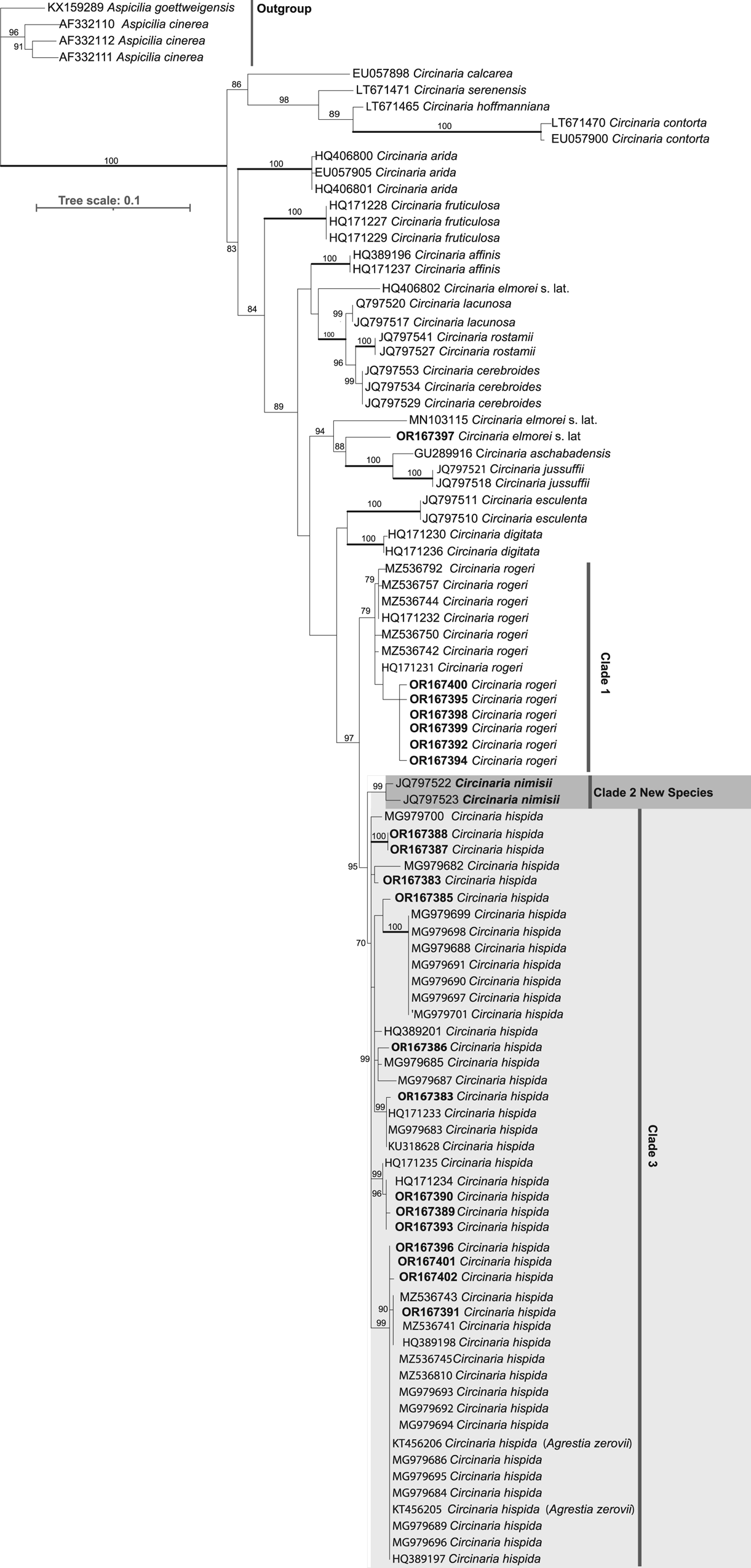
The maximum likelihood (ML) analysis was performed on the CIPRES Science Gateway (Miller et al. Reference Miller, Pfeiffer and Schwartz2010) using RAxML-HPC v. 8.2.10 (Stamatakis Reference Stamatakis2014) and the GTR + G + I model (Stamatakis Reference Stamatakis2014). We performed a non-parametric bootstrap analysis with 1000 replicates. The maximum likelihood consensus tree is shown, with bootstrap values indicated at branches (Fig. 2). The final matrix can be obtained from the corresponding author and is deposited in TreeBase (number pending).
Results and Discussion
In total, 20 new ITS sequences were generated (Table 1). The final ITS alignment comprised 95 sequences and spanned 544 aligned nucleotide position characters.
Voucher details, GenBank Accession numbers and published resources for Circinaria specimens used in this study. New sequences are indicated in bold. Aspicilia specimens were used as outgroup.

Taxonomy
Circinaria nimisii Sohrabi, H. Mayrhofer, Obermayer & S. D. Leav. sp. nov.
MycoBank No.: MB 846975
Thallus vagrant, more or less globose, similar to Circinaria gyrosa Sohrabi et al. but differs in having well-developed, horizontally orientated coralloid, flattened lobes, folds or very thick thalline lobes often forming a distinct, erected areole-like surface, attached to the central portion of the thallus; genetically distinct based on nuclear ribosomal ITS.
Type: Greece, Macedonia, Pieria, Óros Ólimbos (Mt Olympus) between refuge ‘SEO’ and refuge ‘C’, E of Mt Stefani, 45°05ʹN, 22°21ʹE, 2670 m, meadows with calcareous pebbles, on the ground (vagrant), 19 September 1989, H. Mayrhofer 15811 (GZU—holotype; ASU, B, C, CANB, CANL, E, G, GZU, H, HAL, HMAS, LE, M, MAF, MIN, O, TNS, UPS, MICH, PRM—isotypes).
(Fig. 1)
Circinaria nimisii (H. Mayrhofer 15811: A–F holotype in GZU; G & H isotype in H). A & B, thallus (in A with apothecia). C, aspicilioid apothecia arising from the thallus. D, phenotype with abundant pseudocyphellae forming conspicuous whitish dots. E, asci (in KOH) with thickened tholus and spores (the ascus furthest to the right has burst at the base and thus the apical tholus protrudes into the ascoplast). F, conidia (in KOH). G, section through a pycnidium (stained with lactophenol cotton blue). H, section through the thallus showing the typical cortex type with a paraplectenchymatous tissue (stained with lactophenol cotton blue). E & F photographed using differential interference contrast microscopy. Scales: A & B = 2 mm; C & D = 0.5 mm; E, G & H = 20 μm; F = 10 μm. In colour online.

Thallus free (vagrant), subfruticose to tiny folding branches or flattened lobes, forming pebble-like clumps, 0.5–2 cm tall and 0.5–2 (–3) cm wide, usually spherical, rounded, sometimes irregularly shaped, rarely flat, often coralloid, plainly lobe-like branching; compact, predominantly irregularly flattened lobes dense, often forming a distinct, erected areole-like surface, attached to the central portion of the thallus, very compact, short to relatively elongate; main lobes radiating from the central axial part, usually wider up to 1.5–5 mm diam., tough in uppermost parts and more or less rimose, verrucose to verruculose, and somewhat flattened on top, up to 0.2–0.6 cm in the oldest part. Surface exposed side usually dull brown, brownish grey to greyish green, sometimes whitish grey, pale olive-brown to pale brown; surface on the covered side usually darkish green to dark brown, greenish brown or almost dark green-brown (sometimes reddish brown when ferriferous oxides are present in the soil). Branch tips not tapering, pulvinate, not blackened. Pseudocyphellae very common, ±white spots along the folding branches or flattened lobes and usually seen on top of folding branches or flattened lobes; cortex one layer, (15–)20–40(–65) μm thick, paraplectenchymatous, ±brown, c. 2–3 cells thick, cells (4–)6–10(–12) μm diam., inner part indistinct, mixed with prosoplectenchymatous tissue of medulla and sometimes making a distinct layer with (30–)40–80(–90) μm tall epinecral layer (fluctuation of algal cells in the medulla layer make it uneven, without a distinct border and difficult to distinguish from the proper cortex layer), 1–5(–12) μm thick. Photobiont chlorococcoid, cells ±round, 5–22 μm diam., clustered in small groups, each group up to 80–180 × 50–110 μm wide. Medulla white, often muddy, depending on lump size, 0.3–10 mm, I−, containing calcium oxalate crystals.
Apothecia aspicilioid, round to somewhat irregular, adnate to stipitate, rare, up to 0.5–1.5(–2) mm wide, among the folding branches or flattened lobes in older parts. Disc black to brown-black, pruinose, concave to convex when young, becoming flattered when old. Thalline margin flat to ±elevated and prominent in older apothecia, entire, concolorous with thallus or with a thin to thickened white rim. True exciple (25–)35–85(–95) μm wide, ±I+ medially blue, uppermost cell brown, ±globose, 4–5(–7) μm diam.; epihymenium: K+ colour fading from brown to light yellowish green, N+ pale green; hymenium hyaline, occasionally with a few oil drops, (100–)110–140(–150) μm tall; paraphyses moniliform to submoniliform, with upper cells ±globose, 4–7 μm wide, in the lower part 5–9 × 2–3 μm wide, branched; hypothecium and subhymenium pale, (35–)45–65(–85) μm thick, I+ blue. Asci broadly clavate, (80–)90–100(–110) × 25–35 μm, with a thick apical dome (thollus) (20–30 μm tall), 2–4(–5)-spored. Ascospores hyaline, simple, globose to subglobose, (13–)15–19.1–20(–23) × (12–)14–18.6–20(–22) (n = 30).
Pycnidia usually on top of folding branches or flattened lobes, immersed, single, stretched flask-shaped, internal wall colourless, frequently with black to brownish ostiole. Conidia filiform, straight to very slightly curved, (8–)10–14(–17) × 1–1.3 μm.
Chemistry
All spot tests (K, C, KC, CK, P, I) were negative in both the cortex and medulla; UV−. TLC and HPLC: no substances detected.
Etymology
The species is named in honour of Prof. Pier Luigi Nimis, an Italian lichenologist who supported the first author at the initial stages of Iranian lichenology, and author of the ITALIC (versions 1–7) lichen website which has made significant contributions to the development of lichenology in the world.
Ecology and distribution
Circinaria nimisii occurs terricolously between small pebbles of limestone and scattered cushions of perennial grasses and herbs. It grows in the alpine belt at open wind-exposed locations with steppe-like conditions. It is so far known only from the Plateau of Muses on Mount Olympus in Greece.
Remarks
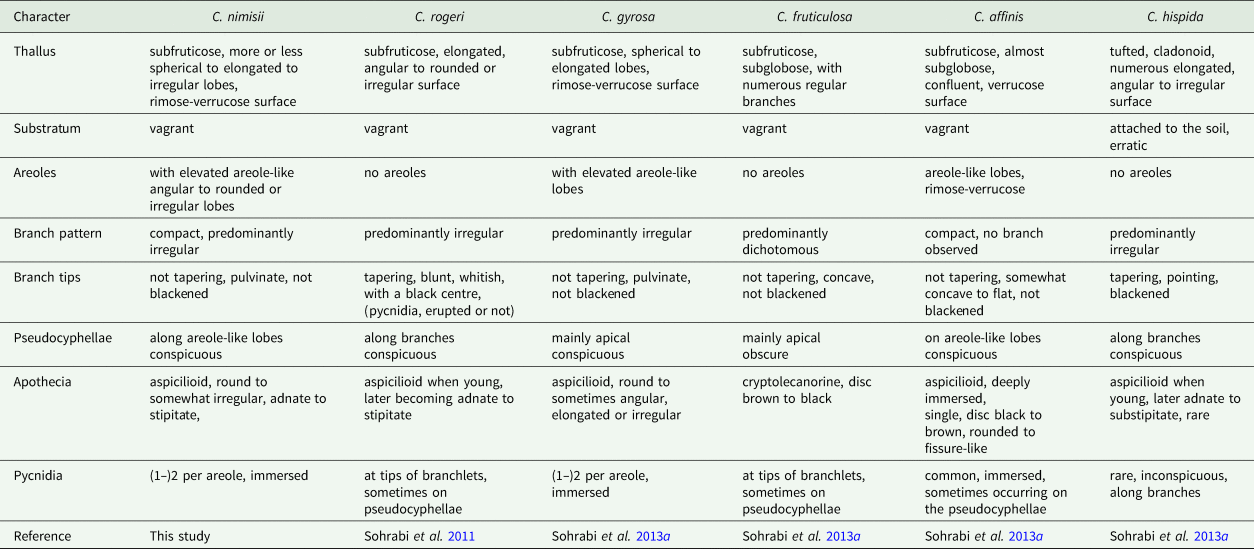
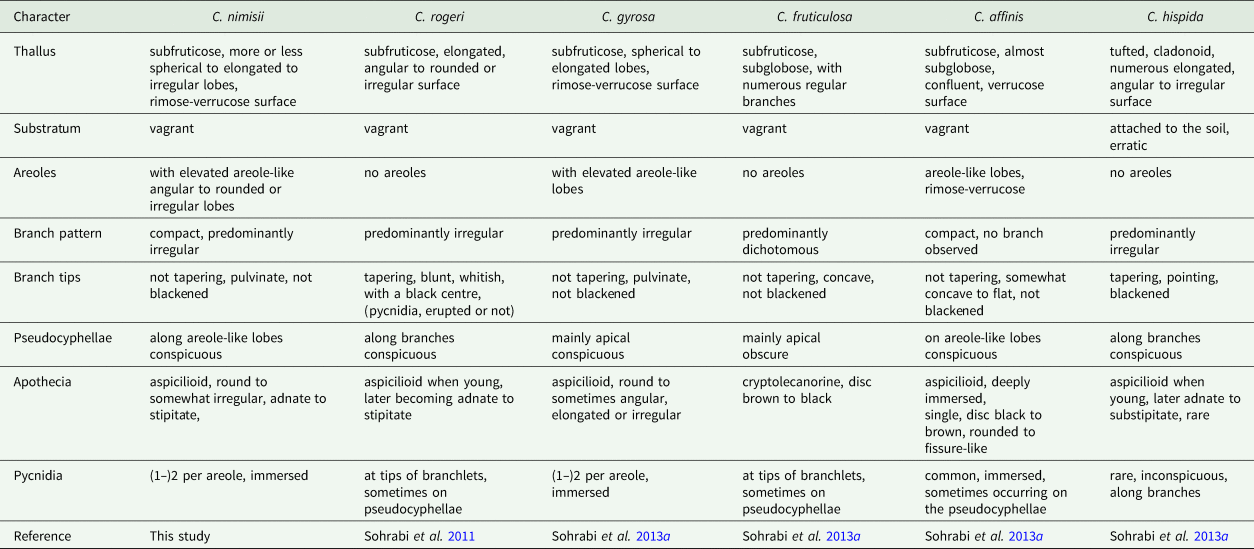
Circinaria nimisii is a distinct subfruticose species, separated from related species by ITS sequence data as well as morphological and anatomical characters (see Table 2). The gross morphology of the thallus in C. nimisii resembles that of C. gyrosa and C. rogeri (Sohrabi) Sohrabi. Circinaria nimisii is characterized by its muddy or earthy colour and subfruticose thallus with whitish pseudocyphellae on tips of folding branches or flattened lobes, 2–4 spored asci, ascospores smaller than those in C. gyrosa, C. hispida and C. rogeri, with oil drops, and conidia that are somewhat longer than in C. hispida. Circinaria fruticulosa differs from C. nimisii by its blackish olive, greyish brown and vagrant, convoluted, aggregated verrucose thallus, well-developed branches more or less rounded to cylindrical, radiating in different directions from the central part, apothecial disc with white rim, and filiform, needle-shaped conidia. Circinaria affinis (Eversm.) Sohrabi differs from C. nimisii by its confluent thallus with verrucae and by lacking branches. Circinaria digitata differs from C. nimisii by its thallus morphology, especially with its relatively finger-like, elongated and branched thallus (Sohrabi et al. Reference Sohrabi, Ahti and Litterski2011a).
A comparison of Circinaria nimisii with morphologically similar species.
Based on ITS sequence data, C. nimisii is most closely related to C. hispida (Fig. 2). However, C. hispida s. str. is directly attached to soil (Rosentreter Reference Rosentreter, Glenn, Harris, Dirig and Cole1998; Sohrabi et al. Reference Sohrabi, Stenroos, Högnabba, Nordin and Owe-Larsson2011b), while C. nimisii is strictly vagrant. Furthermore, morphological differences exist between C. nimisii and the vagrant morphotype of C. hispida s. str. (sensu Mereschkowsky Reference Mereschkowsky1911; Sohrabi et al. Reference Sohrabi, Stenroos, Myllys, Søchting, Ahti and Hyvönen2013). Circinaria hispida s. str. is a subfruticose lichen, forming tiny, bushy thalli with narrow cylindrical branches and black apices at the branch tip, along with scattered whitish pseudocyphellae throughout the thallus, with two types of cortex: paraplectenchymatous and prosoplectenchymatous. The crustose morphotypes of C. hispida are more similar to C. nimisii in terms of how they both colonize pebble surfaces, and C. nimisii can be further diagnosed by the presence of the one-layered cortex (paraplectenchymatous). DNA sequence data from the standard DNA barcode (ITS), consistently separates C. nimisii from the morphologically similar C. hispida specimens (Fig. 2).
Phylogenetic relationships of Circinaria species based on a maximum likelihood (ML) analysis of the ITS nrDNA data set. ML bootstrap values ≥ 70% are adjacent to branches and branches with 100% support are shown in bold. The new species is shown in a grey box and three clades are indicated, with GenBank Accession numbers of new generated sequences shown in bold. Specimens of Aspicilia are outgroup. Information on the specimens used in this analysis is given in Table 1.
Phylogeny
In the phylogenetic analysis of the ITS multiple sequence alignment, C. nimisii was recovered within the sphaerothallioid species group, with close affinities to C. hispida (Clade 3), C. rogeri (Clade 1) and C. digitata (HQ171230, HQ171236). The new species is strongly supported as a distinct clade (Clade 2) in the ITS phylogeny (Fig. 2).
Additional specimens of C. hispida examined for morphological comparison
Kazakhstan: Aklushenskaya District, Bayzhanshal limestone ridge, 1957, Andreeva (LE). Akmola Region: near Kökshetau Mts, S direction, 1957, Andreeva (LE).—Kyrgyzstan: Naryn Region: northern side of Naryn-Twell Valley of River Naryn, 23 km to the E of Naryn Mountain, 2250 m, 1970, Bredkina (LE).—Iran: Hamadan Province: foothills above Gholi-Abad, c. 60 km N of Hamadan, 1800 m, 1974, Alava 14749-d (TUR). East Azerbaijan Province: Marand District, 32 km N of Marand towards Jolfa, 1440 m, 2007, Sohrabi et al. 10102 (hb. M. Sohrabi); ibid., Zonuz, 20 km N of Marand towards Jolfa, 1800 m, 2007, Sohrabi et al. 10064 (hb. M. Sohrabi); Jolfa District, 1 km S of Daran Village, E of Hadishahr, 1700 m, 2007, Sohrabi et al. 10136 (hb. M. Sohrabi).—Italy: Piedmont Region: Province of Cuneo, Alpi Liguri, Cima di Pertega, W above the village of Úpega, just E below the summit, c. 2400 m, 2000, Hafellner & Hafellner 59353 (GZU, TSB); ibid., Alpi Cozie, crest SW above Colle dell'Agnello, c. 2830 m, 2000, Hafellner 59364 (GZU).—Greece: Mt Parnassus, Fterolaka, near the cableway, 1850 m, 1989, Tretiach & Roux (TSB).—Mongolia: Zavkhan Province [correctly Govi-Altai]: Taishir sum, right bank of Zavkhan River, c. 2 km N of Taishir Town, 1978, Biazrov 8373 (LE).—Russia: Astrakhan Oblast: near Lake Baskunchak, 1926, Tomin (H); ibid., 1926, Tomin 37 (FH, H); ibid., 1927, Tomin 56 (FH, H); Regio Astrachanensis per declive (in parte superiore) montis Bogdo ad terram inter gramina, fruticulos lapidesque crescit, saepe libere vagature, 1926, Savicz, in Savicz: Lich. Ross. no. 97 (FH, GZU, H, W).—Turkey: Malatya Province: Malatya, Pınarbaşı mesire alanı ve çevresi, 931 m, 2003, Candan 11 (H).
Circinaria hispida (Mereschk.) A. Nordin, S. Savić & Tibell
In Nordin et al., Mycologia 102, 1346 (2010) (fig. 5a–c in Sohrabi et al. (Reference Sohrabi, Stenroos, Myllys, Søchting, Ahti and Hyvönen2013)).—Basionym: Aspicilia hispida Mereschk., Trudy Obshch. Estestvoisp. Imp. Kazansk. Univ. 43 (5), 10, 35 (1911); type: Russia, ‘Ad terram argilloso-calcaream montis Bogdo prope lacu, Baskuntschak in gub Astrachan’, 50–120 m, 1910, Mereschkowsky in Mereschkowsky: Lich. Ross. Exs. no. 34 (TU—lectotype designated by Sohrabi & Ahti (Reference Sohrabi and Ahti2010); LE L1988, W—isolectotypes).
Syn. nov.: Agrestia zerovii S. Y. Kondr. et al., MB 813878; type: Ukraine, Kharkiv Oblast (= region), Dvorichansky District, in the vicinity of Dvorichana settlement, Korobchyno protected territory (= zakaznik), 49°50ʹ00.5ʺN, 37°40ʹ27.7ʺE, the upper part of the slope, W from the road, below plantation, leg. Gromakova, A. B., s. n., 27.05.2012, (KW-L 70479—holotype); the same locality (KW-L 70480, KHER, CWU—isotypes).
Note
Morphological characteristics and the ITS sequence variation of Agrestia zerovii S. Y. Kondr. et al., published in Kondratyuk et al. (Reference Kondratyuk, Gromakova, Khodosovtsev, Kim, Kondratiuk and Hur2015), fall within the typical variation of C. hispida. Therefore, we propose that A. zerovii is considered a new synonym of C. hispida. We also propose that the identification of EU057905 in Nordin et al. (Reference Nordin, Tibell and Owe-Larsson2007) is corrected in GenBank.
Acknowledgements
We are indebted to the curators of various herbaria (FH, H, LE, TUR, TU, W) for the loan of specimens examined during this study. We also thank Leena Myllys (Helsinki) for the loan of several interesting species of Circinaria, including C. rogeri and C. nimisii. HM thanks Eva Barreno and Arnoldo Santos for their excellent assistance and splendid fellowship during the field trip to Mount Olympus in 1989, and the University of Graz for financial support. The Iranian Research Organization for Science and Technology (IROST) provided financial support (grant number 1402- 023586).
Author ORCIDs
Mohammad Sohrabi, 0000-0003-4864-3905; Steven D. Leavitt, 0000-0002-5034-9724.