Many local leaders view neighborhood activism and participation as a key source of policy information and a critical form of civic engagement. Almost half of mayors selected neighborhood meetings as one of the top two ways they learn about their constituents’ views,Footnote 1 and the National League of Cities highlighted neighborhood meetings as a critical component of community engagement.Footnote 2 The celebration of neighborhood participation is not new. President Lyndon B. Johnson’s Community Action Program—part of the 1964 Economic Opportunity Act—institutionalized neighborhood involvement in the allocation of federal urban spending. President Jimmy Carter made neighborhoods a cornerstone of his administration’s housing programs.Footnote 3 Scholars of local government, and normative theorists more broadly, contend that institutions that spur neighborhood-based political participation help provide voice to underrepresented groups, enhance citizen efficacy, and are integral to a thriving democracy.Footnote 4 Moreover, such institutions may offer opportunities for compromise via deliberative democracy.Footnote 5 Indeed, the local level may offer the most potential to benefit from such institutions as participation and efficacy are greater in smaller jurisdictions.Footnote 6
In some ways, local institutions that enable direct citizen involvement echo national efforts to increase political participation among socioeconomically disadvantaged voters. In response to participatory inequalities, some policymakers and advocates have pursued a variety of initiatives designed to facilitate registration, offer more early voting, and shorten lines at polling places, for example. These policies may, however, have unanticipated consequences. In some cases, they may exacerbate the very inequities they attempt to solve. Berinsky finds that reforms designed to facilitate voting actually increase socioeconomic inequalities in turnout;Footnote 7 de Kadt uncovers a similar phenomenon in South Africa.Footnote 8 Burden et al.Footnote 9 show that, while Election Day registration has a positive effect on overall turnout, early voting appears to decrease turnout in isolation.
Institutions designed to encourage and empower neighborhood participation in local politics could also have distorting consequences for the distribution of influence. We examine this possibility using the substantively important case of housing policy. In the wake of the excesses of urban renewal and the dominance of pro-growth, developer-oriented urban politics,Footnote 10 local governments have promulgated institutions designed to constrain developers and empower neighborhood-level and environmental interests.Footnote 11 One example is a movement in many localities to allow and encourage neighborhood participation in zoning and planning board meetings. Such participation gives neighbors an opportunity to inform appointed board members and local elected officials of their views on projects ranging from large developments to modest renovations. It also offers the potential to extract concessions from developers (sometimes directly).Footnote 12
However, participatory opportunities may amplify some voices more than others. The concentrated costs of development projects in particular may create strong incentives for neighborhood groups that are highly affected by a proposal to mobilize against development. In contrast, the diffuse benefits of an increased housing supply are less likely to motivate participation from the broader population of a city/region that might benefit from more housing. Land use regulations may provide these highly motivated individuals the tools with which to restrict higher-density projects.
This failure to construct an adequate supply of housing has important policy consequences. The Obama White House identified national housing affordability as a critical policy challenge, arguing that “the growing severity of undersupplied housing markets is jeopardizing housing affordability for working families, increasing income inequality by reducing less-skilled workers’ access to high-wage labor markets, and stifling GDP growth by driving labor migration away from the most productive regions.”Footnote 13 The lack of affordable housing in areas with high mobility could have a profound negative impact on many children’s life opportunities.Footnote 14 While housing crises in some of the nation’s coastal cities have been the focus of media attention, a lack of affordable housing is a national crisis. There is not a single county in the country in which a minimum-wage earner can afford an average two-bedroom rental.Footnote 15 Housing affordability and supply are inextricably linked. Economists have attributed the current affordability crisis in large part to insufficient supply.Footnote 16 Moreover, insufficient housing supply may hamper efforts at environmental sustainability. Greater housing density helps reduce sprawl and is a cornerstone of local efforts to mitigate climate change.Footnote 17
We ask how participation may play a role in restricting development. To assess local political participation, previous studies have relied primarily on surveys, voting, case studies of meetings, and aggregate-level analyses of meeting participation.Footnote 18 In contrast, we rely on directly observing both who participates in policy discussions about housing development, and how they participate. We do so across a range of communities by compiling and coding new data on all citizen participants in planning board and zoning board meetings dealing with the construction of multiple housing units in 97 Massachusetts cities and towns. We match thousands of individual participants to the Massachusetts voter file to explore who participates in local political meetings. This data set is the first comprehensive effort to measure the behavior of community meeting participants. Moreover, we juxtapose the opinions of meeting attendees with the vote on a statewide housing ballot referendum to provide a novel comparison of attendee views with those of the broader public. This allows us to learn two separate attributes of meeting attendees: (1) whether they are demographically representative of their broader communities, and (2) whether they are attitudinally representative of their broader communities.
We find that meeting participants are unrepresentative of the broader public in a variety of ways. They are more likely to be older, male, longtime residents, voters in local elections, and homeowners. Moreover, these individuals overwhelmingly oppose the construction of new housing: almost two-thirds of these participants speak out in opposition to new housing development. A sizable minority of meeting participants—especially housing opponents—are repeat participators who attend multiple meetings to speak out about local housing projects. Meeting attendees generally raise a wide variety of issues, from concerns about local trees to traffic. These results suggest that the structure of public meetings surrounding housing development likely contributes to a failure in many locations to produce a sufficient housing supply. More broadly, they reveal that institutions designed to enhance democratic responsiveness may have perverse consequences on participation and the views that policymakers hear.
We make two important contributions. First, while a multitude of political science studies have identified inequalities in political participation, this is the first that is able to document inequalities in who shows up to salient public meetings. Rather than using surveys or vote returns, this study is the only one to our knowledge that directly observes participants in politics to precisely measure inequalities. Second, it makes a novel theoretical argument about the nature of participation in housing policy. We argue that even in areas where public opinion broadly favors redressing housing shortages with increased supply, specific housing development proposals will disproportionately garner opposition that is empowered by local institutions. In the housing policy arena, institutions and behavior align in a way that enable non-majoritarian outcomes with tangible implications for housing availability.
Who Participates
At the heart of all of the predictions outlined below are general and fundamental questions about grass-roots democracy. Throughout our analysis, we consider two competing views about neighborhood-level civic engagement on housing policy. The first is that these meetings are an opportunity for efficacious civic engagement, and mediation of competing interests.Footnote 19 The second, in contrast, views neighborhood activism as captured by a small, unrepresentative group with strong views.Footnote 20
A wide body of scholarship in American politics suggests that more socioeconomically advantaged individuals are more likely to participate and to have their voices amplified in key policy discussions.Footnote 21 Political science research also generally finds higher levels of political participation among the elderly, who have the time, resources, and policy interest that allow for and encourage involvement in politics.Footnote 22 Those who have lived in the same place for a greater duration and those who own their homes also participate in politics at higher rates. Men—especially white men—are more likely to engage in direct contact and collective action relative to women.Footnote 23 We suspect these broad findings will also apply to participants in neighborhood meetings. This would fit with research on participatory small-group decision processes that contends that such institutions are unrepresentative in similar ways to other forms of political participation.Footnote 24
While participatory inequalities have been widely studied—though not precisely measured—it is less obvious whether meeting attendees will be predisposed to hold particular attitudes. Accounts of anti-development, NIMBY (not in my backyard) sentiments among homeowners generally predominate urban politics research.Footnote 25 Many contemporary commentaries on housing, however, point to the influence of a new housing coalition featuring poverty and affordable housing advocates, developers, and urban planners as a potential check on NIMBY sentiments from entrenched homeowners.Footnote 26 Indeed, recent evidence from ballot initiatives and surveys suggests that, in liberal communities, mixed-income developments may generate at least some public support, with individuals basing their preferences for housing on ideology rather than pure economic self-interest.Footnote 27
We argue that the development of new housing may disproportionately induce participation from individuals with unrepresentative opinions. The potential externalities of housing proposals are spatially concentrated while the benefits are diffuse. Proposed housing developments have potentially profound effects on neighborhood property values, amenities, and quality of life.Footnote 28 Increasing the housing supply reduces housing prices.Footnote 29 This reduction in housing prices would adversely impact the economic interests of local homeowners. Interestingly, renters may also feel that new housing developments are detrimental to their economic interests. Recent experimental evidence suggests that renters in high-cost housing markets believe that new developments will raise their rents.Footnote 30
Moreover, housing developments frequently represent stark changes in neighborhood environments and composition. Studies of racial and ethnic politics have found such rapid changes to be strong motivators for attitudes and behavior.Footnote 31
In contrast, we anticipate that proponents of new housing developments will be comparatively less likely to attend meetings on proposed projects. The economic benefits of new housing supply are diffuse. Any change in housing affordability from a single project is likely to be barely perceptible, particularly when weighed against the visible costs experienced by a narrower subset of the neighborhood. Indeed, even if the benefits were comparable, prospect theory suggests that losses have a greater impact on behavior than equivalently sized gains.Footnote 32 Moreover, at least some of the individuals most likely to benefit from a new housing development (potential new residents) live outside the jurisdiction in which the development is proposed. In contrast, virtually all of those experiencing the costs of new housing already reside in that jurisdiction. Relative to supporters, then, housing development opponents are more likely to (1) be informed about developments happening in their community and (2) be able to target their own appointed/elected officials in voicing their views about housing. Both information and efficacy are positively associated with political participation.Footnote 33
Interestingly, this bias towards opposition to specific projects may differentiate housing from some other areas. We contend that even those individuals who are predisposed to support the construction of affordable housing in the abstract will be inclined to oppose specific housing project proposals in their communities. This sharply differs from immigration policy, for example. Iyengar et al. find that citizens in advanced industrialized democracies support the admission of individual immigrants, while generally opposing more open immigration policies.Footnote 34
In addition, we also anticipate that those who participate will do so with high intensity and frequency. The factors listed earlier that should disproportionately spur opposition to local housing development will likely also foment strong public opinions. Intense viewpoints are linked with a greater propensity for political participation.Footnote 35 Therefore, we expect meeting attendees in general—and, in particular, opponents of new housing development—to turn out repeatedly.
Finally, we expect participants to exhibit high levels of expertise. In previous predictions, we suggested that participants are likely to be socioeconomically advantaged and perceive significant costs of proposed housing developments. We might expect a highly educated group that views changes to the housing stock as a major threat to learn about and cite local zoning laws and land use regulations. They may also solicit the views of experts—such as lawyers, engineers, architects, and other real estate professionals—to provide strong and well-sourced arguments about a potential housing development. This expertise might lead to well-informed neighborhood dialogue, but it could also exacerbate political inequalities. Lupia and Norton suggest that deliberative democracy may not work as intended if participating interlocutors use sophisticated language as a form of political power to drown out other policy discussion.Footnote 36
Perhaps strikingly in the context of rising national partisan polarization, we do not expect partisanship to predict participation in housing meetings or to affect the issues that individuals raise.Footnote 37 While partisanship certainly impacts local politics, we anticipate that the immediacy of neighborhood-level concerns will swamp partisan leanings on housing issues.Footnote 38 Indeed, Marble and Nall use survey experiments to show that liberal homeowners—while generally favorable towards redistributive programs—prioritize their home values over their ideological preference for affordable housing.Footnote 39
Data and Methods
To evaluate who participates, we assembled a novel data set of all citizen participants in planning board and zoning board meetings between 2015–2017 in 97 cities and towns in metropolitan Boston. One reason we focused on Massachusetts is data availability. As a consequence of the Commonwealth’s open meeting law, Massachusetts localities are required to provide detailed meeting minutes for all public bodies. These minutes must include “a summary of the discussions on each subject.” A majority of cities/towns in metropolitan Boston have interpreted this to mean including the names and addresses of all members of the public who speak at these meetings.
In addition to the data availability, the Boston metro region has other advantageous traits for studying participation in the politics of housing development. While compact, the Boston metro area includes an unusual number of independent cities and towns. Indeed, there are dozens of autonomous local communities with their own demographics, politics, and local regulations within 50 miles of Boston. Boston’s surrounding communities range from small, leafy, bedroom towns to more diverse small cities. The housing stock in the area includes estates, modest starter homes, three family “triple deckers,” and taller modern apartment buildings. While the eastern Massachusetts economy and housing marking are doing quite well relative to other parts of the country, there is still great variation across municipalities in terms of housing demand, availability, and cost. Moreover, the strength of the overall housing market is an asset for this study because it means there is demand for housing, and a market for new development almost everywhere. Lastly, the fact that eastern Massachusetts is generally liberal makes it a difficult test for some of the hypotheses. It is disproportionately populated by people who, in the abstract, would tend to support more housing and efforts at improving access to affordable housing.
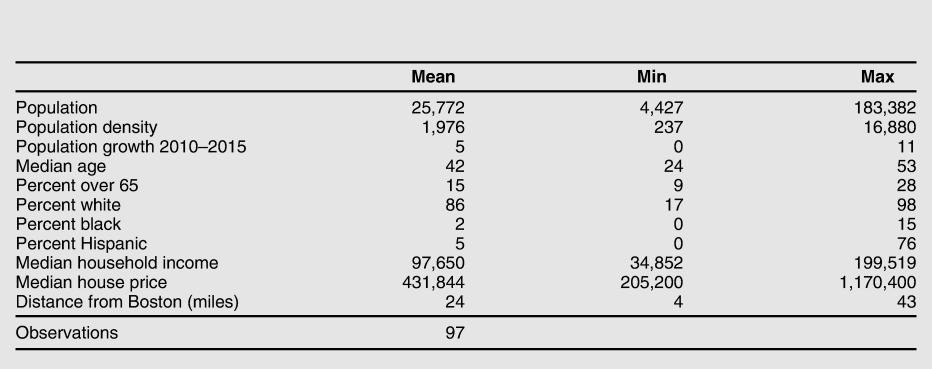
In table 1, we provide summary statistics about a variety of traits (mean, minimum, and maximum) for the 97 cities and towns for which we have coded meeting comments. The data show, our sample is, as would be expected in eastern Massachusetts, relatively white (86% on average) and affluent. More important than the means are the ranges of these variables, many of which are directly pertinent to our theoretical expectations. For example, the sample has tremendous variation in terms of residential density (237 to nearly 17,000 people per square mile), housing prices ($200K to $1.2MM median), population growth (0% to 11% from 2010–2015), and age (9% to 28% over 65).Footnote 40
Traits of cities and towns for which we have participation data

To assemble our dataset, we downloaded all available public hearing minutes for local planning and zoning boards. In all cities and towns, these are the two bodies responsible for reviewing any housing developments not permitted by right under local zoning code. Such housing projects were publicly reviewed by one or both bodies. In many of these meetings, owners or developers are petitioning for variances (exceptions) to the underlying regulations. Under Chapter 40A in Massachusetts, all public hearings for such bodies are published in “a newspaper of general circulation in the city or town once in each of the two successive weeks, the first publication to be not less than fourteen days before the day of the hearing.” Cities/towns also are required to post a notice “in a conspicuous place in the city or town hall” with similar advanced notice. Moreover, the city/town also must mail a notice of a public hearing to “parties of interest,” which are defined as “the petitioner, abutters, owners of land directly opposition on any public or private street or way, and abutters to the abutters within three hundred feet of the property line of the petitioner as they appear on the most recent applicable tax list.”Footnote 41 We utilized all minutes that were posted on cities’ and towns’ websites.
The public hearings captured in our database covered a wide range of policy areas, ranging from the construction of large multifamily or mixed use housing developments with hundreds of rental units to the addition of wireless communication towers. We focus on all hearings concerning housing developments featuring the construction of more than one unit of housing.Footnote 42 This focus reflects our interest in the politics of increasing housing supply via densifying communities with high demand. Even within this more limited policy category, public meeting minutes exhibit enormous variation. Some of these projects are relatively small (e.g., a family seeking to add an accessory apartment), while others are expansive proposals from large professional development companies. Some meetings feature comments from one neighbor who shows up to support a friend in obtaining a variance from local zoning regulations. Others, in contrast, are filled with dozens of comments from residents with deep concerns about a proposed project.
Using these minutes, we created a database of all public comments surrounding the development of more than one housing unit. Each observation—which is at the comment level—includes the name and address of the meeting participant.Footnote 43 We also code whether the individual supports, opposes, or is neutral about a proposed housing development. Finally, when available, we also include a code describing the reason(s) the participant expressed along with her support/opposition/neutrality. These reasons encompassed a wide variety of topics, including parking, environmental concerns, traffic, density, affordability, noise, aesthetics/history, property values, and septic systems, among others.Footnote 44 A full codebook describing these categories and criteria for inclusion is included in the Appendix. Because some of the meeting minutes provide extraordinary detail—including in some cases exact transcripts of proceedings—we are also able to analyze valuable qualitative data.
Even without merging these data with any other information, we can make valuable observations. Because each public comment is an observation, we can calculate the proportion of meeting attendees who are repeat participants (and how many meetings these individuals attend). Moreover, we can learn the proportion of individuals who support/oppose the development of additional housing and the reasons they typically cite.
What’s more, because we have the names and addresses of these individuals, we can merge them with data from the Massachusetts voter file to learn more about their demographics. Using a fuzzy matching algorithm, we link meeting commenters with registered MA voters.Footnote 45 We were able to match 2,580 of the 3,123 people in the set of participants (82.6%). As some people commented more than once, we were able to match the speakers of 85.4% of the comments to the voter file.
The voter file offers some important demographic data about these meeting participants, and allows us to compare these individuals to city/town-level demographics. In particular, the voter file provides data on individuals’ age, gender, partisanship, history of voter turnout in elections at all levels, and registration date at current address (which we use as a rough proxy for duration of residence). While this analysis obviously will not convey a complete picture of (un)representativeness—it does not include income or race, most notably—it offers unprecedented insight into the individuals who participate in local democratic proceedings.
Results
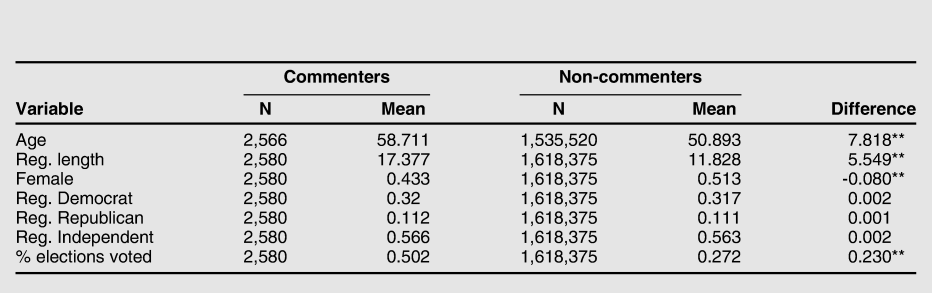
We begin by using the voter file to compare those who participated in local meetings to those in their towns who did not. Table 2 presents the difference in means between commenters and non-commenters. On average, meeting participants are older, have lived at their residence for longer (proxied by the length of their voter registration at that location), and are more likely to be men. Women constitute 51.3% of the voter file, but only 43.3% of the commenters at development meetings. As expected, we find no differences in partisanship. Democrats, Republicans, and Independent/Unaffiliated voters participate at similar rates. There are significant differences based on vote history. The individuals who participated in development meetings voted at roughly twice the frequency of those who did not.Footnote 46
Difference in means between commenters and all voters

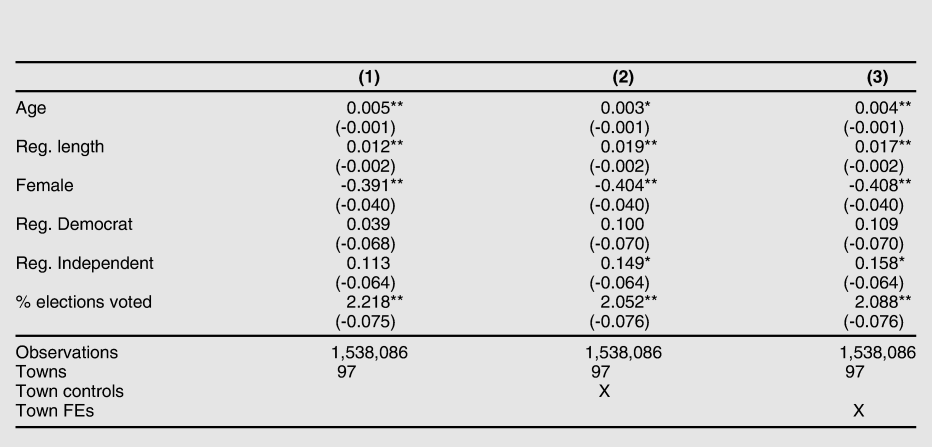
Table 3 presents logit models using the full voter file, where the dependent variable is an indicator of whether or not the resident participated in a development meeting. The first specification includes only individual-level variables, the second includes town-level controls (town averages for each individual variable), and the third includes town-level fixed effects. The results are consistent across all three specifications.Footnote 47 Voters are more likely to participate when they are older, have lived in the same address for longer, and vote more frequently. Female voters are less likely to participate, and we observe no partisan differences. These results broadly confirm that meeting participants are demographically unrepresentative of their towns in ways consistent with our theoretical predictions.
Logit models of commenters relative to full voter file

Standard errors in parentheses
** p<0.01, * p<0.05
One key independent variable that we cannot assess using the voter file is homeownership. While we are unable to collect homeownership data for the thousands of commenters in the data, we did match the 85 individuals who participated in the Town of Arlington’s Zoning and Planning Board meetings with data from the Registry of Deeds. We selected the Town of Arlington because: (1) the relatively high number of comments (122 comments from 85 individuals) in the town allowed us to make reliable comparisons with town-level demographics, and (2) the town has a good mix of homeowners and renters (39% of the population are renters and 61% homeowners). We find that, consistent with our predictions, homeowners are significantly overrepresented as meeting participants; while 39% of the town rents, renters only comprise 22% of participants.
Next, we assess the proportion of meeting attendees in our full data set who participated in multiple meetings. Most participants only attended a single meeting. Seventeen percent of the commenters in our sample spoke at multiple meeting. The average person made 1.3 comments, and 45 people made five or more comments. Among the participants that we matched to the voter file, the only significant predictor of the number of comments made is political party. Democrats were less likely to make multiple comments, and Republicans were more likely to do so.
Predicting Commenter Positions
Turning to the positions expressed by meeting participants, the overwhelming majority of attendees spoke out in opposition to proposed new housing. Sixty-three percent of all comments were in opposition to proposed housing projects, while only 14.6% expressed support; the remaining 22.8% of comments were neutral. These results strongly suggest that, as predicted, the incentives to show up and oppose new housing are far stronger than those to participate in support.
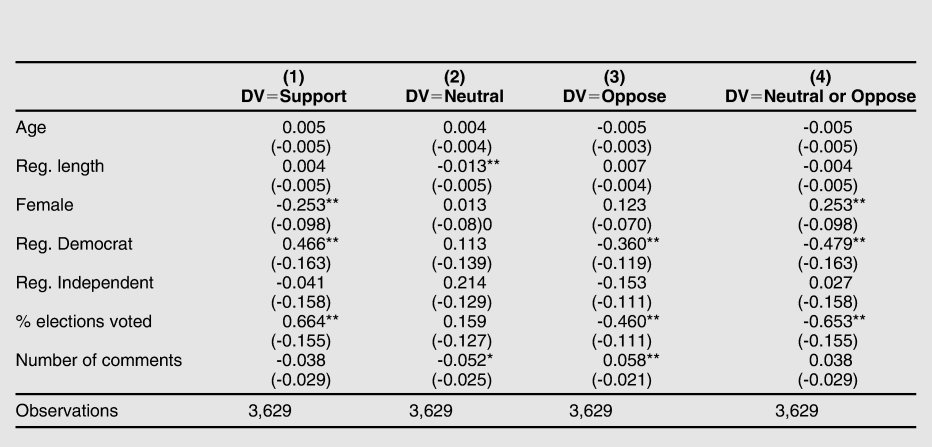
We also use individual-level variables to predict which participants oppose new housing. Table 4 presents the results of this analysis. Consistent with theoretical predictions, all else equal, those who appeared at multiple meetings are more likely to speak in opposition. Women and infrequent voters are also more inclined, on average, towards opposition. Democrats, in contrast, are more likely to support projects and less likely to be neutral or oppose them than independent or Republican participants. This last finding is consistent with Democrats having more progressive views on housing,Footnote 48 but contrasts with much of the media coverage on the NIMBY movement, which suggests that NIMBYism is particularly prevalent among progressives.Footnote 49 Our results suggest that, within the progressive places facing housing crises likely to engender NIMBYism, Republicans are more likely show up to meetings in opposition to new housing. This finding indicates that liberal homeowners and renters may, in some instances, overcome their neighborhood-based opposition to new housing to support more dense housing consistent with their ideological preferences.Footnote 50 Overall, though, support for new housing remains low among both affiliates of both parties: only 19.4% of Democrats and 12.8% of Republicans expressed support for proposed projects at public meetings.
Logit models of commenter positions

Standard errors in parentheses
** p<0.01, * p<0.05
The failure of individual-level demographics like age and gender to predict opposition to housing construction is methodologically important. We theorized that meeting participants would be weighted towards opposition because of a combination of the concentrated costs of new housing, prospect theory, and residence in the jurisdiction where housing is proposed. A propensity towards opposition, however, could also simply be a consequence of the unrepresentative demographics of meeting participants; perhaps older men, for example, are both more likely to participate in planning and zoning meetings and more likely to oppose the construction of new housing. Instead, we find that the predictors of participation in meetings are completely different from those that explain positions in meetings. Older and male individuals are more likely to participate in meetings, but, conditional on participation, age and gender do not predict opposition to new housing.
Support for Housing in the Voting Booth, Opposition at Meetings
We have demonstrated that a large majority of individuals who attend zoning and planning board meetings express opposition to the projects under consideration. To assess if such opposition is disproportionate, we compare meeting participation to the results of an important ballot referendum concerning housing policy. In 2010, Massachusetts held a referendum to repeal Chapter 40B, a law promoting affordable housing that permits developers to bypass local zoning regulations if (1) the town’s housing stock is less than 10% affordable and (2) at least 20–25% of the proposed units have long-term affordability restrictions. Across the state, a majority of voters favored keeping the law, and the referendum to repeal Chapter 40B failed with only 42% of the vote.
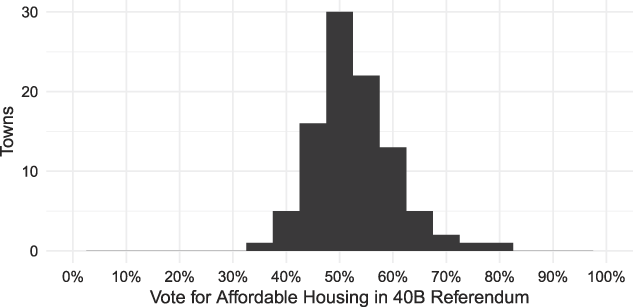
Figure 1 shows the distribution of the vote supporting 40B by town. Across the cities in our sample, 56% of voters in the referendum adopted the pro-affordable housing position and opposed repeal of Chapter 40B, and there was majority support against repeal in 61 of the 96 towns.Footnote 51 This comports with state-level figures, where 58% of voters opposed the repeal. This is a significantly greater level of support than evinced by the mere 15% of meeting commenters who spoke in support of the construction of new housing. This is especially striking given that Chapter 40B deals exclusively with affordable housing. We would expect opposition to affordable housing to be greater than opposition to market-rate housing based on prior scholarship on public opinion surrounding housing.Footnote 52 If anything, then, our measure of general public opinion is biased towards opposition, and should be more similar to the opinions evinced in our meetings minutes. The relative toughness of this particular test makes the 40-percentage point difference between 40B support and support for housing projects at public meetings all the more striking.
Support for 40B referendum

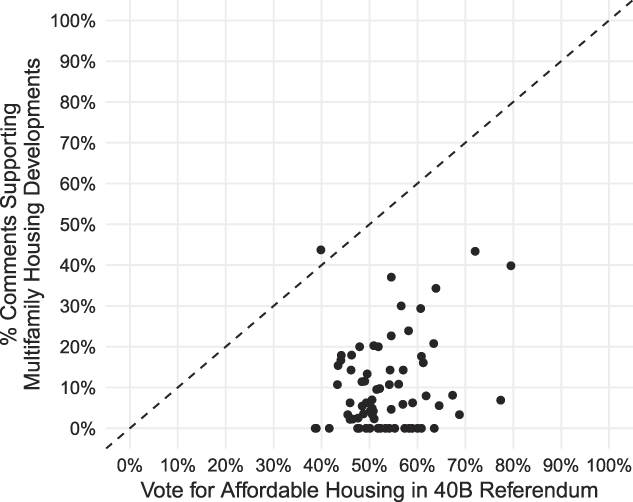
Figure 2 shows the relationship between town-level vote against repealing Chapter 40B and the percentage of comments in each town that were supportive of multifamily housing developments.Footnote 53 While there is a positive correlation between opposition to the 40B repeal and positive comments, in every town, fewer than half of the meeting comments were positive. For example, in Cambridge, the town with the highest support for 40B (80% of voters opposed repeal), only 40% of comments at development meetings supported new housing. Indeed, almost every town in Massachusetts exhibited higher support for Chapter 40B than for the development of specific new housing projects. While voters in these towns supported affordable housing construction in the abstract, a significant majority of those who attended development meetings opposed the development of specific project proposals.
Support for 40B referendum and multifamily housing developments

Reasons Expressed for Supporting and Opposing Development
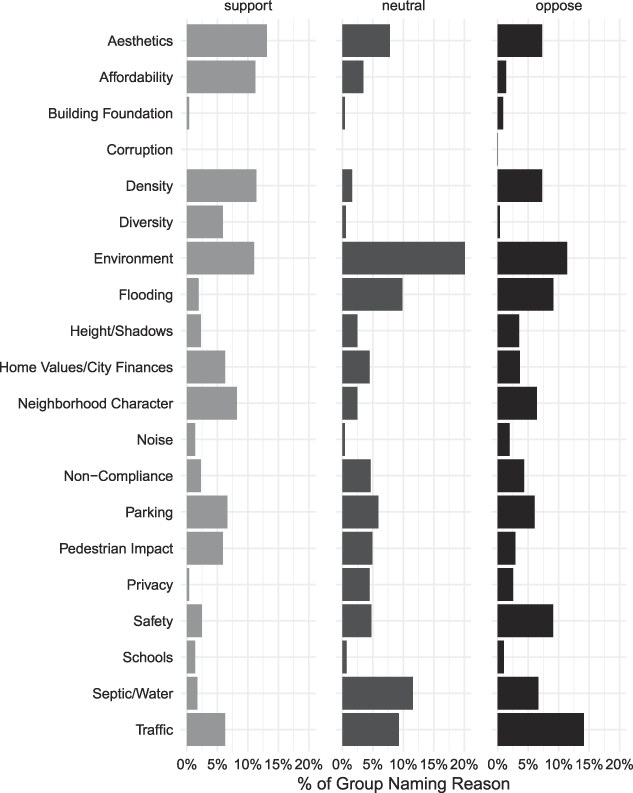
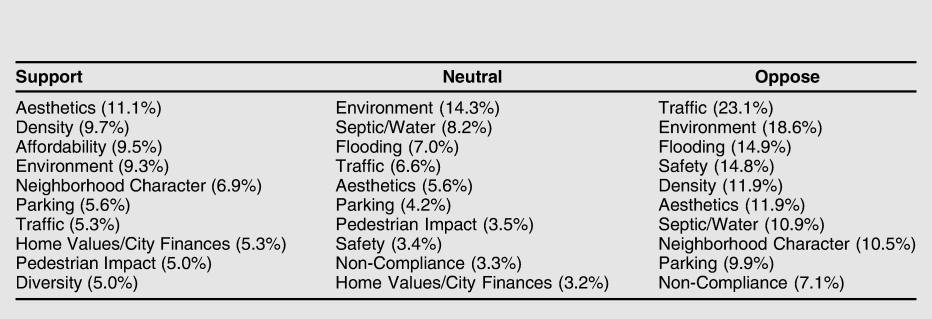
Finally, we also investigate the reasons individuals cited when expressing their support/opposition on housing projects. While many meeting minutes simply noted whether participating individuals supported or opposed a project, some provided greater detail—in some cases exact transcripts of individuals’ comments. Figure 3 shows the frequency of each reason given by the position taken by commenters.
Reasons given by commenters, grouped by position taken

Perhaps the most striking result is the variety of reasons offered, including flood susceptibility, septic systems, environmental concerns, neighborhood character, and parking, among other things. Moreover, there are notable differences in the reasons provided by supporters and opponents. Supporters of new housing were significantly more likely to mention affordability concerns. Opponents, in contrast, were more likely to raise traffic, environmental, flooding, and safety concerns.
The reasons cited suggest that, unsurprisingly, commenters raise issues that reflect the contexts in which their communities are situated. Almost one-quarter of opposing comments cited traffic, and most of these highlighted specific instances of congestion. A Manchester-by-the-Sea woman observed that “traffic has increased at a fast rate even without the new building” in her community. One Foxborough man “commissioned his own traffic study as he feels the impact of cars and children on the area have not been adequately addressed. He has lived in the area for a few years and compares the peak traffic periods to a demolition derby.” (This commenter’s ability to commission his own traffic study also illustrates the unrepresentative resources that many of these participants have available to them. Traffic studies typically cost thousands of dollars.) Similarly, almost 15% of comments opposing new housing mention flooding concerns, and many of these cited specific instances of water in basements, yards, or nearby streets. A Newburyport woman noted that “Boyd Drive already experienced flooding. The impact on existing homes was not assessed.” A Reading man “explained that a couple of homes on Dustin Road have a lot of water and flooding problems, and opined that rain gardens will not work.”
Given the historically exclusionary aims of many zoning and land use regulations, the comments may also provide a means of evaluating the extent to which race and racial bias drive opposition to the construction of new housing.Footnote 54 In particular, the nearly 11 perecent of commenters who cited “neighborhood character” in opposition to a housing project may be using racially coded language.Footnote 55 Indeed, many activists and media observers view such concerns in this light. Jacobus notes that “if you are like me, when someone says they want to ‘preserve the character’ of a community, what you hear is that they want to exclude poor people and people of color.”Footnote 56 A few of the comments that fell under the neighborhood character umbrella appear to be racialized. One man in Beverly—a town that is 83% white—critiqued the design of a building as “ridiculous” and said “Beverly is going to look like Chelsea”; 62% of Chelsea’s population is Latino (and Chelsea is six towns away). He went on to ask if “there is a restriction put on the building that there is to be no Section 8 housing in the building.” Several other comments in the database similarly argued that their homogenous communities would resemble much more diverse ones if a project were approved.
Most of the comments referencing neighborhood character, however, are not explicitly linked with race. A Dighton woman opposed a project because she felt it was “not consistent with the neighborhood. A multi-family home built on a slab is going to negatively impact the values of homes in the neighborhood. The other homes in the neighborhood are single family homes that are owner occupied.” There may very well be racial undertones to this woman’s opposition—and there are almost certainly some class concerns. But there is nothing explicitly in her comments that clearly ties her opposition to racial bias. Many of the comments that referenced neighborhood character across a variety of towns were remarkably similar to hers; a Concord man “spoke in opposition to the project and the change in the neighborhood character.” A woman in Hudson “was worried about the character of the neighborhood and how this doesn’t fit in.”
The content of these comments also allows us to qualitatively capture the knowledge and expertise of these commenters. Many commenters cited their professional backgrounds in law, design, engineering, architecture, and real estate in making assessments of housing projects that personally affected their communities. In addition, the content of many of their comments suggested an extraordinary familiarity with highly complex local land use regulations. Commenters would frequently cite specific statutes in arguing that a particular project was not in compliance with local zoning regulations. One commenter in Arlington “inquired about setbacks, the parking reduction bylaw, and whether the project would go before the Commission.” An engineer in the town of Andover critiqued a developer’s traffic study and stormwater analysis: “He stated that as an engineer he knows what kinds of games can be played with numbers. He gives no credibility to these counts. He added that Merrimack College traffic is not de minimus . . . He asked for a written report from the DPW on the impacts of proceeding with the facility.” Participants in these meetings frequently displayed a high level of knowledge—often derived from their own professional backgrounds—that they used when engaging in local political proceedings, consistent with our predictions.
Policy Impact
Given the affordability and sustainability crises facing many American cities and towns, the participatory bias outlined here presents a potentially serious obstacle to change. Perhaps most importantly, our results reveal that zoning board and planning board officials are overwhelmingly hearing opposition to the construction of new housing. Often, the only voice that these public officials (and meeting attendees) hear speaking in support of new housing is the developer, whose financial stake in the project makes him poorly suited to make the case that new construction is publicly beneficial.
This opposition can be persuasive. One local affordable housing lawyer we interviewed critiqued the Massachusetts system’s emphasis on transparency as propagating exclusion: the towns are “controlled by older and richer people than the town as a whole, and it’s bad! Under the guise of making things more transparent, [we] end up creating a much more exclusive system than would otherwise exist.” A housing consultant recounted that, in her experience, neighbors’ opposition typically resulted in money for neighbors, delay, or changes to the project—all of which render the project more expensive. A planning board member in a suburban Massachusetts town similarly highlighted delay as a frequent outcome of neighborly opposition: she “typically wouldn’t deny a project because of public opposition, but would slow it down a lot.” Another planning board official from a different town described a recent project delayed by months as a consequence of “older” opponents “concerned about parking.” These delays are consequential. As another housing lawyer put it: “delay is the biggest enemy of development . . . the ability of anyone to delay development is the ability to kill it.” This corroborates academic work that implicates public opposition to new development as an important driver of rising housing costs.Footnote 57
To more concretely illustrate the persuasive impact public comments have on planning/zoning decisions, we explore the meeting minutes of two cities in depth: Cambridge and Worcester, MA. We selected these cities for several reasons. First, their meeting minutes were unusually detailed (indeed, Cambridge’s minutes were exact transcriptions). Second, they are both locations where we would not necessarily expect NIMBY attitudes to prevail. Cambridge is one of the most liberal cities in the country and facing a massive affordable housing crisis. Since we found a strong association between Democratic affiliation and support for new housing in our analysis of meeting minutes, we might expect local officials in Cambridge to similarly prefer a greater supply of dense housing. Worcester is one of the poorest cities in our data set. In less affluent cities, concerns about diminished tax base should, in theory, generate more official support for new residential developments.Footnote 58 Both cities thus represent tough tests for observing a significant policy impact.Footnote 59
Obviously, these case studies tracing the evolution of a couple of proposals cannot perfectly measure the policy impact of these land use procedures. In an ideal world, we would be able to randomize the implementation of measures encouraging public input in the zoning process, or at least observe variation in these institutions. Unfortunately, because all Massachusetts towns operate under the same zoning law mandating public input in the zoning process—and, indeed, these regulations are widespread nationally—we do not have the cross-sectional variation to measure policy impact in this way. Moreover, national-level data on land use regulations—including longitudinal data—are extraordinarily difficult to generate. The most detailed available data on land use regulations are cross-sectional Massachusetts regulations from the Housing Regulation Database, and required several years of painstaking work to assemble.Footnote 60 Finally, any study that did look for impact via changes in projects through the meeting process would also have to account for the fact that initial proposals may reflect existing institutional contexts. We believe, however, that these case studies—while imperfect—strongly suggest that these meeting comments shape important policy outcomes.
In 2016, a group of neighbors attended a Cambridge Planning Board meeting in staunch opposition to a proposal seeking to convert an abandoned commercial warehouse into four residential units. Neighbors worried, among other things about “density,” “insufficient parking,” “demolition,” “building foundations,” and that “the development is very non-compliant.” Members of the planning board took these concerns very seriously, and cited them in making multiple additional demands of the developer. One planning board member observed:
This board member would find it very, very difficult tonight . . . in light of the input we’ve gotten from abutters and my review of the documents, to make findings in affirmative . . . It seems like there is the potential to engage in a more detailed conversation with the community to see whether . . . the developer can assuage the primary concerns of parking, of density, and the issue of settlement . . . I would also include the potential . . . for the Board to ask for a parking analysis or a traffic analysis.
Another board member built on the first’s concerns: “In addition to what [NAME] said, I would also request some sort of geotech engineering study done. More than one person mentioned houses sinking based on water.” Other members of the Cambridge Planning Board largely echoed these concerns, similarly rooting them in neighbors’ stated objections at the meeting.
In one of the most liberal cities of the country, a group of neighbors uniformly opposed the development of new housing. The Cambridge Planning Board agreed that these concerns were valid, and suggested a variety of measures imposing significant new costs on the developer, including additional parking and geotech studies. The developer returned to the planning board three months later in January 2017, having completed both the parking and geotech study and altering his proposal in a number of ways to suit neighbors’ concerns: “A number of the neighbors thought that four units was too many and whether we could actually consider having a successful project with only three, and we’ve come to a resolution that we are going to do that.” The developer also agreed to increase the number of parking spaces per unit from one to two. Neighbors thus imposed multiple costs on the developer; geotech and parking studies cost thousands of dollars. Additional months of delay similarly impose significant carrying costs. Finally, and most importantly, the developer has lost the value of an additional unit and use of space now occupied by the additional parking spots. This reduction is not only costly to the developer—it also reduces the overall housing supply in a city desperate for more housing (and likely made each of the three remaining units larger and more expensive). While one unit is obviously not going to have a significant impact on a city’s overall housing supply, this process repeating itself hundreds of times starts to have a marked influence on housing availability. Moreover, anticipation of this process might deter meritorious projects from even being proposed or push the proposals that are made in the direction of more expensive, higher end units to make the economics work.
This policy impact is also evident in less affluent cities, where concerns about diminished tax base should, in theory, generate more official support for new residential developments. A proposed 36-unit condominium in Worcester, MA met steep neighborhood opposition at a 2015 Worcester Zoning Board meeting. One man cited his status as a representative of the Brown Square Neighborhood Group and former zoning board member to question the legality of the proposal. The meeting minutes describe his views: “He stated that he does not believe the proposal meets the statute regulations to be considered hardship. He believes that the petition should be denied and that the developer is only looking to maximize for profitability. This does not fit in with the character of the neighborhood.” Another man similarly worried about negative impacts on “neighborhood character and social structures” as well as “property values.”
As in our example in Cambridge, Worcester Zoning Board members were deeply concerned about neighborhood opposition. Meeting minutes described one board member’s response to neighborhood opposition in the 2015 meeting concerning the development of low-rise condominiums:
The [Worcester Zoning Board Chair] stated that he believes that the design looks like this is an institution. The project needs to have a lot of landscaping to be more appealing. He is concerned the density is very high and also about the amount of impervious area. He would like to see the applicant meet with the neighborhood again because right now there is a big gap from what is proposed to what the neighbors want.
Other board members concurred in a unanimous vote. This meant that discussion of the proposal would be continued through the next meeting six weeks later, and that construction approval was delayed by a further two months. At the subsequent meeting, neighborhood opposition to the proposed low-rise condominium development remained intense, despite the developer having reduced the number of housing units from 36 to 24. This neighbor’s comments perhaps most succinctly described his community’s concerns: “[NAME] stated that there was no compromise or agreement at the neighborhood meeting. They do not want to this type of project in the neighborhood.” The board agreed: “[A Worcester Zoning Board member] stated that the applicant addressed some of his concerns, but that he is concerned with this development not quite fitting in to the neighborhood and the traffic that will be due to the density. [Another board member] concurred.” The developer opted to withdraw his proposal at this point; neighborhood opposition successfully killed the project.
The fact that neighborhood opposition had such a potent impact is striking, and speaks to the generalizability of the political inequality we have documented in this article. Worcester is not the sort of advantaged city frequently featured in media and academic accounts of NIMBYism. As a former industrial city 40 miles outside of Boston, Worcester has considerably lagged the Greater Boston region’s explosive economic growth. It nonetheless features housing policy dynamics that would not be out of place in San Francisco or Palo Alto.
These cases illustrate the potential of citizens to persuade local officials; commenters have other means, however, of effecting policy. Frequent attendance at meetings also in some instances indicates citizens’ willingness to pursue legal challenges against developers or the city/town. Multiple individuals in our data set attended meetings with lawyers or identified themselves as lawyers opposing projects in a personal capacity. In a few cases, we were able to match individuals in our data set with lawsuits filed in the Massachusetts Land Court on the development in question. Given the importance of lawsuits as a key avenue for stymieing development, such implied threats (or actual lawsuits) can have a potent impact.Footnote 61
Finally, prior research using these data shows that the most highly regulated places in Massachusetts permit the least multifamily housing.Footnote 62 This fact is consistent with public meetings constraining the supply of housing. In the absence of stringent land use regulations, housing developments can be constructed “by right,” without necessitating any planning or zoning board meetings. In contrast, review of variance requests by these boards—in concert with public meetings—is associated with the production of significantly less multifamily housing.
Generalizing beyond Massachusetts
One potential limitation of our analyses is that all of our data are from one state: Massachusetts. It is possible that Massachusetts’ town meeting tradition and strong local zoning control (1) lead to a particularly unrepresentative set of citizens who oppose new housing development or (2) make housing opponents particularly impactful. While we are unable to rigorously quantify meeting participation in other states, suggestive evidence indicates that these trends hold, at least to some extent, elsewhere. First, we conducted detailed case studies of the zoning codes in six cities with widely varying institutional and regional contexts: Charleston, SC; Charlotte, NC; Los Angeles, CA; Milwaukee, WI; Phoenix, AZ; and San Francisco, CA. The zoning codes in all six cities mandate the solicitation of public input at multiple stages in the development process, confirming that analogous procedures to those in the Boston area are present elsewhere.
In addition, we surveyed 115 mayors of cities over 75,000 (a response rate of 25%).Footnote 63 Among other topics, we asked mayors whether they believed housing development was more influenced by “majority public opinion” or a “small group with strong views”; 60% of mayors selected “small group with strong views,” and, in more qualitative elaborations, described opposition remarkably similar to that captured in our Massachusetts data. Multiple mayors mentioned dominant elderly groups, while others highlighted the impact of well-organized oppositional neighborhood associations. Interestingly, in all cases, mayors who elaborated on the “small groups” in their cities mentioned individuals/groups who opposed the construction of new housing—consistent with our finding that meeting attendees overwhelmingly oppose housing development.
Finally, we highlight one case with a differing institutional and socioeconomic context: Milwaukee, WI. While NIMBYism has been well-documented in coastal cities like Boston and San Francisco, comparatively less media and scholarly attention has focused on whether opposition to the construction of new housing holds in less affluent communities with lower housing prices like deindustrializing Milwaukee (which, unlike many of the Massachusetts cities/towns, is governed by a strong-mayor system rather than a town meeting). Nonetheless, at least in pockets of the city, media accounts and comments from local officials suggest that an unrepresentative group of neighbors dominate public hearings in similar ways that we observe in eastern Massachusetts. On multiple occasions, after attending hearings concerning housing developments in gentrifying parts of the city, Milwaukee Mayor Tom Barrett has remarked, “I didn’t realize everyone on the East Side was an architect.”Footnote 64 An interview with a Milwaukee alderman confirmed that the mayor used this comment repeatedly and was struck by “well-informed design critiques from professors” at local community meetings. The alderman noted at his community meetings that there were “a lot of regulars” and that he “know[s] who I’m going to run into . . . architects and lawyers. Lawyers show up in lawyerly manner.” He also believed—as we found in our limited quantitative data analysis—that a disproportionate share of meeting attendees were homeowners, not renters.
Perhaps more importantly, the Milwaukee alderman—like the individuals interviewed in Massachusetts—believed that the individuals who attended these meetings had important policy impact. He noted that “the voices of abutters carry a lot of weight,” in how he voted on a development project and that, in some cases it “only takes one voice” to influence a project. Local political bloggers similarly highlighted cases of neighborhood opposition delaying projects by months.Footnote 65
Prescriptions for Local Democracy
We have uncovered two related forms of bias. The first is that an unrepresentative group disproportionately participates in public meetings concerning housing development. The second is that the concentrated costs and diffuse benefits of housing development spur a group of highly affected individuals to both participate and oppose new housing.
The first can potentially be addressed with measures that help to mitigate disparities in participation. In particular, policymakers could do more to include renters in the housing development process. While there is some evidence that renters express hostility towards housing development, Marble and Nall find that renters exhibit more progressive attitudes towards new housing compared with homeowners.Footnote 66 One way to enhance renter participation is to ensure that they are aware of developments in their community. In many Massachusetts communities, notices are mailed to property-owning abutters. In other words, notices are sent to landlords, not their tenants who actually reside in the abutting properties.Footnote 67 In many cases, then, individuals who live nearby may not even be aware of proposed housing developments. Fung notes that, for institutions of empowered participation to operate effectively, they must be structured in ways that encourage participation by all.Footnote 68
The bias towards opposition is harder to address, in part because it is normatively murkier whether it is problematic that the most affected individuals are the most likely to participate and oppose projects. While there are broader negative societal consequences of failing to increase the supply of housing, the era of developer-dominated politics suggests that ignoring or minimizing abutters’ concerns is also normatively problematic. Policymakers might consider restructuring public hearings to encourage greater deliberation and genuine responsiveness to participating interlocutors.Footnote 69 Of course, genuine deliberation requires the representation of all sides of a debate. With only 15% of comments in support of new housing, it is difficult to imagine a well-informed back-and-forth policy discussion surrounding many of the housing developments in many of these meeting minutes.
Finally, these meetings raise important questions about the level of expertise needed to participate in public deliberation.Footnote 70 Many of the commenters exhibit a high level of specialized knowledge about local land use and zoning. On the one hand, this bias towards high knowledge could dissuade some underrepresented voices from speaking up at meetings. On the other, as a society, we may want individuals to have a base level of knowledge about local land use prior to participating in important policy debates surrounding housing.
While we have uncovered some troubling participatory biases in public meetings, these issues do not necessarily mean that neighborhood-level politics are inherently unrepresentative. Scholars have identified other policy arenas where these meetings do appear to significantly enhance the participation of socioeconomically disadvantaged groups.Footnote 71 Moreover, a developer-dominated system like the one that existed prior to the movement towards neighborhood participation is unlikely to yield significantly better outcomes in terms of affordability. Similarly, moving towards a system in which elites on zoning and planning boards wield the greatest influence may not necessarily yield greater democratic accountability; indeed, the demographic and attitudinal composition of zoning and planning board members may not be so different than that of meeting attendees. We hope that future research can build upon our findings to improve the functionality of these public meetings and that political scientists and policymakers alike can learn important lessons about implementing higher-quality democracies from these meeting minutes.
Appendix
Comment Coding
Every time a public participant at a zoning or planning meeting was identified by name and address, and spoke about a project that implicated multiple housing units, we coded a) their information, b) information about the address of the project they spoke about, c) whether they were supportive, neutral, or opposed and d) when they gave reasons or asked questions about topics that fit into one of our 20 categories. The two major coding decisions were how to code the participant’s tone and reasons.
Tone. The support/neutral/oppose variable is coded support or oppose if the coder can detect any hint in either direction. Most supportive comments were quite explicit and included phrases such as “I support this project,” and “this is good for the town” Oppose comments fell into two categories. Some explicitly expressed opposition in general: “this is bad for the town,” “I’m opposed to this project.” Other comments coded “oppose” focused on specific reasons (outlined in Tables A1 and A2) with a negative tone or valence: “I’m worried about traffic,” “it will make the street more dangerous,” or “it doesn’t fit the neighborhood.” Comments coded neutral were generally sincere, or at least neutrally phrased questions. Asking “How will this affect the wildlife” would be coded neutral. Many of these neutral comments likely came from skeptical or even opposed residents who couched their views in a formally neutral question. We coded these as neutral rather than try to guess or assume why they were asking about things with a negative valence. This should make the coding reasonably conservative.
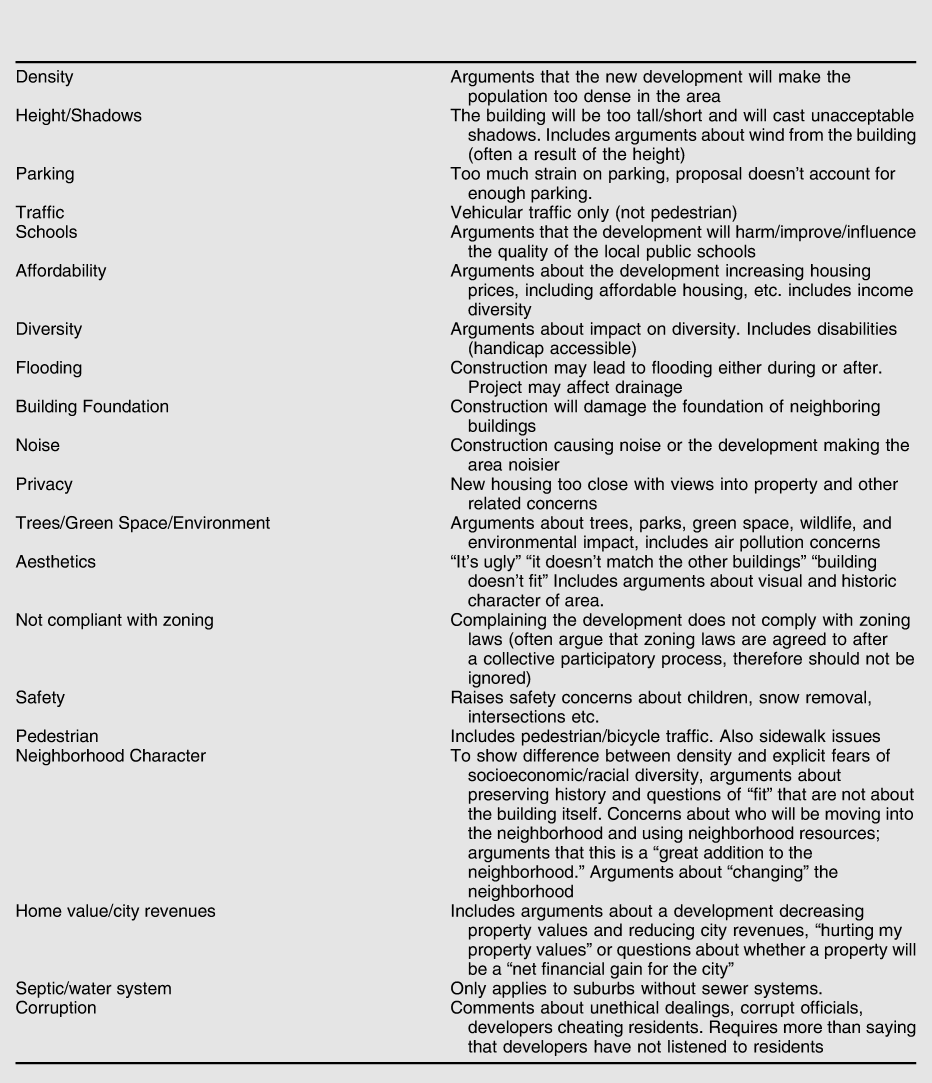
Content. When possible, we coded the substance of each commenter using the scheme depicted in Table A1. We allowed for multiple content areas per commenter such that a person who raised both traffic and environmental concerns would get both comment codes.
Comment issue coding scheme

Top 10 reasons given by position taken

Data Matching
We matched the commenter data to a Massachusetts voter file from the voter data firm Nation Builder. For each comment, the only available fields to identify the commenter were their town, name, and address. We used probabilistic string matching on names and addresses using the Stata reclink2 package. We manually reviewed each match to eliminate false matches.
We matched commenters to the voter file using three different combinations of the available fields. In all combinations, we required that the voter’s mailing address town corresponded to the town of the meeting.
1. First name, last name, address, town: 94% of matches
2. First name, last name, town: 5% of matches. Each match reviewed to verify that first name differences were due to plausible nicknames or middle names.
3. First name from commenters to Middle name from voter file, address, town: 1% of matches.
A small number of matches (10) were rejected because the commenter matched to multiple people in the voter file. Most often, one commenter matched to a father and son with the same name and address. Without suffixes or middle initials, we were unable to differentiate between these pairs.