Traditionally, psychotherapy research has been focused on analyzing changes between the start and end of the treatment, as well as the maintenance of those gains during a follow-up period. However, typical research designs do not address the change trajectory that may occur during the treatment period. Shedding light on these changes may add valuable knowledge on how treatments work (e.g., Greene, Reference Greene2012; Kazdin & Nock, Reference Kazdin and Nock2003), on how long treatments should be (e.g., Baldwin, Berkeljon, Atkins, Olsen, & Nielsen, Reference Baldwin, Berkeljon, Atkins, Olsen and Nielsen2009; Hansen, Lambert, & Forman, Reference Hansen, Lambert and Forman2002), or even to personalize the treatment (e.g., Vittengl, Clark, Thase, & Jarrett, Reference Vittengl, Clark, Thase and Jarrett2016; Wise, Streiner, & Gallop, Reference Wise, Streiner and Gallop2016).
There have been some precursors of the interest in changes during treatment. The dose-effect model (Howard, Kopta, Krause, & Orlinsky, Reference Howard, Kopta, Krause and Orlinsky1986) assumed that each session can be analogous to a dose of treatment and, therefore, it would be plausible to analyze patterns of change in relation to dosage levels. Additionally, the seminal study by Howard et al. (Reference Howard, Kopta, Krause and Orlinsky1986) revealed that different diagnostic groups responded differently to treatment. Patients grouped in the categories anxiety and depression seemed to improve earlier in treatment than those grouped in the borderline or psychotic category. Moreover, it was found that the rate of change during therapy was negatively accelerated. That means that the benefits gained at the first part of the therapy are usually bigger than the benefits later in treatment, although patients generally continue improving (e.g., Lutz, Lowry, Kopta, Einstein, & Howard, Reference Lutz, Lowry, Kopta, Einstein and Howard2001).
In a similar direction, the phase model of therapy (Howard, Lueger, Maling, & Martinovich, Reference Howard, Lueger, Maling and Martinovich1993) has suggested that temporal changes can be observed in how symptoms change. More specifically, the model considers that clients, in the first place, experience remoralization and increased hope, followed by a phase of symptom relief, and finally undertake the reduction of maladaptive behaviors that interfere with adaptive life functioning. Thus, the decelerating curve of improvement for a patient could be due to the increasing difficulty of treatment goals over the course of treatment. Another explanation for these findings is that some patients show a rapid early response (e.g., Hayes, Hope, & Hayes, Reference Hayes, Hope and Hayes2007). Similarly, “sudden gains” (e.g., Tang & DeRubeis, Reference Tang and DeRubeis1999), which are defined as a sudden and large improvement in clinical symptoms during a single between-session interval, when they take place early in treatment, have been associated with larger changes over the course of treatment (e.g., Kelly, Roberts, & Ciesla, Reference Kelly, Roberts and Ciesla2005).
More recent studies using multilevel growth curve models, and controlling for treatment duration, have confirmed this negatively accelerated curve in session-to-session change (e.g., Stulz, Lutz, Kopta, Minami, & Saunders, Reference Stulz, Lutz, Kopta, Minami and Saunders2013). Yet, it is interesting to note that some authors have questioned the general finding of the negatively accelerated rate of change arguing that it might be an artefact of aggregating patients with different lengths of therapy and variable patient difficulty (Barkham et al., Reference Barkham, Connell, Stiles, Miles, Margison, Evans and Mellor-Clark2006). Specifically, it has been suggested that patients who improve more easily tend to finish their treatment early and aggregating their results to the general pool of patients, which also includes more difficult ones, could lead to a bias in the overall pattern of results related to therapeutic change.
Another relevant issue related to the analyses of patterns of change is related to the type of outcomes explored. Most of the published studies have employed the rate of change of clinical symptoms as the outcome variable. Yet, recent literature has pointed out the relevance of positive functioning and satisfaction in patients’ definition of remission (Demyttenaere et al., Reference Demyttenaere, Donneau, Albert, Ansseau, Constant and Van Heeringen2015a; Reference Demyttenaere, Donneau, Albert, Ansseau, Constant and Van Heeringen2015b; Zimmerman et al., Reference Zimmerman, McGlinchey, Posternak, Friedman, Attiullah and Boerescu2006). Consequently, assessing well-being and positive functioning in ongoing psychotherapy research is needed to complement the view of how patients change during psychotherapy (Joseph & Wood, Reference Joseph and Wood2010). In fact, unfortunately, patterns of changes in well-being and positive functioning have received much less attention in psychotherapy research. Some studies have occasionally included in their outcome measures items about subjective well-being and life functioning along with items about psychological symptoms (e.g., Howard, Moras, Brill, Martinovich, & Lutz, Reference Howard, Moras, Brill, Martinovich and Lutz1996; Lutz et al., Reference Lutz, Lowry, Kopta, Einstein and Howard2001; Stulz et al., Reference Stulz, Lutz, Kopta, Minami and Saunders2013). However, some items included in the well-being and life functioning scales used in these studies were based on the idea that subjective well-being is the absence of symptoms (e.g., distress level) and life functioning is the absence of interference of psychological problems in life areas. Therefore, those attempts to include positive items or dimensions have been typically limited as they have ignored key components of current definitions of well-being (e.g., purpose in life, self-acceptance, and positive relationships).
The present study
In a controlled clinical trial, we compared a manualized protocol of empirically-validated positive psychology interventions (IPPI-D) with a cognitive behavioral therapy (CBT) protocol in a sample of participants with a diagnosis of major depressive disorder or dysthymic disorder (Chaves, Lopez-Gomez, Hervas, & Vazquez, 2017). Measures of both clinical and well-being indicators were included. Pre-post analyses showed that both treatments were equally efficacious in reducing clinical symptoms and increasing well-being. Furthermore, both therapies showed similar efficacy for the most severe cases of depression. These results are in line with the extensive literature that supports the equivalent efficacy of different psychological interventions in the treatment of depression (e.g., Cuijpers, van Straten, Andersson, & van Oppen, Reference Cuijpers, van Straten, Andersson and van Oppen2008). Yet, the results of that clinical trial yielded the unanswered question of how patients change during treatment and the patterns of these changes.
The aim of this paper is to provide new evidence by exploring the patterns of changes during the interventions. Examining the rate of change of two different protocols (i.e., CBT vs. PPI) is a new approach that can help to extend previous research. First, there is evidence that the rate of change varies as a function of duration and type of clinical profile, but there is no evidence of a different pattern as a function of the therapeutic approach. Second, positive functioning was monitored in the clinical trial through an integrative measure of well-being, which will allow comparing the rate of change of well-being and clinical symptoms for the two treatment modalities.
Thus, following the dose-effect model, it was hypothesized that a significant improvement in depressive symptoms and well-being would be found across all assessment points, regardless of intervention condition. Secondly, based on results of previous studies about rate of change during psychotherapy (Lutz et al., Reference Lutz, Lowry, Kopta, Einstein and Howard2001; Stulz et al., Reference Stulz, Lutz, Kopta, Minami and Saunders2013), it was also hypothesized that depressive symptoms and well-being would show a higher percentage of improvement in the first period of treatment than in the following ones. Taking into account that there were no significant differences between treatments in previous analyses (Chaves et al., 2017), it was expected that there would be no significant differences between intervention conditions in this pattern of improvement.
Method
Participants
Participants were 128 women (m age = 52.02; SD = 10.58) recruited in a women’s center, linked to the community health and social services centers system. The Faculty Ethics Committee approved the study protocol and all participants gave informed consent to allow their data to be analyzed. All participants were diagnosed with major depressive disorder (MDD) or dysthymia according to DSM-IV-TR criteria (APA, 2000) by using a structured interview (Structured Clinical Interview for the DSM-IV; First, Spitzer, Gibbon, & Williams, Reference First, Spitzer, Gibbon and Williams1996). Participants were blindly allocated to a PPI (n = 62) or CBT (n = 66) intervention condition (for details, see Chaves et al., 2017; Lopez-Gomez, Chaves, Hervas, & Vazquez, Reference López-Gómez, Chaves, Hervás and Vázquez2017). Exclusion criteria for the study were: substance abuse or dependence disorder (present), manic or hypomanic episodes (past or present), psychotic disorder (past or present), and a cognitive status (e.g., dementia or intellectual disability) that might prevent participants to follow the interventions.
Treatment and therapists
Participants were scheduled to attend ten 2-h weekly sessions in a group format. Each program (CBT and PPI) was offered to five groups containing 10–15 members each. Both protocols had the same session structure. Between-session homework was reviewed at the start of each session. Then, the topic of the day was introduced. Participants were encouraged to participate in brief discussions and in in-session exercises. A summary of the key ideas was provided at the end of each session and then the therapist assigned homework exercises to practice the skills learned during the session.
The Integrative Positive Psychological Intervention for Depression (IPPI-D) is a manualized protocol composed of empirically-validated positive psychology interventions for depression (Bolier et al., Reference Bolier, Haverman, Westerhof, Riper, Smit and Bohlmeijer2013; Sin & Lyubomirsky, Reference Sin and Lyubomirsky2009). Sessions were thematically sequenced to facilitate the experience and generation of positive emotions as early as possible in the program (sessions 2 to 4) while sessions on eudaimonic components were incorporated into the middle of the program (sessions 5 to 9, including themes of positive relationships, compassion, personal strengths, meaning in life, personal goals and resilience). A more detailed description of the IPPI-D program can be found elsewhere (Chaves et al., 2017).
The CBT program an adaptation of the Group Therapy Manual for Cognitive-Behavioral Treatment of Depression (Spanish language version; Muñoz, Aguilar-Gaxiola, & Guzman, Reference Muñoz, Aguilar-Gaxiola and Guzman1995), based on the Coping with Depression course (Lewinsohn, Antonuccio, Breckenridge, & Teri, Reference Lewinsohn, Antonuccio, Breckenridge and Teri1984), which has strong empirical support (Cuijpers, Muñoz, Clarke, & Lewinsohn, Reference Cuijpers, Muñoz, Clarke and Lewinsohn2009; Muñoz & Mendelson, Reference Muñoz and Mendelson2005).
Two licensed therapists with 5 years of clinical experience and trained in the manualized interventions provided the intervention programs. They had a postgraduate degree in CBT (2 years of study and clinical training) and received a specific training in PPI and the specific use of intervention manuals. They implemented both interventions with the aid of the co-therapists (for details, see Chaves et al., 2017).
Measures
Assessments were carried out by clinical psychologists who were blind to treatments. Eligibility for this study was assessed individually using the Structured Clinical Interview for DSM-IV (SCID-I; First et al., Reference First, Spitzer, Gibbon and Williams1996). Participants also answered some demographic and clinical questions through a structured interview (e.g., previous psychological or pharmacological treatments, family history of mental problems). A wide protocol of self-report measures covering different aspects of cognitive and emotional components was also administered at the beginning and the end of the intervention - for details see Chaves et al. (2017), and Lopez-Gomez et al., (Reference López-Gómez, Chaves, Hervás and Vázquez2017).
Along with the pre- and post-assessment, participants completed two inter-session assessments of depressive symptoms and well-being in order to explore the patterns of changes during the intervention. Thus, four assessment points (pre, first inter-session, second inter-session, post) were used in the study. Depressive symptoms were measured with the Beck Depression Inventory-II (BDI-II; Beck, Steer, & Brown, Reference Beck, Steer and Brown1996; Sanz, Navarro, & Vazquez, Reference Sanz, Navarro and Vázquez2003; α = .87), and well-being was measured with the Pemberton Happiness Index (PHI; Hervas & Vazquez, 2013; α = .79). The PHI is an integrative measure of well-being that includes eleven items related to different domains of well-being. As in most extant measures of psychological well-being, individuals are asked to make a retrospective evaluation on several domains of their life (i.e., general, emotional, eudaimonic, and social well-being). In the PHI, this retrospective or remembered well-being (PHIrem) is complemented with a measure of the actual well-being experienced the day before. The PHI asks participants to respond whether or not they have experienced a number of experiences with an emotional content (5 negative, 5 positive) Footnote 1 in the last 24 hours. This additional information on well-being, similar to the one gathered in instruments like the Day Reconstruction Method (Kahneman, Krueger, Schkade, Schwarz, & Stone, Reference Kahneman, Krueger, Schkade, Schwarz and Stone2004), is less subjected to memory biases than retrospective or evaluative assessments of well-being (Hervas & Vazquez, 2013). For this study, positive (PHIpos) and negative (PHIneg) experiences were analyzed separately. PHIpos and PHIneg scores ranged from 0 to 5. PHIrem scores ranged from 0 to 10.
Pre-treatment assessment was conducted one week before starting the intervention and post-assessment took place one week after the end of the intervention. Inter-session assessments were conducted prior to the start of session 4 and 7 for both treatments in order to capture changes in two middle points of the therapy besides the pre- and post-treatment assessments.
Data analysis
An Intention to treat (ITT) approach was applied to the data. Following Newman’s recommendations (2014), a Maximum Likelihood (ML) estimate was performed via EM algorithm. Chi-square and t-tests were used to confirm that there were no significant initial differences between intervention conditions in regard to demographic variables. Additionally, mixed-model repeated measures ANOVAs on the BDI-II, PHI remembered well-being subscale (PHIrem), PHI positive experiences subscale (PHIpos) and PHI negative experiences subscale (PHIneg) were separately conducted to compare direct scores between the two treatments across four assessment points (pre, inter-session 1, inter-session 2, post), confidence intervals adjusted by the Bonferroni procedure. When the sphericity assumption was violated, Greenhouse-Geisser correction was applied. Finally, to analyze the pattern of improvement over time, the same analyses were performed using the percentage of improvement observed in three different time periods (i.e., T1→T2: from pre-treatment session to first inter-session assessment; T2→T3: from first to second inter-session assessment; T3→T4: from second inter-session assessment to post-treatment assessment) on outcome measures. Relative percentage of improvement was defined as the partial contribution of each of the three time periods to the total improvement observed from pre- to post-assessment. Improvement was defined, in the four different outcome variables, as the reduction in depressive symptoms (BDI-II) and negative experiences (PHIneg) and the increase in remembered well-being (PHIrem) and positive experiences (PHIpos). Deterioration in outcome variables, from one assessment time to the next one, was coded as zero improvement. Consequently, the sum of the three relative percentages of improvement for each outcome is 100%. Arcsin transformations were applied to the variables of percentage of improvement due to their non-normality in order to conduct a series of mixed-model repeated measures ANOVAs. Data were analyzed using SPSS (version 20.0).
Results
Baseline characteristics
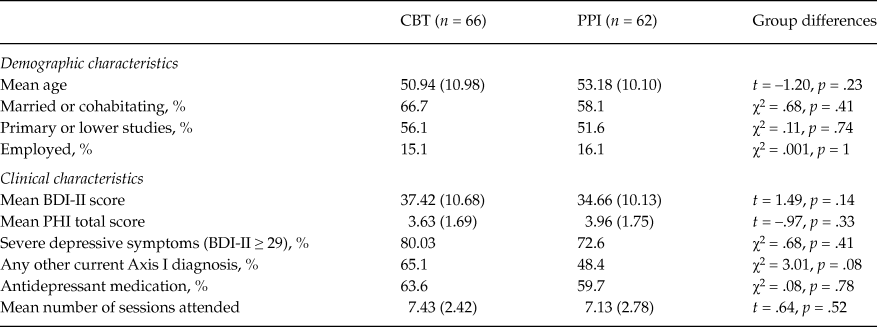
Table 1 displays the main baseline characteristics of participants. No significant differences were found in demographics, clinical characteristics, and primary outcomes (BDI-II and PHI) at baseline between the two intervention conditions (see Table 1).
Baseline characteristics

Note: Standard deviations are shown in parenthesis; CBT = cognitive behavioral therapy; PPI = positive psychology interventions; BDI-II = Beck Depression Inventory-II; PHI = Pemberton Happiness Index.
Regarding dropouts, no significant difference was found among intervention conditions (p = .87). Eleven participants (16.7%) dropped out in the CBT condition and twelve (19.4%) in the PPI condition (for details about attendance and adherence to the interventions, see Lopez-Gomez et al., 2017). Completed data on the four assessment points were collected for 43 participants (65.1%) in the CBT condition and for 40 participants (64.5%) in the PPI condition. Following an ITT model, missing data were imputed analyzing all the assigned participants to each condition.
Analyses of outcome measures scores during interventions
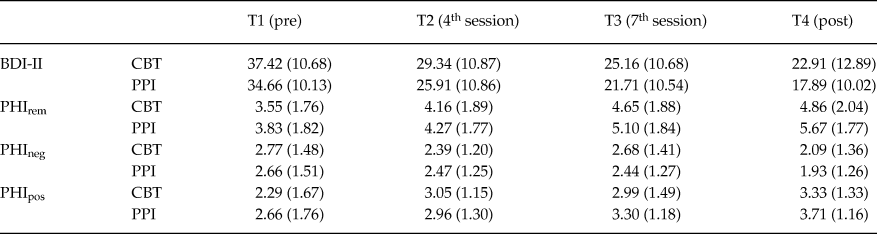
Patterns of changes during interventions were firstly explored via analyses of outcome measures scores in the four assessment points to test the study’s first hypothesis that expected that a significant improvement in depressive symptoms and well-being would be found across all four assessment points, regardless of intervention condition. Mean and standard deviations in outcome measures are shown in Table 2.
Mean and standard deviations in outcome measures

Note: T1= pre-assessment; T2= first inter-session assessment; T3= second inter-session assessment; T4= post-assessment; CBT = cognitive behavioral therapy; PPI = positive psychology interventions; BDI-II = Beck Depression Inventory-II; PHI rem = Pemberton Happiness Index, remembered well-being; PHI neg = Pemberton Happiness Index, negative experiences; PHI pos = Pemberton Happiness Index, positive experiences.
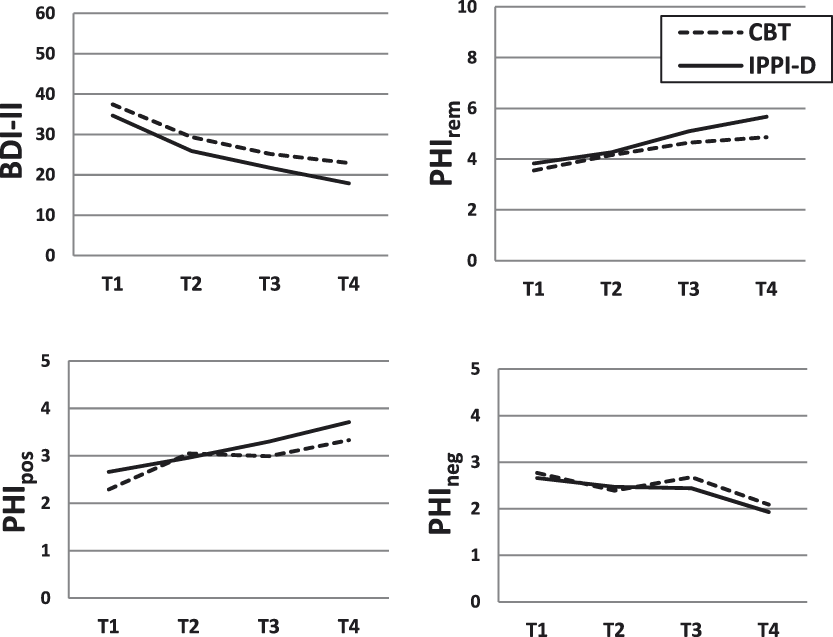
A mixed-model repeated measures ANOVA of the BDI-II was performed for all participants who entered the study (N = 128). The effect for Time was significant, Greenhouse-Geisser corrected F(3, 320) = 138.50, p < .001, ηp 2 = .52, and post-hoc tests showed that depressive symptoms significantly decreased across all assessment points (ps < .001). A trend analysis revealed a significant linear trend, F(1, 126) = 277.00, p < .001, and a significant quadratic trend, F(1, 126) = 19.67, p < .001. Figure 1 shows how the curvature imposed by the quadratic function is superimposed on a decreasing linear trend. There was no significant interaction Intervention condition x Time, Greenhouse-Geisser corrected F(3, 320) = .70, p = .55, ηp 2 = .01.
Changes during interventions in outcome measures (mean scores) in the four assessment points; T1= pre-assessment; T2= first inter-session assessment; T3= second inter-session assessment; T4= post-assessment; CBT = cognitive behavioral therapy; PPI = positive psychology interventions; BDI-II = Beck Depression Inventory-II; PHI rem = Pemberton Happiness Index, remembered well-being; PHI neg = Pemberton Happiness Index, negative experiences; PHI pos = Pemberton Happiness Index, positive experiences.

A series of mixed-model repeated measures ANOVAs of the subscales of PHI were performed for all participants. In the case of PHIrem, the effect for Time was significant, Greenhouse-Geisser corrected F(3, 331) = 52.40, p < .001, ηp 2 = .29. Post-hoc tests for Time indicated that remembered well-being significantly increased across all assessment points (ps ≤ .005). A trend analysis revealed a significant linear trend, F(1, 126) = 113.87, p < .001, that is reflected in Figure 1. No significant interaction Intervention condition x Time was found, Greenhouse-Geisser corrected F(3, 331) = 2.38, p = .08, ηp 2 = .02.
An ANOVA of the PHIpos yielded a significant effect for Time, Greenhouse-Geisser corrected F(3, 331) = 18.22, p < .001, ηp 2 = .13. Post-hoc tests for Time showed that positive experiences significantly increased between T1 and T2 and between T3 and T4 (ps < .04). A trend analysis revealed a significant linear trend, F(1, 126) = 48.13, p < .001, that is shown in Figure 1. There was no significant interaction Intervention condition x Time, Greenhouse-Geisser corrected F(3, 331) = 1.21, p = .30, ηp 2 = .01.
An ANOVA of the PHIneg showed a significant effect for Time, F(3, 378) = 9.61, p < .001, ηp 2 = .07. Post-hoc tests for Time revealed that negative experiences only decreased significantly between T3 and T4 (p < .001). A trend analysis yielded a significant linear trend, F(1, 126) = 18.34, p < .001, and a significant cubic trend, F(1, 126) = 6.76, p = .01. Figure 1 shows how the cubic trend (characterized by two changes in the direction of the trend) is superimposed on a decreasing linear trend. Results revealed no significant interaction Intervention condition x Time, F(3, 378) = .50, p = .68, ηp 2 = .004.
In summary, as shown in Figure 1 and in the results mentioned above, only depressive symptoms and remembered well-being followed the expected pattern in time proposed in the first hypothesis. Depressive symptoms decreased along the interventions, showing significant differences across all assessment points and remembered well-being increased along the interventions, showing also significant differences across all assessment points. There was no significant interaction between time and intervention condition in any measure analyzed.
Analysis of percentages of improvement during interventions
The second hypothesis proposed that both depressive symptoms and well-being would show higher percentage of improvement in the first period of treatment than in the following ones, regardless of condition. Mixed-model repeated measures ANOVAs were performed on the percentage of improvement in the outcome measures between T1→T2 period, T2→T3 period and T3→T4 period across intervention conditions.
Results of the ANOVA of the percentage of improvement in the BDI-II indicated a significant effect for Time, Greenhouse-Geisser corrected F(2, 231) = 9.56, p < .001, ηp 2 = .07. Post-hoc tests for Time showed significant differences between T1→T2 period and both T2→T3 and T3→T4 (ps < .005) in a way in which the percentage of improvement (i.e., decrease) in depressive symptoms in the first period of intervention was significantly higher than the percentage of improvement in the second and third period, as was hypothesized. Also, as hypothesized, no significant interaction Intervention condition x Time was found, Greenhouse-Geisser corrected F(2, 231) = .50, p = .61, ηp 2 = .004.
A series of ANOVAs of the percentage of improvement in the subscales of PHI was also performed for all participants. With regard to PHIrem, no significant effects were found for Time and the interaction Intervention condition x Time, F(2, 246) = 1.93, p = .15, ηp 2 = .01 and F(2, 246) = 1.80, p = .17, ηp 2 = .01, respectively.
Results of the ANOVA of the percentage of improvement in the PHIpos indicated a significant effect for Time, F(2, 234) = 3.13, p = .046, ηp 2 = .03, although specific post-hoc tests for Time did not reveal significant differences between periods of intervention (ps > .08). These results indicated that positive experiences increased differently along the three periods of the intervention, although these differences did not reach statistical significance when comparing specific periods of time. The interaction Intervention condition x Time was not significant, F(2, 234) = .96, p = .38, ηp 2 = .01.
The ANOVA of the percentage of improvement in the PHIneg showed a significant effect for Time, F(2, 234) = 3.86, p = .02, ηp 2 = .03 and post-hoc tests revealed that the decrease of negative experiences in the T3→T4 was significantly higher than in the T1→T2 period (p = .04). The Intervention condition x Time interaction was not significant, F(2, 234) = .36, p = .70, ηp 2 =.003.
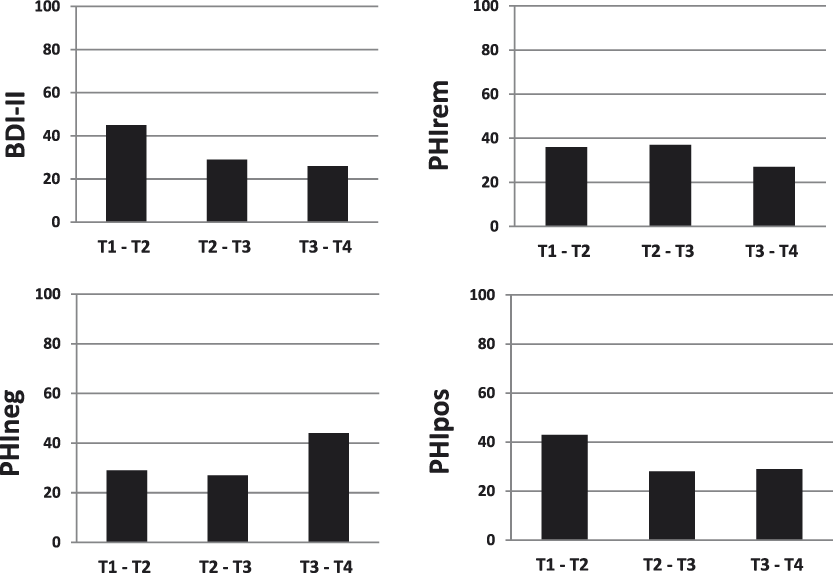
Results (see Figure 2) indicated that BDI-II showed the expected pattern proposed in the second hypothesis. Post-hoc analyses revealed that, in the first period, the percentage of improvement over the total improvement was significantly higher than in the following periods. The improvement over time for positive experiences followed a similar significant pattern although post-hoc tests did not reach statistical significance. Contrary to our hypothesis, the percentage of improvement in remembered well-being was not significantly different in the first period of interventions compared to the following ones. Thus, the percentage of improvement across treatment was homogeneous for both intervention conditions. Interestingly, time-related changes in negative experiences was significant but in an opposite direction to which it was expected. Post-hoc tests revealed that negative experiences decreased significantly more in the third period of the intervention than in the first one.
Percentage of improvement in outcome measures in the three time periods; T1→T2 = period from pre- to first inter-session assessment, T2→T3 = period from first to second inter-session assessment, T3→T4 = period from second inter-session- to post- assessment. Data presented in this figure correspond to the total sample (N = 128). BDI-II = Beck Depression Inventory-II; PHI rem = Pemberton Happiness Index, remembered well-being; PHI neg = Pemberton Happiness Index, negative experiences; PHI pos = Pemberton Happiness Index, positive experiences.

Discussion
The study’s first hypothesis was that significant improvement in depressive symptoms and well-being would be found across all four assessment points, regardless of intervention condition. Results have confirmed this pattern in the case of depressive symptoms and in remembered well-being, coherently with the dose-effect model (Howard et al., Reference Howard, Kopta, Krause and Orlinsky1986). However, changes in positive and negative experiences across assessment points did not follow this pattern. Changes in positive experiences in the 24 hours before the assessment were significant in the first period of intervention (T1→T2) and the third one (T3→T4), whereas in the case of negative experiences a significant change was found only in the third period of intervention (T3→T4). It is possible that the unstable nature of these measures related to emotional experiences happening the day before may help to explain why positive and negative experiences change in a less uniform way across treatment in both intervention conditions, compared to the other measures. The differential results found between the remembered well-being and the experienced well-being subscales emphasize the importance of using both kinds of measures that provide relevant information and help to understand better the complexity of well-being. As expected, the results of the study confirmed that there were no significant differences in terms of change during intervention among CBT and PPI on the measures analyzed. Depressive symptoms decreased and well-being increased similarly during both interventions.
The second hypothesis proposed that depressive symptoms and well-being would show higher percentage of improvement in the first period of treatment than in the following ones, regardless of intervention condition. The results on the BDI-II fully confirmed this hypothesis. This improvement in symptoms at the very beginning of the therapy could be explained by the content of the first modules of both intervention protocols, which were mainly focused on hedonic components in both approaches. This initial emphasis on hedonic elements could also explain that the same pattern of improvement was found in relation to positive experiences lived the 24 hours before the assessment although, in this case, the post-hoc tests did not reach statistical significance for this measure. Interestingly, these results suggest that positive experiences are relatively easy to increase during a hedonic module, compared with decreasing negative experiences. In fact, literature has shown the importance of positive emotions and experiences in depression. For example, studies have suggested that the ability of experiencing positive emotions in daily life is related to a reduced risk of becoming depressed in individuals with a genetic risk and an early change in positive emotions predicts better the response to antidepressants than changes in negative emotions (Geschwind et al., Reference Geschwind, Nicolson, Peeters, van Os, Barge-Schaapveld and Wichers2011; Wichers et al., Reference Wichers, Myin-Germeys, Jacobs, Peeters, Kenis, Derom and Van Os2007). In the case of negative experiences, the percentage of improvement in negative experiences in the last period of intervention was significantly higher than in the first period. This result is in line with the previous one about mean scores; the difference in negative experiences mean score between T3 and T4 was the only significant change during intervention in this measure. It is also interesting to note that a reduction in depressive symptoms is not necessarily accompanied by a reduction in daily negative emotional experiences, as it is showed in the results regarding depressive symptoms and negative experiences in the first period of intervention. In fact, literature has extensively shown that people with depression experience numerous stressors in their daily life (Hammen, Reference Hammen2005). Therefore, these kinds of negative experiences lived by the participants may need more time to decrease, compared with the increase in positive experiences, as they may require difficult changes to be made in the participants’ lives and, to some extent, these circumstances do not entirely depend upon the individual. Additionally, remembered well-being showed no significant differences between the percentages of improvement which occurred during the different time periods. As it has been mentioned before, this result may be due to the nature of the measure. PHI remembered well-being subscale assesses each participant’s judgment of general well-being and the cognitive nature of this type of well-being measures could explain a slower and more gradual change compared with the changes in experiences and symptoms.
In sum, the second hypothesis was confirmed in the case of depressive symptoms, with a higher percentage of improvement in the first period of the interventions than in the following ones. This result supports the idea of a negatively accelerated rate of change stated by recent literature in the field (Lutz et al., Reference Lutz, Lowry, Kopta, Einstein and Howard2001; Stulz et al., Reference Stulz, Lutz, Kopta, Minami and Saunders2013). The same pattern of initial accelerated change was also found in regard to positive experiences, although differences did not reach the statistical significance in the post-hoc tests. However, the patterns of improvement in negative experiences and remembered well-being did not support our hypothesis.
According to what was expected, no significant differences were found in the pattern of improvement between treatments. Despite having different therapeutic goals, PPI and CBT led to improvements in symptoms and well-being to a similar extent during treatment, although the mechanisms of action need to be studied further. This fact supports the relevance of hedonic ingredients in CBT (i.e., increasing pleasant activities).
One key limitation of the study is that data were only available for four assessment points. It must be taken into account that progress of participants was not measured session-by-session as in other studies (Falkenström, Josefsson, Berggren, & Holmqvist, Reference Falkenström, Josefsson, Berggren and Holmqvist2016; Stulz et al., 2013).
Secondly, the measure of well-being applied is a relatively new one that includes two subscales of experienced well-being, the positive experiences subscale and the negative experiences subscale (Hervas & Vazquez, 2013). They include a selection of positive and negative experiences that were chosen from a total of 16 items related to specific experiences that can generally happen the day before in the general population. The final list of items included in the scale were those that were more related to participant’s overall well-being experienced the day before across countries (see Hervas & Vazquez, 2013). Consequently, it could be possible that a different pattern of results might emerge if a different set of experiences were assessed.
Several implications can be drawn from the results presented. Firstly, differences found between measures of depressive symptoms and well-being point out the need to carry out assessments that include clinical measures, as well as measures of well-being, satisfaction and good functioning. It is not usual in clinical trials of depression to include both clinical and positive mental health measures. Yet, both from a theoretical point of view (e.g., Diaz, Blanco, Horcajo, & Valle, 2007; Keyes, Reference Keyes2005) and a practical perspective (e.g., Demyttenaere et al., Reference Demyttenaere, Donneau, Albert, Ansseau, Constant and Van Heeringen2015a; Reference Demyttenaere, Donneau, Albert, Ansseau, Constant and Van Heeringen2015b; Zimmerman et al., Reference Zimmerman, McGlinchey, Posternak, Friedman, Attiullah and Boerescu2006), it seems clear that changes in clinical symptoms and well-being do not run in parallel and should be monitored separately. Consequently, one of the strengths of this study is the inclusion of measures of depression and well-being, covering the complexity of what mental health consists of.
The use of a well-being measure (i.e., the PHI) that covers both experiences as well as general judgements has helped to highlight their differential pattern of change. Being more satisfied in general does not necessarily imply having less negative experiences as it is possible that these experiences are to some extent out of the control of the individual (e.g., being ignored by another person). It is also interesting that symptoms and positive experiences showed a similar pattern of change, which may reflect an intrinsic relationship between them. Once again, these results highlight the importance of positive functioning in recovery and remission for depression (Demyttenaere et al., Reference Demyttenaere, Donneau, Albert, Ansseau, Constant and Van Heeringen2015a; Reference Demyttenaere, Donneau, Albert, Ansseau, Constant and Van Heeringen2015b; Zimmerman et al., Reference Zimmerman, McGlinchey, Posternak, Friedman, Attiullah and Boerescu2006).
A key point that can be inferred from the results at the end of treatment is the absence of floor effects. In other words, given the observed trajectories of change, it seems plausible that if the treatments had included more sessions or had been longer in time, the improvements might have steadily continued. Additionally, studying a sample of clinically depressed participants constitutes a strength of the study since it helps to analyze how changes occur during treatment in a clinical sample and how long treatments should be for them (Hansen et al., Reference Hansen, Lambert and Forman2002).
Discovering patterns of change is an area that deserves future attention in therapy research. Also, new perspectives from network theory (Borsboom & Cramer, Reference Borsboom and Cramer2013) may also contribute to shed light on the dynamics of change. It is likely that changes in certain symptoms (or subset of symptoms) may initiate a cascade of changes in other connected symptoms. Although our results reflect that both treatments work similarly, it could be possible that chains of changes in symptoms could be different between different therapeutic modalities. Network analyses of dynamics of symptom or emotion changes might also provide valuable information on tipping points (i.e., moments that predict an immediate and to some extent unavoidable change of state) – Hofmann, Curtiss, & McNally (Reference Hofmann, Curtiss and McNally2016). For instance, van de Leemput et al. (Reference van de Leemput, Wichers, Cramer, Borsboom, Tuerlinckx, Kuppens and Scheffer2014) found that a critical slowing down in negative and positive mood dynamics can predict immediate transitions into and out of depression. Therefore, future research should explore the field of the dynamics of change using perspectives that may enhance our current limited knowledge on the underlying processes of change.
This study focused on the patterns of change of well-being and depressive symptoms during psychological treatment. Although the pattern of change for depressive symptoms confirmed previous results (i.e., decelerating curve of improvement), well-being progress showed a different pattern, more gradual. It will be important to explore how these discrepancies in the patterns of change may affect the therapeutic outcomes and the psychological functioning of the individuals in the long term. Thus, exploring not only symptom trajectories but also well-being can shed light on how treatments work and how to improve their outcomes.