Rips et al. argue that the concept of natural number, which includes formal properties such as the successor function and commutativity, is not grounded in non-symbolic (nonverbal) numerical representations involving object files and internal magnitudes. Rather, the natural numbers are constructed “top-down” on the basis of innate constraints on processing (e.g., recursion) that lead to “math schemas,” which encompass various formal properties. Although we agree with Rips et al. (and others) that nonverbal numerical representations alone will not allow for the construction of the concept of natural number, we disagree with two claims central to their proposal: (1) the discontinuity claim that there is no continuity between early numerical representations and natural number, and (2) the input claim that particular experiences (e.g., cardinality-related talk and object-based activities) do not support natural number construction.
The discontinuity claim
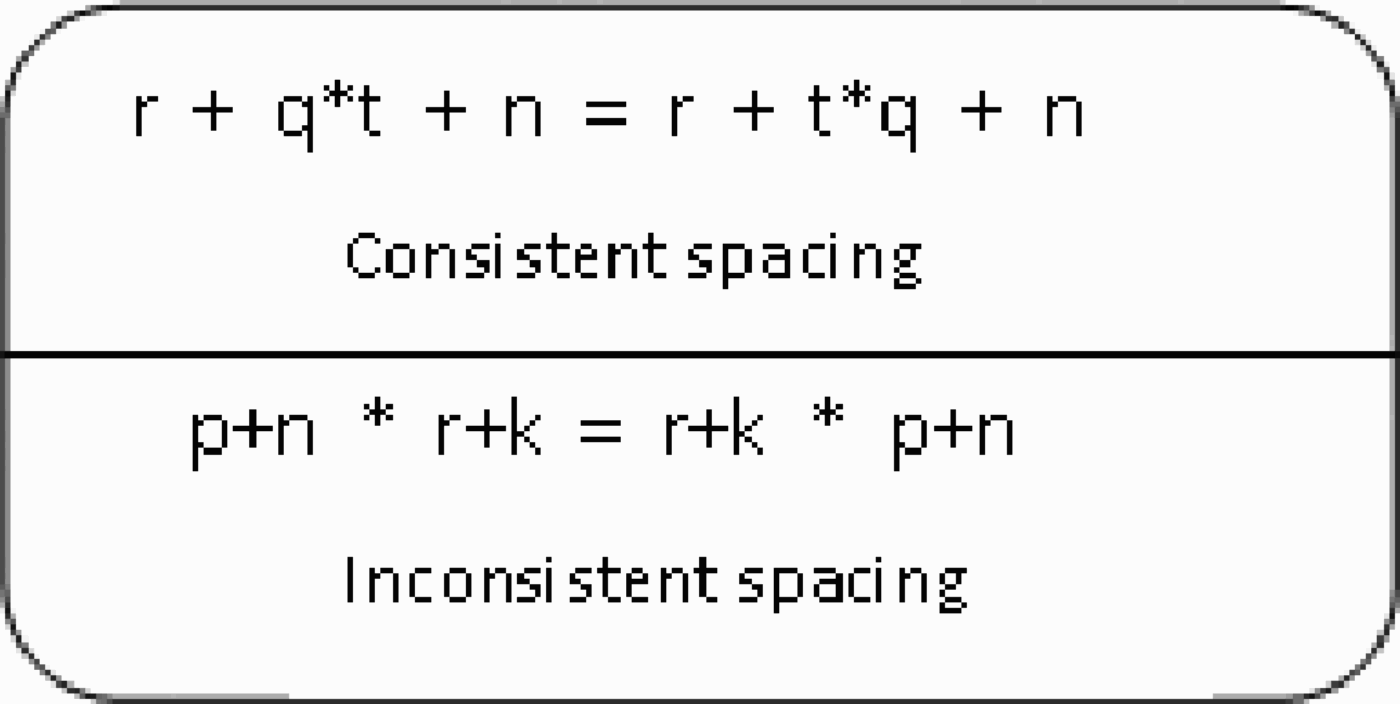
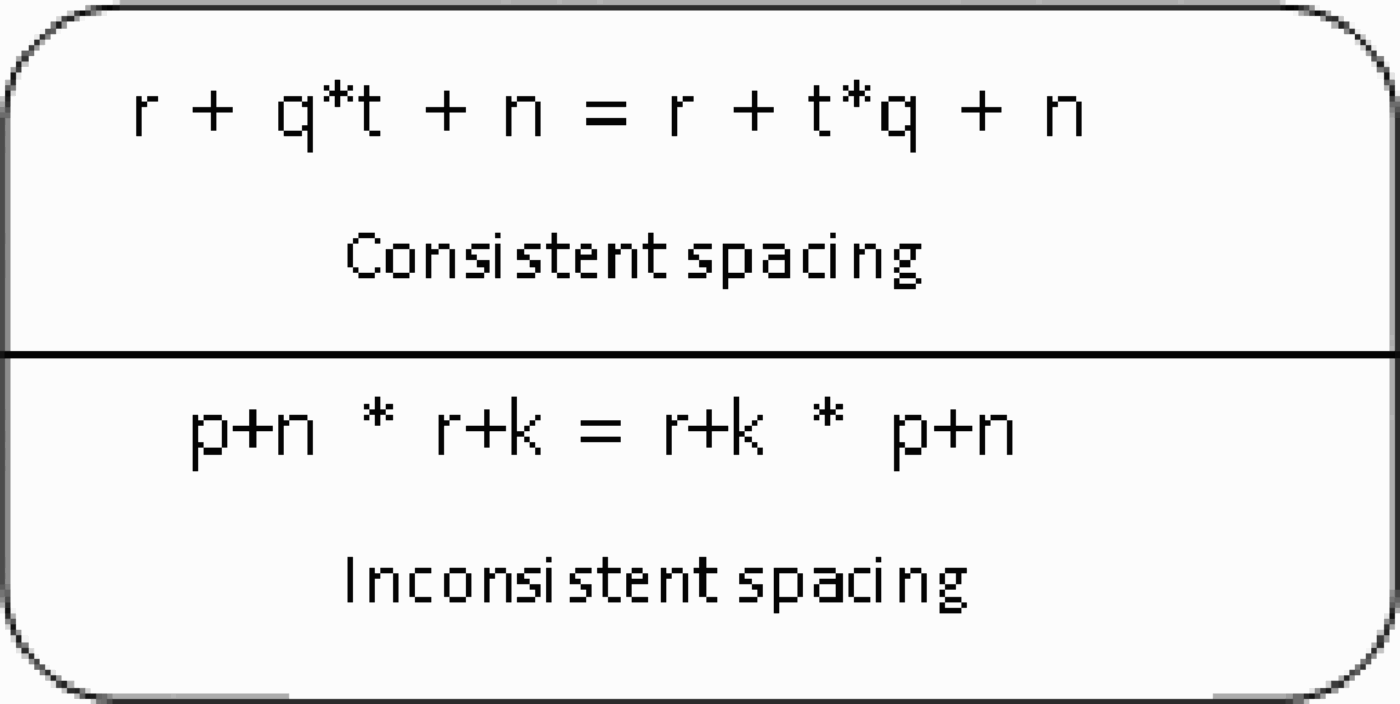
Although Rips et al. acknowledge that adults use magnitude representations on tasks such as numerical estimation and comparison, they argue that this does not provide evidence for continuity between internal magnitudes and natural number, as these tasks could engage the magnitude system alone and not abstract mathematical knowledge. Furthermore, they emphasize that magnitude representations do not serve as precursors to natural number because they do not instantiate key principles such as the successor function. However, evidence that abstract mathematical reasoning might be influenced by magnitude-related information would lend support to greater continuity. In fact, Landy and Goldstone (Reference Landy and Goldstone2007) have shown that adults' success in solving algebraic problems is influenced by the distances between symbols; people are better (and faster) at solving problems for which the spacing is consistent with the order of operations (see our Figure. 1). Algebraic problem-solving involves a learned system of ordered operations, and there is nothing about magnitude that reinforces these operations. And, yet, this type of abstract mathematical reasoning is clearly grounded in spatial-perceptual cues.
Algebraic math problems with consistent and inconsistent spatial cues, as used in Landy and Goldstone (Reference Landy and Goldstone2007).
Other research highlights the predictive value of early numerical competence for particular natural number principles. It has been shown that children who have higher levels of mathematical knowledge at the start of preschool (when this knowledge is largely focused on objects) are those who show higher mathematical knowledge throughout the elementary school years (when the focus is on the numbers themselves) (Duncan et al. Reference Duncan, Dowsett, Claessens, Magnuson, Huston, Klebanov, Pagani, Feinstein, Engel, Brooks-Gunn, Sexton, Duckworth and Japel2007; cf. Denton & West Reference Denton and West2002). It has also been shown that children's ability to solve nonverbal addition and subtraction problems (for which physical objects are used) develops earlier than their ability to solve parallel symbolic calculations. Importantly, however, in support of continuity between early nonverbal numerical representations and natural number concepts, performance on nonverbal, object-based calculation tasks are highly correlated with performance on number fact problems (r=.65, p<.001) and word problems (r=.63, p<.001; Levine et al. Reference Levine, Jordan and Huttenlocher1992).
The input claim
Based largely on the view that there is discontinuity between early numerical representations and the concept of natural number, Rips et al. argue that input related to early representations does not support construction of the natural numbers. They point out that other cultures such as the Mundurukú and Pirahã have “natural language” (although, see Everett Reference Everett2005) and yet do not have natural number. Although we would not suggest that linguistic experience per se allows for natural number construction, particular linguistic experiences, such as those involving the coordination of a count list with successively larger sets of objects, may have a significant impact (Carey Reference Carey2004; Le Corre & Carey Reference Le Corre and Carey2007).
Parent and teacher talk about number is focused mostly on counting and the cardinality of object sets (Klibanoff et al. Reference Klibanoff, Levine, Huttenlocher, Vasilyeva and Hedges2006; Levine et al., under review; Suriyakham Reference Suriyakham2007). If such talk were irrelevant to the construction of natural number, the prediction would be that children who experience little of this input would still perform as well in math as children who experience a lot of it. Such a prediction is counterintuitive, and, more importantly, not supported by existing data (Ehrlich Reference Ehrlich2007; Klibanoff et al. Reference Klibanoff, Levine, Huttenlocher, Vasilyeva and Hedges2006). Furthermore, the top-down construction of math schemas proposed by Rips et al. is consistent with the prediction that more abstract talk about natural number should lead to a better understanding of the formal properties of natural number than what they call “object talk.” Would it really be more beneficial to talk to children about 3 being one more than 2 than about 3 dogs being one more dog than 2 dogs? This seems unlikely, especially since more abstract talk about number principles occurs when concrete objects serve to instantiate these principles (Mix Reference Mix2008; Thompson Reference Thompson1994).
Cognition is not context-free, and even adults rely on supportive structures in the environment to enhance thinking and problem-solving. Moreover, in solving addition problems (e.g., 5+2=7), preschool children employ a variety of strategies, including using their fingers to represent each addend (counting all of them), and more sophisticated strategies such as counting on from the larger addend (Siegler & Jenkins Reference Siegler and Jenkins1989). When addition problems are represented using fingers and other objects, the underlying principles can be made more concrete, allowing children to reflect on them by reversing the addition process and repeating it (Mix, in press). Moreover, object representations or “manipulatives” may lead to automatic retrieval of basic number facts, which, in turn, may lead to increased reliance on abstract numerical properties, rather than concrete objects, to solve these problems.
Summary
Rips et al. lay out a cogent, logical argument for discontinuity between early nonverbal numerical representations and the later concept of natural number, with all its formal properties. Although their argument is appealing, existing empirical findings are, in our opinion, not consistent with complete discontinuity. The associations in adults and children described above suggest magnitude- and object-based grounding of natural number knowledge. Furthermore, the studies of early numerical experiences suggest that object-based numerical input is predictive of (and perhaps causally related to) later mathematical achievements.