

Australia's Aboriginal and Torres Strait Islander peoples, herein First Peoples, possess dynamic and diverse cultures, traditions, languages and histories, yet continue to experience greater health disparities compared to the non-indigenous population (Australian Institute of Health and Welfare, 2015). The ongoing effects of colonisation have fractured First Peoples societies through the dispossession of communities, loss of language and historical policies which included the forced removal of children from their families (Eckermann et al., Reference Eckermann, Dowd and Chong2010). Health disparities continue across all social determinants of health (Australian Institute of Health and Welfare (AIHW), 2016). This systemic oppression is perpetuated by a lack of access to culturally safe health services (Durey et al., Reference Durey, Thompson and Wood2012). Given this, the role of non-indigenous health professionals in reducing health disparities for First Peoples is crucial (Universities Australia Indigenous Higher Education Advisory Council, 2011; Department of Health, 2014). To ensure optimal development of cultural safety, it is fundamental that First Peoples perspectives are meaningfully embedded throughout all health professional programs (Department of Health, 2014; Indigenous Higher Education Advisory Council (IHEAC), 2007).
There are promising outcomes associated with learning First Peoples health content. Previous studies have found that students report an increased knowledge of First Peoples culture, health disparities and ongoing health impacts of past events (Kickett et al., Reference Kickett, Hoffman and Flavell2014; Hunt et al., Reference Hunt, Ramjan, McDonald, Koch, Baird and Salamonson2015; Thackrah et al., Reference Thackrah, Thompson and Durey2015). Some researchers have also reported improved motivation by students to work with First Peoples and a desire to advocate for social justice (Ranzijn et al., Reference Ranzijn, McConnochie, Day, Nolan and Wharton2008; Hunt et al., Reference Hunt, Ramjan, McDonald, Koch, Baird and Salamonson2015). First Peoples health education has also been associated with a reduction in negative attitudes towards First Peoples (Hunt et al., Reference Hunt, Ramjan, McDonald, Koch, Baird and Salamonson2015). However, despite these encouraging findings, a recent review described both difficulties in teaching, and the emotional discomfort in learning such content (Mills et al., Reference Mills, Creedy and West2018).
Whilst many health professional regulatory bodies (such as the Nursing and Midwifery Board of Australia; Medical Council of Australia) mandate that higher education institutions include education on First Peoples health in accredited programs, the complexities of the emotional dimension of student learning has been considerably overlooked. First Peoples health and cultural safety education often includes ‘difficult’ content, such as racism and white privilege (Jackson et al., Reference Jackson, Power, Sherwood and Geia2013; Thackrah and Thompson, Reference Thackrah and Thompson2013; Hunt et al., Reference Hunt, Ramjan, McDonald, Koch, Baird and Salamonson2015). Additionally, given the propensity for content on First Peoples health to be taught by First Peoples educators, personal stories of ongoing trauma, dispossession, loss and grief are likely to be expressed within classroom spaces (Jackson et al., Reference Jackson, Power, Sherwood and Geia2013; Kickett et al., Reference Kickett, Hoffman and Flavell2014).
Despite recognition of the emotional learning associated with studying First Peoples health content, understanding the diverse emotional responses of students has rarely been investigated. We identified only one study that focused on examining the emotional responses of midwifery students (n = 16) when undertaking a First Peoples health course as part of their degree (Thackrah and Thompson, Reference Thackrah and Thompson2013). The study analysed data collected during classroom observations and students' open-ended responses on a course evaluation survey. The authors identified student responses such as shame, shock, disbelief, sorrow, sadness, anger, confusion, guilt and frustration in response to historical events, as well as the lived experiences and stories shared by First Peoples tutors and guest speakers. Students questioned the need to have a First Peoples health course when many issues were not specifically ‘First Peoples issues’. Discussions about Aboriginal identity and ‘benefits’ led to contentious conversations, and for some students, there were unresolved issues of race (Thackrah and Thompson, Reference Thackrah and Thompson2013).
A related study analysed qualitative responses (n = 65) of undergraduate nursing students' on a routine university measure of course quality (Ramjan et al., Reference Ramjan, Hunt and Salamonson2016). Many students believed the course to be ‘a waste of time’, irrelevant and not taking into account the diversity of multicultural Australia. These findings are similar to those in a small hermeneutic phenomenological study that aimed to understand nursing students (n = 9) ‘journey’ in a First Peoples ‘cultural competence’ course (Biles et al., Reference Biles, Coyle, Bernoth and Hill2016). Biles et al. (Reference Biles, Coyle, Bernoth and Hill2016) describe a ‘truth cycle’ model, where students initially struggle with preconceived ideas and move to discovering new ‘truths’. Qualitative data from postgraduate nursing and midwifery students (n = 39) who attended an intensive workshop were also collected by Jackson et al. (Reference Jackson, Power, Sherwood and Geia2013). Students reported the content as emotionally ‘draining’ as well as ‘a lot to take in’. Some students, however, reported personal and professional transformation and possible tangible changes to their practice. Whilst not the specific intention, the identified themes allude to strong emotional responses by some students when learning First Peoples health content.
Theorised in different ways across diverse disciplines, ‘emotion’ appears to be a challenging construct to define (Boler, Reference Boler1999; Zembylas, Reference Zembylas2013). Emotions are generally regarded as either aspects of individuals and their psyche, or socially, culturally and politically constructed and historically embedded (Ahmed, Reference Ahmed2013; Boler, Reference Boler1999; Zembylas, Reference Zembylas2014). For example, Boler (Reference Boler1999) considers that in much western discourse, emotions in the classroom must not be expressed publicly, or, must be managed. This requires an examination of power, including understanding the social and cultural norms underpinning emotions, how they can be expressed, by whom and in what situations (Zembylas, Reference Zembylas2016). Such emotional rules are taught through varying forms of social regulation, as to what is considered ‘appropriate’ (Zembylas, Reference Zembylas2016). In this way, emotions are not simply biological nor privately experienced, but rather, reflect deep-seated cultural norms and are a source of power and resistance.
Educators must be skilled to create conditions in the classroom that address the emotional dimension associated with learning First Peoples health and cultural safety content. When teaching such ‘difficult’ content, educators must do so from an approach that is neither self-righteous (on behalf of the educator) nor therapeutic (towards the student). A self-righteous approach not only seeks to justify some emotions and pacify others, but in doing so, dismisses the relationship between trauma and power (Zembylas, Reference Zembylas2013). Conversely, a therapeutic approach with an over-emphasis on students' wellbeing may decrease the likelihood of students experiencing complexity or discomfort and contribute to the conservation of power inequalities and hierarchies (Zembylas, Reference Zembylas2013).
There is also the risk of oversimplified binary approaches to teaching difficult knowledge. Many authors warn against simplified binaries of ‘perpetrators’ and ‘victims’; ‘oppressor’ and ‘oppressed’; ‘right’ and ‘wrong’ and ‘guilty’ and ‘not guilty’. Within the Australian context and the field of First Peoples studies specifically, Nakata (Reference Nakata2007) cautions against binary classifications in the classroom, where First Peoples knowledges are seen as superior and in opposition to the ‘demonised’ Western other. Similarly, Boler (Reference Boler1999) suggests that a model of ‘binary morality’ may critically diminish educational opportunity. Additionally, Taylor (Reference Taylor2011, p. 45) recommends engaging students in critical self-reflection by avoiding empathy and sentimentalised states regarding ‘feeling good about feeling bad’. When there are only ‘two-sides’, unsafe classroom spaces may be heightened (Zembylas, Reference Zembylas2013). In order to overcome ‘us’ and ‘them’ binaries, the consequences of emotional attachment towards knowledge must be engaged and interrupted in sensitive yet critical ways (Zembylas, Reference Zembylas2014). Therefore, the important experience of some discomfort when learning First Peoples health content must be acknowledged.
The pedagogy of discomfort involves students' engagement in critical inquiry regarding their ‘values and cherished beliefs’ (Boler, Reference Boler1999, p. 176) and examination of ideological assumptions that influence their perceptions of others. Boler (Reference Boler1999) suggests that some form of the emotional response is generated by this critical inquiry. Emotional responses such as defensive fear, anger and guilt may contribute to feelings of ambiguity and discomfort (Boler, Reference Boler1999; Boler and Zembylas, Reference Boler, Zembylas and Trifonas2003). By critiquing these emotions, students may uncover their unconscious privileges as well as their inherent acquiescence with dominant ideology (Boler and Zembylas, Reference Boler, Zembylas and Trifonas2003). Through this process, students move from a position of ‘spectating’ to ‘witnessing’. ‘Spectating’ describes a critical distance between the student and ‘other’ –a privileged position that allows one to waiver any responsibility (Boler, Reference Boler1999). With ‘witnessing’ however, accountability for how students see themselves and others is developed. In a similar understanding to Mezirow (Reference Mezirow1997), the transformation that comes from learning to ‘bear witness’ refers to a process of understanding in relation to others and the world, as well as relationships entwined in structures of gender, race and class (Boler, Reference Boler1999). Importantly, this process of critical inquiry is the first step of transformation. A pedagogy of discomfort argues that education generates some form of political or social agenda. So, it follows that some form of action must manifest as part of this transformation. While transformative education effects a change in perspective and frame of reference (Mezirow, Reference Mezirow1997) the pedagogy of discomfort goes further, to envision, act and respond to social injustice through a ‘call to action’ that challenges systems of differential privilege (Boler, Reference Boler1999).
In education about First Peoples health, if the idea is to teach students about historical trauma, power, privilege and systemic inequality; and the outcome is for students to question their taken-for-granted views and emotions; then, a ‘pedagogy of discomfort’ may be inevitable. Despite this, there is an apparent absence of literature which seeks to offer a sophisticated understanding of the complexities and intersections of emotions and pedagogy within this space. Utilising the pedagogy of discomfort, the current study aims to understand the emotional experiences of non-indigenous students when undertaking a First Peoples health course that included concepts of cultural safety. Understanding students' emotional responses may inform pedagogical interventions to guide students through this challenging content. Significantly, the evidence generated from research on emotions and pedagogy may contribute to education providers moving beyond the notion of ‘cultural safety’ and enable the creation of a productive pathway for students to move toward true ethical and political transformation.
Materials and methods
Design
The qualitative design used a deductive, latent thematic analysis of students' written work.
Setting and sample
All students enrolled in a 3rd year, semester-long undergraduate First Peoples health and cultural safety course (N = 218) were invited to participate. The course is a core component of 11 undergraduate health professional programs. Prior to undertaking the course, students may have had some ad-hoc education in First Peoples health, which varied according to each professional program. This may have included completion of an online First Peoples health module prior to professional field placement, specific First Peoples inter-professional case studies and one-off ‘guest’ lectures and tutorials.
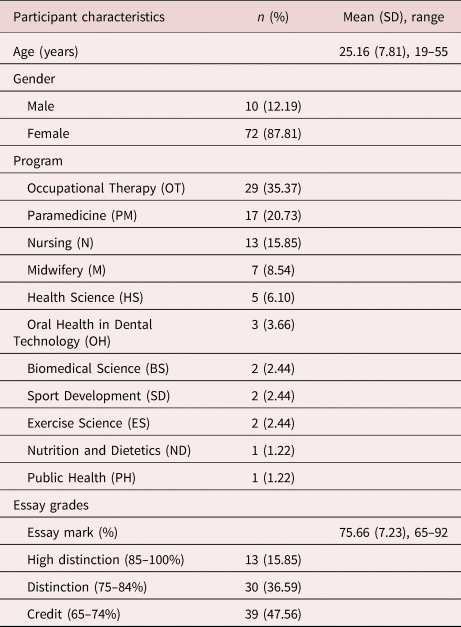
Eighty-three students consented for their essay to be analysed in this study. From this, n = 82 (37.6%) non-indigenous student essays were included. One essay by a First Peoples student was excluded because First Peoples students engaging in First Peoples studies have described their learning as a process of empowerment, often involving unique transformational experiences (Nakata et al., Reference Nakata, Nakata, Keech and Bolt2014). Whilst the researchers acknowledge the importance of understanding this experience, it was not the intention of this study to further explore these specific outcomes. Demographic information of participants is provided in Table 1. Most students were female (n = 72, 87.8%), with a mean age of 25 years (SD = 7.8). The programs of study were diverse with most students studying occupational therapy (n = 29, 35.4%), paramedicine (n = 17, 20.73%) and nursing (n = 13, 15.8%).
Participant characteristics

There appears to be no general consensus regarding adequate sample size in qualitative studies (Burnard, Reference Burnard2004). Samples of qualitative studies examining student experiences whilst undertaking similar content ranged from 9 to 249 (Mills et al., Reference Mills, Creedy and West2018). Given this range, the authors were satisfied that their obtained sample size would provide the depth required to understand the unique and diverse experiences of health professional students.
Data collection
Students were informed about the research project in class, and how to access the participant information sheet on the course online learning platform. If students wished to partake in the study, they attached an electronic consent form with their critical reflective essay. Students submitted their final critical reflective essay in April, 2017. As one author was a member of the teaching team, the included essays were downloaded from the online portal in March, 2018 to maintain a distinction between course assessment and analysis. Consent forms were manually inspected for completeness and saved on a secure drive. Student demographic data were collected by matching student numbers with personal details on the course enrolment system. This data was obtained by an authorised person who was not part of the research team. Essays were then de-identified and each essay allocated a unique identification number and program abbreviation, prior to analysis. For example, participant 4 was a paramedic student with an identification code expressed as 4PM.
The First Peoples health course and critical reflective essay task
The First Peoples health course is designed in accordance with the Aboriginal and Torres Strait Islander Health Curriculum Framework (the Framework) where critical reflection and cultural safety are recognised as central learning tenets (Department of Health, 2014). Cultural safety requires self-reflexivity; is concerned with the transfer of power at both individual and institutional levels; and acknowledges that cultural knowledge belongs to the cultural group (Ramsden, Reference Ramsden2002). In this way, addressing topics like ‘self-reflexivity’, ‘racism and anti-racism in healthcare’ and ‘white privilege’ educators applying the Framework guide students on a process of critical reflection. All members of the teaching team are First Peoples academics and health professionals, consolidating clinical, cultural and lived knowledges within the classroom space. Employing First Peoples' pedagogies, strategies such as: story sharing; deconstruction and reconstruction of information; non-linear approaches and community links, are central to learning and teaching (Yunkaporta and McGinty, Reference Yunkaporta and McGinty2009). Relationships are also important within the classroom, where cooperative learning styles are considered imperative (Mackinlay and Barney, Reference Mackinlay and Barney2012). Learning activities are purposefully designed to challenge preconceived assumptions as well as develop students' understanding of their place in power dynamics within society (Department of Health, 2014).
The assessment task was a 2000-word critical reflective essay based on a critical reflective framework developed by First Peoples academics (Dudgeon et al., Reference Dudgeon, Milroy and Walker2014). Students identified one topic which resonated with them because of an associated emotional response. Common topics students selected included the Stolen Generation, white privilege, intergenerational trauma and racism. Students were asked to reflect upon this emotional response, draw upon their personal and professional culture, as well as the dominant cultural paradigm to critically analyse their understanding of the chosen topic. Students further reflected on how their understanding may influence their perceptions of, and interactions with, First Peoples within healthcare settings. Finally, students discussed their overall learning from this process, as well as its application to practice in the future.
Data analysis
Using the pedagogy of discomfort as a theoretical framework, a deductive, latent thematic analysis approach was used. A deductive approach is appropriate when there is an existing theoretical model enabling the analysis to be based on pre-existing knowledge (Elo and Kyngäs, Reference Elo and Kyngäs2008). At the latent level, the analysis examines underlying conceptualisation shaping data content (Clarke and Braun, Reference Clarke and Braun2017). The analysis of content is not simply described, but theorised. The first step was the development of a categorisation matrix (Elo and Kyngäs, Reference Elo and Kyngäs2008). This involved an in-depth study of the pedagogy of discomfort and identification of key themes to guide the analysis. This categorisation matrix was then transferred into the NVivo qualitative data analysis software program (QSR International Pty Ltd. Version 11) and used to code each essay. Further recurring themes were derived and nested under pre-existing themes, termed ‘sub-themes’. These were used to discover the latent ‘meaning’ and understanding behind the pre-existing themes. Once coded by the lead investigator, the data was checked for consistency by a co-researcher on the project team.
It is important in thematic analysis, to understand the active role of the researchers within this process. That is, to acknowledge our theoretical, ontological and epistemological positions that shape how we ‘see’ the data and how we ‘know’ what data to theme (Clarke and Braun, Reference Clarke and Braun2017). The First author is an Aboriginal woman and a member of the academic teaching team for the First Peoples health course. Respectfully drawing upon the work of Tanana Athabascan scholar Million (Reference Million2009), as an Aboriginal woman and Aboriginal woman scholar, I bring my own ‘felt knowledge’ into the cultural interface (Million, Reference Million2009; Nakata et al., Reference Nakata, Nakata, Keech and Bolt2012). My ‘felt knowledge’ is entangled in the stories of my strong women ancestors. These stories of colonialism are stories ‘felt’ by those who continue to experience it (Million, Reference Million2009). Our stories would be incomplete without the diverse emotions that are a part of them; anger, sadness, grief, loss, hope and resilience. Yet, these emotions are often powerfully excluded in the retelling of history in dominant narratives. As a research team, our research calls for emancipatory epistemologies (Rigney, Reference Rigney1999). Whilst the pedagogy of discomfort is a western framework, we have incorporated elements of First Peoples theory and discourse within the analysis and discussion, to ensure that First Peoples principles, values and ethics have underpinned the project in its entirety.
Ethics
Ethical approval was granted by the lead institution Human Research Ethics Committee (Ref: 2011/38) and adhered to the Guidelines for Ethical Conduct in Aboriginal and Torres Strait Islander Health Research (Values and Ethics) (National Health and Medical Research Council (NHMRC), 2003).
Results
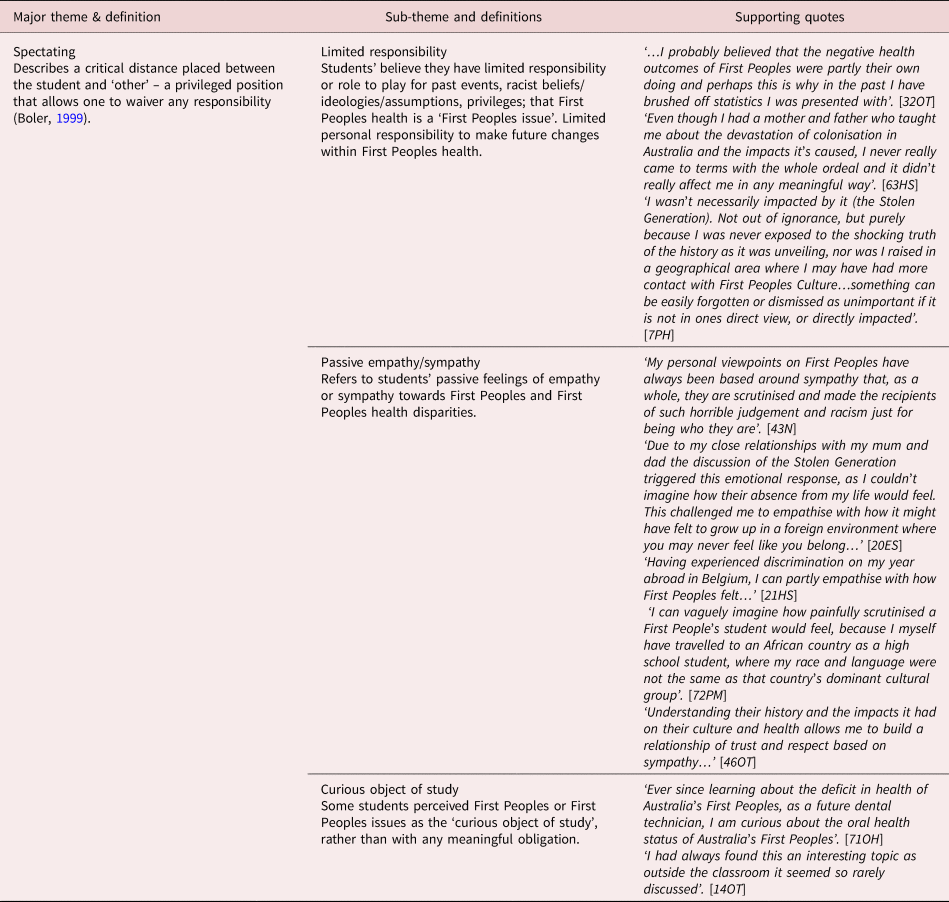
The key findings describe a range of emotions. This was captured in the following overarching themes: Acknowledging preconceived ideas; Uncomfortable emotions; Fragile identities; Spectating and Witnessing. To ensure trustworthiness of the data, sub-themes, definitions and a selection of supporting quotes for the Spectating theme are provided in Table 2.
Major category of ‘Spectating’ with subcategories, definitions and a selection of supporting quotes

Acknowledging preconceived ideas
Students reflected that before undertaking the course, they held varying attitudes and beliefs towards First Peoples as well as First Peoples health. Many students held preconceived notions about the value and relevance of course content to their practice. Some expected the course would not extend their prior knowledge, as explained by this student:
I walked into this course expecting to get nothing out of it as I completed a similar course a few years ago…[4PM]
Other students questioned the need to undertake a course based solely on First Peoples:
Going into this course I did not understand the need to be doing it. Occupational therapy [teaches] us how to have a therapeutic relationship with someone from any nationality, why were First Peoples any different? [36OT]
Prior to undertaking the course, students expressed stereotypical views about First Peoples. It was commonly assumed that First Peoples received ‘everything for free,’ ‘engaged in risky health behaviours and violence’, ‘were unemployed’, ‘had a lack of interest in their own health’, ‘did not contribute to society’ and ‘held negative attitudes towards non-indigenous Australians’. Some students identified that their preconceived ideas were based on individual factors such as ‘laziness’ or as a cultural phenomenon. This was depicted by one student who stated:
I had always known that First Peoples were subjected to alcohol abuse and violence but always assumed it was a part of their culture. [46OT]
Students rarely expressed positive preconceived views about First Peoples or spoke of First Peoples using a strengths-based perspective. Participating students reflected that their stereotypical views of First Peoples were influenced by several factors including narratives of First Peoples shared by friends, parents and family; the influence of mainstream media and a lack of socio-cultural education. These factors are depicted in the following quote:
I had always been told by my parents that First [Peoples] get more Centrelink entitlements than me, more scholarships and that they would have a much higher chance of being employed than me if I was to go for the same job. [36OT]
Some students, currently working in healthcare settings, identified that their negative perceptions of First Peoples were already influencing the care they provided:
I used to avoid talking and interacting with First Peoples and feared having to encounter First Peoples who might abuse me while treating them. [23BS]
Uncomfortable emotions
Students' descriptions of discomfort reflected feeling challenged, confronted, confused, disappointed, hopeless, ignorant, overwhelmed, ashamed, shocked, upset, worried and/or sick. Predominately, uncomfortable emotions were associated with students' lack of knowledge surrounding the history of First Peoples. Students reported being both shocked and then often angry, at not being taught about this history, or having a biased understanding of history:
After learning about the Stolen Generation, followed by weeks of feeling shocked and upset, I began to wonder why I felt all these emotions. I realised that my shock and frustrations were driven by being oblivious to the Stolen Generation, and that I was incredibly naive about an event that shaped many issues concerning First Peoples. [1PM]
Further, some students felt blamed when learning the content:
…I felt as a white person to be made to feel as if I personally had a direct impact to the poor treatment that First Peoples Australians had to endure. [3SD]
While others felt personally responsible and conveyed feelings of guilt.
The guilt, I feel, stems from my identification as a white Australian. It was my people who committed these atrocities and I feel, in part, blame for what was done and for not knowing more about it. [9N]
Fragile identities
Negative emotions often contributed to a perceived sense of threat to identity, or ‘fragile’ identities as students tried to make sense of these emotions (Boler, Reference Boler1999). Some students attached their personal identity to their coalescence with the dominant cultural paradigm. This contributed to feeling as though their ‘Australian’ identity was precarious and incomplete:
I am mindful how lacking such knowledge leaves me feeling like there is a missing chapter in my identity as an Australian and an uneasy sense of belonging without truly understanding the heritage of my home. [8PM]
Frequently, students reflected on their identity and the notion of white privilege which was discussed extensively in class. Students often found it difficult to believe they were afforded certain social privileges associated with being part of the dominant culture:
When I initially thought about white privilege, I thought in denial or excuses, it was difficult to be honest with myself. I thought of my hardships when ultimately, I should have been thinking of my opportunities. [4PM]
Many students found that parts of their identities were difficult to confront or associated with feelings of shame.
…there is a dark and ugly side to what I have learnt about myself. This process has brought to my awareness my inherent racism…[2M]
Spectating
Despite some students reporting transformative learning, the analysis of written work revealed that many students stayed within a comfortable ‘spectating’ position, with 212 statements classified in this position. Occasionally, students reported no personal meaning to their learning, or impact on their life. These views allowed them to remain in the privileged spectating position, where responsibility is abdicated (Boler, Reference Boler1999). Some students felt no responsibility or part to play in further action:
…These thoughts [of sympathy] however are vague and quiet and rarely spoken aloud and are bordered by the thought that I didn't cause the problems so it's not really my problem to solve. [43N]
This privileged ‘spectating’ position allowed for a ‘gaping distance between self and other’ (Boler, Reference Boler1999, p.186). This was often conveyed in the form of passive empathy or sympathy towards First Peoples:
Visualising how dreadful colonisation had been for First Peoples touched my heart, and it is unfortunate that at this stage all I can do is feel sorry for them. [53N]
Other students expressed interest in understanding First Peoples, but, as a curious ‘object of study’, rather than with any meaningful obligation:
This learning has also increased my intrigue in First Peoples from an occupational therapy perspective. [6OT]
Witnessing
There were 166 statements which were classified as ‘witnessing’ statements. This indicated that some students showed evidence of movement from a position of ‘spectating’ to that of ‘witnessing’. Students began to question ‘normal’ and linked these insights to privileged positions within the dominant cultural paradigm:
When I wear my student paramedic uniform or win a scholarship, people do not double-take or make race-based judgments on these, but instead consider the merit behind it. All because I am part of the dominant cultural group on campus. And I have never really questioned it. [72PM]
Witnessing links self-identity to others and a shared history rather than perceptions of self as an individual agent, abstained from responsibility (Boler, Reference Boler1999). This is perhaps best expressed by a student who wrote:
…to really address these atrocities that occurred in our nation's past we all need to be part of this shared history. [3SD]
As explained by Boler (Reference Boler1999), witnessing involves understanding moral relations not as simple differences in perspectives, but knowing there are ethical implications that come with how we see, or choose to see, which may cause others to suffer. This was expressed by one student who stated:
Without acknowledging the power and benefits I have, I am unable to change the inequality and racism experienced by First Peoples, as my ignorance would be contributing to its existence. [32OT]
Witnessing often resulted in students expressing a ‘call to action’. While some students initially found it difficult to acknowledge their individual role in First Peoples health, this facilitated insights on how they could be part of the ‘solution’. Encouragingly, some students articulated the impact of their learning not only on themselves or First Peoples, but to others and their place in society in the future.
… As I look to live a life where everything I do, not only adds value to my life, but adds value to others as well, I constantly ask the question, will this object, action, relationship, experience or comment bring any sense of value to someone in the world we live in? [18SD]
Discussion
This qualitative study revealed the utility of pedagogy of discomfort in understanding student engagement and learning about First Peoples health. It appears that emotional investment by students may contribute to two possible outcomes. One is that emotions act to protect ‘habituated ways of thinking’ (Faulkner and Crowhurst, Reference Faulkner and Crowhurst2014, p. 389), which may engender defensive actions and allow students' stance to remain firmly in their ‘comfort zone’ (spectating position). Alternatively, some students were motivated by these uncomfortable emotional responses to engage with course content and develop altered understandings and transformational changes, seen in the witnessing position (Phillips et al., Reference Phillips, Whatman, Hart, Winslett, Kidman, Te Rito and Penitito2005; Dudgeon and Fielder, Reference Dudgeon and Fielder2006).
Students' preconceived stereotypical ideas prior to undertaking a First Peoples health course are echoed in the literature. Previous research has reported that students commonly undervalue First Peoples health content, often finding it difficult to see the relevance to their future practice (Biles et al., Reference Biles, Coyle, Bernoth and Hill2016; Ramjan et al., Reference Ramjan, Hunt and Salamonson2016). Students have also reported their dissatisfaction with learning about one culture, over the study of ‘multiculturalism’ (Ramjan et al., Reference Ramjan, Hunt and Salamonson2016). While it is important that healthcare students have some understanding of the diverse needs of many cultures, it is equally imperative students understand the colonial history, socio-political and cultural needs of Australia's First Peoples as unique to other cultures. This understanding will contribute to culturally and clinically safe care for First Peoples. Additionally, the insertion of First Peoples into ‘other’ ethnic categories diminishes their position as the First Peoples and traditional owners of Australia (Dunn et al., Reference Dunn, Kamp, Shaw, Forrest and Paradies2010).
The diverse negative attitudes reported by students are typical of previous findings in the literature. Paternalistic attitudes described by students are prevalent (Hunt et al., Reference Hunt, Ramjan, McDonald, Koch, Baird and Salamonson2015; Power et al., Reference Power, Virdun, Gorman, Doab, Smith, Phillips and Gray2018), however, research suggests that education on First Peoples health may be a powerful intervention in decreasing students' initial negative attitudes (Pedersen and Barlow, Reference Pedersen and Barlow2008; Thackrah and Thompson, Reference Thackrah and Thompson2013; Hunt et al., Reference Hunt, Ramjan, McDonald, Koch, Baird and Salamonson2015; Thackrah et al., Reference Thackrah, Thompson and Durey2015). The pervasive negative views about First Peoples described by students are concerning. Currently, health professional students undertake this First Peoples health course in their second or third year of study. These findings suggest the need for more careful and meaningful integration of First Peoples health content earlier and throughout their health programs.
Uncomfortable emotions associated with First Peoples health education are also common. Previous research has reported non-indigenous students feeling victimised, blamed, sad, ashamed, guilty and angry (Thackrah and Thompson, Reference Thackrah and Thompson2013; Kickett et al., Reference Kickett, Hoffman and Flavell2014; Thackrah et al., Reference Thackrah, Thompson and Durey2015; Biles et al., Reference Biles, Coyle, Bernoth and Hill2016). The pedagogy of discomfort draws upon this emotional dimension of learning and affirms the place of emotions within learning experiences. With this, must come new tools to measure emotional learning and development of cultural capability. Bullen and Flavell (Reference Bullen and Flavell2017, p. 592) attest that rather than focusing on conventional evaluative tools of teaching quality, new measures for students' level of ‘comfort with discomfort’ need to be conceptualised. In this way, emotional constructs may need to be included with pre-existing measures of cultural competency and/or capability, as learning to practice in a culturally capable way, may not be considered by a student without a level of corresponding affective learning.
Boler (Reference Boler1999, p.182) argues that challenging content often involves learning to ‘see’ differently. Seeing differently requires a willingness to inhabit morally ambiguous ‘selves’. This ambiguity challenges self-identity on varying levels. The identity associated with white privilege is often unsettling, as this privileged position has little to do with one's own agency (Boler, Reference Boler1999). Whilst students may resist oppression at personal, cultural and structural levels, it appeared difficult for them to articulate their social locality within cultural norms (Moreton-Robinson, Reference Moreton-Robinson2000). This is evident in elements of society, such as the university system, that privileges dominant groups (Fredericks, Reference Fredericks2009). National identity too is often fragile and dependent upon complex investments in the dominant cultural paradigm (Boler, Reference Boler1999). Although education on First Peoples health appears to disrupt students' identities, understanding how privilege and oppression manifest within the healthcare setting are an essential part of being able to practice in a culturally safe way (Ramsden, Reference Ramsden2002; Department of Health, 2014). Additionally, these fragile and ambiguous identities may be an essential part of learning to ‘bear witness’ (Boler, Reference Boler1999).
The notion of ‘spectating’ was often exemplified by students staying within their comfortable, privileged position. As indicated by Boler (Reference Boler1999, p.186), spectating allows ‘oneself to inhabit a position of distance and separation, to remain in the anonymous spectating crowd and abdicate any responsibility’. Uncomfortable emotions may contribute to defensive reactions by students, such as the ‘I didn't do it, therefore it is not my responsibility’. These reactions imply a responsibility by the oppressed to address their own oppression (Moreton-Robinson, Reference Moreton-Robinson2000). The abrogation of responsibility needs to be addressed in students' learning as this position may inherently maintain the power of white privilege in society (Moreton-Robinson, Reference Moreton-Robinson2000). Additionally, comments that students were ‘intrigued’ by First Peoples, suggest a spectating position where First Peoples are represented as the object of the ‘knowers’ (Moreton-Robinson, Reference Moreton-Robinson and Moreton-Robinson2004). The passive sympathy and empathy displayed by many students holds little value in terms of social justice (Boler, Reference Boler1999). While empathy is conceptualised as projecting oneself into the ‘other's situation, the ‘other’ is only known by imagining what one may do in another's situation’. Thus, one does not truly know the ‘other’. This may also be conceptualised as a type of ‘charity,’ of which western health paradigms are often politicised to ‘help’ First Peoples, as ‘all-knowing’ and philanthropic ‘saviours’ (Phillips, Reference Phillips2015). These personal sentiments, whilst seemingly innocuous, are enabled by structural conditions that reinforce who belongs and the degree of belonging in a dominant society (Moreton-Robinson, Reference Moreton-Robinson2007).
The process of ‘witnessing’ may be seen as a transformation of perspective and a call to action. Students ‘bearing witness’ see themselves as inextricably linked to others and history, and are willing to undergo transformation in self-identity. Pedagogical approaches in this space must promote an understanding of both students and First Peoples as embodied subjects (Carey, Reference Carey2015). As they begin to ‘bear witness’ students acknowledge and challenge the contradictory historical, social, political and ideological factors that honours the embodied knowledge and sovereignty of First Peoples, and contribute to their abilities to work safely in culturally contextualised ways (Carey, Reference Carey2015).
It is important that future research consider mechanisms that contribute to transformative learning processes associated with ‘witnessing’. Factors such as the ‘cognitive maturity’ of students to undergo transformative learning in the first place must be examined (Merriam, Reference Merriam2004). In a recent quantitative study, Bullen and Roberts (Reference Bullen and Roberts2018) associated critical reflection with transformative experiences. Factors that contributed to this were relational, namely rapport between student and educator, and creating community classroom spaces. These appeared to facilitate the capacity of students to engage in deep critical reflection in the first instance. Whilst this is promising in terms of understanding the complexities of transformative learning, research that measures learning in this space appears to be in its' infancy.
Finally, conversations about the complex uncomfortable emotions that students may experience when learning First Peoples health content, need to consider associated emotions that academics may experience when teaching this content (Fleming et al., Reference Fleming, Creedy and West2017; Wolfe et al., Reference Wolfe, Sheppard, Le Rossignol and Somerset2018). There is also the risk that academics may ‘over-assume’ the emotional response of students at the cultural interface, inherently affecting pedagogical processes (Thorpe and Burgess, Reference Thorpe and Burgess2016). More research is required on how academic staff teach this content, the extent of institutional and cultural support, and, how the complexities of emotions at the cultural interface within learning and teaching is navigated.
Limitations
There were several limitations of this study. The use of a clearly defined assessment task, whereby students are ‘instructed’ to describe some form of transformation and be graded, undoubtedly influenced their written work. Some students may have described transformative learning experiences, even when no true transformation occurred. Similarly, the assessment process may have influenced social desirability bias. That is, students may have been wary about sharing negative values/beliefs/perspectives. This may have also contributed to some students not choosing to take part in the research. To some extent, this bias was mitigated by reassuring students that their ability to undertake the critical reflective process would be graded, rather than their personal experiences. Yet, this may have remained an influence. Further, inclusion of a range of essays for analysis (with the average mark being 75.6, SD = 7.23) demonstrates a variety of learning outcomes, not necessarily associated with scoring a ‘high level’ of transformation.
Application of the pedagogy of discomfort provided a guiding framework for the researchers to identify the markers of transformation by ‘reading between the lines’, an essential component of latent analysis. As required by the assessment task, students reflected on the implications of their learning for health professional practice. Whilst most students linked their increased knowledge about history or First Peoples to practising in a culturally-safe way, many students found it difficult to articulate how this would occur. The inability of some students to describe the application of key course concepts to clinical practice made it difficult to ascertain whether true, tangible transformation had occurred. This required a high level of interpretation by the researchers without being able to confirm with participants. Having a member of the teaching team as part of the research team could have proved a strength in this instance, by having an intimate understanding of the content and learning processes. Future research could consider a different design that includes a process of member checking to confirm themes.
Conclusion
This study identified a range of emotions experienced by undergraduate students when learning about First Peoples health. The pedagogy of discomfort provided a useful framework from which to identify and explain students' emotions. Although the results were promising, few students reported transformative learning processes characteristic of witnessing. Concepts related to First Peoples health must be embedded early in health professional programs and scaffolded to promote transformative learning processes. Importantly, understanding students' emotional responses will inform pedagogical interventions to guide students through this challenging content. Improving students' learning outcomes will ultimately impact on their future practice as culturally safe health professionals and advance health outcomes for First Peoples.
Kyly Mills is a Kamilaroi woman whose family is from Moree, New South Wales. Kyly currently lives and works on the Yugambeh language region in South-east Queensland. Kyly is an academic at Griffith University and current PhD candidate. Her research seeks to understand the emotional dimension of health professional student learning when undertaking First Peoples health education.
Debra Creedy is a registered nurse with a Masters of Education and PhD in Psychology. Professor Creedy conducts clinical and educational research. Current projects include the development of students’ critical thinking; and strategies to enhance academics’ awareness of cultural safety. Her methodological expertise relates to tool development and mixed methods.