Several phenomena can occur that involve variability of /t/ and some kind of glottal constriction. These include (i) glottal reinforcement of /t/ (often referred to as preglottalization [Wells, Reference Wells1982a:260] or glottalization [Docherty & Foulkes, Reference Docherty, Foulkes, Foulkes and Docherty1999a]), and (ii) glottal replacement of /t/ (often referred to as glottaling [Wells, Reference Wells1982a:261]).Footnote 1
This study focuses exclusively on (ii) among adolescents in London and Edinburgh. The terms T-glottaling, or glottal replacement, will be used here to refer to the complete substitution of /t/ with something that has an acoustically robust glottal quality, whether this is a glottal stop or a period of creaky voice. Thus, in the spirit of most existing sociolinguistic research on T-glottaling, the current study aims to account for the patterns of variation between /t/-realizations that have an impressionistically perceptible linguo-alveolar acoustic quality and the continuum of realizations that have an acoustically robust glottal quality.Footnote 2
T-glottaling is normally restricted to a very specific environment. Its occurrence depends most strongly on stress patterns and segmental context. It can occur after a preceding sonorant in coda or non-foot-initial onset position (cf. Tollfree, Reference Tollfree, Foulkes and Docherty1999:171), the latter referring to cases where “the stress on the syllable following /t/ is less than that borne by the preceding syllable” (Tollfree, Reference Tollfree, Foulkes and Docherty1999:172), such as in better and guilty. Where these conditions apply, T-glottaling may occur variably, influenced by a set of further internal and external constraints.
However, Milroy, Milroy, Hartley, and Walshaw (Reference Milroy, Milroy, Hartley and Walshaw1994:350) argued almost 20 years ago that linguists do not have an accurate idea of the relevant constraints governing the variability of /t/ in British dialects. The situation described by Milroy et al. (Reference Milroy, Milroy, Hartley and Walshaw1994) has barely changed, despite the fact that T-glottaling has since been the subject of several recent studies on sound change in many parts of Britain (Britain, Reference Britain and Bertacca2005:§3, and references therein). Indeed, whereas previous research has made significant advances in documenting the phonetic details of the realizational variants of /t/, most analyses usually assume only a small set of (chiefly) phonological constraints (e.g., Docherty & Foulkes, Reference Docherty, Foulkes, Foulkes and Docherty1999a; Drummond, Reference Drummond2011; Milroy et al., Reference Milroy, Milroy, Hartley and Walshaw1994; Roberts, Reference Roberts2006; Straw & Patrick, Reference Straw and Patrick2007). Other factors that contribute potentially to the variability of /t/—for example, grammatical category, word frequency, and number of syllables—are rarely considered. This prompts a crucial question: Is the variability of /t/ conditioned, almost exclusively, by phonological factors, as the existing literature suggests, or has our understanding of this phenomenon been restricted by the limited set of internal and external factors that has so far been investigated? This study, therefore, provides a new analysis of the realizational variation of /t/, which pays due consideration to a wide range of external and internal factors.
In addition, this study considers T-glottaling in two locations, rather than just one. Whereas sociolinguistic studies focus frequently on patterns of variation in single locations, in order to gain a full understanding of any phenomena, we need a cross-dialectal approach. For example, while T-glottaling is in the process of ongoing language change in some parts of the United Kingdom, it may well be a stable, regularized dialect feature in other areas. Similarly, it is conceivable that there is regional variation in the ordering of sociolinguistic constraints. In view of this, the primary goal of this study is to find out what sociolinguistic factors constrain the phonetic variability of /t/ among adolescent speakers in London and Edinburgh.
This paper is structured as follows. It begins with some background information on T-glottaling and then explains how the study was conducted. An analysis of the (t)Footnote 3 variable is then presented (the alternation between the voiceless alveolar stop and glottal replacement of /t/ in medial and final position, e.g., water [wɔːtə] and [wɔːʔə], what [wɒt] and [wɒʔ]). The paper concludes by discussing frequency and grammatical category effects in the phenomenon under investigation, as these raise important questions concerning the role of morphological compositionality in language change and the nature of lexical diffusion.
GLOTTAL REPLACEMENT OF /t/
Describing the phenomenon
The literature on T-glottaling is quite extensive, and it is reviewed here selectively with two main goals: (i) to outline what is known about the historical development of T-glottaling with a particular focus on London and Edinburgh, and (ii) to identify factors that previous research has found to constrain the variation of /t/.
Fabricius (Reference Fabricius2000:13ff) offered a good summary of some of the speculations made in relation to the history of T-glottaling in England and Scotland. There is historic evidence of glottal replacement in Scotland, and, in fact, some scholars speculate that it may have a longer history in Scotland than in England. Based on references to the phenomenon, Andrésen (Reference Andrésen1968:18, quoted in Fabricius, Reference Fabricius2000:14) assumed a diffusion of glottal reinforcement or replacement from western (1860) to eastern (1889) Scotland. In the early 1900s, Wright (Reference Wright1905:229) found evidence for glottal replacement of intervocalic /t/ when followed by /l/ or /r/ in the next syllable (e.g., battle, better) among speakers in Edinburgh, Lothian, and mid-west Scotland. Andrésen (Reference Andrésen1968:18, quoted in Fabricius, Reference Fabricius2000:14) further suggested that the phenomenon then spread to the North of England, the Midlands, and London in the early 1900s.
There is evidence of T-glottaling and glottal reinforcement on recordings of Received Pronunciation (RP) made before 1900 (Collins & Mees, Reference Collins and Mees1996), and Cruttenden (Reference Cruttenden1994:157) argued that T-glottaling is unlikely to be older than 200 years in London, as it does not occur in Australian English, which, it is assumed, derives predominantly from earlier London speech. In the rest of England, T-glottaling was still quite limited to particular areas in the middle of the last century. In the Linguistic Atlas of England, for which fieldwork was conducted mostly in the 1950s, glottal replacement of /t/ appears only in a small area around London and in East Anglia (Orton, Sanderson, & Widdowson, Reference Orton, Sanderson and Widdowson1978:map Ph239, quoted in Wells, Reference Wells1982a:261).
T-glottaling is now spreading quite rapidly in Britain and is perceived as stereotypical of British urban speech in general (Milroy et al., Reference Milroy, Milroy, Hartley and Walshaw1994:328; also see Britain Reference Britain and Bertacca2005:§3, and references therein for evidence of T-glottaling from all over England). In her study of the phenomenon in RP, Fabricius (Reference Fabricius2000) emphasized the continuing critical role played by London in defining the regional standards for the south of England. Trudgill (Reference Trudgill1988) reported for Norwich that, between 1968 and 1983, glottal stops increased particularly in formal style. He argued that this change “tallies very well with a strong casual impression shared by many older people that younger people in many parts of Britain today no longer feel [ʔ] to be a stigmatized feature to be avoided in certain situations, as older people do” (Trudgill, Reference Trudgill1988:44).
Thus, T-glottaling has been in use for at least 100 years in the two locations of interest: Edinburgh and London. However, the phenomenon seems to have a somewhat longer history in Scotland than in London, and the findings of this study may shed light on this particular point, as one would expect T-glottaling to show somewhat higher proportions of application values in Edinburgh than in London (hypothesis 1).
Linguistic constraints
As outlined, the occurrence of T-glottaling depends most strongly on stress patterns and segmental context. Within the possible manifestation sites, previous research has shown variation in /t/ to be constrained by a small set of internal and external factors. These are discussed with a focus on T-glottaling to the exclusion of glottal reinforcement of /t/, unless specifically mentioned. Previous studies typically examine:
1. the position of /t/ within the word (finding that glottal replacement occurs more frequently word-finally than word-medially [cf. Roberts, Reference Roberts2006]); and
2. phonotactic environment (typically finding that the following context or prosodic boundaries influence the variability of /t/ in statistically consistent ways [see Drummond, Reference Drummond2011; Fabricius, Reference Fabricius2000; Milroy et al., Reference Milroy, Milroy, Hartley and Walshaw1994; Speitel, Reference Speitel1983; Straw & Patrick, Reference Straw and Patrick2007]).
The phonetic environment following /t/ has received the largest amount of attention. Typically, /t/-realizations in at least three contexts are compared: these are (i) preconsonantal /t/ (henceforth, the PreC context); (ii) prevocalic /t/ (the PreV context); and (iii) prepausal /t/ (the PreP context). The PreC environment usually favors glottal variants the most; the PreV environment tends to disfavor it. Investigating word-final T-glottaling, Fabricius (Reference Fabricius2000:141) also found this pattern in acceptability tests and, after showing that the PreC environment is already acceptable in what she called modern RP, she hypothesized that PreP will become the next acceptable environment in RP in a generation or two. Straw and Patrick (Reference Straw and Patrick2007:390) referred to this ordering as the diffusion pattern PreC > PreP > PreV. Findings tend to be constant, but some regional particularities have also been identified (cf. Docherty & Foulkes, Reference Docherty, Foulkes, Foulkes and Docherty1999a; Drummond, Reference Drummond2011; Roberts, Reference Roberts2006; Straw & Patrick, Reference Straw and Patrick2007).
Previous studies normally limit the preceding context to only postvocalic /t/; however, T-glottaling also occurs after other sonorants (Tollfree, Reference Tollfree, Foulkes and Docherty1999:171). Roberts (Reference Roberts2006:235) is a notable exception to such studies. She coded for vowels, obstruents, liquids, glides, and nasals both preceding and following /t/, and the possibility of a pause following /t/. Preceding vowels favor glottal replacement, whereas consonants disfavor it in her study.
Although previous work has focused on accounting for the ways in which phonological factors influence the realizational variability of /t/, other nonphonological factors, such as word frequency and grammatical category, have been largely ignored. Only Mees (Reference Mees1987) and Mees and Collins (Reference Mees, Collins, Foulkes and Docherty1999) commented on word frequency effects in T-glottaling. Based on their assumption that T-glottaling is more frequent in certain words, they elected to examine a small subset of high-frequency monosyllables (e.g., bit, that, not), without, however, attempting to correlate the T-glottaling patterns with frequency counts.
Other studies, in failing to consider word frequency and grammatical factors, leave us wondering at the role such factors may play in determining the patterns of variation of /t/ outside the restricted set of high-frequency monosyllabic words, and they allow me to make some tentative hypotheses. Based on Mees (Reference Mees1987) and Mees and Collins (Reference Mees, Collins, Foulkes and Docherty1999), one should expect number of syllables and word frequency to constrain T-glottaling (hypothesis 2). The widely documented link between word frequency and reductive sound change certainly should result in significant frequency effects (e.g., Bybee, Reference Bybee2001; Phillips, Reference Phillips2006), if T-glottaling is still a change in progress in London and Edinburgh.
Considering the occurrence of T-glottaling in morphologically sensitive positions, morphological compositionality or word class may emerge as a significant predictor for T-glottaling (hypothesis 3). In particular, word class effects are documented widely in the language change literature.Footnote 4 These effects may be due to a variety of reasons, including phonological characteristics of a word class, sentence stress, or language processing (see, for example, Phillips, Reference Phillips2006:112–113). Most importantly, due to the hypothesized longer history of T-glottaling in Edinburgh, all of these factors should play a somewhat more advanced role in Edinburgh than in London.
External constraints
The following external factors have been found to significantly constrain T-glottaling:
• Style (e.g., Holmes, Reference Holmes1997; Romaine & Reid, Reference Romaine and Reid1976; Speitel, Reference Speitel1983). T-glottaling is normally less frequent in formal style.
• Age (e.g., Fabricius, Reference Fabricius2000; Marshall, Reference Marshall2001; Roberts, Reference Roberts2006; Speitel, Reference Speitel1983). T-glottaling is associated widely with young speakers. It has been suggested that T-glottaling, alongside TH-fronting and R-labialization, forms part of a set of youth norms that young people orient to in many parts of the United Kingdom (Williams & Kerswill, Reference Williams, Kerswill, Foulkes and Docherty1999).
• Gender (e.g., Drummond, Reference Drummond2011; Fabricius, Reference Fabricius2000; Holmes, Reference Holmes1997; Roberts, Reference Roberts2006; Speitel, Reference Speitel1983). Findings for gender often differ from study to study. In an attempt to account for gender-related findings in previous research, Mees (Reference Mees1987) and Milroy et al. (Reference Milroy, Milroy, Hartley and Walshaw1994) suggested that women tend to favor glottal replacement when it is associated with supralocal, as opposed to local, norms.
• Socioeconomic class (e.g., Milroy et al., Reference Milroy, Milroy, Hartley and Walshaw1994; Speitel, Reference Speitel1983; Williams & Kerswill, Reference Williams, Kerswill, Foulkes and Docherty1999). Generally, there is more T-glottaling as one goes down the social scale; however, social class often interacts with gender and the prior history of T-glottaling in an area to generate unique patterns in different locales (cf. Mees, Reference Mees1987; Mees & Collins, Reference Mees, Collins, Foulkes and Docherty1999).
Thus, the adoption of this feature by distinct social groups attests to the fact that T-glottaling participates in a variety of different language-change processes across the United Kingdom. Specifically, these processes reflect the fact that, in some locations, T-glottaling is a new feature; while, in other locations, it is not. Stage of diffusion and a prior history of T-glottaling are, thus, factors that may influence the role played by external factors. In London and Edinburgh, T-glottaling is a well-established local feature with a long history of use (yet some recent change in evaluation), which may result in significant findings for style and gender. T-glottaling should be more frequent in informal style (hypothesis 4) and, because it is a local feature, men may use it more frequently. However, if T-glottaling has progressed to an advanced stage, there may not be a gender difference at all (Labov, Reference Labov2001:308–309) (hypothesis 5).
The crucial contribution of this study is that it does not limit itself to accounting for patterns of variation in T-glottaling based on phonological or external factors alone. On the contrary, the role that external factors (with the exception of social class) play in T-glottaling is considered alongside phonological and morphophonological predictors as well as measures of word frequency. As discussed in the results, this approach yields crucial insights that have been overlooked in previous work.
METHODS
Data collection
This study was conducted in two high schools, one in West Edinburgh and one in West London.Footnote 5 Students were interviewed in friendship pairs in order to facilitate a casual atmosphere. Both schools are comparable in terms of the proportion of students from low-income families, amounting to roughly over one-fifth, as indicated by pupils' eligibility for free school meals. This is higher than the national average, but lower than in many poorer areas of the country. The adolescents considered here are comparable in terms of socioeconomic status, which is best described as upper-working to lower-middle class. My attempt to assign each adolescent to a social class, based on their parents' occupation, proved fruitless. The large majority of teenagers come from a mixed-class background, which is a reflection of the particular areas within London and Edinburgh where these data were collected.
The Edinburgh sample consisted of 21 Edinburgh-born teenagers (8 males, 13 females). The London sample consisted of 24 London-born teenagers (12 males, 12 females). The teenagers were all between 12 and 18 years, with a mean age of 14; a locally born female research assistant carried out sociolinguistic interviews in Edinburgh, and another locally born female assistant did the same in London. Recordings were made using the M-AUDIO Microtrack II 2-channel mobile digital recorder and SHURE headset microphones. The interviews were transcribed orthographically using ELAN (Brugman & Russel, Reference Brugman, Russel, Lino, Xavier, Ferreira, Costa and Silva2004),Footnote 6 resulting in a time-aligned, searchable corpus.
Although the interview was structured around certain topics of conversation (e.g., living in London/Edinburgh, school life, hobbies), the conversation was not constrained by these topics, and participants were encouraged to talk freely on other topics too. Speakers were also recorded performing a short reading task of 17 sentences, which were designed to elicit a wide range of different phonological variables. The reading task always preceded the interview. Combining reading and conversation data provides a measure for comparing differences in speech style, in the Labovian sense of attention paid to speech (Labov, Reference Labov1972:208–209).
The dependent variable: (t)
This study focuses on the variable realization of /t/, in particular, the alternation between [t]Footnote 7 and glottal replacement of /t/. These are the two main variants that have been coded in an impressionistic-auditory analysis.Footnote 8
Each realization of /t/ occurring in the relevant envelope of variation (i.e., /t/ after a preceding sonorant in coda or non-foot-initial onset position) was coded twice in ELAN by two paid, independent research assistants. Cases of coding disagreement were discussed with a third researcher and mutually agreed, sometimes after visual inspection in Praat (Boersma, Reference Boersma2001), an acoustic analysis program.Footnote 9 The coded data were then extracted from ELAN and imported into a spreadsheet for further coding, for example, for word frequency, grammatical category, etc., again following the same procedure of double, independent coding by two research assistants and disagreement resolution via a third party.
The relevant envelope of variation excludes /t/ preceded by fricatives or plosives and in consonant clusters like –str- and –st (e.g., best, kept, first), and words in which the stress pattern blocks T-glottaling, such as tutorial. It includes /t/ in consonant clusters with preceding nasals and liquids, such as mountain. However, contexts that showed no variation in the Rbrul analysis (Johnson, Reference Johnson2009)Footnote 10 were excluded postcoding. For example, while preceding bilabial nasals were included at the coding stage as T-glottaling is attested in words such as sometimes (Tollfree, Reference Tollfree, Foulkes and Docherty1999:183), bilabial nasals were excluded postcoding as a scan of the data revealed no variation in the current dataset. As a result, only vowels, alveolar nasals, and liquids are considered under preceding context. Finally, only the first 10 occurrences each of the high-frequency function words—it, at, but, out, that, not—were coded per speaker.
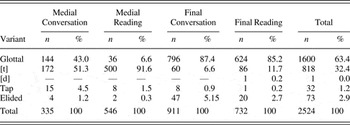
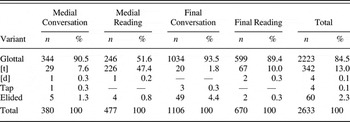
The initial coding included minority variants, such as elision, flap/tap [ɾ], and voiced released [d]. Tokens that could not be categorized reliably were excluded, for example, in cases of speaker overlap. This generated 2633 tokens of /t/ from the Edinburgh speakers and 2524 tokens of /t/ from the London speakers.
The five variants were reduced to two variant groups for statistical analysis: glottal replacement and “other”; the dominant variant of the latter category being released [t] (see Tables 1 and 2). As is usual in Goldvarb/Rbrul-based research on the variable (t) (cf., e.g., Drummond, Reference Drummond2011; Roberts, Reference Roberts2006), the glottal replacement variant was contrasted with the combined “other” variants.
Realizational variants of /t/ for London speakers

Realizational variants of /t/ for Edinburgh speakers

Linguistic and external constraints
The independent variables used in the current analysis, and the factors coded for under each variable, are as follows:
• Preceding phonological context: vowel, pause, nasal, liquidFootnote 11
• Following phonological context: vowel, pause, nasal, liquid, plosive, fricative and affricate, glide
• Position: word-final, word-medial
• Grammatical category: proper noun (e.g., Scott), pronoun (e.g., that), simple noun (e.g., cat), adjective (e.g., wet), adverb (e.g., quite), conjunction (e.g., but), verb (e.g., wait, got), past participle (e.g., spotted), verb progressive (e.g., getting), preposition (e.g., without)
• Number of syllables of the word in which /t/ occurs, based on word pronunciation: 1, 2, 3, 4, 5 (e.g., hot, about, highlighted, reality, university, respectively)
• Lexical frequency (log10 transformed)Footnote 12
• Speech style: reading, conversational
• Speaker sex: male, female
• Speaker age: continuous measure in years
Thus, apart from the usual variables (preceding and following context, sex, style, etc.), some new additions have been made. As mentioned previously, most studies assume T-glottaling is constrained by phonological context alone and, therefore, exclude variables such as grammatical category, word frequency, and number of syllables. Rather than assuming this a priori, these were included in the analysis reported here.
RESULTS
Frequency of variants and comparative sociolinguistics
The data presented in Tables 1 and 2 show the distribution of all variants of (t) among the teenagers recorded in Edinburgh and London for both reading and conversation in final and medial position. A comparison of Tables 1 and 2 indicates that the glottal variant is used more frequently by adolescents in Edinburgh than in London, particularly in medial position. Other variants such as [d] and [ɾ] are very infrequent in the current data (cf. Wells, Reference Wells1982b:324–326, 344, 445).
Tables 1 and 2 indicate that, for both groups of speakers, position—that is, where in a word the variable occurs—constrains T-glottaling in a highly consistent way. Specifically, glottal replacement is much more likely to occur in word-final position than in word-medial position: accordingly, separate statistical models have been provided for medial and word-final /t/.
Having established the general distribution of the variants in both cities, I turn to the detailed analysis of constraints on /t/ that emerge from a multivariate analysis of all the independent variables. This study makes variation itself the focus of comparison by contrasting significant constraints on variation between the same forms in different varieties of English. This comparative variationist approach (cf. Poplack & Tagliamonte, Reference Poplack and Tagliamonte1991; Tagliamonte, Reference Tagliamonte, Chambers, Trudgill and Schilling-Estes2002) subjects different groups of speakers to the same multivariate analysis with factor groups and factors within groups being held constant across populations. The resulting weightings are then compared in respect of significant factor groups and ranking of constraints within these. This approach has been used in a variety of different linguistic settings, such as in situations of language contact (Meyerhoff, Reference Meyerhoff2009; Sankoff, Reference Sankoff, Byrne and Winford1993) and dialect contact (Buchstaller & D'Arcy, Reference Buchstaller and D'Arcy2009). The approach has also been used to infer historical relatedness and to test the similarity of varieties spoken by different groups of speakers (Tagliamonte, Reference Tagliamonte, Chambers, Trudgill and Schilling-Estes2002). This makes it ideal for comparing the variation in the speech of adolescents in London and Edinburgh.
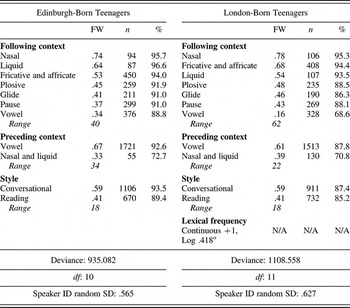
For the dependent variable, the glottal variant was treated as the application value in a mixed-effect multiple regression using Rbrul (Johnson, Reference Johnson2009). The individual speaker was treated as a random effect, which, as Johnson (Reference Johnson2009) discussed, is advisable in order to strengthen confidence in the significance of any other factors. Tables 3 and 4 provide an overview of the constraints that proved significant for the respective populations, including Rbrul (Johnson, Reference Johnson2009) weights for each factor, followed by the number of tokens and the proportion of the application value. Factor groups appear in order of effect size, based on their weight range.
Significant constraints for word-final /t/ in order of effect size
Edinburgh n = 1776; London n = 1643
Application value: glottal replacement

Note: aJohnson (Reference Johnson2009:361) listed log-odds and their weight correspondences, which help to interpret these numbers. For example, log-odds of −.405 and +.405 correspond to weights of .400 and .600, respectively. Log-odds of −.847 and +.847 correspond to weights of .300 and .700, respectively, and so on.
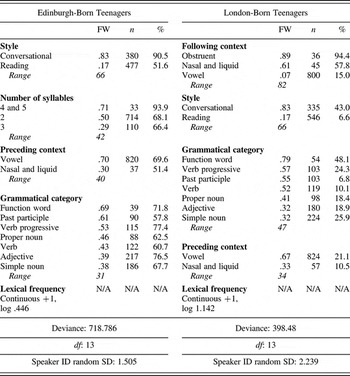
Significant constraints for medial /t/ in order of effect size
Edinburgh n =857; London n = 881
Application value: glottal replacement

Constraints on /t/ in word-final position
The constraints for word-final /t/ are very similar in Edinburgh and London (see Table 3). The two constraints with the highest effect sizes are both phonological. Preceding nasals and liquids tend to disfavor glottal replacement, whereas vowels favor it. In both locations, a following vowel (PreV), pause (PreP), glide, and plosive disfavor glottal replacement. Only following nasals, liquids, fricatives, and affricates favor glottal replacement. There is, thus, very clear evidence, in both locations, for the typical pattern of PreC > PreP > PreV (cf. Fabricius, Reference Fabricius2000; Straw & Patrick, Reference Straw and Patrick2007). However, note that although favorable contexts are almost identical in Edinburgh and London, even in the least favorable contexts, the proportions of application values for T-glottaling are much higher among Edinburgh speakers than in London and never fall below 88%.
Finally, in both locations, glottal replacement is more likely to occur in conversational style. In London, there is an effect of lexical frequency. More frequent words favor glottal replacement in word-final position. There is no word-final frequency effect in Edinburgh, a result that will be scrutinized in the discussion section. Thus, in word-final position, the constraints determining the realizational variation of /t/ vary slightly, but do not seem to differ much between London and Edinburgh.Footnote 13
Constraints on /t/ in word-medial position
Although the factors that appear to constrain the variation in word-medial /t/ are similar in London and Edinburgh, the effect sizes of relevant factor groups are markedly different. Tables 3 and 4 show that preceding and following contexts constrain similarly the variability of word-medial /t/ and word-final /t/ in London. In word-medial position, preceding vowels and following consonants favor glottal realizations of /t/. Though this is also the case for preceding context in Edinburgh, the following context does not influence T-glottaling in a statistically significant way. T-glottaling is equally likely to occur before either vowels or consonants among Edinburgh teenagers. In both locations, results for style are similar in final and medial positions, but the effect is much stronger in word-medial position. This may be due to the majority of word-medial tokens showing glottaling in PreV position, which is more stigmatized than glottaling in PreC position (Wells, Reference Wells1982a:261).
Lexical frequency, too, is significant in both locations; this constraint also applied to word-final /t/ in London. Frequent words favor glottal replacement in word-medial position. The main difference between word-final and word-medial /t/ is the appearance of a grammatical category constraint in medial position for both locations and following context constraining the variation of /t/ in London but not in Edinburgh. In Edinburgh, there is also an effect of number of syllables: words of four or five syllables favor glottal replacement.
The results for the grammatical category are similar in London and Edinburgh. Adjectives and nouns disfavor glottal replacement, whereas function words (i.e., low-content adverbs, prepositions, and pronouns) as well as progressives and past participles favor glottal replacement. Other verbs show only weak effects and are somewhere in between these two extremes. It is well known that function words are more susceptible to reductive processes (Phillips, Reference Phillips1983); however, the tendency for progressives and past participles to undergo T-glottaling in the current data is somewhat surprising. On the other hand, the fact that word classes often fall along a noun-verb continuum is documented widely. Berg (Reference Berg2000) summarized various syntactic, semantic, pragmatic, psycholinguistic, and phonological arguments for why this may occur. He also provided evidence that, in Modern English, adjectives pair more often with nouns than with verbs. Berg (Reference Berg2000) concluded that rhythmic contexts within sentences influence the stress patterns of word classes in a language. Even though the current results provide further evidence for such a continuum, what makes the results in Table 4 stand out is the behavior of /t/ within progressives and past participles, rather than the noun-verb continuum as such.
DISCUSSION
Summary
Before I consider the results for word frequency and grammatical category in more detail, I will return briefly to the hypotheses discussed at the beginning of this paper. First, the proportions of application values indicate that T-glottaling is indeed more advanced in Edinburgh than in London (hypothesis 1). This makes speculations on the longer history of T-glottaling in Edinburgh, when compared with London, very plausible. Furthermore, considering the high degree of similarity of the factors constraining variation in /t/, a diffusion scenario seems more likely than independent development does. This is particularly the case for word-final /t/, but even word-medial /t/ is constrained by similar factors within relevant factor groups. The fact that factor groups are organized differently in this position is not necessarily evidence for independent development. This may merely be a reflection of T-glottaling being under the control of different constraints at different points in the evolution of the change. Glottaling rates in Tables 1 and 2 indicate that Edinburgh speakers are much more advanced in their glottaling of word-medial /t/ than Londoners are. The respective difference of word-final /t/ is much smaller. While Edinburgh speakers are more advanced here too, London speakers have reached a similar stage in the evolution of word-final T-glottaling.
Hypotheses 4 and 5 were confirmed partially. T-glottaling is more frequent in informal style, and no gender difference was detected.Footnote 14 This is not particularly surprising for word-final /t/, as it is in agreement with other recent research (in particular, see Fabricius, Reference Fabricius2000) and the growing evidence suggesting that gender differences disappear as changes near an endpoint (Labov, Reference Labov2010:255). One might expect gender differences to surface for medial /t/, particularly in London, but marked gender differences do not emerge. This may suggest that generalizations with regard to the evolution of a change apply to the variable as a whole, rather than the variable in specific contexts.
Hypotheses 2 and 3, stating that T-glottaling may be constrained by more than phonological factors, have been substantiated. Number of syllables, word frequency, and grammatical category have all proven to be significant, and I will proceed to argue that the grammatical category constraint is, partly, a reflection of the morphological compositionality of relevant words.
The following discussion focuses on two key issues arising from the current data: grammatical category effects in medial position and observed word frequency effects. In both London and Edinburgh, there are significant effects of grammatical category and word frequency for /t/ in medial position. There are no such effects for grammatical category in word-final position; however, there is a word frequency effect in London. These are newly documented constraints on T-glottaling in need of some further scrutiny, as they suggest that: (i) the variable (t) is a function of higher levels of linguistic organization, that is, the morphophonology, and (ii) that T-glottaling may be spreading via lexical diffusion.
On the role of grammatical category in word-medial T-glottaling
This section of the discussion focuses on the previously undocumented grammatical category effect in both London and Edinburgh. I will explore in more detail the underlying reasons for this effect and will return to this argument toward the end of the paper in order to discuss the theoretical implications further.
Function words, verb progressives, and past participles favor glottal replacement, whereas the other grammatical categories show only weak effects or disfavor T-glottaling (in particular adjectives and nouns). So far, it has been assumed that glottal replacement of /t/ is attributable solely to phonological and phonetic processes. The data, however, seem to suggest that the variability of word-medial /t/ is a function of higher levels of linguistic organization—implicating grammatical category. However, word class effects have often been shown to be an epiphenomenon rather than an actual conditioning factor (E. L. Brown, Reference Brown and Alvord2011), so where precisely does this effect come from in the current data? The grammatical category effect may be due to factors such as hidden frequency effects or interaction effects of grammatical category with other constraints or phenomena. The following paragraphs aim to explain the findings for word-medial glottal replacement and explore alternative interpretations of the results.
I consider first the effect of function words, as their favoring glottal replacement is most likely a different process from that relating to verbs. It is well known that function words are more susceptible to reductive processes and sound change, which may be due to their low sentence stress (Phillips, Reference Phillips1983). Although function words may not always change first, and may not always pattern with the most frequent words (Phillips, Reference Phillips2006:103), function words tend to change first in vowel or consonant weakening (ibid.:102). This is precisely what the current data seem to show. The function words concerned are a few prepositions, pronouns, and low-content adverbs (e.g., at the bottom of, whatever, totally). Here, /t/ does not normally occur in favoring contexts for glottal replacement, for example, before consonants or within words of four or five syllables. The main feature these words have in common is that they are function words and usually subject to reduction and, hence, glottal replacement.
The emergence of past and present participles (in their progressive function) in London and Edinburgh is somewhat surprising. Based on the previous discussion of the noun-verb continuum, an explanation that involves merely sentence stress is likely to be insufficient, as only the category of verb is implicated here. It is possible that these effects are due to interaction of grammatical category with other constraints. The data were checked for interaction effects of grammatical category and all other significant factor groups;Footnote 15 however, no such effects were discovered.
The data were also scrutinized for context effects. Previous research has shown that diffusion of a sound change can be affected by the relative frequency of the immediate linguistic context. If certain words occur more often in a particular environment that favors change, these words would change more quickly. Bybee (Reference Bybee2002) argued for this effect for t/d deletion in English. Consonants are the conditioning environment for t/d deletion, and Bybee's (Reference Bybee2002) data indicated that words ending in t/d that occur more frequently in this conditioning environment do indeed have a higher degree of deletion. However, in the current study, /t/ does not occur more frequently in phonologically favorable environments, that is, following consonants, in past participles and progressives. Thus, there are no phonological attractors within the relevant grammatical categories.
Because the phonological makeup of the past participle and progressive forms that occur in the corpus does not yield insight into the variation in /t/, one must look for other shared properties that might explain the predisposition of these structures to exhibit T-glottaling. One likely candidate is the morphological compositionality of these forms. Thus, the presence of a morpheme boundary and a following suffix may affect the rate of glottal replacement in some consistent way. In the present study, the overwhelming majority of past participles in the corpus end in /-t + əd/, while the verb progressives end in /-t + ɪŋ/. This fact is crucial in order to understand the higher rate of glottal replacement in these categories and leads me to formulate two hypotheses to be tested.
(1) High-frequency syllables, such as -ed and -ing, increase the likelihood of words with these suffixes to be targeted by T-glottaling in word-medial position.
(2) Past participles and verb progressives show higher rates of T-glottaling because their root morphemes appear with /t/ in word-final position and, as was shown earlier, with rates for glottal replacement of up to 93%.
I will first examine hypothesis (1). The verbs concerned here are, for the most part, low-frequency verbs in the case of the past participle,Footnote 16 and mid-frequency verbs in the case of the progressive.Footnote 17 They are connected to suffixes with extremely high frequencies. According to Blevins (Reference Blevins2001:196), the most frequent syllables, in order, in English are ing, er, a, ly, and ed.
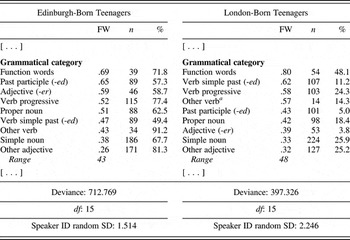
To test whether it is frequent suffixes rather than root morphemes that render certain words more amenable to T-glottaling, I recoded the factor group of grammatical category and separated weak simple past forms from other verbs (simple past having been included previously within the category of verbs). I also separated comparative adjectives from other adjectives to see whether the morpheme -er (the second most frequent suffix in the list) behaves similarly to -ed and -ing. Only adjectives with the same root morphemes in comparative and positive forms are included here, to the exclusion of the word better. None of the other relevant inflectional or derivational morphemes (e.g., adjectives ending in -ish, -est, -ing, -ed and nouns ending in -er, -ing, -s), that is, those directly preceded by a root morpheme ending in -t, resulted in a large enough number of tokens for statistical analysis (i.e., at least 10, as is usually recommended, e.g., Guy, Reference Guy and Labov1980:20). If hypothesis (1) was correct, one would expect -ing, -er, and -ed to favor T-glottaling in precisely this order, as root morphemes with the most frequent suffix -ing should show more glottal replacement than root morphemes combined with -er.
Another mixed effect multiple regression analysis was conducted. Table 5 represents only the relevant factor group. Weights in other factor groups only changed minimally.Footnote 18 The table indicates a distinct trend of words with inflectional morphemes favoring glottal replacement (when compared to their relevant other category, which normally appears with lower weights) and that this is not only restricted to -ing, but also applies to -er.
Significant constraints for medial /t/ and inflectional morphemes in order of effect size
Edinburgh n = 857; London n = 881
Application value: glottal replacement.

Note: aAlso contains irregular and strong past participles, included under past participle in the previous run.
However, Table 5 suggests that these bound morphemes do not help diffuse sound change. If this were the case, the factors verb progressive, adjective (-er), verb simple past (-ed), and past participle (-ed) should follow the order of suffix frequency in both locales: ing, er, ed. Yet they do not, which makes it unlikely that the high frequency of these suffixes has a measurable effect on the application of T-glottaling. Having excluded an effect of suffixes, this leaves us with the root morpheme effect outlined in hypothesis 2.
My second hypothesis links glottal replacement in medial position to the root morphemes of the class of words concerned. Because words such as note, hate, wait, and treat are likely to show glottal replacement in word-final position, they may be predisposed to also show higher rates of T-glottaling in their suffixed forms. In word-final position, even before vowels, rates for glottal replacement of /t/ are high in both locations; up to 89% for vowels in Edinburgh and 69% in London (see Table 3). A word like waited is, thus, in a very different position from a word like water, as the latter does not have any related root morphemes with high rates of glottal replacement. This may explain why, in both London and Edinburgh, the category of other verbs (e.g., notice, mutter) and other adjectives (e.g., little, pretty) are ranked lower than most of the /t/-final root morphemes combining with ing, er, and ed. The data clearly suggest that morphological compositionality plays an important role in T-glottaling. There are certain types of words, those in which /t/ occurs at the boundary of high-frequency bound morphemes, that seem to benefit from some boost for glottal replacement via their related and frequently glottaled word forms with word-final /t/.
However, results also suggest that there is an urgent need for future research that incorporates more data. First, the low number of “other verbs” makes comparisons with relevant verb categories difficult. It would be worthwhile exploring why regular past participles and simple past forms behave so differently from each other and why, in particular, past participles rank below other verbs in London. Second, the current data is not equally distributed by style, that is, certain grammatical forms appear more often in reading than in conversational style. Although the model adapts to these asymmetries, weights and proportions of application values can sometimes indicate rather different trends.
Finally, the current dataset is too small to test whether high-frequency words with word-final /t/ have a more pronounced effect on related words with word-medial /t/ than low-frequency words with word-final /t/. This would certainly be expected, and such effects have been argued for in related studies (cf. E. K. Brown, Reference Brown2011).
Frequency and language change
I will now turn to a discussion of the observed word frequency effects as Tables 3 and 4 show that, based on the current data, T-glottaling is lexically conditioned. There continues to be much debate about the status of lexical diffusion in language change. Word frequency effects are regarded usually as a reflection of lexical diffusion, and the current results may help to specify in more detail what type of sound change affects the most frequent words first.
T-glottaling is an ongoing sound change in many parts of the United Kingdom (e.g., Altendorf & Watt, Reference Altendorf, Watt, Kortmann and Upton2008:209; Fabricius, Reference Fabricius2000:134; Wells, Reference Wells1982b:323). Certainly, it was considered a change in progress in London and Edinburgh toward the end of the last century (e.g., Speitel, Reference Speitel1983; Tollfree, Reference Tollfree, Foulkes and Docherty1999).Footnote 19 Because T-glottaling is a reductive sound change, a type of change frequently associated with lexical diffusion (Bybee, Reference Bybee2002), and because it is known that T-glottaling was or is a change in progress in London and Edinburgh, one would certainly expect frequency effects linked to this change to be observed in both locations synchronically.
Indeed, this is the case for /t/ in medial position, where word frequency effects were found in Edinburgh (log .446) and London (log 1.142). These effects in word-medial position would certainly fit in with an interpretation of an ongoing change in progress that is diffused lexically.
However, in word-final position, only London demonstrates a frequency effect (log .418). The Edinburgh speakers do not show such an effect in word-final position. Why, then, does frequency seem to play a different role for the two dialect groups in word-final position? In the early 1980s, Speitel (Reference Speitel1983) found evidence for a change in progress in Edinburgh, as T-glottaling was more common among younger speakers than older ones in the city, in both word-medial and word-final position. However, the absence of a word-final frequency effect in what is known to have been reductive sound change is an indication that the process is now stable or nearing completion in Edinburgh, while it remains ongoing in London.
Word-final glottal replacement of /t/ now amounts to 92% (1633 of 1776 tokens) in Edinburgh and 86% (1420 of 1643 tokens) in London (see Tables 1 and 2). In Edinburgh, the majority of tokensFootnote 20 with word-final /t/ show glottal replacement. Assuming the rate of sound change follows an S-curve (Labov, Reference Labov1994:65), it would be difficult, and would require considerably more data, to observe frequency effects when a change is nearing completion. The word-final frequency effect in the London data suggests that glottal replacement of /t/ can still be considered a (weak) change in progress in London.
However, these results are somewhat at odds with some views of lexical diffusion. The debate surrounding lexical diffusion concerns whether it is restricted to certain kinds of sound changes. Labov (Reference Labov1994:542) argued that there are two types of sound change: regular sound change, which affects “a single phonetic feature of a phoneme in a continuous phonetic space,” and lexical diffusion, which is characterized by “abrupt substitution of one phoneme for another in words that contain that phoneme.” Sound change is placed squarely in phonology in this view, with lexical diffusion restricted to, in lexical phonology terminology (e.g., Kiparsky, Reference Kiparsky, van der Hulst and Smith1982, Reference Kiparsky and Ingemann1983), lexical rules, those substituting one phoneme for another, but not postlexical rules, which are phonetically conditioned. Lexical and grammatical conditioning is regarded as much more characteristic of lexical diffusion (Labov, Reference Labov1994:542).
Conversely, there are views (e.g., Bybee, Reference Bybee2002; Phillips, Reference Phillips2006; Pierrehumbert, Reference Pierrehumbert, Gussenhoven and Warner2002) that eliminate the long-held opposition of lexical diffusion and Neogrammarian sound change, suggesting that all sound changes are implemented lexically, which may or may not lead to an end result resembling regular sound change. In support of this wide view of lexical diffusion, Phillips (Reference Phillips2006:8–10) quoted several counterexamples of lexically diffused changes involving postlexical rules, or the lexical diffusion of phonetically gradual changes, none of which should occur according to the narrower conception of lexical diffusion discussed here. The picture is further complicated by the fact that not all lexically diffused changes behave the same way: some affect the most frequent words first, some the least frequent words (e.g., Bybee, Reference Bybee2002); some reach Neogrammarian regularity, some do not; some are influenced by word class, some are not, etc. (see Phillips, Reference Phillips2006:10). Crucially, however, according to this position, all changes diffuse lexically, yet for many changes there is no evidence of lexical diffusion (Labov, Reference Labov2006:509).
However, as Phillips (Reference Phillips2006:13) explained, this does not exclude the possibility of lexical diffusion as, for example, some changes may progress very quickly, or a change may have come to a stage where all words have been affected. Clearly, the current data can easily be explained from this wider position. Particularly, the Edinburgh findings for word-final T-glottaling support Phillips' (Reference Phillips2006:13) last point, as they demonstrate that word frequency effects are difficult to detect in very advanced stages of sound change.
How do the current results compare with a narrower conception of lexical diffusion, such as Labov's? Labov (Reference Labov2006:509) summarized his recent views on the issue as follows:
My best present estimate is that lexical diffusion occurs with changes from one abstract category to another . . . , in late stages of a change that has risen above the level of social awareness . . . , and in changes that intersect with morphological paradigms. . . .
T-glottaling, in this dataset, shows evidence of lexical diffusion. It is phonetically abrupt and lexically gradual. Certainly, in word-final position it has reached a late stage in its life cycle, which may have resulted in a lack of a frequency effect in this position in Edinburgh. T-glottaling is also a phenomenon that has risen above the level of social awareness. Most importantly, I have shown that it intersects with morphological categories. Thus, T-glottaling seems to fit squarely into Labov's (Reference Labov2006) notion of lexical diffusion.
However, the situation becomes more complex when considering earlier claims regarding the phonological nature of lexical diffusion. First, even though T-glottaling was indeed observed to be conditioned grammatically in the current data, it is also very much under phonological control. Given how consistently preceding and following phonological context were found to constrain glottal replacement of /t/ in this and other studies, it is not unlikely that there are more general phonetic and phonological constraints operating on this phenomenon that interact with the phonotactic principles of English. For example, the finding that following consonants favor the glottaling of preceding /t/ may be due to perceptual factors; namely, that glottal replacement is less perceptible in preconsonantal position (Tollfree, Reference Tollfree, Foulkes and Docherty1999).
This does not sit entirely easily with a narrow view of lexical diffusion; neither does the fact that, within lexical phonology, the effect of following context would, based on the data provided here, be considered a postlexical rule, which is less characteristic of lexical diffusion.
Thus, what we have is a reductive sound change that is phonetically abrupt and lexically diffusing. It has reached a relatively late stage in some locales and contexts and has risen above the level of social awareness. However, it is not only lexically and morphologically constrained. T-glottaling takes place under well-defined phonological and morphological conditions, and it is sensitive to phonetic context. Thus, phonetic conditioning does not rule out lexical conditioning. Phonetic, phonological, grammatical, and lexical conditioning interact to a large degree in T-glottaling in the current data.
These data certainly fit a wider notion of lexical diffusion as outlined here, particularly a usage-based model incorporating exemplar theory as it combines lexical, grammatical, and phonological conditioning, and it is regarded by many (e.g., Bybee, Reference Bybee2002; Phillips, Reference Phillips2006) as the best current model to account for lexically diffused changes. For example, Bybee's (Reference Bybee2001) usage-based model not only incorporates effects of word frequency on sound change, but it can also unite various other conditioning factors. This school of thought assumes that the phonological knowledge of a speaker includes individual lexical items whose phonetic tokens have been memorized as exemplars (e.g. Bybee, Reference Bybee2002; Pierrehumbert, Reference Pierrehumbert, Gussenhoven and Warner2002). Moreover, the model relates to frequency in that speakers and listeners have stronger representations for items they have encountered more frequently. Bybee (Reference Bybee2002) explained how the model works particularly well for reductive changes, which tend to affect more frequent words first, which also makes it suitable for T-glottaling.
However, it remains an open question which theoretical model might best fit with the word frequency data discussed here. Whereas usage-based approaches can integrate frequency effects very easily, classical modular phonology can certainly be modified to include such effects (Pierrehumbert, Reference Pierrehumbert, Gussenhoven and Warner2002:§3); however, it is clearly beyond the scope of this paper to undertake a comparison of the adequacy of these theories to model the data presented here.
CONCLUSIONS
This study set out to uncover the internal and external constraints on T-glottaling among adolescents in London and Edinburgh. It confirms many of the findings made in previous research. Phonological and stylistic constraints do play a very important role in glottal replacement of /t/.
However, there is also clear evidence that our understanding of this phenomenon has been restricted by the limited set of internal and external factors investigated previously. This study has provided evidence for grammatical category and word frequency effects. The grammatical category effect (especially regarding function words) is likely due to sentence stress, and the morphophonological constraint in word-medial position may be due to the interconnectedness of items within the lexicon.
There are very distinct frequency effects, which are possibly due to reductive sound change. These effects do not only provide evidence for lexical diffusion—in itself not surprising—but also for lexical diffusion that is partly under phonological control and phonetically (i.e., perceptually) conditioned.
The regional comparison of two different varieties was particularly informative in this study as it made it possible to compare frequency phenomena and speculate about the diffusion of this sound change. However, the frequency effects shown here do not concern word frequency alone. They can also be “hidden” in morphological constraints and result from interaction of morphologically complex words with other related, more frequently glottaled, root morphemes.