Introduction
Sperm–oocyte interaction involves multiple steps, from sperm chemo-attraction to oocyte penetration, which only mature, motile and physiologically functional spermatozoa can undertake. The capability of human zona pellucida (ZP) to selectively bind normal functional sperm has been reported in the literature (Menkveld et al., Reference Menkveld, Franken, Kruger, Oehninger and Hodgen1991; Liu & Baker, Reference Liu and Baker1994, Reference Liu and Baker2007). Zona pellucida-bound spermatozoa are characterized by progressive motility, but only a small proportion of the motile sperm (14% in fertile men) is capable of binding the ZP in vitro (Liu et al., Reference Liu, Garrett and Baker2003). This situation suggests that, in vivo, most motile sperm are incapable of fertilizing because they are unable to bind to the ZP. Zona pellucida-bound sperm are also characterized by normal morphology (Liu & Baker, Reference Liu and Baker1994; Garrett et al., Reference Garrett, Liu and Baker1997). Patients with severe teratozoospermia show a high frequency of defective ZP–sperm interaction (Liu & Baker, Reference Liu and Baker2004). In addition to sperm motility and morphology, the ZP seems to select sperm with normal nuclear chromatin structure (Liu & Baker, Reference Liu and Baker2007). Sperm DNA damage has a negative impact on fertilization (Agarwal et al., Reference Agarwal, Juris, Rakesh, Gardner, Weissman, Howles and Shoham2009): it is associated with a reduced fertilization and pregnancy outcome in traditional in vitro fertilization (IVF; Tomlinson et al., Reference Tomlinson, Moffatt, Manicardi, Bizzarro, Afnan and Sakkas2001) and has a critical impact on acrosome reaction and on fertilization after intracytoplasmic sperm injection (ICSI; Ozmen et al., Reference Ozmen, Koutlaki, Youssry, Diedrich and Al-Hasani2007). It has been shown that the proportion of sperm with normal DNA in semen correlates significantly with the number of sperm bound to the ZP; moreover, the proportion of ZP-bound spermatozoa with normal DNA is on average >90%, and very few sperm with abnormal DNA are found to bind the ZP even in men with a high percentage of DNA damaged sperm in semen (Liu & Baker, Reference Liu and Baker2007). To a certain extent, damaged DNA carried by sperm can be repaired by the oocyte (Tesarik et al., Reference Tesarik, Mendoza and Greco2002). However, different studies have shown that paternal genomic defects may compromise fertilization, embryo quality and pregnancy progression (Razavi et al., Reference Razavi, Nasr-Esfahani, Mardani, Mafi and Moghdam2003; Ozmen et al., Reference Ozmen, Koutlaki, Youssry, Diedrich and Al-Hasani2007; Kheirollahi-Kouhestani et al., Reference Kheirollahi-Kouhestani, Razavi, Tavalaee, Deemeh, Mardani, Moshtaghian and Nasr-Esfahani2009; Tavalaee et al., Reference Tavalaee, Razavi and Nasr-Esfahani2009) due to the oocyte aberrant DNA repairing system (Aitken & Krausz, Reference Aitken and Krausz2001). Therefore, sperm selection for ICSI insemination should aim to exclude spermatozoa with damaged DNA (Benchaib et al., Reference Benchaib, Lornage, Mazoyer, Lejeune, Salle and François Guerin2007).
In undertaking the present study we assumed that, in order to improve clinical ICSI outcome, ZP–sperm binding could be a useful physiological method to select spermatozoa with a good motility pattern, morphology and normal DNA. The aim of the present work was to compare standard ICSI (conventional ICSI) with ICSI performed using spermatozoa selected by ZP binding (ZP-ICSI).
Material and methods
Patients
This study was approved by the Institutional Ethical Committee of the European Hospital and oral informed consent from all patients were obtained. All experimentation was performed according to the Helsinki declaration of 1975 and its modifications. Patients inclusion criteria were: (i) number of oocytes ≥7, with mature oocytes (MII) ≥6; (ii) semen sample normal or pathologic (WHO, 1999; azoospermia, cryptozoospermia and globozoospermia excluded); (iii) post-swim-up sperm concentration ≥1 × 10⁶/ml and motility ≥50%. From April 2008 to April 2009, N = 60 cycles meeting such criteria were treated with ZP-ICSI and compared retrospectively with N = 38 cycles treated with conventional ICSI.
Statistical analysis
Data are shown as mean ± standard deviation (SD). Statistical tests were performed using GraphPad Instat 3 (GraphPad Software, Inc.). The statistical tests used are reported in parentheses. Differences were considered to be significant when the P-value was <0.05.
Ovarian stimulation
Ovarian stimulation was conducted using a gonadotrophin-releasing hormone (GnRH) agonists (long (LP) or short (SP) protocols) or a GnRH antagonist (AP), recombinant follicle-stimulating hormone (FSH) and hCG administration. In the ZP-ICSI group, protocols’ proportions were 62, 10 and 28%, whereas in the conventional ICSI group they were 66, 16 and 18% for LP, SP and AP respectively (chi-squared test, NS). Women's age distribution in the ZP-ICSI group was 75% ≤39 years old (35.2 ± 2.94) and 25% ≥40 years old (41.0 ± 1.13). In the conventional ICSI group, 65.8% of female patients were ≤39 years old (34.3 ± 2.89) and 34.2% were ≥40 years old (41.6 ± 1.04) (Fisher's Exact test, NS).
Cumulus–corona–oocyte complexes
After retrieval, cumulus–corona–oocyte complexes were incubated in fertilization medium (Quinn's Advantage Protein Plus Fertilization Medium, SAGE). After denudation, three oocytes were selected for ICSI (Rienzi et al., Reference Rienzi, Ubaldi, Iacobelli, Minasi, Romano, Ferrero, Sapienza, Baroni, Litwicka and Greco2008). The ejaculate was washed with rinsing medium (Quinn's Sperm Washing Medium, SAGE) and centrifuged; the supernatant was removed and fertilization medium added. Motile spermatozoa were collected after 30 min and post-swim-up concentration and motility were evaluated.
ZP–sperm incubation
In the study group, ZP–sperm incubation was performed immediately after oocyte decumulation in a 100 μl drop of post-swim-up medium [post swim-up concentration: 1–100 × 106/ml (24.0 × 10⁶ ± 22.97 × 10⁶/ml); post swim-up motility: 70–99% (93.4% ± 6.45%); whole semen normal morphology: 1–23% (8.9% ± 5.6%)]. Zonae pellucidae evacuated of the inner oocytes, can be obtained by aspiration of the ooplasm with an ICSI pipette. Supernumerary metaphase II (MII) oocytes, not selected for insemination or cryopreservation, which otherwise would have been discarded, were used. When MII were not available, germinal vesicles or metaphase I (or combinations of ZPs at different stages) were used. Many authors report that oocyte maturity has no impact on ZP–sperm binding and penetration (Overstreet & Hembree, Reference Overstreet and Hembree1976; Lopata & Leung, Reference Lopata, Leung, Jones and Schrader1988; Liu & Baker Reference Liu and Baker2002), and on selection of sperm in terms of nuclear DNA integrity (Liu & Baker, Reference Liu and Baker2007). In any case, sperm and ZPs used for incubation were from each individual couple. In order to avoid stress and damage to the bound spermatozoa, the unbound sperm were dislodged by gentle pipetting with a large diameter 200 μl tip. Motile bound sperm were counted at ×400 magnification by focusing on different layers along the spherical ZP; some sperm were then aspirated with a hatching micropipette (avoiding to disturb the head and middle region), released in polyvinylpyrrolidone and immobilized.
Once spermatozoa were available, they were additionally observed/selected at ×400 magnification and, finally, injected [time from decumulation to ICSI: 25–205 min (96.25 min ± 36.81 min); ZP–sperm incubation time: 20–120 min (62.5 min ± 22.62 min)]. Control group oocytes were injected with motile spermatozoa obtained by swim-up and selected by observation at ×400 magnification (time from denudation to injection: 25–280 min (104.6 min ± 59.47 min; unpaired t-test with Welch correction, NS). Injected oocytes were finally moved to cleavage medium (Quinn's Advantage Protein Plus Cleavage Medium, SAGE). Only motile sperm with no gross anomalies (ideally normal sperm) were selected by ZP binding plus additional ×400 observation for ZP-ICSI, and only by ×400 observation for conventional ICSI, independently on the original sperm parameters.
Embryo-quality score and clinical pregnancy rate
After 18 h post-insemination the presence of two pronuclei was assessed. An embryo-quality score was given on the day of embryo transfer (ET) performed on day-2, day-3 and day-5 (Rienzi et al., Reference Rienzi, Ubaldi, Iacobelli, Ferrero, Minasi, Martinez, Tesarik and Greco2002). Clinical pregnancy rate (CPR) was calculated as the number of cycles with at least one fetal sac with heartbeat/the total number of cycles × 100. Implantation rate (IR) was the number of fetal sacs with heartbeat/number of transferred embryos × 100. Take-home-baby rate (TBR) was the number of pregnancies with at least one delivered baby/number of cycles × 100.
Results
The present data describe a general population who received either ZP-ICSI (N = 60) or conventional ICSI (N = 38) independently to stimulation protocols and female partner's age. The most relevant results on fertilization rate, embryo quality, clinical pregnancy, fetal heartbeat and TBRs are shown in Table 1. One to three embryos/cycle were transferred (ZP-ICSI: 2.9 ± 0.34, n = 172; conventional ICSI: 2.8 ± 0.39, n = 107; Mann–Whitney, NS). Respectively for ZP-ICSI and conventional ICSI, ETs were performed on day-2 (51.7% and 52.6%), on day-3 (45.0% and 39.5%) or rarely on day-5 (3.3% and 7.9%) (chi-squared test, NS); positive beta-human chorionic gonadotrophin (beta-hCG) patients were 48.3% and 47.4% (Fisher's Exact test, NS).
Analysis of clinical outcomes in a general population treated either with ZP-ICSI or with conventional ICSI

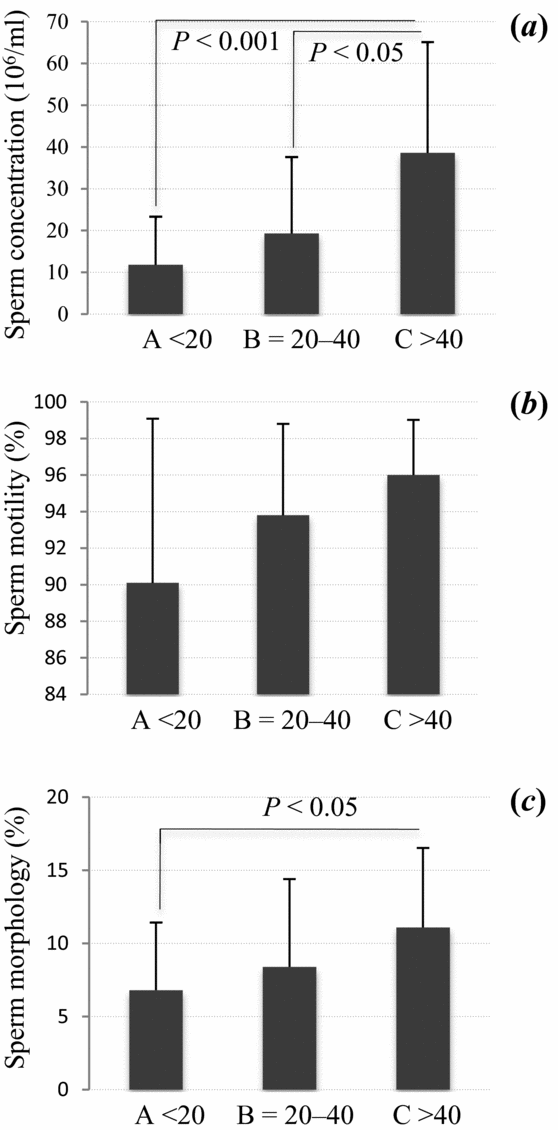
When we analyzed sperm capability of binding the ZP, we sub-divided our population based on the number of sperm bound to the ZP. Groups were (A) <20 sperm bound to the ZP (N = 19); (B) 20–40 sperm bound to the ZP (N = 19); and (C) >40 sperm bound to the ZP (N = 22) [women's mean age: (A) 37.1 years old ± 3.08 years old; (B) 35.6 years old ± 3.96 years old; and (C) 37.2 years old ± 3.75 years old (one-way ANOVA, NS); time from denudation to ICSI: (A) 67.1 min ± 25.07 min; (B) 57.9 min ± 22.6 min; and (C) 62.5 min ± 20.86 min; Kruskal–Wallis test, NS; age and stimulation protocols distribution not statistically different among the three groups; chi-squared test, NS)]. Zona-pellucida–sperm binding positively correlated with increased sperm concentration (Kruskal–Wallis test, P = 0.0002; Fig. 1a). Sperm motility was higher with growing ZP–sperm binding class (Kruskal–Wallis test, P = 0.0544, NS; Fig. 1b); ZP–sperm binding significantly increased with growing normal sperm morphology in semen (Kruskal–Wallis test, P = 0.0185; Fig. 1c). When comparing the three groups, there was no statistical difference in clinical outcomes (chi-squared test). However, in the two groups with lowest (A) and highest (C) ZP–sperm binding, CPRs were 26.3 and 45.5% and TBRs were 21.1 and 31.8%, respectively.
Sperm parameters in relation to ZP–sperm binding. (a) Post swim-up sperm concentration. Group A: 11.8 ± 11.47 106/ml; group B: 19.3 ± 18.31 106/ml; and group C: 38.6 ± 26.51 106/ml (Kruskal–Wallis, P = 0.0002; Dunn's test: A versus C, P < 0.001; B versus C, P < 0.05). (b) Post-swim-up sperm motility. Group A: 90.1 ± 8.98%; group B: 93.8 ± 5.00%; and group C: 96.0 ± 3.02% (Kruskal–Wallis, P = 0.0544). (c) Normal forms in semen. Group A: 6.8 ± 4.63%; group B: 8.4 ± 6.00%; and group C: 11.1 ± 5.43% (Kruskal–Wallis, P = 0.0185; Dunn's test: A versus C, P < 0.05).
Discussion
In the current study, we have evaluated outcomes of two types of ICSI methods: traditional-ICSI and zona-binding selected sperm ICSI by comparing pure transfers of embryos obtained with the two different procedures. The results indicate that selection of spermatozoa by hyaluronan binding using human zona pellucidas and utilization of them for ICSI insemination (ZP-ICSI), does not improve clinical outcomes as compared with our conventional method of sperm selection. Fertilization rates, the percentage of positive beta-human chorionic gonadotrophin patients, embryo quality and CPRs were similar. In addition, no difference appeared in terms of implantation and TBRs in respect to the type of sperm selection performed. Our observations are in agreement with a study by Baker and colleagues that showed no differences in fertilization, embryo quality, implantation and CPR between conventional ICSI and ZP-ICSI (Black et al., Reference Black, Liu, Bourne and Backer2010). However, the literature presents conflicting results on ZP-binding sperm selection for ICSI insemination. One recent publication (Paes Almeida Ferreira de Braga et al., Reference Paes Almeida Ferreira de Braga, Iaconelli, Cássia Sávio de Figueira, Madaschi, Semião-Francisco and Borges2009) presents data on ZP-ICSI versus conventional ICSI on sibling oocytes. No difference in fertilization rate was reported, but an increased percentage of high-quality day-3 embryos was observed when ZP-bound spermatozoa were used. However no data on clinical outcomes are reported. A publication from Liu et al., (Reference Liu, Qiu, Zou, Deng, Yang and Liu2011) reports a significantly higher proportion of day-3 good quality embryos and higher implantation and CPRs with ZP-ICSI. In both cited works (Paes Almeida Ferreira de Braga et al., Reference Paes Almeida Ferreira de Braga, Iaconelli, Cássia Sávio de Figueira, Madaschi, Semião-Francisco and Borges2009; Liu et al., Reference Liu, Qiu, Zou, Deng, Yang and Liu2011), embryo evaluation and transfers were performed on day-3, whereas in our study, we took measurements either on day-2 or day-3. Given the late activation of the sperm genome in the human embryo (Tesarik Reference Tesarik2005), if ZP binding provides a better selection of normal functional sperm, it is possible that differences in embryo quality may appear by extending the length of embryo culture. Consistently with this hypothesis, Black et al. (Reference Black, Liu, Bourne and Backer2010) showed no difference in embryo quality on day-2.
In the present study, we performed pure transfers of embryos obtained either by ZP-ICSI or conventional ICSI. Clinical results of our study point out that in a general population including all female patients’ age, indications, and stimulation protocols, with the possibility to fertilize no more than three oocytes per cycle (as imposed by the Italian legislation 40/2004), despite opposite theoretical expectations, ZP-ICSI is not a superior method compared with conventional ICSI.
When performing conventional ICSI, we applied a strict and meticulous selection of spermatozoa at ×400 magnification. A single motile sperm with normal morphology and possibly no vacuoles was selected from the available pool. As DNA integrity is usually associated with normal motility and morphology, such selection by careful observation aims to discard spermatozoa with possible nuclear/DNA damage (Liu & Baker, Reference Liu and Baker2007). It has been published that certain sperm parameters evident at ×400 magnification [namely straight-line velocity, axial symmetry, narrow neck and large acrosome (Garrett et al., Reference Garrett, Liu and Baker1997, Reference Garrett, Liu, Clarke, Rushford and Baker2003)], are defined as ‘zona pellucida-preferred’ parameters, because they relate closely to sperm ability of binding the ZP. By strict selection of the ideal sperm that met these characteristics in order to perform conventional ICSI, we believe that we were able to perform a selection that was very close to the physiological selection performed by the ZP during ZP–sperm incubation. Therefore it is reasonable to propose that our conventional ICSI results were similar to those obtained by ZP-ICSI.
When we looked at the quality of ZP–sperm interaction, the number of sperm bound to the ZP correlated positively to sperm concentration and motility. Additionally, in agreement with previous findings (Liu & Baker, Reference Liu and Baker1994; Oehninger et al., Reference Oehninger, Mahony, Ozgur, Kolm, Kruger and Franken1997; Liu et al., Reference Liu, Garrett and Baker2003), a higher number of ZP-bound spermatozoa was found in relation to their morphology. It has been shown that once sperm–ZP collisions have occurred during incubation, the ability to bind the ZP is determined by sperm morphology: abnormal sperm are less capable to bind correctly, probably due to defects in their structure or signal activation pathways (Liu et al., Reference Liu, Liu and Baker2009). Interestingly, we observed no relationship between the number of sperm bound to the ZP and the time of incubation: longer incubation does not lead to a higher number of ZP-bound sperm. This finding is in agreement with observations that the cumulative number of ZP-bound sperm approaches the total number of sperm that are capable of binding the ZP and that the proportion of sperm capable of such binding decreases with time during incubation (Liu et al., Reference Liu, Garrett and Baker2003). Conversely, as expected, a significant negative correlation appeared between sperm concentration and the time of incubation; this result suggested that a longer time period is needed for poor semen to allow ZP–sperm collisions. When we looked at clinical outcomes in relation to sperm ability to bind the ZP, we observed higher, although not significant, clinical pregnancy rates and TBRs in the group with higher ZP–sperm binding. Zona pellucida–sperm interaction is well known to relate to fertilization success in classical IVF (Oehninger et al.1997; Liu et al., Reference Liu, Liu and Baker2009) so that ZP–sperm binding was proposed as a tool for male subfertility diagnosis (Liu et al., Reference Liu, Garrett and Baker2003). However, a lower pregnancy rate and even a reduced TBR were seen in the group with lower ZP–sperm binding capacity even when performing ICSI. Therefore, also for ICSI insemination, and not only for classical IVF, clinical outcome seems to be reduced with lower ZP–sperm binding. We speculate that sperm competence could be reduced overall when its ability to bind the ZP is impaired.
The novel ZP-ICSI method is a laborious and time-consuming procedure. In our population, clinical outcomes were not improved by ZP-ICSI, suggesting that our sperm selection method allows us to choose competent sperm for ICSI. Although it does not provide any additional benefit to ICSI insemination, ZP–sperm binding should be further evaluated as a possible prognostic tool for ICSI clinical outcome.
Acknowledgements
The authors thank Dr Zsolt Peter Nagy, M.D. Ph.D., for his precious help in preparing the manuscript.