

Introduction
International relations scholarship has been interested in questions of compliance with international law for a long time, and has theorized effects in relation to cooperation.Footnote 1 With the move toward increasing legalization in the 1990s, the interest turned to studying dispute settlement systems more systematically.Footnote 2
More recently, for instance, studies have analyzed how experience in disputes in area-specific institutions affects subsequent behavior.Footnote 3 In addition, the field of trade policy in particular has focused on the dynamics created by overlapping institutions and analyzed the effects of an evolving regime complexity.Footnote 4 We follow the above lines of research interests and focus in particular on how dispute experience translates into design choices across institutions within the same policy field.
In their recent study, Copelovitch and Putnam present empirical evidence that key provisions found in new treaties are influenced by how well countries “know” each other from prior “encounters” in international cooperation.Footnote 5 We build on these insights and provide additional theoretical and empirical building blocks for research on the nexus between past experience and the design of new institutions. More specifically, we ask how past interaction in dispute settlement affects subsequent design choices in international law. We address this question by examining the issue area of international trade and preferential trade agreements (PTAs). PTAs have proliferated at a rapid pace across the globe since the early 1990s and constitute a central pillar of the international economy.Footnote 6 They have become a universal phenomenon as each member of the World Trade Organization (WTO) has negotiated at least one PTA in the past. Also, the politicization of PTAs has significantly increased over time with domestic debates about the merits of preferential trade liberalization gaining in intensity.
In this article, we focus on how past experience in the WTO dispute settlement system translates into PTA design choices. In particular, we are interested in how interaction among states in this highly legalized international court matters beyond the confines of the WTO. We argue that losing a legal case against a WTO member provides clues to industries about the risk of being sued by the same member under a planned PTA. A lost case translates into a higher perceived risk especially by import-competing industries. This leads these industries to lobby for more flexibility and lower levels of enforcement during PTA negotiations. These lobbying efforts are in turn reflected in PTA design.
We test our hypotheses in an empirical analysis of 347 PTAs in the post-1990 period. We use novel, positional data to account for countries’ prior interaction at the WTO (disputes and coalition activities). Empirically, we find that the more countries were opposed in WTO disputes before signing a PTA, the more likely they are to agree on shallow enforcement provisions and more flexibility in their trade agreements. In light of these results, this study makes two contributions: First, we show systematically how experience in international courts can influence the design of new institutions in the area of international trade. Second, the paper sheds new light on unintended consequences of perceived losses stemming from international disputes. In so doing, this study illustrates additional root causes of growing criticism against international treaties and institutions.
Literature
Studies on the design of international institutions have become a central pillar of the international relations literature. Scholars have examined the design of agreements in areas as diverse as security,Footnote 7 human rights,Footnote 8 the environment,Footnote 9 and trade.Footnote 10 Various explanations have been put forward to account for design variation, such as power asymmetries, diffusion, interest constellations, regime type, veto players, and electoral institutions.
In their contribution, Copelovitch and Putnam add an additional element to this debate, namely “the presence or absence of existing and prior agreements between prospective partners in ‘new’ cooperation.”Footnote 11 They argue that countries with an extensive track record of prior interaction will not establish a strong enforcement mechanism in their new treaty given that fears over defection are unwarranted. Similarly, governments are expected to commit to long-term agreements in light of positive implementation prospects. The authors find support for their argument in an empirical analysis of 144 bilateral agreements notified to the United Nations (UN) and drawn from the areas of economics, human rights, the environment, and security. They present several avenues for further research, two of which are particularly noteworthy for our analysis: First, they identify a need for a more nuanced account of past experience beyond the raw count of UN-notified bilateral treaties as indicators of successful, i.e., uncertainty-reducing, prior cooperation. Second, they emphasize that the exact mechanisms through which prior interaction affects institutional design are unclear.Footnote 12 We seek to provide further evidence in this regard by studying how WTO disputes influence PTA design.
We are not the first to shed light on the role of states’ international litigation experience. Some research examines whether countries adjust the design of their investment agreements as a function of prior experiences in investment disputes.Footnote 13 In international trade, studies have focused on the influence of litigation experience on institutional design from the perspective of individual countries or country groups. Poletti and De Bièvre, for instance, provide insights by analyzing WTO negotiations through the prism of prior experiences in dispute settlement. The authors illustrate how litigation affects negotiation outcomes and hence institutional design, through the channel of the domestic political economy battle between export-oriented, import-competing, and import-dependent industries.Footnote 14 Poletti and Sicurelli explicitly explore in their work the WTO-PTA linkage and provide case-study evidence that the European Union tried to pre-empt a WTO dispute to be launched by Malaysia by addressing the contested policy measures through PTA negotiations.Footnote 15
Rühl provides one of the first studies that addresses the learning spillovers from the multilateral to the regional and bilateral level in international trade in a large-n setting. In an empirical analysis of 262 PTAs concluded post 1945, he finds that countries are more likely to opt for strong dispute settlement provisions in their trade agreements if they have already been involved at least once in General Agreement on Tariffs and Trade (GATT)/WTO litigation. He explains this finding with the diffusion of institutional design features from the WTO to PTAs and the emulation of successful models of dispute settlement by negotiators. However, the author does not specify the type of prior involvement in WTO disputes between prospective PTA partners and does not focus on the actual enforcement capacities of PTA dispute settlement, but rather studies whether some WTO dispute settlement features are being mimicked in PTAs.Footnote 16
We build and expand on these existing studies. Based on an empirical analysis of 347 PTAs, we provide a more nuanced picture as to what extent and in what form past experiences in litigation with a prospective treaty partner matter in negotiations over new institutional arrangements.
Argument
We present an argument about how experiences derived from their home government's positioning in WTO disputes lead the import-competing industries on the defendant side to assess the probability of being challenged by a WTO partner under a planned PTA.Footnote 17 We expect that a legal case at the WTO alerts these industries about a higher risk of litigation under a future trade agreement. As a result, import-competing industries become more mobilized on trade policy. The lessons learned from litigation in Geneva subsequently spill over to the government level to inform preferences for PTA design along the axes of enforcement and flexibility.
We start our theoretical discussion with the assumption that governments design PTAs as a reaction to lobbying by export-oriented and import-competing interests.Footnote 18
Export-oriented industries can reap concentrated benefits from trade liberalization, while import-competing industries suffer from concentrated costs inflicted by market opening. The next question is which aspects of trade policy are particularly important for export-oriented and import-competing industries, respectively? The existing empirical evidence suggests that exporters of goods and capital as well as large and competitive multinational firms are mainly instrumental for the launch and the definition of the depth and scope of trade negotiations.Footnote 19 Import-competing industries, in turn, have been found to be relatively more vocal on other design features of the PTA bargaining process: If they cannot avoid an ambitious agreement pushed by exporters, they seek to water down obligations in other parts of the PTA to ensure continued protection.Footnote 20 For example, in the trade negotiations between the EU and South Korea, the European small and medium-size car producers feared losses due to increased imports of Korean cars. The companies affected did not have enough clout to reject the overall ambition of the treaty, such as the elimination of tariffs over time, but focused their mobilization efforts on the design of a special safeguard clause to allow them to demand protection in case of sudden surges in imports in the car sector.Footnote 21
How exactly do import-competing industries process information related to WTO disputes? We adopt an argument that focuses on experiential learning, which suggests that import-competing industries update their preferences based on their home government's experiences to examine whether a specific institutional design feature favors their interest.Footnote 22 More specifically, we argue that experiential learning is at play when import-competing industries update beliefs about a foreign country's propensity to challenge the trade policies of their home government based on patterns of prior interaction in WTO litigation. These beliefs then influence import-competing industries’ mobilization patterns and their government’s preferences for the design of future PTAs. Referring to the prospective PTA partners A and B, consider the following two scenarios: i) the two countries had never been involved in the same WTO dispute prior to signing their PTA, and ii) they had been opposed in one or more WTO disputes.
Taking the first scenario as the baseline, one can assume that the relevant domestic industries hold a pre-existing, non-WTO related belief about the probability of being challenged by the partner country under the future PTA. In the second scenario, the import-competing industries in country A will update their belief about the risk of litigation under a PTA. These groups now assume a higher risk of being challenged not only in the WTO but also elsewhere and mobilize accordingly.
At this point, two points merit further discussion: First, one could object that a strong assumption is made in stating that if a WTO member challenges another member by using the international organization's dispute settlement forum it might also do so under a PTA. Regarding this point, there is empirical evidence from Latin American PTAs that if a country challenges its trading partners under a prior agreement (WTO or PTA), it is likely to be a “repeat player” under regional agreements.Footnote 23 A challenge in the past can thus reasonably be expected to raise fears about challenges under a prospective PTA.Footnote 24 Moreover, the risk assessment could increase in the future as WTO dispute settlement procedures are blocked at the Appellate Body level and countries increasingly take recourse to PTA dispute settlement.Footnote 25
Second, one might disagree with the description of the domestic political economy forces in the individual countries. So far, it has been assumed that experiences in WTO litigation mainly operate through the channel of import-competing industry mobilization to affect PTA design. This does not preclude that exporters and import-dependent firms can also have a say in this regard.Footnote 26 A strongly enforceable and rigid agreement would favor these interests, given the higher levels of transparency and predictability emanating from such a treaty.Footnote 27 However, we follow the general argument by Goldstein and Martin that import-competing industries become relatively more mobilized as a result of increasing legalization, which includes delegation to enforcement bodies.Footnote 28 This assumption has been corroborated by Pelc, who shows that in the United States, information seeking through Google searches increases when the home government is accused of trade violations in WTO disputes. This mobilization effect, however, is not at work when the United States is challenging its trade partners for violations. The author also shows that material interests in regions with a stronghold of import-competing industries have a magnifying effect for disputes filed against the United States.Footnote 29 Related to this argument of asymmetrical mobilization, Chaudoin demonstrates how audience costs constellations influence the timing of WTO disputes. His work suggests that groups in the United States that are strongly advocating for noncompliance with WTO law (typically import-competing groups) lead to deferred WTO cases against the United States. In particular, in cases related to anti-dumping and countervailing duties, domestic mobilization is usually strong.Footnote 30 Following from this research, we suggest that “noncompliance” groups may not only drive deferred WTO cases but also increase their mobilization activities after a case is lost.Footnote 31
Import-competing industries strategically opt for specific design features that are of direct concern for them. In the existing literature, researchers have identified inter alia three main dimensions along which international institutions can vary: depth, enforcement, and flexibility.Footnote 32 Regarding international trade, the depth of a PTA reflects “the extent to which (an agreement) requires states to depart from what they would have done in its absence.”Footnote 33 This departure can result from a widened scope of commitments and/or a deepening of existing commitments.Footnote 34
The enforcement of a PTA refers to the dispute settlement provisions found in the treaty: Countries can opt for a more or less legalized dispute settlement mechanism, depending on the level of delegation to third parties as well as the strength and automaticity of the retaliation mechanisms.Footnote 35 Finally, concerning flexibility, governments may seek escape clauses in the form of safeguards in case of balance of payments difficulties and import shocks, as well as anti-dumping and countervailing duties in the presence of unfair trading practices by foreign firms and partner states. Moreover, PTA partners can attach strings to the use of escape clauses through transparency and coordination requirements, as well as limited duration provisions.Footnote 36
In our baseline analysis, we focus on PTA enforcement and flexibility provisions.Footnote 37 We contend that enforcement provisions are particularly important because if import-competing industries anticipate a high risk of being challenged by a partner country under a PTA, they have incentives to prevent such challenges by pushing for a weak enforcement mechanism. The reasoning for flexibility is analogous: Opposition in a WTO dispute accentuates concerns over the government's loss of autonomy in protecting import-competing industries, which will lead these industries to develop strong preferences for flexibility under a planned PTA. We expect depth to be a less salient design feature as a result of WTO cases for import-competing industries.Footnote 38 Generally, past studies have shown that exporters are influential in defining the market-liberalizing elements of trade agreements and therefore the level of depth. This is further supported by WTO law, which states that PTAs shall be ambitious and liberalize substantially all trade between PTA partners.
In the following, we provide three examples of how import-competing sectors are increasingly mobilized due to lost WTO cases, how this translates into their demands prior to PTA negotiations, and eventually influences treaty design. Whereas we do not offer a direct test of our causal mechanism in the empirical part, we illustrate how the projected mechanism works in practice. The first example relates to the trade agreement between Canada and the European Union, known as the Comprehensive Economic and Trade Agreement (CETA, signed in October 2016). In the negotiations, the Canadian government was especially circumspect regarding public procurement. The domestic renewable energy industry had warned that the government's autonomy in using flexible procurement rules could be undermined by CETA. In August 2011, the European Union challenged Canada at the WTO for procurement rules aimed at favoring local suppliers of parts and equipment for renewable energy generation in the province of Ontario under the Green Energy Act.Footnote 39 In this context, Canada complied with an adverse ruling by liberalizing its procurement program. In 2013, a research note by the Canadian Centre for Policy Alternatives, supported by stakeholders that had benefitted from the program, addressed the government with the following demand:
In light of the WTO decision, and Ontario's efforts to use procurement to provide economic benefits to Ontarians, it will be essential for the provincial government to fully safeguard its existing policy flexibility over procurement and renewable energy in the CETA and the Trans-Pacific Partnership agreement.Footnote 40
The demand was subsequently brought to the international bargaining table: While CETA covers procurement also in the energy sector, Annex 19-3 of the agreement contains flexibility provisions for the province of Ontario regarding “procurement for the production, transmission and distribution of renewable energy, other than hydro-electricity, by the province of Ontario as set out in the Green Energy Act.”
The second example relates to the shrimp industry in the United States, which has lost a number of WTO cases on US border measures against shrimp imports. In this context, the first WTO case in 1997 was filed by four Asian countries tackling the US import ban for shrimp produced by countries that were not certified as using a certain catching method.Footnote 41 In 2004 and 2005, Thailand and Ecuador requested consultations with the United States in relation to anti-dumping calculations described as “zeroing”, which allegedly overestimates the real dumping margin. On 24 April 2006, Thailand requested additional consultations with the United States concerning anti-dumping measures on imports of frozen warmwater shrimp, focusing again on the US administration's zeroing practice.Footnote 42 The United States lost this case with the final adoption of the Appellate Body report on 1 August 2008.Footnote 43 In the run-up to the Trans-Pacific Partnership (TPP) negotiations, which included the United States, Malaysia, and Vietnam, the Southern Shrimp Alliance made a written submission to the United States Trade Representative (USTR). In its letter on 11 March 2009, the Alliance referred critically to lost WTO cases in respect to anti-dumping measures. More specifically, it criticized that it had
successfully petitioned for relief from unfairly traded imports from Brazil, China, Ecuador, India, Thailand and Vietnam consistent with US law only to see the relief on Ecuador and Thailand eviscerated by the US government's unnecessary and unwarranted capitulation to decisions by the World Trade Organization's Dispute Settlement Body (DSB) that created new obligations for the United States which were never agreed to in negotiations.
The letter continued that “the further expansion of free trade without a commitment to effective enforcement of the fair trade laws is antithetical to the welfare of everyone who makes a living based on the U.S. shrimp industry.” The Alliance suggested, in particular addressing the industry's concerns by pushing for stricter rules, eliminating the use of banned substances in the shrimp production, preventing transshipment and mislabeling of shrimp products, and restricting the subsidization by foreign governments of their shrimp industries.Footnote 44 To what degree did the US government take these concerns on board and what was the outcome of the negotiations? On the one hand, the US government was pushing for a very thin chapter on anti-dumping while excluding it from the PTA dispute settlement chapter and making it therefore non-enforceable. On the other hand, it worked toward a stronger emphasis on science and risk analysis and control of foreign exporters for instance witnessed by an extra article on allowing audits of foreign firms (Art. 7.10: Audits).Footnote 45
The third example pertains to a case the United States lost at the WTO on labeling requirements (Certain Country of Origin Labeling Requirements, COOL).Footnote 46 The case was brought first independently by Canada and Mexico in December 2008 and went through all stages of WTO dispute settlement. Both panels and the Appellate Body found COOL inconsistent with WTO law. On 21 December 2016, the Appellate Body authorized retaliation measures that Mexico and Canada could have applied. The Appellate Body concluded that the least costly way of complying with the COOL measure was “to rely exclusively on domestic livestock […] and thus causing a detrimental impact on the competitive opportunities of imported livestock.” The US government later withdrew the labeling regulation, in particular related to beef and pork products. In the run-up to the NAFTA re-negotiations (United States-Mexico-Canada Agreement, USMCA), when USTR was seeking input, a coalition of import-competing groups and consumer organizations brought the issue back to the table. On 12 June 2017, in a joint letter, the Institute for Agriculture and Trade Policy, Food & Water Watch, the National Family Farm Coalition, the Rural Coalition, and the Western Organization of Resource Councils demanded that a new labeling policy equivalent to COOL should be developed.Footnote 47
In the negotiations leading to the USMCA, the USTR did not strongly advocate these concerns mainly due to opposition by Mexican and Canadian negotiators. Nevertheless, as the USMCA moved toward ratification, the topic was reintroduced. On 25 June 2019, twenty-seven freshman House Democrats sent a letter to the USTR to call for reinstalling COOL requirements as part of the new agreement while threatening to block ratification.Footnote 48 This call was supported in September 2019 by the National Farmers Union, the Ranchers-Cattlemen Action Legal Fund, and the United States Cattlemen's Association among others.
The Cattlemen's Association stressed that “there is still an opportunity to address the unfair treatment of cattle and beef in this trade agreement” and that “we respectfully request the inclusion of a country-of-origin labeling program for U.S. beef products within the context of USMCA.”Footnote 49 These calls were further accentuated by a resolution calling for congressional support on 30 October 2019 by a Democratic and two Republican senators introducing a new Beef Integrity Act.Footnote 50 While the final treaty could not be adjusted, it is noteworthy that parties do not have recourse to the agreement's dispute settlement mechanism for disputes exclusively arising under technical barriers to trade (TBT) provisions. In other words, this would allow Congress to design new labeling programs that could not be challenged through the USMCA's dispute resolution system.
The examples above show how lost WTO cases mobilize import-competing groups and lead to additional lobbying, which is likely to be reflected in the final treaty outcomes of a subsequent PTA. We argue that this mechanism is at play more generally and can influence PTA design. Therefore, our two main hypotheses read as follows:
Hypothesis 1: The more often countries were opposed in WTO disputes prior to signing a PTA, the weaker the enforcement mechanism found in their trade agreement.
Hypothesis 2: The more often countries were opposed in WTO disputes prior to signing a PTA, the higher the degree of flexibility found in their trade agreement.
Data and measurement
For the purpose of the empirical analysis, we use the universe of PTAs concluded from 1990 to 2016 covered in the Design of Trade Agreements (DESTA) database.Footnote 51 The restriction to agreements in the post-1990 era is motivated by two reasons: First, the Cold War had a substantial impact on patterns of cooperation pre 1990, which might introduce bias in our findings. Second, the instances of prior interaction in WTO dispute settlement are only theoretically possible starting in the 1990s. We begin in 1990 rather than 1995 (when the WTO was created) because some of the reforms leading to the new WTO Dispute Settlement Mechanism were already implemented on a provisional basis as early as 1989 during the Uruguay Round negotiations. These reforms included the explicit acceptance of a complainant's right to a panel.Footnote 52 For this reason, litigation behavior in the late phase of the GATT is comparable to that under the WTO.Footnote 53
We also exclude accession PTAs. In this context, little if any deviation from the design of the original agreement can be expected. Moreover, we omit internal EU agreements: In WTO disputes, it is not the member states who are in the driver seat but the European Commission. In addition, there are good reasons to believe that decision-making processes within the European Union differ from those outside the “old continent.”Footnote 54
Dependent variables: PTA enforcement and flexibility
The dependent variables are operationalized using the DESTA dataset. For DESTA, 158 variables have been coded manually to reflect PTA design along different dimensions. Based on these variables, different aggregate indices for enforcement and flexibility exist. As regards enforcement, we revert to an ordinal 0-5 index for the strength of the retaliatory measures in the event of noncompliance in PTA disputes. The variable Retaliation mechanism accounts for the presence of provisions on retaliatory measures, clauses on same-sector and cross-sector retaliation, whether the complaining party can choose the level of retaliation, as well as the scope for monetary sanctions in the form of fines.Footnote 55
Concerning flexibility, we rely on the measure for Flexibility strings proposed by Baccini, Dür, and Elsig: This is an ordinal index ranging from 0 to 6 that reflects whether PTA members refer to and are consequently bound by WTO provisions on anti-dumping measures and safeguards as well as subsidies, whether safeguards are only possible during a transition period, whether the parties envisage developing a common policy on subsidies, and whether they agree on a more ambitious de minimis dumping margin than that of the WTO.Footnote 56
Since our dependent variables are ordinal in scale, we estimate ordered probit models. The output from these models indicates whether the odds of obtaining a high value on the regressand increase (positive coefficient) or decrease (negative coefficient) with a positive change in the respective regressor.
Independent variables: WTO litigation experience
Turning to the main independent variables, we use different measures to account for countries’ experiences in WTO dispute settlement prior to a PTA. Since the unit of observation on the left-hand side of the regression model is at the PTA level, we aggregate the observations as follows: For each undirected dyad within a trade agreement, we account for the number of instances of opposition in previous WTO disputes. The cut-off point for prior interaction is the official signature date of a PTA: It is theoretically possible that a multilateral trade dispute starting just slightly before the end of PTA negotiations influences the final design of the agreement. Once we have the information at the dyadic level, we aggregate the data to the PTA level by taking the average across all treaty dyads.Footnote 57
At the WTO, there are different possibilities for Members to be involved in disputes. At a general level, they can participate in the proceedings of a case as either principal or third parties. The principal parties act as a complainant, co-complainant, or defendant, while third parties can participate in the meetings with the panels and the Appellate Body and are allowed to make oral as well as written submissions. In their contributions, third parties can take either a neutral, pro-complainant, or pro-defendant position. We include these actors in our measure for prior litigation experience for two reasons: First, if a third party takes, for instance, a pro-complainant position in a dispute, the defendant and the relevant domestic industries can potentially observe this positioning and interpret it as implying a heightened risk of being challenged under a PTA by the same country with WTO third party status. Second, more than 60 percent of WTO disputes involve at least one third party, a phenomenon that we ought to capture empirically.Footnote 58 The specific operationalization is as follows: If two countries were opposed in a WTO dispute (for example, a defendant and a third party with a pro-complainant position) prior to signing a PTA, we interpret this as a negative instance of prior interaction. To analyze whether lessons learned are indeed only driven by these incidents, we further control for instances of alignment in disputes, i.e., cases where countries take the same position. Data on the involvement and positioning of WTO members in disputes come from Bechtel and Sattler as well as Kucik and Pelc.Footnote 59 In addition to the principal complainants and defendants, these authors have manually coded the positioning of third parties by going through the panel reports available in the WTO online documentation center. We merged their datasets and obtained a full coverage of disputes from 1995 to 2006. Given that the DESTA dataset in our analysis features agreements until 2016, we coded WTO members’ positioning in the ten subsequent years of trade disputes. Furthermore, we extracted information on GATT disputes from the GATT Digital Library of Stanford University to account for trade disputes occurring post 1989 and pre 1995.
In our coding exercise, we followed Bechtel and Sattler to differentiate between a pro-complainant, pro-defendant, and neutral third-party position.Footnote 60 We examined a total of 187 WTO disputes, 47 of which involved third parties that we have information on, as either written and/or oral submissions. Fourteen GATT disputes were added to the coding list. Overall, we covered 304 third parties. As to the specific coding procedure, in a first step, two researchers performed the coding in an independent manner. Next, a third person arbitrated over potential differences in coding. In case of doubts about the alignment of a third party, the third coder was instructed to assign a neutral position.Footnote 61 Our coding exercise results in two main variables: WTO disputes opposed and WTO disputes aligned. For each PTA, WTO disputes opposed is a count of the average number of disputes in which the PTA countries were opposed before signing their trade agreement. WTO disputes aligned, in turn, reflects the average number of disputes in which the treaty members were aligned prior to the signature of their PTA. The distribution of values on these two variables is zero-inflated and skewed, with many PTA dyads having no track record of interaction in disputes prior to signing their treaty and only very few with an extensive interaction history (for example South Korea and the United States with nine instances of alignment and twenty-seven instances of opposition). To avoid these outliers driving our findings, we apply a log-transformation analogous to Copelovitch and Putnam.Footnote 62
Control variables
To account for potentially confounding factors, we include a number of controls in our baseline model.
First, we use additional variables to gauge whether other instances of interaction affect PTA design. In their empirical analysis of UN-notified bilateral treaties, Copelovitch and Putnam find evidence that lessons learned spill across issue areas, yet do so in a diluted manner.Footnote 63 We identify three fora for further interaction: WTO negotiation rounds, BITs, and the international arena for general cooperation. Other than through litigation, the members of the multilateral trade club regularly interact through negotiations in which they rely on coalitions. One could hypothesize that having shared or continuing to share membership in a WTO coalition constitutes an instance of alignment in prior interaction. This could affect PTA design choices as well. Data on coalition membership come from the WTO website as well as several scholarly contributions.Footnote 64 We focus on issue-specific coalitions, namely groupings that are tailored to a particular negotiation issue at stake. These coalitions differ from general country groupings as neither geography nor political objectives drive their establishment. We create the count variable WTO coalitions, which indicates the average number of issue-specific GATT/WTO coalitions in which the PTA dyads shared membership when signing their trade agreement.
Regarding investment, we check for the presence of BIT disputes among PTA partners. Due to the inextricable links between trade and investment, more and more PTAs include investment provisions. In this regard, BIT disputes could be seen as sending signals to import-competing industries about how litigious foreign investors and export-oriented firms based in the prospective PTA partner state are. As a result, we expect BIT disputes to lead to more flexibility and less enforcement in a PTA. We create a dummy variable labeled BIT dispute to indicate whether the PTA parties were involved in a BIT dispute before sealing their trade agreement. The information comes from UNCTAD's Investment Policy Hub, and was cross-checked with data provided by the International Centre for the Settlement of Investment Disputes as well as the Permanent Court of Arbitration.
Finally, we include a log-transformed count variable for general cooperation patterns prior to the signature of a trade agreement. Positive cooperation should lead to less flexibility and stronger enforcement. In line with Copelovitch and Putnam, we rely on the UN Treaty Series (UNTS) online collection to extract the following information: For each PTA, we count the average number of UN-notified bilateral treaties prior to the conclusion of PTA negotiations (UNTS bilateral).
Next, we include a host of additional controls commonly used in empirical studies of PTA design. We account for the regime type of the PTA members. More democratic regimes have been shown to be more likely to acquiesce to enforceable and rigid agreements.Footnote 65 We rely on information from the PolityIV dataset to create a variable for the average Polity2 score across dyads.Footnote 66 In addition, we include a measure for Veto players based on the POLCON datasetFootnote 67: Research has shown that domestic political constraints render countries more likely to opt for weakly enforceable and flexible PTA provisions.Footnote 68 Regarding the WTO, we use two variables: WTO membership is a dummy indicating whether all members of the PTA were also part of the multilateral trade club when signing their agreement. WTO membership has been shown to correlate positively with highly enforceable and rigid PTAs.Footnote 69 Moreover, we include the average WTO mission size across PTA members to proxy for legal capacity. Low-capacity members are less active in WTO dispute settlement and may also be more wary of committing to strong enforcement and rigidity.Footnote 70 To capture general patterns of power asymmetry, we add a measure for GDP asymmetry among PTA partners, which is the average of the GDP ratios across dyads in a given agreement.Footnote 71 As pointed out by Allee and Elsig, in asymmetric PTAs, powerful countries favor strong enforcement clauses and rigidity.Footnote 72 Data come from the World Bank Development Indicators.
Moreover, two dummies indicate the presence of the trading heavyweights, the United States and European Union, in a PTA. The United States has been shown to be a fairly litigious country favoring strong dispute settlement, while the European Union has been more reluctant to opt for strong dispute settlement provisions.Footnote 73
The political variables are complemented with a set of economic covariates: GDP reflects the natural logarithm of the average GDP levels across PTA members. Countries with large markets may encounter fewer problems in committing to highly enforceable and rigid agreements. Additionally, we include a log-transformed average measure for Trade flows among the PTA partners: More intensive trading relationships may accentuate the need for a tangible enforcement mechanism and rigidity in design to ensure stability in trade flows, but could also exert the opposite effect due to adjustment costs concerns. GDP data are obtained from the World Bank, information on trade flows from the Correlates of War Project.Footnote 74
On the PTA design side, we include a measure for the number of Member states, as the theoretical literature on the rational design of international institutions has claimed that membership is positively correlated with enforcement and flexibility.Footnote 75 Moreover, our baseline model features a variable for PTA depth: Deep agreements have been found to contain strong dispute settlement provisions and flexibility strings.Footnote 76 We rely on the DESTA measure for Depth calculated as a 0-48 index along six dimensions.Footnote 77 In the regression for flexibility, we additionally include a measure for Escape flexibility, which can lead to more strings attached to the use of flexibility instruments because countries become wary of abuse.Footnote 78
Our baseline model is rounded up with dummies for regional fixed effects and time trends: We refer to the regions of Asia, Africa, the Americas, and Oceania,Footnote 79 as well as the year in which a PTA was concluded. Due to space constraints, the coefficients of these variables will not be reported in the output tables.
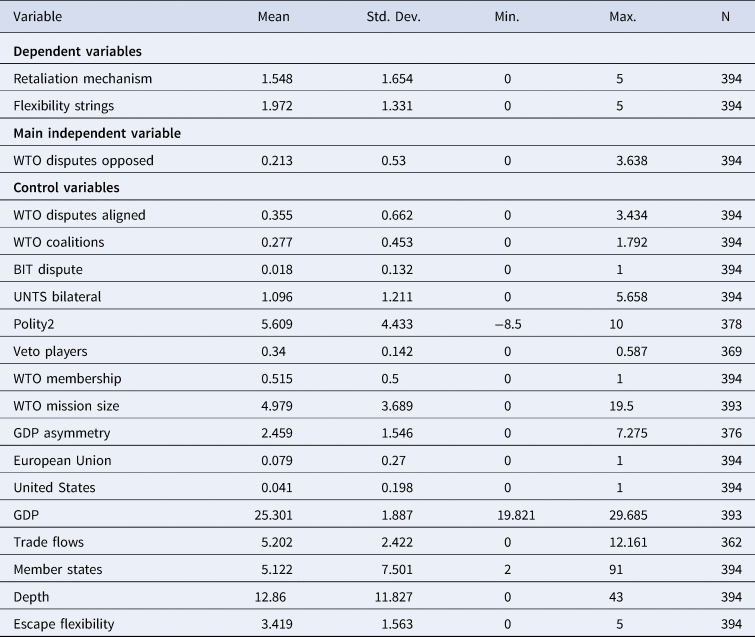
The main descriptive statistics are shown in table 1.
Descriptive statistics

Baseline results and analysis
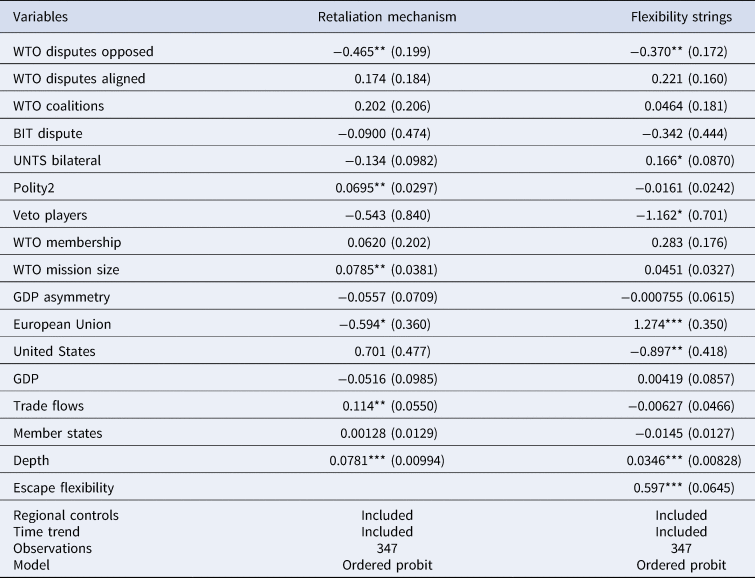
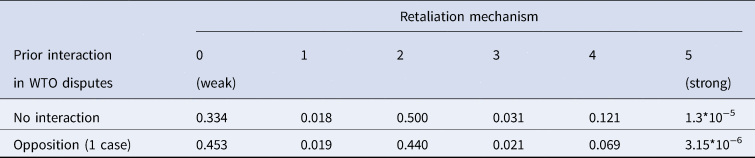
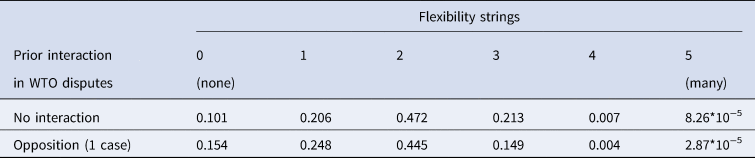
The main results from our analysis are reported in table 2. Overall, we find that prior interaction in WTO litigation matters for the retaliation mechanisms and flexibility strings found in a PTA. In line with our first hypothesis, opposition in WTO disputes leads to weaker retaliation mechanisms. Our second hypothesis is also borne out in the data: Challenges in litigation at the multilateral trade club result in fewer strings attached to the use of flexibility instruments. Since the output of the ordered probit models is not very informative about the magnitude of the identified causal effects, we perform a set of predicted probability calculations. For each dependent variable, we compare the probability of observing a particular value on the ordinal scale for PTA members with no prior interaction in WTO disputes to the probability of observing the same value if the corresponding countries were opposed in a single dispute. All the other variables are fixed at their mean or, in the case of binary and ordinal regressors, at their respective mode. The results are displayed in tables 3 and 4.
Baseline results

Standard errors in parentheses. Constant (cuts) omitted from the output table.
Levels of statistical significance set conventionally: *** p < 0.01, ** p < 0.05, * p < 0.1.
Predicted probabilities retaliation mechanism

Predicted probabilities flexibility strings

Based on these calculations, it can be seen that countries differ substantially in how they design their PTAs as informed by patterns of prior interaction at the WTO. For instance, if two countries were opposed in a WTO dispute before signing their trade agreement, they are 11.9 percentage points more likely to refrain from enshrining any retaliation provisions in their PTA than a dyad with no interaction in WTO litigation. The pattern is the same for flexibility strings (5.3 percentage point increase).
Country-level data further illustrate our results: In 2004, the United States signed a PTA with Australia, a country with which it had been previously opposed in seventeen disputes at the GATT/WTO. The retaliation provisions in this treaty (value of 3) were below the modal value or template that the United States had pushed for in its PTAs up to this point in time (4). Moreover, the Bahrain-US PTA, which was signed just six months later in the same year, featured more stringent clauses on retaliation (5) as well as more flexibility strings (3 as compared to 2 in the Australia-US treaty). Bahrain and the United States had not been involved in any WTO dispute up to 2004. As another case in point, the EU was reluctant to include far-ranging disciplines on the use of flexibility instruments in its PTAs with Mexico (signed in 2000, opposed in fifteen disputes, value flexibility strings: 1, modal value in most recent PTAs: 3) as well as Canada (2014, opposed in thirty-seven cases, value flexibility strings: 3, modal value: 4).
Returning to the main output table, it is noteworthy that the additional regressors for prior interaction do not seem to matter for PTA design.Footnote 80 From these results, we can infer that countries take past experiences into account only in a limited manner in PTA negotiations. WTO litigation experience appears to be salient for learning, while experiences in other fora generate no spillover effects for PTAs. This finding therefore complements the study by Copelovitch and Putnam by showing which type of prior interaction matters for institutional design and why.
The other controls perform as expected. More democratic countries (Polity2) and PTA partners with greater legal capacity (WTO mission size) and higher trade flows tend to opt for stronger enforcement provisions. Veto players, in turn, lead to more flexibility in a PTA. The European Union is shown to be more reluctant to agree on strong retaliation provisions, while the United States is less willing to endorse flexibility strings. Finally, the design variables depth and escape flexibility lead to more stringent retaliation provisions and more rigidity.
At this stage, one might object that the selection into a PTA bargaining process is non-random and might be influenced by countries’ prior experiences in WTO dispute settlement. It could be that governments opposed in many disputes shy away from embarking on PTA negotiations, a hypothesis for which Mavroidis and Sapir find correlational support.Footnote 81
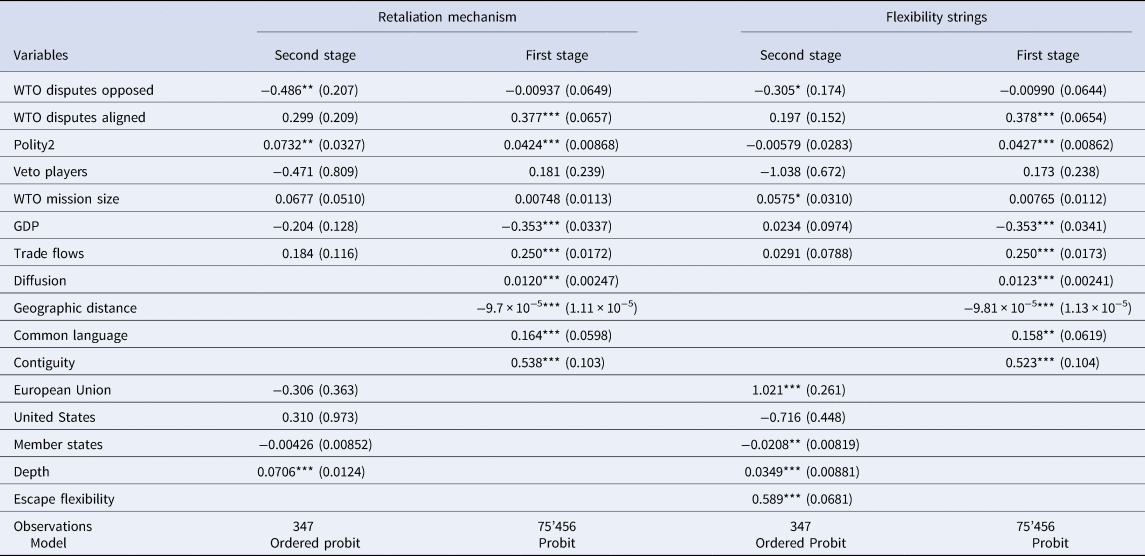
Not accounting for selection effects might bias our results. Therefore, we additionally estimate a Heckman selection model by adding entries in our dataset with nontreatment observations constituted of dyad years for which we do not observe the onset of PTA negotiations or existing PTA ties after 1990. For these observations, we insert the values for our main covariate as well as the control variables. Moreover, we include controls commonly used in the literature on PTA determinants. Given the significant resources required for extracting the data on cooperation in other areas (UNTS, WTO coalitions, and BITs), which are not the focus of the analysis, we refrain from including these covariates in our two-stage estimation. The findings are presented in table 5.
Two-stage estimation

Standard errors in parentheses. Constant (cuts) omitted from the output table.
Levels of statistical significance set conventionally: *** p < 0.01, ** p < 0.05, * p < 0.1.
In the first stage, we included additional variables commonly used in the literature on PTA determinants: geographic distance, common language, contiguity, and competitive pressures measured through the number of PTAs concluded at the global scale in a given year (diffusion). Other classical variables invoked as determinants of PTAs (for example, trade flows) are already part of the baseline model. For an example of a similar model specification, see Mansfield and Milner, Reference Mansfield, Milner, Dür and Elsig2015.
They show that experiences in WTO disputes matter for both the decision to start PTA negotiations and PTA design. Interestingly, alignment in WTO disputes leads to higher odds of observing preferential trade negotiations (first stage), while opposition in litigation matters only for the design process (second stage). These findings are in line with the analysis of Mavroidis and Sapir as well as our theoretical assumption that exporters are mainly instrumental for the launching of PTA negotiations, while import-competing industries tend to be relatively more vocal on flexibility and enforcement provisions.
Robustness checks
We conduct a number of robustness checks to examine whether our results are sensitive to alternative model specifications.Footnote 82
First, we change the estimation procedure from ordered probit to ordered logit to examine whether our assumption about the error term distribution influenced the baseline results, which is not the case.
Second, we examine whether the logarithmic transformation of our key independent variables influences the results. To recall, the transformation was applied in light of the significant skew in the data on the number of prior opposition in WTO disputes and in line with Copelovitch and Putnam. As an alternative, we employ cuts in the covariate to see whether and how opposition in the intervals [0,1] (few instances of opposition for select dyads; low level of litigousness), (1, 10] (intermediate level of litigousness), (10, 37] (high level of litigousness; maximum number of 37 instances of opposition for CETA) matters for PTA design. The results are again corroborated, yet with slight differences for the main dependent variables: For flexibility strings, the intervals (1, 10] and (10, 37] are statistically significant, while in the case of the retaliation mechanism only the interval (10, 37] is statistically significant. These findings provide additional insights into the dynamics of WTO-PTA spillover effects in that opposition in WTO disputes matters for PTA design in particular after a certain threshold of cases.
Third, we account for three additional variables which might drive WTO litigation and PTA design: intra-industry trade (IIT), export orientation, and retaliatory capacity. Concerning IIT, one could argue that a less cautious approach to PTA design might be more likely if countries engage in IIT rather than inter-industry trade because the former is less adjustment-cost intensive and hence less conflictual due to monopolistic competition.Footnote 83 Export orientation could be expected to exert the same effect: The more important export-oriented interests in a PTA, the stronger the push for enforceable and rigid clauses.Footnote 84 Retaliatory capacity, in turn, reflects the leverage a country has in trade disputesFootnote 85 and might elicit fears among import-competing industries about challenges under a planned PTA. We estimate models with variables for the average Grubel Lloyd index of IIT, the mean of countries’ exports to their PTA partners as a share of their total exports, and the GDP-weighted relative importance of export-oriented industries in a PTA. Our results remain unchanged with these modifications with one exception: In the regression with the export orientation indicator and Retaliation provisions as the dependent variable, the coefficient for WTO disputes opposed falls just short of statistical significance (p-value of 0.14). This result is to be interpreted with caution as the number of observations is substantially lower in this model specification (132).
Next, we account in greater detail for power asymmetries and templates in trade negotiations. First, we estimate a model with a dummy for the presence of an OECD member in a PTA bargaining group. Second, we build on and slightly modify the approach by Rühl by including a regressor for the modal PTA enforcement and flexibility design found in the past agreements concluded by the member state with the highest GDP.Footnote 86 Our baseline findings are again corroborated.Footnote 87
Finally, we include regressors for countries’ overall involvement as defendants in trade litigation at the WTO. Davis and Bermeo as well as Rühl make the argument that general involvement in WTO litigation both on the complainant and defendant side increases countries’ propensity to use and endorse strong enforcement mechanisms.Footnote 88 Hence, we add a variable for the average number of times PTA partners were on the defendant and complainant sides (principal and third parties) in WTO disputes prior to signing a PTA. Our results paint a slightly more nuanced picture: In line with our theory, we find that the coefficient for defendant activity is negatively signed and statistically significant in both regressions. Complainant activity, in turn, indeed increases the odds of observing retaliation mechanisms with teeth and flexibility strings. Further research is required to explore these links. Importantly for our analysis, even with this change our main regressor retains the same sign as in the baseline output and remains statistically significant.
Conclusion
Does past interaction matter when countries design new international institutions? We provide a novel explanation for the type of past interaction that spills over to new treaty design in the area of trade. We argue that import-competing industries draw lessons from their home government's involvement in WTO disputes with prospective agreement partners. Conflict-laden instances of prior interaction in WTO litigation lead import-competing industries to lobby for less enforceable and more flexible PTAs, with direct implications for the actual treaty texts. We find support for our hypotheses in an empirical analysis of 347 PTAs concluded in the post-1990 period.
Our argument and findings speak directly to the regime complexity literature, which has analyzed the trade regime characterized by overlapping institutions. While most of the literature has been interested in forum-shopping dynamics, we have actually theorized and provided some evidence on how disputes in the WTO affect domestic mobilization to correct costly WTO decisions in subsequent PTAs. This complements work that focuses on how WTO law is present in PTA law by focusing on the actual disputes spilling over from one trade institution to another.Footnote 89 As to implications for future research and policy relevance, we conclude with the following considerations.
First, the results underscore the importance of contextualizing international negotiations. Existing studies on the design of international institutions still too often neglect how prior interaction in the same or neighboring policy field impacts treaty design. In future research, scholars could examine to what extent the findings from this study apply to other issue areas.
Second, additional case studies on trade negotiations could further illuminate the suggested link between the mobilization of interest groups and the impact on treaty design. What additional conditions shape the extent to which these demands are reflected in the final treaty texts? We could imagine three such conditions that need further study: First, the willingness of the respective PTA partner to accept demands in that direction and the possibility of concession trading within a treaty. Second, the availability for governments to address concerns of import-competing groups through alternative policy instruments such as tax cuts, subsidies, and other domestic support schemes. Third and finally, the practical difficulties to address the trade concerns raised using legal provisions in a PTA. An example is the area of subsidies where countries usually are unable to make bilateral concessions as it is difficult to constrain domestic subsidies in relation to specific export markets. This was echoed by one interview partner from the European Union in reference to a lost WTO case brought by the European Union against Korean shipbuilding subsidies.Footnote 90 He recalled that “the outcome of the WTO case was rather disappointing [. . . ]. Although, we discussed the issue with our industry, we came to the view that it would not be realistic to seek to address the issue with bilateral negotiations.”Footnote 91 As a result, the European Union did not table the subsidy issue for the European Union-Korea PTA negotiations.
Third, the study hints at additional unintended costs of enforcement. In other words, bringing a WTO case against another country can “awake” the latter's import-competing industries. If countries anticipate to negotiate in the near future a trade agreement with a larger country, they need to factor in this additional audience cost. This consideration might affect countries’ incentive to litigate in the first place.
Fourth and relatedly, as illustrated by US trade policy especially under the Trump Administration, audience costs can also threaten the existence of WTO dispute settlement as such. In other words, negative experiences in WTO disputes can amplify the perception of losses from international cooperation, especially among vocal actors such as import-competing industries that have established increased influence over current US trade policy. Instead of trying to remedy WTO losses through PTA design, powerful states, such as the United States, can also obstruct the functioning of the WTO by blocking appointment procedures of WTO Appellate Body members and limiting direct funding to dispute settlement bodies within the multilateral trade organization.
Supplementary material
To view the supplementary material for this article, please visit https://doi.org/10.1017/bap.2020.20
Acknowledgements
For helpful comments and suggestions, the authors are grateful to Todd Allee, Timm Betz, Chad Bown, Marc Busch, Jason Davis, Sebastian Klotz, Jeffrey Kucik, Mark Manger, Edward Mansfeld, Krzysztof Pelc, Lauge Poulsen, and Randall Stone. This article has also benefitted considerably from feedback received at presentations at the Annual General Conference of the European Political Science Association, Brussels, 23–5 June 2016, the Annual Meeting of the American Political Science Association, Philadelphia, 1–4 September 2016, as well as the 2016 conference of the International Political Economy Society, Durham, 11–2 November 2016.