INTRODUCTION
Over 6000 opisthobranch species occur all over the world (Mc Donald, Reference McDonald2006) while inventories of the Mediterranean molluscs include over 600 species in this subclass (Cattaneo-Vietti et al., Reference Cattaneo-Vietti, Chemello and Giannuzzi-Savelli1990; Costello et al., Reference Costello, Emblow and White2001). Despite the fact that many authors have provided information on opisthobranch molluscs of the eastern Mediterranean and the Greek seas in particular (see Koutsoubas & Koukouras, Reference Koutsoubas and Koukouras1993, review and references therein; Koutsoubas et al., Reference Koutsoubas, Koukouras and Thompson1993, Reference Koutsoubas, Tselepides and Eleftheriou2000a, Reference Koutsoubas, Arvanitidis, Dounas and Drummondb; Koutsoubas & Cinelli, Reference Koutsoubas and Cinelli1996; Zenetos et al., Reference Zenetos, Koutsoubas and Vardala-Theodorou2005) there is no doubt that our knowledge on the opisthobranch fauna of these seas is rather limited when compared with other areas of the Mediterranean or the neighbouring north-eastern Atlantic Ocean. Taking into account recent papers providing information on opisthobranch mollusc fauna or invasive mollusc species (e.g. Koutsoubas, Reference Koutsoubas2004; Pancucci-Papadopoulou et al., Reference Pancucci-Papadopoulou, Zenetos, Corsini-Foka and Politou2006; Daskos & Zenetos, Reference Daskos and Zenetos2007; Zenetos et al., Reference Zenetos, Vassilopoulou, Salomidi and Poursanidis2007; Mollo et al., Reference Mollo, Gavagnin, Carbone, Castelluccio, Pozone, Roussis, Templado, Ghiselin and Cimino2008) of the Greek seas (Aegean, Ionian, Sea of Kythira and Libyan Sea) the total number of opisthobranch mollusc fauna of these seas is greater than 160 species. This study aims to provide new data and information about opisthobranch species that have been recently collected and photographed alive in various sites of the Greek seas, along with details on their distribution and habitat.
MATERIALS AND METHODS
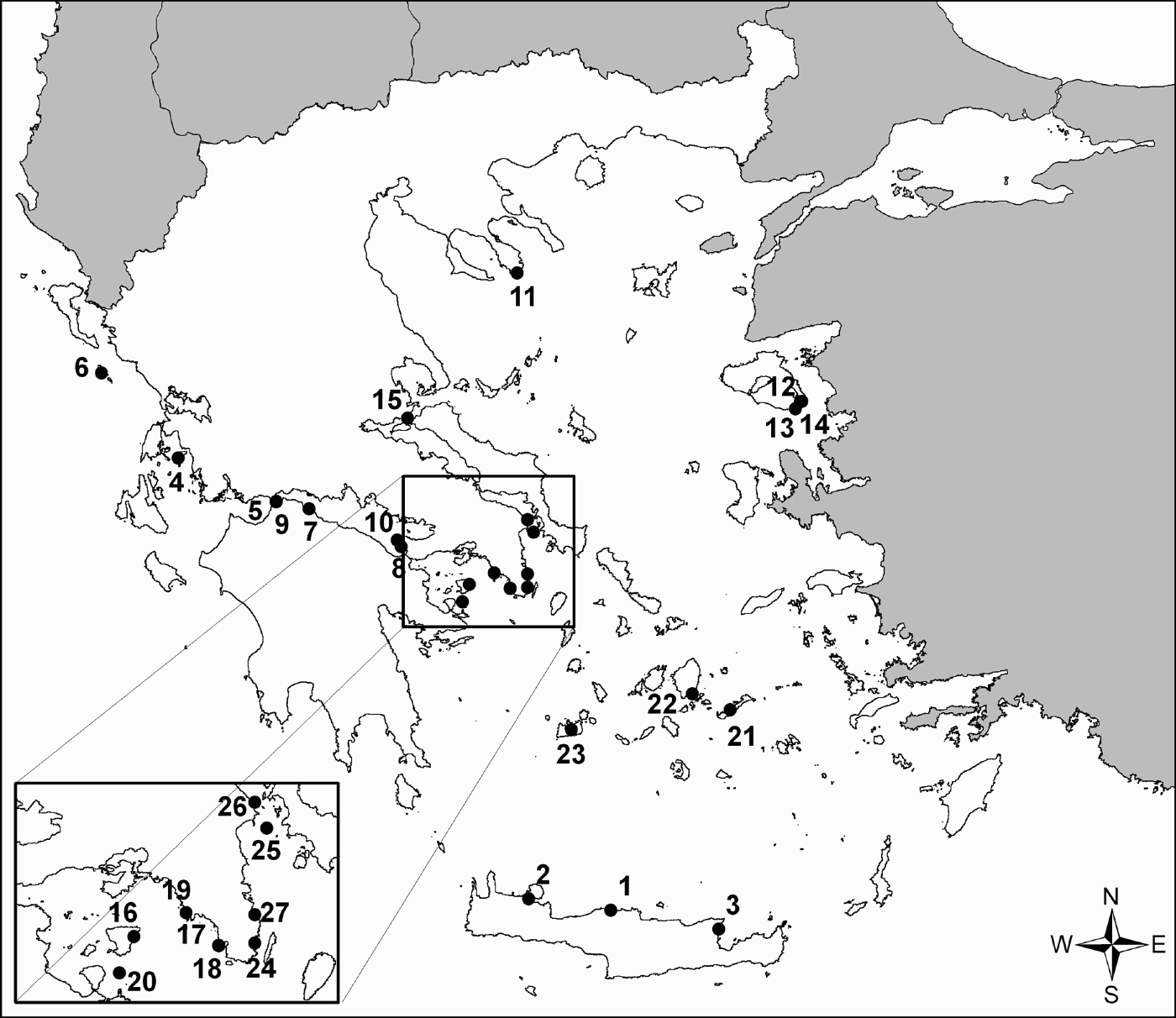
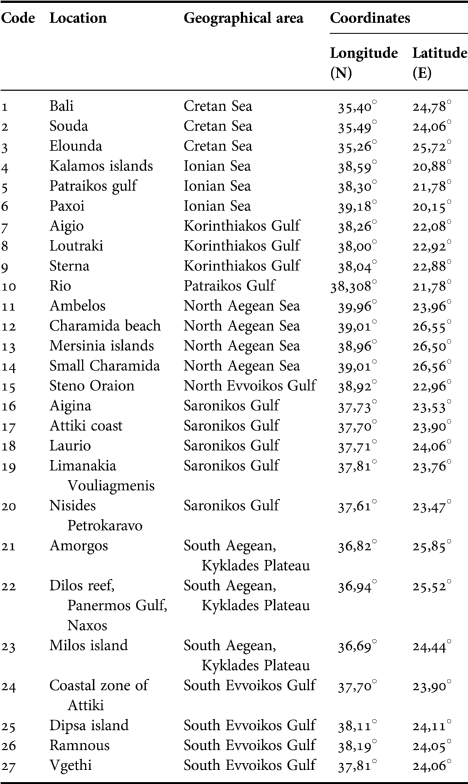
Intensive oceanographic studies over the last 2 decades in the framework of national and EU funded Projects have significantly contributed to the investigation of many areas and habitat types extended in the Greek seas, and consequently to the collection of new material concerning marine biota. Furthermore, the application of a new Law (3409/273/2005) concerning a release of many areas for SCUBA diving activities in the Greek seas has offered the opportunity for divers to investigate many of the previously unexplored areas. Finally, the worldwide diffusion of knowledge via the internet and the training function of some web fora such as the www.seaslugforum.net, has offered the opportunity for many people to search and have closer contact with the fascinating world of marine biota. Biological samples obtained by the authors themselves, along with material (living animals or photographs) collected by divers in various sites of the Greek seas (Table 1; Figure 1) and acknowledged to the authors has led to the identification of the opisthobranch species presented in this study. Specimens collected were stored in 96% ethanol and are deposited in the collection of the Natural History Museum of Crete (NHMC) for further analysis. Nomenclature used for opisthobranchs followed the Check List of European Marine Mollusca (CLEMAM) (http://www.somali.asso.fr/clemam/biotaxis.php).
The locations of the recorded opisthobranchs. Codes correspond to sampling locations shown in Table 1.

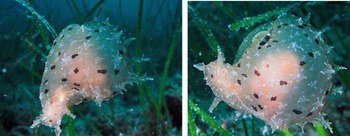
Notarchus punctatus from Patraikos Gulf (photograph: F. Vilanakis).

The locations of the recorded opisthobranchs.

RESULTS
MATERIAL
Two specimens from Rio (Patraikos Gulf).
DISTRIBUTION
Mediterranean Spain (Cervera et al., Reference Cervera, Calado, Gavaia, Malaquias, Templado, Ballesteros, Garcia-Gomez and Megina2004), Italy—coasts of Naples (Engel, Reference Engel1936) and Turkey—Antalya (Yokes, Reference Yokes2002a).
NOTES
The species, which was firstly reported from the Greek seas by Forbes (Reference Forbes1844), was found on Cymodosea nodosa meadow (Figure 2).
MATERIAL
One specimen from the Mersinia islets (Lesvos Island, northern Aegean), 2 specimens from Mount Athos (Chalkidiki Peninsula, northern Aegean), 1 specimen from Nisides Petrokaravo (Saronikos Gulf, southern Aegean), 1 specimen from Panermos beach (Naxos Island, southern Aegean), 2 specimens off the coasts of Bali and Chania bays correspondingly (Crete island, southern Aegean) and finally 2 specimen from Kalamos and Paxos Islands (Ionian Sea).
DISTRIBUTION
Eastern (Canary and Selvagens Islands, Madeira, the Azores: Cervera et al., Reference Cervera, Calado, Gavaia, Malaquias, Templado, Ballesteros, Garcia-Gomez and Megina2004), and western Atlantic (Brazil: Rudman, Reference Rudman2005); western (eastern Andalusia, Spanish Levant, Catalonia, Balearic Islands: Cervera et al., Reference Cervera, Calado, Gavaia, Malaquias, Templado, Ballesteros, Garcia-Gomez and Megina2004; Algeria, France, western Italy, Sicily: Pruvot-Fol, Reference Pruvot-Fol1954) and eastern Mediterranean (coasts of south-eastern Turkey: Yokes, Reference Yokes2002b; Israel: Barash & Danin, Reference Barash and Danin1971).
NOTES
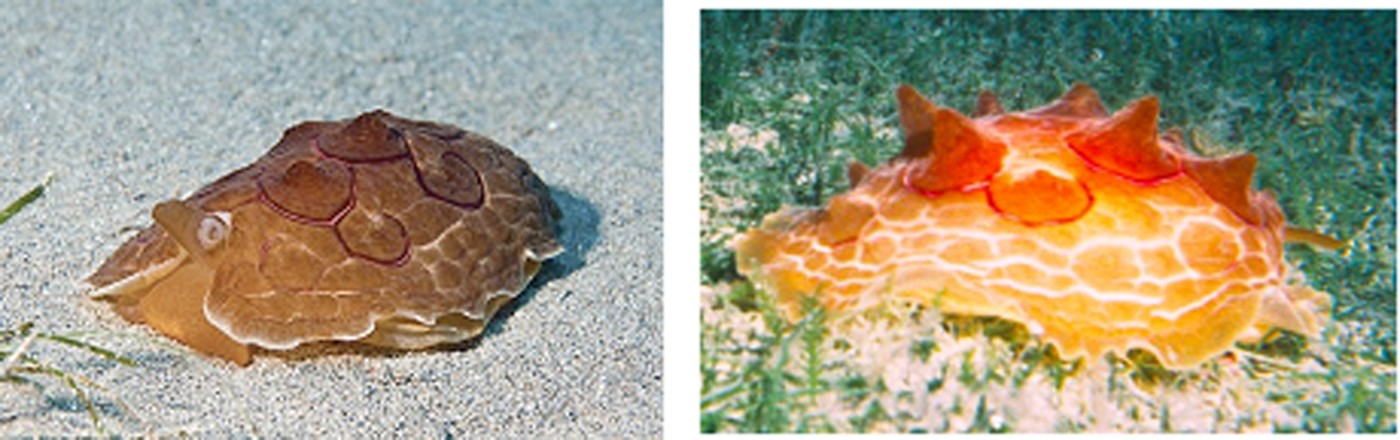
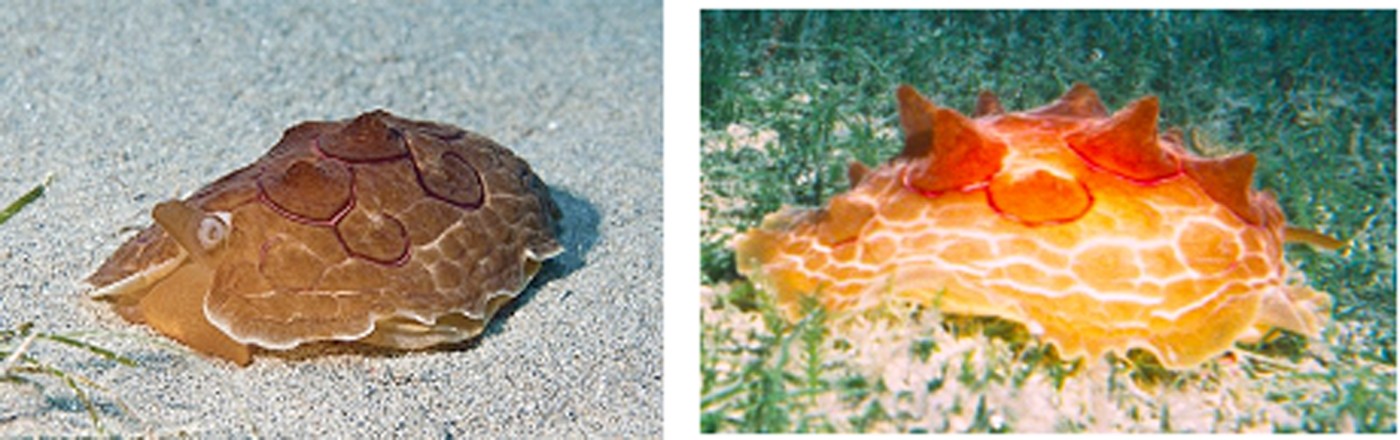
The species is reported for the first time from the Greek seas. Animals were found in shallow and moderate depths (6–30 m) on various habitat types (rocky substrates covered with algae, sand and Posidonia meadows) (Figure 3).
Individuals of Pleurobranchus testudinarius from Crete (left—photograh: J. Issaris) and Naxos Islands (right—photograph: M. Bardanis).
MATERIAL
Twenty individuals from Lesvos Island—Charamida beach (northern Aegean), 10 specimens are deposited in the NHMC reference FC: 10.186.
DISTRIBUTION
Cosmopolitan species with a worldwide distribution (Pruvot-Fol, Reference Pruvot-Fol1954; Rudman, Reference Rudman2004); few records from the Mediterranean (Gulf of Naples: Schmekel, Reference Schmekel1968; southern Aegean: Milos Island, Forbes, Reference Forbes1844 and Israel coasts: Barash & Danin, Reference Barash and Danin1971).
NOTES
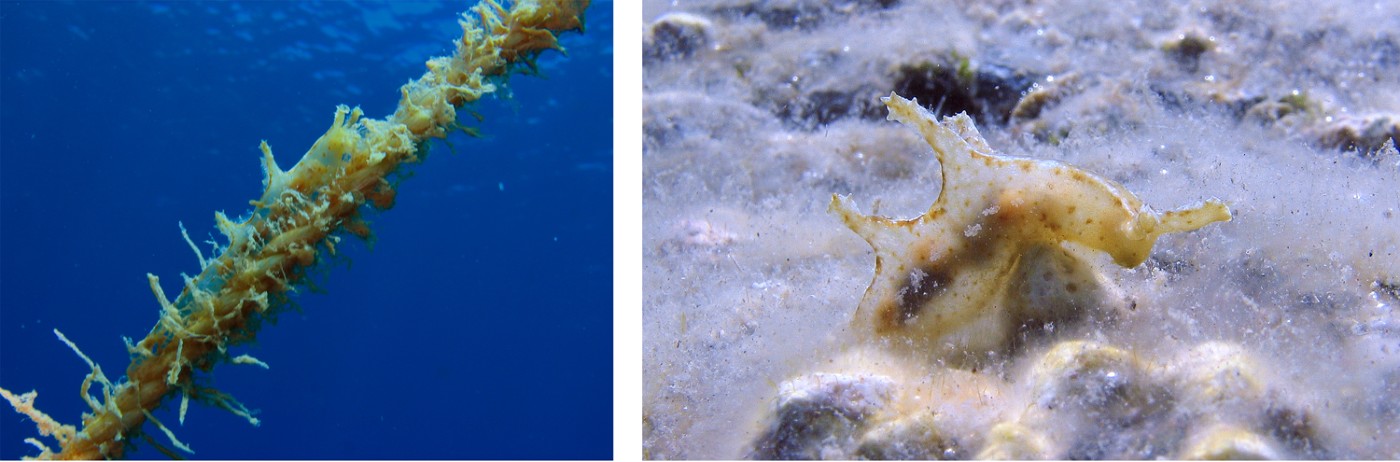
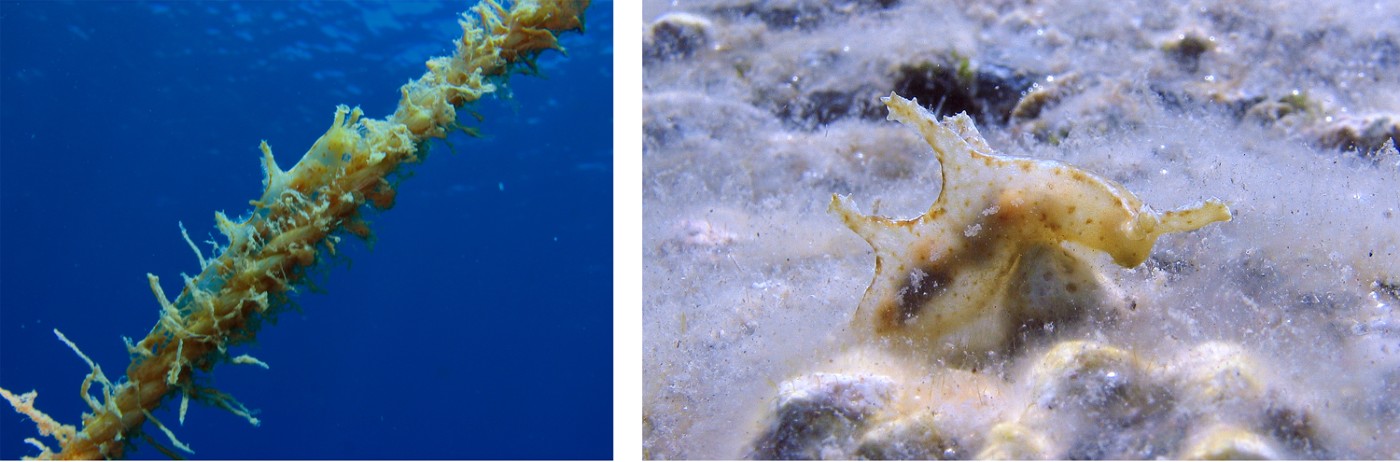
It is a pelagic opisthobranch living on pieces of floating kelp or Sargassum weed, where it feeds on attached hydroids (Rudman, Reference Rudman2004). It is worth mentioning that the species is recorded in this study after more than a century after its first finding in the Greek seas by Forbes (Reference Forbes1844). Most of the individuals collected were attached on a floating rope at close distance from the coast, while 2 specimens were found crawling on rocks (Figure 4).
Scyllaea pelagica from Lesvos Island (photograph: D. Poursanidis).
MATERIAL
Many individuals from the Ionian Sea (Patraikos Gulf—Rio, 2 individuals; Korinthiakos Gulf—Aigio, 1 individual), the southern Aegean (Saronikos Gulf— Aigina Island, 1 individual; Crete Islands—Elounda, Chania, Souda Gulfs, 5 individuals) and the northern Aegean (Chalkidiki Peninsula—Ambelos area, 3 individuals).
DISTRIBUTION
North-eastern Atlantic from Norway to Morocco (Rudman, Reference Rudman1999), western (Strait of Gibraltar, eastern Andalusia, Catalonia: Cervera et al., Reference Cervera, Calado, Gavaia, Malaquias, Templado, Ballesteros, Garcia-Gomez and Megina2004; Palermo, Napoli: Schmekel & Portmann, Reference Schmekel and Portmann1982; Catanneo-Vietti et al., 1990) and eastern Mediterranean (Cyprus: Athanasopoulos, Reference Athanasopoulos2006; south-eastern Turkey: Turkmen, Reference Turkmen2004).
NOTES
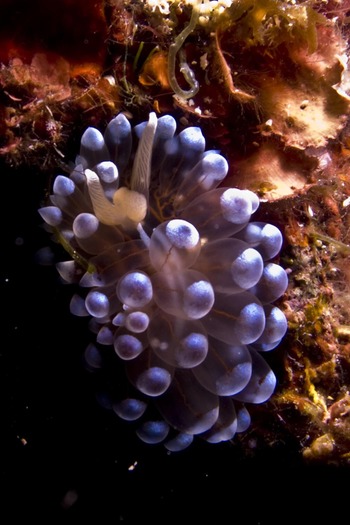
The species is reported for the first time from the Greek seas. In most cases animals were found in shallow depths (8–20 m) on rocky substrates (Figure 5).
A specimen of Janolus cristatus from Korinthiakos Gulf (photograph: J. Issaris).

MATERIAL
Two individuals from Korinthiakos Gulf (Aigio and Loutraki).
DISTRIBUTION
North-eastern Atlantic (Portugal, Spain and Senegal: Rudman, Reference Rudman2002); western (Spain: Cervera et al., Reference Cervera, Calado, Gavaia, Malaquias, Templado, Ballesteros, Garcia-Gomez and Megina2004; France, Italy: Schmekel & Portmann, Reference Schmekel and Portmann1982) and eastern Mediterranean (Adriatic Sea, Croatia: Jaklin, Reference Jaklin2006; Turkey: Yokes, Reference Yokes2002c).
NOTES
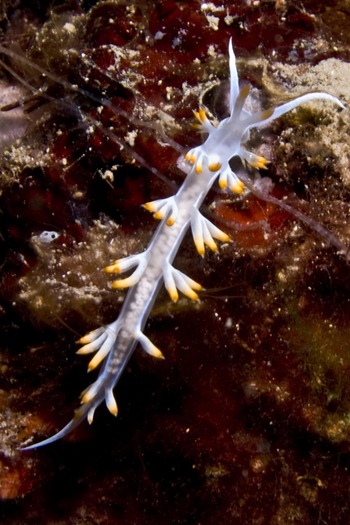
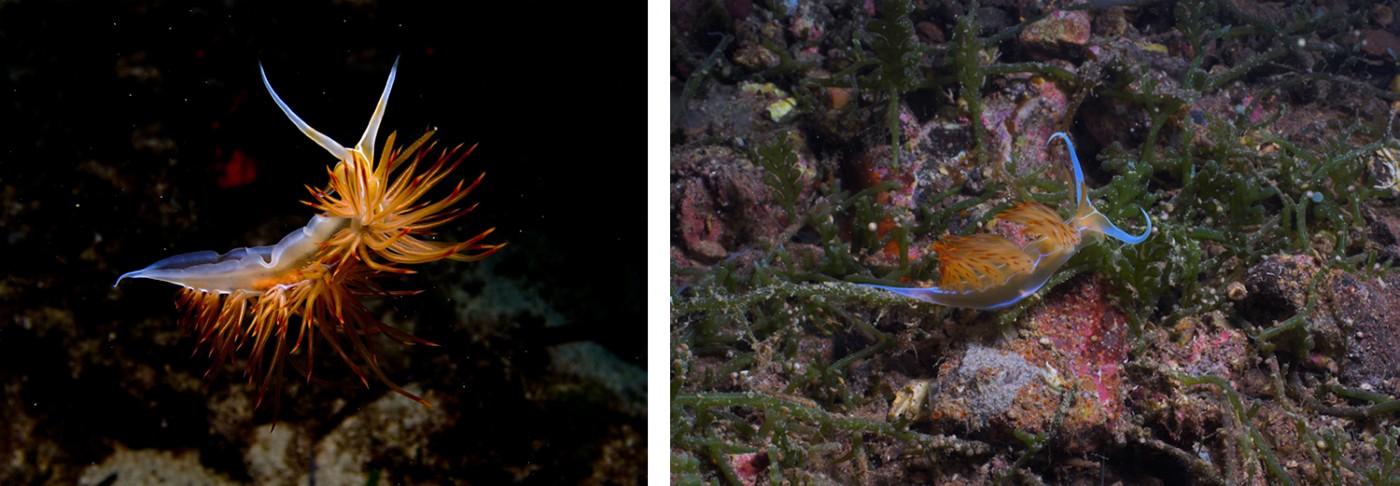
The species is reported for the first time from the Greek seas. Both individuals of the species were found in shallow depths (10–20 m) on rocky substrates (Figure 6).
Flabellina babai from Korinthiakos Gulf (photograph: J. Issaris).

Individual of Caloria elegans from Korinthiakos Gulf (photograph: J. Dimaresis).

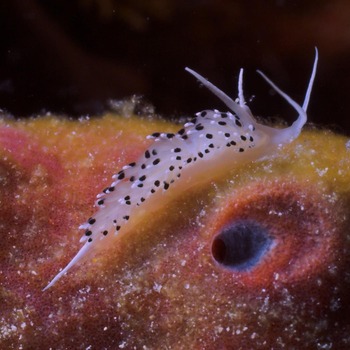
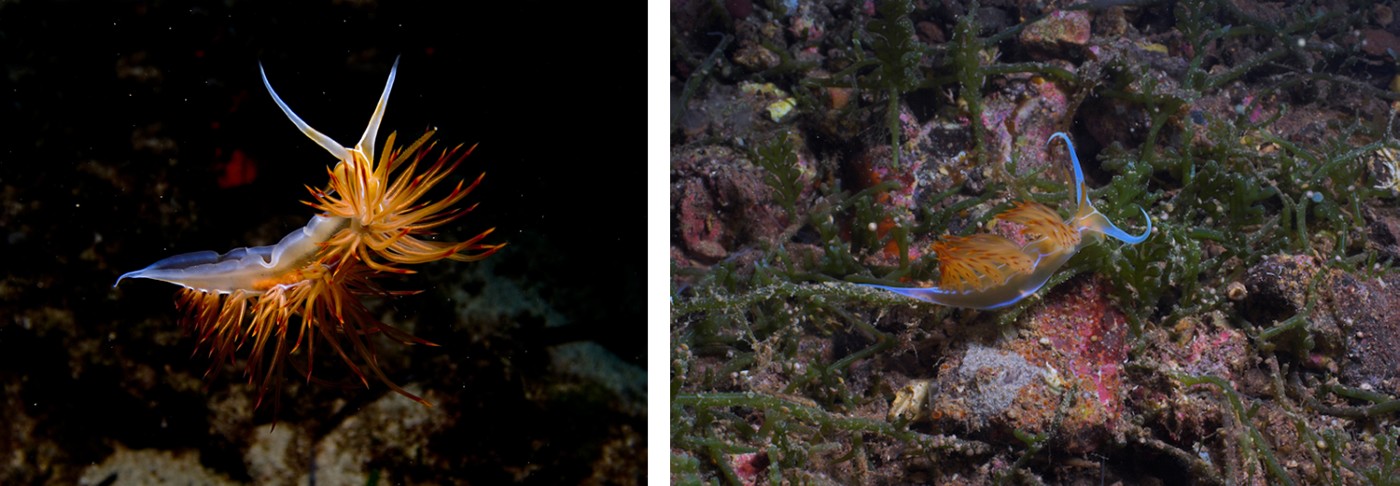
Dondice banyulensis from Saronikos (left, photograph: J. Issaris) and Evoikos (right, photograph: J. Dimaresis) Gulfs.
MATERIAL
Six small individuals, measuring 1–2 cm in length, from northern Aegean (Lesvos Island—Small Charamida beach, 1 specimen preserved in ethanol 96%, deposited in the NHMC reference FC: 10.187), southern Aegean (coasts of Attiki—Lavrio and Vgethi; Amorgos Island) and Korinthiakos Gulf (Loutraki).
DISTRIBUTION
Eastern Atlantic (Portugal, Canary and Selvagens Islands, Madeira and the Azores: Thompson & Brown, Reference Thompson and Brown1984; Cervera et al., Reference Cervera, Calado, Gavaia, Malaquias, Templado, Ballesteros, Garcia-Gomez and Megina2004); western (Strait of Gibraltar, Spanish Levant, eastern Andalusia, Catalonia and Balearic islands: Cervera et al., Reference Cervera, Calado, Gavaia, Malaquias, Templado, Ballesteros, Garcia-Gomez and Megina2004; Italy and Sicily Straits: Schmekel & Portmann, Reference Schmekel and Portmann1982; Catanneo-Vietti et al., 1990) and eastern (south-eastern Turkey: Rudman, Reference Rudman2001; Goksel, Reference Goksel2005) Mediterranean.
NOTES
The species is reported for the first time from the Greek seas. All specimens were found crawling on individuals of the sponge Aplysina aerophoba at rocky substrates (Figure 7) covered with algae vegetation—mainly Padina pavonica at depths from 2–15 m.
MATERIAL
Few individuals from the Ionian Sea (Patraikos Gulf—Rio, 3 individuals; Korinthiakos Gulf—Aigio, 2 individuals), and the northern Aegean (Evoikos Gulf, 1 individual (Figure 8); Lesvos island, 1 individual).
DISTRIBUTION
North-eastern Atlantic (south-eastern England: Picton, Reference Picton1979; Portugal: Cervera et al., Reference Cervera, Calado, Gavaia, Malaquias, Templado, Ballesteros, Garcia-Gomez and Megina2004), western Mediterranean (Strait of Gibraltar, eastern Andalusia, Spanish Levant, Catalonia, Balearic Islands: Cervera et al., Reference Cervera, Calado, Gavaia, Malaquias, Templado, Ballesteros, Garcia-Gomez and Megina2004; Ligurian Sea: Catanneo-Vietti et al., 1990; France, Naples: Schmekel & Portmann, Reference Schmekel and Portmann1982) and eastern Mediterranean (south-eastern Turkey: Yokes, Reference Yokes2002d).
NOTES
It is the largest aeolidian species in the Mediterranean Sea (Catanneo-Vietti et al., 1990; Trainito, Reference Trainito2005). The species is often found in high energy environments such as with algae vegetation (Caulerpa sp.).
DISCUSSION
Taking into account valid records from previous authors along with records provided in this study a total of 166 opisthobranch are known from the Greek seas (almost 25% of the total gastropod fauna recorded from these seas). The most numerous opisthobranch species in the Greek seas are the Nudibranchia (63 species —almost 40% of the total fauna). The majority of the opisthobranch species distributed in the Greek seas have an Atlanto-Mediterranean affinity (almost 40% of the total opisthobranch fauna). However, the opisthobranch Mediterranean endemic species in the Greek seas constitute a major component of the opisthobranch fauna (almost 25% of the total number of species), a phenomenon similar to what has been reported not only for the opisthobranch fauna of the Mediterranean Sea (Cattaneo-Vietti & Thompson, Reference Cattaneo-Vietti and Thompson1989) but for the entire marine biota of this basin (Bianchi & Morri, Reference Bianchi and Morri2000). It is worth mentioning that until almost the end of the 1990s only 2 ‘alien’ or ‘allochthonous’ opisthobranch species (i.e. Bursatella leachii De Blainville, 1817 and Melibe fimbriata Alder & Hancock, 1864) had been reported from the Greek seas (Thompson & Crampton, Reference Thompson and Crampton1984; Koutsoubas & Koukouras, Reference Koutsoubas and Koukouras1993; Koutsoubas & Cinelli, 1997) despite the neighbouring of the Greek seas with the Levantine Basin (area of the Mediterranean Sea in which alien species exceed 30% of the total recorded biota: Por & Dimentman, Reference Por and Dimentman1989).
However, over the last decade many alien opisthobranch species (e.g. Acteocina mucronata, Bulla ampulla, Aplysia dactylomela, Chromodoris annulata and Syphonota geographica) have been recorded (certain of them are well established in the Aegean and Ionian Seas: Zenetos et al., Reference Zenetos, Vassilopoulou, Salomidi and Poursanidis2004) thus implying an exponential rate of introduction of these species in this part of the Mediterranean (Zenetos et al., Reference Zenetos, Koutsoubas and Vardala-Theodorou2005). The majority of the opisthobranch species (i.e. Pleurobranchus testudinarius, Janolus cristatus, Caloria elegans and Dondice banyulensis) recorded in the present study from the Greek seas known to have a wide distribution in different areas of the western Mediterranean, should be considered as well established also in the Greek seas as revealed by their frequent finding at different sites. The remaining species (i.e. Notarchus punctatus, Scyllaea pelagica and Flabellina babai) presented in this study have been recorded from one particular location and should be considered as rather ‘rare’ species as also proved by their restricted distribution in the whole Mediterranean (they have been reported from very few areas of this basin). Despite the fact that an important number of opisthobranch species have been recorded so far from the Greek seas, our knowledge on the opisthobranch fauna of these seas is far from complete. Future intensive sampling in less explored areas (e.g. Ionian Sea and Libyan Sea) and habitat types (e.g. coralligenous communities, semi-dark and dark caves) and facilitated by faster communication and use of electronic means is expected to significantly increase opisthobranch species records from the Greek seas in the near future.
ACKNOWLEDGEMENTS
The authors would like to thank all the divers' community of TETHYS, ABYSS and HUTS divers clubs, who have provided material and photographs of animals (especially F. Vilanakis, J. Dimaresis, E. Tsorapi, M. Salomidi, G. Delveroudis, P. Tasiadakis, G. Karelas, K. Sarmas K. and Th. Dalianis) to the authors. The authors are indebted to Dr B. Rudman who has provided appropriate literature and advice to look at particular details in animals of the opisthobranch Pleurobranchus testudinarius.