INTRODUCTION
The colossal squid (Mesonychoteuthis hamiltoni) is the world's largest invertebrate with a maximum record of approximately 500 kg. Its large size and some unique morphological characters have fuelled speculation that it is an aggressive top predator in the circum-Antarctic Southern Ocean. It has the largest eyes and beak of any cephalopod and its position near the top of the food chain is confirmed by stable isotope analysis (Cherel & Hobson, Reference Cherel and Hobson2005) that reveals large fish, most notably the Antarctic toothfish, are its primary prey. The colossal squid also constitutes an important component in the diets of apex predators, especially sleeper sharks and sperm whales (Clarke, Reference Clarke1980; Xavier et al., Reference Xavier, Rodhouse, Purves, Daw, Arata and Pilling2002; Cherel & Duhamel, Reference Cherel and Duhamel2004).
However, like other cranchid squids, M. hamiltoni is thought to live in the meso- and bathypelagic zones (Filippova & Yukhov, Reference Filippova and Yukhov1979), although the juveniles may be found near the surface (Voss et al., Reference Voss, Stephen and Dong1992), and attains neutral buoyancy by storing ammonium fluid in the coelomic chamber (Filippova, Reference Filippova1991). Furthermore, its mantle wall is soft and semigelatinous (Roper et al., Reference Roper, Sweeney and Nauen1984). Great depth, neutral buoyancy, and gelatinous musculature are usually associated with relaxed requirements for strong locomotory abilities and a passive mode of life (Seibel et al., Reference Seibel, Thuesen, Childress and Gorodezky1997; Nixon & Young, Reference Nixon and Young2003; Boyle & Rodhouse, Reference Boyle and Rodhouse2005).
Here, we estimate the mass-specific routine metabolic rates of M. hamiltoni based on extrapolation from scaling relationships within the family, Cranchiidae. We project the daily energy consumption (kcal day−1) along a depth gradient, and estimate the prey requirements (per day) of this cold-water deep-sea giant in the Southern Ocean.
MATERIALS AND METHODS
In the absence of direct measurements for M. hamiltoni, we used a dataset of routine metabolic rates (RMR) for cranchid species (Seibel et al., Reference Seibel, Thuesen, Childress and Gorodezky1997; Seibel, Reference Seibel2007), across four orders of magnitude size-range, to estimate daily energy consumption and prey biomass requirements for the colossal squid. The scaling relationship (MO2 = aMb) for cranchiid squids was solved for 500 kg. The scaling coefficient (b) was –0.19 for cranchiids (Seibel, Reference Seibel2007) and a temperature coefficient (Q10) of 2 (O'Dor & Wells, Reference O'Dor, Wells and P.R.1987; Rosa & Seibel, in press) was assumed to normalize to temperatures consistent with the Southern Ocean habitat of the species.
To investigate the energy consumption (kcal day−1; based on 4.7 kcal/l O2) as a function of depth in the circum-Antarctic Southern Ocean, temperature data were extracted from IRICS (2009) in sub-Antarctic (50.5°S0.5°E; 50.5°S90.5°E; 50.5°S179.5°W; 50.5°S90.5°W) and Antarctic areas (60.5°S0.5°E; 60.5°S90.5°E; 60.5°S179.5°W; 60.5°S90.5°W).
To compare the daily energy expenditure rates and prey biomass requirements of a 500 kg M. hamiltoni with those of similar-sized top predators (whales) off the Southern Ocean, whale energy rates were standardized with the scaling coefficient of 0.75 (Croll et al., Reference Croll, Kudela, Tershy, Estes, Demaster, Doak, Williams and Brownell2007), while estimates of prey biomass requirements were standardized assuming a value of 0.67 (Innes et al., Reference Innes, Lavigne, Earle and Kovacs1987). Data sources for the metabolic rates and prey biomass requirements of whales are available in the Appendix. For squids' estimates of prey biomass, it was assumed 80% assimilation efficiency (Rosas-Luis et al., Reference Rosas-Luis, Salinas-Zavala, Koch, Del Monte Lunac and Morales-Záratea2008) and 7.8 kJ g−1 for toothfish (Vanella et al., Reference Vanella, Calvo, Morriconi and Aureliano2005).
RESULTS AND DISCUSSION
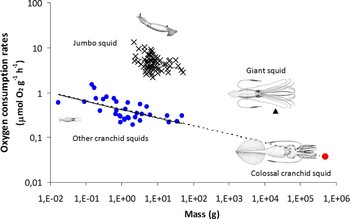
The estimated mass-specific RMR for the colossal squid at 1.5°C (average temperature below 1000 m in Figure 2A) was 0.036 µmol O2 h−1 g−1 (Figure 1). An alternative but similar low value (0.025 µmol O2 h−1 g−1) was attained using the minimum depth of occurrence (MDO) of adult colossal squid (here assumed to be 1000 m) in a plot of squid metabolism against MDO (data not shown, but similar to figure 3 in Seibel et al. (Reference Seibel, Thuesen, Childress and Gorodezky1997)). Our estimated rate for M. hamiltoni is considerably lower than that estimated for a single specimen of the giant squid, Architeuthis spp., based on the activity of citrate synthase measured in mantle muscle (Seibel et al., Reference Seibel, Thuesen and Childress2000), and lower still compared to the direct oxygen consumption measurements in the jumbo squids, Dosidicus gigas (Rosa & Seibel, Reference Rosa and Seibel2008) (Figure 1). Other families of squids that retain ammonium for buoyancy, such as Histioteuthidae and Chiroteuthidae, have similarly low metabolic rates and scale with coefficients near quarter-power (~0.25) (Seibel, Reference Seibel2007). However, the scaling coefficient for the jumbo squid, and other ommastrephids and loliginids, is much higher (less negative) (Seibel, Reference Seibel2007; Rosa & Seibel, Reference Rosa and Seibel2008; Rosa et al., Reference Rosa, Trueblood and Seibel2009).
Effect of size in the routine mass-specific metabolic rate (MO2, mmol O2 h−1 g−1) of deep-sea cranchid squids, from a 0.017 g Liocranchia valdivia to 500 kg Mesonychoteuthis hamiltoni (model Y = 0.5328 × body mass–0.1864). Value of 20 kg giant squid (Architeuthis spp.; solid triangle) was based on the activity of citrate synthase measured in mantle muscle (Seibel et al., Reference Seibel, Thuesen and Childress2000). Jumbo squid data (black crosses) were compiled from Rosa & Seibel (Reference Rosa and Seibel2008). Rates were standardized to 1.5°C assuming a Q10 of 2.

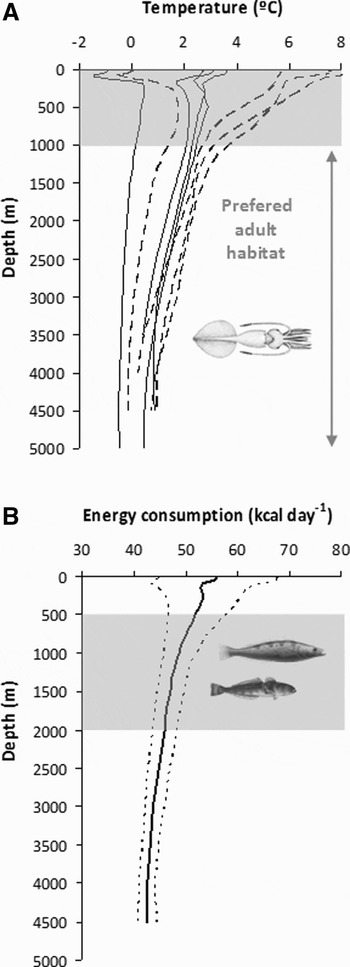
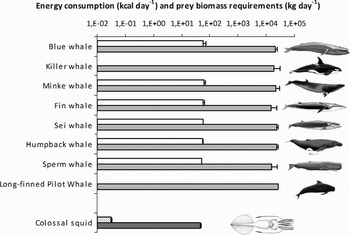
The projected daily energy consumption (kcal day−1) is almost constant as a function of depth (solid line in Figure 2B), because of the nearly isothermal Antarctic waters. The mean value, at depths below 1000 m, was 45.1 kcal day−1 (dark grey bar in Figure 3), which is 300-fold to 600-fold lower than the daily energy requirements of other similar-sized top predators (baleen and toothed whales) of the Southern Ocean (light grey bars). Consequently, while these cetaceans have to capture around 60 kg of prey per day (white bars), the ectothermic colossal squid shows a slow pace of life linked with very low prey requirements of only 0.03 kg of toothfish per day (spotted white bar in Figure 3). Assuming 80% assimilation efficiency (7.8 kJ g−1 for toothfish) and that the cost of growth is minimal at that size, this figure suggests that a single adult toothfish (5 kg) would provide sufficient nourishment for a 500 kg colossal squid for approximately 200 days.
(A) Depth-related changes in temperature in the circum-Antarctic Southern Ocean. Dashed lines represent sub-Antarctic areas (50.5°S0.5°E; 50.5°S90.5°E; 50.5°S179.5°W; 50.5°S90.5°W) and solid lines represent Antarctic areas (60.5°S0.5°E; 60.5°S90.5°E; 60.5°S179.5°W; 60.5°S90.5°W); (B) projected energy consumption (kcal day−1; based on 4.7 kcal/l O2) as a function of depth (temperature dependence of 2) in the circum-Antarctic Southern Ocean region. Thick solid line represents the mean values obtained from the different temperature profiles. Thin dashed line represents the 95% confidence interval for the means. Grey bar represents the main depth-range (500 m–2000 m) occupied by squids' main preys, the sub-Antarctic Patagonian (Dissostichus eleginoides) and Antarctic toothfish (Dissostichus mawsoni).

Comparison of daily energy expenditure rates (grey bars, kcal day−1) and prey biomass requirements (white bars; kg prey−1) of a 500 kg Mesonychoteuthis hamiltoni and similar-sized top predators (whales) off the Southern Ocean. Whale energy rates were standardized with the widespread scaling coefficient of 0.75, while estimates of prey biomass requirements were standardized assuming a value of 0.67 (Innes et al., Reference Innes, Lavigne, Earle and Kovacs1987). Mean energetic value (±SD) of colossal squid was obtained averaging the depth-range below 1000 m (obtained from panel 2B). For squids' estimates of prey biomass, it was assumed 80% assimilation efficiency (Rosas-Luis et al., Reference Rosas-Luis, Salinas-Zavala, Koch, Del Monte Lunac and Morales-Záratea2008) and 7.8 kJ g−1 for toothfish (Vanella et al., Reference Vanella, Calvo, Morriconi and Aureliano2005). Data sources for the metabolic rates and prey biomass requirements of whales are available in Appendix 1.

The underlying causes for the occurrence of this cold-associated gigantism are still poorly understood, but one of the possible factors is temperature. At lower temperatures, ectotherms exhibit lower growth rates, and delayed maturation, but also grow to a larger body size (Atkinson, Reference Atkinson1994; Grist & Jackson, Reference Grist and Jackson2007). Although more inconspicuous at para-larval and juvenile stages in lit shallower waters (Rodhouse & Clarke, Reference Rodhouse and Clarke1985), M. hamiltoni increases its detectability at adult stages. Yet, it seems to circumvent this issue by migrating to deeper darker waters, with a concomitant reduction in predation pressure. Alongside, the colossal squid has developed the largest eyes on the planet (up to 30 cm wide), a morphological adaptation that may indeed increase predator detection and avoidance in the deep Southern Ocean.
In conclusion, it appears that the colossal squid is not a voracious predator capable of high-speed predator–prey interactions. We speculate that it is, rather, an ambush or sit-and-float predator that uses the hooks on its arms and tentacles to ensnare prey that unwittingly approach. The Antarctic toothfish, Dissostichus mawsoni, is a rather agile fish by Antarctic standards (sustained escape over 3.4 m s−1 for short-term periods; Fuiman et al., Reference Fuiman, Davis and Williams2002), and since the metabolic power required for swimming increases with the cube of velocity, we suspect that this sort of activity is not sustainable by M. hamiltoni, especially at great depths where light is limiting for visual predation.
ACKNOWLEDGEMENT
The Portuguese Foundation for Science and Technology (FCT) supported this study through a Senior Research Position (Ciéncia 2007 programme) to the first author.