For over a decade now, a new generation of just war theorists has been pushing for major revisions to well-established accounts of just war theory, particularly to Michael Walzer’s Just and Unjust Wars (Walzer Reference Walzer1977), and to core principles of contemporary International Humanitarian Law (IHL). Why, it has been asked, should soldiers fighting aggressive wars have the same legal rights and permissions that soldiers fighting just wars have? When soldiers fight aggressive wars they pursue wrongful aims, and hence it is unclear that they should be treated, morally or legally, on a par with soldiers whose aim is justified. Jeff McMahan, a leading voice in this ‘revisionist’ challenge, has argued that just as we should deny that murderers have the right to use force against policemen rightfully persecuting them, we must also reject the idea that it is permissible for soldiers fighting unjust wars to use force. As he puts it, ‘those who fight solely to defend themselves and other innocent people from a wrongful threat or attack do not make themselves morally liable to defensive attack’ (McMahan Reference McMahan2009, 14; on a similar vein, see also Coady Reference Coady2008; Rodin Reference Rodin2008, Reference Rodin2011; Fabre Reference Fabre2012, 54–81). When endorsing the equal application of the laws of war to belligerent parties, we would seem to also be endorsing the patently false claim that aggressors can create the conditions under which it is permissible for them to use force against innocent people (McMahan Reference McMahan2004, 699).
Similar challenges have been raised against the principle of distinction, which prohibits the deliberate targeting of non-combatants. Why, asks McMahan, should the use of force be prohibited against ‘noncombatants who bear significant responsibility for initiating or sustaining an unjust war, or for the wrong whose redress is the just cause for war’ (McMahan Reference McMahan2004, 725)? Just as we think that it is normally justifiable to use force to stop or punish someone who is blamefully responsible for a serious wrong, we must also condone the use of military force against non-combatants who are responsible for unjust acts of war (McMahan Reference McMahan2004, 725–29; see also Arneson Reference Arneson2006; Fabre Reference Fabre2009). As examples McMahan cites executives of the United Fruit Company who lobbied for the 1954 coup in Guatemala, which unleashed decades of civil war, and also Israeli civilian settlers in the Occupied Territories today. Their direct responsibility for grievous injustice, McMahan claims, makes them liable to military attack if this is a necessary and proportionate means of preventing or rectifying the wrong, notwithstanding the fact that they are technically civilians not taking direct part in hostilities (McMahan 2009, 221–24; cf. Henckaerts, Doswald-Beck, and ICRC Reference Henckaerts and Louise2007, 3–8).
IHL is indeed agnostic about the jus ad bellum status of the conflicts it governs. Additional Protocol I states in its preamble that, ‘the provisions of the Geneva Conventions of 12 August 1949 and of this Protocol must be fully applied in all circumstances to all persons who are protected by those instruments, without any adverse distinction based on the nature or origin of the armed conflict or on the causes espoused by or attributed to the Parties to the conflict’ (emphasis added). The prohibition against targeting civilians is, of course, also part of the Convention. But if we believe that in general the law should reflect sound moral judgments, then these recent challenges should be read as exerting pressure for legal reform. This would mean, among other things, that the law should somehow reflect the distinction between soldiers fighting just and unjust wars, for example it should contemplate criminal action against unjust soldiers, and it should fine-tune the prohibition of using force against non-combatants (Rodin Reference Rodin2008, Reference Rodin2011, 61–62; McMahan Reference McMahan2009, 107). While McMahan concedes that, under present circumstances, large-scale legal reform is likely to produce more evil than good, he is nonetheless supportive of selective violations of IHL norms on moral grounds. We may not be ready for comprehensive legal reform, but conscientious objection to the laws of war along revisionist lines can be justified today (McMahan Reference McMahan2008, 39).
A common response to this revisionist critique is that legal agnosticism about the causes of war is necessary for the laws of war to work effectively. ‘Without the equal right to kill’, writes Walzer, ‘war as a rule-governed activity would disappear’ (Walzer Reference Walzer1977, 41). The morally valuable project of regulating and moderating war requires that legal restrictions and permissions apply equally to all belligerent parties. This is because legal enforcement in war depends essentially on reciprocity. In Hedley Bull’s words, ‘if one side in an armed conflict regards itself as specially privileged by the laws of war, then reciprocal observance of these laws, which is a basic condition of their efficacy, is undermined’ (Bull Reference Bull1966, 71; see also Lauterpacht Reference Lauterpacht1953). Since each side in war should be expected to consider itself to be justified in waging war, the likely outcome of an asymmetrical doctrine of jus in bello is each side claiming to be justified in not recognizing its enemy’s immunities and permissions, which in turn is likely to lead to the unraveling of all moderating restrictions on the use of force (Roberts Reference Roberts2008).
This consequentialist rejoinder rests on the validity of an empirical claim, namely that reciprocity will produce a moderating effect. But maybe in some conflicts, notably asymmetrical warfare, in which one side can deploy military force far superior to the other, the threat of responses in kind may be negligible. Generally speaking, if the sole justification for the symmetrical application of the laws of war is consequentialist, then a window is left open for selective violations of IHL whenever consequentialist reasons cease to apply (Osiel Reference Osiel2009). There may in fact be too many relevant variables for us to estimate confidently what would be the net effects of an asymmetrical regime of humanitarian law (Kutz Reference Kutz2005, 166–70). Moreover, purely consequentialist arguments seem ill suited to justify the ‘categorical quality’ of the rules of IHL. If the normative force of IHL depended solely on the moderating effects of reciprocity, then one belligerent’s systematic repudiation of IHL would seem to grant permissions to the other side for a similar disregard, which is not how IHL stands substantively (Henckaerts, Doswald-Beck, and ICRC Reference Henckaerts and Louise2007, 498–99).
Alternative attempts to defend the principle of symmetrical application have essentially denied the moral relevance of collective agency in war contexts. Yitzhak Benbaji, for instance, argues that soldiers fighting for the unjust side may be morally innocent of an act of aggression, and as such should be allowed to use force against those who attack them, even if these attackers are fighting justly (Benbaji Reference Benbaji2008). In such cases, soldiers on both sides would face each other as moral and legal equals because they are equally blameless for the threats they pose to each other. Along somewhat similar lines, Uwe Steinhoff argues that the unjust side may permissibly use force to stop or prevent the killing of civilians as collateral damage, that is, to prevent the foreseeable but unintentional and proportional, and thus IHL-permissible, killing of innocent civilians (Steinhoff Reference Steinhoff2012). In such situations, force would be bilaterally justified.
These defenses of symmetry in effect remove from the normative picture the doctrine of jus ad bellum, which essentially involves collective agents. Instead of a single war, soldiers are seen as fighting countless interpersonal wars, in which often both sides face each other as moral innocents and as such are bilaterally permitted to use defensive force. But this amounts to buying the symmetrical application principle at the price of utterly distorting the actual character of warfare. Clearly, wars are not simply the aggregation of countless defensive encounters of individual soldiers, but rather the collective pursuit of at least allegedly collective purposes. Soldiers fight within large, complex, and hierarchical organizations, in the name of groups or states, following tactical and strategic plans that make sense only in the light of overarching collective goals. If we want to think normatively about the actual social and political practice of war making, then we cannot afford to lose sight of its collective nature, aims, and claims.
In this article, I articulate an alternative non-consequentialist defense of the principle of symmetrical application of IHL. This defense is based on a detailed examination of the process by which just causes of war may be adjudicated, something on which recent revisionist work has remarkably little to say. Even though revisionist arguments often begin with a clear-cut distinction between just and unjust sides—or just and unjust soldiers—no systematic account is offered as to the procedure by which these categories would come to be applied in practice. By looking closely at the nature of judgments of jus ad bellum, we will be in a good position to assess the practical relevance of this clear-cut distinction, as well as the implicit assumption that unilateral justice is the paradigmatic case of just war. This assumption, the so-called ‘aggressor–defender paradigm’ (Shue and Rodin Reference Shue and Rodin2007, 15), has been the main source of recent pressure against IHL. I will argue that the assumption follows from an unwarranted use of domestic analogies in war contexts. But once the morally relevant differences between using force within and beyond the pale of well-functioning states are sufficiently appreciated, strong reasons why IHL should (morally) apply symmetrically will become apparent.
The article proceeds as follows. The first section presents an account of the doctrine of jus ad bellum that has virtually canonical standing in the just war tradition. It emphasizes how for both contemporary revisionists and early modern just war theorists there is a fundamental tension between the doctrine of jus ad bellum and the principle of symmetrical application of jus in bello. The second section raises the question of adjudication—the question of who is to judge which side in a war is just and which is an aggressor—and shows that both early modern and revisionist just war theorists lack an adequate answer. Against this critical background, I challenge the aggressor–defender paradigm by constructing a case of bilateral ad bellum justice. In the third section I show that, if we admit that preemptive uses of force can be justified as self-defense, then we must admit that wars can be objectively justified on both sides. In the absence of a well-functioning state, uncertainty about motives and the absence of reliable assurance mechanisms can produce counterexamples to the aggressor–defender paradigm. In short: under acute security dilemmas, there can be crisis situations in which both sides are justified in using preemptive force. The fourth section discusses summarily World War I and post-independence civil war in East Timor as historical illustrations of this phenomenon. The fifth section brings the various strands of argument together to support the principle of symmetrical application of IHL. Instead of the aggressor–defender paradigm, it offers a more nuanced taxonomy of the jus ad bellum status of armed conflicts, and defends a presumption that belligerents have equal jus ad bellum status, from which the principle of symmetrical application of IHL follows as a corollary. I conclude by identifying possible directions for future research.
Just war as rights enforcement and the asymmetry of jus in bello
A fundamental long-standing principle in the just war tradition holds that a war is just only if waged to deter, stop, or reverse a suffered or imminent violation of right. Contemporary accounts typically hold that war is justified only if waged in response to threats or acts of aggression, but ‘aggression’ is an umbrella term covering various forms of injury.Footnote 1 In contemporary international law, the most authoritative definition states that aggression is ‘the use of armed force by a State against the sovereignty or political independence of another State, or in any other manner inconsistent with the Charter of the United Nations’. Among clear instances, the definition lists attacking or invading a state’s territory, blockading its ports and coasts, and attacking its armed forces.Footnote 2 These acts correspond to the violation of various sovereign rights—territorial integrity, access to the open sea, and the immunity of armed forces in peacetime—relative to which other states have an obligation of non-interference.Footnote 3
As in contemporary international law, in the just war tradition the rights the violation of which could justify recourse to war are understood as claim rights, which as such entail correlative duties to abstain from interfering in their exercise. A fundamental theorem follows from this understanding. Since it is impossible to have a right to X and also a duty to abstain from X, wars can be just at most on one side: one side is the aggressor; the other a victim of aggression and only for that reason authorized to use force. Necessarily, then, just wars are asymmetrical situations: the victim of aggression pursues a rightful claim, and for that reason is permitted to use defensive force; the aggressor is delinquent and has no right to use force but rather the obligation to restore the violated right.Footnote 4
The asymmetrical situation of belligerent parties relative to jus ad bellum led early modern just war theorists to propose a correspondingly asymmetrical doctrine of jus in bello, which is of course inconsistent with contemporary IHL. In a succinct statement of the fundamental principle of this doctrine, the Spanish theologian Francisco Suárez wrote that ‘it is just to visit upon the enemy all losses which may seem necessary either for obtaining satisfaction or for securing victory, provided that these losses do not involve an intrinsic injury to innocent persons’.Footnote 5 In this view, all permissions and restrictions on the use of force apply exclusively to the just side—the unjust side has no right to use force—and the central limiting criterion is individual moral responsibility. The only legitimate targets are those guilty or somehow morally responsible for the war-triggering wrong and for sustaining a wrongful state of affairs, including importantly, soldiers on the unjust side. Grotius argued that even soldiers who could not possibly know that their war was unjust, and who were in this sense free of guilt, could be targeted because they were enforcing a wrongful state of affairs.Footnote 6 Protected groups, notably children, women, and clerics, were understood to have immunity from attack, but not on the basis of a conventional distinction between combatants and non-combatants, as in contemporary IHL, but rather on the basis of a presumption of innocence. Their lack of understanding of matters of state and their physical weakness made them innocent in principle (Williams Reference Williams1944, 847).
The very logic of jus ad bellum, then, seems to dictate an asymmetrical doctrine of jus in bello. This structural feature of just war doctrine was familiar to late medieval and early modern theorists (Neff Reference Neff2005, 62–65), and also figured prominently in debates regarding the rights of German officers during the Nuremberg trials (Lauterpacht Reference Lauterpacht1953, 96–99).Footnote 7 It is perhaps testimony of the influence of Michael Walzer’s Just and Unjust Wars that this tension has not appeared more prominently in contemporary normative debates on war. Walzer attempted to dissolve the tension between jus ad bellum and IHL by proposing an ‘independence thesis’ according to which jus ad bellum and jus in bello constitute separate spheres of judgment. To support the thesis, Walzer introduced a division of normative labor, so that just wars could be seen as asymmetrical but only at the level of high politics, where the decision to wage war is made. Ordinary soldiers should be seen as ‘moral equals’, equally instrumentalized by highly placed political decision makers and innocent of the war (Walzer Reference Walzer1977, 34). The symmetrical application of the laws of war follows from the equal moral status of regular soldiers.
Walzer’s thesis remained virtually undisputed until revisionists began attacking it forcefully over the past decade. In so doing, they have revived the theoretical force of early modern views. Most persuasively, they have argued that unjust soldiers can at most be excused for waging unjust war, but this does not make them the moral equals of justified soldiers. Indeed, when a defendant in a criminal case claims that his act is justified, he means to say that the act is not wrongful, even if it meets the criteria of a criminal offense. On the other hand, when a defendant claims that his act should be excused, he concedes that the act is wrongful but seeks to avoid the attribution of the act to him. An important consequence of this distinction is that justified conduct can create duties, rights, and permissions beyond the agent’s act. For example, if A is justified in doing X (e.g. killing C), it would be wrong for B to stop A, and it would be permissibly for B to help A do X. By contrast, if A can only be excused for doing X, B is justified in stopping A, and if B helped A do X, she would also act wrongfully and would be liable to punishment unless she also had an excuse. Excused conduct can mitigate responsibility and even exculpate, but it does not create permissions or validate the effects of criminal conduct (Fletcher Reference Fletcher1978, 759–817).
When soldiers fight an unjust war, they act wrongfully even if they are not culpable of the injustice of the war. When fighting unjust wars, even excused soldiers may be, indeed should be stopped. Their use of force is not permissible, while that of just soldiers is. Revisionist just war theorists have also questioned the validity of standard excuses on behalf of unjust soldiers. In many cases, soldiers cannot persuasively claim duress, that is, that they were coerced into fighting (Mapel Reference Mapel1998), and they cannot credibly claim non-culpable ignorance, that is, that they could not possibly know that their war was unjust (McMahan Reference McMahan2009, 65–66). It is unclear, then, that ordinary soldiers should not be liable for the injustice of their war, and even if they can be excused, they have no right to use force against just soldiers.
Francisco de Vitoria is sometimes read as providing an alternative defense of the jus in bello symmetry principle, which is worth considering in the present context. This defense is related to Walzer’s ‘independence thesis’, but it relies more directly on the epistemic demands of jus ad bellum judgments. Vitoria focused on the excuse of ‘invincible ignorance’, that is, on cases in which agents could not possibly know that their actions were wrong and should for that reason not be held accountable (Pagden and Lawrance Reference Pagden and Lawrance1991, 313). Vitoria’s discussion is subtle and far reaching, but for present purposes the important point is that he claimed that if unjust soldiers could not possibly know that they were doing wrong, their war should be seen as in a sense bilaterally just: just, Vitoria wrote, ‘in itself for the side which has true justice on its side, and also just for the other side, because they wage war in good faith and are hence excused from sin’. Vitoria said that in such wars, ‘subjects on both sides may lawfully [licite] fight’.Footnote 8 While in fact justified only on one side, they could in principle be free of guilt on both sides.
James Turner Johnson influentially argued that consideration of the ‘subjective elements of judgment’ led Vitoria to emphasize the jus in bello principle of moderation over the requirements of jus ad bello, and ultimately to endorse the principle of symmetrical application of jus in bello (Johnson Reference Johnson1975, 185–203). Building on Vitoria’s doctrine, Johnson suggests that, in general, armed conflicts should be seen as having ‘simultaneous ostensible justice’, for belligerents at war should be assumed to be typically fighting under the cloud of invincible ignorance. In principle, it would be unwarranted to attribute negligence or bad faith to fighters who mistakenly think that their war is justified. Consequently, says Johnson, ‘both sides must be treated as justly fighting’ (p. 193). Relative to jus in bello, the emphasis should be wholly on humanitarian concerns, that is, on reducing the harm and suffering caused by war, not on meticulously enforcing jus ad bellum.Footnote 9
The value of moderation certainly plays a central role in Vitoria’s doctrine of just war, and may have contributed historically to a more limitative and recognizably modern doctrine of jus in bello (Reichberg Reference Reichberg2008, 199–200). However, Vitoria’s plea for moderation in cases of invincible ignorance by no means amounts to an endorsement of the symmetrical application of jus in bello. In fact, his discussion of the Spanish war against the Amerindians provides a good illustration of how easily the perception of invincible ignorance may morph into that of wrongful refusal to see the facts.
Vitoria argued that the Amerindians were initially invincibly ignorant of their injustice in waging war against the Spaniards, and held in consequence that Spain should fight with moderation and ‘within the bound of blameless self-defense’, in particular abstaining from punishing, looting, or occupying indigenous lands.Footnote 10 However, Vitoria never came to justify the Amerindians’ use of force. On the contrary, he held that, ‘if the barbarians nevertheless persist in their wickedness and strive to destroy the Spaniards, they may then treat them no longer as innocent enemies, but as treacherous foes against whom all rights of war can be exercised, including plunder, enslavement, deposition of their former masters, and the institution of new ones’.Footnote 11 Evidently there is a significant difference between strictly bilateral justice and simultaneous ostensible justice: in the latter, but not in the former, there is the possibility of refuting or at least disputing an exculpatory claim, and thus of extending blame to the enemy rank and file. At any rate, it is clear that for Vitoria excuses are not the same as permissions, and hence soldiers fighting on opposite sides of a just war cannot be moral equals.
There is no obvious principled way out of the revisionist challenges to Walzer’s theory and to the fundamental principles of IHL. These revisionist challenges have in effect resurrected a fundamental internal tension in just war theory, which seems to make jus ad bellum inherently inhospitable to IHL. The more emphasis is put on the rightfulness of the cause for war, the stronger the perceived reasons for rejecting the symmetrical application of the laws of war, and the more natural it becomes to emphasize individual responsibility as a basis for liability to attack. In the following sections, I will suggest that the proper conclusion to draw from the revisionist critique is not that the principles of IHL are misguided or somehow at odds with the inner logic or ‘deep morality’ of just warfare, but rather that the conception of aggression as a violation of a claim right has to be revised. At least in some cases, belligerents have not a claim right but only a mere liberty right to fight.
Adjudication of just causes of war
As has been noted above, revisionist just war theorists rely systematically on analogies with domestic criminal law. They suggest that, just as murderers have no right to use force against policemen chasing them, unjust soldiers have no right to use force against just soldiers. Similarly, they borrow from domestic criminal law the distinction between excuse and justification, and undermine Walzer’s defense of the moral equality of soldiers on that basis. However, it is far from clear that these domestic juridical concepts belong to the circumstances of war. In domestic criminal proceedings, the decision of which defenses apply is often a matter of significant contention about law and fact, which only ends with the authoritative decision of a judge. But if no institutional equivalent exists when it comes to the adjudication of aggression, how should the justice of a cause for war be established?
There are two main responses in the just war tradition, neither of which is satisfactory. The first, which was proposed by early modern theorists, is self-help or unilateral adjudication: each sovereign ruler should have the normative power to adjudicate his own state’s rights. In peacetime, states are independent and jurisdictionally supreme, but by violating the rights of another state, the aggressor surrenders its claim of non-intervention and the injured party acquires the right to use force against it.Footnote 12 This proposal has an obvious serious problem: rulers are authorized to act as judges and parties in disputes over rights. Why should they be expected to adjudicate accurately or fairly when they have a stake in the matter? Self-help contradicts an old principle of natural justice, according to which nobody should be judge in his own cause. Suárez conceded that a situation in which ‘the same party in one and the same case is both plaintiff and judge’ is problematic and contrary to natural law, but he nonetheless held that it had to be accepted. According to him, ‘this act of punitive justice [just wars] has been indispensable to mankind, and no more fitting method for its performance could, in the order of nature and humanly speaking, be found’.Footnote 13 While, ideally, rights violations should be submitted to an impartial court, the absence of an international court of jus ad bellum makes unilateral adjudication the best available alternative.
However, according to the very tenets of just war theory, the fact that a serious violation of right has occurred, or is about to occur, must be well established for a war to be just. If rulers fail to get matters right, they are injurers themselves and their war is unjust (of course, they may be excused if the mistake is unavoidable). There are many reasons to doubt that a partial adjudicator would meet this standard. Motivationally, rulers contemplating war are likely to be biased in their judgment; they may be motivated not by justice or the public good but by greed and personal ambition. In the absence of effective procedural mechanisms that could unmask wrongful motives and make adjudication accurate, we must doubt in principle the capacity of unilateral adjudication to protect rights through war. Moreover, rulers may lack access to all the relevant facts in the period leading up to war, either because they are not within reach or because the parties involved have strong incentives to distort and misguide. Moreover, even if the parties had full access to accurate and sufficient information and enough time to process it, there may be lingering uncertainty about the applicable law. This follows from the incompleteness inherent in any legal system, which is particularly acute in international law, and from the absence of law-adjudicating bodies with standing jurisdiction to fill in open areas of law (see, generally, Nardin Reference Nardin1983, 133–48; Hart Reference Hart1997, 227–32; specifically on aggression, Stone Reference Stone1977).
In reaction to these worries, contemporary just war theorists have rejected self-help and instead defend the creation of a global court of jus ad bellum, which would accurately adjudicate armed conflicts (Rodin Reference Rodin2004, 179–88; McMahan Reference McMahan2008, Reference McMahan2009, 104–10, Reference McMahan2013). Leaving aside the dangers of political cooptation, structural bias, and the likely partiality of this hypothetical global court, it may be granted that, if such a court had sufficient power to collect all the relevant evidence, the recognized authority to fill in gaps in the law, and the efficacy to elicit general compliance with its rulings, it would put just war theory on a firm institutional basis.Footnote 14 However, it would be hard to overstate what a deep momentous transformation of international society the creation and operation of this court would entail.
In Rodin’s strong version, states would be required to put their military forces at the service of the global court, and ultimately to surrender their sovereign decision-making power in foreign policy—and also in domestic policy, if civil wars should also fall under the jurisdiction of the court, as they presumably should.Footnote 15 In that world, war as we currently know it would no longer exist; there would instead be something better called police action, with military force used to enforce the global court’s rulings. McMahan’s court proposal is weaker, as weak as a ‘congress of experts’, which would produce a body of laws and principles to be applied by an impartial and legitimate but non-binding and non-coercive court (McMahan Reference McMahan2013). McMahan hopes that such a body could earn enough legitimacy and ‘epistemic authority’ to effectively and widely dissuade would-be soldiers from enlisting in unjust armies and fighting unjust wars. Since the function of this quasi-court is purely epistemic—publicly clarifying matters of fact and law involved in an alleged casus belli—it would not require deep transformations in the administration of coercive power in international society, but it presupposes the constitution of an epistemic authority of a global scope that is hard to imagine in practice.
If we conceive of war as being essentially about the use of force in the absence of a common judge—as political and legal theorists have considered it since the early modern period—it seems odd to build a theory of war on the expectation of the creation of a global court. The successful creation of this court would amount to the end of war as we know it. It seems clear that normative theorizing about war must take seriously the fact that wars very often occur in the midst of political controversy, which cannot be settled by a coercive or globally legitimate court. When thinking about the principles that should (morally) regulate the use of force in contemporary armed conflicts, the complex nature and inevitable shortcomings of anarchy must weigh in heavily.
In the following sections, I will show how the absence of reliable coercive adjudication mechanisms can create conditions under which, according to the very premises of just war theory, both sides in a conflict are justified in using force. I will construct an ideal type of war in which there is bilateral justice, and then illustrate its empirical plausibility. By so doing, I will falsify the aggressor–defender paradigm and begin to show the typological complexity that should underlie the doctrine jus ad bellum.
Preemption, security dilemmas, and bilateral rights to use force
Just war theorists tend to reject broadly anticipatory uses of force. Preventive wars aimed at checking a growing and remotely threatening power, in particular wars seeking to ‘preserve the balance of power’, have traditionally been deemed unjust. But while for just war theorists the anticipation of vague remote threats is insufficient grounds for war, wars fought in response to imminent serious threats can sometimes be a justified form of anticipatory self-defense.
There are several ways of conceptually parsing the spectrum of anticipatory measures, in particular different ways of construing the distinction between strictly defensive, preemptive, and preventive wars (Walzer Reference Walzer1977, 74–75; Shue and Rodin Reference Shue and Rodin2007, 2–6). Hugo Grotius wrote that ‘it is permissible to forestall an act of violence which is not immediate, but which is seen to be threatening from a distance’, but he denied categorically that force could be justified in the face of uncertainty, which as we will see is characteristic of justified preemption.Footnote 16 Grotius’ brief remarks on the subject indicate a narrow construction, arguably close to the so-called Caroline standard, which contemporary international lawyers treat as binding customary law.Footnote 17 The standard submits that a lawful preemptive attack must be ‘overwhelming’ in its necessity, leave ‘no choice of means’, and allow ‘no moment for deliberation’. Preemption thus understood is different from strictly defensive action only in that the latter aims at stopping an already suffered aggression or at reversing the consequences of an act of aggression, while the former permits action before that point. However, the Caroline standard in effect submits that action is permissible only right before that point, for it must be certain that an aggression will soon be suffered unless counteraction is taken. Preemption thus conceived is equivalent to a reflex act, a ‘throwing up of one’s arms at the very last minute’, as Walzer puts it (Walzer Reference Walzer1977, 75). Correspondingly, successful preemptive force would be ‘a response to an impending attack so rapid that the response, if successful, lands on the attacker before the attack hits the preempting defender’ (Shue and Rodin Reference Shue and Rodin2007, 2).
Just war theorists have raised several strong objections to the narrowness of the Caroline standard (Walzer Reference Walzer1977, 74–85; Luban Reference Luban2004, Reference Luban2007; Buchanan Reference Buchanan2007; Doyle Reference Doyle2008). By requiring that inaction must lead to being hit, the standard fails to capture the uncertainty that typically surrounds, and the agonizing judgments that typically mediate, anticipatory self-defense. Walzer persuasively argues that there may be cases in which there is uncertainty about the consequences of inaction—cases in which ‘it is still possible to make choices, to begin the fighting or to arm oneself and wait’ (Walzer Reference Walzer1977, 75)—but it would be unreasonable to prohibit military action. Arguing similarly, Allen Buchanan puts the central point clearly: ‘under certain conditions it would be unfair to expect a person or a group to refrain from using force in self-defense until the lethal harm became imminent. It would be unfair in the sense that understanding the contours of the right of self-defense in this way would impose an excessive burden of self-restraint on individuals or groups faced with the threats as described’ (Buchanan Reference Buchanan2007, 140–41). I will refer to this as the condition of intolerable vulnerability.
Walzer proposes three substantive criteria under which preemptive force may be justified: ‘a manifest intent to injure, a degree of active preparation that makes that intent a positive danger, and a general situation in which waiting, or doing anything other than fighting, greatly magnifies the risk’ (Walzer Reference Stone1977, 81). While inaction need not lead to aggression, the source of the threat must have the capacity and intent to attack, and there must be a growing sense of urgency. These cases are characterized by their uncertainty and strategic complexity, and stand in marked contrast to clear cases of self-defense and narrowly construed preemption. They call for fallible judgments of probability, seriousness of threat, and intolerable vulnerability. McMahan and others have defended a more permissive construction of anticipatory force. When the expected harm from an adversary is very high, McMahan argues, anticipatory force may be justified, even if the threat is not growing or the opportunity costs of eschewing force in the present are not prohibitively high (McMahan Reference McMahan2006, 172–74). For McMahan such actions as ‘initial offenses’ and active preparation, or even the sheer formation of an intention to attack without active preparations, may be sufficient to justify anticipatory force (McMahan Reference McMahan2006).
These validations of anticipatory force reflect the morally relevant difference between uses of force within and without a state. Within a well-functioning state, calling the police should generally be a safe and effective way of managing serious but not imminent threats. Without the protection of a state, it may be unreasonable to ask political communities to endure certain threats (Walzer Reference Walzer1977, 85; McMahan Reference McMahan2006, 173; Buchanan Reference Buchanan2007, 140–42). This important concession to the realities of statelessness has consequences beyond the admissibility of anticipatory wars, as we will presently see.
In the absence of reliable security-providing mechanisms, uncertainty and insecurity can escalate to situations in which the parties to a conflict create severe mutual threats out of sheer uncertainty and reasonable fear. Escalation to such threats can be blameless; they need not be caused by the wrongful motives or ‘malign intentions’ of any of the parties. Under circumstances of high vulnerability, thick uncertainty about the other side’s intentions can be sufficient to justify recourse to force. In the limit it may happen that, as Thomas Schelling famously put it, ‘fear that the other might be about to strike in the mistaken belief that we are about to strike gives us a motive for striking’ (Schelling Reference Schelling1980, 207). Of course, if one side strikes in such situation, the other side’s beliefs would not have been after all mistaken. The strategic entanglement and uncertainty surrounding the parties create a situation in which their assessments of each other’s intentions are self-fulfilling.
The escalation mechanism that can lead to this type of war is familiar to students of ‘security dilemmas’ in international relations.Footnote 18 By acquiring military capabilities aimed at enhancing its own security and deterrent power, a state can create a threat to neighboring states or groups. This will happen when the acquired capabilities can be used both defensively and offensively, and their intended use is uncertain. While an increase in military capacity may be intended purely defensively, and as such is permissible, it may nonetheless generate unintended threats to those who have no way of determining the growing power’s intentions. Such threats can escalate to a point of crisis in which preemptive force can be justified for both sides. Put formally: state A undertakes security-enhancing policy P 1, which makes A more capable of defense but also more capable of attacking neighboring state or group B. If A’s motives are uncertain, B may reasonably react to P 1 with defensive policy P 2, which in turn makes A insecure again and generates a counter-response P 3, and so on. This escalation can lead, via a series of permissible steps P 1, P 2, P 3… to a crisis situation in which both sides are intolerably vulnerable and hence justified in using preemptive force.
To see this, take Walzer’s criteria of justified preemption. Firstly, in crises generated by security dilemmas, both sides come to have the ‘capacity and manifest intention’ to use force. This, however, is not because any of them wrongfully intends to attack the other, but rather because each is prepared to use anticipatory defensive force. While the intention to use force is not injurious, it is nonetheless the case that belligerents pose a ‘sufficient threat’ to each other (cf. Walzer Reference Walzer1977, 81). At the point of crisis, the fact that the mutual threat does not stem from malignant intentions does not make it negligible; sheer uncertainty can be enough to produce severe threats under a security dilemma. Secondly, the escalating dynamics of security dilemmas generate ‘a degree of active preparation’ that indeed creates a positive danger. This is true by construction, for at the point of crisis the escalating policies P 1, P 2, P 3,… will take the form of active preparations for war. Finally, due to the escalating force of security dilemmas, waiting may indeed ‘greatly magnify the risk’. In a crisis situation, there is intolerable vulnerability because the other side has acquired enough armed power and has a manifest intention to use it—if only in anticipatory self-defense. In cases in which taking the offensive would be significantly advantageous to both or one of the parties, the threat thus generated can justify preemptive force.
The strategic entanglement of the parties has the tragic air of a self-fulfilling prophecy. An attack would only confirm the parties’ ex ante assessments of risk. Perhaps the most perplexing aspect of the situation is that agents whose motivations are purely defensive may end up fighting each other. For agents living under an acute security dilemma—in which defense and offense cannot be distinguished, no mechanism exist to credibly signal defensive intentions, and taking the offensive has significant advantage—communicating credibly the defensive character of their intentions is prohibitively risky (Glaser Reference Glaser2010, 52, 72–87).
Now, it may be said that these conflicts are not in fact justified for both sides because the decisive element in the escalation is the parties’ false beliefs about each other’s intentions. Had the parties been able to, as it were, peek into each other’s minds, they would have realized the defensive character of their dispositions and refrained from war. Put otherwise, had their beliefs been accurate, they would have seen that war was unnecessary and therefore unjust. It follows that the parties can at most be subjectively justified, that is, from the flawed but often excusable standpoint of their mistaken beliefs about the world. And while these mistaken beliefs may often be excused, if misperception of the other side’s intentions is due to negligence or recklessness, the war would be unjust and the negligent or reckless party blameworthy.
This objection fails to appreciate the full depth of the security dilemma, but it helps to clarify the normative structure of wars stemming from it, and serves to uncover the complex structure of jus ad bellum. The spiraling of security dilemmas is indeed exacerbated by psychological biases and deficient belief formation, notably by the tendency to discount or neglect the opacity to others of one’s own intentions (Jervis Reference Jervis1976, 69–72). To this extent, conflicts generated by security dilemmas may be illusory, more a consequence of bias and misperception than objective threat. However, this need not be the whole story, or even its most important part, as the discussion of World War I in the next section will show. While A may have no manifest intention to use force today, this may change tomorrow for various reasons, including a heightened sense of vulnerability, misperception, or events outside the parties’ control. Crucially, A and B’s mutual vulnerability has a purely objective dimension, solely dependent on their relative situation and actual capacity to inflict harm. As Jervis has noted, it is illusory to think that ‘if states only saw themselves and others more objectively, they could attain their common interest’ in security. Under extreme circumstances, A and B may be structurally blocked from simultaneously avoiding intolerable vulnerability (Jervis Reference Jervis1976, 75–76; Tang Reference Tang2009, 598–603). The expected harm they can inflict to each other is high, and the preparedness and indeed intention to use force all too present.
There may be less tragic cases in which there are mutually attainable levels of sufficient security, but A and B cannot coordinate to reach them. This may be a consequence of a commitment problem, namely the fact that A and B cannot afford to bind themselves credibly to an intention to refrain from force (Fearon Reference Fearon1995). On the basis of all available evidence, which typically excludes the records of internal decision-making procedures, each can reasonably fear that the other will take advantage of unilateral de-escalation. The claim that war is in fact unjust because there exists, as it were objectively, an alternative to war misses this crucial strategic and dynamic aspect of the situation. The decisive fact is that the parties are entangled in an assurance game, in which they can either coordinate their security needs in peace or go to war, the first of which both prefer. The tragedy here lies in the impossibility of reaching the equilibrium of mutual security, but this is a consequence not of mistaken beliefs about each other’s intentions—their intentions are in fact interlocked: A intends to use force if and only if B intends to use force—but of a commitment problem.
Finally, there may be cases in which the parties are in a position to provide assurances and de-escalate the strategic entanglement. Jervis, Glaser, Lindley, and others have shown that, under a wide range of settings, arms races and spiraling can in fact be controlled and avoided (Jervis Reference Jervis1978; Lindley Reference Lindley2007; Glaser Reference Glaser2010). The parties may fail to do this in several ways, including unreasonably refusing to join in trust-building measures; building capabilities with offensive potential when purely defensive capabilities are available; disregarding relevant evidence; inflating probability assessments; bluffing recklessly, etc. It may also happen, as my discussion of East Timor in the next section will show, that third parties deliberately exacerbate spiraling by feeding false information to the parties. In these cases, we can meaningfully ask whether the failure to de-escalate was blameworthy, and indeed whether it amounts to an act of aggression. If the parties cannot be blamed for their failure to de-escalate, their war would not be a case of bilateral justice but of bilateral excuse: the war is avoidable and as such unjust, but the parties have excusably failed to avoid it (this type should not be confused with James Turner Johnson’s ‘simultaneous ostensible justice’, for while here both sides are objectively unjustified, there one side is objectively justified and the other unjust but excused). If one or both of the parties is blameworthy, then the war may be a case of unilateral justice or bilateral aggression, respectively.
Just war theory has traditionally held that wars are just only if waged after exhausting all alternative means of conflict resolution, and it would seem that the failure to de-escalate violates this principle and thus constitutes aggression. It is certainly conceivable that a reckless action or omission, which knowingly exacerbates the security dilemma to a point of crisis, could amount to a wrongful provocation so severe and unbearable that it should be deemed an act of aggression. Such policy would essentially leave no practical alternative to the other side but war, a war that is consequently unilaterally just. However, recklessness or negligence cannot always be so severely judged. The escalation process generated by security dilemmas belongs to what Walzer has called the ‘long political and moral pre-history’ of a war (Walzer Reference Walzer1977, 82). In that history, political actions and judgments may at some points be faulty and condemnable, but if they are several steps removed from the war’s outbreak, they cannot be properly described as acts of aggression. Doing otherwise would in effect condone the validity of widely anticipatory wars, the grave deficiencies of which were amply shown in the critical debates elicited by George W. Bush’s 2002 call for preventive global warfare.
To conclude this section, let me note briefly what my argument has and has not shown so far. Wars in which both sides are justified in using force are analytically possible. These bilaterally justified preemptive wars emerge under specific empirical conditions, which include thick uncertainty about the other side’s intentions, the impossibility of distinguishing between defensive and offensive capabilities, and intolerable vulnerability. These cases are counterexamples to a long-standing theorem in just war theory, the so-called aggressor–defender paradigm. However, I have not claimed that bilateral justice should be treated as the paradigmatic case of just war instead of unilateral justice. I have in fact made no claim about the relative frequency—past, present, or future—of bilaterally justified wars. It may well be that international politics are moving in the direction of eliminating thick uncertainty, and that reliable assurance mechanisms are becoming progressively available. Nonetheless, whether or not security dilemmas will soon be superseded remains a contested issue. Booth and Wheeler have recently made a book-length plea for the enduring relevance of the concept (Booth and Wheeler Reference Booth and Wheeler2008) and its relevance in cases of state failure, particularly in contemporary ethnic conflicts, is well documented (Posen Reference Posen1993; Fearon and Laitin Reference Fearon and Laitin1996; Kaufman Reference Kaufman1996; Snyder and Jervis Reference Snyder and Jervis1999; Kasfir Reference Kasfir2004). My analytical argument is agnostic about the future of the international system. As long as the enabling conditions of security dilemmas exist—and it is clear that they do now exist—the aggressor–defender paradigm stands in need of revision.
Two empirical illustrations
In this section, I want to illustrate some of the normative complexities of conflicts stemming from security dilemmas by discussing two historical cases of bilateral preemptive justice. The first and perhaps most controversial is World War I, the second and less known is the civil war in East Timor after independence from Portugal.
Still now, remarkably, there are ongoing debates among historians and IR theorists about the causes and responsibility for the Great War (for recent contributions, see Lieber Reference Lieber2007 and Snyder Reference Snyder2008; McMeekin Reference McMeekin2011; Clark Reference Clark2012). However, according to one persuasive and influential account, the war was to a decisive extent the consequence of a security dilemma created by an entanglement of rigid alliances, and exacerbated by the belief, common to all the involved parties, that anticipatory force would be required for self-defense (Schelling Reference Schelling1966, 221–27; Snyder Reference Snyder1984; Van Evera Reference Van Evera1984; cf. Copeland Reference Copeland2000, 79–117). Simplifying much, Austria-Hungary’s vulnerability to terrorist attacks by Serbian nationalists became critical when Archduke Franz Ferdinand, heir to the Austrian throne, was assassinated in Sarajevo on 28 June 1914. Nationalist attacks appeared to be facilitated, if not openly instigated, by Serbia, and so war against Serbia was a somewhat desperate but justified attempt to control the internal threat (Howard Reference Howard2007, 6). Russia, on the other hand, was Serbia’s avowed ally and had security reasons for preserving the status quo in the Balkans, most importantly securing passage from the Mediterranean to the Black Sea through Constantinople. Germany was Austria’s long-standing ally and had security reasons of its own to prevent the collapse of Austria-Hungary.
Crucially for present purposes, Russia’s large mobilization in support of Serbia created an existential threat to Germany. Once mobilization was complete, the unsurpassable strength of the Franco-Russian Entente could encircle Germany and crush it on two fronts. The consequences of such a defeat would be hard to calculate, but were likely to include massive losses of lives and territory for Germany. On this basis, it has been argued that the war effectively began with Russia’s mobilization, two days after Austria gave Serbia an ultimatum demanding assurances against future attacks, three days before Austria actually declared war against Serbia. Since Germany was no match for the dual Entente, arguably by late July of 1914 Germany’s only chance was to give a first decisive blow that would neutralize France and then deploy an effective defense on the eastern front. This first blow was based on the strategic understanding that, ‘whoever moved first could penetrate the other deep enough to disrupt mobilization and thus gain an insurmountable advantage’ (Jervis Reference Jervis1978, 191).
Given the manifest readiness and willingness of all the parties involved to use anticipatory force, Germany’s first use of force was arguably justified, as would also have been that of France or Russia had they attacked first. Since by the time of the July crisis Germany’s only viable strategy was to reach France through the ‘bottleneck of Liège’, attacking neutral Belgium became a necessary element of Germany’s preemptive strategy (Snyder Reference Snyder1984, 112–15, 138; Van Evera Reference Van Evera1984, 71–75, 90–94; Trachtenberg Reference Trachtenberg1990–Reference Trachtenberg1991, 142–45; cf. Walzer 1977, 239–42). In sum, the assassination of the Archduke Franz Ferdinand unleashed a crisis that eventually put all the actors involved at existential risk. All major players had good reasons to fear their enemies, and therefore all had plausible justifications for waging war (Howard Reference Howard2007, 28). No single side has been, nor it seems could be, identified as the aggressor.
However, there are two ways in which World War I does not perfectly fit the stylized construction of bilateral preemptive justice. First, the states involved, in particular Germany and Russia, were motivated not purely by security but also by hegemonic expansion; security and expansion were in fact often seen as necessarily connected. Second, escalation towards war was partly driven by an ‘offensive bias’, that is, the mistaken belief that preparation for anticipatory military action was necessary for self-defense. In retrospect it became clear that an accurate assessment of the balance between offense and defense should have seen the tactical superiority of the defense. Had this been common knowledge, the war might well have been avoided. Nonetheless, even if not their only motive, security was a real concern for all the parties involved. And even if the belief in offensive advantage was initially mistaken, it led all parties to a very real and acute security dilemma, indeed to a crisis situation in which the two main sides were justified in using force preemptively. What in retrospect may be seen as mistakes, eventually generated ‘facts on the ground’ and a crisis such that, as Snyder has put it, ‘whoever or whatever had created the European security dilemma, by 1912 there was no simple way out of it. Arguably, a state that gave its neighbors the benefit of the doubt in these circumstances would have come to regret it’ (Snyder Reference Snyder1985, 174).
August 1975 was the month of crisis for East Timor. In 1974, Portugal belatedly granted independence to its colonies and began making preparations for a transition to sovereign statehood. At the time, most of the population in East Timor was split between two main parties, socialist Fretilin and the right-wing UDT (Timorese Democratic Union). As could be expected, once plans for independence were announced, each party claimed to be the sole representative of the Timorese people, and partisan politics eventually escalated into violent conflict. On 11 August 1975, reacting to rumors that a coup d’état by Fretilin was being planned for 15 August, UDT decided to act preemptively and capture the police headquarters in Dili, along with the seaport and airport, and radio, water, and telephone facilities. UDT demanded that the Portuguese administrators purge communists from the army, accelerate decolonization, and recognize UDT as a national liberation movement (CAVR 2005, §§144–48). Instead of granting these demands, which arguably the Portuguese were not in a position to meet, the highest-ranking Timorese officer in the army was appointed as mediator. However, soon afterwards he defected to the side of Fretilin and persuaded the majority of the soldiers to join him. With the backing of these soldiers, Fretilin attacked UDT, the armed conflict flared up, and the Portuguese administrators fled the country. After a short but bloody war, Fretilin claimed victory and declared national independence in November 1975 (CAVR 2005, §156).
An important element in this case is that it was discovered ex post that the rumors regarding a Fretilin coup had been deliberately planted by Indonesia. In fact, throughout the independence crisis Indonesia worked systematically to destabilize the highly volatile situation. In a well-documented meeting in Jakarta, for instance, a top-ranking Indonesian general encouraged UDT to take preemptive action against Fretilin, which, he reportedly said, was bent on turning East Timor into a communist satellite (Taylor Reference Taylor1991, 49–50; Robinson Reference Robinson2010, 35). Former UDT leaders still refuse to accept this. When appearing before the Timorese truth commission, UDT leaders alleged that their actions in 1975 were meant to preempt a coup by Fretilin, and also to redirect the decolonization process away from Fretilin’s communist faction, which they thought would make East Timor unviable as a state and would endanger them personally (CAVR 2005, §148). Even though UDT moved first, its preemptive action need not be seen as an act of war. Significantly, on 11 August they only surrounded the military barracks but did not try to take over the arsenal (Taylor Reference Taylor1991, 50). It could be argued that Fretilin’s later decision to bring in the Timorese army into the fight was really the first act of war: instead of fighting, Fretilin should have submitted to the mediation of the Portuguese administrators.
There are two different plausible readings of this case. One is that the security dilemma caused by the power vacuum left by Portugal eventually escalated to a point of crisis in which both sides were justified in using preemptive force. During the first semester of 1975, violence had been escalating between the parties, including violent harassment of supporters on all sides. Given that Portugal could not reliably be expected to keep the factions in check, each side had solid grounds to fear that the other would take decisive action unilaterally. And while Indonesia wrongfully exploited the situation to its own advantage, its rumors only precipitated a crisis that was already in the making. If there is a guilty party in this war it is Indonesia, which initially was not involved in the fighting; the belligerents themselves were innocent and indeed justified in fighting. An alternative reading is that in fact neither side was justified in fighting because both were deliberately misled by Indonesia, but their mistaken beliefs can be excused under their circumstances. It is a case not of bilateral justice but of bilateral excuse. While UDT mistakenly, though excusably in the circumstances, thought that preemptive force was necessary, Fretilin mistakenly but understandably thought that decisive force against UDT was necessary once UDT had acted unilaterally. As a matter of fact, the right course of action was to stick to Portuguese mediation, ignore Indonesia, and defuse the crisis. Given the available evidence, both interpretations appear reasonable. The important point is that both UDT and Fretilin are placed symmetrically relative to jus ad bellum: they are either both objectively justified or both unjust but excused.
Jus ad bellum and the symmetrical application of IHL
The existence of bilateral justice and bilateral excuse in war cases does not exclude, of course, the existence of cases of unilateral justice, but it does raise questions about their paradigmatic standing in just war theory. Most importantly for present purposes, it shows that in armed conflicts, one side’s justice does not logically entail the other side’s injustice. There is no reason to expect in principle that the adjudication of jus ad bellum will find an aggressor and a defender. Moreover, it is clear that in cases of bilateral justice and bilateral excuse the principle of symmetrical application of jus in bello should stand. Since both parties are placed symmetrically relative to jus ad bellum, the revisionist objection to the symmetrical application of IHL dissolves.
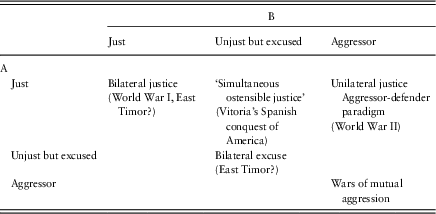
A good theory of jus ad bellum, and a proper account of the relationship between jus ad bellum and jus in bello, must be based on an accurate typology of cases. In the preceding discussion, we have encountered three different types of belligerent groups: (i) justified in waging way; (ii) not justified but excused for waging war; and (iii) neither justified nor excused, that is, aggressors. Since the types are logically independent from each other, this tripartite division leads to five recognizable types of armed conflict relative to jus ad bellum, three of which are symmetrical, as Table 1 shows.
Types of conflict according to jus ad bellum status
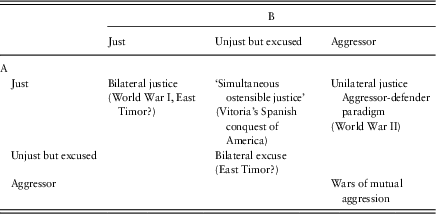
If we were to follow the call to make the laws of war more congruent with jus ad bellum, we would have to split the laws of war into several separate regimes. The principle of symmetrical application of jus in bello should be upheld in the symmetrical types (bilateral justice, bilateral excuse, and bilateral aggression) but possibly not in the asymmetrical types (unilateral aggression and ‘simultaneous ostensible justice’).Footnote 19 Rather than pondering on the jus in bello regimes that would adequately fit the typology of jus ad bellum cases, we need to revisit the question of adjudication, that is, the question of who is to decide to which jus ad bellum type an actual conflict belongs. In this section, I will defend a presumption in favor of symmetrical jus ad bellum standing, which in practice may be close to indefeasible. I will first examine the hypothetical case in which a court or ‘quasi-court institution’ exists for the adjudication of jus ad bellum, and then consider the moral and legal significance of the fact that it does not exist.
Suppose that a court of jus ad bellum had been created, which has the authority to decide to which jus ad bellum type an existing armed conflict belongs. An implication of the previous analysis is that this court would have to establish independently for each belligerent group whether it is justified, excused, or aggressive. Moreover, the jus ad bellum court, like any court tasked with adjudicating disputes under conditions of uncertainty and epistemic obscurity, would have to adopt a procedural norm assigning the parties’ burdens of proof (Gaskins Reference Gaskins1993). When a case comes before the court, it must decide ex ante what the default situation will be against which the parties will have to argue. Specifically, the jus ad bellum court must decide whether the default status of the parties should be objectively just, excused, or aggressor—or, equivalently, whether the parties should be required to prove their innocence or their justice.
Since acts of aggression carry some of the strongest forms of global stigma, authorize victims of aggression and third parties to use counter-force, and should lead to remedial and criminal actions, it is clear that, as a sheer matter of fairness, innocence should be presumed. The burden of proof should be on the claim that a belligerent is an aggressor. This amounts to assuming ex ante that the parties are either excused or justified until proven guilty of aggression. Now obviously, in light of the well-established norm against the unilateral use of force, which is reflected in article 2(4) of the UN Charter and in the general principle demanding strong reasons for any use of force, justification cannot be presumed. It follows that unless the parties can successfully prove either their justice or the other side’s aggression, their conflict should be treated as a case of bilateral excuse.Footnote 20 And since the fitting jus in bello regime for this type upholds the principle of symmetrical application, this amounts to saying that symmetrical application should be upheld unless and until the jus ad bellum court finds otherwise.
Consequently, the timing of the court’s decision-making process is essential. If the court should be expected to take a long time to reach its decisions, the principle of symmetrical application will be upheld in practice for as long as the court is silent. It could be argued, more strongly, that the court should reach a verdict only after armed conflicts have ended, for only then can it aspire to have sufficient access to evidence and witnesses. If the court should only judge ex post, the principle of symmetrical application will stand. Contrary to this, McMahan has argued that the court should ‘render its judgments as quickly as possible’, ideally before the outbreak of violence but at least in the early stages of the war, for otherwise it could not fulfill its paramount function of dissuading would-be soldiers from joining an aggressor army (McMahan Reference McMahan2013, 249). However, this requirement is patently questionable. It is dubious that a court could establish a war’s type both quickly and accurately. McMahan himself recognizes the tension between accuracy and speed, but he is overall confident of the potential accuracy of a fast acting court (McMahan Reference McMahan2013, 250). There is, however, no basis for this confidence. As Julius Stone, a life-long student of the codification of aggression in international law puts it, disputes over jus ad bellum are typically ‘complex, problematical and requiring deliberation in most cases… unlikely to be determinable in a day or two’, often plagued by deep and unresolved questions of law and fact (Stone Reference Stone1977, 14, 10). Manifest cases of aggressions are rarer phenomena than McMahan and other revisionist just war theorists seem to think. Historically, disputes over the justification of force and over responsibility for aggression have often been long lasting and hard or impossible to settle; the very outcome of a war, moreover, can influence ex post judgments about their justice (Kutz Reference Kutz2005, 174–76). If we take seriously both the epistemic obstacles to accurate adjudication and the gravity of premature and inaccurate adjudication, then we should be willing to be patient with the court. While it gathers evidence, deliberates, and decides, armed conflicts should be treated as bilaterally excused, and the principle of symmetrical application of IHL should stand.
Now, the presumption in favor of in bello symmetry may have to be revised if the court rules before the end of the war and finds unilateral justice. In the face of such authoritative ruling, continuation of the war by the condemned party would amount to contempt for the jus ad bellum court, and the war would be a case of law enforcement action. The question, then, boils down to the following: if a jus ad bellum court finds unilateral justice, should the norms of jus in bello somehow favor the defender over the aggressor? In this situation, but only in this situation, suspension of the principle of symmetrical application can be considered.
What does this limiting scenario tell us about the standing of the principle of symmetrical application of IHL in the absence of a jus ad bellum court? Without an authoritative court pronouncement, in practice the closest we can get to this scenario is in cases of manifest aggression. For all other cases—whenever there is room for reasonable doubt and disagreement—it must be assumed that the two sides in a conflict have the same jus ad bellum standing. Doing otherwise would cause a wrong of historical proportions to the party that is justified or excused but mistakenly taken not to be. Revisionist just war theorists have focused on denouncing the fact that the symmetrical application of IHL would give aggressors the right to use force, but they have neglected another possible serious wrong, namely, applying an asymmetrical regime to a symmetrical case, which would seriously wrong the party to which aggression is mistakenly attributed. In principle, there is no reason to think that the aggressor–defender type will occur more often than the symmetrical types.
The whole question, then, hinges on what would constitute manifest aggression in the absence of a jus ad bellum court. I cannot properly defend the claim here, but I submit that for aggression to be manifest, there would have to be a wide agreement, nearing consensus, about it. Declaring aggression short of this amounts to forcing a unilateral judgment upon one of the belligerents, and indeed upon the whole IHL regime. There is no reason why a unilateral judgment should be taken to suspend core principles of IHL. As long as reasonable doubts remain, belligerents should be assumed to be symmetrically placed relative to jus ad bellum. And given how rare consensus has been in history regarding the justice of armed conflicts, the aggressor–defender paradigm may well appear only in exceptional circumstances. While the principled defense of the symmetrical application of IHL that I have articulated here would not apply then, familiar consequentialist defenses, which are based on the values of limitation and moderation, would still apply. The case for asymmetrical norms of jus in bello appears therefore exceptional and highly circumscribed, not really a matter of multi-tiered humanitarian legal regimes, but rather of the justifiability of taking exception from the familiar norms of IHL under extreme circumstances.
Conclusion
I have argued that unilateral justice cannot be treated as the only or even the paradigmatic case of just war. It may well be that contemporary thinking about justice and war has been dominated by the precedents of Nuremberg and World War II, but the moral clarity of World War II may be truly exceptional; when thinking about the justice and regulation of warfare, we should have World War I more present in mind. The sharp distinction between just and unjust soldiers, which is often the starting point of contemporary just war theorizing, altogether excludes the two symmetrical forms of just war that I have articulated. The existence of these pure symmetrical types, together with the fact that the practical application of jus ad bellum often leads to reasonable disagreements among belligerents and third parties, should give pause to those aiming to build a theory of just war on the basis of a clear-cut doctrine of asymmetrical jus ad bellum. Incorporating uncertainty and disagreement into normative theorizing is necessary, and by no means amounts to giving up the long-standing project of articulating constraints on the use of lethal force. Rather, it shifts the focus of analysis towards the concrete application of just war criteria in the non-ideal circumstances of political life without centralized adjudication and enforcement. As long as we endorse enforceable rights of self-defense under anarchy, we are bound to confront gray areas of claim making and implementation.
To conclude, I would like to briefly note two directions for future research in the spirit of this article. My analysis has illustrated how essential the practical judgment of decision makers is for the implementation of jus ad bellum, particularly when it comes to estimating a group’s vulnerability and a threat’s seriousness. Given the complexity of these judgments and their evaluation, it is striking how neglected the jus ad bellum criterion of legitimate authority has been by contemporary just war theorists (Coates Reference Coates1997, 124–25). The legitimacy of a war-declaring authority would seem to hinge importantly on its capacity to accurately and reasonably assess threats and vulnerability, in particular to prevent the escalation of security dilemmas. However, it is far from clear what exactly this capacity entails. It is a task for normative theory to articulate substantive and procedural criteria of reasonableness, and more broadly to elucidate how judgments of jus ad bellum should be made under non-ideal circumstances of uncertainty and epistemic obscurity. This applies to decision making by state leaders but also, and most challengingly, by non-state actors. We have seen that wars between non-state actors in contexts of state-failure can result from the spiraling of security dilemmas, but also asymmetrical wars, in which states are pitted against non-state actors, can in principle be symmetrical jus ad bellum types.
Secondly, a more nuanced and empirically grounded doctrine of jus ad bellum can shed light on difficult questions of jus post bellum. One of the pernicious effects of theorizing on the basis of a clear-cut distinction between just and unjust belligerents is that the actual motives, security concerns, and competing vital interests of the belligerent parties tend to be lost or obscured; blame and excuse become the exclusive or dominant registers of post-war justice (Mamdani Reference Mamdani2009). However, it is clear that these cannot be all, or even the most important part of what it means to do justice in the aftermath of war. The vital interests and security concerns of former belligerents have to be addressed and coordinated for the future. From this perspective, an important element of jus post bellum concerns the justice of peace treaties, which may be conceived as a matter of fairness in the allocation of benefits and burdens in the post-war period, given the existing power constraints (Schwartz Reference Schwartz2012). The relatively scarce literature on jus post bellum has been largely devoted to the rights and obligations of the just side vis-à-vis a defeated aggressor. It barely needs saying that this type of war and outcome is only one of many, and probably not the most frequent. Territorial rights, security arrangements, access to resources, and political representation are all matters that can come up for negotiation in peace talks. Systematic analysis of what justice may require relative to these issues during peace negotiations and in the implementation of peace treaties is largely uncharted territory (but cf. Bergsmo and Kalmanovitz Reference Bergsmo and Kalmanovitz2010).
Acknowledgments
The author would like to thank the editors and reviewers of International Theory for wonderfully constructive advise and reviews, and for helpful and encouraging comments and discussion Yitzhak Benbaji, Nehal Bhuta, Corey Brettschneider, Tom Donahue, Bryan Garsten, Richard Herrmann, David Johnston, Jeff McMahan, Shmulik Nili, Stefano Recchia, Mark Rigstad, Melissa Schwartzberg, Annie Stilz, Daniel Viehoff, and Alex Wendt.