Introduction
This study aims to provide insights into mothers' pregnancy, delivery and early-age survival experience in Ende district in Nusa Tenggara Timur (NTT) province, Indonesia, highlighting inequity issues. In 2012, the neonatal, infant and under-five mortality rates for South-East Asia as a whole were 15, 17 and 30 deaths per 1000 live births respectively (UNICEF, 2013). Early-age mortality rates in Indonesia are above the regional average: Indonesia ranks seven out of eleven South-East Asian countries for its neonatal, infant and under-five mortality, with rates of 15, 26 and 31 deaths per 1000 live births respectively (UNICEF, 2013). However there are substantial variations between its sub-national regions, with some having child mortality rates that are well above the global averages (UNDP, 2011).
Studies linking child mortality to the use of antenatal care in Indonesia have tended to focus on the quality of care (Ensor et al., Reference Ensor, Quayyum, Nadjib and Sucahya2009; D'Ambruoso et al., Reference D'Ambruoso, Achadi, Adisasmita, Izati, Makowiecka and Hussein2009; Hatt et al., Reference Hatt, Stanton, Ronsmans, Makowiecka and Adisasmita2009; Shrestha, Reference Shrestha2010; Sugiharti & Lestary, Reference Sugiharti and Lestary2011) and the social determinants of maternal and child health at the national level (Wahab et al., Reference Wahab, Winkvist, Stenlund and Wilopo2001; Titaley et al., Reference Titaley, Dibley, Agho, Roberts and Hall2008; Anggorodi, Reference Anggorodi2009), and have paid less attention to sub-national-level variations. Only a few studies have focused on mothers' knowledge and attitudes to child health, their practices during pregnancy, or their delivery experiences, and few have investigated the equity of health in Indonesia (Titaley et al., Reference Titaley, Hunter, Dibley and Heywood2010; Adair et al., Reference Adair, Pardosi, Rao, Kosen and Tarigan2012; Kalsum, Reference Kalsum2013). These studies focused on the equity of the health system and the allocation of health resources relating to universal health coverage, and have given less consideration to health-seeking knowledge and practices and experience of health services and to gender equity in health-related decision-making.
This study aims to address a gap in the literature by presenting qualitative insights into mothers' pregnancy, delivery and early-age survival experiences and identifying health service equity and gender inequity issues for a relatively underdeveloped subnational area of Indonesia, namely Ende district.
Study location
The study was conducted in Ende district, NTT province, one of the eastern provinces of Indonesia. Nusa Tenggara Timur province has relatively high early-age mortality with an infant mortality rate (IMR), neonatal mortality rate (NMR) and under-5 mortality rate (U5MR) of 45, 26 and 58 per 1000 live births, respectively (Statistics Indonesia, 2013). Geographically, Ende district is divided into highland (65% of the land area) and lowland areas (35%). The total population of Ende district in December 2011 was 261,093 people (Ende District Health Office, 2012). It has 21 sub-districts and 259 villages, with the most populated sub-districts being South Ende, North Ende, Central Ende and West Ende. Only 5% of Ende's population live in urban areas. The total fertility rates of Nusa Tenggara Timur province (3.3 according to the 2012 Indonesian Demographic and Health Survey (IDHS)) and of Ende district (2.7 according to 2010 Indonesian Population Census) are both above the national averages (Statistics Ende District, 2013a). In contrast to the national picture, Catholicism is the predominant religion in Ende, with 73% of the population, followed by Islam and Protestantism with 25% and 2% respectively. The major employment sectors are agriculture, trade, tourism and other services (Statistics Ende District, 2013b).
Ende's population has relatively poor health, being ranked at 316 out of 500 districts across the country based on the public health development index known as Indeks Pembangunan Kesehatan Masyarakat (IPKM) (Ministry of Health, 2010a). The life expectancy at birth in 2011 was estimated to be 67.6 years compared with the national and provincial life expectancies of 70.9 and 69.9 years respectively (Statistics Nusa Tenggara Timur Province, 2011; Ende District Health Office, 2012). Based on the 2012 Ende District Health Office (EDHO) annual report, the top ten diseases among under-five children in Ende are acute respiratory infections, diarrhoea, allergic skin disease, worm disease, skin disease infection, clinical malaria, vivax malaria, vulnus infection, conjunctivitis and pneumonia (Ende District Health Office, 2012).
In 2009 the NTT Provincial Health Office initiated a maternal and child health programme, known as Revolusi KIA, which aims to improve maternal, neonatal and child health (MNCH) and reduce maternal and early-age mortality. This programme emphasizes the importance of ensuring mothers can give birth at appropriate health facilities. This strategy considers that for births at home there are higher risks of maternal and neonatal deaths, especially for deliveries in the villages, where health care facilities are still insufficient. The issue of mothers' safety is the main reason for promoting childbirth at health-care facilities instead of at home or at non-health facilities, where adequate medical emergency support is often not available (Ende District Health Office, 2012; NTT Provincial Health Office, 2012).
In 2005 the Indonesian government launched a free public health insurance scheme known as Jaminan Kesehatan Masyarakat (Jamkesmas) to cover access to primary health care, including maternity and child care at puskesmas (community health centres), especially for poorer people. However, even after the introduction of this programme significant geographic shortfalls in the availability and quality of health care, especially for those living in relatively remote and rural locations, have persisted. Poorer people continue to experience lower levels of access to health facilities than the wealthier (Harimurti et al., Reference Harimurti, Pambudi, Pigazinni and Tandon2013; Simmonds & Hort, Reference Simmonds and Hort2013). In 2011 a universal maternity benefit, known as Jaminan Persalinan (Jampersal), was implemented to enable all pregnant women to deliver at health facilities (Ende District Health Office, 2012). However, a lack of dissemination of information about the programme to the community, and inadequate preparedness for implementation of the health district office's and other government agencies' programmes, has limited the effectiveness of the programme (Ministry of Health, 2010b).
Methods
Informants
Thirty-two mothers aged 18–45 years with at least one birth in the last five years prior to interview were recruited using purposive sampling. The sample was designed to include an equal number of mothers with a child death, including neonatal, post-neonatal, and under-five deaths, between 2008 and 2013 and mothers without a child death during this period. Where possible either the informant's husband or one of her parents was also interviewed about their experience, knowledge, perceptions and understanding of early-age survival.
Sampling method
Ende district was divided into four regions; the North, South, East and West regions. The informants were selected by targeting the sub-districts with the highest and the lowest under-five mortality based on advice from the Ende District Health Office (EDHO) and using EDHO data between 2010 and 2012. The selected sub-districts with the highest children under-five mortality were Nangapanda, Ende Timur and Wolojita, and Wewaria. Maukaro, Ndona, Ndori and Detusoko were the selected sub-districts with the lowest child mortality. Of these, the only sub-district located in an urban and lowland area was Ende Timur. From each of the selected sub-districts, four informants, including two who had experienced early-age deaths and two without deaths, were interviewed. The selection of the informants from each sub-district was conducted by checking the sub-district midwife's birth register as a sampling frame, and targeting the latest early-age death cases in order to minimize any recall bias from informants. Responses were obtained from all 32 mothers.
Research questions
This study examines the extent of mother's knowledge about child health and survival influences during pregnancy, delivery and post-delivery, their views on the support provided by health services and their families, and how the experiences of those mothers with early-age deaths reveal health service provision and gender inequity issues that exist in Ende district. In order to assess the mothers' knowledge and experience of pregnancy, childbirth and child death, respondents were asked a wide range of open-ended questions. These included questions relating to the pregnancy and delivery experiences, particularly in relation to the antenatal care received, the type of place of delivery and type of delivery assistance received. The mothers were asked about their children's illnesses, how they identified the signs of illness, their access to health care services, the types of support they received from their family, the community and the government, and about their participation in traditional ceremonies. Additional questions probed the experiences of mothers who had delivered with a traditional birth attendant and of mothers who had experienced an early-age death. Information on the birth history and the demographic characteristics of both the mother and her husband was collected from all participants.
Data collection
The data were collected during May 2013. All interviews took place at the interviewee's house, and were conducted using mixed languages (local and Bahasa Indonesia) and fully transcribed into Bahasa Indonesia, except for important indigenous terms. Local terms used by participants in the interviews have been translated and explained in the narrative. After the initial stage of analysis, all transcripts were translated into English, using a professional English translation service. Photos of each participant's house condition were taken, with their consent, to provide additional information that may relate to early-age survival.
Data analysis
For the purpose of analysis, the study used an anonymous code for each participant without any specific information that would reveal their identity. A theme-based approach (thematic analysis) was applied. After transcription, a coding framework, using a priori themes, such as ‘inequity issues’ and ‘community health quality of care’ and other possible themes that emerged during the thematic framework process, was applied. Then indexing by applying either numerical or textual codes was conducted, following a thematic chart. Finally, connections, patterns and further implications were identified in order to develop interpretations.
Triangulation applied using multiple sources, especially from EDHO data between 2008 and 2013, local laws/acts, and Indonesian Ministry of Health (MOH) reports related to child health and survival, was also applied in order to improve the objectivity and internal validity of the project (Hansen, Reference Hansen2006). Ethical clearance was obtained from Macquarie University and the National Institute of Health Research and Development (NIHRD), Ministry of Health, Indonesia.
Results
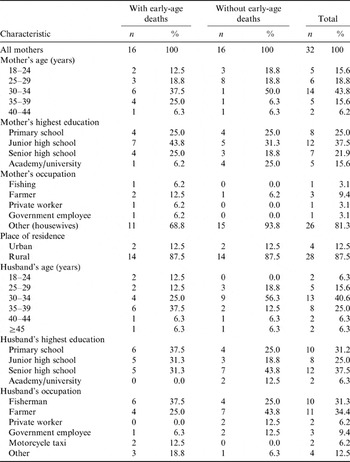
Table 1 presents the demographic characteristics of the mothers, and disaggregated figures for the mothers with experience of early-age deaths and for those without such experience. Only fifteen husbands participated in this study, and five mothers or mothers-in-law were interviewed in place of husbands. For ten of the remaining families no other relative could be interviewed, because at the time of interview they were working on the farm, visiting other cities, working in another city/province/country or studying in another city. For the remaining two families the relatives declined to be interviewed. The modal age group of mother was 30–34 years (43.8%). Just over one-third (37.5%) of the mothers had completed junior high school or passed year 9. Most of the mothers were not working (81.3%), and most (87.5%) lived in rural areas.
Demographic characteristics of mothers with and without early-age deaths and other household informants, Ende district, 2013

Similar to the mothers, almost half the husbands were 30–34 years old. Over a third of the responding husbands had completed senior high school (37.5%) or passed year 12. The most common occupations for responding husbands were farmer (34.4%) and fisherman (31.3%).
The mothers with early-age death experience were more likely to have junior high school education or below than those without early-age deaths. Only one mother with early-age death had academy level education, compared with 25% of mothers without early-age deaths. Similarly, husbands with early-age deaths had lower levels of highest education than those without early-age deaths. Almost all mothers without early-age deaths were housewives, whilst a significant minority of those with early-age deaths worked on the farm or helped with fishing activities, a pattern that could indicate difficult financial circumstances (Table 1).
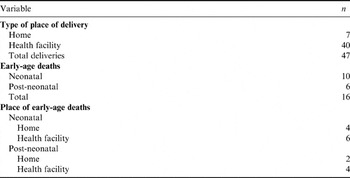
In total 47 births were delivered between 2008 and 2013 to the women in the study (Table 2). Most of the deliveries took place at health facilities, such as puskesmas. Seven births were delivered at home, all of which were assisted by traditional birth attendants (TBAs). The proportion of home deliveries that resulted in neonatal deaths (57.1%) was much higher than the proportion of births at health facilities that did so (15.0%). In this study, neonatal death refers to deaths during the first 28 days of life and post-neonatal death to those that occur between 28 days of life and one year. Of the sixteen early-age deaths among the responding mothers, ten were neonatal deaths and the remainder were post-neonatal deaths. Six early-age deaths occurred at home and the remaining ten at a health facility. Analysis of the qualitative data from mothers identified the following seven major themes.
Health-related variables for labour and early-age survival by mother's birth history, Ende district, 2013

Pregnancy and delivery experience
Pregnancy checks were made at puskesmas, poskesdes (village health posts) or other health facilities. Several women reported that they felt happy and thankful once the midwife confirmed their pregnancy, and had told their pregnancy result to their husband and family members. Several reported the pregnancy test was conducted at the health centre between two and five months after their late period.
Most mothers explained that they experienced nausea, vomiting, dizziness, feeling unwell, weak and lethargy as signs of early pregnancy. One woman was hospitalized at an early stage of pregnancy and decided to not have another child after considering her health condition:
I realized I was pregnant for the second time when it reached two months, then I visited the midwife at puskesmas. I experienced regular morning sickness over and over and even worse I was admitted to the hospital. I stayed in the hospital for one week, after that I released from hospital, but I was admitted to hospital again. I had a problem with gastric ulcer and malaria, so that's probably the reason for me always vomiting. In fact, when I was giving birth, I threw up first, after that my child was born.
(Mother, 32-year-old, E1)The Indonesian Ministry of Health recommends that at least four visits are made during a pregnancy, with at least one visit during each of the first and second trimesters and two visits in the third trimester. This is mainly to prevent possible risks and complications during pregnancy, and also to monitor the fetal growth (Ministry of Health, 2010c). Most mothers in the study had routine pregnancy visits at health-based facilities such as puskesmas and almost all had their pregnancy checked at least twice a month by a midwife. The numbers of antenatal care (ANC) visits varied between four and nine. None of the mothers who complied with the Ministry of Health recommendations had experienced neonatal deaths. However, some mothers whose ANC visits were irregularly spaced over the pregnancy did so. The mothers with higher education had more antenatal visits on average than those with lower education. The frequency of antenatal visits differed by birth order. Some mothers visited a midwife more often for their second or third pregnancy compared with the first pregnancy, while others reported more antenatal visits for the first pregnancy than for the second or third pregnancies:
My first pregnancy was five times and the second one was seven times for antenatal visit.
(Mother, 22-year-old, E8)A few mothers understood the importance of visiting puskesmas during their pregnancy. One expressed a belief that visiting a midwife regularly at the community health centre (CHC) would prevent a repeat of the health problems that occurred in her previous pregnancy:
I checked my pregnancy more often than before. I checked my previous pregnancy regularly, but this one was more more often. Because I was afraid that something will happen like my previous child if I did not visit midwife regularly
(Mother, 33-year-old, E6)Some mothers said that midwives had not fully checked their pregnancy and had provided them with insufficient information. They also felt there was a lack of attention from the midwives, and that they had not provided them with enough time to discuss their pregnancy experience:
The midwife never explained about my pregnancy during the antenatal visit, never…
(Mother, 28-year-old, E23)Midwife usually checked my weight, touched my belly, took blood test but she never told me about the result.
(Mother, 33-year-old, E2)Most mothers showed a high level of awareness of the importance of giving birth at the CHC and assisted by health personnel. Midwifes were the main birth assistants for most women, followed by doctors, nurses and TBAs. Some mothers gave birth at a hospital or a private clinic. However most women chose the puskesmas as the place for delivery.
In certain cases midwives referred mothers to higher health care levels, such as Ende District Hospital (RSUD). Most of these cases involved Caesarean operations or complications during pregnancy or deliveries that needed to be handled by an obstetrician. One informant said that Ende District Hospital would be the best place for the delivery, because it has well supported health facilities and had enough doctors. This informant felt more comfortable delivering at a public hospital. She said that if unexpected things happened then the hospital would ensure adequate emergency treatment to prevent death of the mother or the baby, especially for a late delivery:
I went to puskesmas when I was in labour with my first child, but when I was in labour with my second child I went to Rumah Sakit Umum Ende, because the baby was two weeks late. If you are giving birth in the hospital and you are bleeding you can be admitted to a public hospital or maybe there is another way to solve that problem. If you are giving birth with midwife or TBA in the village, and you are bleeding they will give you a certain herbs, then if it do not work, you must be run out of blood and die.
(Mother, 32-year-old, E1)Since the 1990s the Indonesian government has operated a village midwife programme, which is intended to replace the use of TBAs. However, seven respondents experienced a home delivery and were helped by a TBA. The neonatal death rate was much higher for this group than for those who gave birth at a health facility. The mothers who used TBAs for delivery, rather than health personnel and health services, gave a range of reasons for their doing so including: economic problems, the long distance to reach puskesmas, a lack of health facilities such as poskesdes, and their family history. Some mothers explained that they visited the TBA because they had experienced bleeding or other health-related problems. The following quote illustrates this:
I chose to go to the traditional birth attendant because the bleeding stopped when I was massaged by the traditional birth attendant. But not permanently. It happened again. I think it was just pain, not the term yet. It was a seven months pregnancy. I thought I was at term, I thought the baby was about to deliver, what people say contractions. I called the traditional birth attendant to give me a massage on my back. But suddenly I delivered the baby.
(Mother, 28-year-old, E23)One informant gave birth with a TBA, because the village midwife did not live in her official government-provided house in the village known as rumah dinas. This mother tried to call the midwife but she did not respond, so this informant decided to call a TBA who lived nearby:
I gave birth at 2.30 am. We had called the midwife but she did not stay in her official house. I called, but she didn't sleep there, she came at the morning. I called TBA and she assisted me with my delivery at my home…
(Mother, 32-year-old, E18)Another mother decided to ask a TBA to assist her with the delivery process and delivered at home, because her husband was away working on the farm. This informant explained that initially she was planning to give birth at the puskesmas but the baby arrived unexpectedly:
In the morning, I was selecting corn to be cooked, after that I felt sick, no one was there, everyone went to receive the education report, and my husband was on the farm. I cooked the corn because we as Lio people like to eat corn. When I arrived here [home], I was so sick. I entered home and I was alone. When the baby was in the process of delivery, I screamed to my neighbours and my neighbours came. Our traditional birth attendant helped me. I wanted to give birth in puskesmas , but suddenly the time was arrived, how could I?
(Mother, 37-year-old, E20)This mother shows her regret for not giving birth at a health facility. However, with her condition, she had no other option available other than a TBA. She was unaware of the normal 9 months term of pregnancy.
A majority of the respondents had visited TBAs. However this was only to be massaged due to back pain. Some mothers preferred childbirth using TBAs because they were family relatives and no fees applied. However, some mothers voluntarily gave the TBA food or even transport fees. The following quotes provide illustrations:
My sister is traditional birth attendant so I didn't need to pay her.
(Mother, 37-year-old, E7)We did not gave her money. It was free because we have [a] close family relationship. It depends on us, if we care for her. The TBA never asked for money.
(Mother, 33-year-old, E6)An advantage of using TBAs that several women reported was that most are available 24/7, in contrast to village midwives or health personnel who usually work 6 days a week from 7 am to 4 pm. Other participants saw delivery at a CHC and assisted by a midwife as the best and safest option, due to the availability of medical equipment and drugs:
The midwife's service is better. Giving birth in the puskesmas is better. Because when we give birth and our baby does not breathe, they can help by giving the oxygen or another way. They can think another way to help the baby.
(Mother, 33-year-old, E6)I think midwife is better because the medicine is guaranteed, I compare it with my first child in the home. Maybe my condition was not too good, until the two months I got my health better. And the second child, because of the medicine, the medicine from midwife, so that my condition got better faster.
(Mother, 31-year-old, E19)The mothers who gave birth at home assisted by a TBA all came from the less developed East, West and North regions. These informants mostly lived in villages with poor housing conditions and poor road conditions, and their husbands were either fishermen or farmers. Several women had preferred TBAs over midwives because they feared there would be costs if they delivered at the health facility. This finding points to a lack of suitable information on fees among mothers, especially for young mothers with low socioeconomic conditions. In the words of one mother:
… all childbirth with traditional birth attendant. In that time, our life was so difficult financially. So, I laboured in the house. I am afraid if I deliver at puskesmas, there will be money that I have to pay.
(Mother, 32-year-old, E7)Health personnel's attitudes during pregnancy and delivery
Inappropriate or discomforting attitudes of health personnel towards mothers during pregnancy and, especially, during delivery, were reported by several mothers. For example, one mother reported that during her delivery in a public hospital, she was yelled at by the midwife because she complained about her pain. She believed that midwives should be patient and should comfort mothers during delivery. This informant had her delivery without any help from the midwives:
Midwife yelled at me and said that I was sloppy, but I really really thought I was painful. I know how does it feel when I was delivering my first child. The midwife was getting angry and yelling at me. She said the dilation was not enough to give birth. I told her that it was so painful, and even though I tried to change position in bed but I still felt the pain. At 5 am they brought me to delivery room, but there was no one there only my husband accompanied and hugs me because it was so painful. Suddenly, the baby came out and my husband looked for a midwife.
(Mother, 32-year-old, E1)A few mothers expressed their disappointment about midwive unavailability at CHCs. The Indonesian government has operated its village midwife (Bidan Desa) programme since 1990 to ensure the accessibility of maternal and child health programme for all mothers (Frankenberg et al., Reference Frankenberg, Suriastini and Thomas2005). Several of the mothers said they thought that midwifes should live in puskesmas or in their village.
Mother's knowledge of child health and determinants of survival
Most of the mothers, even those with larger numbers of children, displayed a lack of knowledge of the signs for identifying childhood illness, other than fever. One reason for this is that during antenatal visits they did not receive enough explanation from midwives about the ‘dos and don'ts’ during pregnancy and the signs of illness. Almost all mothers suggested that midwives should give more information during antenatal visits and that there should be continuous MCH promotion, especially of information relating to early-age survival. The following quote is an example:
… never received any information about baby health from midwives. They just said that the baby's weight was decreased.
(Mother, 33-year-old, E2)The mothers who did identify the signs of illness once they felt sick usually took preventive action by giving medicines and immediately taking their child to the closest health facility. Most mothers could identify high fever as an early warning sign for child illness. However, in some cases a lack of awareness of their child's health condition resulted in mortality:
… when the baby sick, the baby was just crying all the times. I do not know whether my baby was sick or not whether my baby was just crying a lot.
(Mother, 33-year-old, E2)… I know a little, just if they are sick, the body gets fever.
(Mother, 33-year-old, E9)Some women reported giving paracetamol to their toddlers if one or two of these signs were observed, as illustrated by the following quote:
Emm, for the toddler, maybe if they got high fever, I was afraid it become stiff or convulsions so I prepare paracetamol in home to decrease the body temperature. Diarrhoea and vomiting really scared me.
(Mother, 31-year-old, E28)One informant said that she learnt from the maternal and child book (Buku KIA) about the signs of childhood illness but she only mentioned two signs:
I read from KIA book. hehehe [laughing], ih maybe like the high fever and, eih I forget it, what else, I forget it,..hihihi [laughing], the feet swollen, I forget the name, anaemia, ha I forget the others.
(Mother, 32-year-old, E29)Cough and fever were the two most common child illnesses mentioned by the participants, a pattern which reflects acute respiratory infections being one of the most prevalent illnesses among under-five children (Ende District Health Office, 2012). Two mothers replied:
Yes, they usually had cough, flu and fever. I bought medicine from local drugs store. If they have it more than 2 days, I took them to puskesmas.
(Mother, 22-year-old, E8)I visited the puskesmas twice because my baby had fever and cough.
(Mother, 39-year-old, E13)Most of the mothers in this study lived in houses whose conditions were not conducive to child health, with many having inadequately ventilated kitchens. Thus when these mothers cooked the smoke would be inhaled by the children, particularly when they were sleeping in the morning or the afternoon.
Health-seeking behaviour
Almost all the mothers reported taking their child to a puskesmas pembantu (community health sub-centre), puskesmas, a doctor's clinic or hospital, even when it only had a fever or a cough. However, prior to doing so most relied on local traditions when taking action for their child's illness. For example, one informant mentioned that she had administered traditional remedies, such as mixing lemon with soy sauce, as first-aid before visiting a health facility:
Just the usual sickness, like flu and diarrhoea. I just took my children to puskesmas to check.
(Mother, 32-year-old, E7)Yes, they did, cough and flu. If they have it more than 2 days, I took them to puskesmas. Usually, I give them traditional medicine, like lemon mixed with soy sauce. And the quantity is different; my youngest child was given a half of spoon and the oldest got one spoon.
(Mother, 22-year-old, E8)A few mothers reported using medicines from street vendors. Some informants reported their children never became sick, and attributed this to their giving their child massage as a preventative measure. One said:
… from birth until now, my son has never been sick. If I sense that he might experienced fall down, I will massage him, massage their chest.
(Mother, 32-year-old, E1)Several of the mothers expressed a preference for using traditional massage for their child illness as an early treatment, for example:
For 3 or 4 nights, I bring my baby to be massaged by TBA and she bathed my baby with coconut water to make the baby stop crying.
(Mother, 25-year-old, E3)Sometime I discuss with my husband, bring them to someone who can handle the ill, such as TBA. She will massage my child.
(Mother, 32-year-old, E1)Access to, and experience of, child health services
Most of the mothers reported their current health services were adequate, and some even agreed that they provided a good service. However, there were some suggestions of inequality in the distribution and delivery of essential medicines, public health insurance (Jamkesmas) and health care to the community. The CHCs were reported to have been unresponsive in addressing long waiting times to receive health services and to have poor sanitary conditions, for example for toilets.
Several women mentioned their house's distance to puskesmas and a lack of health personnel availability, especially of doctors, as inadequacies in the health care service provision. The most common response from mothers was that, on average, the distance to the closest government health facility was between 5 and 20 minutes, and that they used either a motorcycle taxi (ojek) or walked there. However, a few informants reported they had to walk between 30 and 60 minutes:
… just half an hour, yeah walk, through short cut, yeah walk.
(Mother, 39-year-old, E13)If I walk it takes me about one hour.
(Mother, 41-year-old, E22)… one hour for me to walk about 2 kilometres.
(Mother, 31-year-old, E17)Mothers from the more remote East, West and North regions were more likely to have had difficulties accessing puskesmas during delivery and emergency treatment for childhood illness than those in the Central region. There were reports of a lack of awareness and fairness in the provision of health-related information, checks and facilities and in actively checking health, and reports that the information given by health personnel was only partially absorbed:
The village government who handle public health insurance matter is misinterpreting the condition in this place. In fact this place also belongs to poor people. Those who haven't got public health insurance… It means the government is not fair enough. For puskesmas service, I have to wait until two or three hours and then go back at three o'clock in the afternoon and then came home. The waiting time is too long…
(Mother, 32-year-old, E1)… my suggestion, we don't have posyandu [integrated health post] here, please make it here and also toilet. We need it.
(Mother, 31-year-old, E17)Most mothers kept the maternal and child health book, known as Buku KIA, in their home. However, some mothers said that their MCH book was held by a midwife or by health volunteers (kader kesehatan). Such cases are contrary to the recommended practice that MCH books should be kept by the mothers. One informant mentioned that she read the MCH book regularly in order to understand her children's health and survival:
Yes, even when I want to sleep, I read that book [MCH book] first.
(Mother, 33-year-old, E2)Some mothers reported that their infant or toddler had already received a complete set of immunizations, while others admitted that their children had incomplete immunization. These mothers were probed to understand the reasons for incomplete immunization. However, most were either unable or unwilling answer the question. The interviewers also validated an informant's answers by checking the MCH book and the children's health cards (Kartu Menuju Sehat). For mothers who experienced neonatal deaths, invariably there was no information in the MCH book about immunization.
Contrary to common practice, one informant said that she had to pay a certain amount of money for checking her baby's weight, and this made her unwilling to visit child health services:
… and if we want to weigh our kids or for immunization we must pay a thousand rupiahs [equal with 0.08 US$].
(Mother, 31-year-old, E17)Some mothers criticized the delivery room conditions in puskesmas. They felt uncomfortable during antenatal visits or about delivery in a room that only used curtains, which all sorts of people could easily open without permission and see inside. This made them feel dissatisfied with the CHC service:
Yes. Because when we are going to give birth, I am afraid people in my left or right side accidentally open the curtain. If the curtain is opened we feel so awkward.
(Mother, 33-year-old, E6)And also they open and close the door when we are in giving birth, their kids also entering the antenatal room, the men too, we do not feel comfortable, please give door for the antenatal room because when midwife checked my tummy, people can just enter. So we don't feel comfortable.
(Mother, 31-year-old, E17)Early-age death experience
The women who had experienced one or more neonatal deaths had lower levels of utilization of health services than those without neonatal deaths. A majority of the mothers with neonatal deaths had made only irregular visits to the CHC. Home delivery with TBAs was more common among mothers with newborn deaths than among those without newborn deaths, and most mothers who had experienced early-age death did not have access to Jamkesmas.
A lack of health knowledge was common. Most mothers who had experienced a neonatal death did not know the cause of death. Mothers tended to recognize their child's condition from signs such as cough, flu, crying a lot or difficulty breathing. If such signs were observed some mothers called or visited TBAs to massage the child. Others took their infants to puskesmas or to hospital, which in most cases did not help, because they arrived there too late to save the child. Some women believed their infant had not had any health problems and had not received any explanation from the midwives or other health personnel as to why it had died:
… I did not know, midwife never told me what kind of sickness happened to my baby.
(Mother, 24-year-old, E10)… I did not understand why my baby died.
(Mother, 32-year-old, E7)Several mothers were either unable or unwilling to provide information about the cause of death. Most mothers who experienced early-age death said that nothing unusual happened to their baby before and after delivery. They believed that the cause of death was a common sickness, such as ‘flu’ or fever. However, one informant reported her baby died because the baby was born with intestines outside her body, a condition known as Gastroschisis (birth defect). This baby was born at puskesmas and referred to Ende District Hospital. Another mother's baby died because it drank her amniotic fluid, an explanation she eventually received from Ende hospital's health personnel, but had not been given earlier by the midwife. A third informant reported that her baby died because of diarrhoea after several days without any emergency treatment. She acknowledged her fault in not taking her baby to the closest health facility, which was due to her preference to use traditional medicines, such as red onions, for her baby. As a result she arrived too late for the doctors at Ende District Hospital to save her child:
… just diarrhoea. Yes, more than three times a day. It started on Saturday until Tuesday. I did not bring my baby to puskesmas. It was my negligence. Just diarrhoea, no cry. He still moved actively and had no blood in his faeces. I just rubbed his stomach with onions
(Mother, 27-year-old, E30)In several cases treatment at the health facility by the health personnel was received late. The next narrative shows a mother's experience of late action from midwives, because they had to wait for the doctor's instructions. Whilst for certain emergency situations midwives should wait for the doctor's suggestions, in this case the baby's infusion fell off, a problem that is considered a basic matter that nurses can address without necessarily needing a doctor's instructions:
At dawn when I was sleeping the infusion fell from my baby's wrist, and then my husband, without waking me up, asked the help from the nurse to put back the infusion bottle. Unfortunately they asked my husband to wait for the doctor. So my baby was without the infusion from five but the staff behaved as if nothing went wrong. I was very shocked when I saw my baby's face turned pale and her skin was so cold. Again I asked them to give her infusion but they just replied me saying that I should put herbal oil to her. I rubbed he body with oil while my husband took hot water from the pot. I told them about the condition of my baby but they didn't reply.
(Mother, 40-year-old, E32)This informant also reported ignorance among the hospital nurses and their lack of skills in handling infusion:
I asked for help to a nurse who was on the night shift, she was about to leave the hospital at that time. I asked her because nobody wanted to help my baby. She came and rubbed my baby, and I asked her whether there was a doctor who could do something but she said the doctor would come after eight am. We waited but the doctor didn't appear until after eight. When my baby's condition was getting worse everybody called here and there, tried to give infusion to her but nothing worked. They tried for more than twenty times to give infusion but could not find the arteries. I asked them not press my baby's body that way. I thought that time that if it was not possible to help her I would give up because nobody cared for my baby whose condition was bad without the infusion from dawn.
(Mother, 40-year-old, E32)Other mothers reported that after the delivery their baby was placed in an incubator for between two and seven days without any explanation being received from nurses or midwives. The unavailability of health personnel was also mentioned by some informants. One said that when she visited the closest puskesmas, because her baby was in a serious condition the puskesmas health staff told her to go back home because there was no doctor available. This informant went to another health facility and similarly the doctor was not available:
… the medical staff said that the doctor was not available. The doctor went to Jakarta yesterday and the staff told me to go home. Then I went home, and the motorcycle rider said that we had to go to other local hospital, because the doctor was available. Arrived at the hospital's gate, the staff said who was going to get a treatment? Then I said my child. Then the staff said they could not handle a kid because the doctor was not available as well.
(Mother, 37-year-old, E15)This quote suggests a strong effort was made by both the mother and her husband to save their baby. They decided to go to Puskesmas W and were instructed by the midwife to bring the baby to Ende District Hospital, despite the baby's serious illness without any precautionary treatment. Once they arrived at Ende hospital, one of the mother's parents had to call the paediatrician for an emergency treatment. Afterwards this mother said that the doctor felt very angry, because the referral given by the Puskesmas W midwife was inappropriate, and that the midwife should first have given adequate treatment to prevent further illness:
The doctor said the midwife was stupid, she should not admit her to Ende, given her critical condition. The doctor told that the midwife in Puskesmas W should give us a suggestion, so we did not have go to Ende in the middle of the night because it was too dangerous for the baby's health.
(Mother, 37-year-old, E15)This informant experienced her baby's death at the hospital after several treatments administered by the doctors and the health personnel. No explanations were given about her baby's sickness from the previous puskesmas; the only explanation was provided by the Ende hospital personnel. The baby died because of a brain inflammation, so-called encephalitis, which is caused by bacterial infection. Another quote suggests an informant felt really disappointed about doctor unavailability while her baby was in a serious condition. This informant suggested to the midwives that they administer early treatment to her baby:
… so we brought him to puskesmas, and at that time we saw that the doctor wasn't there, so I said it was so sad that the doctor wasn't there, but because the midwives checked him, I said to them to prevent any dangerous thing about the mucus in his throat or tried to see his breath or his navel.
(Mother, 31-year-old, E17)A few informants showed fatalistic attitudes, saying that their baby died as part of God's destiny and they had surrendered it to God.
Not really, maybe it's just a destiny of the baby (laughing). God want to take my baby (laughing).
(Mother, 28-year-old, E4)At one until two o'clock in the morning, there was some white and green foam came out from her mouth. I called my husband and said if God wanted my child to be like this, we had to surrender everything to Him.
(Mother, 37-year-old, E15)Family and community support for child health and survival
Most mothers agreed that during pregnancy their husband, relatives and mothers-in-law gave them full support. Several said that their family advised to them to check their pregnancy at a health facility and gave them advice. Some also said that their husband preferred traditional medicine as the first treatment or called TBAs rather than the health facility during the pregnancy. The husbands provided a range of different forms of support, for example reminding them to do activities with less work, providing money, giving motivation, prayer, advising them not taking a bath at night or to eating nutritious food, and accompanying them to the health facility. As one mother reported:
… frequently my husband told me to go to the puskesmas, check pregnancy regularly, walk carefully, take good care of my health, just like that. My husband also accompanied me, washed clothes, cooked but both my husband and family relatives made health decision.
(Mother, 22-year-old, E14)Most women agreed that their husband could be described as suami siaga, a term that means always ready and aware at any time of delivery. Almost all women reported that their husband held the power for making health decisions in the family and most only followed their husband's decisions. However, some informants said that they always had opportunities for discussion with their husband when making health decisions. In the words of one mother:
Yes, my husband did not insist me to cook, wash, or other things. The important thing was that I had to take a rest. My husband and other family reminded me to go to puskesmas. I went to puskesmas with my husband. The decision was made together.
(Mother, 33-year-old, E12)Almost all mothers said they did not have the power to decide on care-seeking at health facilities, but that such decisions were made by fathers. A few infant deaths were reported to be a consequence of delays in care-seeking by husbands. Some responses indicated important sources of advice beyond health care personnel and family. For example, one informant stated that she learned more information about childhood survival from her neighbours than from the midwife, while another informant reported the only up-to-date maternal and child health information received came from a health volunteer during the integrated health post service (posyandu):
… em, what, I got more information from my neighbours. They said that the midwife told to care the baby nicely. taking a bath, giving massage, like that.
(Mother, 31-year-old, E17)I haven't received any information about the child health, sometimes health volunteer gives it everyday. Every time I go to posyandu, she gave information and socialization.
(Mother, 31-year-old, E17)Discussion
This study identifies a range of concerns relating to mothers' child health-related knowledge, health care accessibility and delivery, and attitudes of health care personnel, all of which may contribute to the continuation of relatively high child mortality rates in this underdeveloped district of Indonesia. Significant levels of use of traditional birth attendants and traditional remedies continue. Geographical and gender inequities and poor housing conditions further serve to promote adverse child health and survival outcomes.
The findings point to an ongoing need for improved health education for mothers. Almost all mothers reported that they had not received enough information during their antenatal visits and childbirth process from midwives or other health personnel. In several newborn death cases mothers did not know and were not informed of the cause of death. This points to a lack of information given by the health staff (Phipps et al., Reference Phipps, Charlton and Dietz2009; Hoque et al., 2011). The importance of education on the need for suitable housing conditions, particularly adequately ventilated kitchens, is apparent from the observations of this study. In some cases mothers experienced difficulty in making health-care-seeking decisions, possibly to the detriment of the child's health or even survival, because they needed to gain their husband's approval for a course of action. Thus fathers too have potentially important needs for child health information in this community where decision-making remains male dominated. A greater involvement of both the father and the mother in health education programmes has been found to increase the number of antenatal visits and change their health behaviour towards child health (Mullany et al., Reference Mullany, Becker and Hindin2007; Tweheyo et al., Reference Tweheyo, Konde-Lule, Tumwesigye and Sekandi2010; Ellis et al., Reference Ellis, Doumbia, Traoré, Dalglish and Winch2013).
Although a majority of the informants gave birth at health facilities with midwives, a significant minority gave birth at home with the assistance of a TBA. This is a concern in view of the much higher neonatal mortality risk associated with TBA-assisted home births (Djaja & Soemantri, Reference Djaja and Soemantri2003; Shrestha, Reference Shrestha2010). This study demonstrates a range of reasons why some in the community still favour using TBAs to help with the birth process, with financial difficulties, midwife unavailability, midwives' lack of professionalism, distance issues and TBAs being family members or respected elders in the community, being some of the reasons why mothers do not deliver with midwives at the closest health facility. This pattern is consistent with studies in West Java Province and Kendari and Cirebon districts (Anggorodi, Reference Anggorodi2009; Titaley et al., Reference Titaley, Hunter, Dibley and Heywood2010). Our study identifies education on the free availability of midwife services as a measure that should reduce the reliance on TBA-assisted delivery. It also illustrates how TBAs not only help the mother with the delivery but also help to take care of both mother and baby after the birth.
The Indonesian Ministry of Health has recommended that all district health offices should try to improve the ongoing partnership between midwives and TBAs, including provision of training, in order to reduce neonatal and maternal mortality (Ministry of Health, 2012). The responses to this study indicate a need for village midwives to improve their basic skills and knowledge, for example of first-aid during birth complications, in order to improve quality of care (D'Ambruoso et al., Reference D'Ambruoso, Achadi, Adisasmita, Izati, Makowiecka and Hussein2009). This study also provides examples of cases in which mothers had not received any information from midwives or other health personnel regarding early-age illnesses that resulted in death. Increasing midwives' professionalism, including encouraging them to continue communicating actively with mothers and to use more appropriate approaches, could also improve mothers' satisfaction with health services and child survival (Halldorsdottir & Karlsdottir, Reference Halldorsdottir and Karlsdottir2011). This study shows a need for midwives at all levels of the health service to be encouraged to provide a more professional, caring service (Hatt et al., Reference Hatt, Stanton, Makowiecka, Adisasmita, Achadi and Ronsmans2007; Kashanian et al., Reference Kashanian, Javadi and Haghighi2010; Dahlberg & Aune, Reference Dahlberg and Aune2013; Aune et al., Reference Aune, Amundsen and Skaget Aas2014).
Geographic inequity is a substantial challenge for reducing early-age deaths (Laksono & Rachmawati, Reference Laksono and Rachmawati2013). Problems with distance to the closest health facility, the inequitable provision of midwives and the distribution of public health insurance, shown by this study, indicate that the current MNCH programmes in Ende district fail not only in providing universal health coverage, but also in reaching the socially disadvantaged population in this community. Mothers from the more rural North, East and West regions are experiencing particular difficulties with childbirth and child health (MNCH) service utilization. For example, some mothers from these areas were unable to check their pregnancy or visit or deliver at a health facility because of the distance involved or a lack of transport (Gabrysch & Campbell, Reference Gabrysch and Campbell2009). Such differences in access to health facilities could help to explain early-age mortality differences between regions in Ende, particularly for the socioeconomically disadvantaged sub-populations (Victora et al., Reference Victora, Wagstaff, Schellenberg, Gwatkin, Claeson and Habicht2003; Starfield, Reference Starfield2007; Pardosi et al., Reference Pardosi, Adair, Rao, Kosen and Tarigan2011). The responses recorded in this study demonstrate cases in which the absence of midwives or other related health personnel has contributed to neonatal deaths. This indicates problems with the distribution of midwives and other health personnel, particularly shortages in areas outside Ende capital city, and, possibly, a lack of motivation on their part (Ronsmans et al., Reference Ronsmans, Endang, Gunawan, Zazri, McDermott, Koblinsky and Marshall2001; Manalu et al., Reference Manalu, Prasodjo and Kasnodihardjo2005; Makowiecka et al., Reference Makowiecka, Achadi, Izati and Ronsmans2008; Ende District Health Office, 2012).
Another aspect of geographic inequity illustrated by this study is the unequal distribution of the free public health insurance scheme, known as Jamkesmas. A few mothers from the North and West regions reported that they had not received a Jamkesmas card. As a result these mothers still had to pay to access MNCH services, which is particularly difficult for mothers with irregular incomes. The informants' responses and the observations of their housing conditions suggest that these mothers were generally from poor households who would face particular difficulties paying out-of-pocket costs. In order to minimize this geographic inequity, there is a need to give priority to targeting Jamkesmas at poor, rural mothers with low education levels to decrease the health status gap and improve child health and survival (Utomo et al., Reference Utomo, Sucahya and Utami2011).
As elsewhere in Indonesia, in Ende there are local customs, norms and traditions that serve to perpetuate gender inequity relating to women's social positions and power in the community (Wamala & Ågren, Reference Wamala and Ågren2002; NIHRD, 2012; Laksono & Rachmawati, Reference Laksono and Rachmawati2013). Almost all mothers in the rural areas and most of those in the urban area in this study had experienced difficulty making health-care-seeking decisions, due to a dependency on their husband. That almost all the mothers do not work outside the home and farm may undermine their bargaining power with their husband. Improving mother's education levels has been shown to increase the utilization of health care services and decrease gender inequity in decision-making (Beegle et al., Reference Beegle, Frankenberg and Thomas2001; Cui et al., Reference Cui, Zhang, Yang, Ye and Lv2010; Sen & Ostlin, Reference Sen, Ostlin, Lee and Sadana2010). Thus improving women's education and empowering women more broadly could assist the improvement of child health and survival in this underdeveloped district of Indonesia (Abu-Ghaida & Klasen, Reference Abu-Ghaida and Klasen2004; Duflo, Reference Duflo2011; Pardosi et al., Reference Pardosi, Adair, Rao, Kosen and Tarigan2011; Connell, Reference Connell2012; Singh et al., Reference Singh, Bloom and Brodish2013).
Whilst the in-depth and open-ended approach used in this study succeeds in identifying a range of new insights into child health and survival influences in Ende district, a number of limitations are inherent in such qualitative approaches. Firstly, caution should be used in generalizing the results to the wider population of Ende, due to the small size of the purposive sample. Further research administering closed questions to a larger sample of mothers is needed to provide more robust statistical inferences. Secondly, inference from the results of this study in Ende to some other parts of Indonesia should be treated with caution, given the atypical characteristics of this underdeveloped, overwhelmingly rural and predominantly Catholic district. Whilst it collected data on mothers' pregnancy, delivery and early-age survival experiences, the study did not seek to explore the experiences of midwives or of other health personnel. Further research is needed to assess the practical issues faced in delivering health education and child health services, particularly in remote areas of Indonesia.
In conclusion, this study identifies pressing needs for child health education of mothers, improvements to the knowledge and professionalism of midwives and health personnel, measures to address the geographical inequity in the access to health services and personnel, especially midwives, and the free public health insurance scheme and gender inequity in this underdeveloped district of Indonesia.
Acknowledgments
The authors are so grateful to all the mothers and household informants for sharing their experiences. They wish to thank Mrs Regina Malon, Ms Nurhasnah, Mrs Seli, Ms Nensi, Mr Agustinus, Mr Memby and Mr Eddy from Ende District Health Office (EDHO) for their support during data collection. They also thank Mrs Rachmalina Prasodjo, Mrs Kartika Handayani and Mr Setyo Utomo from National Institute of Health Research and Development (NIHRD), the Indonesian Ministry of Health in Jakarta, for their input. The research was supported by an International Macquarie Research Excellence Scholarship (iMQRES) from Macquarie University. The authors would like also to thank the anonymous referees for their constructive feedback.