INTRODUCTION
Scyphozoan jellyfish comprise a relatively poorly known group in the Arabian Sea, especially along the Pakistani coast, with only a few species so far recorded, i.e. Cephea sp., Catostylus perezi Ranson, 1945, Marivagia stellata Galil & Gershwin, 2010, Pelagia cf. noctiluca (Forskål, 1775), Rhizostoma pulmo (Macri, 1778) and Sanderia malayensis Goette, 1886 (Stiasny, Reference Stiasny1937; Muhammed & Sultana, Reference Muhammed and Sultana2008; Gul & Morandini, Reference Gul and Morandini2013; Gul et al., Reference Gul, Moazzam and Galil2014). With more attention dedicated to this group and the help of interested SCUBA divers, the list of species is increasing. Here, we report another scyphomedusa from the Pakistani waters, Rhopilema hispidum (Vanhöffen, Reference Vanhöffen1888), found off the coast of Charna Island and at three localities (Manora, Clifton and off Cape Monze) in Karachi, Pakistan. We also noticed that the previous record of Rhizostoma pulmo from the region might be erroneous and this is also discussed here.
MATERIAL AND METHODS
Stranded specimens were collected during two seashore visits to Manora (24°48′11.159″N 66°57′34.616″E) (27 January and 11 May 2012) and during one visit to Clifton (24°48′34.739″N 67°00′41.255″E) (22 June 2014). In addition, specimens were photographed during SCUBA diving and snorkelling trips, respectively, off Cape Monze (off 24°49′38.011″N 66°39′52.323″E) (11 February 2011) and Charna Island (24°53′56.422″N 66°36′15.297′′E) (01 March 2014) along the coast of Pakistan. The collected specimens were measured for their bell width and preserved in 4% formaldehyde solution. The study of the canal system was performed by injecting a red dye (1% safranin solution in water) using a hypodermic syringe. Two specimens and voucher photographs (CN 17, 18, 19P, 20P) were deposited in the Museum of Department of Zoology, Jamia Milla Government Degree College (JMGDC/MDZ), Malir, Karachi, Pakistan. For identification, we followed Kramp (Reference Kramp1961), Omori & Kitamura (Reference Omori and Kitamura2004) and Kitamura & Omori (Reference Kitamura and Omori2010) in addition to original descriptions.
RESULTS
SYSTEMATICS
Class SCYPHOZOA Goette, 1887
Subclass DISCOMEDUSAE Haeckel, 1880
Order RHIZOSTOMEAE Cuvier, 1800
Family RHIZOSTOMATIDAE Cuvier, 1800
Genus Rhopilema Haeckel, 1880
Rhopilema hispidum (Vanhöffen, Reference Vanhöffen1888)
Figures 1–4
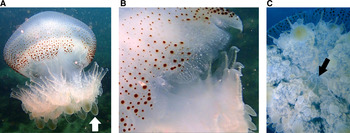
Rhopilema hispidum (Vanhöffen, Reference Vanhöffen1888). Specimen from Charna Island, Pakistan. (A) Lateral view showing various features, arrow pointing to terminal club appendages; (B) Closer view of bell margin showing the rough exumbrellar surface and minute, irregular stripes on rhopalar and velar lappets; (C) Subumbrellar view, arrow pointing to the long whip-like appendages arising from oral side of the fused part of mouth arms. (Photos by Indus Scuba, Pakistan.)

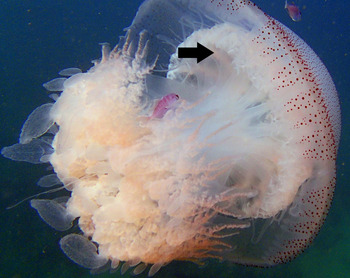
Rhopilema hispidum (Vanhöffen, Reference Vanhöffen1888). Another specimen from Charna Island, Pakistan. Note the scapulets (arrow). (Photo by Indus Scuba, Pakistan.)

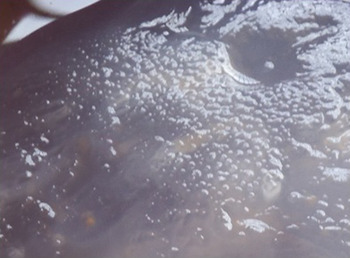
Rhopilema hispidum (Vanhöffen, Reference Vanhöffen1888). Closer view of exumbrellar surface of specimen from Manora, Pakistan showing the colourless, minute, blunt warts. Bell width 120 mm.

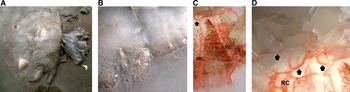
Rhopilema hispidum (Vanhöffen, Reference Vanhöffen1888). Specimen from Clifton, Karachi, Pakistan. (A) Stranded on the shore. Bell width 350 mm; (B) Closer view of exumbrella showing rough surface; (C) Detail of subumbrella showing the canal system highlighted through dye injection, arrow pointing to the smaller one oval-shaped gelatinous projection at the corner of genital ostium; (D) Detail of subumbrella showing the three gelatinous projections (arrows) at subgenital ostium with larger middle one over the rhopalar canal. RC, rhopalar canal; IRC, inter-rhopalar canal.

MATERIAL EXAMINED
01 specimen photographed by SCUBA 11 February 2011: off Cape Monze (approximate bell width 600 mm) (JMGDC/MDZ/CN 19P); 01 specimen collected 27 January 2012: Manora, bell width 120 mm (JMGDC/MDZ/CN 17); 01 specimen collected 11 May 2012: Manora, bell width 300 mm; 06 specimens collected 22 June 2014: Clifton, bell width ranges 300–650 mm; 01 deposited (JMGDC/MDZ/CN 18); 02 specimens photographed during snorkelling 01 March 2014: Charna Island (JMGDC/MDZ/CN 20P) (approximate bell width 250–300 mm).
DESCRIPTION
Rhizostomatidae medusae ranging in diameter from 120–650 mm. Exumbrella whitish in colour and rough; having minute, colourless, blunt warts giving the exumbrellar surface a granulated appearance and larger, brown, conical, pointed warts abundant near margin and velar lappets; becoming gradually sparse and less pronounced in size towards the bell centre (Figures 1A, B, 2, 3 & 4A, B). Eight oblong to round velar lappets per octant, connected by thin membranous webs. Rhopalar lappets pointed (Figure 1A, B). The distal exumbrellar surface of both velar and rhopalar lappets have some minute irregular vertical stripes (Figure 1B).
Rhopalar and inter-rhopalar canals distinct; forming an anastomosing network with numerous fine meshes. Inter-rhopalar canals comparatively wider and branch relatively away the base than the rhopalar canals; no ring canal (Figure 4C). Genital ostia semi-circular. Three oval shaped rough surfaced and rigid gelatinous projections at the opening of each genital ostium; the middle one larger and over the rhopalar canal (Figure 4D). Subumbrellar circular musculature well developed; not interrupted over the radial canals. Mouth arms eight, J-shaped and three winged (Figures 1A & 2); fused in the proximal half of their length. Each wing bearing numerous frilled mouths and small club-shaped appendages. A large club-shaped appendage present at the point of contact of the three wings (Figures 1A & 2). A pair of large, scimitar-shaped scapulets at the base of each oral arm; forked at the end; upper surface bearing numerous frilled mouths and filaments (Figure 2). Four long, whip-like appendages, arising from the oral side of the fused part of the mouth arms (Figure 1C).
DISCUSSION
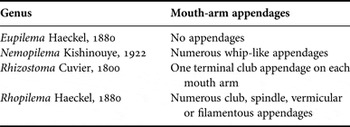
Scyphomedusae of the order Rhizostomeae are traditionally divided into two main groups: the ones with scapulets – the scapulatae; and the others without scapulets – the inscapulatae (proposed by Stiasny, Reference Stiasny1921), which are treated as superfamilies. Calder (Reference Calder2009, p. 40) stated that under the International Code of Zoological Nomenclature these names are invalid as family group names. Even though, it seems that these two categories represent natural groups based on molecular studies (Bayha et al., Reference Bayha, Dawson, Collins, Barbeitos and Haddock2010). Among the rhizostome jellyfishes that possess scapulets, the family Rhizostomatidae can be distinguished by oral arms with complicated canal systems and without a primary mouth opening in the adult medusae (Kramp, Reference Kramp1961; Mianzan & Cornelius, Reference Mianzan, Cornelius and Boltovskoy1999). Distinction within Rhizostomatidae is chiefly based on the mouth-arm appendages and filaments (see Table 1). Five species are recognized in the genus Rhopilema (Kramp, Reference Kramp1961; Galil et al., Reference Galil, Spanier and Ferguson1990): Rhopilema esculentum Kishinouye, 1891; Rhopilema hispidum; Rhopilema nomadica Galil et al., Reference Galil, Spanier and Ferguson1990; Rhopilema rhopalophorum Haeckel, 1880; and Rhopilema verrilli (Fewkes, 1887). The genus Rhopilema is easily recognized by numerous club, spindle, vermicular or filamentous appendages on mouth arms, no window-like openings on mouth arms and large scapulets (Kitamura & Omori, Reference Kitamura and Omori2010, p. 116). We identified the specimens from Pakistan as Rhopilema hispidum due to: (i) their rough surfaced exumbrella with two kinds of warts – the minute, blunt, colourless and the relatively larger, brown, conical, pointed ones; (ii) the mouth arms having small club-shaped appendages between mouths; (iii) a larger terminal club-shaped appendage on each arm (see Table 2). The conical, pointed warts were observed in all specimens including the smallest one (120 mm) in our collection. However, we did not find the terminal club appendage on the mouth arms of all larger specimens which might be torn off during collection or an ontogenetic change (Omori & Kitamura, Reference Omori and Kitamura2004). A map showing the known records of Rhopilema hispidum is provided (Figure 5)
Map showing known distribution of Rhopilema hispidum (Vanhöffen, Reference Vanhöffen1888). Type locality (star), previous records (circles) and study area at the Pakistani coast (box). Sources: Omori & Kitamura (Reference Omori and Kitamura2004, p. 45) and Kanagaraj et al. (Reference Kanagaraj, Kumar and Morandini2008).

Comparison of the genera of the family Rhizostomatidae Cuvier, 1800, based on mouth-arm appendages. Data from Kramp (Reference Kramp1961), Omori & Kitamura (Reference Omori and Kitamura2004) and Kitamura & Omori (Reference Kitamura and Omori2010).

Main distinguishing features and type localities of the valid species of the genus Rhopilema. Data compiled from the original descriptions Stiasny (Reference Stiasny1933), Kramp (Reference Kramp1961), Omori & Kitamura (Reference Omori and Kitamura2004) and Kitamura & Omori (Reference Kitamura and Omori2010).

There is a record of Rhizostoma pulmo (Macri, 1778) from the Pakistani waters (Muhammed & Sultana, Reference Muhammed and Sultana2008); although we have no access to the reported specimens, close examination of the figures provided in the paper show that the morphology of the mouth arms with large scapulets, and three gelatinous oval projections at the genital ostia clearly refuse the identification as belonging to the genus Rhizostoma. Though these are few characters, they pointed out that the specimens reported by Muhammed & Sultana (Reference Muhammed and Sultana2008) in fact belong to the genus Rhopilema and possibly to the Indo-west Pacific, commercially exploited species, Rhopilema hispidum (Omori & Nakano, Reference Omori and Nakano2001; Omori & Kitamura, Reference Omori and Kitamura2004; Kitamura & Omori, Reference Kitamura and Omori2010). Moreover, the genus Rhizostoma is restricted to the Atlantic basin and Rhizostoma pulmo occurs only in the Mediterranean waters (Kramp, Reference Kramp1961, Reference Kramp1970).
ACKNOWLEDGEMENTS
We are very grateful to Mustafa Hasan (Indus Scuba, Pakistan) and their team for the jellyfish images provided by them during SCUBA diving and snorkelling, respectively, at Charna Island and off Cape Monze, which helped us to register another scyphomedusa from Pakistan. ACM was supported by grants 2010/50174-7 and 2011/50242-5 from the São Paulo Research Foundation (FAPESP), and by CNPq (301039/2013-5). This is a contribution of NP-BioMar, USP.