Introduction
The Murray–Darling Basin is a vast area containing a diverse range of animal and plant species and draining an area of 1 million square kilometres (Marohasy and Abbot, Reference Marohasy and Abbot2015). It is also home to 46 native fish species and several freshwater fish farms. Despite the significance of the Murray–Darling Basin, current rates of parasitic infections of native and exotic fish populations, risks of cross-transmission (particularly exotic-to-native), and the distribution and diversity of parasite communities within native and exotic fish populations are currently poorly described.
A recent study on parasites of invasive fish species of the Murray–Darling Basin reported the presence of the infective stage of a Contracaecum nematode larva (C. bancrofti) in carp (Cyprinus carpio) in Coonancoobil Lagoon, New South Wales (Shamsi et al., Reference Shamsi, Turner and Wassens2017). Infection with Contracaecum larvae has also been reported in a human in South Australia, although the parasite was not identified to species level (Shamsi and Butcher, Reference Shamsi and Butcher2011). Nevertheless, it is known that Contracaecum spp. are important parasites that may severely affect a wide range of animals at some stage in their life cycle, including fish, marine mammals, birds and humans (Horbowy et al., Reference Horbowy, Podolska and Nadolna-Ałtyn2016; Zuo et al., Reference Zuo2018). Therefore, the presence of the infective stage of a parasite with very low host specificity in a highly mobile and resilient fish, i.e. C. carpio, in the Murray–Darling Basin, which is home to several freshwater fish farms and many potential intermediate hosts, raises the following question: To what extent does this parasite infect other fish in the region? This research aims to determine the extent of the occurrence of parasitic nematodes in freshwater fish species in selected areas in southern New South Wales.
Materials and methods
Fish collection
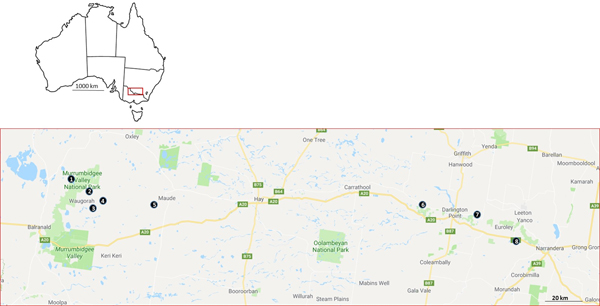
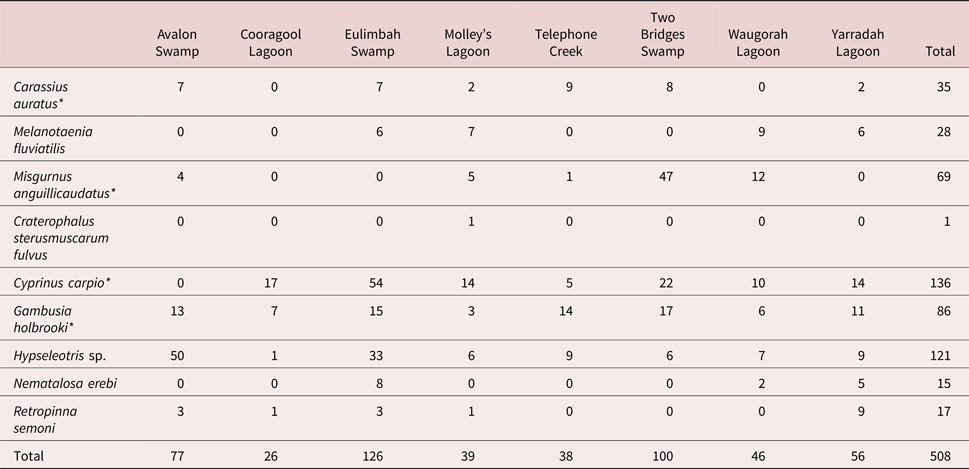
Fish were collected from eight wetlands in the floodplain of the mid and lower Murrumbidgee River (fig. 1) in November 2015 and March 2016. A total of 508 individuals belonging to nine species were collected and examined (table 1).
Locations in southern New South Wales, Australia, where fish were collected: (1) Two Bridges; (2) Waugorah Creek; (3) Avalon Swamp; (4) Telephone Creek; (5) Eulimbah Swamp; (6) Yarrada Lagoon; (7) Gooragool Lagoon; (8) Molley's Lagoon (source: Map Data @2018 Google).

Numbers of individuals of each of the fish species examined from each sampling location in the study area. * denotes introduced species.

Parasite collection and examination
All parasite collections were processed in the Parasitology Laboratory of the School of Animal and Veterinary Sciences at Charles Sturt University, Wagga Wagga, New South Wales. All fish were examined thoroughly according to a revised method of Shamsi and Suthar (Reference Shamsi and Suthar2016) to ensure collection of all nematodes. The method was developed after an accidental discovery of Contracaecum larvae in C. carpio in the Murray–Darling Basin (Shamsi et al., Reference Shamsi, Turner and Wassens2017). Nematode parasites were initially preserved in a 70% ethanol solution. To prepare them for microscopy and molecular analyses, nematodes were cut into three segments. The anterior and posterior ends were used for morphological identification and the small middle section was transferred to an Eppendorf tube and immediately frozen for future molecular analysis. All nematode larvae were cleared in lactophenol for morphological examination. The nematodes were identified based on the morphology of mouthparts, the digestive system and posterior end (Shamsi et al., Reference Shamsi, Gasser and Beveridge2011, Reference Shamsi, Turner and Wassens2017). Measurements are given in millimetres and presented as means with a range. All specimens were deposited with the South Australian Museum.
Genetic characterization of parasites
Representatives from each fish species and locality were subjected to amplification of the ITS-1 and ITS-2 regions of ribosomal DNA using primer sets SS1: 5′ GTTTCCGTAGGTGAACCTGCG-3′ (forward) and NC13R: 5′-GCTGCGTT CTTCATCGAT-3′ (reverse), and SS2: 5′-TTGCAGACACATTGAGCACT-3′ (forward) and NC2: 5′-TTAGTTTCTTTTCCTCCGCT-3′ (reverse), respectively (Shamsi and Suthar, Reference Shamsi and Suthar2016). An aliquot (5 μl) of each amplicon was examined on 1.5% w/v agarose gel, stained with GelRed, and photographed. Selected amplicons were sequenced using the same primer sets used for the polymerase chain reactions (PCR). ITS-1 and ITS-2 sequences were aligned using the program Clustal-X (Thompson et al., Reference Thompson1997) and then adjusted manually. Sequences of the specimens found in the present study were deposited in the European Molecular Biology Laboratory (EMBL) and compared with other sequences available in GenBank (Shamsi et al., Reference Shamsi, Turner and Wassens2017).
Data analyses
Prevalence (P) was calculated as follows:
P = (number of fish infected/number of fish examined) × 100
Point prevalence was calculated by using the above equation for fish collected on a single day at a single location.
Results
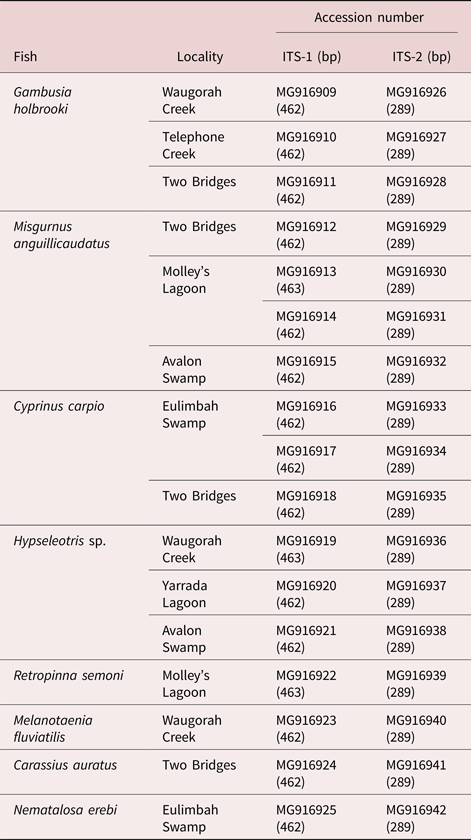
All nematodes found were in the third larval stage and were morphologically identified to genus level as Contracaecum larval type IV of Shamsi et al. (Reference Shamsi, Turner and Wassens2017). A total of 17 larval specimens from different localities and fish species were selected for morphological and molecular studies (table 2).
GenBank accession numbers for specimens characterized in the present study.

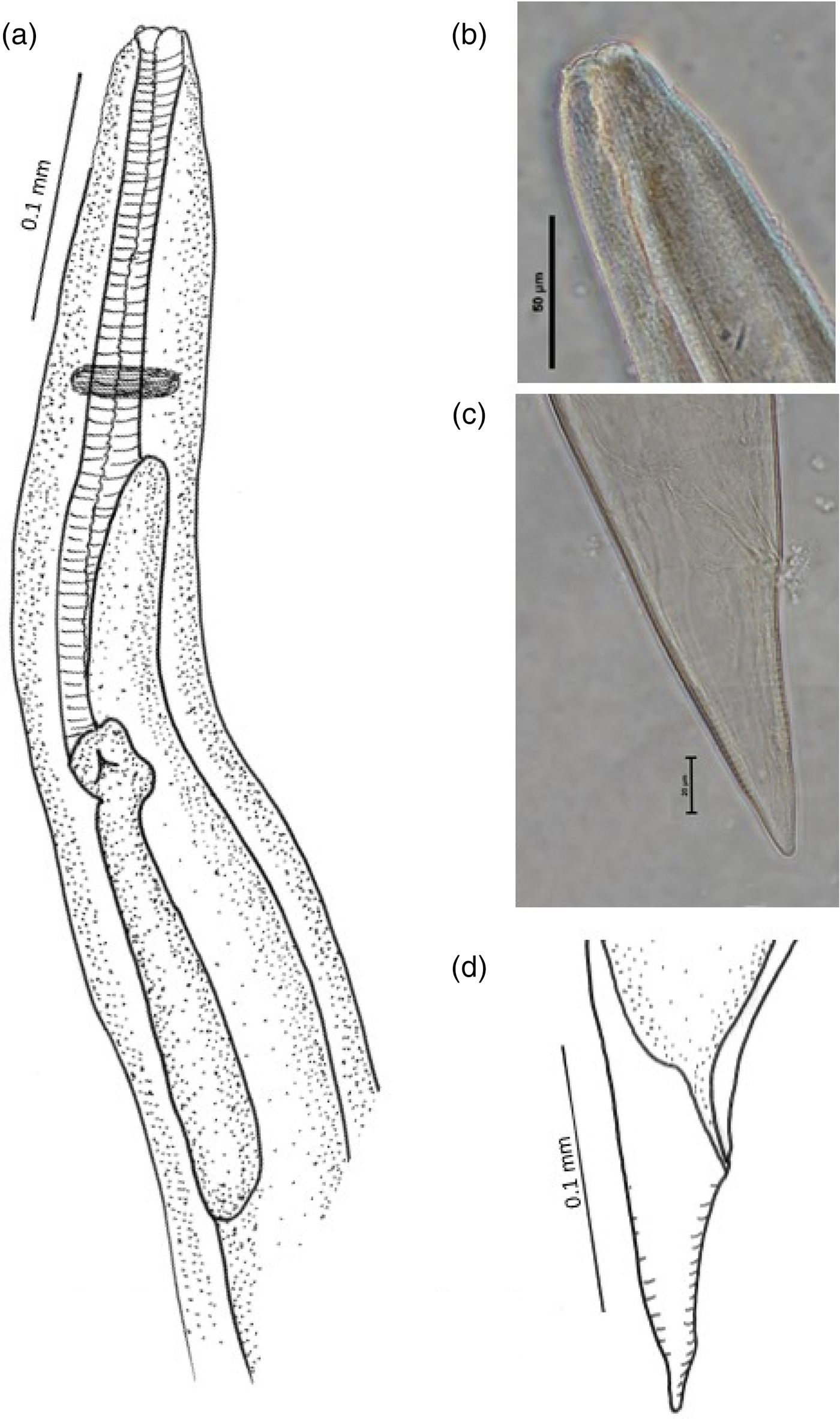
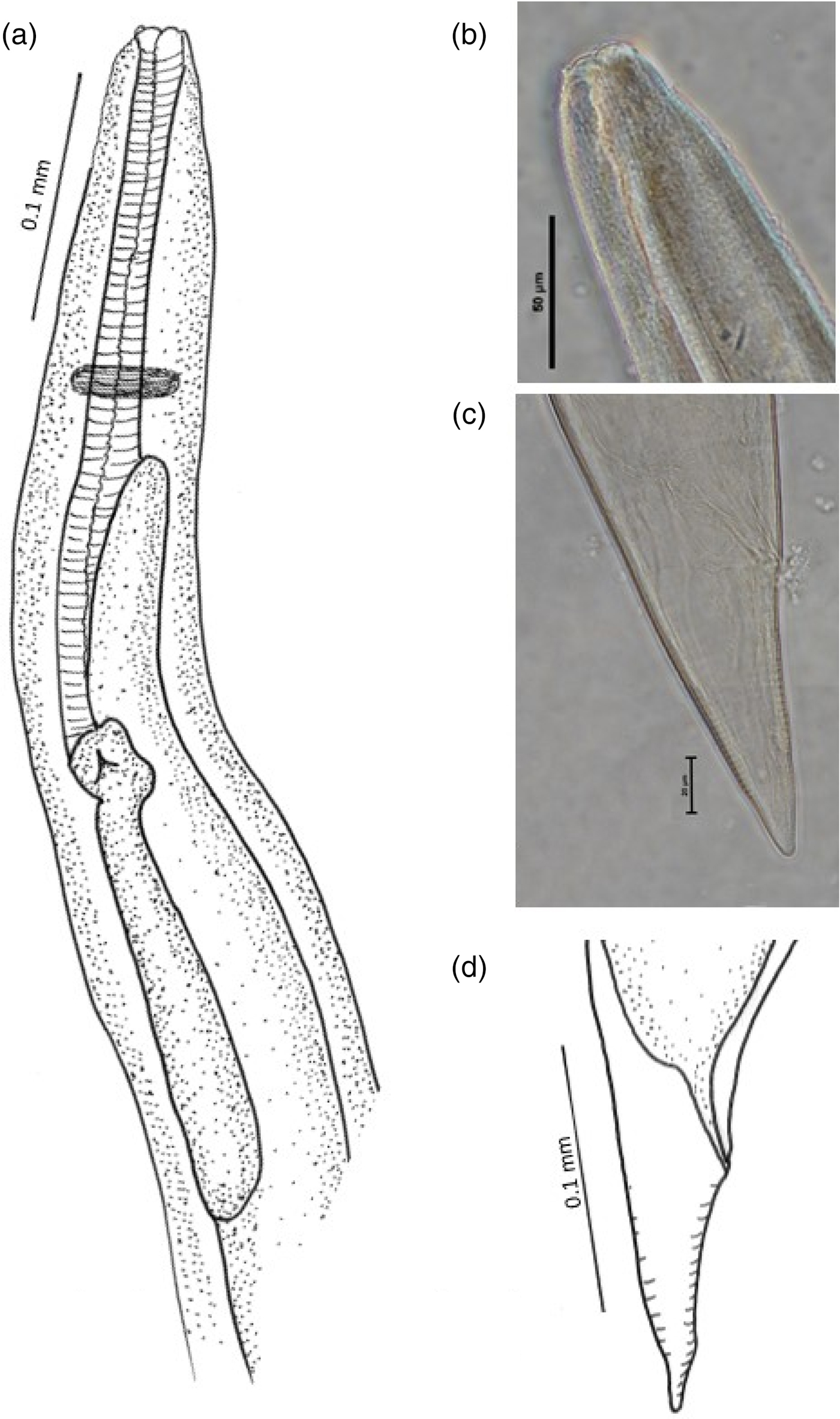
Minute papillae were present on the anterior end, where under-developed lips were located. Bodies had mild striation throughout. Larvae were 2.2 (1.4–3.6) mm long. A nerve ring was located 0.24 (0.15–0.38) mm from the anterior end. Round ventriculus had a diameter of 0.04 (0.03–0.04) mm. Oesophagus was 0.37 (0.24–0.45) mm long. Ventricular appendices and intestinal caeca were 0.32 (0.24–0.40) mm and 0.19 (0.12–0.25) mm long, respectively. Tail width was 0.05 (0.04–0.06) mm, with the anus located 0.09 (0.08–0.12) mm from the tip of the tail (fig. 2).
Microscopic photographs (b & c) and line drawings (a & d) of Contracaecum bancrofti third stage larva found in the present study. (a) Anterior end, (b) mouthpart, and (c, d) tail region.
Representative specimens were also subjected to PCR amplification of the ITS-1 and ITS-2 regions of the ribosomal DNA. The ITS-1 region was 463 bp in three specimens and 462 bp in the remaining specimens (table 2). Apart from an extra adenine in alignment position 460, sequences of the ITS-1 region were identical among all specimens. The ITS-2 region was 289 bp long and had identical sequences among all specimens (table 2). Using the basic local alignment search tool (BLAST) in GenBank it was shown that the ITS-1 and ITS-2 sequences of the specimens were identical to those of adult Contracaecum bancrofti previously reported in the Australian pelican (Pelecanus conspicillatus) (accession numbers EU839567 and EU839568 for ITS-1, and FM177522 for ITS-2).
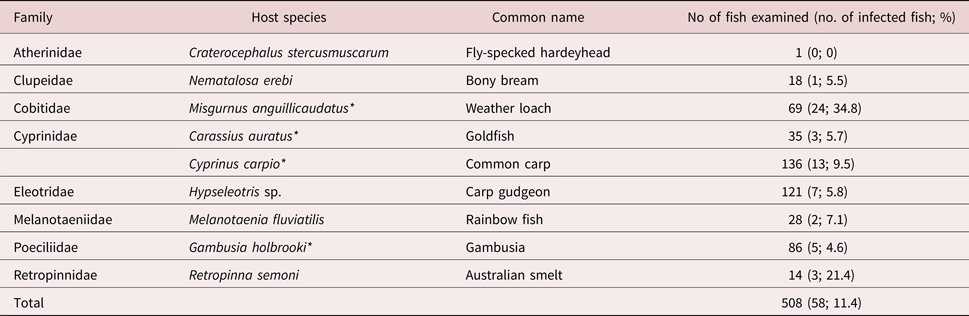
Of the nine species of fish examined (n = 508), four were introduced (n = 326; table 3). Nematode larvae were found in eight species, including both native and introduced species (table 3), except in Craterocephalus stercusmuscarum, for which only one specimen was available for examination. Of all fish examined, 58 were infected with third-stage larvae of Contracaecum bancrofti, with an overall prevalence of 11.4% (table 3). The parasite was more prevalent in Misgurnus anguillicaudatus (n = 69; 34.8%) and Retropinna semoni (n = 14; 21.4%), followed by C. carpio (9.5%) and Melanotaenia fluviatilis (7.1%).
The number of fish found to be infected with the infective stage of Contracaecum bancrofti. * denotes introduced species.

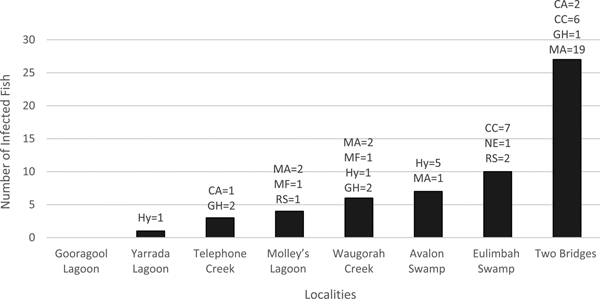
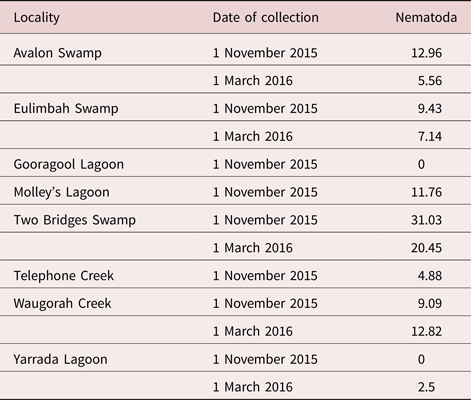
Nematodes were present at seven of the eight wetland locations (fig. 3). Point prevalence was highest in the Two Bridges Swamp at the western edge of the study area, and lowest at Gooragool in the east (table 4). The total number of infected fish in the western collection sites (fig. 1) was 53 out of the 443 collected, including 28 at Two Bridges, six each at Waugorah Creek and Avalon Swamp, three at Telephone Creek and ten at Eulimbh Swamp. At the eastern collection sites (fig. 1), including Yarrada Lagoon, Gooragool Lagoon and Molley's Lagoon, the numbers of infected fish were one, zero and four, respectively (fig. 3). The prevalence of infected fish was calculated as 12.0% and 7.7% for the western and eastern sites, respectively.
Number of fish infected with the infective stage of Contracaecum bancrofti in different localities. NE, Nematalosa erebi; MA, Misgurnus anguillicaudatus; CA, Carassius auratus; CC, Cyprinus carpio; Hy, Hypseleotris sp.; MF, Melanotaenia fluviatilis; GH, Gambusia holbrooki; RS, Retropinna semoni.

Point prevalence of nematodes at each location on each collection date.

Discussion
All nematodes found were in the third larval stage and belonged to the genus Contracaecum. Morphologically, they resembled those previously reported in C. carpio in the Murray–Darling Basin (Shamsi et al., Reference Shamsi, Turner and Wassens2017). They were identified as C. bancrofti based on having ITS-1 and ITS-2 sequences that were identical to those of adult specimens for which voucher specimens are available in the South Australian Museum (Shamsi et al., Reference Shamsi2009).
To date, the adult form of this parasite has been reported only in the Australian pelican (Mawson et al., Reference Mawson, Angel and Edmonds1986; Shamsi et al., Reference Shamsi2009), and has been found at broad geographical locations, including Geelong and Healesville (Victoria), Peron Island (Northern Territory), New South Wales and Queensland (Mawson et al., Reference Mawson, Angel and Edmonds1986; Shamsi et al., Reference Shamsi2009). The Australian pelican is widespread on freshwater, estuarine and marine wetlands and waterways, including lakes, swamps, rivers, coastal islands and shores (Christidis and Boles, Reference Christidis and Boles2008). It is also known to be a host for other members of the genus Contracaecum (Mawson et al., Reference Mawson, Angel and Edmonds1986; Shamsi et al., Reference Shamsi2008, Reference Shamsi2009). Therefore, this highly mobile bird may be responsible for the widespread distribution of Contracaecum spp. across Australia, including the larval stage, which has been reported in both marine (Cannon, Reference Cannon1977; Hooper, Reference Hooper1983; Lymbery et al., Reference Lymbery2002; Shamsi et al., Reference Shamsi, Gasser and Beveridge2011) and freshwater fishes (Shamsi et al., Reference Shamsi, Turner and Wassens2017).
Here, we report Carassius auratus, Gambusia holbrooki, Hypseleotris sp., Melanotaenia fluviatilis, Misgurnus anguillicaudatus, Nematalosa erebi and Retropinna semoni as new hosts for the larval stage of Contracaecum bancrofti. These fish are all in lower trophic levels of the ecosystem, feeding on zooplankton, small crustaceans and the eggs or juveniles of other fish (http://www.fishbase.org), which are all known to be routes of infection for Contracaecum spp. (Anderson, Reference Anderson2000). No Contracaecum larvae were found in Craterocephalus stercusmuscarum. However, only a single specimen was examined, and therefore the absence of Contracaecum spp, a parasite with low host specificity, is probably due to the inadequate sample size. Although our results show that the parasite is more abundant in the western localities of the studied area, this may be due to smaller sample sizes and the low proportion or absence of fish species with prevalent infections in the eastern localities.
With no reports of the parasite from any other parts of the world, and the only known definitive host being the Australian pelican, C. bancrofti is considered to be an endemic species, which in its larval stage may be more prevalent in introduced fish than native ones (table 3). The presence of Contracaecum larvae in a wide range of fish species suggests that the introduction of non-native fish to the Murray–Darling Basin must have favoured this parasite. Larvae of C. bancrofti were found to infect at least eight freshwater fish species from eight different families (table 3). The diversity of infected hosts suggests that this parasite may also occur in other fishes that were not examined in the present study, including valuable edible fish species. As some Contracaecum larvae are known to be able to infect humans (Shamsi and Butcher, Reference Shamsi and Butcher2011), their presence in edible fish could pose a risk to people who catch and consume them. Therefore, promoting education and awareness of this issue among various stakeholders is important.
Another significant finding was that we did not find any other parasitic nematodes in the 508 fish of various species collected from various localities. It cannot yet be concluded that other parasitic nematodes are absent from the region; however, their populations may have undergone considerable declines. Parasitic nematodes are among the most common organisms in aquatic systems, and even with the paucity of studies on Australian freshwater fish parasites, two nematodes, namely Hysterothylacium murrayense and Goezia fluviatilis (Johnston and Mawson, Reference Johnston and Mawson1940), have been reported previously in fish from the Murray–Darling Basin. Similarly, a comprehensive study on freshwater Acanthocephala found none in the Murray–Darling Basin (Smales et al., Reference Smales2018) despite previous reports of their presence there (Smales and Weaver, Reference Smales and Weaver2015). The absence of these parasites may sound positive; however, the significant decline or extinction of a parasite may create new ecosystem niches for other invasive parasitic species to exploit. It may also indicate a serious decline or extinction of other microscopic non-parasitic species in the region. Understanding the factors behind the absence of these species may be highly informative for the sustainable management of the Murray–Darling Basin. Parasites are an integral part of healthy ecosystems (Hudson et al., Reference Hudson, Dobson and Lafferty2006) and their disappearance, if occurring, would be a silent tragedy. How many of Australia's freshwater fauna are disappearing, and at what rate? More importantly, what would the consequences be for the already pressured ecosystem of the Murray–Darling Basin? These are questions that will remain unanswered for the foreseeable future.
This study is based on a relatively small sample of fish of selected species and from selected localities. To gain a better insight into the diversity of parasites and host–parasite interactions within this nationally important region, conducting a well-resourced and focused study is crucial. As pointed out by Roy and Handley (Reference Roy and Handley2012), and Lymbery et al. (Reference Lymbery2014), a deep and evidence-based understanding of host–parasite interactions is essential in sustainable management interventions such as the control of invasive species.
Acknowledgements
Annabel Stoddart is a grateful recipient of an Honours scholarship from the Graham Centre for Agricultural Innovation. We are also thankful to Dr Benjamin Wolfenden and Isaac Kane from Charles Sturt University for their help with collection and dissection of fish.
Financial support
This project was funded by ABRS grant, CN 2015-04 and Graham Centre for Agricultural Innovation Fellowship E116-804-000-50556.
Conflict of interest
None.
Ethical standards
This project was approved by Charles Sturt University's Animal Care and Ethics Committee (No: 15/083).