INTRODUCTION
Trypanosomosis is caused by protozoans of Trypanosoma genre. These parasites are divided in 2 sections: Stercoraria and Salivaria. Trypanosoma evansi species belongs to the Salivaria section; it infects mammals and was described and isolated for the first time by Griffith Evans in 1881 from horses and camels in India (see Woo, Reference Woo and Kreier1977).
T. evansi has a wide geographical distribution and its infection causes many clinical signs described in hosts, including the increase of body temperature, loss of physical condition, weakness and neurological changes (Ngeranwa, Reference Ngeranwa1993). This flagellate can be observed intracellularly in tissues, blood plasma and fluids of the body cavities of infected animals, leading to an immune response in the host (Sharma, Reference Sharma2000).
The adenine nucleotides ATP, ADP and the nucleoside adenosine which are released from many cells, including leukocytes, platelets and damaged endothelial cells, are involved in the modulation of the inflammatory process. Furthermore, ATP has an essential role in lymphocyte function, being necessary for the release of cytokines by T cells, such as interferon-γ (INF-γ) and interleukin-2 (IL-2), which are involved in the triggering of an immune response (Ralevic and Burnstock, Reference Ralevic and Burnstock1998). However, a high ATP concentration may act as a cytotoxic signal capable of inducing cellular death through the opening of pores on the cellular membrane (Fillippini et al. Reference Fillippini, Taffs, Agui and Sitkovsky1990).
The levels of extracellular nucleotides in many tissues are regulated by the action of membrane-bound enzymes. These enzymes hydrolyse the nucleotides into their respective nucleosides. The Ecto-nucleoside Triphosphate Diphosphohydrolase (E-NTPDase, CD39, EC 3.6.1.5) hydrolyses both ATP and ADP into AMP, 5′-nucleotidase terminates the ectonucleotidasic cascade with the hydrolysis of monophosphated nucleotides (AMP) into adenosine, and adenosine deaminase (ADA) converts adenosine into inosine (Zimmermann, Reference Zimmermann1996). NTPDase plays a key role in lymphocyte functions, including antigen recognition and activation of cytotoxic T cells (Fillippini et al. Reference Fillippini, Taffs, Agui and Sitkovsky1990), in addition to the capacity of cell-cell signal amplification (Kaczmarek et al. Reference Kaczmarek, Koziak, Sévigny, Siegel, Anrather and Beaudoin1996).
It has been suggested that ectonucleotidases play an important role in the inflammatory process and in the control of lymphocyte function. In this context, this study aimed to evaluate the activity of NTPDase in lymphocytes from rats infected by T. evansi, once this illness causes a pronounced inflammatory and immunological response in the host during the clinic course of disease.
MATERIALS AND METHODS
Materials
Adenosine 5′-triphosphate disodium salt (ATP), adenosine 5′-diphosphate sodium salt (ADP), bovine serum albumin, Trizma base and Coomassie Brilliant Blue G were obtained from Sigma-Aldrich (St Louis, MO, USA). K2HPO4 was purchased from Reagen and Tetrabutylammonium chloride from Merck (Darmstadt, Germany).
Animals
Forty-five male Wistar (Rattus norvegicus) rats were used (70 days old, 250–300 g). The animals were kept in cages with temperature and humidity controlled (25°C and 80% RH) and had free access to water and food (commercial chow for rodents) for the duration of the experiment, being previously evaluated to the presence of parasitaemia. The procedure was approved by the Ethics and Animal Welfare Commission of Universidade Federal de Santa Maria (UFSM), number 2009-63, in accordance to Brazilian laws and ethical principles published by the Brazilian Society for Laboratory Animal Science.
Aetiological agent and inoculation
The aetiological agent isolate used here was obtained from a naturally infected dog, originating from the town of Uruguaiana-RS (Colpo et al. Reference Colpo, Monteiro and Stainki2005), and was kept in the laboratory under live culture in rats. Thirty rats were inoculated intraperitoneally with 0·2 ml of blood containing 2·5×106 parasites following the methodology described by Assoku (Reference Assoku1975). The other 15 rats were used as controls, receiving 0·2 ml of physiological solution by the same route. Parasitaemia was monitored every 24 h after inoculation by microscopical assessment of peripheral blood smears in accordance with the protocol of Da Silva et al. (Reference Da Silva, Doyle and Monteiro2006). The slides were stained by the panoptic method and visualized in an optical microscope (1000×) stipulating the average number of trypanosomes in 10 homogeneous random fields (considering erythrocytes).
Experimental design
The establishment of inoculated groups (n=10 in each group) was performed in accordance with the method described by Wolkmer et al. (Reference Wolkmer, Silva, Carngelutti, Costa, Traesel, Lopes and Monteiro2007), in which the animals were grouped according to their parasitaemia. The animals were euthanized on the 3rd (beginning of infection), 5th (acute infection) and 15th (chronic infection) days p.i., while the control group was divided into 3 equal subgroups (n=5) which were also euthanized on the 3rd, 5th and 15th days.
Sample collection
The animals were anaesthetized in a chamber with isoflurane to perform the blood collection (4·5 ml) via cardiac puncture. Due to the different parameters to be analysed in this study, a fraction of blood (4 ml) was stored in tubes with ethylenediaminetetracetic acid (EDTA) as anticoagulant, ready for lymphocyte isolation. For haemogram analysis, 0·5 ml of blood was stored in microtubes without anticoagulant.
Haematological parameters
The total leukocyte count was performed in a specific electronic device designed for cell counting (CELM® – model CC 530). The data interpretation was performed as described by Bush (Reference Bush2004).
Lymphocyte isolation
Peripheral lymphocytes were isolated using a Ficoll Hypaque density gradient as described by Böyum (Reference Böyum1968). Immediately after lymphocyte separation the cell viability was determined by measuring the activity of lactate dehydrogenase (LDH) present in the sample (Bergmeyer, Reference Bergmeyer1983).
NTPDase determination
After the isolation of lymphocytes, NTPDase activity was determined according to the method described by Leal et al. (Reference Leal, Streher, Neu, Bittencourt, Leal, Silva, Morsch and Schetinger2005). Briefly, proteins of all samples were adjusted to 0·1–0·2 mg/ml and 20 μl of intact cells (2–4 μg protein) were added to a reaction medium containing 0·5 mm CaCl2, 120 mm NaCl, 5·0 mm KCl, 60 mm glucose and 50 mm Tris-HCl buffer, pH 8·0, in a final volume of 200 μl, and pre-incubated for 10 min at 37°C. The reaction was started by the addition of ATP or ADP as substrate at a final concentration of 2·0 mm and was stopped with 5% trichloracetic acid (TCA). All the samples were run in triplicate, and enzymes (intact lymphocytes) were added to the control after the addition of TCA in order to correct the non-enzymatic hydrolysis of the substrate. The inorganic phosphate (Pi) released was measured by the method of Chan et al. (Reference Chan, Delfert and Junger1986) and enzymatic activity was reported as nmol of Pi released/min/mg protein.
Protein determination
Protein was determined by the Coomassie Blue method using bovine serum albumin as standard as described by Bradford (Reference Bradford1976).
Statistical analysis
Data were expressed as mean±standard error of the mean (s.e.m.) and analysed statistically by the Student's t-test. A P<0·05 was considered to represent a significant difference in all analyses used.
RESULTS
Determination of haematological parameters
The examination of peripheral blood smears showed that the pre-patent period in rats experimentally infected varied between 24 and 72 h. On the 3rd day p.i., the rats showed low parasitaemia (4 parasites per field) without clinical signs. On the 5th day p.i., the animals showed high parasitaemia (mean of 65 parasites per microscopic field; 1000× magnification), and clinical signs such as apathy and lack of coordination. On the 15th day p.i., animals demonstrated a peak of parasitaemia and a low number of circulating parasites remained during the experimental period, ranging between 0 and 1 parasite per field, and the animals showed no abnormality.
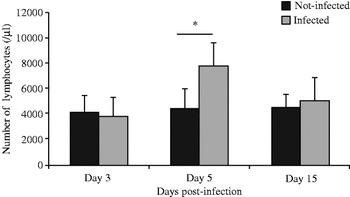
No changes in lymphocyte count were observed on the 3rd and 15th day p.i.: however, on the 5th day the rats did show a lymphocytosis when compared to the control group (Fig. 1).
Lymphocyte counts in rats infected and uninfected at days 3, 5 and 15 post-infection. * Represents significant difference between groups (P<0·05). The columns represent the mean±standard deviation (n=15, t-test).

NTPDase activity
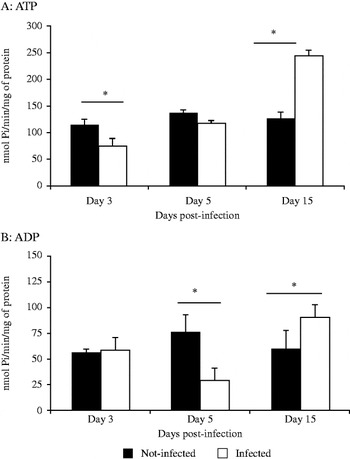
It can be observed that the ATP hydrolysis was significantly (P<0·001) decreased (36%) in the infected group on the 3rd day p.i. and ADP hydrolysis was significantly (P<0·001) decreased (62%) in the infected group on the 5th day p.i. On the 15th day p.i., both ATP and ADP hydrolysis were significantly (P<0·0001) increased (94 and 50%, respectively) when compared to the control (Fig. 2).
ATP (A) and ADP (B) hydrolysis in lymphocytes of rats experimentally infected with Trypanosoma evansi at 3, 5 and 15 days post-infection (* t-test: P<0·001).

DISCUSSION
T. evansi is a parasite that causes clinical, pathological and haematological alterations in infected animals (Hoare, Reference Hoare1972). The most common haematological alteration is anaemia, but the leukocytic values can be normal, increased of even decreased, while the lymphocyte count can be increased (Neitz and McCully, Reference Neitz and McCully1971; Batista, Reference Batista2006) or decreased (Marques, Reference Marques2000). In this study on the 5th day p.i., the infected animals showed lymphocytosis in comparison to the control group. It is suggested that this alteration depends on the parasite infectant dose and virulence and may be attributed to an antigenic stimulation through polyclonal B cell activation to eliminate the parasite as a consequence of high parasitaemia (Masfield and Bagasra, Reference Masfield and Bagasra1978; Rodrigues, Reference Rodrigues2005).
This study evaluated NTPDase activity in rats infected with T. evansi, and the results clearly demonstrated a change in ATP and ADP hydrolysis. Both were significantly altered with different grades of parasitaemia. Previously, our research group showed alterations in the activity of enzymes that hydrolyse adenine nucleotides and nucleosides in cells and tissues. Da Silva et al. (Reference Da Silva, Belle, Bitencourt, Souza, Costa, Oliveira, Jaques, Moretto, Mazzanti, Leal, Lopes and Monteiro2011) presented decreased adenosine deaminase (ADA) activity in lymphocytes and Oliveira et al. (Reference Oliveira, Da Silva, Vargas, Bitencourt, Souza, Costa, Leal, Moretto, Leal, Lopes and Monteiro2011) reported a decreased NTPDase and 5′-nucleotidase activity in platelets. The results obtained in this present study showed that NTPDase activity may contribute to the immune and inflammatory response in the infected animals.
An increase in ATP hydrolysis was observed on the 3rd day p.i. in the infected group. At this time, the animals were at the beginning of infection and this result may be attributed to the inflammatory response, because the ATP level was probably decreased as a consequence of NTPDase activity. This nucleotide is involved in pro-inflammatory functions such as lymphocyte stimulation, proliferation and release of cytokines, being necessary for the maintenance of its basal levels (Trautmann, Reference Trautmann2009).
The T. evansi-induced inflammatory process may have triggered an increased ATP release from blood cells. It is known that high ATP levels may be a potent cytotoxic signal able to induce cellular death through the opening of pores on the cellular membrane through agonism of cytotoxic P2X receptors (Adnolfi et al. Reference Adnolfi, Pizzirani, Idzko, Panther, Norgauer, Di Virgílio and Ferrari2005).
The decreased ATP hydrolysis on the 15th day represents a compensatory mechanism during infection to metabolize ATP and ADP and produce adenosine that decreases the inflammatory response and stimulates immunomodulation, reducing the cellular and tissue damage (Kumar and Sharma, Reference Kumar and Sharma2009). At low concentrations both ATP and ADP have affinity for P2Y purinergic receptors on the lymphocyte surface, stimulating a Th2 immune response that leads to the production of IL-4, eosinophil and mastocyte activation which may cause serious tissue damage (Bach et al. Reference Bach, Leal, Ruchel, Souza, Maboni, Dal Pozzo, Schlemmer, Alves and Santurio2011). When these nucleotides levels are increased they are hydrolysed by NTPDase, which possess other beneficial roles in lymphocytes such as modulation of the inflammatory response by the production of cytokines. The levels of these pro-inflammatory molecules are increased in T. evansi infection (Baral et al. Reference Baral, Baetselier, Brombachier and Magez2007).
ADP hydrolysis was significantly decreased in the infected animals at the 5th day p.i., which probably would lead to its extracellular increase. This fact may be attributed to an altered expression of lymphocyte membrane receptors, because ADP is mainly related to platelet aggregation and thromboregulation (Zimmermann, Reference Zimmermann1996). However, its roles remain unknown in lymphocytes (Dombrowski et al. Reference Dombrowski, Bewer and Kapp1998).
NTPDase has been shown to possess other beneficial roles in lymphocytes such as modulation of cytokine expression and the immune response, cellular proliferation, adhesion and apoptosis by the modulation of pericellular ATP levels. Furthermore, it is involved in the immune response because it inhibits antibody-dependent cytotoxicity and human and rat natural killer cell cytotoxicity (Langston et al. Reference Langston, Ke, Dombrowsky, Gewirtz and Kapp2003). The animals with low parasitaemia (beginning of infection) showed a decreased enzymatic activity. On the other hand, in the chronic infection, an increased NTPDase activity was observed suggesting a compensatory mechanism to produce adenosine that has important immunological and anti-inflammatory functions. These results are in agreement with those of Da Silva et al. (Reference Da Silva, Belle, Bitencourt, Souza, Costa, Oliveira, Jaques, Moretto, Mazzanti, Leal, Lopes and Monteiro2011) in which ADA activity, adenosine deamination into inosine, was shown to be decreased in the lymphocytes of animals infected by T. evansi.
In this research, alterations in the activity of NTPDase were observed in lymphocytes of rats infected by T. evansi. The decreased NTPDase activity suggests an increase of extracellular nucleotide levels as a consequence of parasitaemia in the infected animals. Conversely, in the chronic infection an increased NTPDase activity was observed, indicating a compensatory mechanism to downregulate the inflammatory process by the production of adenosine, which has anti-inflammatory and immunomodulatory functions. The investigation of enzymatic alterations in cells involved in both inflammatory and immunological responses is important to the better understanding of this trypanosomosis in domestic animals.