INTRODUCTION
Fourteen years of nearly relentless war in Liberia ended in August 2003 with the flight into exile of former president Charles Taylor,Footnote 1 and the subsequent demobilisation of over 100,000 ex-combatants in Liberia's Disarmament, Demobilisation, Reintegration and Rehabilitation Programme (DDRR).
There do not exist many systematic analyses of Liberian ex-combatants,Footnote 2 but they are generally seen as people with a history of unemployment, underemployment and idleness (Dufka Reference Dufka2005; UN 2004; UNOWA 2005), often based on a background as uprooted urban youths (Mkandawire Reference Mkandawire2002) or lumpen youths, prone to criminal behaviour and gross indiscipline (Abdullah Reference Abdullah1998). The data we collected in November 2005, interviewing 491 ex-combatants by using Respondent-Driven Sampling at two different sites in Monrovia, offer another picture. These do not seem to have been any more idle, marginalised and alienated than any other group of young men in Liberia. This is not to say that ex-combatants were not (or are not) marginalised in absolute terms – indeed, the situation of Liberian youths as a whole may be considered one of marginalisation and exclusion – but rather that they did not seem more marginalised than their peers. Instead, most of those interviewed cited security concerns – for themselves, their families and communities – rather than idleness and poverty, when asked why they joined an armed faction. This has important ramifications both for the continuation of peace in Liberia, and also for how we view the Liberian civil war.
The objective of this article is therefore to offer a close examination of the conditions and concerns that initially led people to join militias and participate in armed conflict in Liberia. Our primary contention is that attempts at reintegration must be made with an understanding of what the Liberian civil war was all about, not just at a macro level but, perhaps especially, at a micro one. Accordingly, we argue that a greater understanding of what led people to ‘get in’ to a conflict situation will help explain both how and why the conflict was initiated and sustained, and enable the development of more effective and sustainable processes and policies to bring them fully back out. We therefore attempt to rigorously examine the motives, interests, behaviour and larger socio-economic context of people who joined Liberian armed groups, with the understanding that all phases of the Liberian conflict – pre-, mid- and post-conflict – are inextricably linked: the behaviour, motivations and interests of people in the post-conflict phase cannot be seen in isolation either from the conflict they fought, or from the environment that shaped them before the conflict started. On the macro level, meanwhile, we emphasise that the Liberian conflict was not necessarily only one war. Instead, as our examples from Lofa County and Nimba County illustrate, it was a series of local conflicts that got tangled up in each other, as Taylor's rebellion against Doe's dictatorship pushed the dysfunctional Liberian state over the edge and into the abyss.Footnote 3 This nationalisation of local conflicts created a ‘logic of the war’ that, we argue, dramatically affected the course of the conflict and the decision-making of the individuals involved.
METHODOLOGY: RESPONDENT-DRIVEN SAMPLING
The fieldwork on which the material for this article is based was conducted in Monrovia in November 2005. Using Respondent-Driven Sampling (RDS), 491 ex-combatants were interviewed in accordance with a pre-made questionnaire in the Red Light and the Duala Market areas in Monrovia.Footnote 4 Some also took part in longer, in-depth qualitative interviews. RDS is a type of chain referral sampling that has been developed to identify hidden and elusive populations, but the method is also suitable for populations where no sampling frame exists (Heckathorn et al. Reference Heckathorn, Broadgead and Sergeyev2001; Salganik & Heckathorn Reference Salganik and Heckathorn2004). This is the case for ex-combatants in Liberia. RDS is based on a dual incentive structure, in which respondents are rewarded both for being interviewed and for recruiting new respondents. The sampling begins with a set of initial participants from the target group who serve as ‘seeds’, and thereafter expands in waves. The first wave consists of the participants referred to as ‘seeds’ above; the second wave of participants are recruited by the first wave; the third wave are those recruited by the participants in the second wave; and so on. The rationale for self-recruitment is that it is difficult for an outsider to determine whether a person belongs to the target group or not. It is our experience from similar studies in Africa that the method works well for recruiting among an invisible target group, as long as the concept is clear for the individuals recruited and recruiting (see Bøås & Hatløy Reference Bøås and Hatløy2006a; Hatløy & Huser Reference Hatløy and Huser2005). Each of the recruitments is therefore a link in a recruitment chain, and the waves will in theory expand exponentially as long as there are new persons in the target group willing to be recruited.
As the number of ex-combatant interviewed suggests, this was clearly not the case for this study. Both at the Red Light site and at Duala Market, the researchers terminated the recruitment. The reason for this was that we had already reached the target number. When the implementation plan was made the target number was put at 400 persons. Ideally even more ex-combatants could have been included, but this was considered difficult both in practical and ethical terms. Creating a situation which gathers together large numbers of ex-combatants is not only a practical challenge in Monrovia, but may also create a tense environment that could even escalate into violence. Disgruntled ex-combatants have repeatedly staged protests in Monrovia that have ended up in violence, and we did not want to contribute to the creation of such scenes. By and large, the atmosphere at the fieldwork sites was peaceful, but a couple of tense situations at Duala Market reaffirmed our decision to terminate recruitment beyond a specific point.
The incentives used for participation must be neither too high nor too low. If they are too high, those first recruited may try to keep the incentives distributed solely within their own peer group. This can create bias in the study. However, if the incentives are considered too low, those recruited may feel that compensation is insufficient and that it is therefore not worth spending any time taking part in the exercise. This will lead to poor recruitment. These challenges were discussed among the core research group and our Liberian counterparts, and based on these discussions; it was decided to use the same incentive structure as in a study of youth involvement in alluvial diamond mining in Koidu, Sierra Leone (see Bøås & Hatløy Reference Bøås and Hatløy2006a). This implied the following incentive structure: a pack of biscuits for being interviewed, and a combination of biscuit packs, and tins of sardines and corned beef for recruiting, depending on how many respondents they recruited. In our experience this incentive structure worked well. It was sufficiently high to be of interest to ex-combatants, but not so high that too many outside the target group tried to cheat themselves into being interviewed or that people tried to be interviewed more than once. This happened on some occasions, but because each recruiter was given pieces of paper with numbers corresponding to a list of random numbers kept by the researchers, attempts to be interviewed more than once were easily spotted. Placing control questions in the beginning of the questionnaire also worked well in vetting out people trying to make up a history of being an ex-combatant.
MILITIA FORMATION IN LIBERIA: ‘GETTING IN’
Even prior to the war, Liberia was characterised by corruption, political and economic violence, identity crises, generational and other group clashes, and deep poverty (Bøås & Dunn Reference Bøås and Dunn2007; Ellis Reference Ellis1999; Reno Reference Reno1998, Reference Reno, Bøås and Dunn2007; Sawyer Reference Sawyer2005; Utas Reference Utas2003). For the new government and the international community now working in Liberia for the improvement of living conditions and human rights, this particular history should matter – both as a means of understanding the war, but also as a precondition for policy interventions. Of particular relevance is the fact that the spectre of war is nothing new in Liberia. Indeed, the argument can be made that Liberia has been at ‘war’ with itself from the very beginning of its existence as an independent state (Bøås Reference Bøås1997; see also Moran Reference Moran2006). This was first and foremost a ‘war’ over the questions of what it meant to be a Liberian, and how the polity of the country should be constituted and resources distributed. By a combination of neopatrimonial indirect rule through district commissioners and brute force, local chiefs were incorporated into the structure of the True Whig Party (TWP) as a rural elite cementing ethnic differences that through fosterage and intermarriage used to have a relatively shifting nature (see Azevedo Reference Azevedo1989). The result was a highly competitive patrimonial environment where various local elites were locked into struggles over state resources, often but not exclusively built on ethnic affiliation and exclusionary practices that shaped politics and the control of state institutions as a zero-sum game. The task for the various stakeholders currently involved in Liberia is not simply putting Liberia back together again, but, for the first time, constructing a state and a polity based on the principle of inclusion instead of exclusion (Bøås Reference Bøås2005). This mirrors the challenge facing individual ex-combatants as they attempt to re-order their lives after the war.
Before turning to our data on these individuals, a brief discussion of some of our assumptions relevant to this material is necessary. First, we contend that, in societies undergoing conflict, armed groups can provide some sort of order and social organisation, and represent means for social integration and upward social mobility (see Utas Reference Utas2003). Furthermore, we assume that enrolment in the various factions in the Liberian civil war mainly took place out of free will, as a viable response to a person's particular situation.Footnote 5 We also assume that this decision was often made on the basis of different interests and calculations than those of the militia leaders. Although it is true that most of the combatants were poor and did not have a wide variety of options available, this is only an observation, not an explanation, as it does not account for why many similarly situated people did not join. Moreover, we venture that, just because people make choices under some level of coercion – not an uncommon occurrence in any society – this does not remove their agency and their ability to evaluate alternative coping strategies. We therefore premise our analysis on the conviction that people have agency, and are not merely victims of circumstances and structures that they do not understand and did not create. We further draw upon Honwana's (2005, 2006) distinction between ‘tactical’ and ‘strategic’ agency. The first is narrow and opportunistic, ‘exercised to cope with concrete, immediate conditions of their lives in order to maximise the circumstances created by their violent military environment’ (Honwana Reference Honwana2006: 71). The latter is based on a position of power that enables a certain degree of control over the self and the decisions taken. It is an agency of a longer timeframe, where events and action can be planned and are not only ‘determined by random factors they could neither predict or control’ (ibid.).
Carefully examining the conditions and concerns that initially led some people to join militias and participate in armed conflict, rather than simply assuming that only one factor (force, poverty, greed, grievance) was determinative, helps illuminate the distinction between tactical and strategic agency. We see below that, in joining armed groups, many ex-combatants seem to have made tactical decisions rooted in security concerns. We also discover that their current existence in post-war Monrovia is to a large extent tactical – necessarily opportunistic and oriented towards surviving, not thriving. The trick for the Liberian government and the international community is to stabilise Liberian society sufficiently so that youth can finally begin to think strategically, not tactically.
WHO ARE THE EX-COMBATANTS?
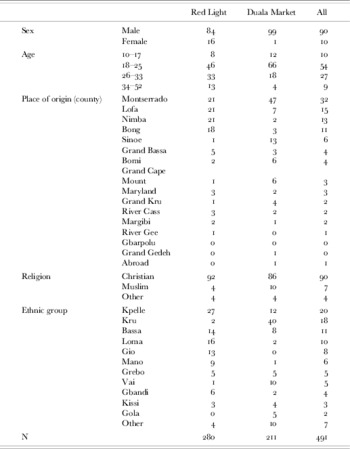
The overall majority of persons in our sample were men. As shown in Table 1, 90% of the respondents were male. However, while only one woman was interviewed at Duala Market, 16% of the respondents in Red Light were women. This is as one might expect. Many more men than women participated in the different warring factions. Those women who did belong to a faction have mostly returned to their home communities without ever picking up the ‘tag’ as ex-combatants. This seems particularly to be the case of females fighting for the movement Liberians United for Reconciliation and Democracy (LURD). This is also a young population: 64% of the ex-combatants are less than 26 years of age, and only 9% are above 34 years of age. On average the persons interviewed at Duala Market are younger than the persons interviewed in Red Light, and while the majority in Red Light are of Kpelle, Loma, Bassa and Gio origin, Kru is the dominant ethnic group at Duala Market.Footnote 6
Background for the ex-fighters by interview site (%)

As shown in Table 1, one-third of the ex-fighters interviewed in Red Light and Duala Market were born in Montserrado, whereas the ex-fighters born outside Monrovia mainly originate from Lofa (15%), Nimba (13%) and Bong (11%). Ex-fighters born in Montserrado were the dominant group at Duala Market, whereas those from Lofa, Nimba and Bong were the three largest groups in Red Light. Almost none of the fighters were of foreign origin. This is somewhat surprising, given the reports from several NGOs that there is a West African community of regional rebels who cross borders both to take part in wars and to benefit from DDRR programmes (see Dufka Reference Dufka2005). Either they have already moved elsewhere, or this group is much smaller than previous research has indicated. We cannot completely rule out the possibility that the results may have been slightly different if the survey had been conducted elsewhere, for instance closer to the Ivorian border or at another rural site. However, as Monrovia has undoubtedly been a magnet for former combatants, the ‘urban bias’ in the study should not be of too much concern.
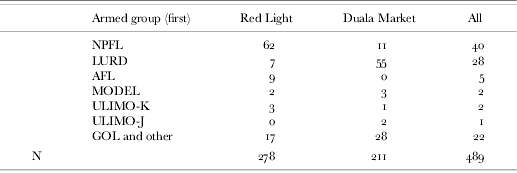
As seen below (Table 3), most of the ex-combatants at Duala Market had fought for LURD, whereas those in Red Light were mainly involved with Taylor's forces. This may help us understand the difference in age between the two groups, as LURD's main recruitment campaign generally took place at a later stage than for Taylor's forces. Although LURD ex-combatants in Duala Market tend to be younger in absolute terms, this does not necessarily mean that LURD recruited younger people than Taylor's forces, as those fighting for Taylor may have been involved in the war for a longer period of time.
The ethnic composition of our informants vis-à-vis their group affiliations, especially in Duala Market, may seem surprising. LURD was mainly a Mandingo project, but many of our LURD-affiliated Duala informants are Kru. The LURD rebellion (which dominated what may be called the second part of the Liberian civil war, from 1999 to 2003) emerged from Lofa County. They initially threatened Taylor and his government from the northeastern part of the country, before advancing towards Monrovia. Although the core fighting force of LURD were of Mandingo origin, this was not necessarily the case for all the combatants in the final offensive against Monrovia in July and August 2003. For that, LURD recruited (voluntary and by force) from among IDPs and local communities encountered as they advanced (see also Human Rights Watch 2004). This is the main explanation for why we find so many people of Kru origin among those sampled at Duala Market. Although these people ‘should’ have been involved with the Movement for Democracy in Liberia (MODEL) – the Krahn-based faction formed in Côte d'Ivoire that marched towards Monrovia from the southern part of the country in the second phase of the civil war – this was largely not the case.Footnote 7
The answer to this puzzle is to be found in combination of the logic of the war and the ethno-geographical stratification of Monrovia. The closer LURD came to the city centre, the more combatants the organisation needed. Taylor's men fought desperately to prevent them from crossing into the town centre through the two main bridges at Providence Island, which LURD fought to control. They therefore needed to recruit on the spot, with no time for training, and, as this part of Monrovia is known as Kru Town, quite a number of boys and men of Kru origin ended up fighting for LURD. In an environment of extreme uncertainty, for some the most sensible thing to do was to join the movement that suddenly controlled the area in which they lived. Their ‘tactical’ agency in this regard was also probably influenced by the increased harassment of local communities by Taylor's forces as the combat zone closed in on Monrovia (see also Human Rights Watch 2004). Most of the Mandingo who fought for LURD, including the women, seem to have returned to Gbarpolu and Lofa. Conversely, those who came from the Monrovia and Montserrado area remained in their home communities. The tactical nature of Monrovia-based recruitment into LURD was reiterated in author interviews in November 2005 and May 2006 in Mandingo towns along the Guinean border. In conversation with former LURD fighters, we asked them what they thought about their ‘brothers in arms’ still hanging around in Monrovia. Almost exclusively, their reply was that these were not true Mandingo warriors who had fought for a cause, but just ‘hoodlums’ and delinquent youths recruited because they were needed for the final offensive on Monrovia.
However, the predominance of people of Kpelle, Loma, Bassa and Gio origin among the ex-combatants interviewed at Red Light is as could be expected: Gio and Loma communities were known to support Taylor. The Gio of Nimba were from the very beginning a bastion of support for Taylor, and when the war came to Lofa, the Loma people in this county ended up allied to Taylor through the Loma-dominated Lofa Defence Force (LDF). It is slightly more difficult to place the Kpelle and the Bassa firmly into such a pattern of alliance. However, Kpelle communities have a history of conflict and tense relations with the Mandingo (see Richards et al. Reference Richards, Archibald, Bruce, Modad, Mulbah, Varpilah and Vincent2005), while a good number of Bassa communities also ended up on Taylor's side in the war. Although the ethnic composition of the groups is interesting, however, it is by no means explanatory: very few fighters cited ethnicity as a reason for joining armed groups. We must therefore examine other factors, including the situation of ex-combatants before the war and for whom they fought.
LIFE BEFORE THE WAR
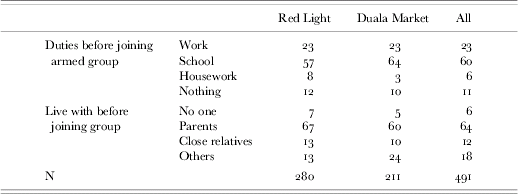
Before joining an armed group, the majority of the ex-combatants went to school: as Table 2 shows, as many as 60% went to school, and almost 25% were working. Only 11% reported that they had nothing to do. Often idleness has been claimed as one of the main reasons for young people to join armed groups (see UN 2004). However, most of the ex-combatants now hanging around in Red Light and Duala Market had something to do before joining an armed group. As seen below (Table 4), the main reason for joining an armed group was to feel more secure themselves, or to keep their family safe. Only a few claimed that they had nothing else to do.
Pre-war occupation and residence by interview site (%)
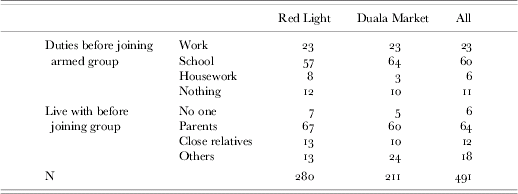
Crucially, as noted above, little in these background variables indicates that our informants were any more marginalised than most other young people in Liberia. They went to school, worked, and lived with either their parents or other close relatives. The ex-combatants' background is therefore surprisingly normal. These are clearly not Mkanadawire's (2002) uprooted urban youths or Abdullah's (1998: 207–8) ‘lumpens’ – unemployed youths ‘prone to criminal behaviour, petty theft, drugs, drunkeness and gross indiscipline’. Rather, they seem to have lived a relatively normal life prior to the war. Their wartime experience may have changed them, their mindset and their behaviour, but there is little in their background to single them out as a particular group.
As argued above, however, it is important to remember that pre-war Liberia was a country in which exclusion and marginalisation were normal conditions for most people. Moreover, there may be substantive differences between, for example, LURD ex-combatants in and around Monrovia and those from Mandingo communities in Lofa County. Nevertheless, people were generally poor, disenfranchised, and without any access to or hope for upward social mobility (see Clapham Reference Clapham and Clapham1982; Ellis Reference Ellis1999; Gifford Reference Gifford1993; Richards et al. Reference Richards, Archibald, Bruce, Modad, Mulbah, Varpilah and Vincent2005). The civil war that started on Christmas Eve 1989 did not improve people's living conditions. For most people, it only made them worse and less predictable.
It is also necessary to realise that, while many of the people in our sample went to school or were working, this does not mean that they were learning very much, or that their work brought them many benefits. Especially in the rural parts of the country, education was left to mission schools, and was not considered an area of particular concern to the state. Proper education was a privilege, not a right. Moreover, its purpose in pre-war Liberia was not necessarily to acquire skills, but rather to become ‘civilised’, i.e. to ascend to the status of a ‘citizen of the Republic’ (see Ellis Reference Ellis1999). Thus, when children were sent to school, it was often not for the purpose of learning per se, but in order to learn the lifestyle of the Americo-Liberians (see Brown Reference Brown1982).
Currently, no reliable national data of school attendance and levels of literacy exist. However, a study carried out in Voinjama District, Lofa County in November 2005 suggests that, even though three out of four children in this district in the age group 10–17 had attended school for at least some period of time, they had learnt very little (Bøås & Hatøy Reference Bøås and Hatløy2006b).Footnote 8 The fact of school attendance thus does not tell us much more than that these people attended school: the benefits typically associated with educational attainment did not necessarily accrue. As seen in the above-mentioned study, this may be as true today as it was during the pre-war period.
WHO DID THEY FIGHT FOR?
We saw above that the majority of ex-combatants in Duala Market fought for LURD, while those in Red Light belonged to various forces associated with Taylor; and we briefly explained how this relates to our data on age distribution and ethnic composition at the two sites. We will now examine their affiliations with armed groups in greater detail.
In the Red Light sample, 62% of the ex-fighters started their career as combatants with Taylor's National Patriotic Front of Liberia (NPFL), whereas in Duala Market, 55% claim war experience with LURD (see Table 3). Few fought for more than one group: 9% fought with two groups, and less than 1% with three. Among the 47 persons who moved from one group to another, 27 moved from NPFL, equally proportioned to LURD, the Armed Forces of Liberia (AFL) and other groups; while 8 moved from other groups into LURD. All the other movements were single cases of transferring from one movement to another.
First armed group joined (% by interview site)
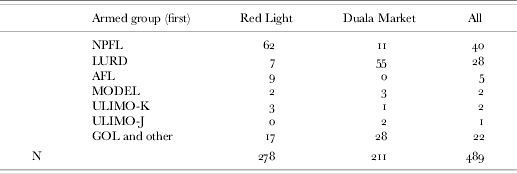
In looking at these data, we must keep in mind that they reflect the whole period of the Liberian civil war, i.e. 1990–2003. This means that some of these reported movements between groups took place a long time ago, for instance from NPFL to AFL or vice versa. Furthermore, between some of the movements there may be a considerable time-lag. For example, people cannot have moved directly from NPFL to LURD, simply because LURD was still not formed when NPFL was active as an armed anti-government militia.
What these data imply, however, is that fewer fighters have switched between the armed factions than suggested by other reports (see Dufka Reference Dufka2005). Our data indicate that the combatants who see war as an occupation – and therefore changed ‘employer’ when new economic opportunities (of looting and plundering) emerge – are relatively few. The ‘mercenary warrior’ problem argued by Human Rights Watch and other NGOs may exist, but this group seems to be smaller than envisioned by for example Dufka. However, the data also suggest (for example in the transfers from NPFL to LURD) that some people fought for a while, then returned to other, more peaceful activities, before yet again taking up arms. This is in line with Ellis (Reference Ellis1999: 133), who observes that ‘there appears to have been a large number of people who took up arms at some stage of the war, but who may have been victims at other times … . Even hard-core fighters seem to have remained attached to wider social communities.’
It is therefore probable that decisions to resume fighting with a different group were made in order to protect themselves and their families, livelihoods, and local communities. This is evident in the case of people in the Mandingo towns along the Guinean border in Lofa County. Here people supported the United Liberian Movement for Democracy-K (ULIMO-K) in the first part of the Liberian civil war (1990–96), and LURD in the latter phase (1999–2003). Some who fought for ULIMO-K also went back into the bush in 1997–98 and returned as LURD fighters in 1999. However, others who had made some money from the first part of the war returned to their home communities, started small enterprises, but rejoined a faction at a latter stage, either to protect their businesses, or in an attempt to make even more money from the war (see also Ellis Reference Ellis1995, Reference Ellis1999).
WHY DID THEY FIGHT? INTERSECTING LOGICS OF THE MACRO AND THE MICRO
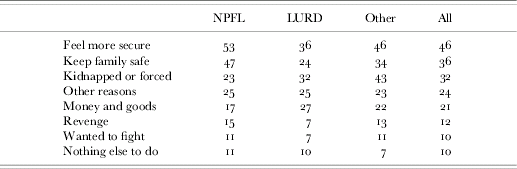
As previously mentioned, most of the ex-combatants stated that their main motivation for joining an armed group was for security, either their own security or to keep their family safe. As Table 4 shows, security was given as the most important reason for joining by people regardless of armed groups. However, as also shown in Table 4, the security motivation was slightly more pronounced for those that joined the NPFL than for LURD. The main reason for this is probably the bias in the LURD sample from Duala Market already mentioned. Many of those interviewed there had clearly only been involved with LURD for a short term during the organisation's final offensive towards Monrovia and may have joined for other and more opportunistic reasons, among others to make some money and obtain goods (27%).
Reasons for joining the armed group (% by first armed group)
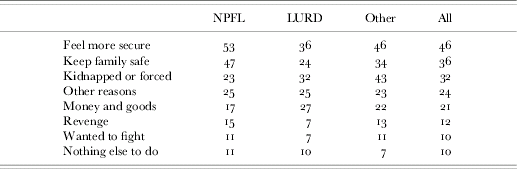
Note: Each respondent could give three main reasons.
It is also important to note that one-third of the ex-combatants say they were kidnapped or forced into the armed group. Abductions and forced recruitment were practised by all armed factions in Liberia, but contrary to some NGO reporting (see Dufka Reference Dufka2005), people also joined out of free will the first time they joined an armed group. We believe that the figure reported here is more accurate than claims that almost all fighters were forcibly recruited. The majority of ex-combatants were ordinary people who joined armed groups based on various ideas concerning protection and opportunity.
There are many different ways to analyse the Liberian civil war: from the perspective of youth (Utas Reference Utas2003); by way of elite manipulation of ethnic factors and various religious dimensions (Ellis Reference Ellis1999); or as a primary example of a new war (Kaldor Reference Kaldor2001). We have previously argued that this was first and foremost a ‘war’ about identity; over the question of what it means to be a Liberian, and how the polity of the country should be constituted and resources distributed (Bøås Reference Bøås2005). Taking this latter perspective as our point of departure, we come to realise that, more than anything else, the Liberian civil war contained many local conflicts fought over similar issues – namely the right to belong, and thereby also to land. The pattern by which this was first played out in Nimba set the stage for how the war was fought in other places. It is in this logic of war that we find the security predicament of the ex-combatants.
Taylor and NPFL started the war on Christmas Eve 1989, as a small band of rebels that sneaked over the Liberian border from Côte d'Ivoire. Initially numbering little more than 100 lightly armed men, by June 1990 NPFL had grown to almost 5,000 men and women. In the following three months, it doubled again. NPFL's rapid expansion is primarily attributable to Taylor's ability to tap quickly into pre-existing hostilities in Nimba between the Gio and Mano communities on one hand, and Krahn and Mandingo communities on the other. The president, Samuel Doe, was himself a Krahn, and while in power he not only promoted people of Krahn origin to positions of authority, but also supported local Krahn communities in their struggles against those of other ethnic origins. Moreover, recognising that several of his political opponents had support from the Gio and Mano, Doe made an effort to build a rival alliance in Nimba by favouring the Mandingo. He appointed them to various political positions in Nimba, and also helped them to secure land (see Ellis Reference Ellis1995, Reference Ellis1999). Thus, when the war started in Nimba, Doe knew that NPFL's main area of support would be among the Gio and Mano, and therefore urged his army to attack their villages. For his part, Taylor unleashed his rebels on the Krahn and Mandingo, known to support Doe. This created a lasting pattern, in which the Gio and Mano communities – particularly in Nimba – became Taylor's most faithful allies, while the Krahn and the Mandingo formed their own militias after Doe's murder in September 1990. Indeed, the same pattern was also evident at the final stage of the war in the summer of 2003: Taylor's last bastion of support was in the Gio and Mano communities in Nimba, while LURD was a Mandingo project, and the other main rebel movement, MODEL, was formed among Krahn living in exile in Côte d'Ivoire.
A similar logic of war – in which particular, localised experiences and conflicts played out alongside and fed into the larger conflict – was also evident in Lofa County. This was partly due to the dynamics of the war itself, but also due to pre-existing tension between the Loma – who consider themselves autochthonous to the area – and the Mandingo, who are generally seen as latecomers. Different stories exist about the settlement of the Lofa area, but most scholars believe that the Loma arrived before the Mandingo in the sixteenth century. The first people of Mandingo origin came into the area in the seventeenth century, and it was only as late as the second half of the nineteenth century that larger groups of Mandingo people migrated into Lofa from southeastern Guinea (see Højbjerg Reference Højbjerg and Kastfelt2005). This migration changed the social and political fabric of Lofa, as it brought both Islam and the Mandingo trade networks to the area. For many people of Loma origin, a narrative of Mandingo expansion and imperialism is an integral part of their cosmology. The basic problem today, however, is that people of Mandingo origin are not considered proper Liberians, but rather as strangers and foreigners (see Bøås & Hatløy Reference Bøås and Hatløy2006b).
Consequently, the relationship between the two main ethnic groups in Lofa has been tense and hostile, particularly since the beginning of the war in 1989–90. The Mandingo people accuse the Loma of supporting Taylor's forces when they reached Lofa in autumn 1990, whereas the Loma believe that the attacks in 1992 on Loma towns by the Mandingo-controlled ULIMO faction,Footnote 9 were unjustified and primarily a means to grab their land and belongings. A similar pattern is evident after LURD crossed over the border from Guinea in 1998–99: the Loma claim that LURD forces attacked their villages indiscriminately.Footnote 10 Unfortunately, this conflict pattern has not been broken, and it came to the fore yet again in the elections in October and November 2005. In the first round of the presidential elections, the Mandingo voted for their candidate, the former Mandingo warlord, Alhaji Kromah, and his All Liberian Coalition Party (ALCOP). In the Mandingo towns along the border to Guinea, Kromah received over 95% of the votes. However, as the Mandingo are a majority in only a few places in Lofa, mainly along the border, Kromah only received 18% of the total votes in the county, taking him to second place in the first presidential round in Lofa. The main reason for Kromah's strong showing among the Mandingo is that they see the former warlord as a hero, who defended them not only against Taylor's forces, but also against Taylor's allies among the Loma.Footnote 11 The Liberian war, and its aftermath, are complex largely because pre-existing, localised conflicts were interpreted and acted upon in different ways in different places, robbing the various groups of much of their coherence and contributing to a general sense of unpredictability and instability.
If security considerations brought about by the localised nature of the civil war provide the main reason why people joined armed groups, the question then becomes how effective the DDRR programme has been in addressing this issue. In serving only a particular population, i.e. ex-combatants,Footnote 12 the DDRR programme necessarily did not account for the fact that that almost all Liberians were poor, underemployed and marginalised in both economic and political terms – yet some joined armed groups and others did not. Re-examining the importance of security considerations in joining armed groups can help us unlock this paradox, while illustrating the need to base post-conflict programmes on knowledge derived from and specific to the local context.
‘GETTING OUT’ – HOW AND WHY
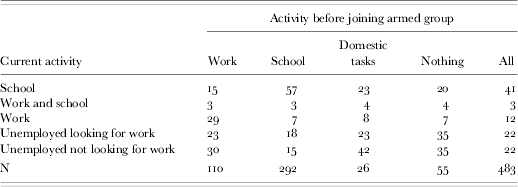
Our results show that as many as 95% of the ex-combatants in Red Light and around Duala Market have been through the DDRR programme. Among these, 97% received the benefit payments, and 95% also received at least some kind of either formal or vocational training; 85% of those who have been through the programme think that it was better than expected; only about 4% found it as expected, while the remaining 11% found it worse than expected. However, the value of this data is hard to gauge without knowing what people's expectations were beforehand. Nevertheless, this is a surprising finding, especially in light of the fact that some groups of ex-combatants have been known to stage protests claiming that the DDRR programme has not improved their situation. This may indicate a disconnect between experiences in the programme and its relation or importance to daily life. In this respect, it is worth noting that a large number of our informants, despite having received DDRR, were presently unemployed (see Table 6).
The main complaints concerned lack of access to training or education programmes. There were also some complaints about the cash payment being lower than expected, while others claimed that they had not received any cash benefits at all. The positive factors reported were mainly that the training and education were found more useful than expected, and that the cash payment was higher than expected. Again, the contradictory findings on the level of the cash payment point to the limitations of data predicated on unknown expectations. Finally, some informants reported that that the DDRR programme had helped them to break away from other militia members. This is of course good, but the question still remains whether the programme has improved the situation for these people, and made them less likely to ‘get in’ again.
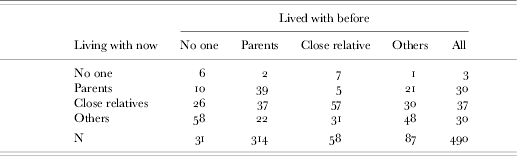
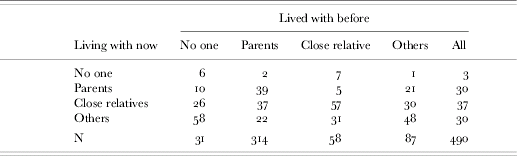
As noted above, most of the ex-combatants (64%) lived with their parents before joining an armed group. Another 15% lived with close relatives, 18% with ‘others’, and 6% lived alone. As Table 5 shows, the situation after the war is somewhat different: now only 3% live alone – some of them having previously lived with close relatives – while nearly all of those who lived alone now live with other people. Approximately 30% still live together with their parents, many of whom also lived with their parents before the war, while others (those who lived with ‘others’ before the war) have been reunited with their families. Details aside, the most important finding is that the majority still live either with their parents or with close relatives. In other words, there is nothing to suggest that they are ex-communicated from their families or local communities. This indicates that the ex-combatants, and their families and local communities, recognise that people mainly started fighting in order to provide for their own, their family's, and their community's security. Their original reason for ‘getting in’ was neither very political, nor overwhelmingly based on a desire for personal enrichment or due to idleness, but in order to improve their security situation. Their motivations for fighting may of course have changed as the war continued, but as this seems to be the initial reason for ‘getting in’, it should also be taken seriously when discussing strategies for ‘getting out’.
Pre-war and current residence of ex-combatants (%)
When we look at informants' current activities compared to their activity before getting involved in the war (Table 6), a similar picture emerges. The informants were quite like any other group of Liberians before the war started, and the same is true after it ended. They started off poor and they ended up poor, but this cannot in itself explain why they took up arms in the first place, as this was also the case for most other groups of Liberians. It merely shows that, although people liked the cash benefits and the education and training they received under the DDRR programme, these did not substantively change their situation.
Pre-war and current activity (%)
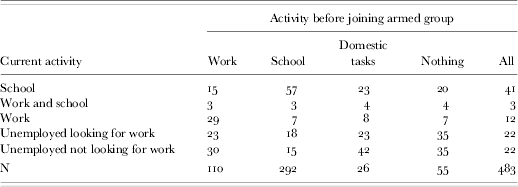
Prior to the war, going to school was the main activity for 60%, another 23% worked, 5% had domestic work as their main activity, whereas only 11% reported that they had nothing to do before they joined the armed group. After the war, 44% report being unemployed; half of these are looking for a job, the other half are not (as shown in Table 6). This shows that neither their wartime experience nor the DDRR programme has placed them in a better position than before the war. This is something that both the Liberian government and the international community in Liberia must take into consideration.
This does not suggest that marginalisation in the form of idleness, disenfranchisement and unemployment does not matter. It does matter, as it sets the ‘scene’ or the context for the war, but it is not what triggered the desire or willingness to fight. What caused the Liberian youth to fight were mainly security concerns. Thus, our data suggest that the effects of ‘idleness’ and ‘unemployment’ are overstated with regard to people joining armed groups, and thereby also the effect on societal security of combating ‘idleness’ and ‘unemployment’ through the DDRR programme. Thus, the question that begs to be asked in the Liberian case is, if idleness does not seem to have been behind the first decision to pick up the gun, then why should post-conflict policy-makers assume that idleness would be behind security problems after the war?
THE 2005 ELECTIONS
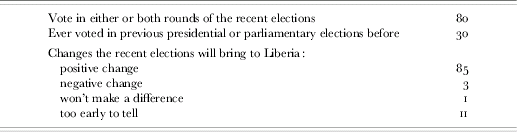
If security was the reason why people got involved in the war, it is interesting to analyse the degree to which ex-combatants participated in the presidential elections in October 2005, as this provides one indicator of people's willingness to solve conflicts peacefully. In fact, most of the ex-combatants participated in this election. As Table 7 shows, 80% voted, and they are optimistic about what the recent elections will bring to Liberia: 85% think there will be positive changes, only 3% that the changes will be negative.
Participation in elections (%, n=466 ex-fighters)
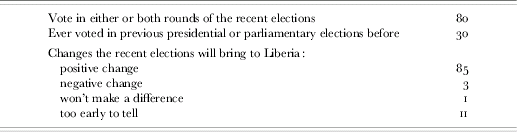
These results are positive because they indicate that ex-combatants seems to believe that democratic elections will bring changes to Liberia that also will also address their underlying security concerns. This is good, and it is therefore important that both the newly democratically elected government under the leadership of Ellen Johnson-Sirleaf, and the United Nations Mission in Liberia (UNMIL), make an attempt to show that the democratic dividend is also a peace dividend for all ethnic groups and local communities in Liberia. In particular, it is important to reach out to previously politically marginalised communities such as the Mandingo, and make it clear that their rights as a Liberian people are just as secure and the same as their neighbours, be it Loma communities in Lofa, or Gio and Mano communities in Nimba. The attempts by Gio communities in Ganta to scare Mandingos from returning from refugee camps in Guinea must be met with decisive sanctions (see Daily Observer 15.5.06), because if these and other similar local conflicts over land rights and similar issues are not dealt with in a fair and transparent manner that reduce people's security concerns, the low willingness to fight reported in Table 8 may very well change once more.
Willingness to fight again (%, n=466 ex-fighters)

As we see, only 2% report that they would join an armed group if fighting restarted in Liberia, and only 1% is willing to join an armed group that fights outside of Liberia. This is positive and indicates that the ex-combatants are just as tired of war as those who did not take part in it. However, if our data concerning the main reason for ‘getting in’ is correct, it also suggests that this could change relatively fast. If the security situation deteriorates once more, for example due to spill-over from conflicts in neighbouring countries, e.g. Guinea and/or Côte d’Ivoire, and becomes interwoven with local conflicts, for instance concerning land rights in Lofa and Nimba, people may yet again feel compelled to get involved in order to take care of their own security, as well as to cater for the security concerns of family members and local communities.
CONCLUSION: ORDINARY BOYS?
The approach to DDRR in Liberia, as elsewhere, was built on the assumption that there is something particularly marginalised about the group of people who constituted the rank-and-file of the movements involved in the war. Our research indicates that this is not necessarily the case.
DDRR is very much a reaction to the notion that these people are stigmatised from society, set apart in their own world, and therefore need reintegration. However, the ex-combatants in our sample do not fit this picture very well. They are not a world apart from their parents, relatives and local communities, but are in fact living with them. DDRR is a programme that aims to help reduce stigmatisation by means of programmes and processes to reintegrate former fighters. However, at least in Liberia, this stigmatisation among family and friends seems overstated. On the contrary, the DDRR programme may have had the opposite effect, by taking a group that was not particularly stigmatised and set them apart as an easily identifiable, stereotyped group, marking them as something ‘other’ and problematic (see Jennings Reference Jennings2007).
Rather, in the case of Liberia it seems that the ex-combatants were quite ordinary boys, neither more nor less marginalised and idle than those who did not get involved in the war. These factors seem to have been overstated as a reason for ‘getting in’, as well as overstated in the DDRR as variables that must be manipulated for ‘getting out’. The answer to the question of why they started fighting must therefore be sought elsewhere. Some report being forced to join an armed group, but for the majority this was not the case. They made their decision based on the security predicament that they believed that they and their families were facing. These are concerns that DDRR programmes cannot address on their own, as they tend to focus on poverty and marginalisation as the main reasons for ‘getting in’. This suggests that DDRR approaches are in dire need of a rethinking that links them more directly to programmes aimed at social cohesion and societal security. In this regard, DDRR can still play an important role as an official signpost for general demobilisation and disarmament, the first step towards an improved security situation, and a change from ‘tactical’ to ‘strategic’ agency. The immediate challenge for policy-makers in the Liberian case is therefore to untangle the many local conflicts that were interwoven as Taylor's rebellion pushed Doe's dysfunctional state over the edge, and into an abyss where people took up arms to protect themselves, their families and communities. This created a situation where means to survival only could be grasped in an agency that was narrow and opportunistic, ‘exercised to cope with concrete, immediate condition of their life’ (Honwana Reference Honwana2006: 71), in an increasingly unpredictable and violent environment. Sustainable peace on the other hand can only be achieved when all groups feel secure in their livelihoods, so that a strategic agency with a longer timeframe can be adopted. Re-examining security considerations can therefore help us understand these challenges, as well as illustrating the importance of basing post-conflict programmes such as DDRR on knowledge derived from and specific to the local context.