





Introduction
Human milk and direct breastfeeding are the biologically normative, globally recommended nutrition for all infants, including infants with critical CHD. 1 Human milk has been associated with reduced necrotising enterocolitis, gastrointestinal distress, sepsis, and infection; shorter length of stay; and improved growth and neurodevelopment for infants with CHD. Reference Elgersma, Davis and Mohan-ONeill2–Reference Elgersma, McKechnie and Schorr7 Despite these benefits, most studies report lower-than-average human milk and breastfeeding rates in this population. In a United States (US) national registry study, only 14.4% of infants with single ventricle CHD were directly breastfeeding at discharge, and human milk feeding prevalence ranged from 30% to 92% across sites. Reference Elgersma, Spatz and Fulkerson8 Importantly, clinical site was identified as one of the strongest predictors of lactation outcomes, suggesting that institutional practices may drive variability in human milk and breastfeeding for infants with critical CHD. Reference Elgersma, Wolfson and Fulkerson9
Extensive evidence describes clinical practices that support lactation outcomes for preterm infants. Reference Hilditch, Rumbold, Keir, Middleton and Gomersall10–Reference Song, Kinshella, Kawaza and Goldfarb12 Established recommendations include family education and support programmes, skin-to-skin care, avoidance of bottles during breastfeeding establishment, and specialised staff training. Reference Elgersma, Davis and Mohan-ONeill2,Reference Hilditch, Rumbold, Keir, Middleton and Gomersall10–Reference Song, Kinshella, Kawaza and Goldfarb12 Institutional approaches that integrate multidisciplinary support and data-driven feedback are critical, Reference Parker, Stellwagen and Noble11 and comprehensive, bundled approaches have been shown to be more effective than implementation of isolated practices. Reference Song, Kinshella, Kawaza and Goldfarb12 Consistent with this finding, two cardiac ICU quality improvement projects demonstrated that implementation of comprehensive programmes can substantially increase human milk feeding during the neonatal hospitalisation. Reference Gauntt, Tucker, Dolan, Gajarski and Krawczeski13,Reference Kataria-Hale, Roddy and Cognata14 However, few lactation-supportive practices tailored for infants with critical CHD have been tested clinically, and the literature on direct breastfeeding, which may offer advantages for microbiota optimisation, immune development, and family-infant quality of life, is sparse. Reference Elgersma, Davis and Mohan-ONeill2,Reference Elgersma, Wolfson and Fulkerson3,Reference Fehr, Moossavi and Sbihi15–Reference Elgersma, McKechnie, Sommerness, Tanner and Swanson17 Current research is further limited by a focus on post-discharge lactation support interventions, Reference Wang, Zhang and Sun18 exclusion of infants with critical forms of CHD, Reference Wang, Zhang and Sun18 and inclusion of infants with multiple types of congenital anomalies. Reference Froh, Schwarz and Spatz19
Lactation-supportive clinical practices across US cardiac ICUs have not been described, and it remains unclear which practices are most strongly associated with improved outcomes. While evidence-based preterm lactation interventions likely apply, they may require adaptation for those with critical CHD who are typically born at term and face neonatal surgical and medical interventions that disrupt normative feeding development. Reference Elgersma, Davis and Mohan-ONeill2,Reference Jones, Desai and Fogel20 Importantly, institutional practices represent modifiable targets, in contrast to unmodifiable patient-level factors.
In this study, we aimed to describe the current landscape of lactation-supportive practices within US paediatric cardiac ICUs and to determine whether these practices are associated with human milk and breastfeeding outcomes for infants with critical CHD. We hypothesised that sites with greater implementation of lactation-supportive practices would have higher average human milk volumes and direct breastfeeding prevalence, and that we would identify practices most strongly associated with lactation outcomes.
Methods
This retrospective cohort study and cross-sectional site survey was conducted across 34 paediatric cardiac centres participating in Collaborative Research from the Pediatric Cardiac Intensive Care Society. Collaborative Research from the Pediatric Cardiac Intensive Care Society institutions establish data use agreements with Riley Hospital for Children at Indiana University Health, which serves as the data coordinating centre. Ethical approval was obtained through each site’s Institutional Review Board.
Methods for the primary aim of the study have been previously described. Reference Elgersma, Joy and Huang21 Briefly, neonates were included if they were born in 2021–2022, were less than 7 days old at admission, and underwent Society of Thoracic Surgeons-European Association for Cardio-Thoracic Surgery mortality category Reference Jacobs, Jacobs and Thibault22 2–5 cardiac surgery with cardiopulmonary bypass before age 30 days. A maximum of 50 patients were included per centre. Exclusion criteria were corrected gestational age less than 37 weeks at surgery, preoperative cardiopulmonary resuscitation or extracorporeal membrane oxygenation, failure to separate from CPB, non-cardiopulmonary bypass cardiac intervention prior to surgery, cardiac transplantation as initial surgery, discharge before surgery or after 6 months corrected age, less than 7 days enteral feeding in the neonatal period (first 28 postnatal days), and major congenital anomaly that could impact feeding (e.g., cleft palate). For analyses of discharge outcomes, infants who died inpatient were excluded.
Survey development
Given no validated measure of lactation support for infants with critical CHD, a survey was developed to elicit information about lactation-supportive practices at each site. The survey included closed- and open-ended questions based on practices shown to support lactation in the neonatal ICU or critical CHD literature. The survey was piloted at one site and refined after feedback from the multi-disciplinary study leadership team before collection via personalised REDCap access from August 2024 to May 2025. Survey questions and their evidence base can be found in Supplementary Table S1 and a completed Consensus-Based Checklist for Reporting of Survey Studies (CROSS) in Supplementary Table S2.
Nutrition, clinical, and site data
Site principal investigators extracted electronic health record data to a REDCap database. Nutrition data, spanning the first 28 days of life and 2 days preceding discharge, included daily enteral nutrition volume, type (e.g., maternal or donor human milk, commercial formula), route (e.g., breastfeeding, bottle, and feeding tube), and fortification information. As direct breastfeeding volume was mostly unmeasured, we estimated volumes based on published averages Reference Feldman-Winter, Kellams and Peter-Wohl23 (see Supplementary Materials). Demographic and clinical data were collected to characterise the sample, with variables defined according to Pediatric Cardiac Critical Care Consortium registry standards when applicable. 24 Site-level data included the number of cardiac ICU beds, number of index surgeries per year, and US region. The study team performed data cleaning and quality checks, consulting site PIs for corrections.
Exposures and outcomes
The primary exposure of interest was the total number of lactation-supportive clinical practices per site. Practices were assigned a score as in Supplementary Table S1, with 22 possible points. Outcomes included (1) the average percentage of human milk received by infants at each site and (2) the percentage of infants with any breastfeeding at each site throughout the neonatal period and at discharge (last 2 inpatient days). The average percentage of human milk was based on enteral nutrition volumes, not including total parenteral nutrition.
Statistical analysis
Data visualisation and descriptive statistics (n, %) characterised the frequency of each lactation-supportive practice, with the relationship between the total number of practices and site size (number of cardiac ICU beds) or region assessed via one-way analysis of variance. We fit simple linear regression models to determine whether the total number of practices was associated with human milk feeding or breastfeeding outcomes.
To identify specific clinical practices that might be particularly supportive, we performed regularised regression using least absolute shrinkage and selection operator and elastic net approaches; however, no practices were identified through this approach. We then used a phased approach to investigate whether there were combined groups of practices that might be supportive. A detailed example is in Supplementary Materials. Briefly, in phase 1, we modelled the relationship between each practice and outcome, selecting practices with a potentially positive effect (i.e., the estimate was positive, even if p > 0.05). In phase 2, we compared the frequency of these practices at the highest- (top 50%) and lowest-performing sites for each outcome, selecting practices with at least 15% greater frequency in the high-performing group (or the top 3 practices). In phase 3, we compared outcomes between sites with high versus low implementation of these selected practices (see Figure 3). We reported the difference in means between high and low sites and calculated uncertainty via 95% confidence intervals. Due to the limited number of sites and the hypothesis-generating nature of the study, there was no adjustment for covariates. Data are presented as mean ± standard deviation for numeric variables, median (25th%, 75th%) for count variables, and n (%) for categorical variables. Statistical significance was set at p < 0.05, and analyses were performed in R version 4.5.2.
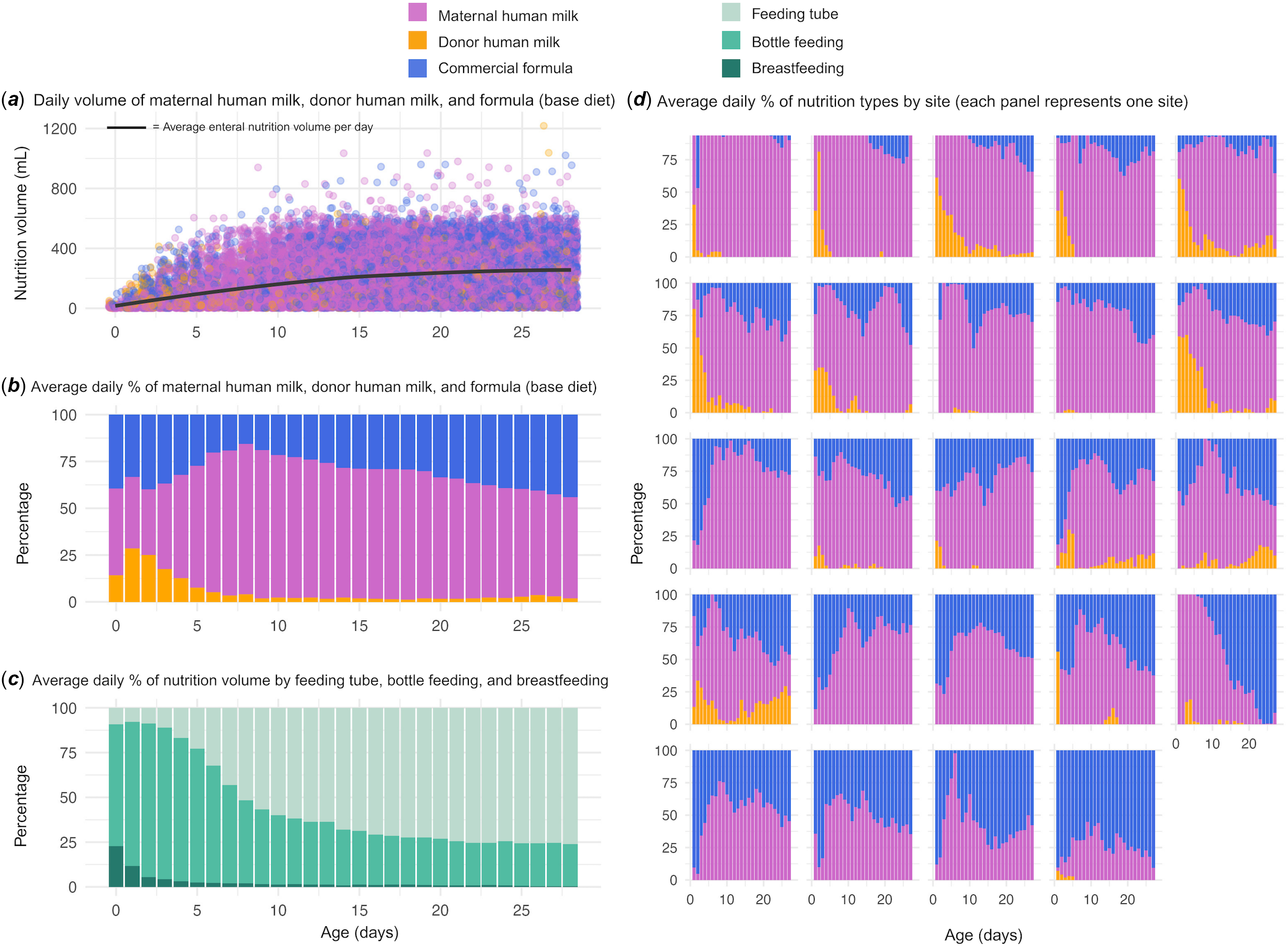
Enteral nutrition volume, type, and route for infants with critical CHD during the neonatal period (n = 832), across 24 US paediatric cardiac ICUs.

Figure 1. Long description
Panel A: A scatter plot shows the daily volume of maternal human milk, donor human milk, and formula (base diet) over time. The x-axis represents age in days, and the y-axis represents nutrition volume in milliliters (mL). The plot includes a black line indicating the average enteral nutrition volume per day. Panel B: A stacked bar chart displays the average daily percentage of maternal human milk, donor human milk, and formula (base diet) over time. The x-axis represents age in days, and the y-axis represents the percentage. Different colors represent different types of nutrition. Panel C: A stacked bar chart shows the average daily percentage of nutrition volume by feeding tube, bottle feeding, and breastfeeding over time. The x-axis represents age in days, and the y-axis represents the percentage. Different colors represent different feeding methods. Panel D: Multiple stacked bar charts represent the average daily percentage of nutrition types by site. Each panel represents one site, with the x-axis showing age in days and the y-axis showing the percentage. Different colors represent different types of nutrition.
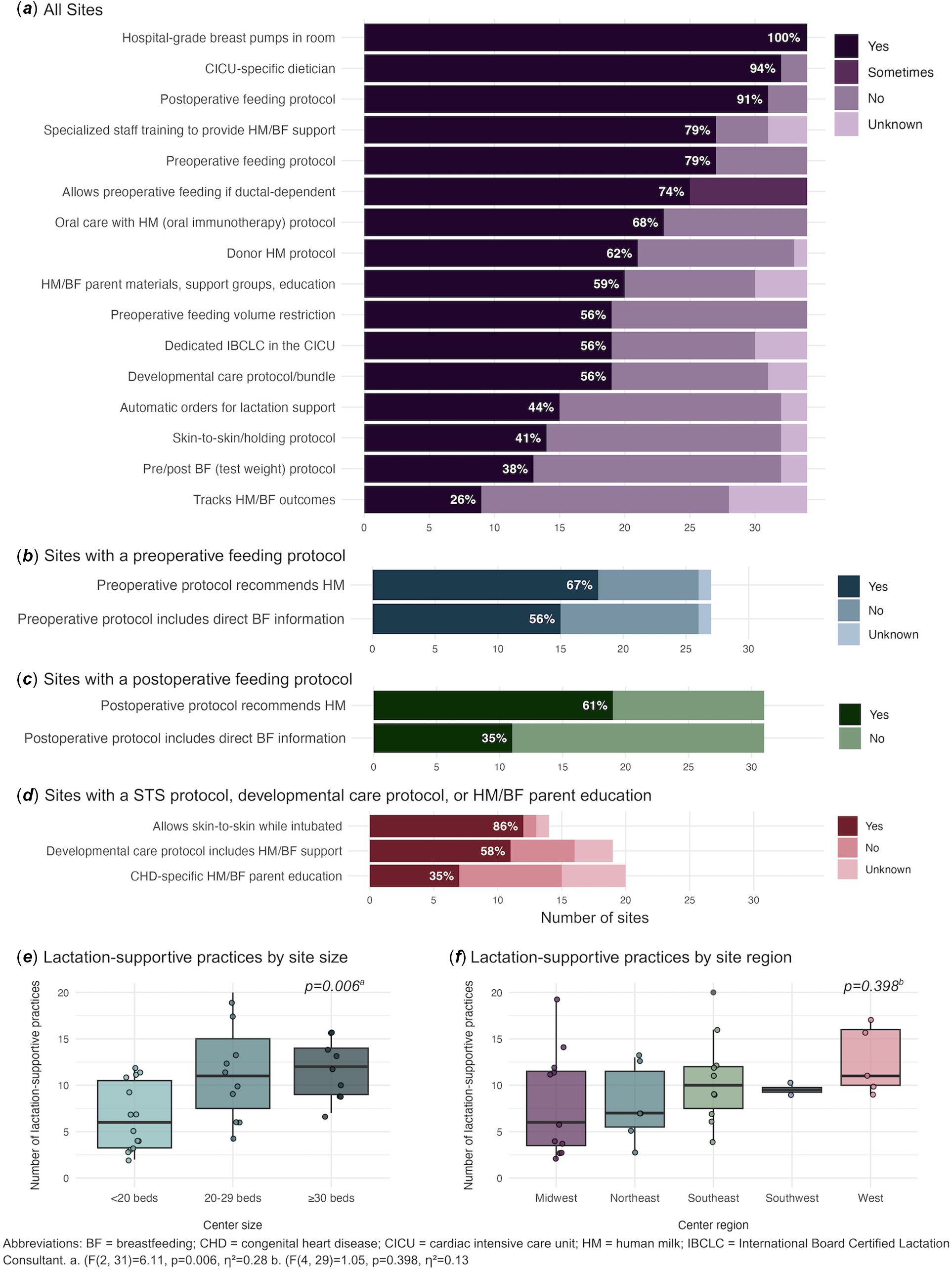
Feeding practices and lactation support in US paediatric cardiac ICUs (n = 34).

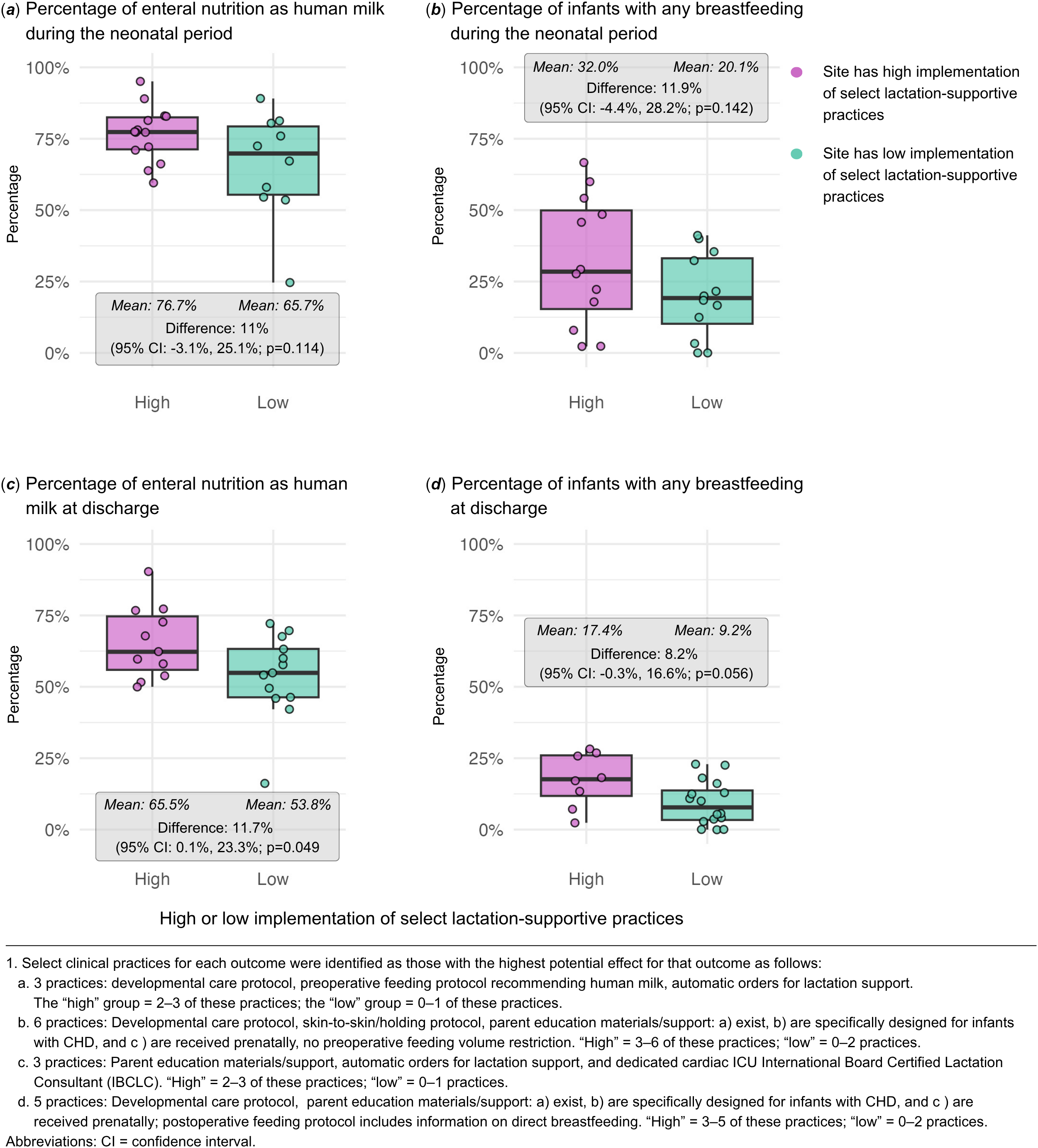
High versus low 1 implementation of select lactation-supportive clinical practices and human milk or breastfeeding outcomes across 24 US cardiac ICUs.

Figure 3. Long description
Panel A: A box plot shows the percentage of enteral nutrition as human milk during the neonatal period. The x-axis is labeled ‘High’ and ‘Low’ implementation of select lactation-supportive practices, and the y-axis is labeled ‘Percentage’. The mean percentage for high implementation is 76.7 percent, and for low implementation, it is 65.7 %. Panel B: Another box plot displays the percentage of infants with any breastfeeding during the neonatal period. The x-axis is labeled similarly, and the y-axis is labeled ‘Percentage’. The mean percentage for high implementation is 32.0 %, and for low implementation, it is 20.1 percent. Panel C: A box plot illustrates the percentage of enteral nutrition as human milk at discharge. The x-axis is labeled ‘High’ and ‘Low’, and the y-axis is labeled ‘Percentage’. The mean percentage for high implementation is 65.5 %, and for low implementation, it is 53.8 %. Panel D: The final box plot shows the percentage of infants with any breastfeeding at discharge. The x-axis is labeled ‘High’ and ‘Low’, and the y-axis is labeled ‘Percentage’. The mean percentage for high implementation is 17.4 %, and for low implementation, it is 9.2 %.
Results
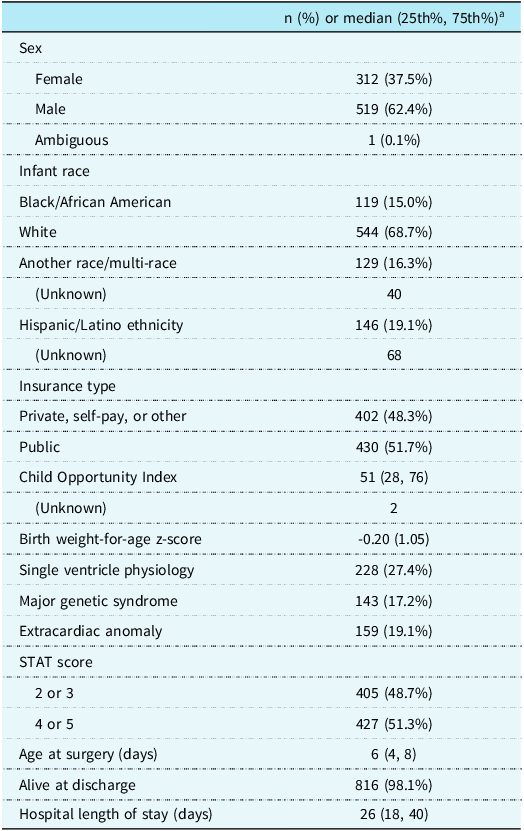
Survey respondents, who were primarily cardiac intensivists, represented 34 paediatric cardiac sites with Midwest (n = 11) and Southeast (n = 10) regions most common. Fourteen sites (41%) had less than 20 beds (173 ± 79 index surgeries per year), 11 sites (33%) had 20–29 beds (324 ± 62), and 9 sites (26%) had 30 or more beds (461 ± 173). Retrospective data were collected on 832 individual patients from 24 centres, with participant characteristics in Table 1. A total of 228 (27.4%) participants had single ventricle physiology and 427 (51.3%) had a STAT score of 4 or 5, with a median 26-day hospital length of stay. On average, 69% of participants’ enteral nutrition during the neonatal period was human milk (base diet, not including fortification), of which 2.8% was donor human milk (Figure 1a,b). Human milk use varied widely across sites (Figure 1d), ranging from 24.8% to 96%. Oral intake made up 33.7% of neonatal enteral nutrition, though nutrition via direct breastfeeding was rare (1.2%; Figure 1c). At discharge, infants averaged 59.6% ±45.5% of their nutrition as human milk, with 560 (69.4%) receiving any human milk and 103 (12.8%) breastfeeding.
Sample characteristics (n = 832)

Table 1. Long description
A table summarizing characteristics of 832 infants represented by survey respondents. The table has 15 rows and 2 columns. Column headers are ‘n (%) or median (25th, 75th)’ and categories. Row labels include Sex, Infant race, Insurance type, Child Opportunity Index, Birth weight-for-age z-score, Single ventricle physiology, Major genetic syndrome, Extracardiac anomaly, STAT score, Age at surgery (days), Alive at discharge, and Hospital length of stay (days). Row 1: Sex, Female, 312 (37.5%). Row 2: Sex, Male, 519 (62.4 %). Row 3: Sex, Ambiguous, 1 (0.1 %). Row 4: Infant race, Black/African American, 119 (15.0 %). Row 5: Infant race, White, 544 (68.7 %). Row 6: Infant race, Another race/multi-race, 129 (16.3%). Row 7: Infant race, Unknown, 40. Row 8: Hispanic/Latino ethnicity, 146 (19.1 %). Row 9: Hispanic/Latino ethnicity, Unknown, 68. Row 10: Insurance type, Private, self-pay, or other, 402 (48.3 %). Row 11: Insurance type, Public, 430 (51.7 %). Row 12: Child Opportunity Index, 51 (28, 76). Row 13: Child Opportunity Index, Unknown, 2. Row 14: Birth weight-for-age z-score, −0.20 (1.05). Row 15: Single ventricle physiology, 228 (27.4 %). Row 16: Major genetic syndrome, 143 (17.2 percent). Row 17: Extracardiac anomaly, 159 (19.1 %). Row 18: STAT score, 2 or 3, 405 (48.7 %). Row 19: STAT score, 4 or 5, 427 (51.3 %). Row 20: Age at surgery (days), 6 (4, 8). Row 21: Alive at discharge, 816 (98.1 %). Row 22: Hospital length of stay (days), 26 (18, 40).
aStatistics are n(%) for categorical data and median (25th%, 75th%) for continuous (count) data, except for birth weight-for-age z-score, which is presented as mean (standard deviation).
Abbreviations: STAT = Society of Thoracic Surgeons-European Association for Cardio-Thoracic Surgery.
Survey results
The frequency of lactation-supportive clinical practices can be seen in Figure 2a. Site implementation varied (median 10 practices, range, 2–20). There was a significant association between site size and the number of practices (Figure 2e; p = 0.006, η 2 = 0.28 indicates that site size explained 28% of the variance in the number of practices), but not with region (p = 0.398). Commonly implemented practices included in-room hospital-grade breast pumps (100%), feeding protocols (79% preoperative, 91% postoperative), and specialised staff lactation training (79%). Fewer than half of sites utilised protocols for pre- and post-breastfeeding weights (38%), protocols for skin-to-skin/holding (41%), or automatic orders for lactation support (44%), which most commonly included lactation consultation (38%), hospital-grade breast pumps (24%), and parent meal trays or vouchers (9%). Only 9 (26%) sites tracked human milk and breastfeeding outcomes. Additional qualitatively reported practices included non-nutritive breastfeeding, infant-driven feeding, a cardiac feeding clinic informed by direct breastfeeding literature review, processes to log and store human milk, a programme to facilitate home pump access, and an International Board Certified Lactation Consultant (IBCLC) available for interstage patients with single ventricle physiology.
All sites allowed infants with ductal-dependent physiology to feed preoperatively, although this was situation-dependent for 9 (26%) centres. Around half (56%) imposed preoperative feeding volume limits, with varied criteria. The most frequently reported preoperative limit was 20 mL/kg/day (n = 7), followed by 30, 40, and 120 mL/kg/day (n = 2 for each). Qualitative responses highlighted the variation in practice: “NICU providers often set restrictions between 40–100 mL/kg/day for ductal-dependent infants, varying by case and provider”; “For ‘high-risk’ patients . . . respiratory and hemodynamic stability guide feeding. If both are stable 10 minute limit for oral feeding, but no max volume”; and “20 mL/kg/day for all newborns stable and awaiting stage 1 palliation . . . placement on protocol versus PO ad lib is attending-dependent.”
Associations between clinical practices and lactation outcomes
In unadjusted linear regression models, there were no significant relationships between the total number of lactation-supportive clinical practices and human milk or breastfeeding outcomes, whether during the neonatal period or at discharge (Supplementary Figure S1, p > 0.05 for all outcomes).
Figure 3 details practices identified as potentially stronger for lactation support. The practices most consistently identified, for 3 of the 4 outcomes of interest, were implementation of a developmental care protocol and availability of lactation-focused parent education materials or support groups. Additional practices, identified for 2 outcomes, were automatic standing orders for supportive lactation care, parent lactation education/support specifically for hospitalised infants, and parent education/support delivered prenatally or both pre- and postnatally (not postnatally alone). As in Figure 3, sites with high implementation of these select practices had higher average human milk and breastfeeding rates, with the lowest uncertainty observed for discharge outcomes. Specifically, infants at sites with high implementation of 3 practices ((1) parent lactation education/support available, (2) automatic orders for lactation support, and (3) dedicated cardiac IBCLC) had 11.7% average higher human milk volume at discharge (95% CI: 0.1%–23.3% higher, p = 0.049). Sites with high implementation of 5 practices ((1) developmental care protocol, (2) parent education/support available, (3) parent education/support designed for hospitalised infants, (4) parent education/support delivered prenatally or both pre- and postnatally, and (5) postoperative feeding protocol includes direct breastfeeding information) had an average 8.2% higher breastfeeding rate at discharge (95% CI: −0.3%–16.6%, p = 0.056).
Discussion
This is the first comprehensive examination of lactation-supportive practices in US cardiac ICUs and is unique in linking these clinical practices to detailed, daily nutrition data from a large sample of infants with critical CHD across multiple sites. Our findings demonstrate significant variability in lactation support across institutions. While in-room hospital-grade breast pumps and specialised staff training (e.g., certified lactation counsellor, IBCLC) were available at most sites, only 41% had a formal protocol for skin-to-skin or holding—one of the most widely studied neonatal ICU interventions with a consistent positive effect on lactation outcomes across meta-analyses. Reference Hilditch, Rumbold, Keir, Middleton and Gomersall10,Reference Song, Kinshella, Kawaza and Goldfarb12 Interestingly, a 2016 survey of cardiac ICUs reported that 46% of sites had a formal skin-to-skin or holding policy, suggesting little change in this area over the past decade. Reference Sood, Berends and Butcher25
Contrary to our hypothesis, we did not identify positive associations between the total number of site lactation-supportive practices and human milk or breastfeeding outcomes. These results are in contrast to Gauntt et al.’s Reference Gauntt, Tucker, Dolan, Gajarski and Krawczeski13 2023 quality improvement project, which implemented 11 interventions at a single site (e.g., parent education materials, easily accessible hospital-grade pumps, staff education and “lactation superuser” training, discussion of skin-to-skin on daily rounds). By the end of the 2-year implementation period, the percentage of infants receiving at least 50% of their nutrition as human milk increased from a baseline of 55–92%, including several months in which every feed for cardiac ICU neonates was human milk. The authors determined that the most effective interventions focused directly on the lactating parent, which aligns with our finding that parent education materials and support were one of the “strongest” clinical practices. The content and timing of this parent education may also matter, with materials specifically designed for hospitalised infants and delivered prenatally identified as supportive of direct breastfeeding outcomes.
In our final analysis including only the strongest practices (Figure 3), we identified positive relationships between implementation of select clinical practices and lactation outcomes, particularly at discharge. Many of these select practices involved formalisation of support at the institutional level. An active developmental care protocol was included as a strong practice in 3 of the 4 final analyses, perhaps reflecting the established role of human milk and breastfeeding as the developmentally appropriate nutritional standard, highlighted in national recommendations for developmental care of infants with CHD. Reference Lisanti, Uzark and Harrison26 Other influential institutional factors included formal protocols for skin-to-skin contact, feeding guidelines that explicitly discuss human milk or breastfeeding, and the absence of formal preoperative volume restrictions.
These findings suggest that formalisation of lactation support at the institutional level may be important for improving human milk and breastfeeding outcomes for infants with CHD. Studies have noted improved clinical outcomes following feeding protocol implementation in the cardiac ICU, Reference Furlong-Dillard, Neary and Marietta27,Reference O.’Neal Maynord, Johnson, Xu, Slaughter and Killen28 but there is limited evidence on feeding protocols designed to target lactation. Kataria-Hale et al. Reference Kataria-Hale, Roddy and Cognata14 compared pre- and post-cohorts following implementation of a human milk-focused preoperative feeding protocol for infants with critical CHD, noting an increase from 54.8 to 100% human milk preoperative feeding post-protocol. At discharge, 78% of infants were receiving human milk, compared to 69% in our cohort, suggesting a potentially lasting effect of this early protocol on human milk feeding; however, direct breastfeeding was not reported. Our results are consistent with this previous work, as inclusion of a preoperative feeding protocol explicitly recommending human milk was identified as supportive of neonatal human milk feeding.
Our findings suggest areas for institutional focus with potential to improve lactation outcomes for infants with critical CHD. Sites may consider implementing protocols for developmental care and skin-to-skin holding, a preoperative feeding protocol recommending human milk as first-line nutrition, and a postoperative feeding protocol including information about direct breastfeeding. Additional key clinical practices may include provision of CHD-specific parent education and support beginning prenatally, establishment of automatic orders for lactation support, and access to an IBCLC. For sites with limited resources or no established culture of lactation support, it could be most effective to focus initial efforts on the practices that appeared most frequently as “strongest” practices: lactation-focused parent education materials/support, and implementation of a developmental care protocol.
Notably, the clinical practices that were identified as potentially strongest were implemented at fewer than 60% of surveyed sites, indicating opportunity for widespread practice improvement. These practices also align with previous literature identifying a model for successful establishment of breastfeeding for infants with critical CHD (the “Wayfinding” model). Reference Elgersma, McKechnie, Sommerness, Tanner and Swanson17 Within this framework, formalising lactation-supportive practices facilitates a productive partnership between the lactating parent and the healthcare team by minimising conflicting feeding priorities, reducing variation in feeding practice, and standardising communication about human milk and breastfeeding across the healthcare team.
The major limitation of this study is the temporal disconnect between the site survey (initiated in 2024) and nutrition data (2021–2022). Although most sites did not report a recent change in feeding protocols, it is possible that survey results do not reflect lactation support at the time of nutrition data. Collaborative Research from the Pediatric Cardiac Intensive Care Society participating sites may differ from other sites, and results may not generalise. Surveys were completed by one clinician per site, and may not fully capture interdisciplinary practice. Additionally, while sites reported the existence of clinical practices, the level to which most practices were implemented was unknown and could vary per provider. While our cohort of 832 infants was large, the effective sample size (n = 24 sites) was likely underpowered; thus, results should be considered preliminary and hypothesis generating. The effect of individual or bundled clinical practices on lactation outcomes requires further confirmation in well-powered studies. Importantly, our survey focused on clinical practices at the site level. There are additional relevant individual- and society-level factors; e.g., early initiation of milk expression, pumping frequency, maternal health, socio-economic factors, and milk supply challenges. Reference Elgersma, Wolfson and Fulkerson9,Reference Iapicca, Bendixen, Spatz and Parker29
This multi-site study provides foundational knowledge about lactation support across US paediatric cardiac ICUs, highlighting varied and inconsistent implementation of lactation-supportive clinical practices. Our findings suggest that institutional formalisation of practices including a developmental care protocol, comprehensive parent education and support, and feeding protocols recommending human milk and breastfeeding may improve lactation outcomes for infants with critical CHD. Although study limitations necessitate further large-scale, prospective validation, these results provide a starting point to bridge the gap in care for this vulnerable population, ensuring that human milk and breastfeeding outcomes are supported by evidence-based policy and minimising variability in clinical practice.
Supplementary material
The supplementary material for this article can be found at https://doi.org/10.1017/S1047951126124093.
Acknowledgements
We thank Julian Wolfson (PhD, Professor, Division of Biostatistics & Health Data Science, School of Public Health, University of Minnesota) for his consultation and guidance. We sincerely thank all participating Collaborative Research from the Pediatric Cardiac Intensive Care Society centres, research coordinators, and clinical staff for their invaluable contributions to this study. Special thanks to those who helped with data collection: Edgar Alfaro, Courtney Alvis, Jonah Berg, Jolynne Carl, Gavin Cole, Annabeth Evans, Muhammad Faisthalab, Sarah Haas, Kristal Hock, Courtney Jones, Rebecca Kaplan, Rachael Keiffe, Nashifa Momin, and Tery Sumrall. We also thank Lina Thiel, Alexis Steiber, and Nellie Munn Swanson for assistance with data cleaning. Finally, we thank Scott Aydin, Adnan Bakar, Robert Hartman, Jillian Olsen, Sowmith Rangu, Chetana Reddy, Christine Riley, Friederike Strelow, Nathan Sznycer-Taub, and Raji Venkitachalam for their support and collaboration.
Financial support
This project was supported by a Grant-in-Aid of Research, Artistry, and Scholarship from the Research and Innovation Office, University of Minnesota. Kristin M. Elgersma was supported by the National Institutes of Health (NCATS 1UM1TR004405-01A1 & K12TR004373). Content is the responsibility of the authors and does not necessarily represent the official views of the National Institutes of Health.
Competing interests
None.
Ethical standard
The authors assert that all procedures contributing to this work comply with the ethical standards United States Federal Policy for the Protection of Human Subjects and with the Helsinki Declaration of 1975, as revised in 2008, and has been approved by the institutional committees of all participating sites.


 Open access

