Introduction
Fifty years ago, at the Tanglewood Symposium, conversations about multiculturalism in music programmes were emerging. In some schools, multicultural programmes were actually occurring: teachers piloting these programmes were subtly side-stepping the dominant Western music curriculum to involve students in diverse musical experiences. As much as research and policy continue to endorse the relevance of, and need for cultural diversity in music education, it remains predominantly in the hands of teachers to implement this diversity. Most universities and teacher training institutions (for example in the United States, Canada, and Australia) still lag in preparing teachers for diverse teaching experiences, rendering some music teachers hesitant to move beyond their professional comfort zone of Western music teaching and learning (Cain Reference CAIN2010, Reference CAIN2011, Reference CAIN2015a, Reference CAIN2015b; Cain, Lindblom & Walden, Reference CAIN, LINDBLOM and WALDEN2013; Campbell, Reference CAMPBELL2004; Schippers, Reference SCHIPPERS2006, Reference SCHIPPERS2010). These key variables of policy versus implementation, issues in teacher incentive and impetus for change, and a lack adequate teacher training underpin the focus of this paper. It is clear that teachers need exemplars of engaged practice to guide them: personal stories of resourceful and innovative educators who are negotiating ways to bring diverse musical experiences into their classrooms. From a teaching perspective, ‘engaged’ practice represents the teacher's integration of social, emotional, and academic learning, investment in building relationships and community, response to cultural contexts, ability to foster connections and meaning, and recognition of developmental stages (Weaver & Wilding, Reference WEAVER and WILDING2013, p. 8). From a student's perspective, it refers to the interest, curiosity, attention, optimism, and passion that students demonstrate in the learning process (Trowler, Reference TROWLER2010). Engaged practice represents the degree of student participation in meaningful learning activities, as well as the proportion of students involved in these activities.
The state of cultural diversity in music education
As described by Kohn (Reference KOHN1999), the grace and persuasive power of an influential idea may be admired; however, the time comes to fear its hold over us:
The time to worry is when the idea is so widely shared that we no longer even notice it, when it is so deeply rooted that it feels to us like plain common sense. At the point when objections are not answered anymore because they are no longer even raised, we are not in control: we do not have the idea; it has us (p. 1).
Highlighted also by leading music education theorists (Campbell, Reference CAMPBELL2004; Drummond, Reference DRUMMOND2010; Rose, Reference ROSE1995; Schippers, Reference SCHIPPERS2010), the Western canon in music education (including Australia, Canada, Europe, and the United States) has reigned dominant for a few hundred years: so long, that it feels to many like just ‘plain common sense’, as described above by Kohn (Reference KOHN1999). The reasons for such hegemony include a lack of practical professional development programmes in culturally diverse musics, a perceived lack of authentic resources, the influence of Western cultural practices in educational policy and curriculum documents, and the persistence of focus on Western music genres in teacher training programmes (Cain Reference CAIN, Campbell, Drummond, Dunbar–Hall, Howard, Schippers and Wiggins2005, Reference CAIN2010, Reference CAIN2011, Reference CAIN2015a, Reference CAIN2015b; Cain, Lindblom & Walden, Reference CAIN, LINDBLOM and WALDEN2013; Campbell, Reference CAMPBELL2004; Colley, Reference COLLEY2009; Draisey–Collishaw, Reference DRAISEY–COLLISHAW2004; Schippers, Reference SCHIPPERS2010). Green (Reference GREEN2003) suggests that the ideology that perpetuates western classical music being respected as ‘the most valuable type of music’ (p. 14) has been accepted by the majority of teachers and curriculum planners around the world for many years. Negative responses may occur when teachers identify some musics as belonging to ‘others’; particularly other social or cultural groups (Cain, Reference CAIN2015b). Educators often approach the study and practice of ‘other’ musics as ‘coming from different places, having a different musical function and requiring a different pedagogy’ (Thompson, Reference THOMPSON2002, p. 19), and this may reinforce the status of these musics as deserving of a marginal place in the curriculum. The importance of educating both pre-service and in-service teachers of all levels of experience about the possibilities and benefits of exposure to culturally diverse music cannot, and should not, be underestimated.
Meeting the needs of pre-service music teachers
Walden (Reference WALDEN2016) in a 2013–2014 survey of music teachers working in North American schools, observes that workshop attendance was the most recognized source for training in multicultural music with university pre-service education placing fourth. Better training for music teachers can be realized, according to Colley (Reference COLLEY2009), by offering ‘representative spectra of musical ensemble opportunities – not necessarily inclusively and comprehensively within each school, district, university, or even one community, but at least as a profession’ (p. 57). Howard, Swanson and Campbell (Reference HOWARD, SWANSON and CAMPBELL2013) refer to this approach as ‘musical encounters’ (p. 10), whereby pre-service and practicing teachers are directly involved in learning multicultural musics. Gay (Reference GAY1997) promotes that ‘competency in multicultural education should be a condition of entry into the profession for all teachers’ (p. 175). This cannot be achieved, however, without significant prototypical change in how music is defined at the undergraduate level, insists Colley (Reference COLLEY2009).
In the classroom: Intention versus practice
‘The growing diversity of ethnic, racial, and cultural backgrounds that are found in schools has created a need for greater cross-cultural understanding,’ explains Draisey–Collishaw (Reference DRAISEY–COLLISHAW2004, p. 21). The intention for pedagogical transformation is evidenced in recent educational policy and curriculum revisions: ‘The [Canadian] government has responded to this need by creating legislation with the intent of promoting greater respect for cross-cultural diversity’ (Draisey–Collishaw, p. 21). So too, the Australian National Curriculum promotes culturally diverse music education, requiring students to explore the ‘histories, traditions, and conventions of music from other places and times including Australia, Aboriginal and Torres Strait Islander cultures, Asia and other world cultures’ (Australian Curriculum and Assessment Reporting Authority, 2017). In both countries, education policy recognises that in these multicultural societies, ‘home’ musics are those both Indigenous and imported. These advances are indeed encouraging. Schippers (Reference SCHIPPERS2010) points out, however, that despite positive rhetoric in educational policy ‘its implementation in teacher training and in classrooms and studios around the world is still lagging. In actual practice, most core courses in history, theory, and performance studies remain almost exclusively directed toward aspects of Western art music . . . ’ (p. 90). What factors, then, create the rift between intention and practice and how can this be overcome?
Cain, Lindblom and Walden (Reference CAIN, LINDBLOM and WALDEN2013) note that some music educators find ‘ . . . musical diversity either unacceptable or impossible to implement’ (p. 84). Teachers who do strive for innovation are described by Barrett (Reference BARRETT2011) as those who ‘have a ‘reform-mindedness’ about their own work, striving toward continual improvement and refinement’ (p. 2).
Colley (Reference COLLEY2009) lists a number of widely accepted assumptions that have, and continue to dominate pedagogical thought. Her most poignant points include the assumptions that: ‘the large [Western musical] ensemble, traditionally orchestra-band-chorus, defines and determines a quality school music programme’; ‘access to music making is achieved solely through one's ability to decode written [Western] notation’; ‘alternative certification paths by which professional musicians from other musical traditions become teachers are inappropriate, suspect, or a threat to school music programme quality’; and ‘styles and instruments outside the traditional ensemble trilogy are acceptable and allowable only as enhancements, supplements, or enrichments to it’ (p. 66). The final point presents the issue of equity: it is important that music education develops a global approach to all musics. This resonates with Lind and McKoy, who write that culturally responsive pedagogy ‘improve[s] the academic experiences of all students by providing equitable experiences . . . this involves broadening the curriculum to include diverse music genres’ (Reference LIND and McKOY2016, p. 30).
Innovative teachers
Fullan (Reference FULLAN2013) scrutinizes the current state of innovation in schools: ‘ . . . only a sprinkling of innovative teachers are engaged in the practices found to be effective. In other words, we have ad hoc innovative teachers but not innovative schools, and no innovative systems’ (p. 44). Culturally diverse music programmes are driven by specific personnel, occurring because a teacher with a passion for musical diversity is leading it, not because the system for which he/she is working has mandated it (Cain Reference CAIN2015a, Reference CAIN2015b; Cain, Lindblom & Walden, Reference CAIN, LINDBLOM and WALDEN2013). Such teachers place emphasis on integrity of practice and process in connecting with their students on a personal level. This is a more dynamic interpretation over authenticity of product, which often relegates ‘traditional’ musics to static interpretations which might not lead to responsive and meaningful experiences (Schippers, Reference SCHIPPERS2006).
It is the work of specific educators, dedicated to increasing the cultural diversity of repertoire, listening, instrumentation, improvisation, and playing/singing experiences in their classrooms who provide essential examples of engaged practice to assist those in the beginning stages of developing culturally diverse music programmes. Therefore, the following ‘snapshots of practice’ present insights into diverse musical education in practice by highlighting the work of five culturally responsive music teachers in Calgary, Canada, and Brisbane, Australia.
Methodology
This research is part of a larger research project in which 17 music teachers were interviewed and observed, and 102 music teachers completed a survey on their practice. Data were gathered on how culturally diverse musics are being transmitted in school classrooms. The research identified common aims and objectives in culturally diverse music programmes and subsequently, teacher attitudes and attributes that facilitate engaged practice. For this paper the authors interviewed five music teachers in Calgary, Canada and Brisbane, Australia. These participants were identified by their reputation for having forged diverse programmes in both cities: some teachers were known through previous research participation, and some were recommended by colleagues. As experienced educators, these teachers are cognisant of the need to differentiate their practice to account for learner needs and preferences, as well as student prior knowledge and musical tastes, and this is inherent in the way they provide students with choice and agency in their culturally diverse approach to music education.
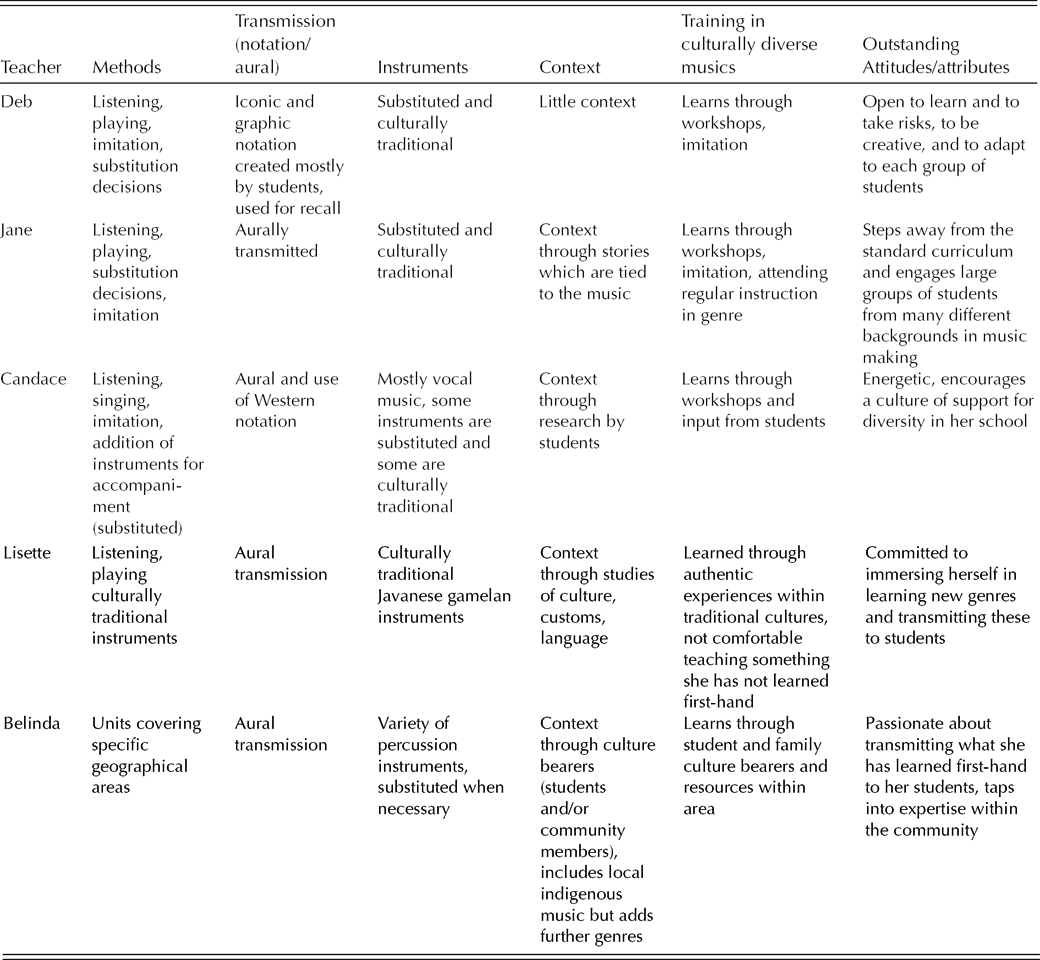
Semi-structured recorded interviews were conducted between March and June, 2014, and were approximately two hours in length, with all participants interviewed individually at their schools. Questions covering themes of teacher beliefs, approaches, methods, background, and training, were explored with each participant. The authors approached this investigation using a form of grounded theory developed by Strauss and Corbin (Reference STRAUSS and CORBIN1998) to deliver a multifaceted description of lived reality; the aim being to develop new theoretical constructs from real world data so to inform future research (Oktay, Reference OKTAY2012). Transcripts of recorded interviews were analysed manually and summarised with common themes colour coded. Interview transcriptions and article drafts were shared with the participants for their feedback to ensure accuracy of the data collection. Appendix A (below) outlines a conceptual/theoretical framework in which the snapshots were placed.
The following research questions informed the collection of data: 1. What factors prompt music teachers to implement programmes based on musical diversity? 2. To what extent is school, parent, and community support important for culturally diverse music programmes to be maintained? 3. What challenges do teachers of culturally diverse music programmes encounter?
‘Snapshots’ of practice in Culturally Diverse Music Education
Deborah is a music specialist at a French immersion elementary school in a middle-income area of Calgary, Canada with an approximately 12% immigrant population. The curriculum is Western-based, with the current curriculum review process reflecting a move toward more diversity and broad interpretation of benchmarks. Due to the school's French immersion component, Deborah includes approximately 25% French folk music into her classes, still generally following the curricular guidelines. Her overall choices of music are somewhat governed by school assemblies; however, Deborah attempts to vary the music of each performance. As her pre-service university training was Western-based, Deborah attends culturally diverse music workshops, peruses written and recorded resources, and accesses instruction on-line to broaden musical diversity in her programme. This requires time, workshop availability, and funding, which are difficult to realise in a public school system that demands many hours per day from teachers and little time allotted to professional development. Deborah uses her own resources along with those provided by the school and the parent council. She feels her programme choices are supported by her administration, as evidenced by the school's overall mission of diversity, their willingness to assist with special programme scheduling, and their advocacy of her work.
Although Deborah's programme is not yet as multicultural as she would like, it contains components which reflect cultural diversity: 1) students bring in instruments and /or songs from their own cultures or those they have visited, 2) the use of graphic and iconic notation and mnemonic devices generated by both students and teacher, 3) guest musicians/culture bearers occasionally work with students, and 4) time each year is devoted to culturally diverse units. Deborah states, ‘It's my job to bring them other stuff [non-Western musics] . . . so they're seeing something they normally wouldn't have encountered’. She approaches authenticity from the standpoint that music, although having traditional origins, is constantly changing: ‘It seems like the ‘experts’ want to preserve the music in a museum but that's not how kids explore music’. Deborah's students are aware of traditional musics, but as observed in her classes, the students take the musical ideas and generate their own.
One of Deborah's successful approaches to cultural diversity begins with students listening to and/or watching a recording of the piece. Parts are written on the board in graphic and iconic notation, provided by Deborah and also derived from student input. These are in the form of simple drawings of instruments, graphic symbols for soft and loud, and colours representing groups. Some students follow the notation while others learn aurally as Deborah repeats patterns while students play. Students have the opportunity to try different parts on glockenspiels, xylophones, metallophones, contrabass bars, handbells, piano, axatse, rainstick, wooden spoons, dun duns, and djembes. Most are substituted instruments; students have a chance to play each instrument and eventually find their preferred choice. Deborah encourages students to experiment with different instrument timbres, concerned more about sonic exploration inspired by the music than attempts to precisely recreate the examples they have heard. After a few lessons, students put together their own ideas for sections, and each class ‘maps out’ its preferred sequence of sections. Deborah's approach allows for an amount of chaos and uncertainty, but she is confident students benefit from this experience of hearing a traditional version of a piece, discussing its contextual position, experimenting with instruments available to them, working as a team, helping out peers, and ultimately being engaged in a meaningful musical experience. Each child's musical learning style is accommodated in an environment that encompasses aural transmission, visual cues (student-generated notation), and peer reinforced skill acquisition.
At an arts-centred school in Calgary, Jane teaches concert band, jazz band, and ‘African Drumming’ (focused on Guinean music) to students ages 12–15. The student population is approximately 70% Caucasian, with the remaining 30% from (in descending order of percentages) Pakistan, India, Nigeria, Somalia, Belarus, Saudi Arabia, and other Asian countries. With her pre-service training mainly in Western concert band, Jane acquired her percussion skills through workshops and weekly classes predominantly in Calgary. Jane's drumming programme provides a three-month opportunity for students to play a style of music that is aurally transmitted, with no prerequisite requirements. It is widely supported by staff, administration, and parents for its inclusion of students not in band or choir, and popular among students for its kinaesthetic nature. This is evidenced by parental and faculty praise for the programme, priority scheduling and room assignment by the administration, and the popularity of the class among the students.
With no formal curriculum to follow, Jane chooses traditional Guinean rhythms based on student ability, starting with basic rhythms on djembes and dun duns and progressing to more difficult combinations. Throughout most of her 55-minute classes, students are engaged in playing as Jane demonstrates technique and gives reminders through mnemonic devices. Jane helps students individually as the class keeps playing, which means struggling students are not singled out, and the music being played by the students continues without interruption. Jane's directions are clear and her feedback positive and continuous. Her enthusiasm drives the energy of the group: students know from her exclamations of praise when they are playing well. Students are also part of the assessment process: they self-assess and discuss how they can improve as an ensemble.
Contextual integration is through narrative: ‘I add stories that go with the rhythms. When I realize we've been drumming for 15–20 minutes, I just stop and I'll tell an accompanying story’. It is important to Jane that students understand that different cultures perceive ideas differently. This triggers further discussion in class, during which students give their own input and reactions, reinforcing the multiculturalism that exists in the class itself. The instruments used are culturally authentic; when dun duns are substituted with timpani or drum set, the reaction is unanimous: ‘ . . . it just doesn't cut it, in any way, shape, or form . . . It's only good for them in terms of their technique and coordination, but sound-wise it just seems to take away from the effect of everything’. Jane's students have grown accustomed to the sounds of the culturally authentic instruments, and to her style of teaching. This presents two interesting perspectives: deviation from these distinct timbres has resulted in discord because the sound is simply not the same. Would the sounds be acceptable were they playing substitutions from the beginning? Would a different style of teaching create discord as well?
One of the aims of Jane's programme is to have students involved in making music. Jane articulates, ‘I think lots of kids give up on their chance to be involved in music if they haven't taken band or if they're not studying privately’. She reinforces that in the African drumming class
. . . they don't have to read music, they don't have to know anything about music. They get to hit things . . . You've got some kids who come in believing they are not going to engage and then they come out at the end of it with a performance. They can be on stage, they can celebrate that learning; their parents can come in and watch them and go, ‘Wow!’
In a Canadian music curriculum dominated by Western music practice, Jane has built a thriving, popular course that validates and honours a non-Western genre. The message to students is that this style of music stands strongly on its own in its instruments, timbres, and rhythms and is clearly not an enhancement, supplement, or enrichment.
Originally a piano major with a music education degree, Candace teaches choir at a Calgary high school (ages 15–18 years). Her programme is strongly supported by an administration that recognizes the benefits of providing diverse musical opportunities for the large English Language Learner (ELL) population, currently 43% of the school (most of these students speaking languages from India and Pakistan). The nature of these demographics presents an interesting position: families have immigrated to Canada for a ‘better life’ and to provide their children with education opportunities they never had. Says Candace, ‘They're instilling values into their children that they need to get a good job and high grades. As a result, a lot of these kids don't value music and the arts as much’. The choir programme is, however, growing and becoming more culturally diverse in its participants: ‘there is a handful of different ethnicities and it's really been opening their eyes up’. Candace would love to include more diverse music choices but is confined by lack of time for professional development and a school timetable already at its maximum.
A few times each school year, opportunities are available for choirs to attend workshops and to host visiting musicians. However, ‘the majority of multicultural experiences’ Candace explains of her choir programme, ‘are through the repertoire’. Much of the enthusiasm in her classes emanates from Candace's passion for teaching music. Through efficient vocal warm-ups interspersed with comments, assessment, and laughter, students are engaged from the moment the rehearsal begins. As opposed to simply attending rehearsal, they are contributing ideas, taking risks with new techniques, and unafraid to be spontaneous. Candace is clear in her conducting gestures, changing her movements depending on the style of music being sung. Because she recognizes, ‘every voice is unique, like a fingerprint’ Candace focuses on each student as well as the overall sound: ‘If you just spend ten seconds with one individual it really makes a difference’.
Candace engages in research in the summer and throughout the year to find new multicultural material: ‘I've always got my ears peeled for different pieces, listening to other choirs, and soloists. I'm always gathering ideas and listening for new things’. When available, she has students listen to recordings in order to grasp what pieces sound like in traditional settings. When students know pieces well, she includes movement characteristic of each piece's style. Candace would like to include more context-focused activities, but finds her time to do so is limited. Fortunately, translations are usually included to illuminate the song's meaning, and the students ‘Google’ answers to contextual questions during rehearsals and share information with the choir. Student input is valued, especially from those who may come from the same culture as a piece being taught. Candace has students demonstrate singing style and enhances experiences with first-hand information about different genres.
Candace aims to give students a broad outlook toward, and appreciation of as many cultures as possible. As validated by one of her students: ‘We can grow in many more different ways, in styles of singing and moving. We learn about the culture, what the music means to the culture, and how it all relates to the culture’. The administration at her school wants ‘as many students as possible to experience as many different types of music as they can. It's about not having this traditional Western outlook toward music’.
Lisette is a music specialist at a private college in the southern suburbs of Brisbane, Australia which aims to develop a sense of ‘international mindedness’ in its students. The school's global outlook is supported by its culturally diverse clientele, including many international students who board at the college. Lisette, who trained in Scotland, was exposed to Scottish musics in addition to having access to her college's Javanese gamelan which she taught to her fellow students. Lisette has also lived in Indonesia and Japan, and thus musics from these countries provide a focus for her lessons. She continues to travel to Java periodically to take lessons from master gamelan musicians.
The school's music curriculum is primarily Western-based, with acknowledgement of several non-Western musical cultures in which Lisette has the confidence and experience to teach. All students in grades seven and eight learn to play Javanese gamelan on Lisette's own set of instruments. Students in grades nine to 12 also complete performance in gamelan (designed by Lisette) at a high standard. Lisette has brought her personal love for Javanese gamelan music to the school. She is extremely accomplished with the ability to play the most complex instruments, yet is able to explain the intricacies and nuances of gamelan performance in a simplified manner for her students. Lisette's lessons are structured around the inquiry method which encourages a sense of wonder and inquisitiveness about sound exploration. The best way to inculcate a culture of diversity in the music classroom, suggests Lisette, is to ‘start young and expose students to a variety of sounds’ and this is certainly obvious in the way her lessons progress. ‘That's the coolest sound in the world!’ says ten-year-old Henry after playing the large gong ageng for the first time. As a result of this approach to music education, Lisette's students are open to, and appreciative of new and unfamiliar sounds.
For Lisette, cultural context is a very important part of learning the gamelan, with students gaining an appreciation for Indonesian culture, pertinent customs associated with playing the gamelan, and some simple language functions. In the younger years, students learn the music aurally without notation as a support, as it would be done in Java, which develops enhanced listening skills and a stronger sense of collective musical understanding. The skeleton framework of the music's structure is explored, and then embellishments are gradually added so the students come to understand how the music is traditionally layered.
Although Lisette fully believes in exposing students to a wide variety of sounds, issues of authenticity and a lack of resources and funding can limit the choice of musical cultures she explores in her classroom: ‘I don't feel comfortable with teaching music of places that I have not been to myself – just teaching them from a textbook rather than having had practical experience in them’. The gamelan programme is fully supported by the principal and parents, especially when they come to appreciate the many musical and extra-musical benefits. ‘My school is very good about allowing individuality and flexibility in what I teach. As an International school, we address [diversity] as a lived experience’. Lisette believes that the success of her programme comes down to her individual passion for musical diversity and a supportive environment. However, Lisette offers that this support is reliant on her remaining at the school. If she was to leave and take her instruments, this diversity would most likely cease. Although a general appreciation for the benefits of a practical approach to musical diversity is an important source of support for Lisette's programme, more like-minded educators are needed to ensure the continuation and longevity of this type of programme.
Belinda teaches music at a coeducational government funded school located in the southern suburbs of Brisbane, Australia. The area is characterised as low socio-economic with large populations of Indigenous and Pasifika groups, and smaller populations of Philippino, East African, and Middle Eastern cultures. The music curriculum is Western-based but there is evidence of a strong commitment to the inclusion and valuing of ‘home culture’ and ‘youth culture’ musics in the classroom. Belinda's school has been the recent recipient of a substantial grant for schools with low socio-economic disadvantage. Not only has this grant been utilised in the regular classrooms but it has also had a positive impact on the music programme, supporting a recording studio and a large number of percussion instruments including djembes.
Unlike many schools which might take a deficit view of their multicultural clientele, Belinda's school embraces and values the cultural richness her students bring. This is evident in the school's vision, and in the manner in which the school is led by the principal. Strong support is also provided by family cultural liaison officers who are also musicians, other teachers, parents, and the local community. In addition, there is a network of teachers from schools with similar clientele and a similar vision for music education. Community involvement is particularly evident during preparations for the large annual cultural festival in which groups perform music and dance, and share food and other cultural activities. Belinda explains: ‘For Cultural Day we always invite parents and families to come in and do the workshops. I actually run the African drumming one, but we have parents and friends from the Polynesian community come and even perform with the kids on stage’.
Belinda received her formal music education at school and university settings in Western methodologies, with no inclusion of diverse music approaches. Therefore, her commitment to exploring diverse musics in her classroom comes from personal interest, further driven by interaction with the many cultural groups she teaches. Belinda has demonstrated a passion for diverse musics by making a consistent effort to tap into the knowledge, skills, and talents of her students whom she takes on field trips to hear both Western and non-Western musics, and invites groups to the school to widen their sound base. Her students have come to expect the inclusion of diverse sounds as part of their regular routine and incorporate this diversity in their musicianship; in particular their compositions. This openness to new sounds and willingness to share their own musics has been developed over many years. Belinda has worked diligently at creating an atmosphere of musical trust and acceptance. ‘My senior students are from very mixed backgrounds ethnically and musically. They trust me. They know that I am exposing them to [new sounds] and they just go with it. It's also a two-way street as I'm open to what they want to show me. You have to listen to what they are interested in, to make that connection’.
Belinda offers a ‘world music’ unit which is extremely popular with the students. ‘I teach a specific world music unit, which is one of my passions, with my clientele in mind. I incorporate some of their cultures and then I learn too’. Belinda uses local world music and folk festivals as her primary resources. Students volunteer to attend the festivals and continue to attend even after graduation, which suggests that Belinda has inculcated an enduring appreciation of diverse musics in the community. Belinda highlights the inclusion of ‘Australian’ musics in the national curriculum, but believes that most music teachers interpret this edict too narrowly. ‘There's a lot in the curriculum about embedding Indigenous perspectives. But we need to be incorporating [all musical cultures represented in Australia] because we've got them all!’
Discussion
These snapshots of practice highlight the educational contexts and specific conditions in which musical diversity is initiated, nurtured, and maintained. It is evident that the teachers involved share certain characteristics and attitudes in their approach to culturally diverse music education and that several themes have emerged regarding the success of their practice.
Diversity in the classroom
In all snapshots, one main impetus for the exploration of non-Western musics are the diverse student bodies in the schools examined. For example, Deborah incorporates French language music as part of the school's immersion programme and has branched out to include non-Western musics, partly as a result of teaching immigrant students. Jane's students come from a wide range of cultures prompting her to become skilled in a non-Western musical culture in which all students can participate and achieve some degree of practical accomplishment. Jane's Guinean drumming programme is highly successful in achieving this goal and has become a valued and integral part of the music curriculum; not a casual addition. It is evident that cultural diversity drives musical experiences at Belinda's school and that the significant populations of immigrant students, their families, and communities provide access to knowledge, skills, and resources to support these experiences. We may question, however, would these teachers have developed these musically diverse programmes if their students had been culturally homogenous? The data do suggest that this may indeed be the case, as another significant driving factor for the success of the programmes examined are the personalities of the teachers involved.
Teachers with a passion for diversity
In all cases, there was a high degree of interest in, and validation of, musical diversity as evidenced by teachers educating themselves to facilitate such experiences. For Lisette, Indonesian gamelan is her passion and as such she has committed many hours to learning from professionals and immersing herself in the Javanese culture to gain an emic understanding of this musical genre. Her commitment to professional development in this and other Asian musics allows for these musics to have an equal standing in her programme as Western genres. Candace's energy and enthusiasm for the musics she teaches was evident in her interview, and similarly encourages a culture of genuine support and appreciation for musical diversity at her school. In the same manner, Belinda's vision has assisted in developing an ethos of trust amongst her students, who have come to expect multiplicity in sound as the norm. What differentiates these teachers from those who feel bound by the hegemony of Western music, is that they have acted on their intention (Draisey–Collishaw, Reference DRAISEY–COLLISHAW2004), and continue to do so.
Student input
Part of the success of these programmes is also due to the way these teachers make student input a priority. At Belinda's school, students are viewed as experts in their ‘home culture’ musics who have the ability to develop experiences for fellow students, and who take charge of finding opportunities for their talents to be showcased. Belinda also has collegial relationships with her students, who know that their musical experiences and preferences will be validated in her classroom. This reciprocal arrangement allows for both teacher and students to learn from each other and for lessons to be devised based on student knowledge and interest. Deborah and Jane promote a similar methodology in which self- and peer-assessment lead to student-led refinements in performance. Most importantly, is the tangible and visible support given to all these programmes by administration, fellow teachers, parents and community members. They, just as Gay (Reference GAY1997) and Howard et al. (Reference HOWARD, SWANSON and CAMPBELL2013) note, see the value in developing and promoting culturally diverse music practices which allow for students to experience sound from many angles.
Conclusions and implications for further research and teaching
As demonstrated in the five ‘snapshots’ in this article, opening students’ ears to the complexities and enjoyment of diverse musics is not only possible but being practiced in innovative ways. The teachers who have provided a window into their progressive programmes are faced with a number of philosophical, administrative, and practical challenges, but continue to believe in the integrity of teaching sound exploration from all angles. Their passion and determination to deliver such experiences to their students by seeking training, working with community cultural groups, and cementing a permanent place for world musics within their schools, provides other teachers with accessible real-world examples in culturally diverse music education. These beliefs, attitudes, and attributes, along with the impetus and incentive to learn about diverse musical cultures on their own are what drive these teachers to step beyond their comfort zones.
In establishing exemplars of diverse practice for inclusion in this study, and despite investigations through a broad network of contacts, the authors found it more difficult than expected to identify teachers who included diverse musics in their repertoire, and who had purposefully directed attention to issues of transmission, instrumentation, notation, and cultural context. The practitioners included in this paper are all female, as were the vast majority of those identified in the initial search. This provides an area for further investigation; is gender a factor in culturally diverse music education in Western institutions? Despite this research study being small scale, it clearly informs the need for new directions in research and teaching in this area. While philosophy, theory, and curriculum changes assist to promote a more culturally diverse approach to music education, it is evident that further examples of practice need to be documented on a global scale. Teachers need to be able to see exemplars of culturally diverse music education in action and speak with experienced mentors to create ways of implementing similar diversity in their own programmes. The authors therefore recommend that further research is undertaken in identifying examples of engaged practice and that those with experience initiate online professional communities of practice to support others wishing to learn and develop their skills in this area. With the identification of a web of professionals providing direction and support, culturally diverse music education becomes the influential idea (Kohn, Reference KOHN1999) that gains a stronghold and becomes ‘just plain common sense’.
Conceptual/theoretical framework of methods, training, and attributes