Introduction
Reduction or elimination of potential environment pollutants is a major issue for the sustainable growth of agricultural industries due to public concern (Summers, Reference SUMMERS1993). Every year over 13 billion kg of poultry litter and manure are generated in the United States (Moore, Reference MOORE1998). Broilers and commercial laying hens excrete approximately 50% and 65% of the dietary nitrogen that may affect air, soil and surface-ground water quality (Patterson, Reference PATTERSON2005).
Several environmental problems are associated with poultry manure which include but are not limited to substances leaching, surface runoff pollutants, and ammonia volatilisation (Moore, Reference MOORE1998). Nitrate leaching into groundwater has been linked to methemoglobinemia, toxicities in livestock and eutrophication (Sandstedt, Reference SANDSTEDT1990; Amdur et al., Reference AMDUR, DULL and KLASSEN1991). Although nitrogen may exist in various forms, ammonia is of particular importance because of its potential to volatilise and negatively impact water and air quality (Sommer and Hutchings, Reference SOMMER and HUTCHINGS2001). Ammonia concentration exceeding 25 ppm is considered hazardous for humans as well (Kristensen and Wathes, Reference KRISTENSEN and WATHES2000).
According to Battye et al. (Reference BATTYE, BATTYE, OVERCASH and FUDGE1994), animal agriculture accounts for 80% of the total ammonia production with poultry being the second largest source of ammonia emission (26.7%). According to Ferket et al. (Reference FERKET, VAN HEUGTEN, VAN KEMPEN and ANGEL2002), nitrogen excretion can be significantly reduced by lowering dietary crude protein levels and optimising the addition of the synthetic amino acids. Nitrogen output can be limited by the addition of dietary enzymes that improve protein digestibility by destroying anti-nutritional factors (Bedford and Morgan, Reference BEDFORD and MORGAN1996; de Lange et al., Reference DE LANGE, NYACHOTI and VERSTEGEN2000). However, the capacity of the exogenous enzymes to enhance nutrient utilisation is limited by physiological features such as pH and retention time within the digestive tract (Ravindran, Reference RAVINDRAN2013). Therefore, nitrogen overloading of poultry diets continues to be a challenge posing a risk to environment, animal and human health. This review discusses the use of crystalline amino acids and genetically modified plant protein sources in the conventional poultry industry with regard to optimisation of nitrogen level in feed formulation. In addition, the application of the ideal protein ratio concept in poultry feed preparation as a tool for nitrogen level optimisation is assessed.
Use of synthetic amino acids in low protein feed
Although there is no complete list of dietary or management strategies, all of them address total dietary nitrogen concentration and take into consideration the amino acid balance of the remaining protein in diets. An empirical feed formulation study showed that a commonly-used 23% crude protein (CP) corn/soybean meal diet contains several essential amino acids in excess: leucine (170% of NRC broiler requirement), glycine and serine (157%), histidine (153%), phenylalanine, tyrosine, tryptophan, valine, and arginine (Kim et al., Reference KIM, PATTERSON and KIM2014). They are not utilised for metabolic purposes and are excreted in broiler manure. These authors reported that synthetic amino acid addition in a 16% CP diet significantly reduced nitrogen input by 23% compared to a typical 23% CP corn and soybean meal diet, indicating that minimising excess amino acids and nitrogen input is critical to reduce nitrogen excretion in broilers (Kim et al., Reference KIM, PATTERSON and KIM2014).
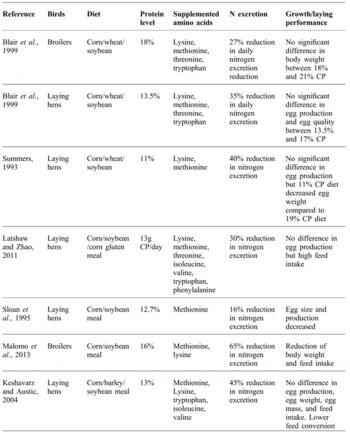
Many broiler studies have demonstrated that synthetic amino acid supplementation in low protein diets ( Table 1 ) significantly reduced nitrogen excretion (Summers, Reference SUMMERS1993; Sloan et al., Reference SLOAN, HARMS, BARNARD and NORDSTEDT1995; Blair et al., Reference BLAIR, JACOB, IBRAHIM and WANG1999; Waldroup, Reference WALDROUP2000). Blair et al. (Reference BLAIR, JACOB, IBRAHIM and WANG1999) reduced dietary crude protein and added synthetic amino acids for both broilers and layers to impact faecal nutrient excretion. The reduction in CP from 21 to 18% resulted in a 27% reduction in total-N excreted during a six week broiler study. Malomo et al. (Reference MALOMO, BOLU and OLUTADE2013) reported that broiler chicks fed 16% CP diets with methionine and lysine supplementation significantly reduce nitrogen excretion by 65% compared to those fed a 20% CP diet. In the layer study, reducing dietary CP from 17 to 13.5% resulted in approximately a 35% reduction in daily faecal nitrogen output. Sloan et al. (Reference SLOAN, HARMS, BARNARD and NORDSTEDT1995) fed hens diets containing 15.5, 12.7 without methionine supplementation or 12.7% CP supplemented with 0.02% methionine. As dietary CP was reduced from 15.5 to 12.7%, faecal N excretion decreased from 6.07 to 5.47%. Meluzzi et al. (Reference MELUZZI, SIRRI, TALLARICO and FARACHINI2010) reported that a 1.3% reduction in dietary CP resulted in a 21% reduction in N excretion in layers. Keshavarz and Austic (Reference KESHAVARZ and AUSTIC2004) found that increased use of synthetic amino acids reduced N emission by 45% in laying hens. A more recent study has confirmed this reduction by showing that lysine and methionine supplementation could lower dietary protein by 4% and reduce nitrogen in laying hen manure by 30% (Latshaw and Zhao, Reference LATSHAW and ZHAO2011).
Effects of synthetic amino acids in low protein diets on manure nitrogen excretion.

Although the dietary CP level can be reduced by 3 to 4% in broilers and laying hens, there are biological limits to the amount of dietary protein that can be replaced with synthetic amino acids (Patterson, Reference PATTERSON2002). An extension and refinement of dietary crude protein reduction is the concept of the premise for the ideal protein ratio. Thus, the application of the ideal protein ratio in the diet formulation is a potential method to further reduce nitrogen excretion in broilers.
Ideal protein ratio in poultry feed formulation
The ideal protein concept is designed to deliver a dietary amino acid pattern which precisely meets the animal's requirement for protein accretion and maintenance without deficiencies or excesses (Emmert and Baker, Reference EMMERT and BAKER1997). This approach may reduce nitrogen excretion further because it creates a better amino acid balance compared to the National Research Council (NRC, 1994) amino acid requirements. The amino acid levels based on the ideal protein ratio are digestible rather than total requirements. When this is taken into account, the amount of limiting amino acids which should be supplemented to meet the bird's amino acid requirements can be more precisely estimated.
Dietary patterns of amino acids have been estimated through carcass amino acid composition (Robel and Menge, Reference ROBEL and MENGE1973; Oviedo-Rondón and Waldroup, Reference OVIEDO-RONDÓN and WALDROUP2002). However, because carcass composition is only a starting point for an ideal ratio and cannot account for the dynamic amino acid flow in live animals (Firman and Boling, Reference FIRMAN and BOLING1998), a better approach is to utilise the ideal protein ratio values for poultry and pigs derived from numerous studies conducted with purified amino acid diets and based on digestible levels of amino acids in their diets (Chung and Baker, Reference CHUNG and BAKER1992; Baker, Reference BAKER1994). The requirements of the essential amino acids in the ideal protein ratio are expressed as ratios to lysine for several reasons: 1) lysine is a major limiting amino acid in practical broiler diets; 2) lysine is used only for protein accretion and maintenance; 3) lysine concentrations in feed ingredients and the lysine requirement of the chicken are well known; and 4) analytical determination of lysine is easy and straightforward (Fernandez et al., Reference FERNANDEZ, AOYAGI, HAN, PARSONS and BAKER1994; Emmert and Baker, Reference EMMERT and BAKER1997). Average lysine digestibility was used to modify the digestible lysine requirement to the total lysine requirement, and the remaining amino acid requirements were calculated according to the ideal ratios corrected for digestibility values.
Baker and Han (Reference BAKER and HAN1994) compared the NRC (1994) requirements for broilers to the ideal protein diet in a chick bioassay. The authors reported that all amino acid ratios relative to lysine in the ideal protein diet were lower than those in the NRC (1994) except for leucine and histidine. There were no significant differences in weight gain or feed efficiency between the chicks fed the NRC (1994) and ideal protein diets. The authors reported that the essential amino acid ratios in the NRC (1994) recommendation were too high relative to lysine because the requirement level in the NRC (1994) was too low as a reference level relative to the other amino acids. Thus, feed formulation based on ideal protein ratios offers one of the more promising strategies to further reduce nitrogen excretion in poultry. Emmert and Baker (Reference EMMERT and BAKER1997) established ideal amino acid ratios for selected amino acids at three growth periods: 1) 0 to 21 days = Lys (100%), Met + Cys (72%), Met (36%), Cys (36%), Thr (67%), Val (77%), and Arg (105%); 2) 21 to 42 days = Lys (100%), Met + Cys (75%), Met (37%), Cys (38%), Thr (70%), Val (80%), and Arg (108%); and 3) 42 to 56 days = Lys (100%), Met + Cys (75%), Met (37%), Cys (38%), Thr (70%), Val (80%), and Arg (108%).
Use of transgenic plant protein sources with improved essential amino acid content
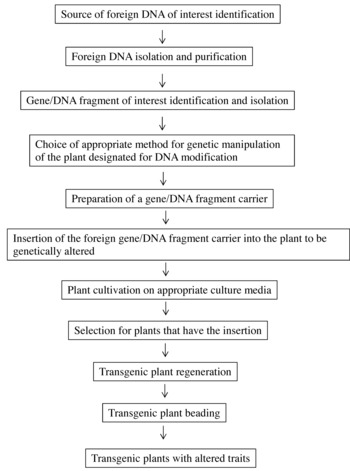
The use of genetically modified crops with increased levels of essential amino acids as feed ingredients in poultry is an alternative to the direct addition of supplemental amino acids in diet formulations (Swiatkiewicz and Arczewska-Włosek, Reference SWIATKIEWICZ and ARCZEWSKA-WŁOSEK2011). In the last 20 years, the advanced development of agricultural biotechnology has resulted in the generation of various transgenic plants modified in one or several traits. An overview of transgenic plant generation is presented in Figure 1 . DNA recombinant technology has been mainly directed to development of plants with improved agronomic traits such as increased tolerance to herbicides and insecticides or higher resistance to insects (Ricke and Saengkerdsub, Reference RICKE and SAENGKERDSUB2015). The nutritional profile of the ‘first-generation transgenic plants’ was found to be similar to their non-engineered counterparts (Flachowsky, Reference FLACHOWSKY2013). ‘Second-generation transgenic plants’ are characterised with modified nutritional properties mainly with regard to protein content, amino acid and fatty acid profiles as well as vitamin and mineral concentrations. In recent years, fortification of crop plants with essential amino acids by means of genetic engineering approaches has been extensively studied (Galili and Amir, Reference GALILI and AMIR2013). In the poultry feed industry, transgenic crops with altered amino acid composition could be used to balance amino acid concentrations in feed ingredients (Swiatkiewicz and Arczewska-Włosek, Reference SWIATKIEWICZ and ARCZEWSKA-WŁOSEK2011). Their utilisation as feed ingredients was proven to be as safe as the one of their native counterparts, although growing genetically modified plants remains controversial in many parts of the world. Numerous studies have been conducted to evaluate the influence of feed processing and gastrointestinal passage on traceability of transgenes or their products and their potential incorporation into animal tissues (Flachowsky, Reference FLACHOWSKY2011). After evaluating safety issues of the utilisation of maize-grain, genetically modified to express Bacillus thuringiensis (Bt) – derived endotoxin, in feed broiler formulation, Tony et al. (Reference TONY, BUTSCHKE, BROLL, GROHMANN, ZAGON, HALLE, DÄNICKE, SCHAUZU, HAFEZ and FLACHOWSKY2003) and Einspanier et al. (Reference EINSPANIER, KLOTZ, KRAFT, AULRICH, POSER, SCHWÄGELE, JAHREIS and FLACHOWSKY2001) did not detect any transgenic DNA in animal blood, organs or tissues. Flachowsky et al. (Reference FLACHOWSKY, CHESSON and AULRICH2005) reported that 211 bp transgenic Bt-maise-grain fragments became established in the stomach and the gastrointestinal tract of 10 generations of quail but did not enter the muscle, liver, stomach, spleen, kidney, heart and eggs. By evaluating the fate of transgenic Escherichia coli DNA from genetically modified maize with enhanced amino acids for pigs, Beagle et al. (Reference BEAGLE, APGAR, JONES, GRISWOLD, RADCLIFFE, QIU, LIGHTFOOT and IQBAL2006) reported that it was effectively degraded in the gastrointestinal tract and was not detected in large intestine, white blood cells, plasma, liver, or muscle samples. Overall, the recombinant DNA fragments are degraded during feed processing and/or in the gastrointestinal tract in a manner similar to indigenous genetic material of the plant material and are not detectable in food products derived from the animals, using the most sensitive detection methods (Tufarelli et al., Reference TUFARELLI, SELVAGGI, DARIO and LAUDADIO2015).
From all essential amino acids, lysine and methionine appeared to be the most targeted amino acids in agricultural biotechnology because of their deficiency in both cereals and legume seeds (Ufaz and Galili, Reference UFAZ and GALILI2008). According to Galili and Amir (Reference GALILI and AMIR2013), the limited content of lysine and methionine may reduce the nutritional value of these crops from 50 to 70% when compared to a diet possessing balanced levels of amino acids.
Schematic outline of transgenic plant generation.

transgenic plants with enhanced lysine content
Corn is one of the most studied and manipulated crops for enhancing lysine content either as free- or protein-bound lysine. Maize grain with higher-than-average lysine content (LY038) was developed by a stable integration of the cordapA Corynebacterium glutamicum derived gene which encodes the lysine-insensitive dihydrodipicolinate synthase (DHPS) enzyme (Lucas et al., Reference LUCAS, TAYLOR, HARTNELL, NEMETH, GLENN and DAVIS2007). The resulting variety conferred enhanced production and accumulation of free lysine (0.96%) in the germ of the kernel when compared to conventional maize such as Pioneer 34M94 (0.03%). Subsequently, LY038 was conventionally bred to MON 810 to produce a cultivar combining a high level lysine and protection against feeding damage from the European corn borer (Ostrinia numbilalis) (Lucas et al., Reference LUCAS, TAYLOR, HARTNELL, NEMETH, GLENN and DAVIS2007). After conducting a 42-d broiler feeding study (10 pens of 10 male Cobb ×Cobb 500 broilers/treatment) and evaluating broiler performance and carcass characteristics, these same authors concluded that the bio-efficiency of the incremental lysine in LY038 or LY038 x MON810 grain was not different from that of lysine in conventional maize diets supplemented with L-Lys HCl. Although the utilisation of LY038 for food and feed purposes has been approved in Canada, Japan, Philippines and the United States (Center for Environmental Risk Assessment, http://cera-gmc.org), in the European Union, the application for approval has been withdrawn because of concerns made by the EU regulators on the European Food Safety Agency (EFSA) GMO panel about the safety of LY038 (GMO compass, http://www.gmo-compass.org).
Reyes et al. (Reference REYES, BONIN, HOUMARD, HUANG and MALVAR2009) increased the level of free lysine in maize by regulating lysine-ketoglutarate reductase/saccharopine dehydrogenase (LKR/SDH), a bifunctional enzyme which is responsible for lysine catabolism (Azevedo et al., Reference AZEVEDO, LANCIEN and LEA2006; Stepansky et al., Reference STEPANSKY, LESS, ANGELOVICI, AHARON, ZHU and GALILI2006). The suppression of the corresponding genes in embryo and endosperm resulted in accumulation of 0.2 mg/g and 0.9 mg/g dry weight of soluble lysine respectively, while the combination of both enhanced the concentration of the free lysine to 1.6 mg/g dry weight. A 40-fold proximate increase of free lysine in corn grain by the combination of LKR/SDH silencing and cordapA expression was reported by Frizzi et al. (Reference FRIZZI, HUANG, GILBERTSON, ARMSTRONG, LUETHY and MALVAR2008; Reference FRIZZI, CALDO, MORRELL, WANG, LUTFIYYA, BROWN, MALVAR and HUANG2010).
Overproduction of naturally lysine rich proteins in a different plant organism is another approach to fortify plants with this essential amino acid. The extent of enhancement of the protein-bound lysine level depends on the type of the proteins and the plant species to which they are introduced (Galili and Amir, Reference GALILI and AMIR2013). The sb401 gene from potato (Solanum berthaultii) encoding a pollen-specific protein with high lysine content (16.7%) was successfully integrated into the genome of maize plants by microprojectile bombardment (Yu et al., Reference YU, PENG, ZHANG, ZHAO, ZHU, SUN, LIU and AO2005). The lysine and total protein contents in the transgenic line were increased by up to 54.8% and 39% respectively. Another natural lysine-rich protein gene, GhLRP, from cotton appeared to be a good candidate to modify the nutritive composition of maize. The transformation of immature maize embryos with the construct pSB130-GhLRP resulted in transgenic lines where the lysine content varied from 16.2% to 65.0% relative to the wild-type (Yue et al., Reference YUE, LI, ZHAO, ZHU and YU2014).
Constitutive expression of mutant Escherichia coli genes encoding lysine feed-back insensitive forms of aspartate kinase (AK) and DHPS in barley resulted in an alteration of amino acid composition (Brinch-Pedersen et al., Reference BRINCH-PEDERSEN, GALILI, KNUDSEN and HOLM1996). The leaves of primary transformants exhibited 14- and eight-fold increases in lysine and methionine respectively. A two-fold increase in free lysine in mature seeds of DHPS transgenic plants was observed. Enhancement of the total lysine by more than 45% in rice seeds was observed after expressing a gene that contained combined sequences of a rice glutelin and a lysine-rich protein from winged bean (Wenefrida et al., Reference WENEFRIDA, UTOMO, BLANCHE and LINSCOMBE2009). By conducting experiments with adult caecectomised cockerels, Edwards et al. (Reference EDWARDS, DOUGLAS, PARSONS and BAKER2000) established a higher level of metabolisable energy of the genetically modified soybean M703 where the crude protein level reached up to 62.70%. Higher digestibility of lysine, methionine, threonine, and valine when compared to conventional soybean meal was observed as well. Soybean is a high protein plant protein source and the content enhancement of the limiting amino acids would increase its agricultural and economical value.
transgenic plants with enhanced methionine content
The increase of methionine content in crop plant seeds was attempted mainly by the introduction and expression of heterologous genes encoding methionine-rich albumin storage proteins (Galili and Amir, Reference GALILI and AMIR2013). By expressing a chimeric gene encoding a methionine-rich seed protein from Brazil nut (18.8% methionine) in canola seeds, the transgenics contained up to 33% more methionine (Altenbach et al., Reference ALTENBACH, KUO, STARACI, PEARSON, WAINWRIGHT, GEORGESCU and TOWNSEND1992). In a similar manner, methionine content of rice and lupine plants was fortified by heterologous expression of sesame 2S albumin and sunflower 2S albumin encoding genes respectively (Molvig et al., Reference MOLVIG, TABE, EGGUM, MOORE, CRAIG, SPENCER and HIGGINS1997; Lee et al., Reference LEE, WANG, HOU, CHEN, SU, WANG and TZEN2003). Feeding broilers with narrow-leafed lupin (Lupinus angustifolius) expressing methionine-rich sunflower albumin reduced the supplemental methionine required in diets by 0.6 g/kg (Ravindran et al., Reference RAVINDRAN, TABE, MOLVIG, HIGGINS and BRYDEN2002).
Avraham et al. (Reference AVRAHAM, BADANI, GALILI and AMIR2005) generated transgenic alfalfa (Medicago sativa L.) plants by over-expressing the Arabidopsis cystathionine gamma-synthase gene. When compared to the wild type, transgenic lines contained 32-fold, 19-fold, and 2.2-fold higher methionine, S-methylmethionine and water soluble protein-bound methionine respectively. Although several studies indicated that the increase of methionine content is at the expense of other sulphur-rich proteins or sulphur compounds (Hagan et al., Reference HAGAN, UPADHYAYA, TABE and HIGGINS2003; Amir and Tabe, Reference AMIR and TABE2006), the study by Avraham et al. (Reference AVRAHAM, BADANI, GALILI and AMIR2005) demonstrated a 2.6-fold, 5.5-fold, and 2.3-fold enhancement of cysteine, glutathione and protein-bound cysteine respectively as well.
Conclusions
Preparation of diets, which contain all the necessary nutritive compounds but low excessive nitrogen, is difficult to achieve. In conventional poultry, the optimisation of nitrogen level is facilitated by crystalline amino acid supplementation and the utilisation of plant sources with genetically modified nutritive composition. Recombinant DNA technology is a powerful tool for the production of plant proteins with enhanced and balanced amino acid levels. The ideal protein ratio concept can be further applied to prevent the provision of excessive nitrogen in poultry diets and reduce its excretion in poultry manure.
Acknowledgements
This review was supported in part by the University of Georgia Faculty Research Grant and the University of Georgia Startup Grant to author W.K.K and USDA/CREES NIFSI no. 2008-51110-04439 and USDA-SARE project #LS11-245 grants to author SCR.